
Zhou Dynasty: Map & History
The Zhou dynasty was a royal dynasty of China that existed for 790 years from c.
Wikipedia Encyclopedic Compendium
Historiographical synthesis & structured realm registry
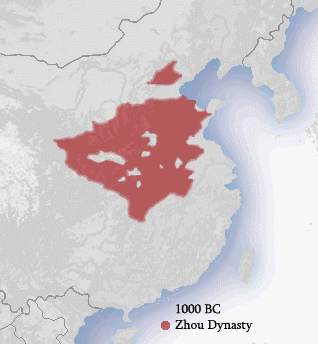
The Zhou dynasty was a royal dynasty of China that existed for 790 years from c. 1046 BC until 256 BC, the longest span of any dynasty in Chinese history. During the Western Zhou period, the royal house, surnamed Ji, had military control over territories centered on the Wei River valley and North China Plain. Even as Zhou suzerainty became increasingly ceremonial over the following Eastern Zhou period (771–256 BC), the political system created by the Zhou royal house survived in some form for several additional centuries. A date of 1046 BC for the Zhou's establishment is supported by the Xia–Shang–Zhou Chronology Project and David Pankenier, after David Nivison and Edward L. Shaughnessy had previously dated the establishment to 1045 BC.
Modern Countries Once Part of Zhou Dynasty
At its mapped extent, Zhou Dynasty covered territory in 1 present-day country. The period shown is when the mapped borders include that country, and the note says how much of it.
States and Provinces
Largest Present-Day Cities in Its Territory
Each opens on the live map inside Zhou Dynasty's borders of that time.
Derived by testing mapped cities against this polity's dated territorial polygons, so the list is indicative and follows the borders in the source dataset.
Zhou Dynasty in Depth
History
According to Chinese mythology, the Zhou lineage began when Jiang Yuan, a consort of the legendary Emperor Ku, miraculously conceived a child, Qi "the Abandoned One", after stepping into the divine footprint of Shangdi. Qi was a culture hero credited with surviving abandonment by his mother three times, and with greatly improving agriculture, to the point where he was granted lordship over Tai, the surname Ji, and the title Houji "Lord of Millet", by the Emperor Shun. He even received sacrifice as a harvest god. The term Houji was probably a hereditary title attached to a lineage.
Culture and society
The Zhou heartland was the Wei River valley; this remained their primary base of power after conquering the Shang.
Zhou rulers introduced the Mandate of Heaven, which would prove to be among East Asia's most enduring political doctrines. According to the theory, Heaven imposed a mandate to replace the Shang with the Zhou, whose moral superiority justified seizing Shang wealth and territory in order to return good governance to the people.
The Mandate of Heaven was presented as a religious compact between the Zhou people and their supreme god in heaven. The Zhou agreed that since worldly affairs were supposed to align with those of the heavens, the heavens conferred legitimate power on only one person, the Zhou ruler.
Sections adapted from Wikipedia: Zhou dynasty (CC BY-SA 4.0).
Zhou Dynasty: Key Facts
| Official language | Old Chinese |
|---|---|
| Form of government | monarchy |
| Currencies | spade money, knife money |
| Founded | 1046 BCE |
| Dissolved | 256 BCE |
Preceded by
Succeeded by
Facts from Wikidata Q35216 (CC0).
Zhou Dynasty Map Over Time
Dated world maps on which Zhou Dynasty appears, with the other states of the time.
Zhou Dynasty Timeline
Key historical inflections from foundation to peak territorial expansion
Expansion to peak recorded area of 699,623 km² in 776 BCE.
Zhou Dynasty: Frequently Asked Questions
When did the Zhou Dynasty exist?
The Zhou Dynasty is dated to 1000 BCE – 751 BCE, in the Bronze & Iron Age Civilizations era.
What was the capital of the Zhou Dynasty?
The capital of the Zhou Dynasty was (1046–771 BC), Wangcheng), Chengzhou.
How large was the Zhou Dynasty at its peak?
At its peak in 776 BC the Zhou Dynasty covered about 699,623 km².
Other Sovereign Realms
Classical Antiquity • Capital: Persepolis, Pasargadae, Susa, Babylon
Bronze Age Civilizations • Capital: Memphis
Bronze & Iron Age Civilizations • Capital: Kerma
Classical Antiquity • Capital: Persepolis, Pasargadae, Susa, Babylon