India
Pen/cape · 3.27M km²
India is a pen/cape in Asia, covering an estimated 3.27M km². It extends across India and Pakistan. It is the 10th-largest of the 231 landforms with a mapped extent in YearMaps.
India, officially the Republic of India, is a country in South Asia. It is the world's seventh-largest country by area and its most populous. Bounded by the Indian Ocean on the south, the Arabian Sea on the southwest, and the Bay of Bengal on the southeast, it shares land borders with Pakistan to the west, China, Nepal, and Bhutan to the north, and Bangladesh and Myanmar to the east. In the Indian Ocean, India is near Sri Lanka and the Maldives.
Modern humans arrived on the Indian subcontinent from Africa by 55,000 years ago. Settled life emerged in the western margins of the Indus river basin 9,000 years ago, evolving into the Indus Valley Civilisation of the third millennium BCE. By 1200 BCE, an archaic form of Sanskrit, an Indo-European language, diffused into India from the northwest, its earliest hymns containing elements of what would become Hinduism. The pre-existing Dravidian and other languages were gradually superseded in India's northern plains. Across the central stretch of these plains, rapid urbanisation took place, and after 500 BCE a caste-based, hereditary form of social stratification began to solidify as Hinduism took fuller shape.
Adapted from Wikipedia: India (CC BY-SA 4.0).
- Feature class
- Pen/cape
- Mapped extent
- 3.27M km²
- Size rank
- #10 of 231 landforms
- Region
- Asia
- Countries
- India, Pakistan
- Coordinates
- 27.1244°, 77.8765°
- Summits:
- Salher (1,567 m), Nanda Devi (7,817 m), Kanchenjunga (8,586 m)
- Ranges:
- Vindhya Range (Asia), Satpura Range (Asia)
More about India
Geography
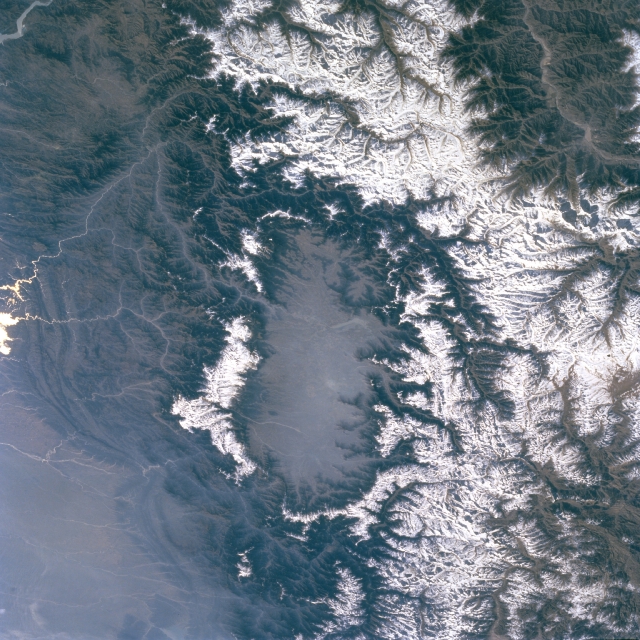
India accounts for the bulk of the Indian subcontinent, lying atop the Indian tectonic plate, a part of the Indo-Australian Plate. India's defining geologic processes began approximately 70 million years ago, when the Indian Plate, then part of the southern supercontinent Gondwana, began a north-eastward drift caused by seafloor spreading to its south-west, and later, south and south-east. Simultaneously, the vast Tethyan oceanic crust, to its northeast, began to subduct under the Eurasian Plate. The Indian continental crust was obstructed and was sheared horizontally; while its lower crust and mantle slid beneath Eurasia, the upper layer piled up in sheets ahead of the subduction zone. This mountain-building orogeny created the Himalayas.
History
Based on coalescence of Mitochondrial DNA and Y Chromosome data, the earliest extant lineages of modern humans on the Indian subcontinent had reached there from Africa between 80,000 and 50,000 years ago, and with high likelihood by 55,000 years ago. Neolithic and chalcolithic cultures arose in the western margins of the Indus river basin around Mehrgarh in Balochistan, Pakistan after 7000 BCE. These gradually evolved into the Indus Valley Civilisation, which flourished during 2500–1900 BCE in Pakistan and western India. Centred around cities such as Mohenjo-daro, Harappa and Dholavira, its characteristic features included steatite seals, a written script, urban planning, terracotta human figures and animal statuettes.
Economy
After independence in 1947, India shifted from the colonial economic model to a focus on industrialisation and poverty reduction. This transition brought a large expansion of government authority. Government spending as a share of gross domestic product (GDP) increased from 3 to 5 per cent in 1931 to 22 per cent by 1981. Public administration and state-owned enterprises became major employers. To manage this market intervention, India developed—during the 1950s—a comprehensive, federally managed statistical system to conduct large-scale sample surveys for monitoring and assessing living standards or effects of interventions.
Sections adapted from Wikipedia: India (CC BY-SA 4.0).
India: Key Facts
| Area | 3,287,263 km² |
|---|---|
| Highest point | Kanchenjunga |
| On | Arabian Sea, Bay of Bengal |
Facts from Wikidata Q668 (CC0).