
RMS Lusitania’s Last Voyage (1915)
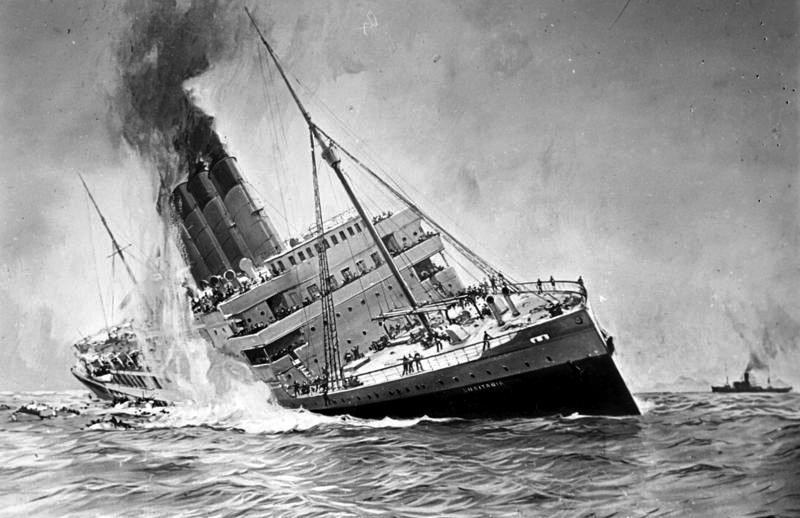
On 1 May 1915 the Cunard liner Lusitania left New York for Liverpool despite German warnings that ships in British waters were liable to be sunk. Six days later, eleven miles off the Old Head of Kinsale, the submarine U-20 hit her with a single torpedo and she sank in eighteen minutes. Of 1,960 people on board, 1,197 died, including 128 Americans, and the sinking helped turn the United States against Germany.
5,296 km mapped4 stops6 days
Route Map of the Lusitania’s last voyage
- Route from recorded positions
- Reconstructed or uncertain track
- 1Numbered stop (see the itinerary)
- Ship on the map: steamship (20th century)
- Rescue boats from Queenstown (rescue)
- Shown as she gets there: U-20 and its torpedo at stop 3
- The ship goes down at stop 3: play the voyage, or open the stop, to watch
Lines are drawn by YearMaps between the recorded stops, kept at sea around Natural Earth coastlines. They show the order and general track of the voyage, not the exact course steered. How the maps are made.
About the Lusitania’s last voyage
RMS Lusitania was a British-registered ocean liner that was torpedoed by an Imperial German Navy U-boat during the First World War on 7 May 1915, about 11 nautical miles (20 kilometres; 13 miles) off the Old Head of Kinsale, Ireland (then part of the United Kingdom). The attack took place in the declared maritime war-zone around the United Kingdom, three months after unrestricted submarine warfare against the ships of the United Kingdom had been announced by Germany following the Allied powers' implementation of a naval blockade against it and the other Central Powers.
The passengers had been notified before departing New York of the general danger of voyaging into the area in a British ship, but the attack itself came without warning. From a submerged position 700 metres (2,300 ft) to starboard, U-20 commanded by Kapitänleutnant Walther Schwieger launched a single torpedo at the Cunard liner. After the torpedo struck, a second explosion occurred inside the ship, which then sank in only 18 minutes. U-20's mission was to torpedo warships and liners in Lusitania's area of operation.
From Wikipedia: Sinking of RMS Lusitania (CC BY-SA 4.0).
Itinerary: 4 Stops
In order of the voyage. Numbers match the map; select a stop to show it there.
New York (Pier 54)
DepartureThe Lusitania sails at 12:30 p.m., after an embassy warning is printed in the New York papers.
Atlantic crossing
PassageCaptain Turner keeps up about 21 knots to save coal, with one boiler room shut.
Torpedoed off the Old Head of Kinsale
Wreck or lossAt 2:10 p.m. a torpedo from U-20 strikes the starboard side; a second explosion follows. The ship sinks in 18 minutes.
Queenstown (Cobh)
ArrivalFishing boats and steamers bring 761 survivors and many of the dead into Queenstown that night.
Rescue leg, sailed by Rescue boats from Queenstown.
Sources: Wikipedia: Sinking of RMS Lusitania; wreck position from survey.
RMS Lusitania’s Last Voyage in Depth
Background
When Lusitania was built, her construction and operating expenses were subsidized by the British government, with the provision that she could be converted to an armed merchant cruiser (AMC) if need be. Pillars and supports were included in her design to allow the emplacement of 12 6-inch guns, and she was listed as a "Royal Naval Reserve Merchant Vessel". In the 1914 edition of Jane's All the World's Fighting Ships, its silhouette was listed for identification reasons as a civilian liner, together with Mauretania and all liners of all nations capable of over 18 knots. Brassey's 1914 The Naval Annual categorised her as a "Royal Naval Reserved Merchant Cruiser".
At the outbreak of the First World War, the British Admiralty considered her for requisition as an AMC. However the Admiralty then cancelled their decision and decided not to use her as an AMC after all; large liners such as Lusitania consumed enormous quantities of coal (910 tons/day, or 37.6 tons/hour) and became a serious drain on the Admiralty's fuel reserves, so express liners were deemed inappropriate for the role when smaller cruisers would do. They were also very distinctive, so smaller liners were used as transports instead.
At the outbreak of hostilities, fears for the safety of Lusitania and other great liners ran high.
Final voyage
While many British passenger ships had been called into duty for the war effort, Lusitania remained on her regular route between Liverpool and New York City. Captain Turner, known as "Bowler Bill" for his favourite shoreside headgear, tried to calm the passengers by explaining that the ship's speed made her safe from attack by submarine.
As the liner steamed across the ocean, the British Admiralty had been tracking the movements of U-20, commanded by Kapitänleutnant Walther Schwieger, through wireless intercepts and radio direction finding. The submarine left Borkum on 30 April, heading north-west across the North Sea.
U-20 surfaced again at 12:45 as visibility was now excellent. At 13:20, something was sighted and Schwieger was summoned to the conning tower: at first it appeared to be several ships because of the number of funnels and masts, but this resolved into one large steamer appearing over the horizon. At 13:25, the submarine submerged to periscope depth of 6 fathoms (11 m; 36 ft) and set a course to intercept the liner at her maximum submerged speed of 9 knots.
Official inquiries
On 8 May, the local county coroner John Hogan opened an inquest in Kinsale into the deaths of two males and three females whose bodies had been brought ashore by a local boat, Heron. Most of the survivors (and dead) had been taken to Queenstown instead of Kinsale, which was closer. On 10 May Captain Turner gave evidence as to the events of the sinking where he described that the ship had been struck by one torpedo between the third and fourth funnels.
The formal Board of Trade investigation into the sinking was presided over by Wreck Commissioner Lord Mersey and took place in the Westminster Central Hall from 15 to 18 June 1915 with further sessions at the Westminster Palace Hotel on 1 July and Caxton Hall on 17 July. Lord Mersey had a background in commercial rather than maritime law but had presided over a number of important maritime investigations, including that into the loss of Titanic.
In the United States, 67 claims for compensation were lodged against Cunard, which were all heard together in 1918 before the United States District Court for the Southern District of New York. Judge Julius Mayer, presided over the case: he had previously presided over the case brought following the loss of Titanic, where he had ruled in favour of the shipping company.
International reaction
On 8 May Dr. Bernhard Dernburg, the former German Colonial Secretary and representative of the German Red Cross, made a statement in Cleveland, Ohio, in which he attempted to justify the sinking of Lusitania.
There is such a thing as a man being too proud to fight. There is such a thing as a nation being so right that it does not need to convince others by force that it is right.
When Germany began its submarine campaign against Britain, Wilson had warned that the US would hold the German government strictly accountable for any violations of American rights.
While outwardly Germany conducted a propaganda skirmish, internally there had long been a faction opposed to the new submarine war.
The British press highlighted the savagery of the Germans, condemning Schwieger as a war criminal. Thanks to the Defence of the Realm Act, matters relating to the ship's cargo were censored.
Last survivor
The last survivor was Audrey Warren Lawson-Johnston (née Pearl), who was born in New York City on 15 February 1915. She was the fourth of seven children (the youngest three born after the disaster) born to Major Frederic "Frank" Warren Pearl (1869–1952) and Amy Lea (née Duncan; 1880–1964). She was only three months old when she boarded Lusitania in New York with her parents, three siblings, and two nurses – and due to her age had no first hand recollection of the disaster. She and her brother Stuart (age 5) were saved by their British nursemaid Alice Maud Lines, then 18 years old, who jumped off the boat deck and escaped in a lifeboat. Her parents also survived, but her sisters Amy (age 3) and Susan (age 14 months) died. Pearl married Hugh de Beauchamp Lawson-Johnston, second son of George Lawson Johnston, 1st Baron Luke, on 18 July 1946. They had three children and lived in Melchbourne, Bedfordshire. Hugh was Sheriff of Bedfordshire in 1961. Johnston gifted an inshore lifeboat, Amy Lea, to New Quay Lifeboat Station in 2004 in memory of her mother. Audrey Johnston died on 11 January 2011, at age 95.
Controversies
The "prize rules" or "cruiser rules", based in customary law and influenced by the Hague Conventions of 1899 and 1907 and the 1909 London Declaration concerning the Laws of Naval War, governed the seizure of vessels at sea during wartime.
Many survivors from Lusitania reported that a second explosion took place either immediately or a few seconds afterwards, some suggesting it felt more severe.
There has long been a theory, expressed by historian and former British naval intelligence officer Patrick Beesly and authors Colin Simpson and Donald E. Schmidt among others, that Lusitania was deliberately placed in danger by the British authorities, so as to entice a U-boat attack and thereby drag the US into the war on the side of Britain.
Lusitania was officially carrying among her cargo 4,200 cases of rifle/machine-gun ammunition, 1,250 cases of empty shrapnel artillery shells, and the artillery fuzes for those shells stored separately. This comprised a total of 173 tons.
The wreck was depth-charged or attacked with Hedgehog mortars. A Dublin-based technical diver, Des Quigley, who dived on the wreck in the 1990s, reported that the wreck is "like Swiss cheese" and the seabed around her "is littered with unexploded hedgehog mines".
Wreck site
The wreck of Lusitania lies on her starboard side at an approximately 30-degree angle in 305 feet (93 metres) of sea water. She is severely collapsed onto her starboard side as a result of the force with which she slammed into the sea floor, and over decades, Lusitania has deteriorated significantly faster than Titanic because of the corrosion in the winter tides. The keel has an "unusual curvature", in a boomerang shape, which may be related to a lack of strength from the loss of her superstructure. The beam is reduced with the funnels missing, presumably due to deterioration. The bow is the most prominent portion of the wreck with the stern damaged from the removal of three of the four propellers by Oceaneering International in 1982 for display.
Some of the prominent features on Lusitania include her still-legible name, some bollards with the ropes still intact, pieces of the ruined promenade deck, some portholes, the prow and the remaining propeller. Recent expeditions to the wreck have revealed that Lusitania is in surprisingly poor condition compared to Titanic, as her hull has already started to collapse.
Sections adapted from Wikipedia: Sinking of RMS Lusitania (CC BY-SA 4.0).
RMS Lusitania’s Last Voyage: Key Facts
| Date | 7 May 1915 |
|---|
Facts from Wikidata Q5551560 (CC0).
Pictures of the Lusitania’s last voyage
23 images from Wikimedia Commons. Select one to enlarge it.
Part of front page of The New York Times with article "Lusitania Sunk By a Submarine ..."The New York Times (newspaper) · Public domain · Commons John Bigham, 1st Viscount Mersey (1840-1929)Bros. Barclay · Public domain · Commons Alfred Gwynne Vanderbilt, the famous millionaire who was on board the Lusitania (liner sunk on May 7, 1915 by a German submarine).Agence Rol · Public domain · Commons האדמירל ווב, צילום מקרוב של ווב על הסוס בעת המצעד ביפו.אוסף תצלומים של הרברט ואדווין סמואל · Public domain · Commons Baudichon Lusitania Medal reverse 146381RHaworth · CC BY-SA 4.0 · Commons An artists depiction of the wanderer which was near the sinking lusitania and saved around 200 survivorsRaketelli · CC BY-SA 4.0 · Commons For documentary purposes the German Federal Archive often retained the original image captions, which may be erroneous, biased, obsolete or politically extreme. Kapitänleutnant Schwieger, Walther (gefallen Sept. 1917)UnknownUnknown · CC BY-SA 3.0 de · Commons Geredde officieren van de RMS Lusitania SFA022806963Unknown authorUnknown author · Public domain · Commons Map showing submarine warfare zone around the United Kingdom, declared by Germany on February 18 1915.German_Submarine_Zone_February_1915_SGW_Vol_V.png: artist not identified Europe_satellite_image_location_map.jpg: NordNordWest derivative work: Bellhalla (talk) · Public domain · Commons Goetz medal commemorating the German sinking of the Lusitania (30689585541)National Museum of the U.S. Navy · Public domain · Commons British Ships of the First World War HMS JUNOSymonds & Co · Public domain · Commons Industry during the First World War- Birmingham A female worker manufacturing .303-inch ammunition cartridges at Kynoch's factory in Birmingham during the First World War.Unknown authorUnknown author · Public domain · Commons Julius Marshuetz Mayer, New York State Attorney General, judge on the United States District Court for the Southern District of New York, judge on the United States Court of Appeals for the Second CircuitUnknown authorUnknown author · Public domain · Commons Title: Just like that! Abstract/medium: 1 print.Miscellaneous Items in High Demand, PPOC, Library of Congress · Public domain · Commons The last known photo taken of the Lusitania before her sinking. This picture was taken from the HMS Glory, at New York Harbour.Rance, G R · Public domain · Commons Letter from the president philadelphia recordunknown, cartoonist for the Philadelphia Record · Public domain · Commons Original caption 'Returning baseball tourists'. Bain news service photograph of RMS Lusitania in New York. One of a series taken at the same time. Detail shows lifeboats on the boat deck above waving passengers.Bain News Service · Public domain · Commons A Quadruple blade Blade propeller from the RMS LusitaniaSeano1 · CC BY-SA 3.0 · Commons Lusitania Sinking, the Greatest of Ocean TragediesLibrary of Congress, Washington, DC New York : New York Times, Co., 1919. · Public domain · Commons Photograph of an exact replica of the German "Lusitania" commemorative medal, showing both sides. The medal was produced in Britain as evidence of German propaganda concerning the sinking of the RMS LusitaniaVacarme · CC BY-SA 3.0 · Commons View south towards Albert DockRodhullandemu · CC BY-SA 4.0 · Commons Lusitania, Ludwig Gies, Germany, 1915, British Museum exhibition: "The other side of the medal: how Germany saw the First World War", 9 May – 23 November 2014Johnbod · CC BY-SA 4.0 · Commons Now remember what I told you. Newspaper cartoon by Oscar Cesare commenting on German Foreign office led restrictions on submarine warfare. Book dates from 1916, likely refers to events of late 1915/early 1916.Oscar Cesare · Public domain · Commons
Frequently Asked Questions
How long did the Lusitania’s last voyage take?
It lasted 6 days, from 1 May 1915 to 7 May 1915.
How far did the Lusitania’s last voyage travel?
The route as mapped here, through all 4 stops, is about 5,296 km (2,860 nautical miles). It follows the recorded stops at sea and is a reconstruction, so the true distance sailed was longer.
Who led the Lusitania’s last voyage?
Captain William Turner, sponsored by Cunard Line.
What ship was used on the Lusitania’s last voyage?
RMS Lusitania.
Where did the Lusitania’s last voyage start and end?
It started at New York (Pier 54) (1 May 1915) and ended at Queenstown (Cobh) (7 May 1915).
What did the Lusitania’s last voyage achieve?
Torpedoed by U-20 off Ireland and sunk in 18 minutes, turning American opinion against Germany.