
UNESCO World Heritage Sites in Madagascar
Madagascar has 3 sites on the UNESCO World Heritage List (1 cultural and 2 natural), the first inscribed in 1990 (Tsingy de Bemaraha Strict Nature Reserve). The map below plots every one of them alongside the rest of the List, and each site is written up in full further down the page.
- World Heritage Sites
- 3
- Cultural
- 1
- Natural and Mixed
- 2
- First Inscribed
- 1990
Map of World Heritage Sites in Madagascar
CulturalNaturalMixedIn DangerLarge dots are in Madagascar. Click a dot to read about the site.

Tsingy de Bemaraha Strict Nature Reserve
Madagascar · 18.6667° S, 44.7500° E · 7,343 km² · 121 km from Miandrivazo
Tsingy de Bemaraha Strict Nature Reserve (Malagasy: Tsingin'i Bemaraha, French: Réserve naturelle intégrale du Tsingy de Bemaraha) is a nature reserve located near the western coast of Madagascar in Melaky Region. The area was listed as a UNESCO World Heritage Site in 1990 due to the unique geography, preserved mangrove forests, and wild bird and lemur populations.
Adapted from Wikipedia: Tsingy de Bemaraha Strict Nature Reserve (CC BY-SA 4.0).
Why Tsingy de Bemaraha Strict Nature Reserve Is Listed
- (vii)
- Superlative natural phenomena or exceptional natural beauty.
- (x)
- The most important natural habitats for conserving biodiversity.
More about Tsingy de Bemaraha Strict Nature Reserve
UNESCO's Description
This serial property in western Madagascar comprises karstic landscapes and limestone uplands cut into impressive 'tsingy' peaks and a 'forest' of limestone needles, the spectacular canyon of the Manambolo river, rolling hills and high peaks. Undisturbed forests, lakes and mangrove swamps are the habitat for rare and endangered lemurs and birds. The component parts of the property cover almost the full range of ecological and evolutionary variation within the western forests of Madagascar, including western dry forests and southwestern spiny forest-thicket. These sites contain a spectacular array of endemic and threatened biodiversity, including baobabs, flame trees ( Delonix ), as well as unique evolutionary lineages such as the Mesitornithiformes, an order of birds which is 54 million years old.
From the UNESCO World Heritage Centre (CC BY-SA IGO 3.0).
Tourism
Tourists can access the national park by road from Morondava, a town 150 km south of the park. Limited access is also possible from the town of Antsalova, which can be reached by plane from Antananarivo or Mahajanga.
Sections adapted from Wikipedia: Tsingy de Bemaraha Strict Nature Reserve (CC BY-SA 4.0).
Key Facts
| Established | 1991 |
|---|---|
| Area | 853 km² |
Facts from Wikidata Q1405154 (CC0).

Ambohimanga
Madagascar · 18.7592° S, 47.5628° E · 1 km² · 18 km from Antananarivo
Ambohimanga is a hill and traditional fortified royal settlement (rova) in Madagascar, located approximately 24 kilometers (15 mi) northeast of the capital city of Antananarivo. It is situated in the commune of Ambohimanga Rova.
The hill and the rova that stands on top are considered the most significant symbol of the cultural identity of the Merina people and the most important and best-preserved monument of the precolonial Merina Kingdom. The walled historic village includes residences and burial sites of several key monarchs. The site, one of the twelve sacred hills of Imerina, is associated with strong feelings of national identity and has maintained its spiritual and sacred character both in ritual practice and the popular imagination for at least four hundred years. It remains a place of worship to which pilgrims come from Madagascar and elsewhere.
The site has been politically important since the early 18th century, when King Andriamasinavalona (1675–1710) divided the Kingdom of Imerina into four quadrants and assigned his son Andriantsimitoviaminiandriana to govern the northeastern quadrant, Avaradrano, from its newly designated capital at Ambohimanga.
Adapted from Wikipedia: Ambohimanga (CC BY-SA 4.0).
Why Ambohimanga Is Listed
- (iii)
- A unique testimony to a cultural tradition or civilisation.
- (iv)
- An outstanding example of a type of building or landscape.
- (vi)
- A direct association with events, ideas or beliefs of universal significance.
More about Ambohimanga
UNESCO's Description
The Royal Hill of Ambohimanga consists of a royal city and burial site, and an ensemble of sacred places. It is associated with strong feelings of national identity, and has maintained its spiritual and sacred character both in ritual practice and the popular imagination for the past 500 years. It remains a place of worship to which pilgrims come from Madagascar and elsewhere.
From the UNESCO World Heritage Centre (CC BY-SA IGO 3.0).
History
Madagascar's central highlands, including the area around Ambohimanga, were first inhabited between 200 BCE–300 CE by the island's earliest settlers, the Vazimba, who appear to have arrived by pirogue from southeastern Borneo to establish simple villages in the island's dense forests. By the 15th century the Merina ethnic group from the southeastern coast had gradually migrated into the central highlands where they established hilltop villages interspersed among the existing Vazimba settlements, which were ruled by local kings. The tombs of at least four Vazimba are located on or around Ambohimanga hill and are sites of pilgrimage, including the tombs of Ingorikelisahiloza, Andriantsidonina, Ramomba and Kotosarotra.
Sections adapted from Wikipedia: Ambohimanga (CC BY-SA 4.0).
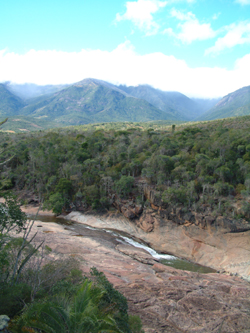
Rainforests of the Atsinanana
Madagascar · 14.4597° S, 49.7025° E · 4,797 km² · 54 km from Sambava
The Rainforests of the Atsinanana is a World Heritage Site that was inscribed in 2007 and consists of 13 specific areas in six national parks in the eastern part of Madagascar:
The Rainforests of the Atsinanana are distributed along the eastern part of the island. These relict forests are critically important for maintaining ongoing ecological processes necessary for the survival of Madagascar's unique biodiversity, which reflects the island's geological history. Having completed its separation from all other land masses more than 60 million years ago, Madagascar's plant and animal life evolved in isolation. The rainforests are inscribed for their importance to both ecological and biological processes as well as their biodiversity and the threatened species they support. Many species are rare and threatened especially lemurs and other primates.
Adapted from Wikipedia: Rainforests of the Atsinanana (CC BY-SA 4.0).
Why Rainforests of the Atsinanana Is Listed
- (ix)
- An outstanding example of ongoing ecological and biological processes.
- (x)
- The most important natural habitats for conserving biodiversity.
More about Rainforests of the Atsinanana
UNESCO's Description
The Rainforests of the Atsinanana comprise six national parks distributed along the eastern part of the island. These relict forests are critically important for maintaining ongoing ecological processes necessary for the survival of Madagascar’s unique biodiversity, which reflects the island’s geological history. Having completed its separation from all other land masses more than 60 million years ago, Madagascar’s plant and animal life evolved in isolation. The rainforests are inscribed for their importance to both ecological and biological processes as well as their biodiversity and the threatened species they support. Many species are rare and threatened especially primates and lemurs.
From the UNESCO World Heritage Centre (CC BY-SA IGO 3.0).
Key Facts
| Area | 4,797 km² |
|---|
Facts from Wikidata Q564321 (CC0).
World Heritage in Madagascar: Quick Answers
- How many UNESCO World Heritage Sites are in Madagascar?
- Madagascar has 3 World Heritage Sites: 1 cultural and 2 natural.
- What was the first World Heritage Site in Madagascar?
- Tsingy de Bemaraha Strict Nature Reserve, inscribed in 1990. The most recent is Rainforests of the Atsinanana, inscribed in 2007.
- What are the natural World Heritage Sites in Madagascar?
- Tsingy de Bemaraha Strict Nature Reserve, Rainforests of the Atsinanana.
- Are any World Heritage Sites in Madagascar in danger?
- None of the World Heritage Sites in Madagascar is on UNESCO's List of World Heritage in Danger.