Skip to content
YearMaps

The Big Bang, Cosmic Evolution, and Beyond in 3D

The universe began about 13.8 billion years ago. Journey through cosmic history across 12 animated 3D scenes: watch space expand and cool, forge its first nuclei and light, ignite early stars and quasars, weave the vast cosmic web, assemble the Milky Way, synthesize heavy elements in supernovae and kilonovae, form our Sun and planets, and look billions of years ahead to the ultimate destiny of spacetime.

12 animated 3D scenes

How the universe began & evolved

The first instantHot and dense
TempT > 10³² K
Redshiftz → ∞
Cosmic Chronicles · Step by Step Guide

The 12 Milestones of Cosmic Evolution

Each chapter explores a pivotal moment, connecting the 3D simulation with real observations, the theories that explain them and the scientists who worked them out.

Milestone 1 of 12

13.8 billion years ago

The Big Bang

Telescope image · the evidenceThe Hubble Ultra Deep Field looks back over 13 billion years into cosmic history, capturing nearly 10,000 primordial galaxies.NASA / ESA / H. Teplitz & M. Rafelski (IPAC/Caltech) / A. Koekemoer (STScI) · Public Domain ↗
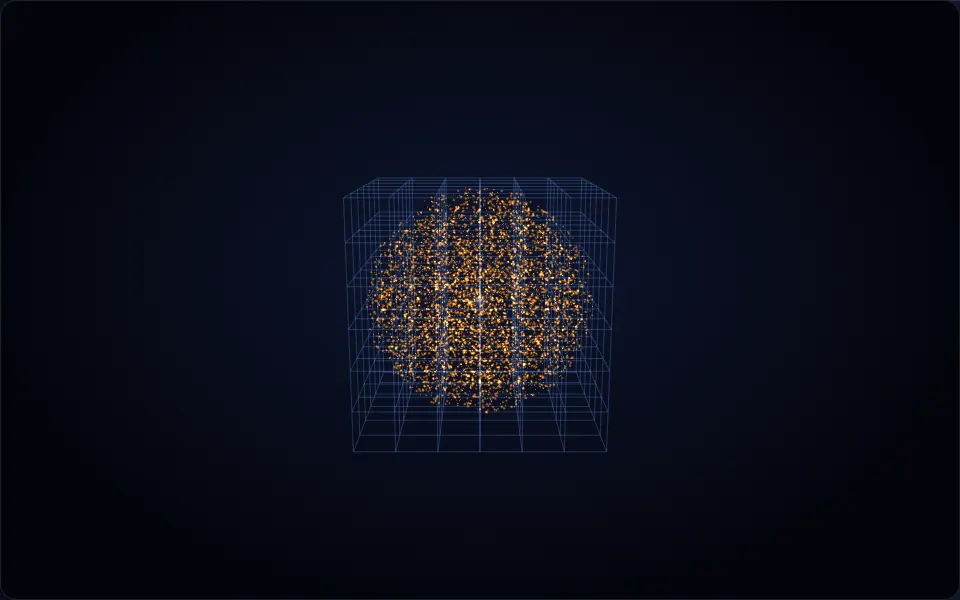
Our simulationThe same moment in the 3D scene above.

What was the Big Bang?

The Big Bang was not an explosion into empty space but the rapid expansion of space itself from an extremely hot, dense state about 13.8 billion years ago. Everything we can see was once packed together; as space stretched, it cooled.

Key milestones

  1. Hot and denseThe first instant
    T > 10³² Kz → ∞

    All the matter and energy of the observable universe is packed into a tiny, unimaginably hot region.

  2. Space stretchesFractions of a second
    T ~ 10²⁷ Kz ~ 10²⁸

    Space itself expands, carrying everything apart: there is no centre and no edge to fly out from.

  3. CoolingSeconds to minutes
    T ~ 10¹⁰ K → 10⁹ Kz ~ 10⁹

    As space stretches, the radiation filling it loses energy and the universe cools from trillions of degrees.

In the 3D scene 4 pointers

  • Primordial Singularity

    The infinitesimally small, hot, dense initial state containing all observable mass-energy.

  • Spacetime Coordinate Metric

    The 3D coordinate fabric of space itself stretching outward uniformly without an edge.

  • High-Energy Particle Plasma

    Relativistic leptons, quarks and photons cooling from trillions of degrees.

  • Cosmic Shockwave Front

    Outward relativistic wave boundary propagating through expanding space.

Theories and models

  • General Theory of Relativity (1915)

    Einstein’s field equations describe gravity as the curvature of spacetime caused by mass and energy, predicting a non-static, dynamic universe.

  • FLRW Cosmological Metric (1922–1935)

    Exact mathematical solution of Einstein’s equations for a homogeneous, isotropic, expanding or contracting universe.

  • Hubble’s Law of Expansion (1929)

    Astronomical observation proving that galaxy recessional velocity is directly proportional to cosmological distance (v = H₀ d).

Pioneers

  • Georges Lemaître

    Belgian Priest & Cosmologist (1894–1966)

    First to derive cosmological expansion from General Relativity (1927) and proposed the "Primeval Atom" hypothesis of cosmic origin.

  • Edwin Hubble

    American Astronomer (1889–1953)

    Proved galaxies exist beyond the Milky Way and measured their systemic Doppler redshifts at Mount Wilson Observatory.

  • Alexander Friedmann

    Russian Mathematician & Physicist (1888–1925)

    Discovered the dynamic expanding-universe solutions to Einstein’s field equations without a cosmological constant.
Milestone 2 of 12

About 10⁻³⁶ to 10⁻³² seconds

Cosmic inflation

Diagram or data map · the evidenceCosmological expansion diagram depicting exponential inflation and the unfolding spacetime timeline after the Big Bang.NASA / WMAP Science Team · Public Domain ↗
Our simulationThe same moment in the 3D scene above.

What is cosmic inflation?

Inflation is a widely accepted idea that, in the first tiny fraction of a second, space expanded by an enormous factor almost instantly. It smoothed the universe out but stretched tiny quantum ripples into the seeds of every galaxy.

Key milestones

  1. Quantum jitter10⁻³⁶ seconds
    T ~ 10²⁸ KPlanck Era

    At the smallest scales, energy flickers randomly: tiny quantum ripples.

  2. InflationUntil 10⁻³² seconds
    SupercooledScale a × 10²⁶

    Space balloons in size by at least 10²⁶ times in a split second, faster than light can cross it.

  3. Frozen ripplesAfter inflation
    T ~ 10²⁷ KReheating

    The ripples are stretched to cosmic size and frozen in as slightly denser and thinner regions: the seeds of galaxies.

In the 3D scene 4 pointers

  • Inflaton Scalar Field

    High-energy scalar field with negative pressure that drove exponential cosmic ballooning.

  • Quantum Density Ripples

    Subatomic Planck-scale ripples stretched to cosmological light-year dimensions.

  • Frozen Ripple Seeds

    Overdense and underdense density perturbations frozen into space as the seeds of galaxies.

  • Reheating Thermal Burst

    Decay of the inflaton field releasing standard-model particles and initiating the hot Big Bang.

Theories and models

  • Cosmic Inflation Theory (1981)

    Rapid exponential expansion by a factor of >10²⁶ in ~10⁻³² seconds, explaining the cosmic horizon and flatness problems.

  • Quantum Fluctuation Seeding

    Inflation stretches Heisenberg quantum vacuum fluctuations into macroscopic primordial density perturbations (δρ/ρ ~ 10⁻⁵).

  • Slow-Roll & Chaotic Inflation

    Models describing how the scalar inflaton field slowly rolls down its potential well before decaying.

Pioneers

  • Alan Guth

    American Theoretical Physicist (MIT, b. 1947)

    First proposed cosmic inflation in 1981 while studying magnetic monopoles at SLAC and Cornell.

  • Andrei Linde

    Theoretical Physicist (Stanford, b. 1948)

    Developed "new inflation" and chaotic inflation, proposing the modern eternal inflationary multiverse.

  • Alexei Starobinsky

    Soviet/Russian Astrophysicist (1948–2023)

    Developed the Starobinsky R² modified-gravity model of inflation, one of the best fits to Planck satellite data.

Milestone 3 of 12

First 3 to 20 minutes

The first atomic nuclei

Diagram or data map · the evidenceTimeline of the universe from high-energy Quark-Gluon plasma to the synthesis of the first hydrogen and helium atomic nuclei.NASA / WMAP Science Team · Public Domain ↗
Our simulationThe same moment in the 3D scene above.

How were the first elements made?

In the first minutes, quarks joined into protons and neutrons, which then fused into the nuclei of the lightest elements. When this “Big Bang nucleosynthesis” ended, matter was about 75% hydrogen and 25% helium by mass, with a trace of lithium.

Key milestones

  1. A soup of quarksUnder a millionth of a second
    T ~ 2 × 10¹² KHadron Epoch

    Quarks and gluons fill space in a hot soup.

  2. Protons and neutronsAbout a millionth of a second
    T ~ 10¹² KNucleon Freeze-out

    As it cools, quarks bind in threes into protons and neutrons.

  3. The first nuclei3 to 20 minutes
    T ~ 10⁹ KBBN Period

    Protons and neutrons fuse into helium nuclei, until expansion cools the universe too much: 75% hydrogen, 25% helium.

In the 3D scene 4 pointers

  • Quarks (u, d)

    Fundamental color charges (RGB) in high-energy plasma.

  • Gluon Flux Confinement

    Strong nuclear force snapping quarks in triplets into stable nucleons at T ~ 10¹² K.

  • Protons & Neutrons

    Nucleons (protons uud, neutrons udd) freezing out in a 7:1 ratio.

  • Helium-4 (Alpha) Nuclei

    Tightly bound nuclei containing two protons and two neutrons forming 25% of cosmic baryonic mass.

Theories and models

  • Big Bang Nucleosynthesis (BBN)

    Nuclear fusion occurring between 3 and 20 minutes after the Big Bang, synthesizing hydrogen, helium-4, deuterium, and lithium-7.

  • Quantum Chromodynamics (QCD) Confinement

    As the universe cooled below 2 trillion Kelvin, the strong force bound quarks into hadrons via color confinement.

  • Alpher–Bethe–Gamow Theory (1948)

    Seminal mathematical paper detailing how light elements were synthesized via successive neutron capture in the early universe.

Pioneers

  • George Gamow

    Soviet-American Physicist (1904–1968)

    Conceived the early hot Big Bang universe and spearheaded the theoretical physics of primordial nucleosynthesis.

  • Ralph Alpher

    American Cosmologist (1921–2007)

    Lead author of the landmark 1948 αβγ paper calculating primordial helium abundances and predicting the CMB.

  • Robert Herman

    American Physicist (1914–1997)

    Collaborated with Alpher to estimate the remaining background radiation temperature of the universe (~5 K).

Milestone 4 of 12

380,000 years after the Big Bang

The first light (the cosmic microwave background)

Diagram or data map · the evidenceThe European Space Agency Planck satellite all-sky map of the Cosmic Microwave Background (CMB) at 380,000 years after the Big Bang.ESA and the Planck Collaboration · CC BY-SA 3.0 IGO ↗
Our simulationThe same moment in the 3D scene above.

What is the cosmic microwave background?

About 380,000 years after the Big Bang the universe cooled enough for electrons to join nuclei into atoms. Light could suddenly travel freely, and that first released light still fills the sky today as the cosmic microwave background, mapped by the COBE, WMAP and Planck satellites.

Key milestones

  1. A glowing fogThe first 380,000 years
    T > 3,000 °Cz > 1,100

    Free electrons scatter light constantly, so the universe is a hot, opaque, glowing fog.

  2. The fog clears380,000 years
    T ≈ 3,000 Kz ≈ 1,100

    At about 3,000 °C, electrons join nuclei to make atoms, and light streams free.

  3. The afterglowStill seen today
    T = 2.725 Kz = 0

    That light, stretched into microwaves, still arrives from every direction with tiny hot and cold spots: the seeds of galaxies.

  4. The Dark Ages0.4 to ~100 million years
    T ~ 60 Kz ≈ 100 → 20

    With no stars yet, the universe goes dark while gravity slowly gathers gas.

In the 3D scene 5 pointers

  • Thomson Scattering Fog

    Free electrons scattering photons constantly, rendering the early universe completely opaque.

  • Recombination Neutral Atoms

    At T ≈ 3,000 K, protons capture electrons into neutral hydrogen atoms, clearing the fog.

  • Free-Streaming Photons

    Decoupled light rays suddenly streaming freely across 13.8 billion years to reach modern telescopes.

  • Sound Horizon (BAO) Ring

    Frozen acoustic sound wave shell in the primordial baryon-photon fluid (~150 Mpc comoving radius).

  • Cosmic Microwave Background (CMB)

    The all-sky thermal afterglow cooled by expansion to 2.725 K with 10⁻⁵ temperature ripples.

Theories and models

  • Saha Ionization Equation & Decoupling

    Thermodynamic equilibrium equation determining when thermal radiation can no longer ionize hydrogen, causing sudden transparency.

  • Baryon Acoustic Oscillations (BAO)

    Sound waves driven by radiation pressure propagating through plasma until decoupling, providing a cosmic "standard ruler".

  • Blackbody Radiation & Dipole Anisotropy

    The CMB exhibits the most perfect blackbody spectrum ever measured in nature (Planck blackbody formula).

Pioneers

  • Arno Penzias & Robert Wilson

    Radio Astronomers (Bell Labs, Nobel 1978)

    Accidentally discovered the uniform 2.7 K microwave background radiation using the Holmdel Horn Antenna in 1964.

  • Jim Peebles

    Theoretical Cosmologist (Princeton, Nobel 2019)

    Laid the theoretical foundation of CMB physical interpretation, acoustic peaks, and cold dark matter.

  • John Mather & George Smoot

    Astrophysicists (NASA COBE, Nobel 2006)

    Measured the CMB blackbody spectrum and discovered the primordial temperature ripples that seeded galaxies.

Milestone 5 of 12

100–200 million years after the Big Bang

The first stars

Telescope image · the evidenceJames Webb Space Telescope First Deep Field (SMACS 0723), revealing early Population III star clusters and gravitational arcs from the cosmic dawn.NASA / ESA / CSA / STScI · Public Domain ↗
Our simulationThe same moment in the 3D scene above.

When did the first stars form?

Gravity pulled gas along a web of dark-matter filaments into dense clumps that ignited as the first stars, probably 100 to 200 million years after the Big Bang. They were huge, hot and short-lived, and their ultraviolet light gradually ionised the gas between galaxies again (reionisation).

Key milestones

  1. The cosmic webTens of millions of years
    T ~ 30 Kz ≈ 25

    Gas and dark matter gather into a web of filaments with knots where they cross.

  2. Collapse~100 million years
    T ~ 1,000 Kz ≈ 20

    In the densest knots, gas collapses and heats up.

  3. First light from stars100–200 million years
    T ~ 10⁸ K (cores)z ≈ 15

    Fusion ignites: massive, blue-hot stars light up the universe.

  4. ReionisationUp to ~1 billion years
    Ionising UVz ≈ 12 → 6

    Their ultraviolet light blows bubbles of ionised gas that grow and merge.

In the 3D scene 4 pointers

  • Dark Matter Filaments

    Pristine cold dark matter web channeling primordial gas into gravitational knot wells.

  • Gravitational Collapse Knots

    Cooling molecular hydrogen gas clouds collapsing past the Jeans mass threshold.

  • Population III Hypergiants

    Zero-metallicity monster stars (100–300 M☉) burning at >50,000 K with lifespans of ~3 million years.

  • Strömgren UV Ionization Bubbles

    Expanding spheres of re-ionized hydrogen gas carved out by ultraviolet starlight.

Theories and models

  • Jeans Instability Criterion

    A gas cloud collapses under self-gravity when its gravitational binding energy exceeds internal thermal pressure.

  • Zero-Metallicity Star Formation

    Without carbon, oxygen, or iron to cool gas, primordial clouds could only cool via H₂ molecules, forming massive stars.

  • Epoch of Reionization (EoR)

    Ultraviolet photons from Pop III stars and early mini-quasars re-ionized intergalactic neutral hydrogen (z ~ 12 to 6).

Pioneers

  • Martin Rees

    British Astronomer Royal (Cambridge, b. 1942)

    Pioneered theoretical research on how first-generation stars ended the Cosmic Dark Ages and reionized the cosmos.

  • Abraham Loeb

    Theoretical Astrophysicist (Harvard, b. 1962)

    Authored landmark papers and textbooks modeling the 21-cm hydrogen absorption signature and first stars.

  • Volker Bromm

    Astrophysicist (UT Austin, b. 1965)

    Conducted the first 3D supercomputer hydrodynamic simulations of Population III star formation.

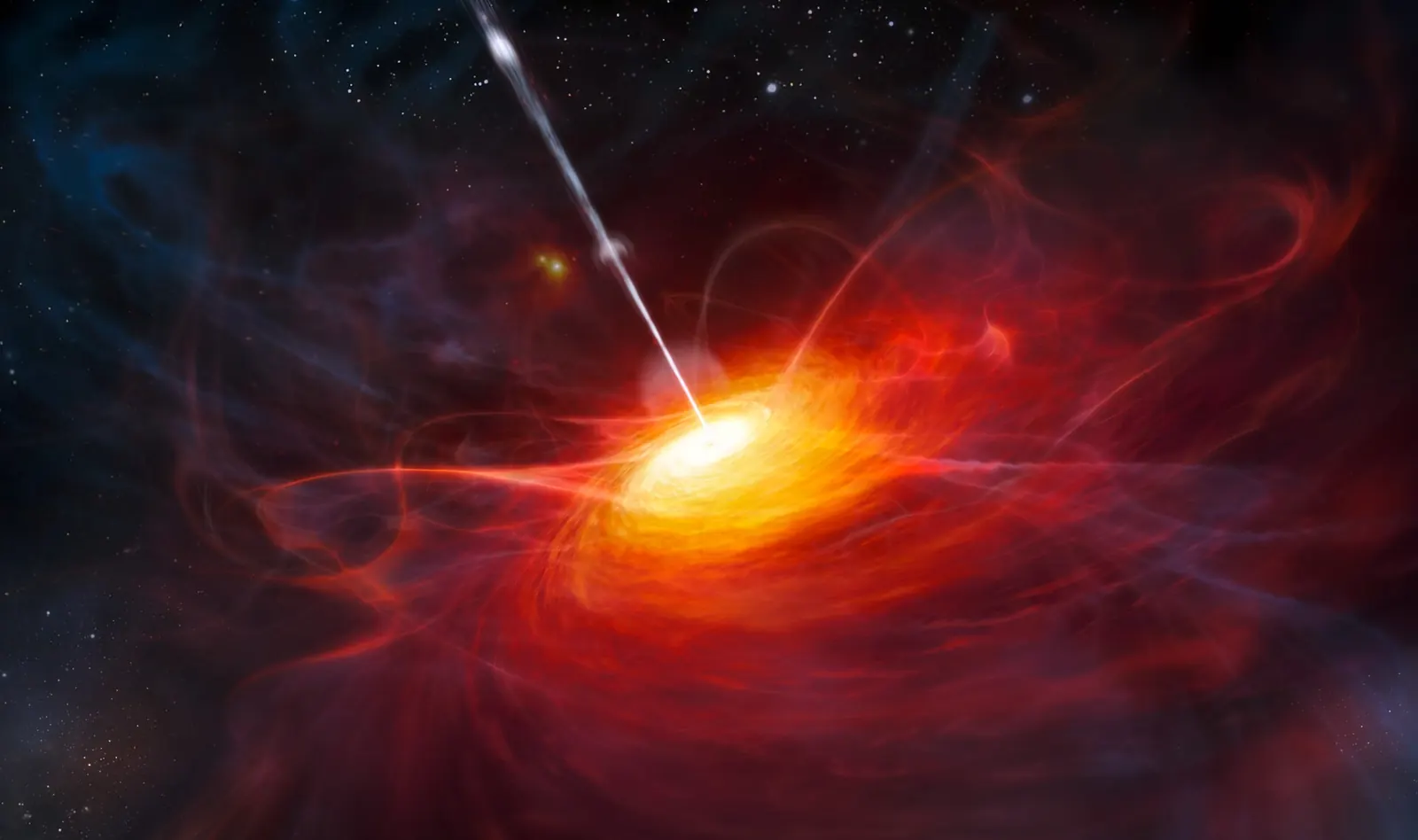
Artist impression of a distant early quasar powered by a supermassive black hole accreting matter and blasting relativistic jets.
Milestone 6 of 12

700 million to 2 billion years after the Big Bang

Early supermassive black holes and quasars

What are quasars and how did early black holes grow so fast?

In the young universe, gargantuan supermassive black holes formed inside growing galaxies. Matter spiraling into them reached millions of degrees, creating quasars that outshone entire galaxies and blasted relativistic plasma jets across hundreds of thousands of light-years.

Key milestones

  1. Primordial black hole seeds700 million years
    T ~ 10⁷ Kz ≈ 7

    Massive clouds of primordial gas collapse directly into giant black hole seeds.

  2. Blazing accretion disk1 billion years
    T ~ 10⁸ Kz ≈ 6

    Infalling gas forms a superheated disk spinning near the speed of light, shining brighter than 1,000 Milky Ways.

  3. Relativistic jets1.5 billion years
    Relativistic Plasmaz ≈ 4

    Twisted magnetic fields launch colossal particle jets from the poles, blowing gas out of the host galaxy.

In the 3D scene 5 pointers

  • Kerr Event Horizon

    The central spinning boundary from which not even light can escape.

  • Einstein Photon Ring

    Luminous circular photon orbit created by extreme gravitational light deflection.

  • Accretion Disk (Doppler Beaming)

    Superheated gas orbiting at near-light speed; approaching side is blueshifted and bright.

  • Relativistic Collimated Jets

    Twin magnetic particle beams launched along rotational poles at >0.99c spanning galaxy clusters.

  • Infalling Galactic Feeding Streams

    Primordial gas clouds spiraling into the central gravitational well.

Theories and models

  • Blandford–Znajek Mechanism (1977)

    Extraction of spin energy from a rotating Kerr black hole via magnetic field lines to accelerate relativistic jets.

  • Eddington Luminosity Limit

    The theoretical maximum brightness of an accreting body where outward radiation pressure balances inward gravity.

  • Direct Collapse Black Hole (DCBH)

    Primordial gas clouds collapsing directly into 100,000 M☉ seeds, explaining billion-solar-mass quasars at z > 7.

Pioneers

  • Maarten Schmidt

    Dutch-American Astronomer (1929–2022)

    Discovered the extraordinary optical redshift of 3C 273 in 1963, proving quasars are the brightest beacons in the universe.

  • Donald Lynden-Bell

    British Astrophysicist (1935–2018)

    First proposed in 1969 that quasars are powered by supermassive black holes accreting gas from host galaxies.

  • Roy Kerr

    New Zealand Mathematician (b. 1934)

    Solved Einstein’s field equations for a spinning black hole in 1963 (the Kerr metric fundamental to all astrophysical black holes).

Artist impression of a distant early quasar powered by a supermassive black hole accreting matter and blasting relativistic jets. · ESO / M. Kornmesser · CC BY 4.0 ↗

Milestone 7 of 12

2 to 5 billion years after the Big Bang

The cosmic web and great voids

Diagram or data map · the evidenceThe Millennium Simulation: large-scale structure showing dark matter filaments and galaxy superclusters connecting across cosmic voids.Springel et al. / Max Planck Institute for Astrophysics · CC BY-SA 3.0 ↗

What does the universe look like on the largest scale?

Matter is not scattered randomly: gravity has organized it into an immense sponge-like web spanning hundreds of millions of light-years. Filaments of dark matter and galaxies connect dense superclusters, surrounding vast, near-empty cosmic voids.

Key milestones

  1. Dark matter skeleton2 billion years
    T ~ 30 Kz ≈ 3

    Invisible dark matter forms an intricate cosmic scaffold under the pull of gravity.

  2. Filaments and voids5 billion years
    T ~ 10 Kz ≈ 1.5

    Galaxies flow along dense cosmic highways, leaving voids hundreds of millions of light-years across.

  3. Superclusters and great walls8 billion years to present
    T = 2.73 Kz ≈ 0.5

    Thousands of galaxies cluster into massive complexes like the Laniakea Supercluster, where our Milky Way resides.

In the 3D scene 4 pointers

  • Dark Matter Filaments

    Invisible gravitational highways linking massive galaxy clusters across deep space.

  • Supercluster Nodes

    Overdense intersections where thousands of galaxies gather (e.g. Laniakea, Coma).

  • Cosmic Voids

    Immense underdense bubbles (100–300 million light-years across) devoid of major galaxies.

  • Gravitational Drift Streams

    Galaxies and intergalactic gas slowly migrating toward major cluster attractors.

Theories and models

  • Zel’dovich Pancake Collapse (1970)

    Gravitational instability collapses primordial density perturbations along their shortest axes first, making sheets and filaments.

  • Cold Dark Matter (ΛCDM) Paradigm

    Non-relativistic dark matter forms bottom-up hierarchical structure, creating the sponge-like cosmic tapestry.

  • Void Expansion & Dynamic Outflow

    Cosmic voids act as repulsive gravitational regions, clearing matter into surrounding filament walls.

Pioneers

  • Margaret Geller & John Huchra

    Astronomers (Harvard-Smithsonian CfA)

    Conducted the CfA Redshift Survey (1989), discovering the "Great Wall" and revealing the 3D sponge-like cosmic web.

  • Yakov Borisovich Zel’dovich

    Soviet Physicist (1914–1987)

    Formulated the analytical theory of anisotropic gravitational collapse that predicted the filamentary cosmic web.

  • Volker Springel

    Computational Astrophysicist (Max Planck, b. 1970)

    Led the landmark Millennium Simulation (2005) mapping 10 billion dark matter particles across cosmic time.

Milestone 8 of 12

Over 13 billion years ago and still growing

Galaxies and the Milky Way

Telescope image · the evidenceThe Milky Way galaxy galactic plane and core arching across the sky above the Very Large Telescope (VLT) in the Atacama Desert.ESO / Yuri Beletsky · CC BY 4.0 ↗
Our simulationThe same moment in the 3D scene above.

How did the Milky Way form?

Galaxies grew as smaller clumps of stars, gas and dark matter merged. Our Milky Way’s oldest stars are over 13 billion years old; gas settling into a spinning disk formed its spiral arms, and it is still growing by swallowing smaller galaxies.

Key milestones

  1. Small galaxiesFirst billion years
    T ~ 10⁴ Kz ≈ 5 → 3

    Many small, irregular galaxies form in the knots of the cosmic web.

  2. MergersBillions of years
    T ~ 10⁴ Kz ≈ 2 → 1

    They collide and merge, building bigger galaxies with tidal streams.

  3. A spinning diskAbout 10 billion years ago on
    Disk Equilibriumz ≈ 0

    Gas settles into a flat, rotating disk where spiral arms form new stars.

In the 3D scene 5 pointers

  • Sagittarius A* & Galactic Bulge

    A 4.15-million-solar-mass supermassive black hole surrounded by an ancient golden stellar bar.

  • OB Starburst Clusters

    Young, hot blue stars illuminating the leading edges of spiral density waves.

  • H II Emission Nebulae

    Glowing pink ionized hydrogen star-forming nurseries (e.g. Orion, Carina).

  • Interstellar Dust Extinction Lanes

    Silhouetted ribbons of cold molecular gas and carbon/silicate dust grains.

  • Globular Cluster Halo

    Spherical swarm of ancient 13-billion-year-old stellar clusters orbiting the galaxy.

Theories and models

  • Density Wave Theory (1964)

    Spiral arms are rotating density waves of gravitational compression that trigger gas clouds to collapse into stars.

  • Hierarchical Galaxy Assembly

    Galaxies grow by continually accreting dwarf galaxies (e.g. Gaia-Sausage-Enceladus merger ~10 billion years ago).

  • Galactic Bar Dynamics

    Gravitational torque from a central rotating stellar bar channels gas into the core to feed the central black hole.

Pioneers

  • C.C. Lin & Frank Shu

    Astrophysicists (MIT & UC Berkeley)

    Formulated the mathematical density wave theory explaining why spiral arms do not wind up and disappear.

  • Andrea Ghez & Reinhard Genzel

    Astronomers (UCLA & Max Planck, Nobel 2020)

    Tracked stellar orbits around the galactic center over 25 years, proving the existence of supermassive black hole Sagittarius A*.

  • Walter Baade

    German Astronomer (1893–1960)

    Discovered distinct stellar populations (young blue Pop I in arms, old golden Pop II in the bulge and halo).

Milestone 9 of 12

Across 9 billion years before the Sun

Stars forge the elements

Telescope image · the evidenceThe Crab Nebula (M1) supernova remnant, an expanding stellar forge dispersing carbon, oxygen, silicon, and iron around a central pulsar.NASA / ESA / J. Hester and A. Loll (ASU) · Public Domain ↗
Our simulationThe same moment in the 3D scene above.

Where did the elements in our bodies come from?

Apart from hydrogen and some helium, almost every atom in your body was made inside stars. Stars fuse light elements into carbon, oxygen and on up to iron; dying stars and supernova explosions scatter them into space to build new stars and planets.

Key milestones

  1. A massive starMillions of years
    Core T ~ 4 × 10⁷ KLocal Stellar

    A massive star fuses hydrogen into helium in its core.

  2. Layers like an onionIts last million years
    Core T ~ 3 × 10⁹ KPre-Supernova

    Near its end it fuses heavier elements in layers: carbon, oxygen, silicon, and finally iron at the centre.

  3. CollapseUnder a second
    Core T ~ 10¹¹ KMillisecond Core Collapse

    Iron cannot release energy by fusion; the core collapses catastrophically into a neutron star.

  4. SupernovaWeeks of brightness
    T ~ 10⁹ KBlast Wave v ~ 10⁴ km/s

    The star explodes, scattering its elements, and making more, into space.

In the 3D scene 5 pointers

  • Convective Red Supergiant Envelope

    Enormous boiling atmosphere expanding past the orbit of Jupiter.

  • Concentric Onion Fusion Shells

    Concentric burning layers: Hydrogen, Helium, Carbon, Oxygen, Neon, Silicon, and Iron.

  • Inert Iron Core

    Chandrasekhar-mass core unable to generate fusion energy, collapsing in milliseconds.

  • Supernova Detonation Blast

    Neutrino-driven shockwave blasting elements into interstellar space at 10,000 km/s.

  • Spinning Pulsar Remnant

    Ultra-dense neutron star spinning dozens of times per second with relativistic magnetic beams.

Theories and models

  • Stellar Nucleosynthesis (B²FH, 1957)

    Seminal paper proving all elements from carbon to uranium are forged inside stars and supernovae.

  • Chandrasekhar Mass Limit (1.44 M☉)

    The maximum mass supported by quantum electron degeneracy pressure before gravitational collapse is inevitable.

  • Core-Collapse Supernova Mechanism

    Infalling stellar envelope rebounds off the stiff degenerate core, propelled by intense neutrino heating.

Pioneers

  • Fred Hoyle & William Fowler

    Astrophysicists (Cambridge & Caltech, Fowler Nobel 1983)

    Discovered the triple-alpha process and worked out the nucleosynthetic nuclear reaction rates inside stars.

  • Subrahmanyan Chandrasekhar

    Indian-American Theoretical Physicist (Chicago, Nobel 1983)

    Calculated the relativistic quantum degeneracy limit of white dwarfs and dying stellar cores.

  • Hans Bethe

    Nuclear Physicist (Cornell, Nobel 1967)

    Discovered the carbon-nitrogen-oxygen (CNO) cycle and proton-proton fusion reactions powering massive stars.

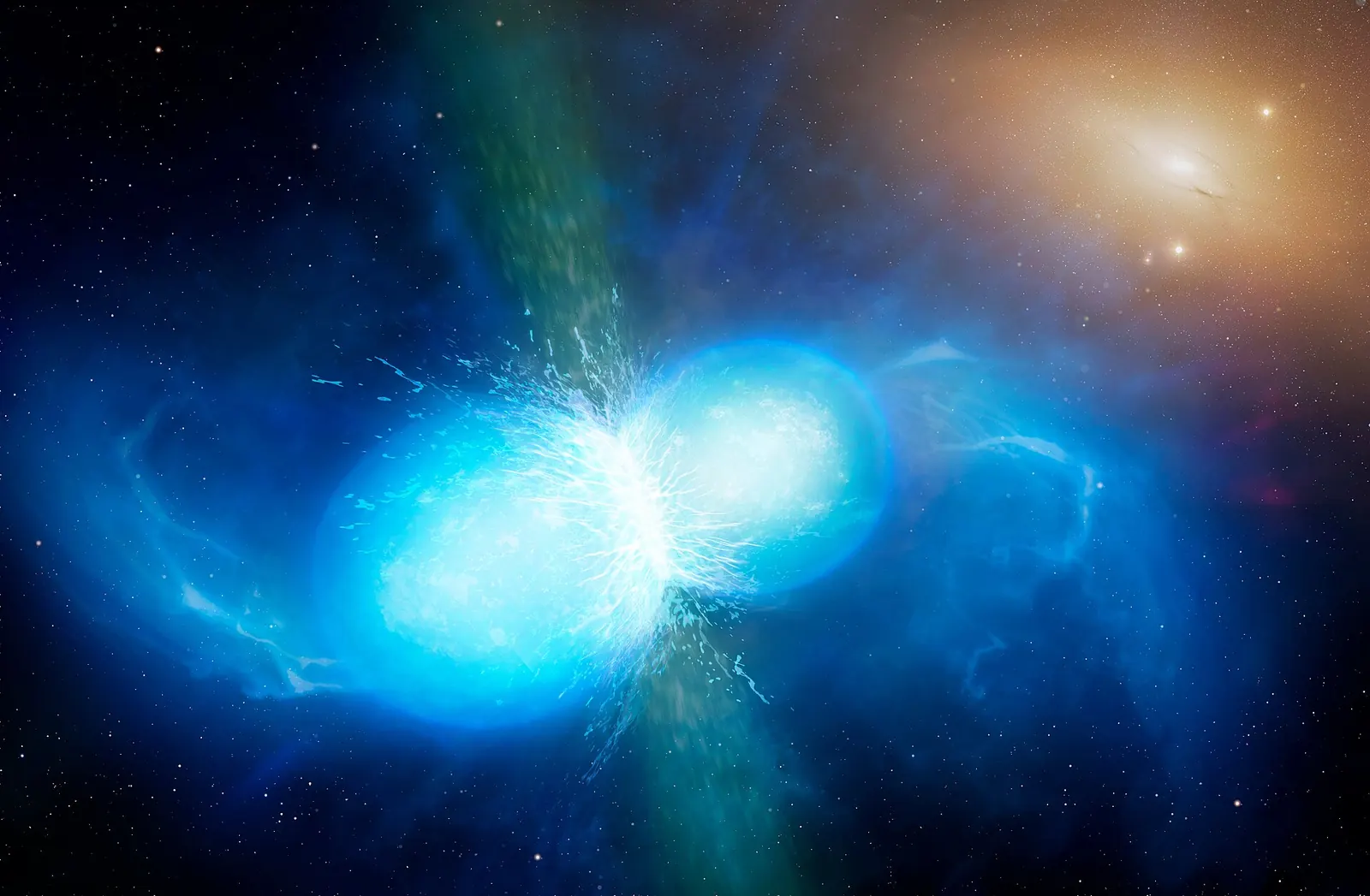
Artist impression of binary neutron stars colliding (kilonova GW170817), forging gold, platinum and uranium via the r-process.
Milestone 10 of 12

Across cosmic history

Neutron star collisions and the origin of gold

Where do gold, platinum and heavy metals come from?

While normal stars and supernovae make elements up to iron, the heaviest elements—like gold, platinum and uranium—are forged when two ultra-dense neutron stars collide. This "kilonova" floods space with neutrons, synthesising precious metals and sending ripples through spacetime.

Key milestones

  1. The death spiralFinal orbits
    T ~ 10⁹ KBinary Orbit

    Two city-sized neutron stars, each heavier than the Sun, whirl around each other hundreds of times per second.

  2. The collisionMilliseconds
    T > 10¹¹ KRelativistic Clash

    They crash together in a cataclysm that ripples spacetime and unleashes a blinding beam of gamma rays.

  3. Forging heavy elementsDays to weeks
    Radioactive Glowr-Process

    A cloud of radioactive neutron-rich matter expands, forging several Earth-masses of gold and platinum (the r-process).

In the 3D scene 4 pointers

  • Binary Neutron Stars

    City-sized ultra-dense stellar remnants whirling around each other at hundreds of orbits per second.

  • Gravitational Wave Spirals

    Quadrupole ripples warping spacetime and carrying orbital energy away at the speed of light.

  • Relativistic Collision Detonation

    Violent merger releasing gamma-ray burst jets and crushing matter past nuclear density.

  • r-Process Golden Fireball

    Radioactive cloud synthesizing Earth-masses of gold, platinum, and uranium.

Theories and models

  • Rapid Neutron Capture (r-process)

    Extreme neutron flux where seeds capture neutrons faster than beta decay, synthesizing elements heavier than iron.

  • Kilonova Radioactive Decay Model

    Decay of heavy radioactive lanthanide nuclei illuminates a bright, rapidly reddening thermal optical transient.

  • Gravitational Wave Chirp & Inspiral

    Einstein’s General Relativity predicts a rising frequency and amplitude "chirp" as orbiting masses lose energy.

Pioneers

  • Brian Metzger

    Theoretical Astrophysicist (Columbia, b. 1981)

    Coined the term "kilonova" in 2010 and predicted the radioactive lanthanide opacity that was confirmed by GW170817.

  • Bohdan Paczyński

    Polish Astrophysicist (Princeton, 1940–2007)

    First proposed in 1986 that colliding binary neutron stars produce cosmological gamma-ray bursts.

  • Rainer Weiss, Kip Thorne & Barry Barish

    Physicists (LIGO, Nobel 2017)

    Founded and led LIGO, detecting gravitational waves from black hole and neutron star collisions.

Artist impression of binary neutron stars colliding (kilonova GW170817), forging gold, platinum and uranium via the r-process. · ESO / L. Calçada / M. Kornmesser · CC BY 4.0 ↗

Milestone 11 of 12

About 4.57 billion years ago

The solar nebula collapses

Telescope image · the evidenceALMA millimeter-wave observation of protoplanetary disk HL Tauri, showing concentric dark orbital rings swept clean by forming planets.ALMA (ESO / NAOJ / NRAO) · CC BY 4.0 ↗
Our simulationThe same moment in the 3D scene above.

How did the Solar System begin?

About 4.6 billion years ago a cloud of gas and dust, enriched by earlier stars, began to collapse, perhaps nudged by a nearby supernova. As it shrank it spun faster and flattened into a disk, with the young Sun forming at the centre.

Key milestones

  1. A cold cloud4.6 billion years ago
    T ~ 10–20 Kt = -4.6 Ga

    A cloud of hydrogen, helium and dust drifts in the Milky Way.

  2. A shock waveA nudge
    Shock FrontTriggered Collapse

    A shock, perhaps from a nearby supernova, squeezes part of the cloud.

  3. Collapse and spinTens of thousands of years
    T ~ 100–300 Kt = -4.57 Ga

    Gravity pulls the cloud in; like a skater pulling in her arms, it spins faster.

  4. A disk and a protostar~100,000 years
    Protostar T ~ 4,000 KProtoplanetary Disk

    The cloud flattens into a spinning disk with a hot protostar at its heart.

In the 3D scene 5 pointers

  • Supernova Shock Front

    External compression wave from a nearby exploding star triggering molecular cloud collapse.

  • Rotating Protoplanetary Disk

    Centrifugal forces flattening the spinning gas cloud into a Keplerian accretion disk.

  • Nascent Protostar (Young Sun)

    Gravitational core growing in mass and heating up to become our Sun.

  • Bipolar Herbig-Haro Jets

    Magnetic plasma outflows launched perpendicular to the disk to shed excess angular momentum.

  • Planetesimal Ring Gaps

    Dark concentric circular lanes cleared out by infant giant planets (proto-Jupiter).

Theories and models

  • Kant–Laplace Nebular Hypothesis

    Planets condense out of a flattened rotating disk of gas and dust surrounding a newborn central star.

  • Conservation of Angular Momentum

    As the cloud contracts under gravity (shrinking radius r), orbital speed v increases, flattening the envelope.

  • Safronov Planetesimal Accretion (1969)

    Coagulation of microscopic dust grains into kilometer-sized planetesimals and protoplanetary embryos.

Pioneers

  • Immanuel Kant & Pierre-Simon Laplace

    Philosopher & Mathematician (1755 & 1796)

    Independently developed the original rotating nebular hypothesis of Solar System formation.

  • Viktor Safronov

    Soviet Astronomer (1917–1999)

    Developed the quantitative modern theory of planetesimal collision, runaway accretion, and planet formation.

  • Chushiro Hayashi

    Japanese Astrophysicist (Kyoto, 1920–2010)

    Calculated the luminosity-temperature evolutionary tracks of protostars (Hayashi track) and the Minimum Mass Solar Nebula.

Milestone 12 of 12

Far future: 100 billion to 10¹⁰⁰ years

The ultimate fate: dark energy and the Big Freeze

Telescope image · the evidenceSupernova SN 1994D on the outskirts of galaxy NGC 4526. Standard candle Type Ia supernovae proved the accelerating expansion of the universe.High-Z Supernova Search Team / NASA / ESA / STScI · Public Domain ↗

How will the universe end?

Driven by dark energy, the expansion of the universe is accelerating. Over trillions of years, distant galaxies will slip beyond our view, stars will exhaust their fuel and go dark, and black holes will slowly evaporate through Hawking radiation, leaving an ever-expanding, cold void.

Key milestones

  1. Accelerating expansionTens of billions of years
    T ~ 2.7 K → 1 Kz → -1

    Dark energy accelerates expansion: all galaxies outside our local group disappear beyond the cosmic event horizon.

  2. The last stars fade1 to 100 trillion years
    T → near 0 KStelliferous Sunset

    Gas is exhausted, and the longest-lived red dwarfs cool into dark black dwarfs. The Stelliferous Era ends.

  3. The Big Freeze & heat death10⁴⁰ to 10¹⁰⁰ years and beyond
    T ≈ 0 K (-273.15 °C)Heat Death

    Only black holes remain, slowly evaporating away via Hawking radiation until space is cold, calm, and empty.

In the 3D scene 4 pointers

  • Cosmological Event Horizon

    The boundary beyond which accelerating spatial expansion prevents light from ever reaching us.

  • Receding Redshifted Galaxies

    Distant galaxy clusters slipping beyond causal contact as dark energy dominates.

  • Degenerate Stellar Embers

    Burned-out white dwarfs and red dwarfs slowly cooling into dark black dwarfs.

  • Hawking Radiation Evaporation

    Faint quantum particle emission slowly radiating away black holes over 10¹⁰⁰ years.

Theories and models

  • Dark Energy & Cosmological Constant (Λ)

    Repulsive vacuum energy density (~68% of total cosmic density) causing accelerated metric expansion.

  • The Five Eras of the Universe (Adams & Laughlin)

    Primordial Era → Stelliferous Era (now) → Degenerate Era → Black Hole Era → Dark Era.

  • Hawking Radiation & Black Hole Evaporation

    Quantum vacuum fluctuations near event horizons cause black holes to emit thermal radiation and lose mass.

  • Heat Death / The Big Freeze

    Thermodynamic entropy reaches its maximum; temperatures approach absolute zero in an eternal calm void.

Pioneers

  • Saul Perlmutter, Brian Schmidt & Adam Riess

    Astrophysicists (Nobel 2011)

    Discovered the accelerating expansion of the universe in 1998 using distant Type Ia supernovae as standard candles.

  • Stephen Hawking

    Theoretical Physicist (Cambridge, 1942–2018)

    Proved black holes emit quantum thermal radiation and eventually evaporate completely over googols of years.

  • Freeman Dyson

    Theoretical Physicist (Princeton IAS, 1923–2020)

    Authored "Time without end" (1979), calculating the ultimate physical and thermodynamic fate of an open expanding universe.

What happened next

Inside the disk around the young Sun, dust coagulated into planetesimals, then protoplanets, and eventually Earth. Explore how Earth formed, or spin an interactive 3D globe of Earth through 4.5 billion years of geological and biological evolution.

Quick Answers

How old is the universe?
About 13.8 billion years. Measurements of the cosmic microwave background by the Planck satellite give 13.787 ± 0.020 billion years.
Are these animations exact?
No. They are illustrations of the standard picture of cosmic history, simplified so each step can be seen. Ages and figures in the text are standard measured values from modern observational cosmology and astrophysics.