East Antarctica
Geoarea · 884,951 km²
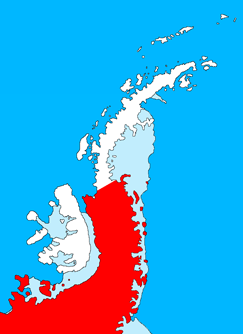
East Antarctica is a geoarea in Antarctica, covering an estimated 884,951 km². It is the 18th-largest of the 231 landforms with a mapped extent in YearMaps.
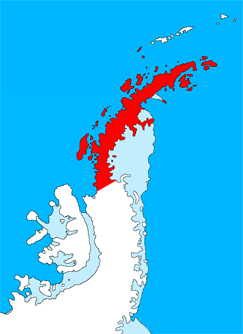
East Antarctica, also called Greater Antarctica, constitutes the majority (two-thirds) of the Antarctic continent, lying primarily in the Eastern Hemisphere south of the Indian Ocean, and separated from West Antarctica by the Transantarctic Mountains. It is generally greater in elevation than West Antarctica, and includes the Gamburtsev Mountain Range in the center. The geographic South Pole is located within East Antarctica.
Apart from small areas of the coast, East Antarctica is permanently covered by ice and it has relatively low biodiversity, with only a small number of species of terrestrial plants, animals, algae, and lichens. The coasts are the breeding ground for various seabirds and penguins, and the leopard seal, Weddell seal, elephant seal, crabeater seal and Ross seal breed on the surrounding pack ice in summer.
Adapted from Wikipedia: East Antarctica (CC BY-SA 4.0).
- Feature class
- Geoarea
- Mapped extent
- 884,951 km²
- Size rank
- #18 of 231 landforms
- Region
- Antarctica
- Coordinates
- -81.5516°, 17.0344°
- Summits:
- Isachsen Mountain (3,425 m), Anderson Summit (2,810 m), Faure Peak (3,940 m)
- Ranges:
- Shackleton Range (Antarctica), Pensacola Mountains (Antarctica)
- Settlements:
- Ushuaia (3,937 km), Rio Grande (4,035 km), Punta Arenas (4,155 km)
More about East Antarctica
Location and description
Almost completely covered in thick, permanent ice, East Antarctica comprises Coats Land, Queen Maud Land, Enderby Land, Kemp Land, Mac. Robertson Land, Princess Elizabeth Land, Wilhelm II Land, Queen Mary Land, Wilkes Land, Adélie Land, George V Land, Oates Land and Victoria Land. All but a small portion of this region lies within the Eastern Hemisphere, a fact that has suggested the name. The name has been in existence for more than 110 years (Balch, 1902; Nordenskjöld, 1904), but its greatest use followed the International Geophysical Year (1957–58) and explorations disclosing that the Transantarctic Mountains provide a useful regional separation of East Antarctica and West Antarctica.
Sections adapted from Wikipedia: East Antarctica (CC BY-SA 4.0).
East Antarctica: Key Facts
| On | Weddell Sea, Ross Sea |
|---|
Facts from Wikidata Q866405 (CC0).