Skip to content
YearMaps
6 states1815 CE – 2024 CE

Modern States of Scandinavia and the Baltic: Map & History

6 states of Scandinavia and the Baltic on one map, from 1815 CE to 2024 CE.The largest, United Kingdoms of Sweden and Norway, covered about 804,282 km²; the longest-lived, Republic of Latvia, lasted 1920 CE – 2024 CE. Each has its own section below with its rulers, capitals, wars and pictures where the records hold them.

View of Gamla stan ("Old town") in Stockholm, and surroundings
JZ · CC BY-SA 3.0 · Commons
[King of Denmark]
{{Creator:https://www.loc.gov/pictures/related/?fi=name&q=Bain%20News%20Service; publisher; Bain News Service}} · Public domain · Commons
Konstantin Päts
Unknown authorUnknown author · Public domain · Commons
Old hillfort mounds in Kernavė (Lithuania).
Lestat (Jan Mehlich) · CC BY-SA 3.0 · Commons
Base map
1815 AD
1920 AD
2024 AD
1815 AD
1875 AD
1925 AD
1975 AD
2024 AD
Epochs:
↗
↗
↗
↗
↗
↗
↗
↗

Each state in its own colour. Move the timeline to see which existed in any year from 1815 to 2024; select a territory to read about it. Borders: Cliopatria / Seshat (CC BY 4.0).

The Modern States of Scandinavia and the Baltic Compared

StateYearsCapitalLargest extentRulers
United Kingdoms of Sweden and Norway1815 CE – 1904 CEStockholm and Christiania[a]804,282 km²2
Kingdom of Iceland1918 CE – 1939 CEReykjavík112,115 km²1
Estonia1919 CE – 1939 CETallinn48,569 km²7
Kingdom of Lithuania1919 CE – 1939 CEKernavė62,642 km²1
Republic of Latvia1920 CE – 2024 CERiga68,198 km²12
Republic of Estonia1992 CE – 2024 CETallinn48,569 km²7

Timeline of the Modern States of Scandinavia and the Baltic

When each state existed, 1815 CE to 2024 CE. Select a year to see the map then.

  1. United Kingdoms of Sweden and Norway
    1815 CE – 1904 CE
  2. Kingdom of Iceland
    1918 CE – 1939 CE
  3. Estonia
    1919 CE – 1939 CE
  4. Kingdom of Lithuania
    1919 CE – 1939 CE
  5. Republic of Latvia
    1920 CE – 2024 CE
  6. Republic of Estonia
    1992 CE – 2024 CE

The 6 States

United Kingdoms of Sweden and Norway

1815 CE – 1904 CE · Capital: Stockholm and Christiania[a] · 804,282 km²
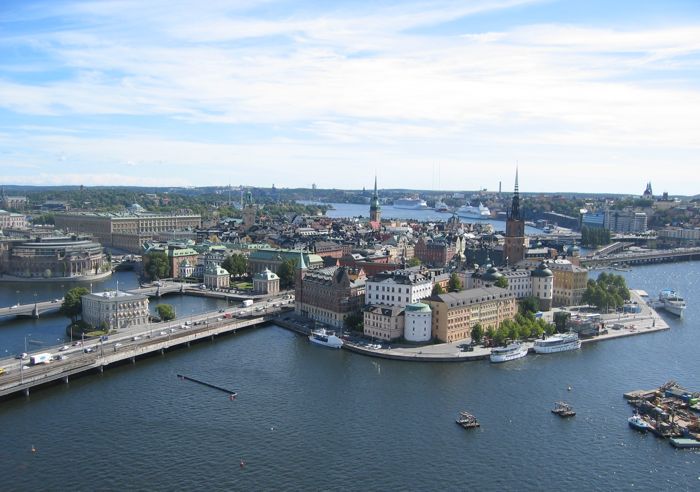
View of Gamla stan ("Old town") in Stockholm, and surroundings
View of Gamla stan ("Old town") in Stockholm, and surroundings JZ · CC BY-SA 3.0 · Commons

Sweden and Norway or Sweden–Norway (Swedish: Svensk-norska unionen; Norwegian: Den svensk-norske union(en)), officially the United Kingdoms of Sweden and Norway, and known as the United Kingdoms, was a personal union of the separate kingdoms of Sweden and Norway under a common monarch and common foreign policy that lasted from 1814 until its peaceful dissolution in 1905. The two states kept separate constitutions, laws, legislatures, administrations, state churches, armed forces, and currencies; the kings mostly resided in Stockholm, where foreign diplomatic representations were located.

From Wikipedia: Union between Sweden and Norway (CC BY-SA 4.0)

Origins and Founding

Sweden and Norway had been united under the same crown on two previous occasions: from 1319 to 1343 under Magnus Eriksson and again briefly from 1449 to 1450 under Karl Knutsson in opposition to Christian of Oldenburg who was elected king of the Kalmar Union by the Danes. During the following centuries, Norway remained united with Denmark in close union, nominally as one kingdom, but in reality reduced to the status of a mere province ruled by Danish kings from their capital, Copenhagen. After the establishment of absolutism in 1660, a more centralized form of government was established, but Norway kept some separate institutions, including its own laws, army, and coinage. The united kingdoms are referred to as Denmark–Norway by later historians.

From Wikipedia: Union between Sweden and Norway · Background (CC BY-SA 4.0)

Founded
1815 CE

Capitals

Stockholm
Capital
Christiania
Capital

Rulers

  • Charles XIII/II
  • Charles XIV/III John

Government, Society and Religion

Government
Constitutional monarchies
Languages
Swedish, Norwegian, [b] Danish, Sámi, Finnish
Religion
Sweden: Church of Sweden (state religion), Norway: Church of Norway (state religion)

Coins, Currency and Symbols

Currency
Sweden: Norway:
  • Jack of Sweden and Norway (1844–1905)
    Jack of Sweden and Norway (1844–1905) Kaiser Torikka+-xfi- · Public domain · Commons
  • Coat of arms of Sweden-Norway 1844
    Coat of arms of Sweden-Norway 1844 Fenn-O-maniC · CC BY 4.0 · Commons

Wars and Battles

Sweden and Denmark-Norway strenuously attempted to remain neutral during the Napoleonic wars, and succeeded for a long time, in spite of many invitations to join the belligerent alliances. Both countries joined Russia and Prussia in a League of Armed Neutrality in 1800. Denmark-Norway was forced to withdraw from the League after the British victory at the First Battle of Copenhagen in April 1801, but still stuck to a policy of neutrality. However, the league collapsed after the assassination of Tsar Paul I in 1801.

Read more

Denmark-Norway was compelled into an alliance with France after the second British attack on the Danish navy at the Second Battle of Copenhagen. The Danish were forced to surrender the navy after heavy bombardment, because the army was at the southern border to defend it against a possible French attack.

From Wikipedia: Union between Sweden and Norway · Consequences of the Napoleonic Wars (CC BY-SA 4.0)

Achievements and Monuments

Decline and Fall

The relations with Norway during the reign of King Oscar II (1872–1907) had great influence on political life in Sweden, and more than once it seemed as if the union between the two countries was on the point of ending. The dissensions chiefly had their origin in the demand by Norway for separate consuls and eventually a separate foreign service. Norway had, according to the revised constitution of 1814, the right to separate consular offices, but had not exercised that right. This was partly for financial reasons, and partly because the consuls appointed by the Swedish foreign office generally did a satisfactory job of representing Norway. During the late 19th century, however, Norway's merchant marine grew rapidly to become one of the world's largest, and one of the most important factors of the national economy.

From Wikipedia: Union between Sweden and Norway · Prelude to dissolution (CC BY-SA 4.0)

Ended
1904 CE

Kingdom of Iceland

1918 CE – 1939 CE · Capital: Reykjavík · 112,115 km²

[King of Denmark]
[King of Denmark] {{Creator:https://www.loc.gov/pictures/related/?fi=name&q=Bain%20News%20Service; publisher; Bain News Service}} · Public domain · Commons

The Kingdom of Iceland (Icelandic: Konungsríkið Ísland; Danish: Kongeriget Island) was an associated state of Denmark (prior to its invasion by Nazi Germany) and kingdom under a personal union that was established by the Act of Union signed on 1 December 1918. It lasted until 17 June 1944 when a national referendum established the republic of Iceland in its place.

From Wikipedia: Kingdom of Iceland (CC BY-SA 4.0)

Origins and Founding

Because of the Kalmar Union, Iceland had been under the control of the Crown of Denmark since 1380, although formally it had been a Norwegian possession until 1814. In 1874, one thousand years after the first acknowledged settlement, Denmark granted Iceland home rule. The constitution, written the same year, was revised in 1903 and the extent of Iceland's home rule increased in 1904.

From Wikipedia: Kingdom of Iceland · History: Origins of Danish rule (CC BY-SA 4.0)

Founded
1918 CE

Rulers

Government, Society and Religion

Government
Parliamentary constitutional monarchy
Languages
Icelandic, Danish
Religion
Church of Iceland, (state religion)
Population
125967

Coins, Currency and Symbols

Currency
Króna
  • Flag of Iceland (1918–1944)
    Flag of Iceland (1918–1944) Original: Matthías Þórðarson Vector: Gustavo Ronconi · Public domain · Commons
  • Kingdom of Iceland Coat of Arms
    Kingdom of Iceland Coat of Arms Fenn-O-maniC · CC BY-SA 3.0 · Commons

Decline and Fall

Ended
1939 CE
Last recorded ruler
Christian X of Denmark
Succeeded by
Iceland

Estonia

1919 CE – 1939 CE · Capital: Tallinn · 48,569 km²

Konstantin Päts
Konstantin Päts Unknown authorUnknown author · Public domain · Commons

Estonia, officially the Republic of Estonia, is a country in the Baltic region of Northern Europe. It is bordered to the north by the Gulf of Finland across from Finland, to the west by the Baltic Sea across from Sweden, to the south by Latvia, and to the east by Russia. The territory of Estonia consists of the mainland, the larger islands of Saaremaa and Hiiumaa, and over 2,300 other islands and islets on the east coast of the Baltic Sea. Its capital city of Tallinn, along with the city of Tartu, are the country's two largest urban areas.

From Wikipedia: Estonia (CC BY-SA 4.0)

Origins and Founding

The oldest known settlement in Estonia is the Pulli settlement on the banks of Pärnu that dates to the early 9th millennium BC, making it at least 11,000 years old.

Read more

The earliest human habitation during the Mesolithic period is connected to the Kunda culture. Around 5300 BCE, ceramics appear of the neolithic period, known as Narva culture. The Comb Ceramic culture emerged around 3900 BC, bringing traces of early agriculture and sophisticated religious art. Starting from around 2800 BC the Corded Ware culture appeared; this included new activities like primitive farming and animal husbandry.

The Bronze Age started around 1800 BCE, and saw the establishment of the first hill fort settlements. A transition from hunter-fisher subsistence to single-farm-based settlement started around 1000 BC, and was complete by the beginning of the Iron Age around 500 BC.

From Wikipedia: Estonia · History: Prehistory (CC BY-SA 4.0)

Founded
1919 CE

Rulers

Government, Society and Religion

Estonia is a unitary parliamentary republic. The unicameral parliament Riigikogu serves as the legislature and the government as the executive.

Read more

Estonian parliament Riigikogu is elected by citizens over 18 years of age for a four-year term by proportional representation, and has 101 members. Riigikogu's responsibilities include approval and preservation of the national government, passing legal acts, passing the state budget, and conducting parliamentary supervision. On proposal of the president Riigikogu appoints the Chief Justice of the Supreme Court, the chairman of the board of the Bank of Estonia, the Auditor General, the Legal Chancellor, and the Commander-in-Chief of the Defence Forces.

The Government of Estonia is formed by the Prime Minister of Estonia at recommendation of the President, and approved by the Riigikogu.

From Wikipedia: Estonia · Politics (CC BY-SA 4.0)

Government
Unitary parliamentary republic
Languages
Estonian
Religion
58.4% no religion, 26.7% Christianity, 16.3% Eastern Orthodoxy, 7.7% Lutheranism, 2.7% other Christian, 12.7% undeclared, 2.1% other

Economy and Trade

As a member of the European Union and OECD, Estonia is considered a high-income economy by the World Bank. The GDP (PPP) per capita of the country was $46,385 in 2023 according to the International Monetary Fund, ranked 40th.

Read more

Estonia ranks highly in international rankings for quality of life, education, press freedom, digitalisation of public services and the prevalence of technology companies.

Beginning 1 January 2011, Estonia adopted the euro and became the 17th eurozone member state.

Estonia produces about 75% of its consumed electricity. In 2011, about 85% of it was generated with locally mined oil shale. Alternative energy sources such as wood, peat, and biomass make up approximately 9% of primary energy production. Renewable wind energy was about 6% of total consumption in 2009. Estonia imports petroleum products from western Europe and Russia.

From Wikipedia: Estonia · Economy (CC BY-SA 4.0)

Coins, Currency and Symbols

Estonian 1000 Mark note
Estonian 1000 Mark note Nikolai Triik · Public domain · Commons
Currency
euro, Estonian kroon, Estonian mark
  • 50 Euro Banknote
    50 Euro Banknote StefanosAndreadis · CC BY-SA 4.0 · Commons
  • ESTONIE, 2 Krooni célébrant le tricentenaire de l'Université de Tartu, 1932
    ESTONIE, 2 Krooni célébrant le tricentenaire de l'Université de Tartu, 1932 cgb · CC BY-SA 3.0 · Commons
  • 1000. margane Eesti pangatäht aastast 1922; kujundaja Nikolai Triik (1884–1940).
    1000. margane Eesti pangatäht aastast 1922; kujundaja Nikolai Triik (1884–1940). Nikolai Triik · Public domain · Commons
  • Flag of Estonia
    Flag of Estonia Original: Unknown author Vector: SKopp, PeepP and ‍others · Public domain · Commons
  • Coat of arms of Estonia
    Coat of arms of Estonia Riigikantselei · Public domain · Commons

Wars and Battles

A week before the outbreak of World War II, on 23 August 1939, Nazi Germany and the Stalinist Soviet Union signed the Molotov–Ribbentrop Pact. In the pact's secret protocol Poland, Romania, Lithuania, Latvia, Estonia and Finland were divided between USSR and Germany into "spheres of influence", with Estonia assigned to the Soviet "sphere". On 24 September 1939, the Soviet dictator Stalin presented the Estonian government an ultimatum demanding that Estonia immediately sign a treaty that would allow the USSR to establish military bases in Estonia, or else face war. The Estonian government decided to avoid military conflict, and a "mutual assistance treaty" was signed in Moscow on 28 September 1939. On 14 June 1940 the Soviet Union instituted a full naval and air blockade on Estonia. On the same day, the airliner Kaleva was shot down by the Soviet Air Force.

From Wikipedia: Estonia · History: World War II (CC BY-SA 4.0)

Achievements and Monuments

Traces of Estonian artistry date back to the Stone Age, with decorated bone artefacts, amber pendants, and early figurines. During the Middle Ages, Gothic art became prominent, visible in the medieval churches of Saaremaa and exemplified by Bernt Notke's Danse Macabre in St. Nicholas Church, Tallinn. Renaissance painter Michael Sittow, trained in the Early Netherlandish style, was Estonia's first internationally recognised artist.

Read more

In the Neoclassical period, landscape painting gained prominence among Estonian artists, both at home and abroad. This era also saw the emergence of other genres like mural painting, miniature painting, glass painting, and watercolours, often featuring antique themes or Estonian nature scenes. Famous painters of this era include Gustav Adolf Hippius, Karl August Senff and Julie Wilhelmine Hagen-Schwarz.

From Wikipedia: Estonia · Culture: Art (CC BY-SA 4.0)

Decline and Fall

Ended
1939 CE
Last recorded ruler
Ülle Madise

Kingdom of Lithuania

1919 CE – 1939 CE · Capital: Kernavė · 62,642 km²

Old hillfort mounds in Kernavė (Lithuania).
Old hillfort mounds in Kernavė (Lithuania). Lestat (Jan Mehlich) · CC BY-SA 3.0 · Commons

The Kingdom of Lithuania was a sovereign state that existed from 17 July 1251 until the death of the first crowned king of Lithuania, Mindaugas, on 12 September 1263. Mindaugas was the only Lithuanian monarch crowned king with the assent of the Pope and the head of the first Catholic Lithuanian state. The formation of the kingdom is widely regarded as a partially successful attempt at unifying all surrounding Baltic tribes, including the Old Prussians, into a single unified state under a common king.

From Wikipedia: Kingdom of Lithuania (CC BY-SA 4.0)

Rulers

  • Mindaugas

Government, Society and Religion

Government
Hereditary feudal absolute monarchy
Languages
Lithuanian, Ruthenian
Religion
Catholicism (institutional), Lithuanian polytheism (widely practised), Eastern Orthodox Church (in eastern lands)

Coins, Currency and Symbols

Currency
Ilgasis

Republic of Latvia

1920 CE – 2024 CE · Capital: Riga · 68,198 km²

Satellite image of Latvia in March 2003.
Satellite image of Latvia in March 2003. Jeff Schmaltz, MODIS Rapid Response Team, NASA/GSFC · Public domain · Commons

Latvia, officially the Republic of Latvia, is a country in the Baltic region of northern Europe. It is one of the three Baltic states, along with Estonia to the north and Lithuania to the south. It borders Russia to the east and Belarus to the southeast and shares a maritime border with Sweden to the west. Latvia covers an area of 64,573 km2 (24,932 sq mi), with a population of 1.83 million. The country has a temperate seasonal climate. Its capital and largest city is Riga.

From Wikipedia: Latvia (CC BY-SA 4.0)

Origins and Founding

Founded
1920 CE

Rulers

Government, Society and Religion

The National Armed Forces (Latvian: Nacionālie bruņotie spēki (NAF)) of Latvia consists of the Land Forces, Naval Forces, Air Force, National Guard, Special Tasks Unit, Military Police, NAF staff Battalion, Training and Doctrine Command, and Logistics Command. Latvia's defence concept is based upon the Swedish-Finnish model of a rapid response force composed of a mobilisation base and a small group of career professionals. From 1 January 2007, Latvia switched to a professional fully contract-based army.

Read more

Latvia participates in international peacekeeping and security operations. Latvian armed forces have contributed to NATO and EU military operations in Bosnia and Herzegovina (1996–2009), Albania (1999), Kosovo (2000–2009), Macedonia (2003), Iraq (2005–2006), Afghanistan (since 2003), Somalia (since 2011) and Mali (since 2013).

From Wikipedia: Latvia · Government and politics: Military (CC BY-SA 4.0)

Government
Unitary parliamentary republic
Languages
Latviana

Economy and Trade

Latvia is a member of the World Trade Organization (1999) and the European Union (2004). On 1 January 2014, the euro became the country's currency, superseding the Lats. According to statistics in late 2013, 45% of the population supported the introduction of the euro, while 52% opposed it. Following the introduction of the Euro, Eurobarometer surveys in January 2014 showed support for the euro to be around 53%, close to the European average.

Read more

Since the year 2000, Latvia has had one of the highest (GDP) growth rates in Europe. However, the chiefly consumption-driven growth in Latvia resulted in the collapse of Latvian GDP in late 2008 and early 2009, exacerbated by the global economic crisis, shortage of credit and huge money resources used for the bailout of Parex Bank. The Latvian economy fell 18% in the first three months of 2009, the biggest fall in the European Union.

From Wikipedia: Latvia · Economy (CC BY-SA 4.0)

Coins, Currency and Symbols

50 Euro Banknote
50 Euro Banknote StefanosAndreadis · CC BY-SA 4.0 · Commons
Currency
Latvian lats, euro, Latvian rublis
  • Flag of Latvia
    Flag of Latvia Original: Ansis Cīrulis Vector: SKopp · Public domain · Commons
  • Coat of arms of Latvia
    Coat of arms of Latvia The original uploader was Zscout370 at English Wikipedia. · Public domain · Commons

Wars and Battles

Achievements and Monuments

Traditional Latvian folklore, especially the dance of the folk songs, dates back well over a thousand years. More than 1.2 million texts and 30,000 melodies of folk songs have been identified.

Read more

In the 19th century, Latvian nationalist movements emerged. They promoted Latvian culture and encouraged Latvians to take part in cultural activities. The 19th century and beginning of the 20th century is often regarded by Latvians as a classical era of Latvian culture. Posters show the influence of other European cultures, for example, works of artists such as the Baltic-German artist Bernhard Borchert and the French Raoul Dufy. With the onset of World War II, many Latvian artists and other members of the cultural elite fled the country yet continued to produce their work, largely for a Latvian émigré audience.

From Wikipedia: Latvia · Culture (CC BY-SA 4.0)

Decline and Fall

Ended
2024 CE
Last recorded ruler
Edgars Rinkēvičs

Republic of Estonia

1992 CE – 2024 CE · Capital: Tallinn · 48,569 km²

Konstantin Päts
Konstantin Päts Unknown authorUnknown author · Public domain · Commons

Estonia, officially the Republic of Estonia, is a country in the Baltic region of Northern Europe. It is bordered to the north by the Gulf of Finland across from Finland, to the west by the Baltic Sea across from Sweden, to the south by Latvia, and to the east by Russia. The territory of Estonia consists of the mainland, the larger islands of Saaremaa and Hiiumaa, and over 2,300 other islands and islets on the east coast of the Baltic Sea. Its capital city of Tallinn, along with the city of Tartu, are the country's two largest urban areas.

From Wikipedia: Estonia (CC BY-SA 4.0)

Origins and Founding

The oldest known settlement in Estonia is the Pulli settlement on the banks of Pärnu that dates to the early 9th millennium BC, making it at least 11,000 years old.

Read more

The earliest human habitation during the Mesolithic period is connected to the Kunda culture. Around 5300 BCE, ceramics appear of the neolithic period, known as Narva culture. The Comb Ceramic culture emerged around 3900 BC, bringing traces of early agriculture and sophisticated religious art. Starting from around 2800 BC the Corded Ware culture appeared; this included new activities like primitive farming and animal husbandry.

The Bronze Age started around 1800 BCE, and saw the establishment of the first hill fort settlements. A transition from hunter-fisher subsistence to single-farm-based settlement started around 1000 BC, and was complete by the beginning of the Iron Age around 500 BC.

From Wikipedia: Estonia · History: Prehistory (CC BY-SA 4.0)

Founded
1992 CE

Rulers

Government, Society and Religion

Estonia is a unitary parliamentary republic. The unicameral parliament Riigikogu serves as the legislature and the government as the executive.

Read more

Estonian parliament Riigikogu is elected by citizens over 18 years of age for a four-year term by proportional representation, and has 101 members. Riigikogu's responsibilities include approval and preservation of the national government, passing legal acts, passing the state budget, and conducting parliamentary supervision. On proposal of the president Riigikogu appoints the Chief Justice of the Supreme Court, the chairman of the board of the Bank of Estonia, the Auditor General, the Legal Chancellor, and the Commander-in-Chief of the Defence Forces.

The Government of Estonia is formed by the Prime Minister of Estonia at recommendation of the President, and approved by the Riigikogu.

From Wikipedia: Estonia · Politics (CC BY-SA 4.0)

Government
Unitary parliamentary republic
Languages
Estonian
Religion
58.4% no religion, 26.7% Christianity, 16.3% Eastern Orthodoxy, 7.7% Lutheranism, 2.7% other Christian, 12.7% undeclared, 2.1% other

Economy and Trade

As a member of the European Union and OECD, Estonia is considered a high-income economy by the World Bank. The GDP (PPP) per capita of the country was $46,385 in 2023 according to the International Monetary Fund, ranked 40th.

Read more

Estonia ranks highly in international rankings for quality of life, education, press freedom, digitalisation of public services and the prevalence of technology companies.

Beginning 1 January 2011, Estonia adopted the euro and became the 17th eurozone member state.

Estonia produces about 75% of its consumed electricity. In 2011, about 85% of it was generated with locally mined oil shale. Alternative energy sources such as wood, peat, and biomass make up approximately 9% of primary energy production. Renewable wind energy was about 6% of total consumption in 2009. Estonia imports petroleum products from western Europe and Russia.

From Wikipedia: Estonia · Economy (CC BY-SA 4.0)

Coins, Currency and Symbols

Estonian 1000 Mark note
Estonian 1000 Mark note Nikolai Triik · Public domain · Commons
Currency
euro, Estonian kroon, Estonian mark
  • 50 Euro Banknote
    50 Euro Banknote StefanosAndreadis · CC BY-SA 4.0 · Commons
  • ESTONIE, 2 Krooni célébrant le tricentenaire de l'Université de Tartu, 1932
    ESTONIE, 2 Krooni célébrant le tricentenaire de l'Université de Tartu, 1932 cgb · CC BY-SA 3.0 · Commons
  • 1000. margane Eesti pangatäht aastast 1922; kujundaja Nikolai Triik (1884–1940).
    1000. margane Eesti pangatäht aastast 1922; kujundaja Nikolai Triik (1884–1940). Nikolai Triik · Public domain · Commons
  • Flag of Estonia
    Flag of Estonia Original: Unknown author Vector: SKopp, PeepP and ‍others · Public domain · Commons
  • Coat of arms of Estonia
    Coat of arms of Estonia Riigikantselei · Public domain · Commons

Wars and Battles

A week before the outbreak of World War II, on 23 August 1939, Nazi Germany and the Stalinist Soviet Union signed the Molotov–Ribbentrop Pact. In the pact's secret protocol Poland, Romania, Lithuania, Latvia, Estonia and Finland were divided between USSR and Germany into "spheres of influence", with Estonia assigned to the Soviet "sphere". On 24 September 1939, the Soviet dictator Stalin presented the Estonian government an ultimatum demanding that Estonia immediately sign a treaty that would allow the USSR to establish military bases in Estonia, or else face war. The Estonian government decided to avoid military conflict, and a "mutual assistance treaty" was signed in Moscow on 28 September 1939. On 14 June 1940 the Soviet Union instituted a full naval and air blockade on Estonia. On the same day, the airliner Kaleva was shot down by the Soviet Air Force.

From Wikipedia: Estonia · History: World War II (CC BY-SA 4.0)

Achievements and Monuments

Traces of Estonian artistry date back to the Stone Age, with decorated bone artefacts, amber pendants, and early figurines. During the Middle Ages, Gothic art became prominent, visible in the medieval churches of Saaremaa and exemplified by Bernt Notke's Danse Macabre in St. Nicholas Church, Tallinn. Renaissance painter Michael Sittow, trained in the Early Netherlandish style, was Estonia's first internationally recognised artist.

Read more

In the Neoclassical period, landscape painting gained prominence among Estonian artists, both at home and abroad. This era also saw the emergence of other genres like mural painting, miniature painting, glass painting, and watercolours, often featuring antique themes or Estonian nature scenes. Famous painters of this era include Gustav Adolf Hippius, Karl August Senff and Julie Wilhelmine Hagen-Schwarz.

From Wikipedia: Estonia · Culture: Art (CC BY-SA 4.0)

Decline and Fall

Ended
2024 CE
Last recorded ruler
Ülle Madise

Modern States of Scandinavia and the Baltic: Frequently Asked Questions

Which states existed in Scandinavia and the Baltic in this period?

This page maps 6 states of Scandinavia and the Baltic founded between 1815 CE and 1992 CE: United Kingdoms of Sweden and Norway, Kingdom of Iceland, Estonia, Kingdom of Lithuania, Republic of Latvia, Republic of Estonia.

Which was the largest of the Modern States of Scandinavia and the Baltic?

United Kingdoms of Sweden and Norway had the largest mapped extent, about 804,282 km².

Which of the Modern States of Scandinavia and the Baltic lasted longest?

Republic of Latvia lasted longest, 1920 CE – 2024 CE.

Sources

  • Reading text: Wikipedia articles on the group and each state, condensed (CC BY-SA 4.0).
  • Facts, rulers and wars: Wikidata (CC0).
  • Borders: Cliopatria, Seshat Global History Databank (CC BY 4.0).
  • Pictures: Wikimedia Commons; the author and licence are under each picture.

Largest state by mapped extent: United Kingdoms of Sweden and Norway.