A personal union is a combination of two or more monarchical states that have the same monarch while their boundaries, laws, and interests remain distinct. A real union, by contrast, involves the constituent states being to some extent interlinked, such as by sharing some limited governmental institutions. It differs from a federation in that each constituent state has an independent government, whereas a federal state is united by a central government. The ruler in a personal union does not need to be a hereditary monarch.
The term was coined by German jurist Johann Stephan Pütter, introducing it into Elementa iuris publici germanici (Elements of German Public Law) of 1760.
They can also be codified (i.e., the constitutions of the states clearly express that they shall share the same person as head of state) or non-codified, in which case they can easily be broken (e.g., by the death of the monarch when the two states have different succession laws).
The concept of a personal union has only very rarely crossed over from monarchies into republics.
There are currently two personal unions in the world: the 15 Commonwealth realms, who share Charles III as their head of state, and one of the co-princes of Andorra being the President of France.
Unknown authorUnknown author · Public domain · CommonsUnknown authorUnknown author · Public domain · CommonsJacob Truedson Demitz assisted by Emil Eikner for Ristesson · Public domain · CommonsJacob Truedson Demitz assisted by Emil Eikner for Ristesson · Public domain · Commons
Layers
HistoryChanges with the year
PlacesToday
Water
Land
1492 AD
Base map
An empire takes the map to its years and shows the borders.
Each state in its own colour. Move the timeline to see which existed in any year from 1216 AD to 1563; select a territory to read about it. Borders: Cliopatria / Seshat (CC BY 4.0).
Personal union of Holy Roman Empire with Kingdom of Sicily
1216 CE – 1259 CE · 1,117,520 km²
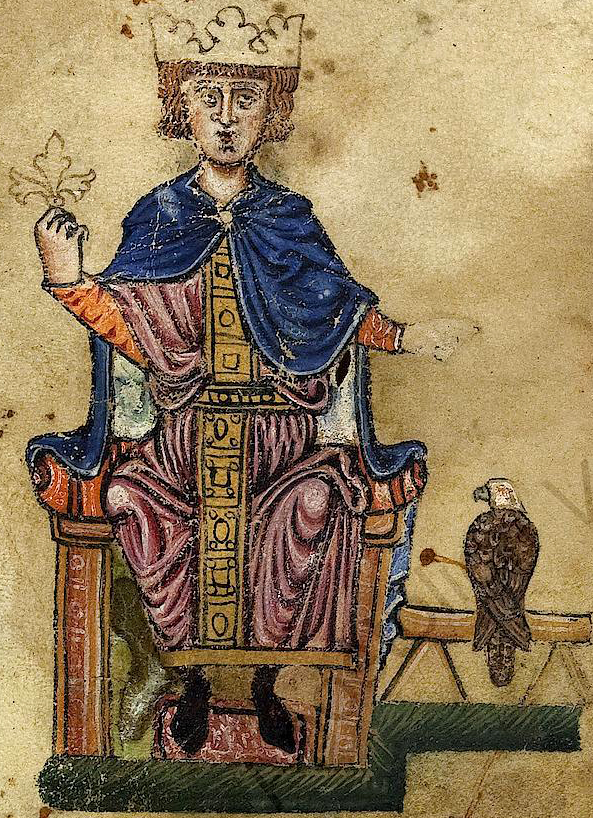
Frederick II and his falcon. From his book De arte venandi cum avibus (The art of hunting with birds). From a manuscript in Biblioteca Vaticana, Pal. lat 1071, fol. 1), late 13th centuryUnknown authorUnknown author · Public domain · Commons
Frederick II (Italian: Federico, Sicilian: Fidiricu, German: Friedrich, Latin: Fridericus; 26 December 1194 – 13 December 1250) was King of Sicily from 1198, King of Germany from 1212, King of Italy and Holy Roman Emperor from 1220, and King of Jerusalem from 1225 to 1228. He was the son of Emperor Henry VI, of the Hohenstaufen dynasty (the second son of Emperor Frederick Barbarossa), and Queen Constance I of Sicily, of the Hauteville dynasty.
Frederick II's most profound and revolutionary legal legacy remains the Constitutions of Melfi or Constitutiones Regni Siciliarum (English: Constitutions of the Kingdom of the Sicilies), promulgated in 1231 in the Kingdom of Sicily. The sophistication of the Constitutions, also known as the Liber Augustalis, and his involvement in their formulation sets Frederick apart as perhaps the supreme lawgiver of the Middle Ages. Under the direction of a group of jurists headed by Frederick himself, including Roffredo Epifanio, Pier della Vigna, and archbishops Giacomo Amalfitano of Capua and Andrea Bonello of Barletta, the Constitutions harmonized decades of Siculo-Norman legal tradition stretching back to Roger II.
Shield and Coat of Arms of the Holy Roman Emperor (c.1200-c.1300)Heralder & Tom Lemmens · CC BY-SA 3.0 · Commons
Wars and Battles
Frederick eventually sailed again from Brindisi in June 1228. Gregory IX, surprised by the emperor's defiance, regarded this action as a provocation, since, as an excommunicate, Frederick was technically not capable of conducting a crusade. Gregory excommunicated the emperor a second time. Frederick's crusade in the East began with his attempt to assert imperial authority over Cyprus, but his tactless and high-handling of the Cypriot barons—especially John of Ibelin—created immediate tension and mistrust. After arriving at Acre in September, the emperor quickly recognized that success would have to come through diplomacy rather than war. The crusading army was already a small force and papal hostility and divisions among the crusaders undermined his position. Many of the local nobility, the Templars, and Hospitallers were also reluctant to offer overt support.
Frederick had a great thirst for knowledge and learning. Frederick employed Jews from Sicily, who had migrated there from the Holy Land, to translate Greek and Arabic works. He also introduced paper into a European court.
Read more
He played a major role in promoting literature through the Sicilian School of poetry. His Sicilian royal court in Palermo saw the first use of a literary form of an Italo-Romance language, Sicilian. Through the mix of Arabic, Hebrew, Latin, Greek, and Sicilian language poems and art at the court, Arabic "muwashshahat" or "girdle poems" influenced the birth of the sonnet. The language developed by Giacomo da Lentini and Pier delle Vigne in the Sicilian School of Poetry gathering around Frederick II in the first half of the thirteenth century had a decisive influence on Dante Alighieri and then on the development of Italian language itself.
When he died, Frederick II still retained his fundamental dominance, even though his conflict with the papacy and its allies in Italy and Germany was unresolved. The remarkable recovery of imperial fortunes across the board in 1250 seems to have confirmed his apparent personal supremacy. Indeed, the shock of his sudden death signified, perhaps, a contemporary sense that he bestrode the era like a colossus in the "full glory" of imperial power. Yet, for all the grandeur of his reign, his "herculean" efforts to bind together first Sicily, then Italy and Germany, in closer imperial unity proved futile with the eventual collapse of his dynasty. Frederick had attempted the impossible and achieved the improbable. Considering the highly complex, many-faceted level he had operated, and for so long against such intensity, his achievements were weighty.
Historians rate Frederick II as a highly significant and consequential European monarch of the Middle Ages. This reputation was present even among his contemporaries, who saw him as an almost cosmic figure capable of monumental things. The emperor's posthumous shadow was scarcely less imposing than his living presence. From Matthew of Paris to Giovanni Villani, and Dante to Boccaccio, many medieval commentators, whether hostile or favorable to the emperor, seemed to have viewed him as an extraordinarily sophisticated and imaginative ruler. In the century after his death, Italian writers continued to treat Frederick as the decisive benchmark against which imperial authority, ambition, and legitimacy were measured. Yet he was still seen ambivalently, as opposed to his grandfather, Frederick Barbarossa, who was a more cleanly accessible chivalric-emperor.
Personal union of Kingdom of Bohemia with Kingdom of Poland
1305 CE – 1313 CE · 314,040 km²
Wenceslaus II of Bohemia (Czech: Václav II.; Polish: Wacław II Czeski; 27 September 1271 – 21 June 1305) was King of Bohemia (1278–1305), Duke of Cracow (1291–1305), and King of Poland (1296–1305).
He was the only surviving son of King Ottokar II of Bohemia and Ottokar's second wife Kunigunda. He was born in 1271, ten years after the marriage of his parents. Kunigunda was the daughter of Rostislav Mikhailovich, lord of Slavonia, son of a Grand Prince of Kiev, and Anna of Hungary, daughter of Béla IV of Hungary. His great-grandfather was the German king Philip of Swabia.
Weneclaus was one of three sons of Ottokar II and Kunigunda, and the only one to survive to adulthood. In 1276 Rudolf I, King of the Romans, placed Ottokar under the ban of the empire and besieged Vienna. This compelled Ottokar in November 1276 to sign a new treaty by which he gave up all claims to Austria and the neighbouring duchies, retaining for himself only Bohemia and Moravia. Wenceslaus was then betrothed to Rudolf's daughter Judith, creating an uneasy peace. Wenceslaus's father died on 26 August 1278 in the Battle on the Marchfeld shortly before Wenceslaus's seventh birthday.
Read more
Before Wenceslaus became of age, the government was handled by Otto V, Margrave of Brandenburg, who is said to have held Wenceslaus captive in several locations.
Wenceslaus II is considered one of the most important Czech kings. He built a great empire stretching from the Baltic Sea to the Danube river and established numerous cities, such as Plzeň in 1295. He won for his family three royal crowns (Bohemia, Hungary and Poland). The Kingdom of Bohemia was the largest producer of silver in Europe in his time. He created the Prague Groschen, which was an important European currency for centuries.
Read more
During his reign, there was great urban development. He planned to build the first university in Central Europe. The power and wealth of the Kingdom of Bohemia gave rise to great respect, but also to the hostility of European royal families. His son King Wenceslaus III was unable to maintain a mighty empire, and soon after the untimely death of Wenceslaus II, his empire began to crumble.
Personal union of Kingdom of Sweden with Old Kingdom of Norway
1326 CE – 1362 CE · 895,861 km²
King Magnus IV of Sweden - Sigillum ad causasUnknown authorUnknown author · Public domain · Commons
Magnus Eriksson (April or May 1316 – 1 December 1374) was King of Sweden from 1319 to 1364, King of Norway as Magnus VII from 1319 to 1355, and ruler of Scania from 1332 to 1360. His long reign saw major legal and administrative reforms, including the introduction of Magnus Erikssons landslag, the first law code intended to apply throughout the Swedish countryside.
Medieval Swedish kings did not use regnal numbers as part of their titles. Magnus is therefore variously referred to in modern sources as Magnus II, Magnus III, or Magnus IV.
Because of the increase in taxes to pay for the acquisition of the Scanian province, some Swedish nobles supported by the Church attempted to oust Magnus, setting up his elder son Erik as king. Erik died supposedly of the plague in 1359, with his wife Beatrix and their son.
In spite of his many formal expansions, his rule was considered a period of decline both for Swedish royal power and for Sweden as a whole. Foreign powers such as Denmark (after its recovery in 1340) and Mecklenburg intervened, and Magnus appears to have been unable to counter the internal opposition that arose. He was regarded as a weak king and criticised for giving favourites too much power.
Read more
Magnus's young favourite courtier was Bengt Algotsson, whom he elevated to Duke of Finland and Halland, as well as Viceroy of Scania. Accusations of sexual relations between Magnus and men, including Algotsson, formed part of the political attacks directed against the king.
Personal union of Old Kingdom of Norway with Kingdom of Sweden
1363 CE – 1374 CE · 858,036 km²
Haakon VI (Norwegian: Håkon Magnusson; Swedish: Håkan Magnusson; c. August 1340 – 11 September 1380) was King of Norway from 1343 until his death and King of Sweden between 1362 and 1364. He is sometimes known as Haakon Magnusson the Younger to distinguish him from his great-grandfather, Haakon V (r. 1299–1319).
Haakon was the younger son of Magnus Eriksson, king of both Norway and Sweden. His older brother Eric was meant to succeed their father on the throne of Sweden, while Haakon was made king of Norway in his father's lifetime.
Throughout the reign of Haakon, the Norwegian military was extensively reformed. The military structure was altered from that of the traditional leidang peasant conscription to under the direct control of loyal Norwegian lords. His Norwegian predecessor had pursued a domestic policy to establish a functional civil service in his realm, also extending to the military. This was however not continued by Haakon who elected to transfer more power and military responsibilities on to loyal lords. As a consequence, Haakon would be able to field much larger armies, but it became increasingly expensive to maintain this system. Because of the war against Sweden and the aggressive Norwegian policies in the east, Haakon had to mortgage and borrow money at an unprecedented scale to maintain his armies, and had to increasingly rely on the Norwegian nobility and the rich German merchants.
Personal union of Kingdom of Poland with Kingdom of Hungary
1375 CE – 1384 CE · Capital: Kraków and Visegrád (1370–1382)/Buda (1440–1444) · 568,424 km²
Personal union between the Kingdom of Hungary and the Kingdom of Poland was achieved twice: under Louis I of Hungary, in 1370–1382, and under Władysław III of Poland in 1440–1444. An earlier union was also accomplished by Wenceslaus III of Bohemia for a few months in 1305, although he was heavily resisted by local nobles in both kingdoms, and gave up the Hungarian crown soon after.
Personal union of Kingdom of Denmark with Old Kingdom of Norway
1385 CE – 1401 CE · 615,752 km²
Portrait detail of tomb of Queen Margaret the Great of Denmark, Norway and Sweden in Roskilde Cathedral, as released by image creator Ristesson; Place: Roskilde, DenmarkJacob Truedson Demitz assisted by Emil Eikner for Ristesson · Public domain · Commons
Margaret I (Danish: Margrete Valdemarsdatter; March 1353 – 28 October 1412) was queen regnant of Denmark, Norway, and Sweden from the late 1380s until her death, and the founder of the Kalmar Union that joined the Scandinavian kingdoms together for over a century. She had been queen consort of Norway from 1363 to 1380 and of Sweden from 1363 to 1364 by marriage to Haakon VI. Margaret was known as a wise, energetic and capable leader, who governed with "farsighted tact and caution", earning the nickname "Semiramis of the North".
Margaret was born in March 1353 as the sixth and youngest child of King Valdemar IV and Queen Helvig of Denmark. She was born in the prison of Søborg Castle, where her father had already confined her mother. She was baptised in Roskilde and in 1359, at the age of six, engaged to the 18-year-old King Haakon VI, the youngest son of the Swedish-Norwegian king Magnus IV & VII. As part of the marriage contract, it is presumed that a treaty was signed ensuring Magnus the assistance of King Valdemar in a dispute with his second son, Erik "XII" of Sweden, who in 1356 held dominion over Southern Sweden. Margaret's marriage was thus a part of the Nordic power struggle. There was dissatisfaction with this in some circles, and the political activist Bridget of Sweden described the agreement in a letter to the Pope as "children playing with dolls".
Margaret I of Denmark armsIchthyovenatorSsolbergj (crowns) · CC BY-SA 4.0 · Commons
Legacy in the Modern World
E.C. Otte writes in 1874, that "f Margaret could have been certain of being followed on the throne by rulers as able and just as she had been, this Act of the Union of Calmar might have worked for the good of the three kingdoms. For it was quite true, as the Queen said, that each one alone was a poor weak state, open to danger from every side, but that the three united would make a monarchy, strong enough to defy the attacks and schemes of the Hanse traders and all foes from the side of Germany, and would keep the Baltic clear of danger from foreigners. However no ruler came after Queen Margaret equal to her, as there had been none before her to be compared to her."
Read more
According to Imsen, her political genius has never been contested, but her motives have always been the target of much debate.
Personal union of Kingdom of Denmark with Kingdom of Sweden
1395 CE – 1401 CE · 433,944 km²
Portrait detail of tomb of Queen Margaret the Great of Denmark, Norway and Sweden in Roskilde Cathedral, as released by image creator Ristesson; Place: Roskilde, DenmarkJacob Truedson Demitz assisted by Emil Eikner for Ristesson · Public domain · Commons
Margaret I (Danish: Margrete Valdemarsdatter; March 1353 – 28 October 1412) was queen regnant of Denmark, Norway, and Sweden from the late 1380s until her death, and the founder of the Kalmar Union that joined the Scandinavian kingdoms together for over a century. She had been queen consort of Norway from 1363 to 1380 and of Sweden from 1363 to 1364 by marriage to Haakon VI. Margaret was known as a wise, energetic and capable leader, who governed with "farsighted tact and caution", earning the nickname "Semiramis of the North".
Margaret was born in March 1353 as the sixth and youngest child of King Valdemar IV and Queen Helvig of Denmark. She was born in the prison of Søborg Castle, where her father had already confined her mother. She was baptised in Roskilde and in 1359, at the age of six, engaged to the 18-year-old King Haakon VI, the youngest son of the Swedish-Norwegian king Magnus IV & VII. As part of the marriage contract, it is presumed that a treaty was signed ensuring Magnus the assistance of King Valdemar in a dispute with his second son, Erik "XII" of Sweden, who in 1356 held dominion over Southern Sweden. Margaret's marriage was thus a part of the Nordic power struggle. There was dissatisfaction with this in some circles, and the political activist Bridget of Sweden described the agreement in a letter to the Pope as "children playing with dolls".
Margaret I of Denmark armsIchthyovenatorSsolbergj (crowns) · CC BY-SA 4.0 · Commons
Legacy in the Modern World
E.C. Otte writes in 1874, that "f Margaret could have been certain of being followed on the throne by rulers as able and just as she had been, this Act of the Union of Calmar might have worked for the good of the three kingdoms. For it was quite true, as the Queen said, that each one alone was a poor weak state, open to danger from every side, but that the three united would make a monarchy, strong enough to defy the attacks and schemes of the Hanse traders and all foes from the side of Germany, and would keep the Baltic clear of danger from foreigners. However no ruler came after Queen Margaret equal to her, as there had been none before her to be compared to her."
Read more
According to Imsen, her political genius has never been contested, but her motives have always been the target of much debate.
Personal union of Kingdom of Hungary with Kingdom of Bohemia
1422 CE – 1528 CE · 466,273 km²
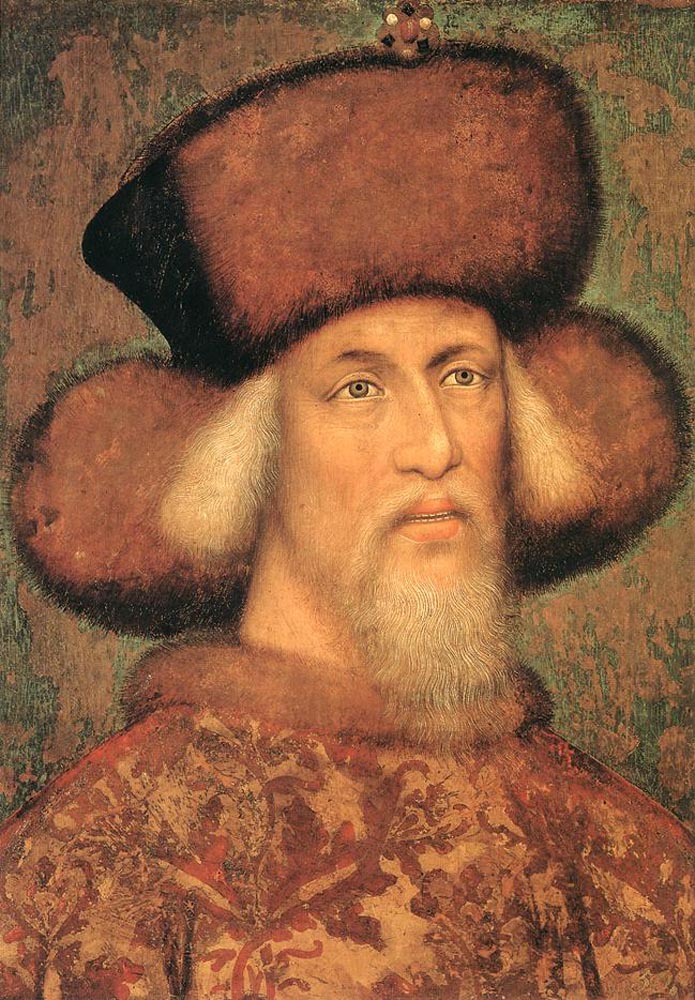
Person depicted: Emperor Sigismund I. Son of Charles IV of LuxembourgFormerly attributed to Pisanello · Public domain · Commons
Sigismund of Luxembourg (15 February 1368 – 9 December 1437) was Holy Roman Emperor from 1433 until his death in 1437. As the husband of Mary, Queen of Hungary, he was King of Hungary and Croatia (jure uxoris) from 1387. He was elected King of Germany (King of the Romans) in 1410, and was also King of Bohemia from 1419, as well as prince-elector of Brandenburg (1378–88 and 1411–15). He was the last male member of the House of Luxembourg.
Sigismund was the son of Charles IV, Holy Roman Emperor and his fourth wife Elizabeth of Pomerania.
Coat of Arms of the Holy Roman Emperor (c.1433-c.1450)Tom Lemmens & Heralder · CC BY-SA 3.0 · Commons
Wars and Battles
In 1419, the death of Wenceslaus IV of Bohemia left Sigismund titular King of Bohemia, but he had to wait for seventeen years before the Czech Estates would acknowledge him. Although the two dignities of king of the Romans and king of Bohemia added considerably to his importance, and indeed made him the nominal temporal head of Christendom, they conferred no increase of power and financially embarrassed him. It was only as King of Hungary that he had succeeded in establishing his authority and in doing anything for the order and good government of the land. Entrusting the government of Bohemia to Sophia of Bavaria, the widow of Wenceslaus, he hastened into Hungary.
Read more
The Bohemians, who distrusted him as the betrayer of Jan Hus, were soon in arms, and the flame was fanned when Sigismund declared his intention of prosecuting the war against heretics.
Personal union of Polish-Lithuania Kingdom with Kingdom of Hungary
1440 CE – 1449 CE · Capital: Kraków and Visegrád (1370–1382)/Buda (1440–1444) · 1,370,662 km²
Personal union between the Kingdom of Hungary and the Kingdom of Poland was achieved twice: under Louis I of Hungary, in 1370–1382, and under Władysław III of Poland in 1440–1444. An earlier union was also accomplished by Wenceslaus III of Bohemia for a few months in 1305, although he was heavily resisted by local nobles in both kingdoms, and gave up the Hungarian crown soon after.
Personal union of Crown of Aragon with Crown of Castile
1475 CE – 1515 CE · 761,000 km²
Wedding portrait of King Ferdinand of Aragon and Queen Isabella of Castileanonymous · Public domain · Commons
The Catholic Monarchs were Queen Isabella I of Castile (r. 1474–1504) and King Ferdinand II of Aragon (r. 1479–1516), whose marriage and joint rule marked the de facto unification of Spain. They were both from the House of Trastámara and were second cousins, as they were both descended from John I of Castile. To remove the obstacle that this consanguinity would otherwise have posed to their marriage under canon law, they were given a papal dispensation by Sixtus IV. They married on October 19, 1469, in the city of Valladolid; Isabella was 18 years old and Ferdinand a year younger.
Along with the desire of the Catholic Monarchs to extend their dominion to all the kingdoms of the Iberian Peninsula, their reign was characterised by the religious unification of the peninsula through militant Catholicism. On receiving a petition for authority, Pope Sixtus IV issued a bull in 1478 to establish a Holy Office of the Inquisition in Castile. This was to ensure that Jews and Muslims who converted to Christianity did not revert to their previous faiths. The papal bull gave the sovereigns full powers to name inquisitors, but the papacy retained the right to formally appoint the royal nominees. The Inquisition did not have jurisdiction over Jews and Muslims who did not convert. Since the kingdom of Aragon had existed since 1248, the Spanish Inquisition was the only common institution for the two kingdoms.
Coat of Arms of Queen Isabella of Castile (1492-1504)Heralder · CC BY-SA 3.0 · Commons
Personal union of Kingdom of Bohemia with Kingdom of Hungary
1492 CE – 1518 CE · 466,273 km²
Vladislaus II, also known as Vladislav, Władysław, or Wladislas (Hungarian: II. Ulászló; Czech: Vladislav Jagellonský; Croatian: Vladislav II. Jagelović; Slovak: Vladislav II. Jagelovský); (1 March 1456 – 13 March 1516), was King of Bohemia from 1471 to 1516 and King of Hungary and King of Croatia from 1490 to 1516. As the eldest son of Casimir IV Jagiellon, he was expected to inherit the Crown Kingdom of Poland and adjacent Grand Duchy of Lithuania. George of Poděbrady, the Hussite ruler of Bohemia, offered to make Vladislaus his heir in 1468.
Personal union of Spanish Empire with Habsburg Monarchy
1519 CE – 1563 CE · 5,298,014 km²
German: Bildnis Kaiser Karls V. im Lehnstuhl Portrait of Charles Vtitle QS:P1476,de:"Bildnis Kaiser Karls V. im Lehnstuhl "label QS:Lde,"Bildnis Kaiser Karls V.Attributed to Titian · Public domain · Commons
Charles V (24 February 1500 – 21 September 1558) was Holy Roman Emperor and Archduke of Austria from 1519 to 1556, King of Spain (as Charles I) from 1516 to 1556, King of Sicily and Naples from 1516 to 1554, and also Lord of the Netherlands and titular Duke of Burgundy (as Charles II) from 1506 to 1555. He was heir to and then head of the rising House of Habsburg.
From his maternal grandmother, Isabella I of Castile, who had funded Christopher Columbus's first voyage in 1492, Charles inherited Castile's overseas territories in the Americas. Spanish colonization of the Americas began in 1493, but these permanent settlements in the Caribbean and Spanish Main were marginal to Charles's European empire and not the focus of his attention. Through the Treaty of Tordesillas (1494), Spain and Portugal had agreed on a division of overseas territories, so that with the exception of Brazil, which Portugal could claim, Charles could claim the rest of the New World.
Read more
The realm of his known possessions expanded with the Spanish conquest of the Aztec Empire (1519–1521) under conquistador Hernán Cortés and by Magellan's circumnavigation of the globe in 1522.
Charles V has traditionally attracted considerable scholarly attention. There are differences among historians regarding his character, his rule and achievements (or failures) in the countries in his personal empire, as well as various social movements and wider problems associated with his reign. Historically seen as a great ruler by some or a tragic failure of a politician by others, he is generally seen by modern historians as both a capable politician and a brave and effective military leader, although his political vision and financial management tend to be questioned. References to Charles in popular culture include a large number of legends and folk tales; literary renderings of historical events connected to his life and romantic adventures, his relationship to Flanders, and his abdication; and products marketed in his name.
Personal Unions of Crowns: Frequently Asked Questions
What were the Personal Unions of Crowns?
A personal union is a combination of two or more monarchical states that have the same monarch while their boundaries, laws, and interests remain distinct.
How many states were there among the Personal Unions of Crowns?
The atlas maps 12 of them: Personal union of Holy Roman Empire with Kingdom of Sicily, Personal union of Kingdom of Bohemia with Kingdom of Poland, Personal union of Kingdom of Sweden with Old Kingdom of Norway, Personal union of Old Kingdom of Norway with Kingdom of Sweden, Personal union of Kingdom of Poland with Kingdom of Hungary, Personal union of Kingdom of Denmark with Old Kingdom of Norway, Personal union of Kingdom of Denmark with Kingdom of Sweden, Personal union of Kingdom of Hungary with Kingdom of Bohemia, Personal union of Polish-Lithuania Kingdom with Kingdom of Hungary, Personal union of Crown of Aragon with Crown of Castile, Personal union of Kingdom of Bohemia with Kingdom of Hungary, Personal union of Spanish Empire with Habsburg Monarchy.
Which was the largest of the Personal Unions of Crowns?
Personal union of Spanish Empire with Habsburg Monarchy had the largest mapped extent, about 5,298,014 km².
Which of the Personal Unions of Crowns lasted longest?
Personal union of Kingdom of Hungary with Kingdom of Bohemia lasted longest, 1422 CE – 1528 CE.
↑↓ to navigate↵ to open
12,754 Planetary Entities Indexed
We use Google Analytics cookies to understand which pages are useful. Necessary storage only keeps your theme and this choice on your device. Privacy policy