
Neoproterozoic Era · Tonian Period
Earth 1 Billion Years Ago: The Supercontinent Rodinia
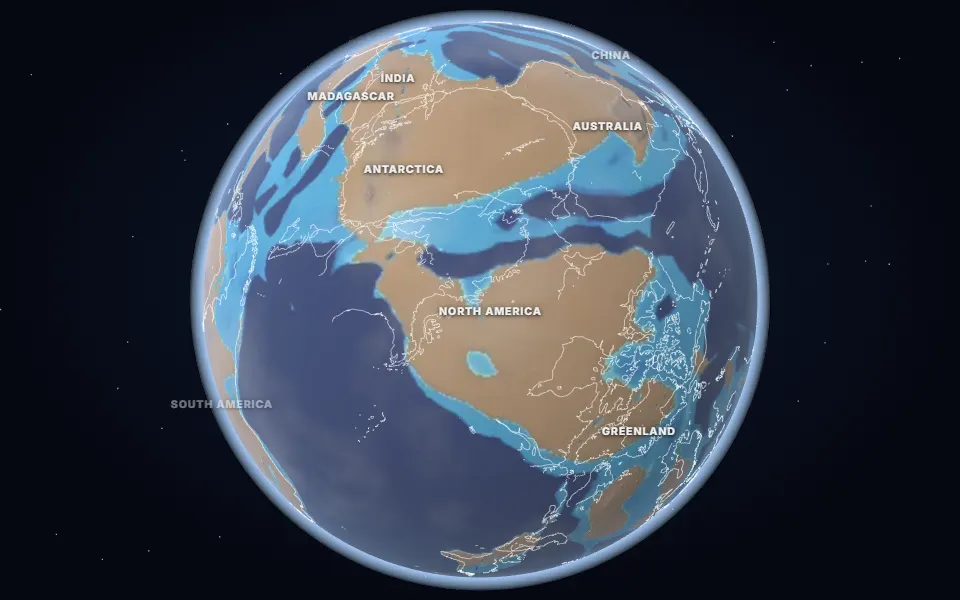
What Earth looked like 1 billion years ago: the supercontinent Rodinia, with North America at its heart, on a world of bare rock and microbial life.
 Spin it in 3D and move through time
Approximate: the continents of 540 million years ago, carried back to this time with the PALEOMAP plate model.
Map: Ancient maps: PALEOMAP PaleoDEMs (Scotese & Wright 2018), CC BY 4.0 · Natural Earth.
One billion years ago most of Earth’s land was joined in the supercontinent Rodinia. North America (Laurentia) lay near its centre, with the cores of Australia, Antarctica, Siberia, Baltica and South America around it. The Grenville mountains, whose worn roots run from Texas to Labrador and Scotland, record the collisions that built it.
The land was bare rock: no plants grew on it. In the sea, life was mostly microscopic, though simple multicellular algae had appeared; the red alga Bangiomorpha, about 1.05 billion years old, is one of the oldest known.
A day lasted about 19 hours. The globe carries the continents of 540 million years ago back to this time with the PALEOMAP plate model, so the positions follow the model but the coastlines are approximate.
Events of the time
Rodinia
1 billion years ago · North America at its heart
The Grenville mountain-building, whose roots run from Texas to Labrador and Scotland, records the collisions that built Rodinia.
Part of the Origin of Life & Proterozoic Eon.