
Paleoproterozoic Era · Orosirian Period
Earth 2 Billion Years Ago: Giant Impacts and a Supercontinent Forming
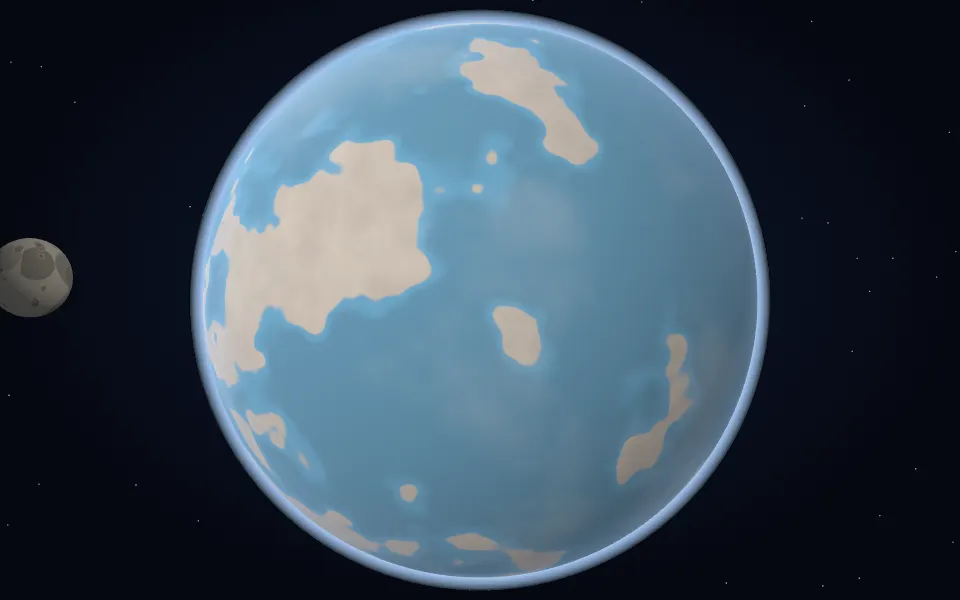
Earth 2 billion years ago: the Vredefort asteroid strikes South Africa, continents collide to form the supercontinent Columbia, and the sky is blue.
 Spin it in 3D and move through time
No map of the land exists this far back: the globe is an illustration of what Earth was like.
Map: Ancient maps: PALEOMAP PaleoDEMs (Scotese & Wright 2018), CC BY 4.0.
About 2.02 billion years ago an asteroid perhaps 10 to 15 km wide struck what is now South Africa, leaving the Vredefort structure, once about 250 to 300 km across and the largest verified impact on Earth.
Across the planet, continents were colliding and welding together into the supercontinent Columbia, also called Nuna, which was largely complete by about 1.8 billion years ago. Mountain belts from these collisions survive in North America, Scandinavia and Australia.
After the Great Oxidation Event the sky was blue, though the air held far less oxygen than today. Complex cells with a nucleus were about to appear. No map of the continents is shown: the globe is an illustration.
Events of the time
Vredefort impact
2.02 billion years ago · South Africa (position illustrative)
The largest verified impact structure on Earth, once about 250–300 km across, made by an asteroid around 10–15 km wide 2.02 billion years ago.
Part of the Origin of Life & Proterozoic Eon.