
Archean Eon · Eoarchean
Earth 4 Billion Years Ago: Oceans, Craters and the First Rocks
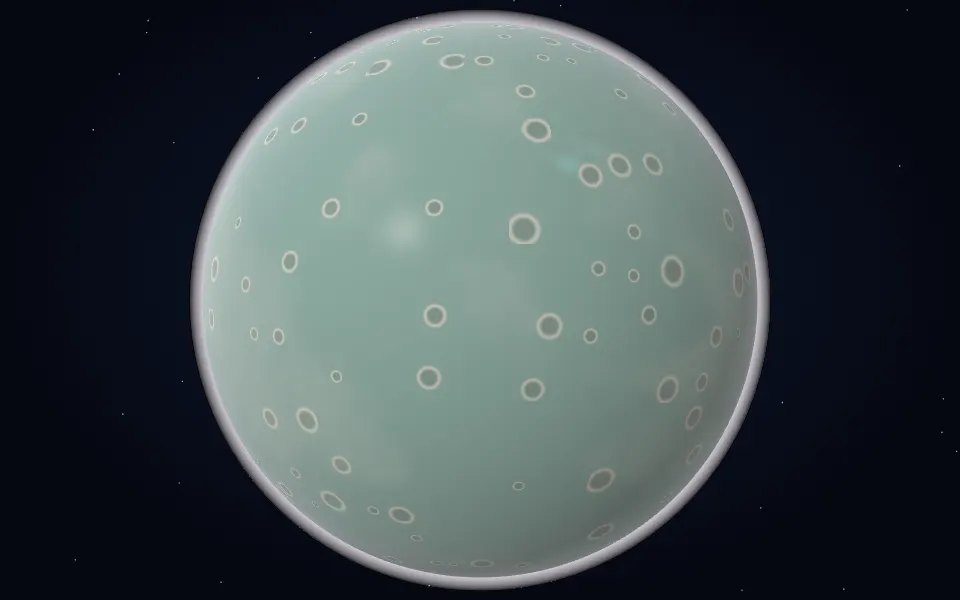
Earth 4 billion years ago: a water world under a hazy sky, still pelted by asteroids, at the end of the Hadean. The oldest rocks we can still visit date from now.
 Spin it in 3D and move through time
No map of the land exists this far back: the globe is an illustration of what Earth was like.
Map: Ancient maps: PALEOMAP PaleoDEMs (Scotese & Wright 2018), CC BY 4.0.
By 4 billion years ago Earth had cooled enough for a global ocean to form; zircon crystals from Western Australia show liquid water existed as early as 4.4 billion years ago. A few small pieces of crust stood above the sea, but nothing like today’s continents.
This is the end of the Hadean Eon and the start of the Archean. The oldest surviving rock, the Acasta Gneiss of northern Canada, is about 4.03 billion years old. Asteroid impacts were still far more common than today, and some scientists argue for a “Late Heavy Bombardment” around 4.1 to 3.8 billion years ago, though this is debated.
The air held nitrogen, carbon dioxide and probably methane, but no free oxygen, and the seas were rich in dissolved iron. Life may already have begun around hot vents on the ocean floor. The globe is an illustration: no map of this world exists.
Events of the time
The oldest crystals
4.4 billion years ago · Jack Hills, Western Australia (position illustrative)
Zircon crystals 4.4 billion years old carry chemical traces of liquid water, so oceans formed soon after Earth did.
The first life
3.8 billion years ago · Deep-sea vents (position illustrative)
Life may have begun around hot springs on the sea floor, where minerals and energy were on hand. Its oldest generally accepted traces are about 3.5 billion years old.
Part of the Origin of Life & Proterozoic Eon.