
Neoproterozoic Era · Cryogenian Period
Earth 650 Million Years Ago: Snowball Earth
Earth 650 million years ago: ice covers the planet almost from pole to pole in the Marinoan glaciation, the second Snowball Earth of the Cryogenian.
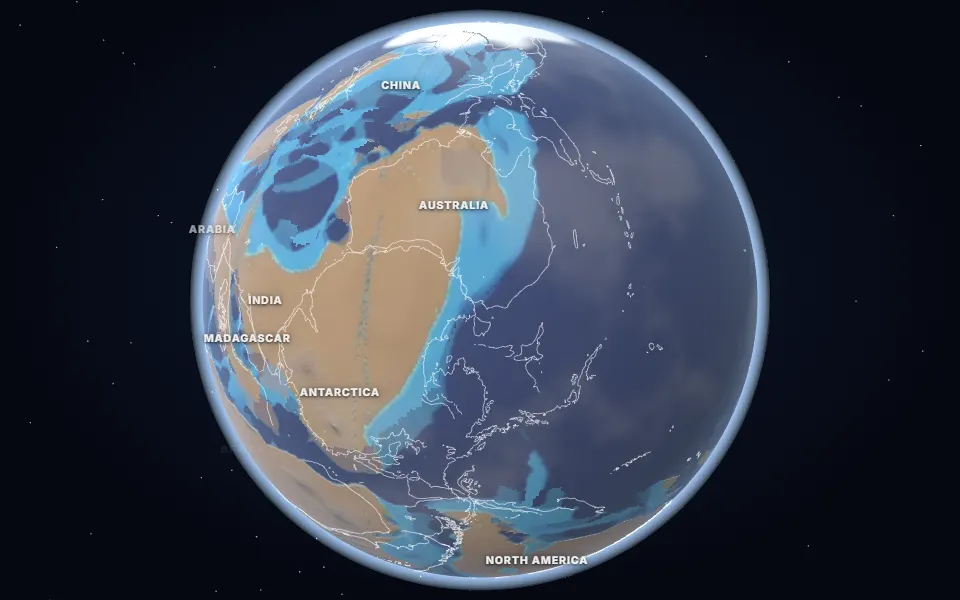 Spin it in 3D and move through time
Approximate: the continents of 540 million years ago, carried back to this time with the PALEOMAP plate model.
Map: Ancient maps: PALEOMAP PaleoDEMs (Scotese & Wright 2018), CC BY 4.0 · Natural Earth.
Around 650 million years ago Earth was entering the second of two global glaciations of the Cryogenian Period. The first, the Sturtian, lasted from about 717 to 660 million years ago; the second, the Marinoan, from about 650 to 635 million years ago.
Glacial rocks laid down at sea level near the equator, now found in Australia, Namibia and elsewhere, show that ice reached the tropics. Once ice passes about 30° latitude, its white surface reflects so much sunlight that cooling runs away. How complete the ice was is still debated: some favour a “slushball” with open water near the equator.
Each freeze ended when volcanic carbon dioxide built up enough to melt the ice rapidly, leaving distinctive “cap carbonate” rocks. Soon after the last thaw, the first large animals appeared. The globe’s continents are approximate.
Events of the time
Snowball Earth
700 million years ago · Flinders Ranges, Australia
Glacial rocks laid down near the equator, now in Australia and elsewhere, show ice reached the tropics twice, about 717–660 and 650–635 million years ago.
▶ Watch it happen on the globe
Part of the Origin of Life & Proterozoic Eon.