Ancient and Medieval States of Scandinavia and the Baltic: Map & History
15 states of Scandinavia and the Baltic on one map, from 30 CE to 2024 CE.The largest, Kalmar Union, covered about 1,285,990 km²; the longest-lived, Kingdom of Sweden, lasted 980 CE – 2024 CE. Each has its own section below with its rulers, capitals, wars and pictures where the records hold them.
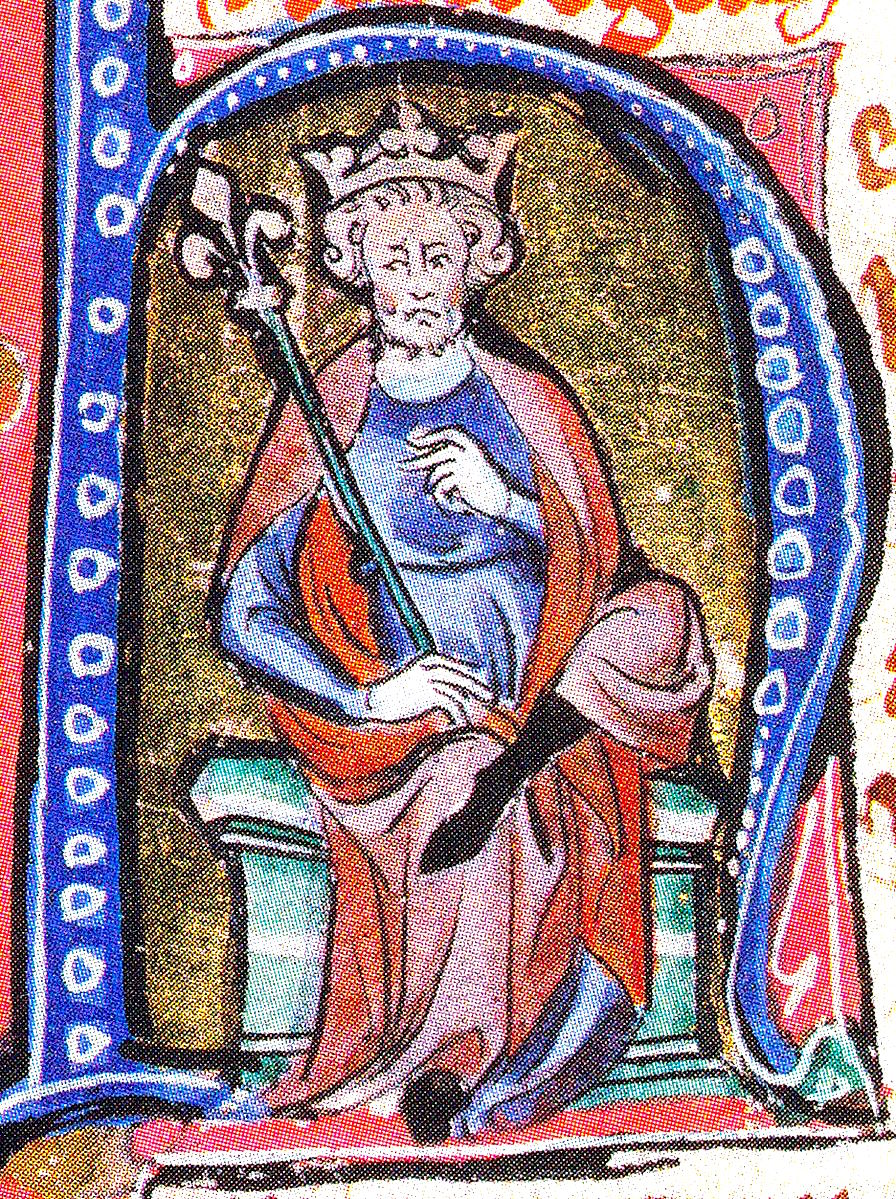
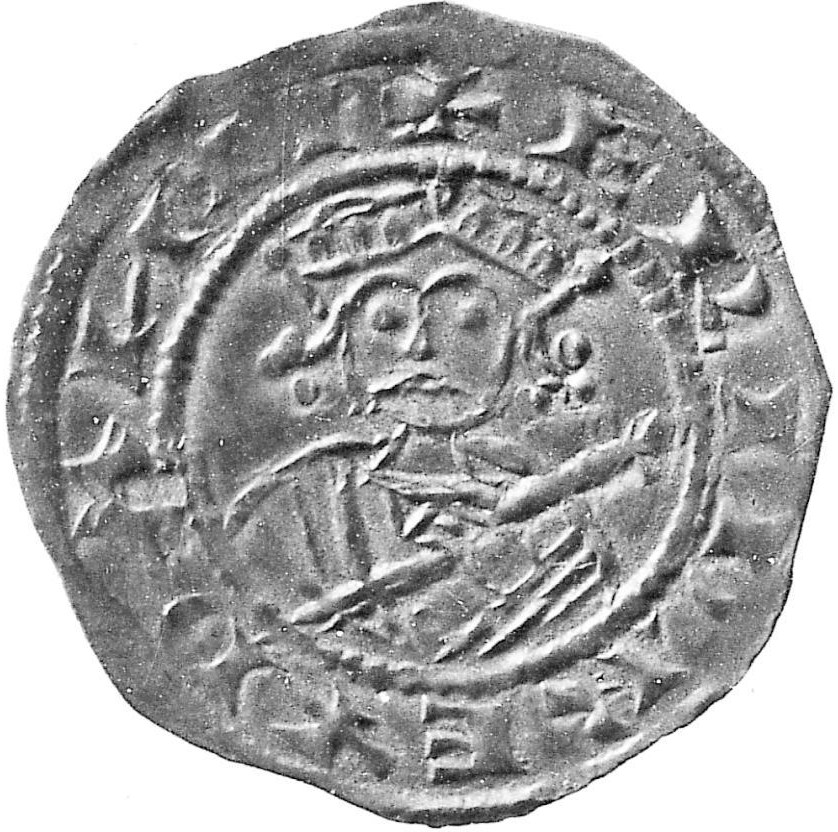
Unknown authorUnknown author · CC BY-SA 3.0 · CommonsNicholas Roerich · Public domain · CommonsAndreas Tille · CC BY-SA 4.0 · CommonsThis image was produced by me, David Castor (user:dcastor). The pictures I submit to the Wikipedia Project are released to the public domain. · CC0 · Commons
Layers
HistoryChanges with the year
PlacesToday
Water
Land
1120 AD
Base map
An empire takes the map to its years and shows the borders.
Each state in its own colour. Move the timeline to see which existed in any year from 30 AD to 2024; select a territory to read about it. Borders: Cliopatria / Seshat (CC BY 4.0).
The Ancient and Medieval States of Scandinavia and the Baltic Compared
The Goths were a Germanic people who played a major role in the fall of the Western Roman Empire and the emergence of medieval Europe. They were first mentioned by Greco-Roman authors in the 3rd century AD, living north of the Lower Danube in what is now Ukraine, Moldova, and Romania. From here, they conducted raids into Roman territory, and large numbers of them joined the Roman military. These early Goths lived in the regions where archaeologists find the Chernyakhov culture, which flourished throughout this region during the 3rd and 4th centuries.
A crucial source on Gothic history is the Getica of the 6th-century historian Jordanes, who may have been of Gothic descent. Jordanes claims to have based the Getica on an earlier lost work by Cassiodorus, but also cites material from fifteen other classical sources, including an otherwise unknown writer, Ablabius. Many scholars accept that Jordanes' account on Gothic origins is at least partially derived from Gothic tribal tradition and accurate on certain details, and as a result the Goths are often identified as originating from south-central Sweden.
Read more
According to Jordanes, the Goths originated on an island called Scandza (Scandinavia), from where they emigrated by sea to an area called Gothiscandza under their king Berig. Historians are not in agreement on the authenticity and accuracy of this account.
The Goths were Germanic-speaking. The Gothic language is the Germanic language with the earliest attestation (the 4th century), and the only East Germanic language documented in more than proper names, short phrases that survived in historical accounts, and loan-words in other languages, making it a language of great interest in comparative linguistics. Gothic is known primarily from the Codex Argenteus, now preserved in Uppsala, Sweden, which contains a partial translation of the Bible credited to Ulfilas.
Read more
The language was in decline by the mid-500s, due to the military victory of the Franks, the elimination of the Goths in Italy, and geographic isolation.
Mistreated by corrupt local Roman officials, the Gothic refugees were soon experiencing a famine; some are recorded as having been forced to sell their children to Roman slave traders in return for rotten dog meat. Enraged by this treachery, Fritigern unleashed a widescale rebellion in Thrace, in which he was joined not only by Gothic refugees and slaves, but also by disgruntled Roman workers and peasants, and Gothic deserters from the Roman Army. The ensuing conflict, known as the Gothic War, lasted for several years. Meanwhile, a group of Greuthungi, led by the chieftains Alatheus and Saphrax, who were co-regents with Vithericus, son and heir of the Greuthungi king Vithimiris, crossed the Danube without Roman permission. The Gothic War culminated in the Battle of Adrianople in 378, in which the Romans were badly defeated and Valens was killed.
In Spain an important collection of Visigothic metalwork was found in the treasure of Guarrazar, Guadamur, Province of Toledo, Castile-La Mancha, an archeological find composed of twenty-six votive crowns and gold crosses from the royal workshop in Toledo, with Byzantine influence. The treasure represents the high point of Visigothic goldsmithery, according to Guerra, Galligaro & Perea (2007). The two most important votive crowns are those of Recceswinth and of Suintila, displayed in the National Archaeological Museum of Madrid; both are made of gold, encrusted with sapphires, pearls, and other precious stones. Suintila's crown was stolen in 1921 and never recovered. There are several other small crowns and many votive crosses in the treasure.
Read more
National Archaeological Museum of Spain: six crowns, five crosses, a pendant and remnants of foil and channels (almost all of gold).
The Goths' relationship with Sweden became an important part of Swedish nationalism, and until the 19th century, before the Gothic origin had been thoroughly researched by archaeologists, Swedish scholars considered Swedes to be the direct descendants of the Goths. Today, scholars identify this as a cultural movement called Gothicismus, which included an enthusiasm for things Old Norse.
Read more
In medieval and modern Spain, the Visigoths were believed to be the progenitors of the Spanish nobility (compare Gobineau for a similar French idea). By the early 7th century, the ethnic distinction between Visigoths and Hispano-Romans had all but disappeared, but recognition of a Gothic origin, e.g. on gravestones, still survived among the nobility.
Norse is either a demonym for Norsemen, a Medieval North Germanic ethnolinguistic group ancestral to modern Scandinavians, defined as speakers of Old Norse from about the 9th to the 13th centuries, or Norwegians specifically, a group descended from the Old Norse.
Nicholas Roerich "Guests from Overseas". From the series "Beginnings of Russia. The Slavs." 1901Nicholas Roerich · Public domain · Commons
The Viking Age (about 800–1050 CE) was the period during the Middle Ages when Norsemen, referred to as Vikings, undertook large-scale raiding, colonising, conquest, and trading throughout Europe and reached North America. The Viking Age applies not only to their homeland of Scandinavia but also to any place significantly settled by these Norsemen, or Scandinavians during the period. Although few of the Scandinavians of the Viking Age were Vikings in the sense of being engaged in piracy, they are often referred to as Vikings as well as Norsemen.
The Vikings who invaded western and eastern Europe were mainly pagans from the same area as present-day Denmark, Norway, and Sweden. They also settled in the Faroe Islands, Ireland, Iceland, peripheral Scotland (Caithness, the Hebrides and the Northern Isles), Greenland, and Canada.
Read more
Their North Germanic language, Old Norse, became the precursor to present-day Scandinavian languages. By 801, a strong central authority appears to have been established in Jutland, and the Danes were beginning to look beyond their own territory for land, trade, and plunder.
In Norway, mountainous terrain and fjords formed strong natural boundaries. Communities remained independent of each other, unlike the situation in lowland Denmark. By 800, some 30 small kingdoms existed in Norway.
The sea was the easiest way of communication between the Norwegian kingdoms and the outside world.
The first of two main components to the political model is the external "pull" factor, which suggests that the weak political bodies of Britain and Western Europe, especially after the death in January 814 of Charlemagne, made them attractive targets for Viking raiders. The reasons for these weaknesses vary, but generally can be simplified into decentralised polities, or religious sites. As a result, Viking raiders found it easy to sack and then retreat from these areas which were thus frequently raided. The second case is the internal "push" factor, which coincides with a period just before the Viking Age in which Scandinavia was undergoing a mass centralisation of power in the modern-day countries of Denmark, Sweden, and especially Norway.
Some of the most important trading ports founded by the Norse during the period include both existing and former cities such as Aarhus (Denmark), Ribe (Denmark), Hedeby (Germany), Vineta (Pomerania), Truso (Poland), Bjørgvin (Norway), Kaupang (Norway), Skiringssal (Norway), Birka (Sweden), Bordeaux (France), York (England), Dublin (Ireland) and Aldeigjuborg (Russia).
Read more
As Viking ships carried cargo and trade goods throughout the Baltic area and beyond, their active trading centres grew into thriving towns. One important centre of trade was at Hedeby. Close to the border with the Franks, it was effectively a crossroads between the cultures, until its eventual destruction by the Norwegians in an internecine dispute around 1050.
Viking naval technology was among the most advanced in all societies of the time; their other technological works were also well-regarded. The Vikings were equipped with the technologically superior longships; for purposes of conducting trade however, another type of ship, the knarr, wider and deeper in draft, were customarily used. The Vikings were competent sailors, adept in land warfare as well as at sea, and they often struck at accessible and poorly defended targets, usually with near impunity. The effectiveness of these tactics earned Vikings a formidable reputation as raiders and pirates.
Read more
The Vikings used their longships to travel vast distances and attain certain tactical advantages in battle. They could perform highly efficient hit-and-run attacks, in which they quickly approached a target, then left as rapidly as possible before a counter-offensive could be launched.
The Icelandic Commonwealth, also known as the Icelandic Free State, was the political unit existing in Iceland between the establishment of the Althing (Icelandic: Alþingi) in 930 and the pledge of fealty to the Norwegian king with the Old Covenant in 1262. With the probable exception of hermitic Irish monks known as Papar, Iceland was an uninhabited island until around 874.
The Icelandic Commonwealth had a unique political system whereby chieftains (goðar) established a common legal code and settled judicial disputes at the Althing, a national assembly.
The first Bishop of Skalholt was Ísleifur Gissurarson, who was elected by the Althing in 1056. After his son Gissur was installed as bishop, the power and wealth of the church quickly grew due to the introduction of tithing, the first tax introduced in Iceland. The church became the second unifying institution in the country after the Althing. Continuing similar patterns from the pre-Christian era, church estates could be owned by goðar who would then get a portion of the tithe.
Coat of arms of the Icelandic CommonwealthUnknown author · Public domain · Commons
Wars and Battles
The followers of the goðar owed them military service. They were organized into platoons or companies based on their social status and equipment, and these formed expeditionary armies or leiðangrs. Icelandic military tradition of the time closely followed developments in Norway. No organized cavalry formations or formations of troops equipped with projectile weapons are recorded: instead the bulk of the forces were formed in units of light, medium and heavy infantry, with bowmen or slingers distributed among the infantry units, operating as light support skirmishers. Before the end of the Commonwealth, at least 21 fortresses and castles had been built in Iceland. During the Age of the Sturlungs, the average battle involved fewer than 1000 men, with an average casualty rate of only 15%.
In the early 13th century, the Age of the Sturlungs, the Commonwealth began to suffer from chaos and division resulting from internal disputes. Originally, the goðar (chieftains) functioned more as a contractual relationship than a fixed geographic chieftaincy. However, by 1220 this form of communal leadership was replaced by dominant regional individuals who battled with one another for more control. One historian argues the chaos and violence of this period stem from an imbalance of power and changes in the nature of Icelandic warfare. Whereas the number of goðar had been at least 39 early in the Icelandic Commonwealth, a few powerful families had consolidated control over most of the goðorð in the late 12th century.
Read more
There are several factors that may have resulted in the consolidation of goðorð.
936 CE – 1406 CE · Capital: Copenhagen · 164,307 km²
Drönarbild av Kronborgs slott i Helsingör på Själland. På andra sidan Öresund skymtas Skånes västkust.This image was produced by me, David Castor (user:dcastor). The pictures I submit to the Wikipedia Project are released to the public domain. · CC0 · Commons
The Danish Realm, officially the Kingdom of Denmark, often known as Denmark, is a sovereign state consisting of a collection of constituent territories united by the Constitutional Act, which applies to the entire territory. It consists of metropolitan Denmark (sometimes called "Denmark proper")—the kingdom's territory in continental Europe and its proximate islands—and the realm's two autonomous (but not sovereign) regions: the Faroe Islands in the North Atlantic and Greenland in North America.
In Iceland there was a growing nationalism in the 19th century, and Iceland was in 1874 given its own constitution and increased autonomy, but still with the executive power in Danish hands. Iceland was granted home rule in 1904, and, by the Danish–Icelandic Act of Union, full independence in 1918. The act established a personal union between Denmark and the newly created Kingdom of Iceland, with Denmark handling coastal protection and foreign affairs. In 1944, Iceland abolished the personal union and adopted a new constitution that established the current republic, after a referendum on the subject. This happened during World War II, where Denmark and Iceland were cut off from each other, as Denmark was occupied by Germany, and Iceland by the United States.
Read more
The Faroe Islands were made a Danish county in 1816, and with the constitution of 1849, it gained representation in the Rigsdag.
Eric the Victorious992–993 CEThis file is from the Mechanical Curator collection, a set of over 1 million images scanned from out-of-copyright books and released to Flickr Commons by the… · Public domain · Commons
Denmark's population is by far the largest of the three; just over six million people live in Denmark, and about 52,000 and 56,000 in the Faroe Islands and Greenland, respectively. In comparison, there are ten cities in Denmark with a population above 50,000 people. Denmark is populated by the Danes, the Faroe Islands by the Faroese, and Greenland by the Greenlandic Inuit. In both the Faroe Islands and Greenland, Danes make up 7.6% of the population, as of 2018. As of 2020, there are about 11,000 Faroese-born and 17,000 Greenlandic-born people living in Denmark.
Read more
With respect to area, Greenland is by far the largest, and makes up 98% of the realm. The entire kingdom has an area of 2.2 million square kilometres (0.85 million square miles), and is according to The World Factbook the twelfth-largest country in the world, the same rank held by Greenland alone.
Jämtland (Swedish: [ˈjɛ̌mːtland]) is a historical province (landskap) in the centre of Sweden in northern Europe. It borders Härjedalen and Medelpad to the south, Ångermanland to the east, Lapland to the north and Trøndelag and Norway to the west. Jämtland covers an area of 34,009 square kilometres, 8.3% of Sweden's total area and is the second largest province in Sweden. It has a population of 115,331, the majority of whom live in Storsjöbygden, the area surrounding lake Storsjön. Östersund is Jämtland's only city and is the 24th most populous city in Sweden.
Some finds from the time before humans have been discovered in Jämtland, most notably the remains from a woolly mammoth in Pilgrimstad.
Read more
The first humans came to Jämtland from the west across the Keel approximately 7000–6000 BC, after the last ice age. The climate was at the time much warmer than today and trees such as oak were growing at the top of today's mountains. Several thousand archaeological remains have been located in the province, predominantly near old camp-sites, beaches and lakes. The oldest settlement found is located at Foskvattnet, not far way from the so-called Fosna culture, this settlement has been dated to 6600 BC. In Jämtland the moose was the dominant prey, which is clearly shown on petroglyphs and rock paintings in for example Gärde and Glösa.
Jämtland was originally divided into four parts, so called farthings (fjalingan or fjålingan in Jamtish), just like Iceland (fjórðungr in Icelandic). This division is similar to the hundred subdivision the rest of Scandinavia had. Just like on Iceland these farthings were named after cardinal directions. Exactly how the borders for each farthing went is unknown although it has been suggested that they all reached Storsjön in the center of the province. The eastern farthing at Brunflo, the western from Trångsviken to the Rödö peninsula and the south farthing from Oviken and Hackås and southwards. The northern farthing is assumed to have covered all the northern parts in addition to all the islands in Storsjön (like Frösön, Norderön, Andersön etc.) and Mörsil plus Hallen parish all the way to Oviksfjällen.
The first humans came to Jämtland after the last ice age and later switched to a more agricultural lifestyle. Though the agriculture could not sustain the population so it was combined with a great deal of trading, hunting and iron production. When the rise of industrialism begun, Jämtland was one of the few Swedish regions that never became fully industrialized. Instead Jämtland supplied the Norrlandic coast with raw materials, mainly lumber. The focus in Jämtland's economy was directed towards tourism after the construction of the railroad, starting with the "clean air tourists" who came to experience the fresh air, to see the snow clad fells, the waterfalls and the natural environment. Today the tourism in Jämtland is dominated by winter sports and especially alpine skiing in various facilities in Åre, Bydalen, Storlien, Klövsjö, etc.
The culture in Jämtland has been marked by the stages in human development; the hunting-gathering stage, the semi-nomadic herding stage, the fully agricultural stage and the modern technological stage.
Read more
Remnants from the hunter-gathering stage is first and foremost hunting itself. Jämtland's population remained in this stage for a very long time due to the hunters ability to sustain the population. Today the moose hunt is regarded by many Jamts as the major holiday of the year. When the first humans came to Jämtland they brought dogs with them as helpers. The local dog, Jämthund, is a canine breed eponymous to Jämtland. Even if it is not explicitly stated, popular perception holds that the dog depicted in the coat of arms is of that breed. The Jämthund is often described having a wolf-like appearance.
980 CE – 2024 CE · Capital: Stockholm · 732,468 km²
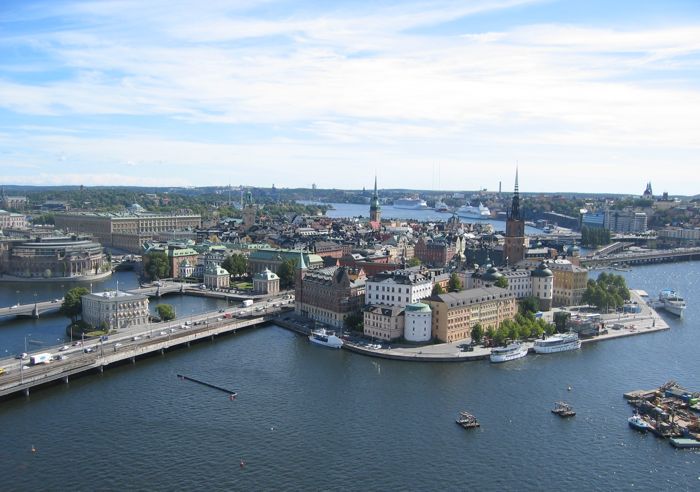
View of Gamla stan ("Old town") in Stockholm, and surroundingsJZ · CC BY-SA 3.0 · Commons
Sweden, formally the Kingdom of Sweden, is a Nordic country located on the Scandinavian Peninsula in Northern Europe. It borders Norway to the west and north, Finland to the east, and shares a maritime border with Denmark to the south. At 450,295 square kilometres (173,860 sq mi) and with a population of 10.6 million, Sweden is the largest and most populous Nordic country, and is the fifth-largest country in Europe. Its capital and largest city is Stockholm.
Sweden's prehistory begins in the Allerød oscillation, a warm period around 12,000 BC, with Late Palaeolithic reindeer-hunting camps of the Bromme culture at the edge of the ice in what is now the country's southernmost province, Scania. This period was characterised by small clans of hunter-gatherers who relied on flint technology.
Read more
Sweden and its people were first described by the Roman historian Publius Cornelius Tacitus in his Germania (98 AD). In Germania 44 and 45 he mentions the Swedes (Suiones) as a powerful tribe with ships that had a prow at each end (longships). Which kings (*kuningaz) ruled these Suiones is unknown, but Norse mythology presents a long line of legendary and semi-legendary kings going back to the last centuries BC.
Sweden has four fundamental laws (Swedish: grundlagar) which together form the Constitution: the Instrument of Government (Swedish: Regeringsformen), the Act of Succession (Swedish: Successionsordningen), the Freedom of the Press Act (Swedish: Tryckfrihetsförordningen), and the Fundamental Law on Freedom of Expression (Swedish: Yttrandefrihetsgrundlagen).
Read more
The public sector in Sweden is divided into two parts: the legal person known as the State (Swedish: staten) and local authorities: the latter include Regional Councils (Swedish: regioner) (renamed from county councils (landsting) in 2020) and local Municipalities (Swedish: kommuner). The local authorities, rather than the State, make up the larger part of the public sector in Sweden. Regional Councils and Municipalities are independent of one another, the former merely covers a larger geographical area than the latter.
Sweden is the twelfth-richest country in the world in terms of GDP (gross domestic product) per capita and a high standard of living is experienced by its citizens. Sweden is an export-oriented mixed economy. Timber, hydropower and iron ore constitute the resource base of an economy with a heavy emphasis on foreign trade. Sweden's engineering sector accounts for 50% of output and exports, while telecommunications, the automotive industry and the pharmaceutical industries are also of great importance. Sweden is the ninth-largest arms exporter in the world. Agriculture accounts for 2% of GDP and employment. The country ranks among the highest for telephone and Internet access penetration.
Read more
Trade unions, employers' associations and collective agreements cover a large share of the employees in Sweden.
The upside of a Swedish femkrona from 1986-1993.Riksbanken · Public domain · Commons
Currency
Swedish krona
Flag of SwedenJon Harald Søby and others. · Public domain · Commons
Great coat of arms of SwedenSodacan · Public domain · Commons
Wars and Battles
Sweden was officially neutral during World War I. However, under pressure from the German Empire, they did take steps which were detrimental to the Allied powers – most notably, mining the Öresund channel, thus closing it to Allied shipping, and allowing the Germans to use Swedish facilities and the Swedish cipher to transmit secret messages to their overseas embassies. Sweden also allowed volunteers to fight alongside the Germans for the White Guards against the Red Guards and Russians in the Finnish Civil War, and briefly occupied Åland in cooperation with the German Empire.
Read more
As in the First World War, Sweden remained officially neutral during World War II, although its neutrality has been disputed. Sweden was under German influence for much of the war, as ties to the rest of the world were cut off through blockades.
Sweden has many authors of worldwide recognition including August Strindberg, Astrid Lindgren, and Nobel Prize winners Selma Lagerlöf and Harry Martinson. In total seven Nobel Prizes in Literature have been awarded to Swedes.
Read more
The first literary text from Sweden is the Rök runestone, carved during the Viking Age c. 800 AD. With the conversion of the land to Christianity around 1100 AD, Sweden entered the Middle Ages, during which monastic writers preferred to use Latin. Therefore, there are only a few texts in Old Swedish from that period. Swedish literature only began to flourish when the language was standardised during the 16th century. This standardisation was largely due to the full translation of the Bible into Swedish in 1541. This translation is the so-called Gustav Vasa Bible.
1046 CE – 1055 CE · Capital: Copenhagen · 379,163 km²
Presumed portrait of Elizabeth of Denmark, Duchess of Brunswick-Wolfenbüttel (1573-1626), wife of Henry Julius, Duke of Brunswick-Lüneburg (1564-1613).Circle of Robert Peake the elder · Public domain · Commons
Denmark–Norway was a 16th-to-19th-century multi-national and multi-lingual real union consisting of the Kingdom of Denmark, the Kingdom of Norway (including the then Norwegian overseas possessions: the Faroe Islands, Iceland, Greenland, and other possessions), the Duchy of Schleswig, and the Duchy of Holstein. The state also claimed sovereignty over three historical peoples: Frisians, Gutes and Wends. Denmark–Norway had several colonies, namely the Danish Gold Coast, Danish India (the Nicobar Islands, Serampore, Tharangambadi), and the Danish West Indies.
The three kingdoms of Denmark, Norway and Sweden united in the Kalmar Union in 1397. Sweden broke out of this union and re-entered it several times, until 1521, when Sweden finally left the Union, leaving Denmark–Norway (including overseas possessions in the North Atlantic and the island of Saaremaa in modern Estonia). During the Count's Feud, where the Danish crown was contested between Protestant Oldenburg King Christian III and Catholic King Christian II, the relatively Catholic realm of Norway also wished to leave the union in the 1530s, but was unable to do so due to Denmark's superior military might. Following this, King Christian III completely united the two kingdoms to reduce the chances of further uprisings, and made Lutheranism the state religion in both kingdoms.
Denmark: Elective monarchy (1537–1660), Hereditary absolute monarchy (1660–1814), Norway: Hereditary monarchy (de jure 1537–1814, de facto 1537–1661), Hereditary absolute monarchy (de facto 1661–1814)
Languages
Norwegian, Icelandic, Faroese, Sámi languages, Kven, North Frisian
Flag of DenmarkMadden and others · Public domain · Commons
Royal Arms of Denmark & Norway (1699–1819)TRAJAN 117 This W3C-unspecified vector image was created with Inkscape . · CC BY-SA 3.0 · Commons
Wars and Battles
Christian III, who had relied on Swedish aid in the Count's Feud, kept peaceful relations with Sweden throughout his reign. However, Frederick II was quite hostile towards the Swedes.
Read more
Another major factor in the war were Sweden's goals in Livonia. Both Denmark–Norway and Sweden, along with Russia, sought to control the previously Hanseatic region, as it was extremely important in controlling the Baltic Sea. When Denmark purchased Osel, Duke Magnus, brother of King Frederick II was granted control of the island. Magnus attempted to claim himself King of Estonia, but he was kicked out by the Russian army. The Estonians, who were fearful of the Russians, contacted King Eric XIV of Sweden for protection. Sweden then annexed Estonia, securing the region under their rule.
Protestantism had been a religious movement in Denmark ever since the reign of Christian II. Though the country remained Catholic during the reign of Frederick I, and in Norway it was not a big movement at that time. But the victory in the Count's Feud secured Denmark under the Protestant King Christian III, and in 1537 he also secured Norway, creating the union between the two kingdoms.
Read more
In the following years, Denmark–Norway was among the countries to follow Martin Luther after the Protestant Reformation, and thus established Lutheran Protestantism as official religion in place of Roman Catholicism. Lutheran Protestantism prevailed through the union's life span. The Church of Denmark and the Church of Norway was founded during this time as well. The introduction of Lutheranism in Denmark–Norway was also a political move.
Denmark–Norway was defeated and King Frederick VI had to cede the Kingdom of Norway to the King Charles XIII of Sweden 14 January 1814 at the Treaty of Kiel, but Norway's overseas possessions were kept by Denmark. The Norwegians objected to the terms of this treaty, and a constitutional assembly declared Norwegian independence on 17 May 1814 and elected the Crown Prince Christian Frederik as king of independent Norway. Following a Swedish invasion, Norway was forced to accept a personal union between Sweden and Norway, but retained its liberal constitution and separate institutions, except for the foreign service. The union was dissolved in 1905.
Although the Dano–Norwegian union was generally viewed favourably in Denmark and Norway at the time of its dissolution in 1814, some 19th-century Norwegian writers disparaged the union as a "400-year night". Some modern historians describe the idea of a "400-year night" as a myth that was created as a rhetorical device in the struggle against the Swedish–Norwegian union, inspired by 19th-century national-romanticist ideas.
Read more
Since the late 19th century the Danish–Norwegian union was increasingly viewed in a more nuanced and favourable light in Norway with a stronger focus on empirical research, and historians have highlighted that the Norwegian economy thrived and that Norway was one of the world's wealthiest countries during the entire period of union with Denmark.
The Norse settlement of North America, including Greenland, began in the late 10th century AD and lasted for about 500 years. Further west, the evidence is more limited. Only one Canadian settlement has been confirmed: L'Anse aux Meadows in Newfoundland. There is evidence of Norse activity in other parts of Canada, but no trace of the long-term farming colonies found in Greenland. In the present-day United States, there are no confirmed remains. Claimed US discoveries are hoaxes or mistaken identifications.
The Little Ice Age of this period made travel between Greenland and Europe, as well as farming, more difficult. Although the hunting of seal and other animals provided a healthy diet, there was more prestige in cattle farming, and there was increased availability of farms in Scandinavian countries depopulated by famine and plague epidemics. In addition, Greenlandic ivory may have been supplanted in European markets by cheaper ivory from Africa. Despite the loss of contact with the Greenlanders, Denmark–Norway continued to consider Greenland a dependency.
Read more
To some extent, it seemed that the Norse were unwilling to integrate with the Thule people of Greenland, through either marriage or culture. There is evidence of contact as seen through the Thule archaeological record, including ivory depictions of the Norse as well as bronze and steel artifacts.
1111 CE – 1209 CE · Capital: Koknese Castle · 2,288 km²
Ruins of Koknese medieval castle from the opposite bank of DaugavaDaarznieks · CC BY-SA 3.0 · Commons
The Principality of Koknese (Russian: Кукейносское княжество; German: Fürstentum Kokenhusen; Latin: Terra Kukonois) was a small vassal state of the Principality of Polotsk on the right bank of the Daugava River in ancient Livonia (modern Latvia) during the Middle Ages.
Albert of Riga, Riga Dome CathedralArtifex · Public domain · Commons
The order of Livonian Brothers of the Sword or Sword Brethren (German: Schwertbrüderorden), formally known as the Militia of Christ of Livonia (Latin: Fratres militiæ Christi Livoniae), was a Catholic military order of German crusading knights established in 1202 in Livonia by Albert, the third bishop of Riga. Pope Innocent III sanctioned the establishment in 1204 for the second time.
The membership of the crusading order comprised warrior monks mostly from northern Germany, who fought Baltic and Finnic pagans in the area of modern-day Estonia, Latvia and Lithuania.
Albert, Bishop of Riga (also called Prince-Bishop of Livonia) (or possibly Theoderich von Treyden) realised that a standing army in Livonia would be more useful than crusaders staying a short time. As rewards for secular knights in the Baltic area were not enough to ensure their long-term stance, Albert founded the Brotherhood in 1202 to aid the Bishopric of Livonia in the conversion of the pagan Livonians, Latgalians and Selonians living across the ancient trade routes from the Gulf of Riga eastwards.
Read more
The Brotherhood had its headquarters at Fellin (Viljandi) in present-day Estonia, where the walls of the Master's castle still stand. Other strongholds included Wenden (Cēsis), Segewold (Sigulda) and Ascheraden (Aizkraukle).
The Sword Brethren had a set of rules adapted from the Knights Templar, requiring them to be of noble birth and to take vows of obedience, poverty, and celibacy. The order also included soldiers, artisans, and clerics as members. The Knights made up a general assembly, which selected a grand master and other officials.
Read more
The grandmaster served for life in the order. He chose a council and a military chief for each district castle, where the order's knights were living. Wenno von Rohrbach was the first master of the order (1204–1209), followed by Volkwin Schenk von Winterstein, who died in the Battle of Saule in 1236.
In the beginning, the main duty of the Sword Brothers was to protect priests and missionaries. The characteristics of the territory brought a moral challenge for the crusaders because the land of the Livs and Letts had not previously been Christian.
In 1205, the first battle of the Livonian brothers occurred. The Semigallian duke Viesthard visited Riga to request the help of the Swordbrothers after a local Semigallian tribe was devastated by the Lithuanians. The brotherhood was reluctant to go to war due to the absence of bishop Albert. However, Viesthard successfully persuaded the Swordbrothers. They prepared an ambush against the Lithuanians that were returning with the booty, where the Lithuanian leader was beheaded.
Read more
In 1206, the Duke Vladimir of Polozk demanded tribute from the inhabitants of the Daugava when the terms of service of the crusaders expired. The Swordbrothers, with the help of the remaining crusaders, beat the Russian troops that arrived suddenly to Daugava.
In 1207, the Swordbrothers faced an attack from Lithuania launched during the winter.
Modern statue in en:Bassenheim, Germany of en:Henry Walpot, the first Grand Master of the en:Teutonic OrderGFreihalter · CC BY-SA 3.0 · Commons
The Teutonic Order is a Catholic religious institution founded as a military society c. 1190 in Acre, Kingdom of Jerusalem. The Order of Brothers of the German House of Saint Mary in Jerusalem was formed to aid Christians on their pilgrimages to the Holy Land and to establish hospitals. Its members have commonly been known as the Teutonic Knights, having historically served as a crusading military order for supporting Catholic rule in the Holy Land and the Northern Crusades during the Middle Ages, as well as supplying military protection for Catholics in Eastern Europe.
In 1143, Pope Celestine II ordered the Knights Hospitaller to take over management of a German hospital in Jerusalem, which, according to the chronicler Jean d'Ypres, accommodated the countless German pilgrims and crusaders who could neither speak the local language nor Latin (patriæ linguam ignorantibus atque Latinam). Although formally an institution of the Hospitallers, the pope commanded that the prior and the brothers of the domus Theutonicorum (house of the Germans) should always be Germans themselves, so a tradition of a German-led religious institution could develop during the 12th century in the Kingdom of Jerusalem.
The Catholic order continued to exist in the various territories ruled by the Austrian Empire, out of Napoleon's reach. From 1804 the Order was headed by members of the Habsburg dynasty.
Read more
The collapse of the Habsburg monarchy and the Empire it governed in Austria, the Italian Tyrol, Bohemia and the Balkans brought a shattering crisis to the Order. While in the new Austrian Republic, the Order seemed to have some hope of survival, in the other former parts of the Habsburg territories, the tendency was to regard the Order as an honorary chivalric Order of the House of Habsburg. The consequence of this risked being the confiscation of the Order's property as belongings of the House of Habsburg.
In 1236, the Knights of Saint Thomas, an English order, adopted the rules of the Teutonic Order. A contingent of Teutonic Knights of indeterminate number is traditionally believed to have participated at the Battle of Legnica in 1241 during the first Mongol invasion of Poland. The combined Polish-German army was crushed by the Mongol army and their superior tactics, with few survivors.
In 1410, at the Battle of Grunwald a combined Polish–Lithuanian army, led by Władysław II Jagiełło and Vytautas, decisively defeated the Order in the Polish–Lithuanian–Teutonic War. Grand Master Ulrich von Jungingen and most (50 out of 60) of the Order's higher dignitaries fell on the battlefield. The Polish–Lithuanian army then began the Siege of Marienburg (Malbork), the capital of the Order, but was unable to take Marienburg owing to the resistance of Heinrich von Plauen. When the First Peace of Thorn was signed in 1411, the Order managed to retain essentially all of its territories, although the Knights' reputation as invincible warriors was irreparably damaged.
Read more
While Poland and Lithuania were growing in power, that of the Teutonic Knights dwindled through infighting.
The German historian Heinrich von Treitschke used imagery of the Teutonic Knights, a Germanic myth, to promote pro-German and anti-Polish rhetoric. Many middle-class German nationalists adopted this imagery and its symbols. During the Weimar Republic, associations and organisations of this nature contributed to laying the groundwork for the formation of Nazi Germany.
Read more
An organization predating the Nazi Party itself,α as well as Nazi-supported preceding and Nazi propaganda preceding and during[β] World War II made use of the Teutonic Knights' imagery, with the common goal of instilling the importance of Lebensraum for the future of Germany and the German people. According to medieval historian Eric Christiansen, "Himmler's plan to mould the SS as a reincarnation of [The Teutonic Order] proved [...] the irresistible strength of bad history."
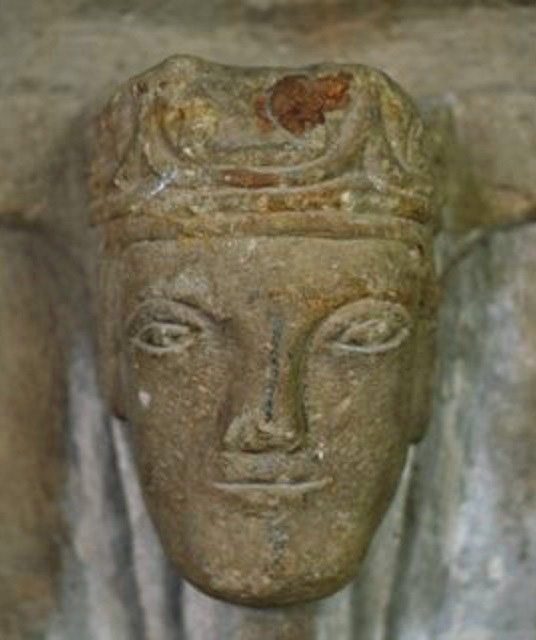
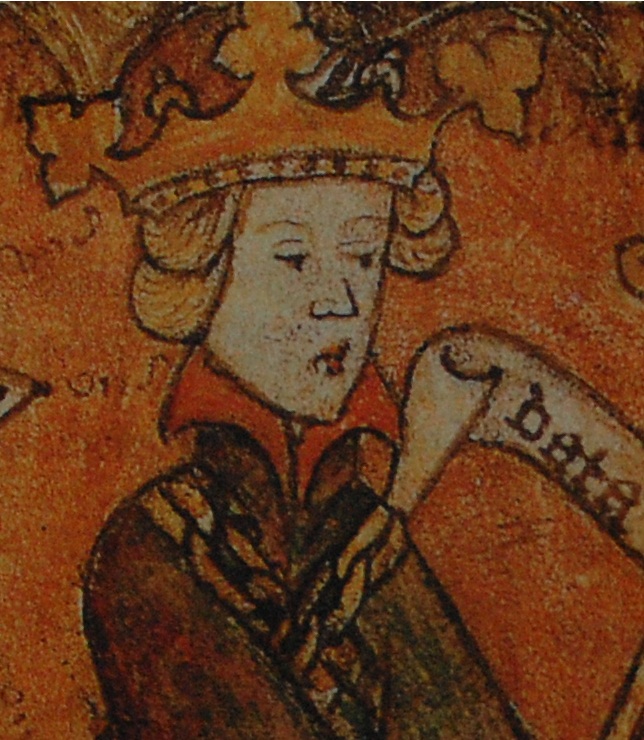
King of Denmark Christopher II, detail of his tomb at SorøMariusz Paździora · CC BY 3.0 · Commons
Christopher II (Danish: Christoffer 2.; 29 September 1276 – 2 August 1332) was King of Denmark from 1320 to 1326 and again from 1329 until his death. He was a younger son of Eric V. His name is connected with national disaster, as his rule ended in a near-total dissolution of the Danish state.
National Coat of arms of Denmark no crownUser:Galico; User:Derfel73 · CC BY-SA 3.0 · Commons
Legacy in the Modern World
History's judgment of Christopher has been extremely hard, and he has often been regarded as a weak, unreliable and incapable tyrant— "the king who mortgaged Denmark to the Germans". He in many ways simply carried on the policy of his predecessor. The policy of mortgaging parts of Denmark was common practice by nobles and kings alike to raise money. It would be incorrect to call him a passive ruler; the power of the Danish and German high nobility and their co-operation with church establishment undermined his freedom of action.
Montage with various landmarks of Oslo, the capital of Norway.Jonipoon · CC BY-SA 3.0 · Commons
The Kalmar Union was a personal union in Scandinavia, agreed at Kalmar in Sweden as designed by Queen Margaret I of Denmark. From 1397 to 1523, it joined under a single monarch the three kingdoms of Denmark, Sweden (then including much of present-day Finland), and Norway, together with Norway's maritime colonies (then including Iceland, Greenland, the Faroe Islands, and the Northern Isles of Orkney and Shetland).
The union was not continuous.
Official use: Middle Danish, Old Swedish, Middle Norwegian, Renaissance Latin, Also spoken: Middle Icelandic, Old Faroese, Norn, Greenlandic Norse, Middle Low German, Finnish, Sami, Greenlandic, Karelian
Coins, Currency and Symbols
Currency
Mark, Örtug, Norwegian penning, Swedish penning
Wars and Battles
Diverging interests (especially the Swedish nobility's dissatisfaction with the dominant role played by Denmark and Holstein) gave rise to a conflict that hampered the union in several intervals starting in the 1430s. The Engelbrekt rebellion, which started in 1434, led to the overthrow of King Erik (in Denmark and Sweden in 1439, as well as Norway in 1442). The aristocracy sided with the rebels.
Read more
King Erik's foreign policy, in particular his conflict with the Hanseatic League, necessitated greater taxation and complicated exports of iron, which in turn may have precipitated the rebellion. Discontent with the nature of Erik's regime has also been cited as a motivating factor for the rebellion. Erik also lacked a standing army and had limited tax revenues.
Livonian (Livonian: līvõ kēļ or rāndakēļ) is a Finnic language that originated on the Livonian Coast of the Gulf of Riga, located in the north of the Kurzeme peninsula in Latvia but also used to be spoken in the Salaca River valley. Although its last known native speaker died in 2013, a child, Kuldi Medne, born in 2020, is reported to be a native speaker of Livonian. Her parents are Livonian language revival activists Jānis Mednis and Renāte Medne. Also, there are about 40 reported L2 speakers and 210 having reported some knowledge of the language.
Livonian has for centuries been thoroughly influenced by Latvian in terms of grammar, phonology and word derivation etc. The dative case in Livonian, for example, is very unusual for a Finnic language. There are about 2,000 Latvian and 200 Low Saxon and German loanwords in Livonian and most of the Germanic loanwords were adopted through Latvian. Latvian, however, was influenced by Livonian as well. Its regular syllable stress, which is based on Livonian, is very unusual in a Baltic language. Especially as of the end of the nineteenth century there was a great deal of contact with Estonians, namely between (Kurzeme) Livonian fishers or mariners and the Estonians from Saaremaa or other islands. Many inhabitants of the islands of Western Estonia worked in the summer in Kurzeme Livonian villages.
The first Livonian words were recorded in the Livonian Chronicle of Henry. The first written sources about Livonian appeared in the 16th century. The collection of Livonian poems "Mariners sacred songs and prayers" (Latvian: Jūrnieku svētās dziesmas un lūgšanas) was translated into Latvian by Jānis Prints and his son Jānis Jr. and was published in 1845. The first book in Livonian was the Gospel of Matthew, published in 1863 in London in both the eastern and western Courland dialects. It was translated into eastern Curonian by Nick Pollmann and into western Curonian by Jānis Prints and Peteris. The plan with the book was to establish a standard orthography by F. Wiedemann, which consisted of 36 letters with many diacritics. The total circulation was 250 copies. The Livonians received only one copy of each dialect.
Ancient and Medieval States of Scandinavia and the Baltic: Frequently Asked Questions
Which states existed in Scandinavia and the Baltic in this period?
This page maps 15 states of Scandinavia and the Baltic founded between 30 CE and 1422 CE: Goths, Norse, Scandinavian minor kingdoms, Icelandic Commonwealth, Kingdom of Denmark, Jaemtland, Kingdom of Sweden, Norway-Denmark, Norse Greenland, Principality of Koknese, Livonian Brothers of the Sword, Teutonic Order and 3 more.
Which was the largest of the Ancient and Medieval States of Scandinavia and the Baltic?
Kalmar Union had the largest mapped extent, about 1,285,990 km².
Which of the Ancient and Medieval States of Scandinavia and the Baltic lasted longest?
Kingdom of Sweden lasted longest, 980 CE – 2024 CE.
↑↓ to navigate↵ to open
12,754 Planetary Entities Indexed
We use Google Analytics cookies to understand which pages are useful. Necessary storage only keeps your theme and this choice on your device. Privacy policy