Ancient States of Mesopotamia and the Levant: Map & History
20 states of Mesopotamia and the Levant on one map, from 3400 BCE to 646 CE.The largest, Neo-Babylonian Empire, covered about 703,405 km²; the longest-lived, Sumerian City-States, lasted 3400 BCE – 1761 BCE. Each has its own section below with its rulers, capitals, wars and pictures where the records hold them.
Each state in its own colour. Move the timeline to see which existed in any year from 3400 BC to 646 AD; select a territory to read about it. Borders: Cliopatria / Seshat (CC BY 4.0).
The Ancient States of Mesopotamia and the Levant Compared
The history of Sumer spans the late fifth to the third millennium BC in southern Mesopotamia, documenting the world's first transition from Neolithic village life to a complex urban civilization. This development was catalyzed by the "monumentalization of the sacred," a process where modest ritual shrines—most notably at Eridu—evolved into massive temple complexes that functioned as "sacred magnets." These centers exerted a centripetal force on the landscape, triggering an "urban implosion" that concentrated populations into the first true metropolises, such as Uruk.
The transition from village to city was inextricably linked to the invention of writing, which emerged not for literature, but as a logistical necessity for the "Temple-Magnet" economy. By the late Uruk period (c. 3300 BC), the sheer volume of offerings, labor records, and resource distribution managed by the Eanna precinct surpassed the capacity of human memory. Writing developed as a technological solution to the "crisis of scale" inherent in the first metropolis.
Read more
The process began with the use of clay tokens, which represented specific quantities of goods like barley or sheep. These were eventually enclosed in hollow clay spheres called bullae, marked on the outside with seals to guarantee their contents. By Uruk IV, administrators began pressing tokens directly into flat clay tablets, leading to the creation of proto-cuneiform logograms.
Victory Stele of Naram-Sin title QS:P1476,en:"Victory Stele of Naram-Sin "label QS:Len,"Victory Stele of Naram-Sin "label QS:Les,"Estela de Naram-Sim"label QS:Lfr,"stèle de victoire du roi Naram-Sin"label…Unknown artistUnknown artist · Public domain · Commons
The Akkadian Empire or the Kingdom of Akkad/Agade was an ancient kingdom established around 2300 BCE, often seen as the first empire in world history, succeeding and unifying the long-lived city-states of the Early Dynastic period.
Centered on the city of Akkad (or) and its surrounding region in modern-day Iraq, the empire united the Semitic Akkadian and Sumerian speakers under one rule and exercised significant influence across Mesopotamia, Syria and modern-day western Iran, sending expeditions as far south as Dilmun and Magan in the Arabian Peninsula.
The 'peripheral' regions are politically and demographically diverse and often distant from the center, which complicates control over them. Akkadian domination in these regions was sporadic and uneven: the Akkadian presence was very limited or even nonexistent during the first three reigns; it took shape primarily under Naram-Sin and relied on a network of Akkadian garrisons stationed at strategic locations (Susa, Tell Brak, Gasur) in order to control the major trade routes. The fact that Akkadian control manifested itself primarily through the occupation of places along these communication routes suggests that these ventures were also (and above all?) intended to control trade routes for goods prized by the empire’s elites, while leaving vast portions of territory outside their control.
Stone sculpture (particularly in diorite) and metal sculpture (using lost-wax casting) underwent significant development during the Akkadian period. The Akkadian dynasty developed its own visual identity, derived from the traditions of the Early dynasties, which is particularly evident in the carving of royal monuments, characterized by their size, their placement in public and sacred spaces, and also a more naturalistic style. Due to its artistic quality and, in particular, its attention to anatomical detail, the sculpture of this period is among the most realistic in Mesopotamian history. It foreshadows that of the Neo-Sumerian period, known for the statues of King Gudea of Lagash. But it is in the subject matter that the most profound changes occurred. The king became the central figure, replacing the deities.
The reign of Shar-kali-sharri, son of Naram-Sin, who came to power around 2217 BC (or 2205, or 2165 BC), is the best documented in administrative records, but little is known about the political and military events of that time. This king is omitted from later accounts of the fall of Akkad, which refer only to his father. The few inscriptions dating from this reign bear witness to the decline of imperial ambitions.
Read more
This period saw the emergence of a new threat: the Gutians, a people considered "barbaric" by the Mesopotamians and originating from the western regions of the Zagros. The Gutians launched several raids into Mesopotamia during the final decades of the Akkadian Empire and ultimately settle in the vicinity of Adab.
The Akkadian Empire had a profound impact on the history of Mesopotamia. The old system of city-states gave way to a new form of state whose mission was universal domination. The kingdom of the Third Dynasty of Ur, established a few decades after the fall of Akkad, stood in the tradition of this 'first empire.' From that point on, the kings of Akkad—first and foremost Sargon and Naram-Sin—became heroic figures who served as models for the Mesopotamian royal ideology that they themselves had helped to shape. However, they were viewed in opposite ways: the former became the example to follow, symbolizing the empire’s rise to power, while the latter became the example to avoid, symbolizing its excessive pride and decline.
The Gutian dynasty (Sumerian: 𒄖𒋾𒌝𒆠, gu-ti-umKI) was a line of kings, originating among the Gutian people. Originally thought to be a horde that swept in and brought down Akkadian and Sumerian rule in Mesopotamia, the Gutians are now known to have been in the area for at least a century by then. By the end of the Akkadian period, the Sumerian city of Adab was occupied by the Gutians, who made it their capital. The Gutian dynasty came to power in Mesopotamia near the end of the 3rd millennium BC, after the decline and fall of the Akkadian Empire.
"[The god... is his (personal) god], [the goddess Esta]r-[Annuni]tum (is) his..., (and) the god Ilaba, the mighty one of the gods, is his clan (god). Erridu-pizir, the mighty, king of Gutium and of the four quarters:... and dedicated a statue of myself to the god Enlil in Nippur. As for the one who removes this inscription, may the gods Samas, Astar, [and] Ila[ba] tear out his foundations and destroy his rogeny."
Read more
"Lasirab, the mig[hty, ki]ng of utium, Lacuna... fash[ioned] and dedicated (this mace).As for the one who removes this inscription and writes his own name (instead), may the god of Gutium, Astar, and Sin tear out his foundations and destroy his progeny."
One possible god of Gutium has been proposed, Abublab, identified with Ninurta.
"Enlil brought out of the mountains those who do not resemble other people, who are not reckoned as part of the Land, the Gutians, an unbridled people, with human intelligence but canine instincts and monkeys' features. Like small birds they swooped on the ground in great flocks. Because of Enlil, they stretched their arms out across the plain like a net for animals. Nothing escaped their clutches, no one left their grasp. Messengers no longer traveled the highways, the courier's boat no longer passed along the rivers. The Gutians drove the trusty (?) goats of Enlil out of their folds and compelled their herdsmen to follow them, they drove the cows out of their pens and compelled their cowherds to follow them. Prisoners manned the watch. Brigands occupied the highways.
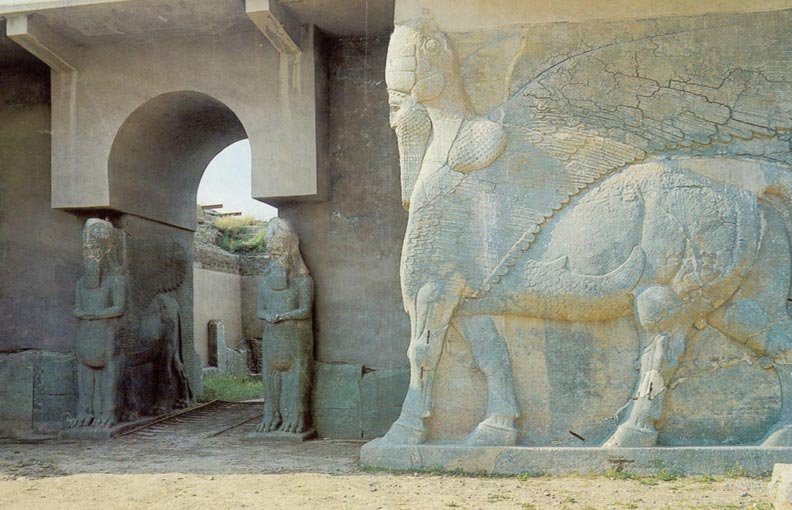
Nimrud Lamassu's at the North West Palace of AshurnasirpalM.chohan · Public domain · Commons
Assyria was a major ancient Mesopotamian civilization that existed from the 21st to the 7th century BCE which conquered and administered most of West Asia from the Assyrian heartland in Upper Mesopotamia. Assyria is called the first true military superpower in human history, and pioneered major inventions and advances in the first libraries and large-scale preservation and accumulation of knowledge, as well as in statecraft, centralised government, bureaucracy, warfare, military organisation, propaganda, art, and architecture.
Agricultural villages in the region that would later become Assyria are known to have existed by the time of the Hassuna culture, c. 6300–5800 BC. Though the sites of some nearby cities that would later be incorporated into the Assyrian heartland, such as Nineveh, are known to have been inhabited since the Neolithic, the earliest archaeological evidence from Assur dates to the Early Dynastic Period, c. 2600 BC. During this time, the surrounding region was already relatively urbanized. There is no evidence that early Assur was an independent settlement, and it might not have been called Assur at all initially, but rather Baltil or Baltila, used in later times to refer to the city's oldest portion.
Read more
The name "Assur" is first attested for the site in documents of the Akkadian period in the 24th century BC.
The success of Assyria was not only due to energetic kings who expanded its borders but more importantly due to its ability to efficiently incorporate and govern conquered lands. From the rise of Assyria as a territorial state at the beginning of the Middle Assyrian period onward, Assyrian territory was divided into a set of provinces or districts (pāḫutu). The total number and size of these provinces varied and changed as Assyria expanded and contracted. Every province was headed by a provincial governor (bel pāḫete, bēl pīhāti or šaknu) who was responsible for handling local order, public safety and economy.
Read more
Governors stored and distributed the goods produced in their province, which were inspected and collected by royal representatives once a year. Through these inspections, the central government could keep track of current stocks and production throughout the country.
In the Assur city-state of the Old Assyrian period, the government was in many respects an oligarchy, where the king was a permanent, albeit not the only prominent, actor. The Old Assyrian kings were not autocrats, with sole power, but rather acted as stewards on behalf of the god Ashur and presided over the meetings of the city assembly, the main Assyrian administrative body during this time. The composition of the city assembly is not known, but it is generally believed to have been made up of members of the most powerful families of the city, many of whom were merchants.
Read more
The king acted as the main executive officer and chairman of this group of influential individuals and also contributed with legal knowledge and expertise. The Old Assyrian kings were styled as iššiak Aššur ("governor [on behalf] of Ashur"), with Ashur being considered the city's formal king.
A relatively large number of statues and figurines have been recovered from the ruins of temples in Assur dating to the Early Assyrian period. Most of the surviving artwork from this time was clearly influenced by the artwork of foreign powers. For instance, a set of 87 alabaster figures of male and female worshippers from Assur before the rise of the Akkadian Empire greatly resembles Early Dynastic Sumerian figures. Because of variation in artwork elsewhere, the artwork of early Assur was also highly variable depending on the time period, ranging from highly stylized to highly naturalistic.
Read more
Among the most unique finds from the Early period is the head of a woman of which her eyes, eyebrows, and elaborate hair covering were originally inlaid. This head is typical of the art style of the Akkadian period, with an overall naturalistic style, smooth and soft curves and a full mouth.
Code of Hammurabi, king of Babylon; front, bas-relief.Mbzt · CC BY 3.0 · Commons
Babylonia (Akkadian: 𒆳𒆍𒀭𒊏𒆠, māt Akkadī) was an ancient Akkadian-speaking state and cultural area based on the city of Babylon in central-southern Mesopotamia (present-day Iraq and parts of Syria). It emerged as an Akkadian-populated but Amorite-ruled state c. 1894 BC. During the reign of Hammurabi and afterwards, Babylonia was retrospectively called "the country of Akkad" (māt Akkadī in Akkadian), a deliberate archaism in reference to the previous glory of the Akkadian Empire.
We find [medical semiotics] in a whole constellation of disciplines.... There was a real common ground among these [Babylonian] forms of knowledge... an approach involving analysis of particular cases, constructed only through traces, symptoms, hints.... In short, we can speak about a symptomatic or divinatory [or conjectural] paradigm which could be oriented toward past present or future, depending on the form of knowledge called upon. Toward future... that was the medical science of symptoms, with its double character, diagnostic, explaining past and present, and prognostic, suggesting likely future....
Read more
The oldest Babylonian (i.e., Akkadian) texts on medicine date back to the First Babylonian dynasty in the first half of the 2nd millennium BC although the earliest medical prescriptions appear in Sumerian during the Third Dynasty of Ur period.
Babylonia was absorbed into the Achaemenid Empire in 539 BC, becoming the satrapy of Babirush (Old Persian: 𐎲𐎠𐎲𐎡𐎽, romanized: Bābiruš).
Read more
A year before Cyrus' death, in 529 BC, he elevated his son Cambyses II in the government, making him king of Babylon. He reserved for himself the fuller title of "king of the (other) provinces" of the empire. It was only when Darius I acquired the Persian throne and ruled it as a representative of the Zoroastrian religion that the old tradition was broken and the claim of Babylon to confer legitimacy on the rulers of West Asia ceased to be acknowledged.
Immediately after Darius seized Persia, Babylonia briefly recovered its independence under a native ruler, Nidinta-Bel, who took the name of Nebuchadnezzar III, and reigned from October 522 BC to August 520 BC, when Darius took the city by storm.
Babylonia, and particularly its capital city Babylon, has long held a place in the Abrahamic religions as a symbol of excess and dissolute power. Many references are made to Babylon in the Bible, both literally (historical) and allegorically. The mentions in the Tanakh tend to be historical or prophetic, while New Testament apocalyptic references to the Whore of Babylon are more likely figurative, or cryptic references possibly to pagan Rome, or some other archetype. The legendary Hanging Gardens of Babylon and the Tower of Babel are seen as symbols of luxurious and arrogant power respectively.
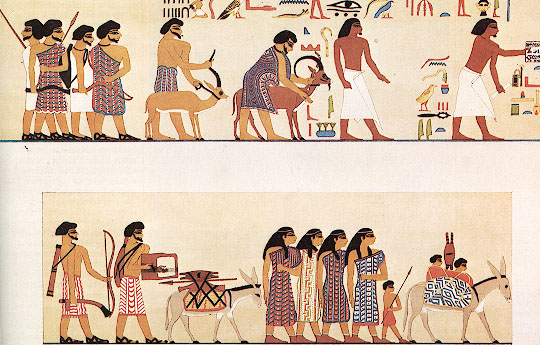
Drawing of the famous depiction of the Aamu group.NebMaatRa · CC BY-SA 3.0 · Commons
The Hyksos (Egyptian ḥqꜣ(w)-ḫꜣswt, Egyptological pronunciation: heqau khasut, 'ruler(s) of foreign lands'), in modern Egyptology, were the kings of the Fifteenth Dynasty of Egypt (fl. c. 1650 – c. 1550 BC). Their seat of power was the city of Avaris in the Nile Delta, from where they ruled over Lower Egypt and Middle Egypt up to Cusae.
In the Aegyptiaca, a history of Egypt written by the Greco-Egyptian priest and historian Manetho in the 3rd century BC, the term Hyksos is used ethnically to designate people of probable West Semitic, Levantine origin.
A people of ignoble origin from the east, whose coming was unforeseen, had the audacity to invade the country, which they mastered by main force without difficulty or even battle. Having overpowered the chiefs, they then savagely burnt the cities, razed the temples of the gods to the ground, and treated the whole native population with the utmost cruelty, massacring some, and carrying off the wives and children of others into slavery (Contra Apion I.75-77).
Read more
Manetho's invasion narrative is "nowadays rejected by most scholars." It is likely that more recent foreign invasions of Egypt influenced him. Instead, it appears that the establishment of Hyksos rule was mostly peaceful and did not involve an invasion of an entirely foreign population.
The Hyksos engagement in long-distance diplomacy is confirmed by a cuneiform letter discovered in the ruins of Avaris. Hyksos diplomacy with Crete and ancient Near East is also confirmed by the presence of gifts from the Hyksos court in those places. Khyan, one of the Hyksos rulers, is known for his wide-ranging contacts, as objects in his name have been found at Knossos and Hattusha indicating diplomatic contacts with Crete and the Hittites, and a sphinx with his name was bought on the art market at Baghdad and might demonstrate diplomatic contacts with Babylon, possibly with the first Kassites ruler Gandash.
Read more
The Theban rulers of the Seventeenth Dynasty are known to have imitated the Hyksos both in their architecture and regnal names.
The conflict between Thebes and the Hyksos is known exclusively from pro-Theban sources, and it is not easy to construct a chronology. These sources propagandistically portray the conflict as a war of national liberation. This perspective was formerly taken by scholars as well but is no longer thought to be accurate.
Read more
Hostilities between the Hyksos and the Theban Seventeenth Dynasty appear to have begun during the reign of Theban king Seqenenra Taa. Seqenenra Taa's mummy shows that he was killed by several blows of an axe to the head, apparently in battle with the Hyksos. It is unclear why hostilities may have started. The much later fragmentary New Kingdom tale The Quarrel of Apophis and Seqenenre blames the Hyksos ruler Apepi/Apophis for initiating the conflict by demanding that Seqenenre Tao remove a pool of hippopotamuses near Thebes.
The early period of Hyksos presence established their capital of Avaris "as the commercial capital of the Delta". The trading relations of the Hyksos were mainly with Canaan and Cyprus. Trade with Canaan is said to have been "intensive", especially with many imports of Canaanite wares, and may have reflected the Canaanite origins of the dynasty. Trade was mostly with the cities of the northern Levant, but connections with the southern Levant also developed. Additionally, trade was conducted with Faiyum, Memphis, oases in Egypt, Nubia, and Mesopotamia. Trade relations with Cyprus were also very important, particularly at the end of the Hyksos period. Aaron Burke has interpreted the equid burials in Avaris of evidence that the people buried with them were involved in the caravan trade.
The Hyksos' rule continued to be condemned by New Kingdom pharaohs such as Hatshepsut, who, 80 years after their defeat, claimed to rebuild many shrines and temples which they had neglected.
Read more
Ramses II moved Egypt's capital to the Delta, building Pi-Ramesses near the site of Avaris, where he set up a stela marking the 400th anniversary of the cult of Set. Scholars used to suggest that this marked 400 years since the Hyksos had established their rule, however the lists of Ramesses' ancestors continued to omit the Hyksos and there is no evidence that they were honored during his reign. The Turin King List, which includes the Hyksos and all other disputed or disgraced former rulers of Egypt, appears to date from the reign of Ramesses or one of his successors.
Conquest of the Sea-Land by the Kassites.Edwin A. Morrow · Public domain · Commons
The First Sealand dynasty (URU.KÙKI), or the 2nd Dynasty of Babylon (although it was independent of Amorite-ruled Babylon), very speculatively c. 1732–1475 BC (MC), is an enigmatic series of kings attested to primarily in laconic references in the King Lists A and B, and as contemporaries recorded on the Assyrian Synchronistic king list A.117. Initially it was named the "Dynasty of the Country of the Sea" with Sealand later becoming customary.
Tell Fecheriye, view from the EastSebastian Hageneuer · CC BY-SA 3.0 · Commons
Mitanni or Mittani (c. 1550–1260 BC), earlier called Ḫabigalbat in old Babylonian texts, c. 1600 BC; Ḫanigalbat or Ḫani-Rabbat in Assyrian records, or Naharin in Egyptian and some Akkadian texts, was a Hurrian-speaking kingdom in northern Syria and southeast Anatolia (modern-day Turkey) with Indo-Aryan linguistic and political influences. Since no histories, royal annals or chronicles have yet been found in its excavated sites, knowledge about Mitanni is sparse compared to the other powers in the area, and dependent on what its neighbours commented in their texts.
The organization of the Mitanni kingdom is very poorly understood, even at its peak during the second half of the 15th century. Information must be gleaned from a small number of documents and is therefore limited.
Read more
The Mitannian kingdom appears to have been a sort of confederation dominated by the king of Mitanni, one of the "Great Kings" (Akkadian šarru rabu) of the Near East in the second half of the 2nd century (along with those of Ancient Egypt, Babylon, and the Hittites). He led a heterogeneous group of political entities, probably subject to various forms of domination. The kingdom includes provinces (ḫalṣu) administered directly and entrusted to governors (Hurrian ḫalzogli?), such as in Aleppo. It then includes vassal kingdoms, such as Alalakh and Arrapha.
Royal seal of Šauštatar of MitanniSnubcube at English Wikipedia, public domain because copies of two dimensional works can't be copyrighted · Public domain · Commons
Wars and Battles
The War waged by Suppiluliuma on Tushrata's Mitanni was called 'the Great Syrian War'. The war goals were the Destruction of the Mitanni Heartlands and conquest of its Syrian vassal states. This included persuading Ugarit to join the side of Suppiluliuma. Mukish and Nuhašši retaliated against Ugarit, but once Suppiluliuma arrived, they were defeated by the Hittite-Ugaritic alliance, and Ugarit got a significant portion of their lands annexed to it. Suppiluliuma then crossed the Euphrates and sacking Washukanni, Tushrata escaping with some of his troops before the sack. After which Suppiluliuma turned back to Syria and subjugated Aleppo, Mukish, Niya, Arahtu, Qatna and Nuhašši. This campaign was fought in 1345 BC. A number of years later in 1327 BC Carchemish too was taken after a siege and Tushratta got murdered sometime after the war by Mitannians.
With the final decline of the Mitanni Empire the western portions of its territory came under direct control of the Hittites and the eastern portions came under direct control of the Assyrians. The middle part continued on as the rump state of Hanigalbat. Eventually, under Shalmaneser I, that remaining part of the former Mitanni territory came under direct Assyrian control. This continued until the decline of Middle Assyrian power after the death of Tukulti-Ninurta I.
Read more
While under direct Assyrian control Hanigalbat was ruled by appointed governors such as the Assyrian grand-vizier Ilī-padâ, father of Ninurta-apal-Ekur (1191–1179), who took the title of King of Hanigalbat. He resided in the newly built (over an existing Mitanni tower and residence) Assyrian administrative centre at Tell Sabi Abyad.
Philistia refers to the territory inhabited by the Philistines in Canaan, where they maintained a pentapolis comprising the cities of Gaza, Ashkelon, Ashdod, Ekron, and Gath. For a time, Philistia also included Jaffa, which may have briefly changed hands with Israel before it was ultimately lost to the Neo-Assyrian Empire during Sennacherib's Levantine campaign.
Scholars believe that the Philistines originated from Greek migrant groups of the Aegean civilization that, from roughly 1200 BC onwards, settled in the area and gradually intermixed with the indigenous Canaanite population.
Philistine, Canaanite, Aramaic (from the 6th century BC)
Religion
Canaanite religion
Phoenicia
1150 BCE – 501 BCE · Capital: None; dominant cities were Byblos, Sidon, and Tyre · 35,130 km²
Achaemenid cavalry on Alexander Sarcophagusderivative work: User:G.dallorto (talk) NAMABG-Colored_Alexander_Sarcophagus_1.JPG: Marsyas · CC BY-SA 3.0 · Commons
The Phoenicians were an ancient Semitic-speaking people who inhabited city-states in Canaan along the Levantine coast of the eastern Mediterranean, primarily in present-day Lebanon. Their maritime civilization expanded and contracted over time, with its cultural core stretching from Arwad to Mount Carmel. Through trade and colonization, the Phoenicians extended their influence across the Mediterranean, from Cyprus to the Maghreb and Iberian Peninsula, leaving behind thousands of inscriptions.
The Canaanite culture that gave rise to the Phoenicians apparently developed in situ from the earlier Ghassulian chalcolithic culture. The Ghassulian culture itself developed from the Circum-Arabian Nomadic Pastoral Complex, which in turn developed from a fusion of their ancestral Natufian and Harifian cultures with Pre-Pottery Neolithic B (PPNB) farming cultures. These practiced the domestication of animals during the 8.2 kiloyear event, which led to the Neolithic Revolution in the Levant. The Late Bronze Age state of Ugarit is considered Canaanite, even though the Ugaritic language does not belong to the Canaanite languages proper, and some of the texts on clay tablets discovered there indicate that the inhabitants of Ugarit did not consider themselves Canaanites.
Didolived Unknown authorUnknown author · Public domain · Commons
Government, Society and Religion
The religious practices and beliefs of Phoenicians were generally common to those of their neighbors in Canaan, which in turn shared characteristics common throughout the ancient Semitic world. Religious rites were primarily for city-state purposes; payment of taxes by citizens was considered in the category of religious sacrifices. The Phoenician sacred writings known to the ancients have been lost.
Read more
Several Canaanite practices are alleged in ancient sources and mentioned by scholars, such as temple prostitution and child sacrifice. Special sites known as "Tophets" were allegedly used by the Phoenicians "to burn their sons and their daughters in the fire", and are condemned in the Hebrew Bible, particularly in Jeremiah 7:30–32, and in 2nd Kings 23:10 and 17:17. Notwithstanding differences, cultural and religious similarities persisted between the ancient Hebrews and the Phoenicians.
City-states ruled by kings, with varying degrees of oligarchy or plutocracy; oligarchic republic in Carthage after c. 480 BC
Languages
Phoenician
Religion
Canaanite religion
Economy and Trade
As early as 1200 BC, texts from Ugarit suggest that Canaanite merchant ships were capable of carrying cargoes weighing up to 450 tons. During the first millennium BC, the cargo capacity of Phoenician merchant ships ranged between 100 and 500 tons. The Phoenicians pioneered the use of locked mortise and tenon joints, known as Phoenician joints, to secure the planking of ship hulls underwater. This method involved cutting mortises into adjoining planks and inserting wooden tenons to join them, which were then secured with dowels. Examples of this technique include the Uluburun shipwreck (c. 1320 BC) and the Cape Gelidonya shipwreck (c. 1200 BC). The innovation spread across the Mediterranean and influenced Greek and Roman shipbuilding, with the Romans referring to it as coagmenta punicana.
Read more
The Phoenicians were possibly the first to introduce the bireme.
The Phoenician city-states were highly independent, competing with each other. Formal alliances between city-states were rare. The relative power and influence of city-states varied over time. Sidon was dominant between the 12th and 11th centuries BC and influenced its neighbors. However, by the tenth century BC, Tyre rose to become the most powerful city.
Read more
At least in its earlier stages, Phoenician society was highly stratified and predominantly monarchical. Hereditary kings usually governed with absolute power over civic, commercial, and religious affairs. They often relied upon senior officials from the noble and merchant classes; the priesthood was a distinct class, usually of royal lineage or leading merchant families. The King was considered a representative of the gods and carried many obligations and duties concerning religious processions and rituals.
Dome of the Rock seen from the Mount of Olives in Jerusalem Jerusalemaskii · CC BY-SA 2.0 · Commons
The Kingdom of Israel (Hebrew: מַמְלֶכֶת יִשְׂרָאֵל, Mamleḵeṯ Yīśrāʾēl) was an Israelite kingdom that may have existed in the Southern Levant. The first extra-biblical mention of Israel dates from the Merneptah Stele created by Pharaoh Merneptah in 1208 BC. According to the Deuteronomistic history in the Hebrew Bible, the United Kingdom of Israel or the United Monarchy existed under the reigns of Saul, Ish-bosheth, David, and Solomon, encompassing the territories of both the later kingdoms of Judah and Israel.
Breaking the Silence Hebron tour, August 28, 2015. Hebron and the Cave of the Patriarchs. This is what it's all about. It's quite lovely, really, shame about how crazy it all is.Oren Rozen · CC BY-SA 4.0 · Commons
Following Solomon's death in c. 926 BCE, tensions between the northern part of Israel, containing the ten northern tribes, and the southern section, dominated by Jerusalem and the southern tribes, reached a boiling point. When Solomon's son and successor Rehoboam dealt tactlessly with economic complaints of the northern tribes, in about 930 BCE (there are differences of opinion as to the actual year), the Kingdom of Israel and Judah splits into two kingdoms: the northern Kingdom of Israel, which included the cities of Shechem and Samaria, and the southern Kingdom of Judah, which contained Jerusalem.
Read more
The Kingdom of Israel (or the Northern Kingdom or Samaria) existed as an independent state until 722 BCE when it was conquered by the Neo-Assyrian Empire.
Dome of the Rock seen from the Mount of Olives in Jerusalem Jerusalemaskii · CC BY-SA 2.0 · Commons
The Kingdom of Judah was an Israelite kingdom of the Southern Levant during the Iron Age. Centered in the highlands to the west of the Dead Sea, the kingdom's capital was Jerusalem. It was ruled by the House of David for four centuries. Jews are named after Judah, and primarily descend from people who lived in the region.
The Hebrew Bible depicts the Kingdom of Judah as one of the two successor states of the United Kingdom of Israel, a term denoting the united monarchy under biblical kings Saul, David, and Solomon and covering the territory of Judah and Israel.
The major theme of the Hebrew Bible's narrative is the loyalty of Judah, especially its kings, to Yahweh, which it states is the God of Israel. Accordingly, all of the kings of Israel (except to some extent Jehu) and many of the kings of Judah were "bad" in terms of the biblical narrative by failing to enforce monotheism. Of the "good" kings, Hezekiah (727–698 BCE) is noted for his efforts at stamping out idolatry (in his case, the worship of Baal and Asherah, among other traditional Near Eastern divinities), but his successors, Manasseh of Judah (698–642 BCE) and Amon (642–640 BCE), revived idolatry, which drew down on the kingdom the anger of Yahweh.
Yahwism (Early Judaism), Canaanite religion, Folk religion
Economy and Trade
Judah's traditional economy was a traditional mediterranean subsistence. The kingdom's economy transformed under Assyrian influence, shifting from subsistence farming to a system where each region focused on specific agricultural products.
Read more
The highlands west and north of Jerusalem, and likely to the south as well, were known for viticulture. The Late Iron Age saw a surge in rural activity across the Soreq and Rephaim Valleys, with 65 sites identified and excavated. These sites formed a four-tiered hierarchy, including large administrative centers like Tel Moza, smaller villages, isolated buildings and farms, and agro-production spots like wine presses. The Nahal Shmuel area, in particular, became a key center for wine production, with 57 documented wine presses, while further north in Gibeon, the largest concentration of wine storage cellars, 63 in total, was found, used for aging wine.
There are several archeological findings that highlight elements of crisis and decline in the Kingdom of Judah. The Kingdom of Judah experienced a major political and territorial crisis during the late 8th century BCE following the expansion of the Neo-Assyrian Empire. In 701 BCE, Sennacherib invaded Judah after King Hezekiah rebelled against Assyrian rule. Assyrian records describe the destruction and capture of numerous Judahite fortified settlements and the imposition of tribute on Hezekiah.
Read more
Judah subsequently recovered during the 7th century BCE and experienced renewed economic and demographic growth. The kingdom nevertheless became caught between the competing powers of Assyria, Egypt and Babylonia following the collapse of the Assyrian Empire.
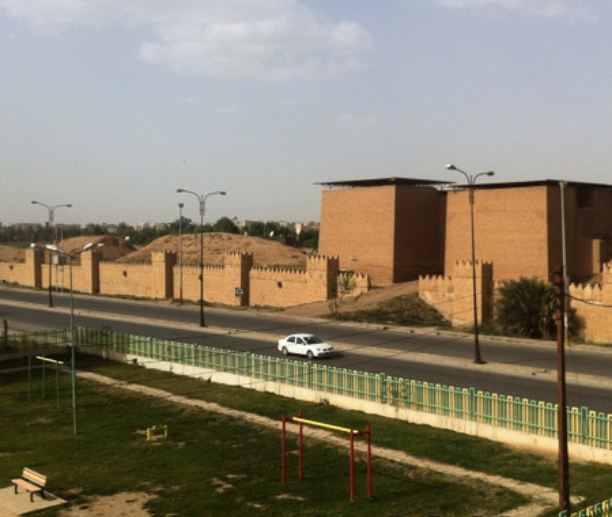
Ruins of the ancient city of Babylon Al-Hillah, Mesopotamia (Irak). S. VIII b.C - S.V b.C.Mohamm3dfadil · CC BY-SA 4.0 · Commons
The Neo-Babylonian Empire or Second Babylonian Empire, historically known as the Chaldean Empire, was the last polity ruled by monarchs native to ancient Mesopotamia. Beginning with the coronation of Nabopolassar as the King of Babylon in 626 BC and being firmly established through the fall of the Assyrian Empire in 612–609 BC, the Neo-Babylonian Empire was conquered by the Achaemenid Persian Empire in 539 BC, less than a century after the founding of the Chaldean dynasty.
Babylonia was founded as an independent state by an Amorite chieftain named Sumu-abum c. 1894 BC. For over a century after its founding, it was a minor and relatively weak state, overshadowed by older and more powerful states such as Isin, Larsa, Assyria and Elam. But Hammurabi (r. c. 1792–1750 BC) turned Babylon into a major power and eventually conquered Mesopotamia and beyond, founding the Old or First Babylonian Empire. After his death, his dynasty lasted another century and a half, but the Babylonian Empire quickly collapsed, and Babylon once more became a small state. Babylonia fell to the Hittite king Mursili I c. 1595 BC, after which the Kassites took control and ruled for almost five centuries before being deposed by native Babylonian rulers, who continued to rule the Babylonian rump state.
At the top of the Neo-Babylonian Empire social ladder was the king (šar); his subjects took an oath of loyalty called the ade to him, a tradition inherited from the Neo-Assyrian Empire. The Neo-Babylonian kings used the titles King of Babylon and King of Sumer and Akkad. They abandoned many of the boastful Neo-Assyrian titles that claimed universal rule (though some of these would be reintroduced under Nabonidus), possibly because the Assyrians had been resented by the Babylonians as impious and warlike and the Neo-Babylonian kings preferred to present themselves as devout kings.
Read more
The king was also the single most important landowner within the empire, with there being several large swaths of land placed under direct royal control throughout Babylonia.
The establishment of the Neo-Babylonian Empire meant that for the first time since the Assyrian conquest, tribute flowed into Babylonia rather than being drained from it. This reversal, combined with building projects and the relocation of subjugated peoples stimulated both population and economic growth in the region.
Read more
Although the soil in Mesopotamia was fertile, the average rainfall in the region was not enough to sustain regular crops. As such, water had to be drawn from the two major rivers, the Euphrates and the Tigris, for use in irrigation. These rivers tended to flood at inconvenient times, such as at grain harvest time. To solve these issues and allow for efficient farming, Mesopotamia required a sophisticated large-scale system of canals, dams and dikes, both to protect from floods and to supply water. These structures required constant maintenance and supervision to function.
For the Neo-Babylonian kings, war was a means to obtain tribute, plunder (in particular sought after materials such as various metals and quality wood) and prisoners of war which could be put to work as slaves in the temples. Like their predecessors, the Assyrians, the Neo-Babylonian kings also used deportation as a means of control. The Assyrians had displaced populations throughout their vast empire, but the practice under the Babylonian kings seems to have been more limited, only being used to establish new populations in Babylonia itself. Though royal inscriptions from the Neo-Babylonian period don't speak of acts of destruction and deportation in the same boastful way royal inscriptions from the Neo-Assyrian period do, this does not prove that the practice ceased or that the Babylonians were less brutal than the Assyrians.
Monumental architecture encompasses building works such as temples, palaces, ziggurats (a massive structure with religious connections, composed of a massive stepped tower with a shrine on top), city walls, processional streets, artificial waterways and cross-country defensive structures. The Babylonian king was traditionally a builder and restorer, and as such large-scale building projects were important as a legitimizing factor for Babylonian rulers. Due to the interests of early excavators of the ancient cities in Babylonia, most of the archaeological knowledge regarding the Neo-Babylonian Empire is related to the vast monumental buildings that were located in the hearts of Babylonia's major cities. This early bias has resulted in that the makeup of the cities themselves (such as residential areas) and the structure of smaller settlements remains under-researched.
Early in the reign of the Neo-Assyrian king Sinsharishkun, the southern official or general Nabopolassar revolted amid ongoing political instability in Assyria, caused by an earlier brief civil war between Sinsharishkun and the general Sin-shumu-lishir. In 626 BC, Nabopolassar assaulted and successfully seized the cities of Babylon and Nippur. Sinsharishkun's response was quick and decisive; by October of that year the Assyrians had recaptured Nippur and besieged Nabopolassar at the city of Uruk. However, Sinsharishkun failed to capture Babylon, and Nabopolassar endured the siege of Uruk, repulsing the Assyrian army.
Read more
In November 626 BC, Nabopolassar was crowned King of Babylon, restoring Babylonia as an independent kingdom after more than a century of direct Assyrian rule.
The early Achaemenid rulers had great respect for Babylonia, regarding it as a separate entity or kingdom united with their own kingdom in something akin to a personal union. The region was a major economical asset and provided as much as a third of the entire Achaemenid Empire's tribute. Despite Achaemenid attention and the recognition of the Achaemenid rulers as kings of Babylon, Babylonia resented the Achaemenids, like the Assyrians had been resented a century earlier. At least five rebels proclaimed themselves King of Babylon and revolted during the time of Achaemenid rule in attempts at restoring native rule; Nebuchadnezzar III (522 BC), Nebuchadnezzar IV (521–520 BC), Bel-shimanni (484 BC), Shamash-eriba (482–481 BC) and Nidin-Bel (336 BC). The revolt of Shamash-eriba against Xerxes I in particular is suggested by ancient sources to have had dire consequences for the city.
Coin of Tigranes the Younger, Tigranocerta mint.Classical Numismatic Group; [1] · CC BY-SA 3.0 · Commons
The Kingdom of Greater Armenia or simply Greater Armenia or Armenia Major (Armenian: Մեծ Հայք Mets Hayk; Latin: Armenia Maior), sometimes referred to as the Armenian Empire under Tigranes II, was an Armenian kingdom in the Ancient Near East which existed from 331 BC to 428 AD. Its history is divided into the successive reigns of three royal dynasties: Orontid (331–200 BC), Artaxiad (189 BC – 12 AD), and Arsacid (52–428).
Prior to the 9th century BC, the geographic region known as the Armenian Highlands was inhabited by Proto-Armenian and other tribes which did not yet constitute a unitary state or nation. The first state to rule over a significant part of the Armenian Highlands was the Kingdom of Urartu, also known as the Kingdom of Van or Ararat and called Biainili in the Urartian language used by its rulers. The kingdom competed with Assyria over supremacy in the highlands of Ararat and the Fertile Crescent.
Read more
Both kingdoms fell to Iranian invaders from the east (the Medes, followed by the Achaemenid Persians) in the 6th century BC. Its territory was reorganized into a satrapy called Armenia. The Orontid dynasty ruled as satraps of the Achaemenid Empire for three centuries until the empire was defeated by Alexander the Great's Macedonian Empire at the Battle of Gaugamela in 331 BC.
The Kingdom of Armenia was bordered by Caucasian Albania in the east, Iberia in the north, the Roman Empire in the west, and Parthia, later succeeded by Sassanian Empire, in the south. The border between Iberia and the Kingdom of Armenia was the Kur River, which was also the border between Caucasian Albania and Kingdom of Armenia.
Read more
After 331 BC, Armenia was divided into Lesser Armenia (a region of the Kingdom of Pontus), the Kingdom of Armenia (corresponding to Armenia Major) and the Kingdom of Sophene. In 189 BC when Artashes I's reign began, many neighboring countries (Media, Caucasian Iberia, Seleucid Empire) exploiting the weakened state of the kingdom, conquered its remote regions.
The army of the Kingdom of Armenia reached its peak under the reign of Tigranes the Great. According to the author of Judith, his army included chariots and 12,000 cavalrymen, most likely heavy cavalry or cataphracts, a unit also commonly used by Seleucids and Parthians. His army consisted mainly of 120,000 infantrymen and 12,000 mounted archers, also an important feature of the Parthian army. Like the Seleucids, the bulk of Tigranes' army were foot soldiers. The Jewish historian Josephus talks of 500,000 men in total, including camp followers. These followers consisted of camels, donkeys, and mules used for baggage, sheep, cattle, and goats for food, said to be stocked in abundance for each man, and hoards of gold and silver.
Laomedon (Greek: Λαoμέδων ὁ Μυτιληναῖος; lived during the 4th century BC) was a Greek military commander, native of Mytilene and son of Larichus. He was one of Alexander the Great's generals, and appears to have enjoyed a high place in his confidence even before the death of Philip II, as he was one of those banished by that monarch (together with his brother Erigyius, Ptolemy, Nearchus, and others) for taking part in the intrigues of the young prince.
Il generale macedone Perdicca, incisione del XVIII secoloAlessio Cosentino · CC BY-SA 4.0 · Commons
Perdiccas (Greek: Περδίκκας, Perdikkas; c. 355 BC – 320 BC) was a Macedonian general and bodyguard (somatophylax) of Alexander the Great, and the regent of Alexander's empire after his death. When Alexander was dying, he entrusted his signet ring to Perdiccas, initially the most pre-eminent of the successors due to being second-in-command. Perdiccas effectively ruled Alexander's increasingly unstable empire from Babylon for three years until his assassination.
Perdiccas was born to Macedonian nobility.
According to the 2nd-century historian Arrian, Perdiccas was the son of the Macedonian nobleman Orontes, a descendant of the independent princes of the Macedonian province of Orestis. While Perdiccas' actual date of birth is unknown, he would seem to have been of a similar age to Alexander; historian Tristan Hughes estimated that he was born around 361 BC and historian Waldemar Heckel described him as younger than Ptolemy, son of Lagus. He had a younger brother called Alcetas and a sister, Atalante, who married Attalus. Perdiccas may have had, through some distant relation, blood of the Argead royal family.
Read more
Little is known of Perdiccas' youth, but he was probably brought to the Macedonian court in Pella to serve as page like many other young nobles alongside Alexander.
Ptolemy had been fortifying his satrapy for two years, believing war with Perdiccas was highly likely, and this greatly contributed to Perdiccas' difficulties and ultimate defeat. Ptolemy directed his efforts to preventing an open pitched battle between him and Perdiccas.
Read more
Perdiccas reached the most easterly tributary of the Nile near Pelusium, and discovered the opposite side was garrisoned. He had his troops construct a dam, probably intending to lower the water levels to ease a crossing, but the force of the river broke it apart. It is possible that Perdiccas' invasion occurred while the Nile was flooding. In any case, the destruction of the dam led some officers in Perdiccas' camp to defect; Perdiccas, in response, successfully inspired his army with gifts and titles to continue the war effort.
Perdiccas then decamped, not informing his soldiers where he intended to march.
Perdiccas' death and the transfer of the regency to Antipater has been seen as marking the end "for the empire as Alexander had envisioned it", as Perdiccas was not only quite close to Alexander but, like Alexander, had chosen to centre the empire at Babylon. Classicist Robin Waterfield believes that since Perdiccas represented direct succession from Alexander himself, his assassination was a "momentous step".
Read more
Perdiccas' motives are debated, though he is typically held to have acted from ambition. Some, such as Romm, believe he may have acted out of a desire to protect Alexander IV and maintain the unity of Alexander's empire. Anson disbelieves this, citing Perdiccas' duplicitous communications with the Aetolian League against Antipater. Whether for ambition or loyalty, it is agreed that Perdiccas sought to "hold Alexander's legacy intact".
The Nabataeans, also spelled Nabateans (Nabataean Aramaic / Nabataean Arabic: 𐢕𐢃𐢋𐢈, romanized: nbṭw, vocalized: Nabāṭū; Arabic: الأنباط, romanized: al-ʾanbāṭ), were an ancient Arab people who inhabited the southern Levant and northern Arabia. Their settlements—most prominently the assumed capital city of Raqmu (present-day Petra, Jordan)—gave the name Nabatene (Ancient Greek: Ναβατηνή, romanized: Nabatēnḗ) to the Arabian borderland that stretched from the Euphrates to the Red Sea.
Dushara was the supreme deity of the Nabataean Arabs and was the official god of the Nabataean Kingdom who enjoyed special royal patronage. His official position is reflected in multiple inscriptions that render him as "The god of our lord" (the king).
Read more
The name Dushara is from the Arabic "Dhu ash-Shara": which simply means "the one of Shara", a mountain range southeast of Petra also known as Mount Seir. Therefore, from a Nabataean perspective, Dhushara was probably associated with the heavens. However, one theory which connects Dushara with the forest gives a different idea of the god. The eagle was one of the symbols of Dushara. It was widely used in Hegra as a source of protection for the tombs against thievery.
Nabataean inscriptions from Hegra suggest that Dushara was linked either with the sun or with Mercury with which Ruda, another Arabian god, was identified.
Nabataean Arabic (native), Nabataean Aramaic (commercial and official purposes)
Religion
Nabataean polytheism, Christianity
Achievements and Monuments
Many examples of graffiti and inscriptions—largely of names and greetings—document the area of Nabataean culture, which extended as far north as the north end of the Dead Sea, and testify to widespread literacy; but except for a few letters no Nabataean literature has survived, nor was any noted in antiquity. Onomastic analysis has suggested that Nabataean culture may have had multiple influences. Classical references to the Nabataeans begin with Diodorus Siculus. They suggest that the Nabataeans' trade routes and the origins of their goods were regarded as trade secrets, and disguised in tales that should have strained outsiders' credulity.
Judea or Judaea (Hebrew: יהודה, Modern: Yəhūda, Tiberian: Yehūḏā; Arabic: يهودا, Yahūdā; Greek: Ἰουδαία, Ioudaía; Latin: Iudaea) is a mountainous region of the Levant. Traditionally dominated by the city of Jerusalem, it is now part of Israel and the West Bank. The name is derived from the Hebrew name Yehudah, and was used during the Babylonian, Persian, Hellenistic, and Roman periods. Under the Hasmoneans, the Herodians, and the Romans, the term was applied to an area larger than the Judea of earlier periods.
There is no consensus among linguists and historians as to the origins of the name Judah (Yehudah). The Book of Genesis presents a folk etymology deriving it from a legendary founder Judah, the son of Jacob, offering a wordplay This etymology is generally regarded as dubious by modern scholars because of its strong similarity to other eponymic legends from antiquity that were later proven to be false, and because Judah does not appear as a given name until late in the post-Exilic period. Several scholars have suggested Judah may be a theophoric name referencing the tetragrammaton (y-h-w), a shortening of Yehuda-el ("praise be to El"), or an otherwise-unattested god y-h-w-d. However, there is little to no agreement on the specifics of such an origin, and these theories have fallen out of favor.
In 66 CE, the Jewish population rose against Roman rule in a revolt that was unsuccessful. Jerusalem was besieged in 70 CE. The city was razed, the Second Temple was destroyed, and much of the population was killed or enslaved.
Osroene (Ancient Greek: Ὀσροηνή), also spelled Osrhoene, was an ancient kingdom and region in Upper Mesopotamia. The Kingdom of Osroene, also known as the Kingdom of Edessa (Classical Syriac: ܡܠܟܘܬܐ ܕܒܝܬ ܐܘܪܗܝ, "Kingdom of Urhay") after its capital city (now Şanlıurfa, Turkey), existed from the 2nd century BC up to the 3rd century AD, and was ruled by the Nabataean Arab Abgarid dynasty. They were generally allied with the Parthians.
Osroene, or Edessa, was one of several states that acquired independence from the collapsing Seleucid Empire through a dynasty of the nomadic Nabataean tribe from Southern Canaan and North Arabia, the Osrhoeni, from 136 BC. Osroene's name either derives from the name of this tribe, or from Orhay (Urhay), the original Aramaic name of Edessa. Arab influence had been strong in the region.
Read more
Osroene endured for four centuries, with twenty-eight rulers occasionally named "king" on their coins. Most of the kings of Osroene were called Abgar or Manu and settled in urban centers.
Osroene was generally allied with the Parthian Empire. After a period under the rule of the Parthian Empire, it was absorbed into the Roman Empire in 114 as a semiautonomous vassal state, and incorporated as a simple Roman province in 214.
Aramaic (official), Koine Greek, Arabic, Persian, Parthian, Armenian
Religion
Christianity c. 200 AD (State religion) (contested)
Achievements and Monuments
Most of Osroene's rulers were sedentarized Arabs from the Nabataean Abgarid dynasty, and the kingdom's population was primarily of mixed Semitic origins, being Aramaic-speaking from the earliest times. Before emerging as an early and important center for Syriac Christianity, Edessa was a major centre for cult worship in the Near East, with devotees of Atargatis and Sabians mixing with those of Mesopotamian/Palmyrene Bel and Nabataean Dushara worshippers, among other pre-Islamic Arabian cults (such as the twins Monimos and Azizos).. Its overall cultural setting was hybridized and syncretic, incorporating Babylonian, Aramaean, Arab, Jewish, Iranian, Indian and Hellenistic influences. A centre of local reaction against Hellenism, its Arab dynasts became increasingly influenced by Syriac Christianity, presaging Rome's later embrace of monotheism.
Ancient States of Mesopotamia and the Levant: Frequently Asked Questions
Which states existed in Mesopotamia and the Levant in this period?
This page maps 20 states of Mesopotamia and the Levant founded between 3400 BCE and 63 BCE: Sumerian City-States, Akkadian Empire, Gutian Dynasty, Assyria, Babylonia, Hyksos, First Sealand Dynasty, Mitanni, Philistia, Phoenicia, Phoenician Empire, Kingdom of Israel and 8 more.
Which was the largest of the Ancient States of Mesopotamia and the Levant?
Neo-Babylonian Empire had the largest mapped extent, about 703,405 km².
Which of the Ancient States of Mesopotamia and the Levant lasted longest?
We use Google Analytics cookies to understand which pages are useful. Necessary storage only keeps your theme and this choice on your device. Privacy policy