
UNESCO World Heritage Sites in Kazakhstan
Kazakhstan has 2 sites on the UNESCO World Heritage List (2 cultural), the first inscribed in 2003 (Mausoleum of Khoja Ahmed Yasawi). The map below plots every one of them alongside the rest of the List, and each site is written up in full further down the page.
- World Heritage Sites
- 2
- Cultural
- 2
- Natural and Mixed
- 0
- First Inscribed
- 2003
Map of World Heritage Sites in Kazakhstan
CulturalNaturalMixedIn DangerLarge dots are in Kazakhstan. Click a dot to read about the site.

Mausoleum of Khoja Ahmed Yasawi
Kazakhstan · 43.2976° N, 68.2710° E · 1 km from Turkistan
The Mausoleum of Khawaja Ahmed Yasawi (Kazakh: Қожа Ахмет Яссауи кесенесі, romanized: Qoja Ahmet İassaui kesenesı) is a mausoleum in the city of Turkestan, in southern Kazakhstan. The structure was commissioned in 1389 by Timur, who ruled the area as part of the expansive Timurid Empire, to replace a smaller 12th-century mausoleum of the famous Turkic poet and Sufi mystic, Khoja Ahmed Yasawi (1093–1166). However, construction was halted with the death of Timur in 1405.
Despite its incomplete state, the mausoleum has survived as one of the best-preserved of all Timurid constructions. Its creation marked the beginning of the Timurid architectural style. The experimental spatial arrangements, innovative architectural solutions for vault and dome constructions, and ornamentations using glazed tiles made the structure the prototype for this distinctive art, which spread across the empire and beyond.
The religious structure continues to draw pilgrims from across Central Asia and has come to epitomize the Kazakh national identity. It has been protected as a national monument, while UNESCO recognized it as the country's first site of patrimony, declaring it a World Heritage Site in 2003.
Adapted from Wikipedia: Mausoleum of Khoja Ahmed Yasawi (CC BY-SA 4.0).
Why Mausoleum of Khoja Ahmed Yasawi Is Listed
- (i)
- A masterpiece of human creative genius.
- (iii)
- A unique testimony to a cultural tradition or civilisation.
- (iv)
- An outstanding example of a type of building or landscape.
More about Mausoleum of Khoja Ahmed Yasawi
UNESCO's Description
The Mausoleum of Khoja Ahmed Yasawi, in the town of Yasi, now Turkestan, was built at the time of Timur (Tamerlane), from 1389 to 1405. In this partly unfinished building, Persian master builders experimented with architectural and structural solutions later used in the construction of Samarkand, the capital of the Timurid Empire. Today, it is one of the largest and best-preserved constructions of the Timurid period.
From the UNESCO World Heritage Centre (CC BY-SA IGO 3.0).
History
Khoja Ahmed Yasawi (Khawaja or Khwaja (Persian: خواجه pronounced khâje) corresponds to "master", whence Arabic: خواجة khawājah), also spelled as Khawajah Akhmet Yassawi, was the 12th-century head of a regional school of Sufism, a mystic movement in Islam which began in the 9th century. He was born in Ispidjab (modern Sayram) in 1093, and spent most of his life in Yasi, dying there in 1166. He is widely revered in Central Asia and the Turkic-speaking world for popularizing Sufism, which sustained the diffusion of Islam in the area despite the contemporary onslaught of the Mongol invasion. The theological school he created turned Yasi into the most important centre of learning in the region. He was also an outstanding poet, philosopher and statesman.
Location
The Mausoleum of Khawaja Ahmed Yasawi is situated in the north-eastern part of the modern-day town of Turkestan (formerly known as Hazrat-e Turkestan), an ancient centre of caravan trade known earlier as Khazret and later as Yasi, in the southern part of Kazakhstan. The structure is within the vicinity of a historic citadel, which is now an archaeological site.
Remains of medieval structures such as other mausoleums, mosques and bath houses characterize the archaeological area. To the north of the Mausoleum of Khawaja Ahmed Yasawi, a reconstructed section of the citadel wall from the 1970s separates the historical area from the developments of the modern town.
Sections adapted from Wikipedia: Mausoleum of Khoja Ahmed Yasawi (CC BY-SA 4.0).
Key Facts
| Established | 14th century |
|---|---|
| Architectural style | Timurid architecture |
Facts from Wikidata Q46069 (CC0).
Tamgaly
Kazakhstan · 43.8033° N, 75.5350° E · 9 km² · 110 km from Tokmak
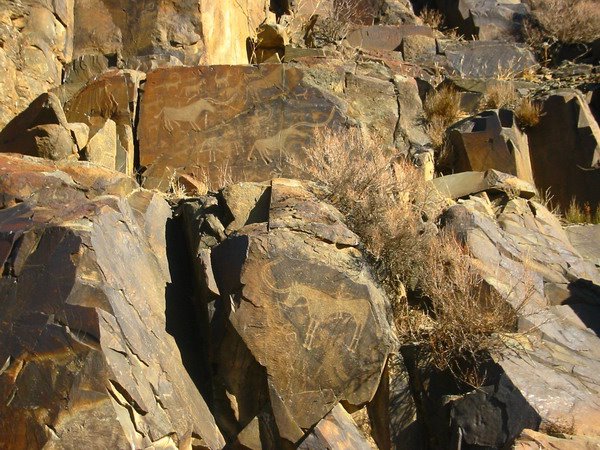
Tamgaly (Kazakh: Таңбалы, romanized: Tañbalı) is a petroglyph site in the Zhetysu of Kazakhstan.
Tamgaly became a UNESCO World Heritage Site in 2004.
Tamgaly is located 170 km (by road) northwest of Almaty.
The earliest of the petroglyphs of Tamgaly date from the Bronze Age (about 3,000 years ago), when the area was populated by the precursors to the Saka/Scythian people, and the most recent from the 18th or 19th century.
Adapted from Wikipedia: Tanbaly (CC BY-SA 4.0).
Why Tamgaly Is Listed
- (iii)
- A unique testimony to a cultural tradition or civilisation.
More about Tamgaly
UNESCO's Description
Set around the lush Tanbaly Gorge, amidst the vast, arid Chu-Ili mountains, is a remarkable concentration of some 5,000 petroglyphs (rock carvings) dating from the second half of the second millennium BC to the beginning of the 20th century. Distributed among 48 complexes with associated settlements and burial grounds, they are testimonies to the husbandry, social organization and rituals of pastoral peoples. Human settlements in the site are often multilayered and show occupation through the ages. A huge number of ancient tombs are also to be found including stone enclosures with boxes and cists (middle and late Bronze Age), and mounds (kurgans) of stone and earth (early Iron Age to the present). The central canyon contains the densest concentration of engravings and what are believed to be altars, suggesting that these places were used for sacrificial offerings.
From the UNESCO World Heritage Centre (CC BY-SA IGO 3.0).
Description
There are approximately 5,000 petroglyphs at Tamgaly distributed among 48 sites. Five of the most important sites, designated I, II, III, IV, and V, contain approximately 3,000 of the glyphs. These five sites are concentrated in the small Tamgaly canyon. Another 22 sites of secondary importance contain from 50 to 100 representations each. The remaining sites contain from 1 to 50 figures each and are widely distributed in area.
Middle Bronze Age glyphs have the greatest aesthetic and cultural value. Image sizes average around 25 to 30 cm with exceptional images reaching 0.7 to 1.0 meters in size. They were developed primarily by picking with an engraving depth of 3 to 5 mm.
Sections adapted from Wikipedia: Tanbaly (CC BY-SA 4.0).
World Heritage in Kazakhstan: Quick Answers
- How many UNESCO World Heritage Sites are in Kazakhstan?
- Kazakhstan has 2 World Heritage Sites: 2 cultural.
- What was the first World Heritage Site in Kazakhstan?
- Mausoleum of Khoja Ahmed Yasawi, inscribed in 2003. The most recent is Tamgaly, inscribed in 2004.
- Are any World Heritage Sites in Kazakhstan in danger?
- None of the World Heritage Sites in Kazakhstan is on UNESCO's List of World Heritage in Danger.