
UNESCO World Heritage Sites in Sudan
Sudan has 2 sites on the UNESCO World Heritage List (2 cultural), the first inscribed in 2003 (Gebel Barkal and the Sites of the Napatan Region). The map below plots every one of them alongside the rest of the List, and each site is written up in full further down the page.
- World Heritage Sites
- 2
- Cultural
- 2
- Natural and Mixed
- 0
- First Inscribed
- 2003
Map of World Heritage Sites in Sudan
CulturalNaturalMixedIn DangerLarge dots are in Sudan. Click a dot to read about the site.

Gebel Barkal and the Sites of the Napatan Region
Sudan · 18.5333° N, 31.8167° E · 2 km²
These five archaeological sites, stretching over more than 60 km in the Nile valley, are testimony to the Napatan (900 to 270 BC) and Meroitic (270 BC to 350 AD) cultures, of the second kingdom of Kush. Tombs, with and without pyramids, temples, living complexes and palaces, are to be found on the site. Since Antiquity, the hill of Gebel Barkal has been strongly associated with religious traditions and folklore. The largest temples are still considered by the local people as sacred places.
Description from the UNESCO World Heritage Centre (CC BY-SA IGO 3.0).
Why Gebel Barkal and the Sites of the Napatan Region Is Listed
- (i)
- A masterpiece of human creative genius.
- (ii)
- An important interchange of human values.
- (iii)
- A unique testimony to a cultural tradition or civilisation.
- (iv)
- An outstanding example of a type of building or landscape.
- (vi)
- A direct association with events, ideas or beliefs of universal significance.
Archaeological Sites of the Island of Meroe
Sudan · 16.9333° N, 33.7167° E · 24 km² · 42 km from Shendi
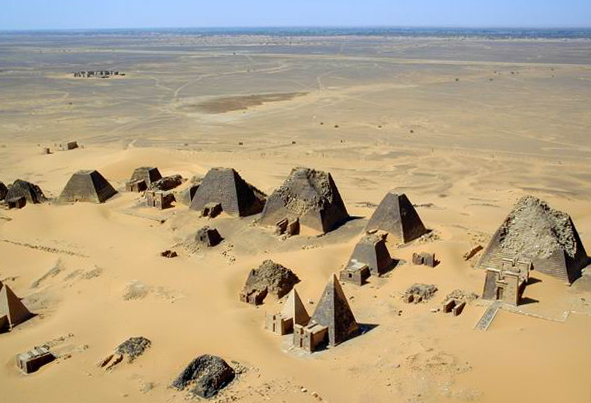
The Archaeological Sites of the Island of Meroe, a semi-desert landscape between the Nile and Atbara rivers, was the heartland of the Kingdom of Kush, a major power from the 8th century B.C. to the 4th century A.D. The property consists of the royal city of the Kushite kings at Meroe, near the River Nile, the nearby religious site of Naqa and Musawwarat es Sufra. It was the seat of the rulers who occupied Egypt for close to a century and features, among other vestiges, pyramids, temples and domestic buildings as well as major installations connected to water management. Their vast empire extended from the Mediterranean to the heart of Africa, and the property testifies to the exchange between the art, architectures, religions and languages of both regions.
Description from the UNESCO World Heritage Centre (CC BY-SA IGO 3.0).
Why Archaeological Sites of the Island of Meroe Is Listed
- (ii)
- An important interchange of human values.
- (iii)
- A unique testimony to a cultural tradition or civilisation.
- (iv)
- An outstanding example of a type of building or landscape.
- (v)
- An outstanding example of traditional human settlement or land use.
World Heritage in Sudan: Quick Answers
- How many UNESCO World Heritage Sites are in Sudan?
- Sudan has 2 World Heritage Sites: 2 cultural.
- What was the first World Heritage Site in Sudan?
- Gebel Barkal and the Sites of the Napatan Region, inscribed in 2003. The most recent is Archaeological Sites of the Island of Meroe, inscribed in 2011.
- Are any World Heritage Sites in Sudan in danger?
- None of the World Heritage Sites in Sudan is on UNESCO's List of World Heritage in Danger.