Ancient and Medieval States of Maritime Southeast Asia: Map & History
15 states of Maritime Southeast Asia on one map, from 367 CE to 1578 CE.The largest, Srivijaya, covered about 537,553 km²; the longest-lived, Sunda Kingdom, lasted 674 CE – 1578 CE. Each has its own section below with its rulers, capitals, wars and pictures where the records hold them.
Each state in its own colour. Move the timeline to see which existed in any year from 367 AD to 1578; select a territory to read about it. Borders: Cliopatria / Seshat (CC BY 4.0).
The Ancient and Medieval States of Maritime Southeast Asia Compared
367 CE – 673 CE · Capital: Sundapura (between North Jakarta and Bekasi Regency) · 62,499 km²
Tarumanagara or Taruma Kingdom or just Taruma was an early Sundanese Indianised kingdom, located in western Java, whose 5th-century ruler, Purnawarman, produced the earliest known inscriptions in Java, which are estimated to date from around 358 AD.
At least seven stone inscriptions connected to this kingdom were discovered in Western Java area, near Bogor and Jakarta. They are Ciaruteun, Kebon Kopi, Jambu, Pasir Awi, and Muara Cianten inscriptions near Bogor; Tugu inscription near Cilincing in North Jakarta; and Cidanghiang inscription in Lebak village, Munjul district, south of Banten.
According to the 4th century writings of Faxian, a Chinese Buddhist pilgrim that visited Tarumanagara in his journey to India; in the early 5th century there were three kinds of religions adhered by the population of Taruma kingdom; i.e. Buddhism just as adhered by Faxian himself, Hinduism, and a religion which he described as "impure" religion. The so-called "impure" religion probably refer to native animism beliefs practiced by local population prior of Hindu-Buddhist influence.
Read more
Hinduism was the main religion in Tarumanagara kingdom, at least among its elites ruling class. This is based on several inscriptions dated from Tarumanagara period. For example, Tugu inscription mentioned that the father of Purnawarman is titled as Rajadhiraja Guru has dug the canal in Chandrabhaga. Purnawarman himself credited for the construction of Gomati canal.
The Chinese source mentioned about the product being traded in Taruma, which suggests the population made a living in hunting, mining, fishing, trade and shipping; aside of agriculture and farming sector. The commodities being traded in Taruma was specific hunting products, such as rhino horn, ivory and turtle shell. Gold and silver were traded too, which suggest the active mining sector. The Tugu inscription mentioned about the construction of hydraulic projects through the construction canals. This irrigation project suggest that the area of northern West Java and Jakarta was transformed into irrigated rice paddies. The canals also meant as a water management to prevent flooding that often hit the capital of Tarumanagara.
According to 7th century Kota Kapur inscription, Srivijaya, centred in today Palembang, South Sumatra, launched a military expedition against Bhumi Jawa, the period coincides with the decline of Tarumanagara. It is very likely that Tarumanagara kingdom was attacked and defeated by Srivijaya around 686. The pretext behind Srivijayan campaign against Tarumanagara was obscure, however it was probably because of Jayanasa's own claim to Tarumanagara's throne, after all his wife, Sobakancana, is the daughter of Linggawarman, the late king of Tarumanagara. After this naval invasion, Tarumanegara's influence began to decline.
Read more
Devastated by Srivijayan invasion, King Tarusbawa then moved further inland to find a refuge in the south and established a new capital near the Cipakancilan river upstream (today in modern Bogor).
Unlike its successor; the Sunda kingdom that still remembered in Pantun Sunda; the oral tradition of local Sundanese—Tarumanagara was completely forgotten among local population in West Java. It was not until late 19th century when archaeologist and historian finally deciphered the stone inscriptions discovered near Buitenzorg and Batavia. The discovery and study of numerous Tarumanagara inscriptions; especially those issued by King Purnawarman, had uncover that this kingdom was indeed the earliest Hindu polity in western Indonesia. Together with Kutai and Kalingga, Tarumanagara is remembered as a pioneer states that started the historical period of Indonesia.
Read more
Tarumanagara is especially important as the historical identity for the city of Bekasi and its surrounding area, since local historians believe that the capital of Tarumanagara was located in or around the present day Bekasi city.
The Galuh Kingdom was a medieval Sundanese kingdom located in the eastern part of Tatar Sunda (now West Java province and Banyumasan region of Central Java province), present-day Indonesia. It was established as a breakaway kingdom of the Tarumanagara around the 669 AD. Traditionally the kingdom was associated with the Central & Eastern Parahyangan cultural regions, with territory spanning from Citarum River in the west, to Cipamali and Cisarayu River in the east.
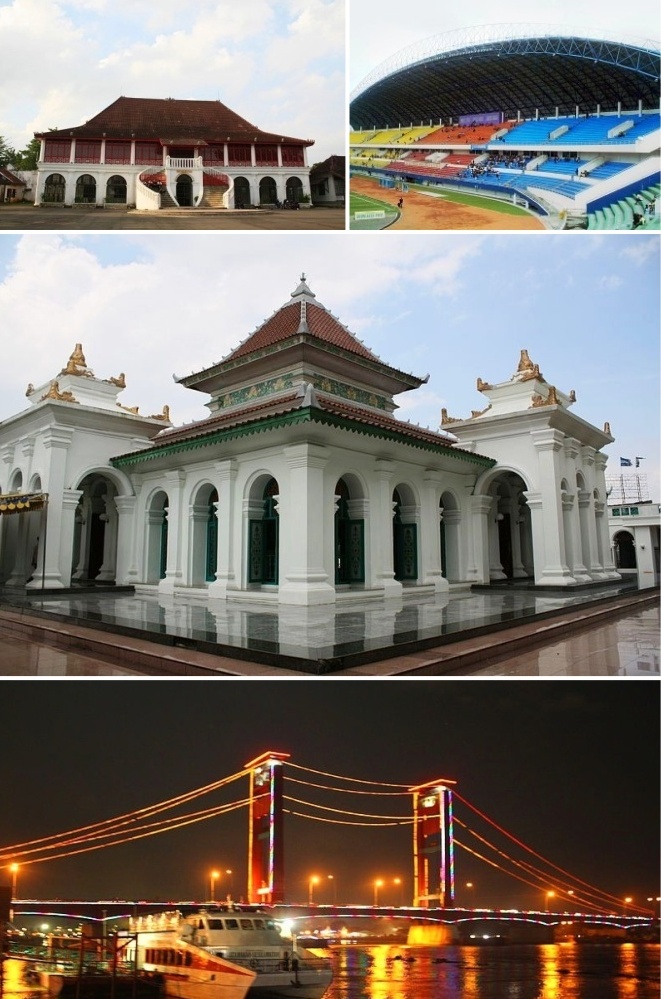
Srivijaya, also spelled Sri Vijaya or Sriwijaya, was a Buddhist thalassocratic empire based on the island of Sumatra (in modern-day Indonesia) that influenced much of Southeast Asia. Srivijaya was an important centre for the expansion of Buddhism from the 7th to 11th century. Srivijaya was the first polity to dominate much of western Maritime Southeast Asia. Its economy became progressively reliant on the booming trade in the region, thus transforming it into a prestige goods-based economy.
The earliest reference to it dates from the 7th century.
Previously it was assumed that Srivijaya was a maritime power that could not be separated from ethnicity and society in the Malacca Strait. The assumption that occurs is that the formation of a successful state and hegemony in the strait is directly related to the ability to participate in international maritime activities, which means that a shore-based state like this develops and maintains its power with its navy. However, a survey of the available information shows that such an assumption is incorrect. Data on maritime activity are scanty and mentions of their navy occurs only in incomplete sources. Even the material aspects of Southeast Asian navies were not known until the 15th century, scientific attention generally focused on shipbuilding techniques.
In the 10th century, the rivalry between Sumatran Srivijaya and the Javanese Mataram kingdom became more intense and hostile. The animosity was probably caused by Srivijaya's effort to reclaim the Sailendra lands in Java or by Mataram's aspiration to challenge Srivijaya domination in the region. In East Java, the Anjukladang inscription dated 937 mentions an infiltration attack from Malayu — which refers to a Srivijayan attack upon the Mataram Kingdom of East Java. The villagers of Anjuk Ladang were awarded for their service and merit in assisting the king's army, under the leadership of Mpu Sindok, in repelling invading Malayu (Sumatra) forces; subsequently, a jayastambha (victory monument) was erected in their honor.
Read more
In 990, King Dharmawangsa of Java launched a naval invasion against Srivijaya and attempted to capture the capital Palembang.
Some art was heavily influenced by Buddhism, further spreading religion and ideologies through the trade of art. The Buddhist art and architecture of Srivijaya was influenced by the Indian art of the Gupta Empire and Pala Empire. This is evident in the Indian Amaravati style Buddha statue located in Palembang. This statue, dating back to the 7th or 8th century, is evidence of the spread of art, culture, and ideology through trade. According to various historical sources, a complex and cosmopolitan society with a culture deeply influenced by Vajrayana Buddhism, flourished in the Srivijayan capital. The 7th century Talang Tuwo inscription described Buddhist rituals and blessings at the event of establishing a public park. This inscription allowed historians to understand the practices being held at the time, as well as their importance to the function of Srivijayan society.
Although Srivijaya left few archaeological remains and was almost forgotten in the collective memory of Maritime Southeast Asia, the rediscovery of this ancient maritime empire by Cœdès in the 1920s raised the notion that it was possible for a widespread political entity to have thrived in Southeast Asia in the past. Modern Indonesian historians have used Srivijaya as a frame of reference of how ancient globalisation, foreign relations and maritime trade, have shaped Asian civilisation. The royal style itself travelled. Walailak Songsiri derives the second element of the place-name Phraek Si Racha, an old town on the Noi River in what is now Chai Nat province, from Sri Maharaja, the style of a prestigious Srivijayan king, taken up as a place-name in the way that peninsular and Khmer royal names were taken up as titles in the central plain of Thailand.
The Sunda Kingdom (Old Sundanese: ᮕᮢ(pra)ᮠ(ha)ᮏᮡ (jya)ᮔ᮪(n) ᮞᮥ(su)ᮔ᮪(n)ᮓ(da), romanized: Prahajyan Sunda, Indonesian pronunciation: [ˈsunda]) was a Sundanese Hindu kingdom located in the western portion of the island of Java from 932 AD to around 1579, covering the area of present-day Banten, Jakarta, West Java, Lampung, and the western part of Central Java. The capital of the Sunda Kingdom moved several times during its history, shifting between the Galuh (Kawali) area in the east and Pakuan Pajajaran in the west.
China and Portuguese reports, all refer to "Sunda" as a kingdom. On the other hand, the term "Pakuan" and "Pajajaran" or "Dayeuh" refer to its capital which corresponds to the modern city of Bogor. The tangible evidence on the existence of a kingdom as an administrative social structure, was found in Sanghyang Tapak inscription dated 952 Saka (1030), that mentioned Prahajyan Suṇḍa (Sunda Kingdom), with Sri Jayabhupati claimed as haji ri Suṇḍa (the king of Sunda).
Read more
Through the study on the 14th century inscriptions in Astana Gede site in Kawali, historian suggests that the political model of Sunda Kingdom adhered the concept of Tri Tangtu di Buana, which administrative power was distributed in triad among three elements; Prebu (king), Rama (village chief or regional elder) and Resi (rishi priestly class of religious authority).
The economy of the Sunda kingdom relied on agriculture, especially rice cultivation; this is reflected in Sundanese culture and the annual ceremonies of crop seeding and Seren Taun rice harvest festival. The harvest ceremony also allowed the king's official to collect tax in the form of rice that can be stored in the state's Leuit (rice barn).
Read more
According to Siksakanda ng Karesian, Sundanese farmers during the era of the Sunda Kingdom did recognize sawah or the wet-field rice cultivation. However, the widespread rice cultivation system applied in the kingdom seems to be the ladang or the dry-field rice which is a much simpler form of cultivation that doesn't require an elaborate social structure to support it.
10-facher Dukat, Gold, Salzburg, 1687, Rückseite: Hl. Rupert mit Salzfass im Gespräch mit Hl. Virgin vor dem Dom zu Salzburg, Dauerleihgabe des Salzburger Museumsvereins, Inv.-Nr. MÜ 16775User:Mateus2019 · Public domain · Commons
German; Lily-dollar (Lilienthaler); CoinsThis file was donated to Wikimedia Commons as part of a project by the Metropolitan Museum of Art. See the Image and Data Resources Open Access Policy · CC0 · Commons
Norway under Oscar II. 10 kroner, 1877, gold, 4.49 g, Kongsberg mint. Head right / crowned shield of arms within a wreath. Provenance: Schulman b.v., Scandinavian Auction 382, 26 October 2024, lot 2015.Schulman bv · CC BY-SA 4.0 · Commons
The culture of the Sunda kingdom centred on agricultural activity, especially rice cultivation. Nyi Pohaci Sanghyang Asri or Sanghyang Asri, the goddess of rice, is revered as the main deity or the highest goddess within Sundanese pantheon. The priest was concerned about the religious ceremonies and the king and his subjects participated in annual ceremonies and festivals such as the blessing of the rice seeds ceremonies and harvest festival. The annual Seren Taun rice harvest festival is still practised today in traditional Sundanese communities.
Read more
According to the Bujangga Manik manuscript, the courtly culture of Sunda kraton and its nobles' etiquette in Pakuan Pajajaran was sophisticated. However, no traces of the palace or buildings survived in the former capital, probably because their wood construction decayed over the centuries.
This trade and defence treaty was fallen apart tremendously due to Portuguese failure to deliver their promise to construct the fortress in Kalapa. The delay was caused by troubles in Goa. To make things worse, in 1527 Fatahillah, a military commander sent from Demak, managed to capture the Sunda Kalapa harbour just before the Portuguese returned.
Read more
The army of Fatahillah, comprising around Cirebon-Demak troops, conquered Sunda Kalapa. The Sunda authority stationed in the port were fallen. The harbour chief and his family, the royal minister, and all of the people working in the harbour were slaughtered. The port city was completely destroyed and razed, as the Sundanese reinforcements sent from Pakuan was too weak and retreated. The Sunda Kingdom has lost its most important port, thus subsequently Sunda Kalapa was renamed Jayakarta by its Muslim conqueror.
Although the kingdom of Sunda left little archaeological remains, it remains part of the culture of Sundanese people being kept alive through the Pantun oral tradition, the chant of poetic verses.
Read more
Translation: It was better during the Pajajaran era, when Kuwera (the god of wealth) was still revered. The era when the earth guru was still honoured. The lost era when the essence of teaching is delivered. No farmer had to take loans. No farmer had to sell their lands. No farmer died in vain. No farmer died in hunger.
Translation: In the prosperous kingdom of Pakuan, people lacked no food or clothing. Rice was plenteous. The blessing of Dewa Guru laid on the land, so everyone was rich. The land's fame spread to other lands. Dewa Guru ordered Ki Semar to the kingdom of Pakuan!
741 CE – 1009 CE · Capital: Medang, Poh Pitu, Tamwlang, Watugaluh, Wwatan · 59,610 km²
The Mataram kingdom (Javanese: ꦩꦠꦫꦩ꧀, Javanese pronunciation: [mətaram]), also known as the Medang kingdom, was a Javanese Hindu-Buddhist kingdom that flourished between the 8th and 11th centuries AD. It was based in Central Java, and later in East Java. Established by King Sanjaya, the kingdom was ruled by members the Shailendra dynasty during the late eighth century, and by the Ishana dynasty from 929 to 1017.
During most of its history the kingdom seems to have relied heavily on agriculture, especially extensive rice farming, and later also benefited from maritime trade.
The earliest account of the Mataram kingdom is in the Canggal inscription, dated 732 AD, discovered within the compound of Gunung Wukir temple in Canggal village, southwest of the town of Magelang. This inscription, written in Sanskrit using the Pallava script, tells of the erection of a lingga (a symbol of Shiva) on the hill in the Kunjarakunja area, located on a noble island called Yawadwipa (Java) which had an abundance of rice and gold. The establishment of lingga was under the order of Rakai Mataram Sang Ratu Sanjaya (King Sanjaya Rakai (lord) of Mataram). This inscription tells that Yawadwipa was ruled by King Sanna, whose long reign was marked by wisdom and virtue. After Sanna died, the kingdom fell into disunity. Sanjaya, the son of Sannaha (Sanna's sister) ascended to the throne.
During this period the administration level of Javanese polity was only consists of two levels; the central government level centred in king's court, and the wanua or village level took form of settlements scattered around within kingdom's realm. The palace where the King resided was mentioned as kadatwan or karaton, the court was the centre of kingdom's administration. The wanua or village is more likely took shape of an "island" filled with housings and orchards in the middle of vast rice paddies, this village layout still can be found in modern Javanese desa.
Read more
The King was regarded as the paramount ruler or chakravartin, where the highest power and authority lies. He ruled the nagara or kadatwan which means the kingdom, from his puri (palace or walled compound). Under the king, there are state officials that serve to forward the king's laws and orders.
During this period the common concept of city, as it known in Europe, Middle East or China, as the urban concentration centre of politics, administration, religious and economic activities, was not quite established yet in ancient Java. The proper urban development as a city took place later in the 13th-century Majapahit's Trowulan.
Read more
The capital itself is more likely refer to the palace, a walled compound called pura in Sanskrit, or in local Javanese as karaton or kadatwan, this is where the king and his family reside and rule his court. The palace itself is more of a collection of pendopo style pavilions surrounded by walls. These pavilions and halls are made from organic wooden and thatched materials, so they had decayed over centuries leaving only stone walls, gates, terraces and bases. The example of this type of secular buildings can be found in Ratu Boko compound.
In 990, Dharmawangsa launched a naval invasion against Srivijaya in an attempt to capture Palembang.
Read more
The news of Javanese invasion of Srivijaya was recorded in Chinese accounts from Song period. In 988, an envoy from San-fo-qi (Srivijaya) was sent to Chinese court in Guangzhou. After sojourned for about two years in China, the envoy learned that his country has been attacked by She-po (Java) thus made him unable to return home.
The hostility between Srivijaya and Java was confirmed by the Javanese envoy. In 992 the envoy from She-po (Java) arrived in Chinese court and explaining that their country has involved in continuous war with Srivijaya.
The bas-reliefs and statuaries of the temples built during Mataram kingdom demonstrated a fine aesthetic quality of well proportioned anatomy, intricate details, superb sculpting technical workmanship, with distinct style of art, commonly identified in archaeological term as "Javanese art" or more precisely "Shailendra art". These sculptures are exquisite and are considered to be among the finest works of art in the Hindu-Buddhist world. The fine example of Javanese art bas-reliefs can be found as early in the 8th century on the walls of Kalasan and Sari temples. Masterpieces of Javanese Hindu-Buddhist art can be found in the sculptures of Sewu, Borobudur, Prambanan, and Plaosan temples. Prambanan and Borobudur in particular are considered as the pinnacle of Javanese Hindu-Buddhist art. Both monuments testify to Java's glorious past in its classical period.
In the late 10th century, the rivalry between the Sumatran Srivijaya and Javanese Mataram became more hostile. The animosity was probably caused by the Srivijayan effort to reclaim Sailendra lands in Java, as Balaputra and his offspring—a new dynasty of Srivijaya maharajas—belonged to the Sailendra dynasty, or by Mataram aspirations to challenge Srivijaya dominance as the regional power. Previously the Anjukladang inscription dated from 937 mentioned about infiltration attack from Malayu which refer to a Srivijayan attack.
The period between the late 8th century to the late 9th century, between the reign of Panangkaran to Balitung, has left numbers of religious monuments; among others are Manjusrigrha, Bhumisambharabudhara and Shivagrha.
Read more
The Mataram era is hailed as the classical period of Javanese civilisation; for during this period the Javanese culture, art and architecture was blossoming and developed further, consolidated and mixed their indigenous elements with dharmic influences. By incorporating Hindu-Buddhist frame of reference and elements into their culture, art and architecture, and by Sanskritisation their language, Javanese has formulating their own Hindu-Buddhist Javanese style and developing an ingenious civilisation.
922 CE – 1343 CE · Capital: Bedulu (Warmadewa period), Samprangan (Majapahit period), Gelgel (Gelgel period), Klungkung (Nine Kingdoms period) · 7,748 km²
The Bali Kingdom (Balinese: ᭚ᬓᭂᬭᬚ᭡ᬦ᭄ᬩᬮᬶ, romanized: Kĕrajaan Bali) was a series of Hindu-Buddhist kingdoms that once ruled some parts of the volcanic island of Bali, in Lesser Sunda Islands, Indonesia. With a history of native Balinese kingship spanning from the early 10th to early 20th centuries, Balinese kingdoms demonstrated sophisticated Balinese court culture where native elements of spirit and ancestral reverence combined with Hindu influences—adopted from India through ancient Java intermediary—flourished, enriched and shaped Balinese culture.
Bali has been inhabited by humans since Paleolithic times (1 Million BCE to 200,000 BCE), testified by the finding of ancient tools such as hand axes in Sembiran and Trunyan villages in Bali, followed by the Mesolithic period (200,000–3,000 BCE). However, the ancestors of the current Balinese inhabitants reached the island around 3,000 to 600 BCE during the Neolithic period, characterised by rice-growing technology and speaking Austronesian languages. The Bronze Age period followed, from around 600 BCE to 800 CE.
1028 CE – 1045 CE · Capital: Kahuripan (estuarine of Brantas river somewhere around modern Surabaya and Pasuruan) · 80,771 km²
Kahuripan (also spelled Kuripan) was an 11th-century Javanese Hindu-Buddhist kingdom with its capital located around the estuarine of Brantas River valley in East Java. The kingdom was short-lived, only spanning the period between 1019 and 1045, and Airlangga was the only raja of the kingdom, which was built out of the rubble of the Kingdom of Mataram after the Srivijayan invasion. Airlangga later in 1045 abdicated in favour of his two sons and divided the kingdom into Janggala and Panjalu (Kadiri).
In 1019, after several years in self-imposed exile in Vanagiri hermitage, Airlangga rallied support from officials and regents that were loyal to the former Isyana dynasty and began to unite the areas that had formerly been ruled by the Mataram kingdom, which had disintegrated after Dharmawangsa's death. He consolidated his authority, established a new kingdom, and made peace with Srivijaya. The new kingdom was called the Kingdom of Kahuripan, and stretched from Pasuruan in the east to Madiun in the west. In 1025, Airlangga increased the power and influence of Kahuripan as the Srivijaya Empire began to decline. Airlangga was known for his religious tolerance and was a patron of both the Hindu and Buddhist religions.
Read more
In 1035 Airlangga constructed a Buddhist monastery named Srivijayasrama dedicated to his queen consort Dharmaprasadottungadevi.
Towards the end of his life, Airlangga was faced with the problem of succession. His heiress, the crown princess Sanggramawijaya, chose to become a Bhikkuni Buddhist hermit rather than succeed Airlangga. Sangramawijaya was the daughter of the queen consort. The story of a crown princess who renounces the throne to become a hermit is linked with the popular legend of Dewi Kilisuci who resides in the Selomangleng Cave beneath Mount Klothok, 5 kilometers to the west of the city of Kediri. In 1045, Airlangga divided Kahuripan into two kingdoms which were inherited by his two sons; Janggala and Kediri. Airlangga himself abdicated the throne in 1045 and returned to the hermit life by assuming a new name Resi Gentayu, bestowed by Mpu Bharada, a famous hermit. A local legend, mixed with fantastic fiction, mentions the partition of the kingdom.
1046 CE – 1226 CE · Capital: Dahanapūra (modern Kediri) · 73,225 km²
Brantas river passing Kediri city.Wibowo Djatmiko (Wie146) · CC BY-SA 3.0 · Commons
Kediri Kingdom or Kadiri, also known as Panjalu, was a Hindu-Buddhist Javanese kingdom based in East Java from 1042 until 1222 (1292–1293 under Jayakatwang). This kingdom is centered in the ancient city Dahanapura, despite the lack of archaeological remains, the age of Kediri saw much development in classical literature. Mpu Sedah's Kakawin Bharatayuddha, Mpu Panuluh's Gatotkacasraya, and Mpu Dharmaja's Smaradhana blossomed in this era.
The Kingdom of Kediri is the successor of Airlangga's Kahuripan kingdom and is thought of as the continuation of the Isyana Dynasty in Java. In 1042, Airlangga divided his kingdom of Kahuripan into two, Janggala and Panjalu (Kadiri), and abdicated in favour of his sons to live as an ascetic. He died seven years later.
Read more
and the Illustrious Panjalu-Protector in Daha, the moment of Yawa-land (Java)'s going into two halves.
The Illustrious Airlangghya (Erlangga), He caused, in His love for his children, the honoured two Prabhus (to be)...— (Nagarakretagama, Canto 68).
The Wurare inscription carved at the foot of the Mahaksobhya statue during the Singhasari period, tells of two new regions that had been divided by the priest Aryya Bharada. According to the Marimbong Inscription (1264 AD), the boundary between the two regions is the Bengawan River.
According to Chinese sources, the main occupations of the Kediri people revolved around agriculture (rice cultivation), animal farming (cattle, boar, poultry), and the spice trade. Daha, the capital city of Kediri, (suggested to be at the same site as modern Kediri) is located inland, near the fertile Brantas river valley. From the predecessor kingdom of Airlangga's Kahuripan, Kediri inherited irrigation systems, including the Wringin Sapta dam. Kediri economy was partly monetised, with silver coins issued by the royal court.
Read more
In later periods, Kediri economy grew to rely more heavily on trade, especially the spice trade. This resulted from Kediri's development of a navy, allowing them to control the spice trade routes to eastern islands. Kediri collected spices from tributaries in southern Kalimantan and the Maluku Islands.
Celebrated as an era of blossoming literature, Kediri produced significant contributions in the field of Javanese classic literature. Next to the literary works already mentioned, Śiwarātrikalpa and Wrtasancaya by Mpu Tanakung, Krisnayana written by Mpu Triguna, and Sumanasantaka by Mpu Monaguṇa are also notable.
Read more
The book of Ling-wai-tai-ta composed by Chinese author Chou K'u-fei in 1178, gave a glimpse of everyday life in Kediri that cannot be found in any other source material, about the government and people of Kediri. According to Chou K'u-fei, people wore clothes that covered them down to their legs, with a loose hairstyle. Their houses were clean and well arranged with floors made from green or yellow cut stones. Agriculture, animal farming, and trading flourished and gained the full attention of the government.
According to Jiyu and Petak inscriptions, during the end of the Majapahit era in the 15th century, there was a brief resurrection of Daha (Kediri) as the centre of political power, which was led by Girindrawardhana in 1478 after he managed to defeat Kertabhumi. But it was short lived since descendant of Bhre Kertabhumi who became ruler of Demak crushed Daha in 1527.
The Kingdom of Janggala is one of the two Javanese kingdoms that was formed when Airlangga abdicated his throne in favour of his two sons in 1045. The other Kingdom was Kediri. The Kingdom of Janggala comprised the northeastern part of the Kingdom of Kahuripan.
1202 CE – 1571 CE · Capital: Namayan, Mandaluyong or Sapa · 1,128 km²
Namayan (Baybayin: Pre-Kudlit: ᜈᜋᜌ or ᜐᜉ (Sapa), Post-Kudlit: ᜈᜋᜌᜈ᜔), also called Sapa and sometimes Lamayan, was an independent polity on the banks of the Pasig River in the Philippines. It is believed to have peaked in the 11th-14th centuries, although it continued to be inhabited until the arrival of European colonizers in the 1570s.
Formed as a polity occupying several barangays, it was one of several polities on the Pasig River just prior to the Spanish colonization of the Philippines, alongside Tondo, Maynila, and Cainta.
Feudalism under barangay state led by the house of Lakantagkan
Languages
Old Tagalog, Old Malay
Religion
Islam, Tagalog polytheism
Economy and Trade
Huerta describes the original settlement in Santa Ana as a fishing village that had other industries including carpentry, masonry, piña (pineapple cloth) embroidery, tinapá, cigars, bricks, sugar and bread.
Read more
This contrasts sharply with the economic activities of the contemporaneous polities of Tondo and Maynila, which monopolized the influx of goods coming from China, and monopolized the re-sale of the same Chinese goods to other ports in the archipelago, respectively.
Singhasari (Javanese: ꦏꦫꦠꦺꦴꦤ꧀ꦱꦶꦔ꧀ꦲꦱꦫꦶ, romanized: Karaton Singhasari or Karaton Singosari, Indonesian: Kerajaan Singasari), also known as Tumapel, was a Javanese Hindu-Buddhist kingdom located in east Java between 1222 and 1292. The kingdom succeeded the Kingdom of Kediri as the dominant kingdom in eastern Java. The kingdom's name is cognate to the Singosari district of Malang Regency, located several kilometres north of Malang City.
Singhasari was founded by Ken Arok (1182–1227/1247), whose story is a popular folktale in Central and East Java. Most of Ken Arok's life story and the early history of Singhasari were taken from the Pararaton account, which also incorporates some mythical aspects. Ken Arok was an orphan born of a mother named Ken Endok and an unknown father (some tales stated he was a son of the god Brahma) in the Kediri kingdom's territory.
Read more
Ken Arok rose from being a servant of Tunggul Ametung, a regional ruler in Tumapel (present-day Malang) to becoming a ruler of Java from Kediri. He is considered the founder of the Rajasa dynasty of both the Singhasari and later the Majapahit line of monarchs. He killed Tunggul Ametung and was later assassinated by Anusapati, in revenge for killing his father, Tunggul Ametung.
Singhasari, and its successor kingdom, Majapahit, were among the few kingdoms in Asia that were able to thwart an invasion by the Mongol horde by repelling a Mongol force in 1293. As the centre of the Malayan peninsula trade winds, the rising power, influence, and wealth of the Javanese Singhasari empire came to the attention of Kublai Khan of the Mongol Yuan dynasty based in China. Moreover, Singhasari had allied with Champa, another powerful state in the region. Both Java (Singhasari) and Champa were worried about Mongol expansion and raids against neighbouring states, such as their raid of Bagan in Burma.
Read more
Kublai Khan then sent emissaries demanding submission and tribute from Java. In 1280, Kublai Khan sent the first emissary to King Kertanegara, demanding Singhasari's submission and tribute to the great Khan. The demand was refused.
In 1292, Regent Jayakatwang, a vassal king from the Kingdom of Daha (also known as Kediri or Gelang-gelang), prepared his army to conquer Singhasari and kill its king if possible, assisted by Arya Viraraja, a regent from Sumenep on the island of Madura.
Read more
The Kediri (Gelang-gelang) army attacked Singhasari simultaneously from both north and south. The king only realized the invasion from the north and sent his son-in-law, Nararya Sanggramawijaya, informally known as 'Raden Wijaya', northward to vanquish the rebellion. The northern attack was put at bay, but the southern attackers successfully remained undetected until they reached and sacked the unprepared capital city of Kutaraja. Jayakatwang usurped and killed Kertanagara during the Tantra sacred ceremony, thus bringing an end to the Singhasari kingdom.
Museum Islam Samudra Pasai 2DISDIKBUD Aceh Utara · Public domain · Commons
The Samudera Pasai Sultanate (Malay: كسلطانن سامودرا ڤاساي), also known as Samudera or Pasai or Samudera Darussalam or Pacem, was a Muslim kingdom on the north coast of Sumatra from the 13th to the 16th centuries.
Little evidence has been left to allow for historical study of the kingdom. The kingdom was believed to have been founded by Merah Silu, who later converted to Islam and adopted the name Malik ul Salih, in the year 1267 CE. After the 1521 Portuguese invasion, the garrison evacuated Pasai in 1524 and the first Sultan of Aceh, Ali Mughayat Syah, annexed the territory.
Khazar coin, the so called 'Moses coin', from the Spillings Hoard at Gotland Museum, Visby, Gotland, Sweden, cropped photo.W.carter · CC BY-SA 4.0 · Commons
The discovery of the tomb of Sultan Malik as-Saleh (696 H or 1267 AD), was referred to by historians as a sign that Islam had entered the Archipelago around the 13th century. Although there is an opinion that the possibility of Islam has come earlier than that. The story of the Pasai Kings is indeed full of myths and legends but the description of the story has helped in uncovering the dark side of history of the existence of this kingdom. The kingdom's past glory has inspired its people to re-use the name of the founder of this kingdom for the University of Malikussaleh in Lhokseumawe.
1294 CE – 1351 CE · Capital: Kuala Lumpur · 143,936 km²
HRH Tuanku Abdul Rahman Ibni Al-Marhum Tuanku Muhammad (1895 - 1960). Unknown photographer and date. The original image is on display at the Tuanku Ja'afar Royal Gallery, Seremban, Negeri Sembilan, Malaysia.anonymity · Public domain · Commons
Malaya, officially the Federation of Malaya, was a country in Southeast Asia from 1948 to 1963. It succeeded the Malayan Union and, before that, British Malaya. It comprised eleven states – nine Malay states and two of the Straits Settlements, Penang and Malacca. It was established on the 1st of February 1948.
Initially a self-governing colony of the United Kingdom, Malaya became fully sovereign on 31 August 1957, and on 16 September 1963, the federation was superseded by Malaysia when it united with Singapore, North Borneo (Sabah) and Sarawak.
Prior to its independence, the government of the Federation of Malaya was headed by a British high commissioner with executive powers, assisted and advised by the Federation of Malaya Executive Council and the Federation of Malaya Legislative Council.
Read more
The Federation of Malaya Executive Council comprised 7 official and 7 unofficial members.
The Federation of Malaya Legislative Council comprised the high commissioner as the council president, 14 official and 50 unofficial members representing the Straits Settlements, business groups and all races. Additionally, 9 State Council Yang Di Pertua (heads of state), chief ministers and 2 representatives from the Straits Settlements became unofficial members.
The Malay Conference of Rulers would advise the high commissioner on immigration issues. The British Resident was replaced with a chief minister in each state of the federation.
The Kingdom of Singapura (Malay: Kerajaan Singapura) was a Malay polity believed to have been founded as a Hindu–Buddhist kingdom during the early history of Singapore on the island of Temasek, lasting from 1299 until its decline and fall between 1396 and 1398. Conventional view marks c. 1299 as the founding year of the kingdom by Sang Nila Utama (also known as "Sri Tri Buana"), whose father is Sang Sapurba, a semi-divine figure who according to legend is the ancestor of several Malay monarchs in the Malay world.
The Malay Annals provide a well-defined hierarchical structure of Singapura, which was later partly adopted by its successor, Malacca. The highest hierarchical position was the Raja (king) as an absolute monarch. Next to the Raja were the Orang Besar Berempat (four senior nobles) headed by a Bendahara (equivalent to a Grand Vizier) as the highest-ranking officer and the advisor to the King. He was then assisted by three other senior nobles based on the order of precedence namely; Perdana Menteri (prime minister), Penghulu Bendahari (chief of treasurer) and Hulubalang Besar (grand commander).
Read more
The Perdana Menteri assisted the Bendahara in administering the internal affairs of the kingdom and usually sat opposite to the Bendahara in the royal court, while the Penghulu Bendahari was responsible for the financial affairs of the kingdom.
Singapura's rise as a trade-post was concurrent with the era known as Pax Mongolica, where the Mongol Empire's influence over both the overland and maritime Silk Road allowed a new global trading system to develop. Previously, shipping occurred on long-distance routes from the Far East to India or even further west to the Arabian Peninsula, which was relatively costly, risky and time-consuming. However, the new trading system involved the division of the maritime Silk Road into three segments: an Indian Ocean sector linking the Gulf of Aden and the Strait of Hormuz-based Arab traders to India, a Bay of Bengal sector linking the Indian ports with the Strait of Malacca and its associated ports including Singapura and the South China Sea sector linking Southeast Asia with Southern China.
Read more
Singapura achieved its significance due to its role as a port.
As mentioned in the Malay Annals, the story of the fall of Singapura and the flight of its last king begins with Iskandar Shah's accusing one of his concubines of adultery. As punishment, the king had her stripped naked in public. In revenge, the concubine's father, Sang Rajuna Tapa who was also an official in Iskandar Shah's court, secretly sent a message to the king of Majapahit, pledging his support should the king choose to invade Singapura. In 1398, Majapahit dispatched a fleet of 300 jong and hundreds of smaller vessels (of kelulus, pelang, and jongkong), carrying no fewer than 200,000 men.
Read more
The Javanese soldiers engaged with the defenders in a battle outside the fortress, before forcing them to retreat behind the walls. The invasion force laid siege to the city and repeatedly tried to attack the fortress. However the fortress proved to be impregnable.
According to the Malay Annals, after sacking Singapura, the Majapahit army abandoned the city and returned to Java. The city would have been ruined and greatly depopulated. The rivalry between the courts of the Javanese and Malay in the region was renewed a few years later when the last king Iskandar Shah, founded his new stronghold on the mouth of Bertam River on the west coast of the Malay Peninsula. Within decades, the new city grew rapidly to become the capital of Malacca Sultanate and emerged as the primary base in continuing the historic struggles of Singapura against their Java-based rivals. The account by João de Barros suggests that Singapura did not end suddenly after the attack by the Siamese, rather Singapore declined gradually when Parameswara's son Iskandar Shah pushed for trade to move to Malacca instead of Singapura.
Tondo (Tagalog: [tunˈdo]; Baybayin: ᜆᜓᜇᜓ, Kapampangan: Balen ning Tundo), also popularly known referred to as the Kingdom of Tondo, was a Tagalog and Kapampangan settlement which served as a major trade hub located on the northern part of the Pasig River delta on Luzon Island. Together with Maynila, the polity (bayan) which was also situated on the southern part of the Pasig River delta, Tondo established a shared monopoly on the trade of Chinese goods throughout the rest of the Philippine archipelago, making it an established force in trade throughout Southeast Asia and East Asia.
Numerous theories on the origin of the name "Tondo" have been put forward. Filipino National Artist Nick Joaquin suggested that it might be a reference to high ground ("tundok"). The French linguist Jean-Paul Potet, however, has suggested that the river mangrove, Aegiceras corniculatum, which at the time was called "tundok" ("tinduk-tindukan" today), is the most likely origin of the name. Kapampangan studies professor Robby Tantingco suggested that the name was derived from tundun, Kapampangan term of "nape."
the Senapati of Tundun and Lord Minister of Pailah (according to a record of debt acquittance)
Gat Lontok and Dayang Kalangitan
Government, Society and Religion
The Tagalog belief system revolved around the idea that the world was inhabited by spirits and supernatural entities, a worldview reflected in their religious practices and rituals.
Read more
According to the early Spanish missionary-ethnographers, the Tagalog people believed in a creator-god named Bathala, whom they referred to both as maylicha (creator; lit. "actor of creation") and maycapal (lord, or almighty; lit. "actor of power"). Loarca and Chirino also report that in some places, they were called "Molayri" (Molaiari) or "Diwata" (Dioata)." However, these early missionary-ethnographers also noted that the Tagalogs did not include Bathala in their daily acts of worship (pag-a-anito).
Feudal Bayan ruled by a lakan, consisting of several barangay duchies that are ruled by the respective datu, under a Lakan
Languages
Old Tagalog, Kapampangan, and Classical Malay
Religion
Hinduism, Tagalog polytheism
Economy and Trade
Historians widely agree that the larger coastal polities which flourished throughout the Philippine archipelago in the period immediately prior to the arrival of the Spanish colonizers (including Tondo and Maynila) were "organizationally complex", demonstrating both economic specialization and a level of social stratification which would have led to a local demand for "prestige goods".
Read more
Specialized industries in the Tagalog and Kapampangan regions, including Tondo and Maynila, included agriculture, textile weaving, basketry, metallurgy, hunting, among others. The social stratification which gave birth to the Maginoo class created a demand for prestige products including ceramics, textiles, and precious stones. This demand, in turn, served as the impetus for both internal and external trade.
Tondo was a large coastal settlement led by several leaders, called datu, who had their own followings, called either "dulohan" or "barangay". These datus with their respective barangays in turn acknowledged the leadership of a datu with the most senior rank – a "paramount ruler" or "paramount datu", who was called a "lakan". According to San Buenaventura, a large coastal settlement with this kind of leadership structure was called a "bayan".
Read more
The equivalent paramount datus who led the southern polity of Maynila were referred to using the term "rajah", and in Mindanao, a similar title in more Islamized polities was that of "sultan".
The term for the barangay social groupings refers to the large ships called balangay, which were common on such coastal polities, and is used by present-day scholars to describe the leadership structure of settlements in early Philippine history.
Although popular portrayals and early nationalist historical texts sometimes depict Philippine paramount rulers, such as those in the Maynila and Tondo polities, as having broad sovereign powers and holding vast territories, critical historiographers such as Jocano, Scott, and Junker explain that historical sources clearly show that paramount leaders, such as the lakans of Tondo and the rajahs of Maynila, exercised only a limited degree of influence, which did not include claims over the barangays and territories of less-senior datus.
Ancient and Medieval States of Maritime Southeast Asia: Frequently Asked Questions
Which states existed in Maritime Southeast Asia in this period?
This page maps 15 states of Maritime Southeast Asia founded between 367 CE and 1375 CE: Tarumanagara, Galuh Kingdom, Srivijaya, Sunda Kingdom, Mataram Kingdom, Early Balinese Kingdoms, Kahuripan, Kediri Kingdom, Kingdom of Janggala, Namayan, Singhasari, Samudera Pasai Sultanate and 3 more.
Which was the largest of the Ancient and Medieval States of Maritime Southeast Asia?
Srivijaya had the largest mapped extent, about 537,553 km².
Which of the Ancient and Medieval States of Maritime Southeast Asia lasted longest?
Sunda Kingdom lasted longest, 674 CE – 1578 CE.
↑↓ to navigate↵ to open
12,754 Planetary Entities Indexed
We use Google Analytics cookies to understand which pages are useful. Necessary storage only keeps your theme and this choice on your device. Privacy policy