The Malay world or Malay realm (Indonesian/Malay: Dunia Melayu or Alam Melayu) or Malaysphere is a political concept or an expression that has been used by different authors and groups over time to denote several different notions, derived from varied interpretations of 'Malay' either as an ethnic group, as a racial category, as a linguistic group or as a cultural group. The label "Malay" as a cultural term is largely based on the prevalent Malay cultural influence, manifested in particular through the spread of the Malay language in Southeast Asia as observed by different colonial powers during the Age of Discovery and spread of Islam. The term remains highly controversial in Indonesia and outside the Malay-speaking areas, because it is considered politically charged and irredentist rather than purely cultural.
The concept in its broadest territorial stretch may apply to a region synonymous with Austronesia, homeland to the Austronesian peoples, that extends from Easter Island in the east to Madagascar in the west. Such description has its origin in the introduction of the term Malay race in the late 18th century that has been popularised by orientalists to describe the Austronesian peoples. In the development of further research, the Malay race was categorized as a Malayo-Polynesian languages.
Adiput at en.wikipedia · Public domain · Commonsanonymous · Public domain · CommonsCircle of Titian · Public domain · CommonsPhotographer's Mate 1st Class Jon Gesch, USN · Public domain · Commons
Layers
HistoryChanges with the year
PlacesToday
Water
Land
1747 AD
Base map
An empire takes the map to its years and shows the borders.
Each state in its own colour. Move the timeline to see which existed in any year from 1139 AD to 2024; select a territory to read about it. Borders: Cliopatria / Seshat (CC BY 4.0).
Sayong Pinang (1530s–1536), Johor Lama (1536–1564), Bukit Seluyut (1564–1570), Johor Lama (1570–1587), Batu Sawar (1587–1618), Lingga (1618–1625), No fixed place (1625–1640), Batu Sawar (1640–1675), No fixed place, Sultan based in Pahang then Riau (1675–1688), Kota Tinggi (1688–1700), Pancur (1700–1708), Riau (1708–1715), Pancur (1715–1720), Riau (1720–?)
Where did the Sultanates of the Malay World come from?
Malayadvipa, "Malaya Dvipa", is described in chapter 48, Vayu Purana as one of the mountainous provinces in the eastern sea that was full of gold and silver. The exact modern location befitting with this term is disputed. Some scholars equate the term with Sumatra, while several Indian scholars associating it with the mountainous Malay Peninsula. Other scholars even suggested Sri Lanka's possibility. while Sumatra is more correctly associated with Suvarnadvipa (an ancient name referred to Sumatra) which means "The Gold Land" and the Barisan Mountains which is the mountainous range scattered from north to the south Sumatra hemisphere.
Read more
Maleu-kolon – a location in the Malay Peninsula, from Ptolemy's work, Geographia.
Mo-lo-yu – mentioned by Yijing, a Tang dynasty Chinese Buddhist monk who visited the Southeast Asia in 688–695.
1139 CE – 1910 CE · Capital: Alor Setar, Anak Bukit · 18,586 km²
The Kedah Sultanate (Malay: كسلطانن قدح) is a Muslim dynasty located in the Malay Peninsula. It was originally an independent state, but became a British protectorate in 1909. Its monarchy was abolished after it was added to the Malayan Union but was restored and added to the Malayan Union's successor, the Federation of Malaya.
The information regarding the formation of this sultanate and the history before and after its creation comes from the "Kedah Annals". The annals were written in the 18th century, over a millennium after the formation of the supposed Kedah Kingdom.
The nobat musical instruments of Nagara and Nepiri were introduced to Kedah by Maharaja Derbar Raja. The instrument is also called semambu. The band is led by the king, and it consists of drums, a gong, a flute and a trumpet. Today, nobat is a royal orchestra, played only during royal ceremonies such as inaugurations, weddings, and funerals. The building which houses the instruments and where the ensemble rehearses is known as the Balai Nobat, literally the Office of Nobat, in Alor Setar city proper.
After the death of Sultan Abdullah Mukarram Shah in 1797, the throne was given to his half brother Sultan Dziaddin Mukarram Shah II. However Sultan Dziaddin was forced to abdicate in 1803 by the King of Siam and was replaced by his nephew Sultan Ahmad Tajuddin II. This sparked a succession crisis as crown prince, Tunku Bisnu claimed to be the rightful heir to the throne. Fearing civil war, Siam reconciled the two parties by appointing Tunku Bisnu as ruler of Setul, thus establishing the Kingdom of Setul Mambang Segara in 1808.
Read more
From 1821, a Siamese invasion of Kedah fragmented Kedah's territory. This period marked the exile of Sultan Ahmad Tajuddin Halim Shah II and the imposition of direct Siamese rule on Kedah for a time. Tengku Kudin, a nephew of Sultan Ahmad Tajuddin, captured Alor Setar from the Siamese in 1831 but the town was retaken soon after.
1363 CE – 2024 CE · Capital: Kota Batu (1368–1660), Brunei Town, Kampong Ayer (1660–1920) · 230,860 km²
The Sultanate of Brunei (Malay: Kesultanan Brunei, Jawi: كسلطانن بروني) or simply Brunei (broo-NY), also known as the Bruneian Empire, was a Malay sultanate centred around Brunei on the northern coast of Borneo in Southeast Asia. Brunei became a sovereign state around the 15th century, when it substantially expanded after the fall of Malacca to the Portuguese, extending throughout coastal areas of Borneo and the Philippines, before it declined in the 17th and 18th centuries. It became a British protectorate in the 19th century.
The rising power of the nearby Sultanate of Sulu occurred due to infighting between Bruneian nobles and the king. Brunei eventually lost its authority over the Bajaus and lapsed into a collection of riverine territories ruled by semi-autonomous chiefs. By the end of 17th century, Brunei entered a period of decline brought on by internal strife over royal succession, colonial expansion of European powers, and piracy. By 1725, Brunei had many of its supply routes to the Sultanate of Sulu. However despite all of this pressure against them, they were not a state of decline like that of the Ottomans as the Sultans of Sulu still paid tribute, with Brunei humiliating the Sulu in the Apostate War which lasted to 1769 until 1790. True collapse only happened in 1836 when the Bau region ruled Pengiran Indera Mahkota was in full revolt.
1459 CE – 1861 CE · Capital: Malacca · 230,357 km²
View of Malacca City in Malaysia.Adiput at en.wikipedia · Public domain · Commons
The Malacca Sultanate (Malay: Kesultanan Melaka; Jawi script: کسلطانن ملاک) was a Malay sultanate based in the modern-day state of Malacca, Malaysia. Conventional historical thesis marks c. 1400 as the founding year of the sultanate by King of Singapura, Parameswara, also known as Iskandar Shah, although earlier dates for its founding have been proposed.
The founding of Malacca is generally taken to be c. 1400. The region was dominated by the Srivijaya empire centered on Palembang in Sumatra until it was weakened by the Chola Empire in the 11th century. By the end of the 13th century, the Javanese Singhasari followed by the Majapahit had become dominant.
Read more
According to the Malay Annals, a prince from Palembang named Seri Teri Buana who claimed to be a descendant of Alexander the Great stayed on Bintan Island for several years before he set sail and landed on Temasek in 1299. The Orang Laut, known for their loyal services to Srivijaya, eventually made him king of a new kingdom called Singapura. In the 14th century, Singapura developed concurrently with the Pax Mongolica era and rose from a small trading outpost into a centre of international trade with strong ties to the Yuan dynasty.
Malacca had a well-defined government with a set of laws. At the top of the sultanate's hierarchy sat the Sultan who was an absolute monarch. The earlier Srivijayan concept of kingship in which the king's right to rule was based on legitimate lineage still prevailed, and with the coming of Islam, it was reintroduced with the name daulat (sovereignty). Malacca's legal codes identified four main state officials appointed by the Sultan.
Read more
Below the Sultan was a Bendahara, a position similar to that of a vizier, who acted as an advisor to the Sultan. It was the highest-ranking office that could be held by any common people in Malacca. The Bendahara was also responsible for ensuring cordial relations with foreign states. Malacca's fifth Bendahara, Tun Perak, excelled in both war and diplomacy.
Malacca developed from a small settlement to a cosmopolitan Entrepôt within the span of a century. This rapid progression was attributable to several factors, key among which were its strategic location along one of the world's most important shipping lanes, the Strait of Malacca and the increasing demand for commodities from both the East and the West. Ships from the East bearing goods from China, the Ryukyu Islands, Java and the Maluku Islands would sail in by the northeast monsoon from December to January, while ships leaving for ports along Indian coastline, the Red Sea and East Africa would sail with the southwest monsoon.
Read more
There were other ports along the Strait of Malacca such as Kedah in the peninsula and Jambi and Palembang in Sumatra, yet none of them came close to challenging Malacca's success as a centre of international trade.
Whether the first ruler of Malacca, Parameswara, converted to Islam is unknown as there is no evidence to suggest that he had. The 16th-century Portuguese writer Tomé Pires explicitly mentioned that Parameswara was succeeded by his son, Megat Iskandar Shah who only converted to Islam at age 72. On the other hand, the Malay Annals noted that it was during the reign of the third ruler Muhammad Shah (r. 1424–1444), that the ruling class and their subjects began accepting Islam. While there are differing views on when the Islamization of Malacca actually took place, it is generally agreed that Islam was firmly established during the reign of Muzaffar Shah (r. 1445–1459).
Read more
Islamisation in the region surrounding Malacca gradually intensified between the 15th and 16th centuries through study centres in Upeh, the district on the north bank of the Malacca River.
The Malacca Sultanate heralded the golden age of the Malay world and became an important port in the far east during the 16th century. It became so rich that Tomé Pires said "Whoever is lord of Malacca shall have his hands on the throat of Venice.". Within a span of a century, the sultanate left a lasting and important legacy, especially within Malay culture and the History of Malaysia. Malacca was the first Malay Muslim state that achieved the status of a regional maritime power. Despite the existence of earlier Muslim kingdoms such as Kedah, Samudra Pasai and Aru, which also possessed well-established ports, none of them came close in challenging Malacca's success in expanding its territory and influence in the region.
1459 CE – 1821 CE · Capital: Palembang, Kuto Lamo (1659–1797), Kuto Besak (1797–1823) · 77,003 km²
The Sultanate of Palembang Darussalam (Malay: كسلطانن ڤلمبڠ دارالسلام, romanized: Kesultanan Palembang Darussalam) was an early modern polity and sultanate located in the southern part of the Indonesian island of Sumatra. It was ruled by the Sultans of Palembang. It was proclaimed in 1659 by Susuhunan Abdurrahman, and dissolved by the colonial government of the Dutch East Indies on 7 October 1823. In 1825, its last ruler, Sultan Ahmad Najamuddin IV, was arrested and sent into exile on the island of Banda Neira in the Moluccas.
According to the story of Kidung Pamacangah and Babad Arya Tabanan it was said that a figure from Kediri named Arya Damar who was a "regent of Palembang" joined Gajah Mada, ruler of Majapahit in conquering Bali in 1343. Historian C.C. Berg thought that Arya Damar was identical to Adityawarman. The name Palembang was also mentioned in Nagarakretagama as one of the conquered lands of Majapahit. Gajah Mada also mentioned the name Palembang in Pararaton as one of the regions that he conquered.
Read more
A Chinese chronicle Chu-fan-chi written in 1178 by Chou-Ju-Kua recorded the name Pa-lin-fong, a reference to Palembang. Around 1513, Tomé Pires an adventurer from Portugal mentioned Palembang, a kingdom which is led by a patron who was appointed from Java and was then referred to as the Sultanate of Demak and participated in the invasion of Portuguese Controlled Melaka.
The Sultanate of Palembang was involved in skirmishes with the Dutch Colonial Empire and the private joint-stock companies such as the Dutch East India Company. After losing control of Palembang following a series of skirmishes and ambushes with Sultanate forces, the Dutch gave way briefly to the British installed government of Indonesia.
Read more
Specific Conflicts include the 1811 attack on a Dutch Fort garrison off the cost of the Musi River led by Sultanate forces. There was an investigation carried out by Dutch officials to determine whether British official Thomas Stamford Raffles coordinated with Sultan Mahmud Badaruddin II to conduct the operation. Results found copies letters between Raffles and Sultan Mahmud Badaruddin II but without unquestionable evidence.
The First Expedition to Palembang in 1819 resulted in the defeat of Dutch forces invading Palembang in 1819.
Sultan Mahmud Badaruddin II would be removed from his position by Dutch authority and replaced by his son, Sultan Ahmad Najamuddin III, who would maintain slight political power for 4 years until his status as Sultan was revoked by Dutch officials after he had attempted to escape to the Bengkulu region. In 1821 the Dutch implemented a Bureaucracy with an appointed governor and regional heads of authority to manage assigned districts of the area. They were considered a higher power than of that of the Sultan. Islamic religious courts were not altered.
Read more
When the Sultanate was abolished, so was the allowance given to Palembang nobles by the Dutch government. Regional control and influence of the Sultanate and its officials would decrease over time and be directly influenced by Dutch decisions and policy.
1459 CE – 1879 CE · Capital: Maimbung · 68,286 km²
Daru Jambangan (Palace of Flowers) which was the royal palace of the Sultan of Sulu since historical times. The palace was made of wood, and was destroyedanonymous · Public domain · Commons
The Sultanate of Sug (Sulu) (Tausug: Kasultanan sin Sūg; Central Sama: Kasultanan Sūg or Kasultanan Sūk; Malay: Kesultanan Suluk; Filipino: Kasultanan ng Sulu or Sultanato ng Sulu) was a Sunni Muslim Tausūg state that ruled the Sulu Archipelago, coastal areas of Zamboanga City, and certain portions of Palawan in today's Philippines, alongside parts of present-day Sabah,North Kalimantan and in north eastern parts of Borneo and Berau.
The sultanate was founded either on November 17 1405 or 1457 by Johore-born explorer and Sunni religious scholar Sharif ul-Hashim, the 1st Sultan of Sulu.
The present area of the Sultanate of Sulu was once under the influence of the Bruneian Empire before it gained its own independence in 1578. During the 13th century the people of Sulu began migrating to present-day Zamboanga and Sulu archipelago from their homelands in northeastern Mindanao. Scott (1994) writes that the Sulu are the descendants of ancient Butuanons and Surigaonons from the Rajahnate of Butuan, which was then Hindu, like pre-islamic Sulu. They moved south and established a spice trading port in Sulu. Sultan Batarah Shah Tengah, who ruled as sultan in 1600, was said to be an actual native of Butuan. The Butuanon-Surigaonon origins of the Tausugs are suggested by the relationship of their languages, as the Butuanon, Surigaonon and Tausug languages are all members of the Southern sub-family of Visayan.
Chinese who lived in Sulu ran guns across a Spanish blockade to supply the Moro datus and sultanates with weapons to fight the Spanish, who were engaging in a campaign to subjugate the Moro sultanates on Mindanao. A trade involving the Moros selling slaves and other goods in exchange for guns developed. The Chinese had entered the economy of the sultanate, taking almost total control of the sultanate's economies in Mindanao and dominating the markets. Though the sultans did not like one group of people exercising exclusive control over the economy, they did business with them.
Read more
The Chinese set up a trading network between Singapore, Zamboanga, Jolo and Sulu. The Chinese sold small arms like Enfield and Spencer Rifles to the Buayan Datu Uto. They were used to battle the Spanish invasion of Buayan. The datu paid for the weapons in slaves.
Olaus Magnus - On Trade Without Using MoneyOlaus Magnus · Public domain · Commons
Currency
barter
Maori bartering a crayfish [Drawing no.12] A Maori bartering a crayfish with an English naval officer.Creator:Artist of the Chief Mourner · CC0 · Commons
Late 19th Century Flag of SuluOrange Tuesday (talk) · Public domain · Commons
Wars and Battles
In 1746, Sultan Azim ud-Din I, with Spanish assistance, carried out punitive expeditions around the Sebuku region against the Tidungs to reconsolidate his power in Borneo. By April 1747, the expeditions were declared a success and the chief of Tarakan declared his allegiance to Sulu. After the Sultan returned to Sulu, he brought back 50 captives who were previously under the hands of the Tidung and among them was a friar, while others were Tidung chiefs. Two of the Tidung chiefs were left in Jolo while the rest were brought to Zamboanga. Tausug traders began settling in Tarakan. However, things began to complicate after the Tidungs made a political marriage with Bulungan, placing the Tidungs also under the Sultanate of Bulungan.
Among the people of the Sultanate of Sulu, nobility could be acquired only by lineage, a closed hereditary system.
Read more
Datu (susultanun), acquired purely by lineage. All male members of the royal house of Sulu held this title and style "His Royal Highness (HRH)". Their spouses automatically held the title of Dayangdayang (princess of the first degree). Adopted members of the royal house of Sulu were styled "His Highness (HH)" and their spouses also held the title of Dayangdayang and the style: "Her Highness".
Datu sadja, which may be acquired through confirming the titles (gullal) on the middleman of the sultan.
In 1848 and 1851, the Spanish launched attacks on Balanguingui and Jolo respectively. A peace treaty was signed on 30 April 1851 in which the sultan could only regain the capital if Sulu and its dependencies became a part of the Philippine Islands under the sovereignty of Spain. There were different understandings of this treaty; although the Spanish interpreted it as the sultan accepting Spanish sovereignty over Sulu and Tawi-Tawi, but the sultan took it as a friendly treaty amongst equals. These areas were only partially controlled by the Spanish, and their power was limited to military stations and garrisons and pockets of civilian settlements. This lasted until they had to abandon the region as a consequence of their defeat in the Spanish–American War.
The Sultanate of Cirebon (Indonesian: Kesultanan Cirebon, Pegon: كسلطانن چيربون, Sundanese: ᮊᮞᮥᮜ᮪ᮒᮔᮔ᮪ ᮎᮤᮛᮨᮘᮧᮔ᮪) was an Islamic sultanate in West Java founded in the 15th century. It is said to have been founded by Sunan Gunungjati, as marked by his letter proclaiming Cirebon's independence from Pajajaran in 1482, although the settlement and the polity had been established earlier in 1445. Sunan Gunungjati also established the Sultanate of Banten. It was one of the earliest Islamic states established in Java, along with the Sultanate of Demak.
The village of Muara Jati was in the coastal area around the port of Cirebon and was part of the Sunda Kingdom, as stated in the travel records of Prince Bujangga Manik, a Hindu Sundanese hermit who visited several Hindu sites in Java and Bali in the late 15th century or early 16th century. The border of the Sunda Kingdom in the west is the Sunda Strait and in the east is the Cipamali River (present-day kali Brebes) and Cisarayu River in Central Java. During this time, Muara Jati was located around 14 kilometres north of modern-day Cirebon. The transformation from a small Hindu coastal fishing village into a thriving Muslim port began with the rule of Ki Ageng Tapa.
COLLECTIE TROPENMUSEUM Katoenen banier met Arabische kalligrafie TMnr 5663-1Tropenmuseum · CC BY-SA 3.0 · Commons
Achievements and Monuments
During its early formation years, the sultanate actively propagated Islam. Cirebon sent their ulamas to proselytise Islam into inland West Java. Together with Banten, they are credited for the Islamization of the Sundanese people in West Java as well as coastal Java. Because the Sultanate is located on the border of the Javanese and Sundanese cultural realms, the Sultanate of Cirebon demonstrates both aspects, reflected in its art, architecture, and language. The Sultanate of Pakungwati Palace shows the influence of Majapahit red brick masonry architecture. The styles and titles of its officials are also influenced by Javanese Mataram courtly culture.
Read more
As a port city, Cirebon attracts settlers from around and overseas alike.
With the death of Panembahan Girilaya, Cirebon was left without a monarch. Prince Wangsakerta assumed the everyday administration, but was worried about the fate of his elder brothers being held as hostages in the Mataram court. Because of this incident, the Cirebon succession was also held hostage by Mataram, and by their own grandfather Amangkurat I. Wangsakerta went to Banten to seek Sultan Ageng Tirtayasa's help to free his brothers. The sultan was the son of Prince Abu Maali that had died in the 1650 war with Cirebon. Tirtayasa agreed to assist Cirebon and saw it as an opportunity to improve diplomatic relations between Banten and Cirebon. Taking advantage of the outbreak of the Trunojoya rebellion against Mataram, Sultan Ageng Tirtayasa secretly supported the revolt and managed to save the two Cirebon princes.
German: Sultan Suleiman II. (1495/1496-1566) im Profil , Halbfigur Sultan Suleiman in profiletitle QS:P1476,de:"Sultan Suleiman II. (1495/1496-1566) im Profil , Halbfigur "label QS:Lde,"Sultan Suleiman II.Circle of Titian · Public domain · Commons
Sultan (Arabic: سلطان sulṭān, pronounced [sʊlˈtˤɑːn, solˈtˤɑːn]) is a position with several historical meanings. Originally, it was an Arabic abstract noun meaning "strength", "authority", "rulership", derived from the verbal noun سلطة sulṭah, meaning "authority" or "power". Later, it came to be used as the title of certain rulers who claimed almost full sovereignty (i.e., not having dependence on any higher ruler) without claiming the overall caliphate, or to refer to a powerful governor of a province within the caliphate.
In a number of post-caliphal states under Mongol or Turkic rule, there was a feudal type of military hierarchy. These administrations were often decimal (mainly in larger empires), using originally princely titles such as khan, malik, amir as mere rank denominations.
Read more
In the Persian empire, the rank of sultan was roughly equivalent to that of a modern-day captain in the West; socially in the fifth-rank class, styled 'Ali Jah.
The Sultanate of Gowa was one of the great kingdoms in the history of Indonesia and the most successful kingdom in the South Sulawesi region. People of this kingdom come from the Makassarese people who lived in the south end and the west coast of southern Sulawesi.
The epic poem the Nagarakretagama, in praise of King Rajasanagara of Majapahit, lists Makassar as one of the kingdom's tributaries in 1365.
Read more
The first queen of Gowa was Tomanurung Baine. Not much is known about the exact time when the kingdom was established nor about the first queen, and only during the reign of the 6th king, Tonatangka Kopi, have local sources noted about the division of the kingdom into two new kingdoms led by two Kopi's sons: Kingdom of Gowa led by Batara Gowa as its 7th king covering areas of Paccelekang, Pattalasang, Bontomanai Ilau, Bontomanai 'Iraya, Tombolo and Mangasa while the other son, Karaeng Loe ri Sero, led a new kingdom called Tallo which included areas of Saumata, Pannampu, Moncong Loe, and Parang Loe.
For years both kingdoms were involved in wars until the kingdom of Tallo was defeated.
The variety of titles used by leaders of small polities is bewildering: anrongguru, dampang, gallarrang, jannang, kare, kasuiang, lao, loqmoq, todo, and more besides. All were local titles Makassarese used before the rise of Gowa. Gowa's expansion brought some systematic order to this variety.
Read more
Granting titles was an important method of establishing and recognizing a given person/s and a given community's place within society. Ideally, but not always in fact, this hierarchy of titles corresponded to the natural hierarchy of the white blood that the nobles possessed. Distinguishing nobles from commoners, for example, was the right to have a royal or daeng name as well as a personal name. Distinguishing lower ranking nobles such as anaq ceraq from higher-ranking nobles like anaq tiqno was the latter's right to a karaeng title.
Jingaraʼ, Gold and copper coins was used in circulation, the Barter system was used
Flag of the Sultanate of GowaSamhanin · CC0 · Commons
Wars and Battles
From 1630 until the early twentieth century, Gowa's political leaders and Islamic functionaries were both recruited from the ranks of the nobility. Since 1607, sultans of Makassar established a policy of welcoming all foreign traders. In 1613, an English factory built in Makassar. This began the hostilities of English-Dutch against Makassar.
Read more
In 1644, Bone rose up against Gowa. The Battle of Passempe saw Bone defeated and a regent heading an Islamic religious council installed. In 1660 Arung Palakka, the long-haired prince of the Sultanate of Bonu, led a Bugis revolt against Gowa, but failed.
In 1666, under the command of Admiral Cornelis Speelman, The Dutch East India Company (VOC) attempted to bring the small kingdoms in the North under their control, but did not manage to subdue the Sultanate of Gowa.
Since 1673 the area around Fort Rotterdam grew into a city currently known as Makassar. Since 1904 the Dutch colonial government had engaged in the South Sulawesi expedition and started war against small kingdoms in South Sulawesi, including Gowa. In 1911 the Sultanate lost its independence after losing the war and became one of the Dutch Indies' regencies. Following the Indonesian Independence from Netherlands in 1945, the sultanate dissolved and has since become part of the Republic of Indonesia and the former region becomes part of Gowa Regency.
1516 CE – 1959 CE · Capital: Kutaraja or Bandar Aceh Darussalam (modern Banda Aceh), (1496–1874), Pagar Ayer, (1875–1878), Indrapuri, (1878–1879), Keumala, (1879–1898), Kuta Sawang, (1898), Batee Illiek-Samalanga, (1898–1901), Loyang Sekam-Laut, (1901–1903) · 127,447 km²
Coast of Banda Aceh 2-12-05 050212-N-1450G-241Photographer's Mate 1st Class Jon Gesch, USN · Public domain · Commons
The Aceh Sultanate, officially the Kingdom of Aceh Darussalam (Acehnese: Acèh Darussalam; Jawoe: اچيه دارالسلام), was a sultanate centered in the modern-day province of Aceh of Indonesia. It was a major regional power in the 16th and 17th centuries, before experiencing a long period of decline. Its capital was Kutaraja, the present-day Banda Aceh. Along with Mataram and Makassar, it has been referred to as one of Southeast Asia's major "gunpowder empires".
The sultanate was founded by Ali Mughayat Syah, who began campaigns to extend his control over northern Sumatra and the Indonesia in 1520. His conquests included Deli, Pedir, and Pasai, and he attacked Aru. His son Alauddin al-Kahar (d. 1571) extended the domains further south into Sumatra, but was less successful in his attempts to gain a foothold across the strait, though he made several attacks on both Johor and Malacca, with the support along with men and firearms from Suleiman the Magnificent's Ottoman Empire. The Ottoman Empire sent a relief force of 15 Xebecs commanded by Kurtoğlu Hızır Reis.
Read more
Aceh formed the northern tip of Sumatra at the southeast corner of the Bay of Bengal. Ships from the Bengal Sultanate transported diplomats from Sumatra and Brunei to Ming China.
During the reign of Iskandar Muda (c.1583–1636), state centralization was carried out. This was done by removing or exterminating the present nobility and creating new ones that were friendly to the state. Besides this, the policy carried out the division of plots of land within the sultanate by mukim (similar to Christian parishes subdivisions), each of these mukims would be headed by an ulèebalang (leader) who was responsible for security. Some regions of Aceh, especially of the pepper-producing western regions, were controlled by appointed panglima (governors) whose duty was to report on events and were rotated every three years.
Centralized absolute monarchy (c. 1496–1641)Absolute monarchy under the Sultanahs (1641–1699)Decentralized / quasi-confederate sultanate under powerful uleebalang federations (1699–1873)Wartime monarchy during the Aceh War (1873–1903)Aceh under the Wali Negara, Uleebalang Federations, Nominal monarchy amid continued resistance (1903–1914)
Languages
Acehnese, Malay, Arabic, and other local languages
Religion
Sunni Islam
Economy and Trade
Aceh gained wealth from its export of pepper, nutmeg, cloves, betel nuts, and also tin once it conquered Pahang in 1617. Low-interest rates and the use of gold currency strengthened its economy. Aceh tended somehow to be fragile economically, however, because of the difficulty in providing enough surplus food to support the military and commercial adventures of the state. As Aceh lost political cohesion in the 17th century, it saw its trading importance yielded to the Dutch East India Company, who became the dominant military and economic power in the region following the successful siege of Malacca in 1641.
In 1699, Sultan Badr al-alam Syarif Hasyim Jamal ad-din ascended to the throne, the first male to rule in almost 60 years. He was succeeded by several short-lived rulers, and in 1727 a member of the Buginese dynasty, Sultan Ala ad-din Ahmad Shah took power. The coming to power of a Bugis dynasty strengthened Acehnese identity in-contrast to the Bugis of Johor, which emphasized their connections to Malay culture. In the late 18th and early 19th centuries, Koh Lay Huan – the first Kapitan Cina of Penang, had good contacts with the English-and-French-speaking sultan of Aceh, Jauhar al-Alam. The sultan allowed Koh to gather pepper plants in Aceh to begin pepper cultivation in Penang. Later, about 1819, Koh helped Sultan Jauhar al-Alam put down a rebellion by Acehnese territorial chiefs.
Aceh (Dutch: Atchin or Acheh; English: Achin; French: Achen or Acheh; Arabic: Asyi; Portuguese: Achen or Achem; Chinese: A-tsi or Ache), now known as the province of Aceh, is thought to have a substrate (underlying layer) from the Mon-Khmer language family with other linguistic regions such as the southern part using the Aneuk Jame language, whilst the central, south-eastern and eastern parts use the Gayo language; the south-eastern part uses the Alas language; and the eastern part, further east, uses the Tamiang language. Similarly, the Kluet ethnic group in the southern part uses the Kluet language, whilst in Simeulue the Simeulue language is used; however, each of these local languages can be further subdivided into dialects. The Acehnese language, for example, is spoken with slight variations in Aceh Besar, Pidie, and North Aceh.
1521 CE – 1852 CE · Capital: Tubok (1515–1543), Selangan (1543–1619; 1701–1711), Ramitan (1619–1637), Simuay (1639–1701), Tamontaka (1711–1861), Cotabato (1861–1888), Libungan (1896–1900), Sibugay (1900–1926) · 106,474 km²
Marker at PC Hill Cotabato City during the Shariff Kabunsuan Festival 2019PeterParker22 · CC BY-SA 4.0 · Commons
The Sultanate of Maguindanao (Maguindanaon: Kasultanan nu Magindanaw, Jawi: كسولتانن نو مڬیندنو; Filipino: Kasultanan ng Mangindánaw) was a Sunni Muslim sultanate that ruled parts of the island of Mindanao, in the southern Philippines, especially in modern-day Maguindanao provinces (Maguindanao del Sur and Maguindanao del Norte), Soccsksargen, Zamboanga Peninsula and Davao Region.
Its known historical influence stretches from the peninsula of Zamboanga to bay of Sarangani until Davao Gulf.
Two brothers named Mamalu and Tabunaway lived peacefully in the Cotabato Valley on Mindanao and then Sharif Kabungsuwan from Johor in what is now modern day Malaysia, preached Islam in the area in the 16th century, Tabunaway converted, while Mamalu decided to hold fast to their ancestral animist beliefs. The brothers parted ways, with Tabunaway heading to the lowlands and Mamalu to the mountains, but they vowed to honor their kinship, and thus an unwritten pact of peace between Maguindanaons and the Teduray was forged through the two brothers.
Read more
Shariff Kabungsuwan preached Islam in the area, which was earlier Hindu-influenced from Srivijaya times, at the end of the 16th century and established himself as Sultan seated in Malabang. He exiled some of his people who apostatised to Cotabato.
The people of Maguindanao are certainly known under one name, but consist of many different nations.
Read more
At its peak, Maguindanao maintained a diverse mosaic of indigenous ethnicities and communities; besides the Maguindanaon themselves, under various forms of vassalage were Iranun (including Maranao), Sama-Bajau, Subanon, Sarangani, and Kalagan peoples, while in more mutual yet interdependent trade-based relationships were highlander Tirurays and Manobos.
Since the ratification of a peace treaty between Muslims and Christians in 1645 by Kudarat and Zamboanga governor Francisco de Atienza Ibañez, the following period of relative stability ushered an economic golden age as Maguindanao reopened its harbors to international trade, first based in Kudarat's capital of Simuay (present-day Sultan Mastura).
Read more
Maguindanao's economy was principally driven by two sectors: trade exports of raw materials like agricultural and jungle produce, and slave labor; it did not maintain a market large enough for imported spices, gold, silk, and other exotic goods. Consequently, this model largely relied on annual outgoing trade expeditions led by Chinese nakodas accompanying trading chiefs most frequently to Ternate and Manila, and regularly to Amboina, Makassar, Batavia and elsewhere in Java, and around Sumatra.
Olaus Magnus - On Trade Without Using MoneyOlaus Magnus · Public domain · Commons
Currency
barter
Maori bartering a crayfish [Drawing no.12] A Maori bartering a crayfish with an English naval officer.Creator:Artist of the Chief Mourner · CC0 · Commons
Flag of MaguindanaoBringing It All Back Home · Public domain · Commons
Wars and Battles
Sultan Muhammad Kudarat, and whose name as a youth was Ullah Untong, was one of the greatest sultans who controlled Mindanao. In his island sanctuary in Sulu, he was known as Sultan Nasiruddin, and is buried there. His grandson Abd al-Rahman continued increasing the Sultanate's power and influence.
Read more
The Maguindanao sultanate also had a close alliance with the Ternate sultanate of the Moluccas region of Indonesia. Ternate regularly sent military reinforcements to Maguindanao during the Spanish-Moro Wars.
Nevertheless, its power was reduced when the Confederate Sultanates of Lanao declared independence from the Maguindanao Sultanate.
During the Spanish colonial period, the Sultanate of Maguindanao was able to defend its territory, preventing the Spaniards from colonizing the entire coastal Mindanao and ceding the island of Palawan to the Spanish government in 1705.
Much of the architecture of the Sultanate is described in an 1683 travel journal written by visiting English explorer and privateer William Dampier. All houses of every social standing were built on posts like elsewhere in Southeast Asia, ranging from 14 to 20 feet high. The ground floor either open-air or enclosed for varying purposes like chicken and duck coops or free space. All roofs were thatched with palm leaves.
Read more
During the reign of Sultan Barahaman, the tulugan, or royal palace, of the Sultan was described to be supported by 180 large, thick tree posts and was uniquely served by a broad stairway. The first room upon entering was noted to be flanked by 20 lantakas placed on gun carriages. Like all other houses, however, the tulugan was a single-story complex consisting of many partitioned rooms, yet towered substantially over the rest of town.
1526 CE – 1859 CE · Capital: Banjarmasin (1857–1860), Baras Kuning (1862–1905) · 39,178 km²
Banjarmasin MontageFile:Bundaran Kayu Tangi Banjarmasin.jpg: Ezagren (bicara / talk) File:Tugu Proklamasi Kalimantan Selatan.jpg: Ezagren (bicara / talk) File:BANJARMASINIUM -… · CC BY-SA 3.0 · Commons
The Sultanate of Banjar (Banjar: كسلطانن بنجر, romanized: Kasultanan Banjar) was a nation-state of the Banjar in the form of an Islamic sultanate in Borneo which was founded in 1520 before Raden Samudera (Suriansyah), the king of Banjar, embraced Islam, after that in 1526 Raden Samudera embraced Islam with the help of the Demak Sultanate, after Raden Samudera converted to Islam, he Changed his name to Sultan Suriansyah and also changed the Banjar Kingdom to the Banjar Sultanate. existed until its dissolution in 1860 by the colonial government of the Dutch East Indies and its collapse in 1905.
The Banten Sultanate (Sundanese: ᮊᮞᮥᮜ᮪ᮒᮔᮔ᮪ ᮘᮔ᮪ᮒᮨᮔ᮪, كسلطانن بنتن, Kasultanan Banten) was a Bantenese Islamic trading kingdom founded in the 16th century and centred in Banten, a port city on the northwest coast of Java; the contemporary English name of both was Bantam. It is said to have been founded by Sunan Gunungjati, who had previously founded Cirebon.
Once a great trading centre in Southeast Asia, especially of pepper, the kingdom reached its apogee in the late 16th and mid-17th centuries.
Prior to 1526, a settlement called Banten was situated about ten kilometres inland from the coast on the Cibanten River, in what is today a suburb of Serang town. It was known as Banten Girang, meaning "Upper Banten" owing to its location. This town previously was a native Hindu Sundanese principality that was held under the Kingdom of Sunda.
Read more
A grandson of the King of Sunda, Sri Baduga Maharaja (also known as Prabu Siliwangi) was an ulama named Sunan Gunungjati (Sharif Hidayatullah). He was part of the educated class of Muslim legal scholars who was educated in the Middle East. In the early 16th century, Gunungjati arrived in the town of Banten Girang with the intention of spreading Islam in the then Hindu-dominated area.
The desire to spread the faith of Islam was possibly one of the main reason behind Demak's decision to capture Banten in 1527, and supplant the ancient Hindu Sunda Kingdom with a new Islamic kingdom. Although, a more pragmatic reason was more possible; a geopolitical move to prevent Muslim's rival; the Catholic Christian Portuguese in Malacca to ever established their base in Java. The role of Muslim proselytizers that targeted the ruling class was also an instrumental action that contributed to the spread of Islam in Indonesian archipelago around the 15th century. At that time, Islam also benefited as being the predominant faith of the Asian merchant class, that established their trading network from the coasts of Arabia, India, all the way to Indonesia.
Bantenese (predominantly), Malay (trade and diplomatic), Sundanese, Cirebonese, Lampung
Religion
Islam
Population
191000
Economy and Trade
The sultanate's economy was built mainly upon its most important commodity; pepper, thus its international trade mainly consists of this product. At least since the 13th century, the Chinese record Zhu Fan Zhi mentioned that area of both sides of Sunda Strait with its main port of Sin-t'o (Sunda) – which probably refer to the port of Banten, was famous as the producer of excellent pepper. It was one of the main commodities of its predecessor, the ancient Kingdom of Sunda; and the Muslim Banten simply took over the established pepper trade of its Hindu predecessor. Indeed, it was pepper that attracted foreign traders to Banten; from Chinese, Moors, to Portuguese, Dutch, English and Danish merchants has established their export-import business in the port city.
Palace disputes erupted between Sultan Ageng Tirtayasa and his son and co-sovereign Sultan Haji. Sultan Ageng wished to maintain a policy of free-trade with all European powers, but his son wanted close relations with the Dutch in Batavia. Ageng's independence is shown in the letter to the Danish king mentioned above, offering to trade pepper from Banten for firearms and gunpowder.
Read more
Unlike his valiant father however, Sultan Haji were reluctant to continue the fight and sought to make peace with Batavia. Sultan Haji, angered by criticism of his new political policy from court officials loyal to his father, demanded the removal of Prime Minister Mangunjaya from the court.
Attesting to Bantam's renown in Europe is Henry Fielding's play The Author's Farce at whose conclusion the protagonist's problems are neatly solved when he is suddenly informed that he is "The Prince of Bantam", and that as the old "King of Bantam" has died he is to inherit the throne. Fielding and his London audience clearly conceived of "Bantam" as a prosperous country of which it was a great fortune to become the monarch.
Read more
Religious tolerance in Banten is well developed. Although dominated by Muslims, certain communities were allowed to build their facilities of worship, where around 1673 several temples had been established in the area around the port of Banten.
Around 1676 thousands of Chinese people sought asylum and worked in Banten. This wave of migration was due to the outbreak of war in Fujian and other areas of South China.
After the reign of Sultan Haji in the late 17th century, Banten was overshadowed by the neighboring port city of Batavia. There was much palace intrigues during the reign of Sultan Zainul Arifin (r. 1733–48) when his Arab wife Ratu Sarifa engineered a conflict between him and the crown prince which resulted in the latter being exiled and Ratu Sarifa's nephew instead being named the crown prince, however he was too young to rule. Meanwhile Zainul Arifin was showing signs of insanity and was exiled by his wife with the help of the VOC in 1748. Ratu Sarifa was now made regent and she managed to sideline many nobles and commoners alike, she teamed up with VOC in 1750 where their 800 men was defeated by Kyai Tapa, later another force of 460 was again defeated by 7,000 Banten rebels. Eventually even Ratu Sarifa and her nephew was exiled by the VOC to Edam Island and she died in 1751.
1529 CE – 1884 CE · Capital: Sayong Pinang (1530s–1536), Johor Lama (1536–1564), Bukit Seluyut (1564–1570), Johor Lama (1570–1587), Batu Sawar (1587–1618), Lingga (1618–1625), No fixed place (1625–1640), Batu Sawar (1640–1675), No fixed place, Sultan based in Pahang then Riau (1675–1688), Kota Tinggi (1688–1700), Pancur (1700–1708), Riau (1708–1715), Pancur (1715–1720), Riau (1720–?) · 208,008 km²
Johor Bahru aerial view, the southern-most city of Asia's mainland.Azharsofii · CC BY-SA 4.0 · Commons
The Johor Sultanate (Malay: Kesultanan Johor or کسلطانن جوهر; also called the Sultanate of Johor, Johor-Pahang-Riau-Lingga, or the Johor Empire) was founded by Sultan of Malacca Mahmud Shah's son, Alauddin Riayat Shah II in 1528.
Prior to being a sultanate of its own right, Johor had been part of the Malaccan Sultanate before the Portuguese captured its capital in 1511.
The Johor Sultanate continued the system of administration previously practised in Malacca. The highest authority lay in the hands of the Yang di-Pertuan who was known as the sultan. The sultan was assisted by a body known as the Majlis Orang Kaya (Council of Rich Men) which was tasked with advising the sultan. Among them were the Bendahara, Temenggong, Laksamana, Shahbandar and Seri Bija Diraja. During the 18th century, the bendahara lived in Pahang and the Temenggong Johor in Teluk Belanga, Singapore. Each one managed the administration of their individual areas based on the level of authority bestowed upon them by the Sultan of Johor.
Read more
The Johor's empire was decentralised. It was made of four main fiefs and the sultan's territory.
The obverse of a Straits Settlements 1 Straits dollar banknote from 1935Bradbury, Wilkinson & Co. · Public domain · Commons
Currency
Straits dollar
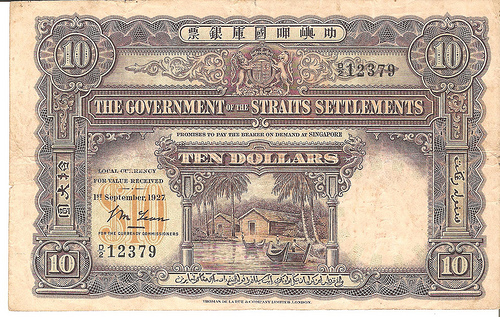
A Straits Settlements 10 Straits dollar banknote from 1927De La Rue · Public domain · Commons
Flag of JohorMrmw, Mike Rohsopht · Public domain · Commons
Coat of arms of JohorThe State Government of Johor · Public domain · Commons
Wars and Battles
With the fall of Portuguese Malacca in 1641 and the decline of Aceh due to the growing power of the Dutch, Johor started to re-establish itself as a power along the Strait of Malacca during the reign of Sultan Abdul Jalil Shah III (1623–1677). Its influence extended to Pahang, Sungei Ujong, Malacca, Klang and the Riau Archipelago. During the triangular war, the Jambi Sultanate emerged as a regional economic and political power in Sumatra. Initially there was an attempt of an alliance between Johor and Jambi with a promised marriage between the heir Raja Muda and daughter of the Pengeran of Jambi. However, the Raja Muda instead married the daughter of the Laksamana Abdul Jamil who, concerned about the dilution of power from such an alliance, offered his own daughter for marriage instead.
The British were worried by this development and forced the 1855 treaty between Temenggong Ibrahim and Tengku Ali. In exchange for recognition as sultan, Tengku Ali agreed to "give up all of Johor". The treaty was intended to solidify the position of Temenggong Ibrahim, their key ally.
Read more
Bendahara Ali was asked by the Sultan Mahmud Muzaffar about the 1855 treaty. In his reply, the Bendahara reiterated that the Temenggong was supposed to swear fealty to his majesty and on the behaviour of Tengku Ali, the Bendehara claimed ignorance. He also reiterated that he was not a party to any discussion with the British or Dutch.
The Dutch were also very worried. It seemed that the sultan was acting on his own and would not listen to any of the Dutch-influenced Yam Tuan Muda of Riau and the Bugis nobility.
Sultan Mahmud II, was a person of unstable disposition. When Tun Habib was the Bendahara, he effectively shielded the people from Mahmud II's eccentricities. After Tun Habib's death he was replaced by Abdul Jalil. As the Bendahara was only a cousin, he could not rein in Mahmud II's eccentric behaviour.
Read more
Sultan Mahmud II ordered the pregnant wife of a noble, Orang Kaya Megat Sri Rama killed, as she had taken a slice of the royal jackfruit. Subsequently, the sultan was assassinated in 1699 by Megat Sri Rama in revenge, leaving no heirs. The Orang Kayas, who were normally tasked with advising the sultan, went to Muar to meet Sa Akar DiRaja, Raja Temenggong of Muar, Mahmud II's uncle and asked for his counsel. He told them that Bendahara Abdul Jalil should inherit the throne which he did as Sultan Abdul Jalil IV. Many, particularly the Orang Laut, felt that the declaration was improper.
The Sultan of Perak (Malay: Sultan Perak, Jawi: سلطان ڤيراق) is the constitutional monarch and head of state of the Malaysian state of Perak. It is one of the oldest hereditary seats among the Malay states. The current sultan of Perak, Sultan Nazrin Muizzuddin Shah, has been in office since 29 May 2014.
When the Malacca Sultanate fell to Portugal in 1511, Sultan Mahmud Shah retreated to Kampar, Sumatra, and died there in 1528. He left behind two princes, Alauddin Riayat Shah II and Muzaffar Shah. The former established the Sultanate of Johor.
The Mempawah Kingdom (Malay: کرجاءن ممڤاوه, romanized: Kerajaan Mempawah) also known as the Mempawah Sultanate, was a Malay-Dayak kingdom located in a territory now known as the Mempawah Regency, West Kalimantan, Indonesia. The name Mempawah is taken from the term "Mempauh", which is the name of a tree that grows in the upper reaches of the river, also known as the Mempawah River. In its development, Mempawah became known as the name of one of the kingdoms and sultanates that developed in West Borneo.
Opu Daeng Menambun comes from the Bugis Luwu Kingdom in South Sulawesi. Opu Daeng Menambun's father named Opu Tendriburang Daeng Rilaga traveled from Sulawesi to the countries in the Malayan Peninsula. Opu Tendriburang Daeng Rilaga is the son of Opu La Maddusila, the first Bugis king to convert to Islam. Opu Tenrri borong Daeng Rilekke had five sons who were invited to travel to the Malayan Peninsula. The five children of Opu Tendriburang Daeng Rilaga were Opu Daeng Menambun, Opu Daeng Parani, Opu Daeng Chelak, Opu Daeng Marewah, and Opu Daeng Kemasi. Their arrival to the Malayan Peninsula became one of the migration stages of the Bugis people that occurred in the 17th century. Opu Tendriburang Daeng Rilaga and his five sons played an important role in the Malayan Peninsula and Borneo, especially in the spread of Islam.
The Sultanate of Sambas (Malay: كسلطانن سمبس, romanized: Kesultanan Sambas) was a traditional Malay state on the Western coast of the island of Borneo, in modern-day Indonesia.
1619 CE – 1833 CE · Capital: Tanjungpura Negeri Baru (1487)Sukadana (1590) Sungai Matan Indra Laya KartapuraTanjungpura (resettle)Muliakarta · 11,473 km²
Keraton Kerajaan Matan terletak di Mulia Kerta, Benua Kayong, Kabupaten Ketapang, Kalimantan BaratMuhammad Ali Yofi · CC BY-SA 4.0 · Commons
Tanjungpura Kingdom was an eighth century Malay kingdom located along the southwestern coast of Borneo facing the Java Sea, a region that today corresponds to the Ketapang Regency of West Kalimantan province of Indonesia. The kingdom experienced several moves of the royal capital, first located in Negeri Baru, Ketapang Regency, then moved to Sukadana, since Panembahan Sorgi (Giri Kesuma) embraced Islam.
Tanjungpura was once a province of the Singasari Kingdom as Bakulapura.
The Sultanate of Bima (Malay: كسلطانن بيم, romanized: Kesultanan Bima), officially known as The Settlements and Lands of Mbojo (Bima: Rasa ro Dana Mbojo), alternatively the Kingdom of Bima (Malay: کرجاءن بيم, romanized: Kerajaan Bima), was a Muslim state in the eastern part of Sumbawa in Indonesia, at the site of the present-day regency of Bima. It was a regionally important polity which formed the eastern limit of Islam in this part of Indonesia and developed an elite culture inspired by the Makassarese and the Malays models.
From early times, Sumbawa Island was divided in six kingdoms called Sumbawa (previously, they were still separate small chiefdom, which is called the Kedatuan. Such as the Kedatuan of Taliwang, the Kedatuan of Seran, and the Kedatuan of Jereweh, atc., which later united in 1648 to form the Sultanate of Sumbawa), Tambora, Dompu, Pekat, Sanggar and Bima. Of these, the last four spoke Nggahi Mbojo, the language of the Bimanese people, related to the languages of Flores and Sumba. The Hindu-Buddhist Bima Kingdom was the forerunner of the Sultanate of Bima and was probably founded around the 8th century, the exact year was 631 Saka, or 709 AD, based on the age of the Wadu Paa site, which was carved by Sang Bhima upon his first arrival in the land of Mbojo (the ancient name before it became known as Bima).. The indigenous name for the kingdom is Mbojo.
The Jambi Sultanate (Jawi: كسلطانن جمبي, romanized: Kesultanan Jambi), alternatively known as Djambi, was a sultanate that was centered in the modern-day province of Jambi in Indonesia.
Initially part of the Majapahit Empire, Jambi broke away in the early 16th century and established the sultanate in 1615. The state's founder is believed to be Datuk Puduko Berhalo. The sultanate grew rich on pepper, gold and timber exports in the early 17th century, but would face decline in the early 18th century due to the aftermath of the Johor-Jambi war that occurred in the mid to late 17th century.
In the 7th century, there was an early reference to a Malay Kingdom based in Jambi, which was eventually absorbed into the Srivijaya empire as an independent trading community or a subject-region. An account associated the early history of the sultanate with the Islamization of Sumatra, citing that these two events roughly coincided in the fifteenth century.
Read more
In 852–853 and 871, Tang dynasty China received diplomatic missions from Jambi. While Song and Yuan dynasty Chinese porcelain were found in Muara Jambi, near Jambi city (Chan-pei or Zhanbei). In 1095, 1094, 1090, 1088, and 1084 China received diplomatic delegations from Jambi, and the Jambi (Zhanbei) ruler and his daughter sent cloth, camphor and two Chinese language letters to Guangzhou in 1082.
Datuk Puduko Berhalo and Putri Selaras Pinang Masak (first)
Sultan Thaha Syaifuddin (last)
Government, Society and Religion
The Jambian monarchy did not practice direct succession. The Sultan of Jambi and the Pangeran Ratu (ڤڠيرن راتو, meaning crown prince) were elected by representatives of Jambi's four noble families: the Kraton, Kedipan, Perban, and the Raja Ampat Puluh (Jawi: راج امڤت ڤوله, lit: forty rajas). The candidates came from the largest family: the Kraton. The matriarch's social status determined the ranking of the candidates.
Read more
Like other Malay states, the Jambi sultan spent much of his time in leisure activities such as hunting or fishing, leaving the Pangeran Ratu to administer state affairs. The twelve-person Rapat XII council served the Pangeran Ratu for advisory and administrative functions. Its members came from the Jambian nobility (Jawi: انق راج; romanized: anak raja), including the heads of the four noble families.
Sultanate of Jambi FlagRakyat Kesultanan Jambi · CC BY 2.5 · Commons
Wars and Battles
Jambi took advantage of the Acehnese invasion of Johor to seize Tungkal, a disputed district on the border with Johor. Despite a 1629 Johorese attempt to seek its return, Tungkal remained under Jambian sovereignty until a pro-Johorese rebellion forced them out in 1655. Eventually, it was decided that Jambi and Johor should settle their disagreements through marriage. In 1659, the Raja Muda of Johor, Raja Ibrahim, who himself was the son of a Jambi princess and a previous sultan, was married to the daughter of the Jambi sultan. Their marriage would be a happy one. During his year-long stay in Jambi, he encouraged the Sultan to break from Mataram's overlordship, which would allow Johor and Jambi to come to a long-term peace arrangement. Eventually, Jambi did break away from Mataram's overlordship in 1663/64.
The conflict between Jambi and Johor caused Jambi to lose its position as a major pepper-producing port and go on the decline. In 1688, Sultan Ingalaga would be arrested and deposed by the VOC. This act split Jambi in two: Lower Jambi based in Tanah Pilih, ruled by Kiai Gede and supported by the VOC, and Upper Jambi, ruled by Pangeran Pringgabaya, under the influence of the ruler of Pagaruyung and supported by the highlanders. In 1708, an arrangement was made that Kiai Gede would relinquish his authority and cede his position to Pringgabaya, which reunified Jambi. However, the sultanate had become extremely weakened with the decline of trade. In March 1768, the Dutch settlement in Jambi would be attacked by a hundred men acting on orders from the Sultan. By 1770, they had abandoned Jambi for good.
The Sultan of Terengganu (Malay: Sultan Terengganu, Jawi: سلطان ترڠݢانو) is the title of the constitutional head of Terengganu state in Malaysia. The current sultan, Mizan Zainal Abidin of Terengganu, is the 18th sultan and 13th Yang di-Pertuan Agong of Malaysia from 2006 to 2011. He is the head of Islam in the state and the source of all titles, honours and dignities in the state.
Coat of arms of TerengganuFile converted to SVG format by Arteyu. · Public domain · Commons
Sultanate of Kutai Kartanegara
1734 CE – 1845 CE · 6,766 km²
Kutai is a historical region in what is now the Indonesian province of East Kalimantan on the island of Borneo. The region shares its name with the native ethnic group of the region (known as Urang Kutai 'the Kutai people'), with a total population around 300,000, who have their own language known as the Kutainese language which accompanies their own rich history.
The Kutai Martadipura Kingdom (399–1635) was the earliest Hindu kingdom in the East Indies. It was later succeeded by the Muslim sultanate of Kutai Kartanegara (1300–1844).
On 4 October 1999, the territory once belonging to the Sultanate of Kutai Kartanegara, until then composing the single Kutai Regency, was divided between a reduced Kutai Regency (renamed the Kutai Kartanegara Regency on 23 March 2002), new East Kutai and West Kutai regencies, and the independent city of Bontang; on 14 December 2012 the western districts of West Kutai Regency were split off to create a separate Mahakam Ulu Regency. Each regency was and is headed by a regent (known locally as Bupati) and forms a part of East Kalimantan|East Kalimantan. Meanwhile, the position of Sultan of Kutai Kartanegara still exists and resides in the Kutai Palace (Kedaton) in Tenggarong but administratively, the governance is conducted by the regional government of the Republic of Indonesia, not the sultanate. The Sultan holds an honorary status in Kutai and is highly respected by Kutai people.
Sultan of Selangor (سلطان سلاڠور) is the title of the constitutional ruler of Selangor, Malaysia who is the head of state and head of the Islamic religion in Selangor. The current monarch, Sultan Sharafuddin Idris Shah ascended the throne on the death of his father, on 22 November 2001.
Raja Lumu did not succeed his father after the latter's death in 1745. Instead, his first cousin, Daeng Kemboja was appointed as the third Yang di-Pertuan Muda of Riau. In February 1756, Sulaiman Badrul Alam Shah of Johor, who assumed Selangor is still a part of his territory, offered the Dutch to mine tin ore in Selangor after helping his nephew, Raja Mahmud winning a civil war against his step-brother, Raja Alam. His action was opposed by Daeng Kemboja, Raja Tua of Klang and Raja Lumu. Raja Lumu then sought to strengthen his influence and removed Selangor from Johor empire by seeking recognition from the 16th Sultan of Perak, Sultan Mahmud Shah ibni Sultan Muhammad Shah. He was installed by Sultan Mahmud Shah as the first Sultan of Selangor in November 1766, taking the regnal name, Sultan Salehuddin Shah.
The Sultanate of Sambaliung represents a significant historical sovereign polity documented in the Seshat Global History Databank. Active from 1830 CE – 1848 CE, the polity encompasses 2 geocoded time-slice polygons spanning across modern geographic coordinates [118.77, 1.12]. At its recorded apex in 1848 CE, it controlled an estimated 13,415 km² of territory, contributing to the administrative, cultural, and political landscape of the Industrial Era.
Sultanates of the Malay World: Frequently Asked Questions
What were the Sultanates of the Malay World?
The Malay world or Malay realm (Indonesian/Malay: Dunia Melayu or Alam Melayu) or Malaysphere is a political concept or an expression that has been used by different authors and groups over time to denote several different notions, derived from varied interpretations of 'Malay' either as an ethnic group, as a racial category, as a linguistic group or as a cultural group.
How many states were there among the Sultanates of the Malay World?
The atlas maps 23 of them: Sultanate of Kedah, Sultanate of Brunei, Sultanate of Malacca, Sultanate of Palembang, Sultanate of Sulu, Sultanate of Cirebon, Sultanate of Bone, Sultanate of Gowa, Sultanate of Aceh, Sultanate of Maguindanao, Sultanate of Banjar, Sultanate of Banten and 11 more.
Which was the largest of the Sultanates of the Malay World?
Sultanate of Brunei had the largest mapped extent, about 230,860 km².
Which of the Sultanates of the Malay World lasted longest?
Sultanate of Kedah lasted longest, 1139 CE – 1910 CE.
↑↓ to navigate↵ to open
12,754 Planetary Entities Indexed
We use Google Analytics cookies to understand which pages are useful. Necessary storage only keeps your theme and this choice on your device. Privacy policy