Skip to content
YearMaps
4 states337 CE – 723 CE

Ancient States of Iberia: Map & History

4 states of Iberia on one map, from 337 CE to 723 CE.The largest, Visigothic Kingdom, covered about 689,712 km². Each has its own section below with its rulers, capitals, wars and pictures where the records hold them.

026 Rekonstruktionsversuch wandalicher Trachten von dem Äußere Karpatensenken und Westbeskiden, 2 bis 3 Jh. PR DSC 1315 przeworsk
Silar · CC BY-SA 3.0 · Commons
Migrations des Alains selon Nathalie Kálnoky : Des princes scythes aux capitaines des Iasses, in : Droit et cultures [cote INIST : 24217] n° 52, L'Harmattan publ., Paris 2006. Fond de carte : [1]
Uploaded by Julieta39 · Public domain · Commons
Theodomir or Theodomar' (559-570), was one of the last Suevic Kings of Galicia. He has his statue in the West facade of the Royal Palace of Madrid.
Basilio · CC BY-SA 3.0 · Commons
Retrato imaginario de Teodorico I († 451), rey de los Visigodos e hijo ilegítimo del rey Alarico I.
Felix Castello · Public domain · Commons
Base map
337 AD
427 AD
723 AD
337 AD
425 AD
525 AD
625 AD
723 AD
Epochs:
↗
↗
↗
↗
↗
↗
↗
↗

Each state in its own colour. Move the timeline to see which existed in any year from 337 AD to 723 AD; select a territory to read about it. Borders: Cliopatria / Seshat (CC BY 4.0).

The Ancient States of Iberia Compared

StateYearsCapitalLargest extentRulers
Vandals337 CE – 438 CECarthage420,482 km²2
Alans414 CE – 438 CE–225,366 km²–
Kingdom of the Suebi414 CE – 586 CEBraga248,613 km²13
Visigothic Kingdom426 CE – 723 CEToulouse689,712 km²32

Timeline of the Ancient States of Iberia

When each state existed, 337 CE to 723 CE. Select a year to see the map then.

  1. Vandals
    337 CE – 438 CE
  2. Alans
    414 CE – 438 CE
  3. Kingdom of the Suebi
    414 CE – 586 CE
  4. Visigothic Kingdom
    426 CE – 723 CE

The 4 States

Vandals

337 CE – 438 CE · Capital: Carthage · 420,482 km²

026 Rekonstruktionsversuch wandalicher Trachten von dem Äußere Karpatensenken und Westbeskiden, 2 bis 3 Jh. PR DSC 1315 przeworsk
026 Rekonstruktionsversuch wandalicher Trachten von dem Äußere Karpatensenken und Westbeskiden, 2 bis 3 Jh. PR DSC 1315 przeworsk Silar · CC BY-SA 3.0 · Commons

The Vandals were a group of Germanic peoples who were first mentioned in passing by a small number of Roman writers in the first and second centuries, but became more prominent starting in the late second century during the tumultuous Marcomannic Wars of the Romans against many of the Germanic peoples north of the Danube, when Hasdingi-led Vandals took the side of the Romans, in exchange for territory in or near Dacia.

From Wikipedia: Vandals (CC BY-SA 4.0)

Rulers

Government, Society and Religion

Differences between the Arian Vandals and their Trinitarian subjects (including both Catholics and Donatists) were a constant source of tension in their African state. Catholic bishops were exiled or killed by Genseric and laymen were excluded from office and frequently suffered confiscation of their property. He protected his Catholic subjects when his relations with Rome and Constantinople were friendly, as during the years 454–457, when the Catholic community at Carthage, being without a head, elected Deogratias bishop. The same was also the case during the years 476–477, when Bishop Victor of Cartenna sent him, during a period of peace, a sharp refutation of Arianism and suffered no punishment. Huneric, Genseric's successor, issued edicts against Catholics in 483 and 484 in an effort to marginalise them and make Arianism the primary religion in North Africa.

From Wikipedia: Vandals · Kingdom in North Africa: Domestic religious tensions (CC BY-SA 4.0)

Wars and Battles

Decline and Fall

According to the 1913 Catholic Encyclopedia: "Genseric, one of the most powerful personalities of the "era of the Migrations", died on 25 January 477, at the great age of around 88 years. According to the law of succession that he had promulgated, the oldest male member of the royal house was to succeed. Thus he was succeeded by his son Huneric (477–484), who at first tolerated Catholics, owing to his fear of Constantinople, but after 482 began to persecute Manichaeans and Catholics."

Read more

Gunthamund (484–496), his cousin and successor, sought internal peace with the Catholics and ceased persecution once more. Externally, the Vandal power had been declining since Genseric's death and, early in his reign, Gunthamund lost all but a small wedge of western Sicily to the Ostrogoths, which was lost in 491 and had to withstand increasing pressure from the autochthonous Moors.

From Wikipedia: Vandals · Kingdom in North Africa: Decline (CC BY-SA 4.0)

Ended
438 CE

Legacy in the Modern World

Since the Middle Ages, kings of Denmark were styled "King of Denmark, the Goths and the Wends", the Wends being a group of West Slavs formerly living in Mecklenburg and eastern Holstein in modern Germany. The title "King of the Wends" is translated as vandalorum rex in Latin. The title was shortened to "King of Denmark" in 1972. Starting in 1540, Swedish kings (following Denmark) were styled Suecorum, Gothorum et Vandalorum Rex ("King of the Swedes, Geats, and Wends"). Carl XVI Gustaf dropped the title in 1973 and now styles himself simply as "King of Sweden".

Read more

The modern term vandalism stems from the Vandals' reputation as the barbarian people who sacked and looted Rome in AD 455. The Vandals were probably not any more destructive than other invaders of ancient times, but writers who idealized Rome often blamed them for its destruction.

From Wikipedia: Vandals · Legacy (CC BY-SA 4.0)
Alans

414 CE – 438 CE · 225,366 km²

Migrations des Alains selon Nathalie Kálnoky : Des princes scythes aux capitaines des Iasses, in : Droit et cultures [cote INIST : 24217] n° 52, L'Harmattan publ., Paris 2006. Fond de carte : [1]
Migrations des Alains selon Nathalie Kálnoky : Des princes scythes aux capitaines des Iasses, in : Droit et cultures [cote INIST : 24217] n° 52, L'Harmattan publ., Paris 2006. Fond de carte : [1] Uploaded by Julieta39 · Public domain · Commons

The Alans (Latin: Alani) were an ancient and medieval Iranic nomadic pastoral people who migrated to what is today the North Caucasus; some continued on to Europe and later North Africa. They are generally regarded as part of the Sarmatians, and possibly related to the Massagetae. Modern historians have connected the Alans with the Central Asian Yancai of Chinese sources and with the Aorsi of Roman sources. Having migrated westwards and becoming dominant among the Sarmatians on the Pontic–Caspian steppe, the Alans are mentioned by Roman sources in the 1st century CE.

From Wikipedia: Alans (CC BY-SA 4.0)

Origins and Founding

The Alans were formed out of the merger of the Massagetae, a Central Asian Iranian nomadic people, with some old tribal groups. Related to the Asii who previously invaded Bactria in the 2nd century BC, the Alans were pushed west by the Kangju people (known to Graeco-Roman authors as the Ἰαξάρται Iaxártai in Greek, and the Iaxartae in Latin), the latter of whom were living in the Syr Darya basin, from where they expanded their rule from Fergana to the Aral Sea region.

From Wikipedia: Alans · History: Origin (CC BY-SA 4.0)

Founded
414 CE

Government, Society and Religion

Prior to their Christianisation, the Alans were Indo-Iranian polytheists, subscribing either to the poorly understood Scythian pantheon or to a polytheistic form of Zoroastrianism. Some traditions were directly inherited from the Scythians, like embodying their dominant god in elaborate rituals.

Read more

In the 4th–5th centuries the Alans were at least partially Christianized by Byzantine Arian missionaries of the church. The Alans converted to Byzantine Orthodoxy in the first quarter of the 10th century, during the patriarchate of Nicholas I Mystikos. Al-Mas‘udi reports that they apostasized in 932, but this seems to have been short-lived. By the 13th century, most of the urban population of Ossetia gradually became Eastern Orthodox Christian as a result of Georgian missionary work.

From Wikipedia: Alans · Religion (CC BY-SA 4.0)

Languages
Scythian, Alanic
Religion
Ancient Iranic paganism, then Arianism (c. 5th century), and Nicene Christianity

Wars and Battles

The Alans were famed for their elite and highly mobile cavalry, a fighting style they inherited from their Sarmatian relatives. The Alans' influence on mounted warfare was widespread, with their tactics and equipment impacting the Roman and Germanic armies, among others.

Read more

Alani boys learned to ride at a young age, and Roman writer Ammianus Marcellinus remarked that walking was considered offensive for an Alanic man. A hallmark Alanic tactic, the feigned retreat was designed to draw enemy infantry into a vulnerable position. Alani horsemen would pretend to flee before suddenly wheeling around to attack the enemy's exposed flank.

As mercenaries for the Romans and other powers, the Alans demonstrated a sophisticated understanding of combined-arms tactics. Their missile-equipped cavalry would harry the enemy, pinning them in place before the shock cavalry delivered a devastating charge.

From Wikipedia: Alans · The Alans and warfare (CC BY-SA 4.0)

Kingdom of the Suebi

414 CE – 586 CE · Capital: Braga · 248,613 km²

Theodomir or Theodomar' (559-570), was one of the last Suevic Kings of Galicia. He has his statue in the West facade of the Royal Palace of Madrid.
Theodomir or Theodomar' (559-570), was one of the last Suevic Kings of Galicia. He has his statue in the West facade of the Royal Palace of Madrid. Basilio · CC BY-SA 3.0 · Commons

The Kingdom of the Suebi (Latin: Regnum Suevorum), also called the Kingdom of Galicia (Latin: Regnum Galicia) or Suebi Kingdom of Galicia (Latin: Galicia suevorum regnum), was a Germanic post-Roman kingdom that was one of the first to separate from the Roman Empire. Based in the former Roman provinces of Gallaecia and northern Lusitania, the de facto kingdom was established by the Suebi about 409, and during the 6th century it became a formally declared kingdom identifying with Gallaecia.

From Wikipedia: Kingdom of the Suebi (CC BY-SA 4.0)

Origins and Founding

Little is known about the Suebi who crossed the Rhine on the night of 31 December 405 AD and entered the Roman Empire. It is speculated that these Suevi are the same group as the Quadi, who are mentioned in early writings as living north of the middle Danube, in what is now lower Austria and western Slovakia, and who played an important part in the Germanic Wars of the 2nd century, when, allied with the Marcomanni, they fought fiercely against the Romans under Marcus Aurelius. The main reason behind the identification of the Suevi and Quadi as the same group comes from a letter written by St. Jerome to Ageruchia, listing the invaders who were in Gaul in 409, in which the Quadi are listed and the Suevi are not.

From Wikipedia: Kingdom of the Suebi · History: Origins (CC BY-SA 4.0)

Founded
414 CE
Preceded by
Gallaecia
Preceded by
Hispania

Rulers

Government, Society and Religion

Government
Monarchy
Languages
Suebi (spoken among elite), Latin (administrative/liturgical)
Religion
Germanic paganism (initially among elite and rural), Arianism (mostly among elite), Chalcedonian Christianity (among commoners)

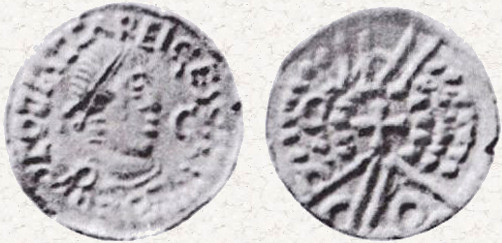
Coins, Currency and Symbols

Wars and Battles

Achievements and Monuments

The ruins of the Monastery of Dumio in Braga, an early paleo-Christian church constructed by the Suebic king Chararic.

Read more

The Church of Santa María Madre in Ourense, which used to be the site of a Suebic cathedral. Today, the façade still contains Suebi-era marble columns.

The Church of Cedofeita in Porto, a church that (according to tradition) was originally built by the Suebic king Theodemir.

The Ourense Cathedral, which was the site of a Suebic church built by king Chararic before destruction by the Moors.

The Monastery of Santa María de Mezonzo in Vilasantar, which was most likely the site of a Suebic church.

The Archaeological Station of Santa Marta das Cortiças in Braga, which includes the archeological remains of a Suebic palace.

From Wikipedia: Kingdom of the Suebi · Architecture and art: Architecture (CC BY-SA 4.0)

Decline and Fall

Ended
586 CE
Last recorded ruler
Liuvigild
Succeeded by
Kingdom of Toledo

Legacy in the Modern World

As the Suebi quickly adopted the local Vulgar Latin language, few traces were left of their Germanic tongue in the Galician and Portuguese languages. Distinguishing between loanwords from Gothic or Suevic is difficult, but there is a series of words, characteristic of Galicia and northern half of Portugal, which are attributed either to the Suebi or to the Goths, although no major Visigothic immigration into Gallaecia is known before the 8th century.

From Wikipedia: Kingdom of the Suebi · Linguistic and toponymic legacy (CC BY-SA 4.0)

Visigothic Kingdom

426 CE – 723 CE · Capital: Toulouse · 689,712 km²

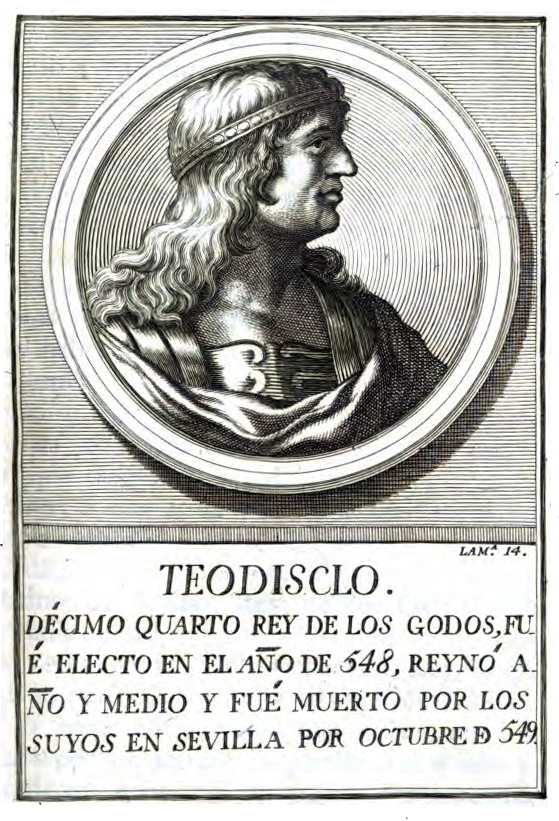
Retrato imaginario de Teodorico I († 451), rey de los Visigodos e hijo ilegítimo del rey Alarico I.
Retrato imaginario de Teodorico I († 451), rey de los Visigodos e hijo ilegítimo del rey Alarico I. Felix Castello · Public domain · Commons

The Visigothic Kingdom, Visigothic Spain or Kingdom of the Goths (Latin: Regnum Gothorum) was a barbarian kingdom that occupied what is now southwestern France and the Iberian Peninsula from the 5th to the 8th century. One of the Germanic successor states to the Western Roman Empire, it was originally created by the settlement of the Visigoths under King Wallia in the province of Gallia Aquitania in southwest Gaul by the Roman government and then extended by conquest over all of Hispania.

From Wikipedia: Visigothic Kingdom (CC BY-SA 4.0)

Origins and Founding

Founded
426 CE

Capitals

Toledo
Toledo Dmitry Dzhus from London · CC BY 2.0 · Commons
Toulouse
418–507 CE
Barcelona
507–542 CE

Rulers

Government, Society and Religion

Government
Elective Monarchy
Languages
indented, Gothic (spoken among elite), Vulgar Latin, Vasconic languages (spoken by several tribes throughout almost the entire Pyrenean and pre-Pyrenean region), Medieval Hebrew and Middle Aramaic (used as a liturgical language, during this period, among Jews), Alanic (spoken by the Alans of Aurelianum)

Wars and Battles

In 711, Tariq ibn Ziyad, a Muslim Berber client of Musa bin Nusair, the governor of Islamic Africa, invaded Spain with about 7,000 Berber men, while Roderic was in the north fighting the Basques. The tale that Julian, Count of Ceuta, facilitated the invasion because one of his daughters had been dishonored by Roderic is possibly mythical. By late July, a battle took place at the Guadalete River in the province of Cádiz. Roderic was betrayed by his troops, who sided with his enemies, and the king was killed in battle. The Muslims then took much of southern Spain with little resistance and went on to capture Toledo, where they executed several Visigothic nobles. In 712, Musa, the governor of Ifriqiya, arrived with another army of 18,000, with large Arab contingents. He took Mérida in 713 and invaded the north, taking Zaragoza and León, which were still under King Ardo, in 714.

From Wikipedia: Visigothic Kingdom · History: Muslim conquest (CC BY-SA 4.0)

Decline and Fall

Ended
723 CE
Last recorded ruler
Ardo
Succeeded by
al-Andalus

Legacy in the Modern World

The Visigothic rule has often been misattributed to be a part of the so-called Dark Ages, a time of supposedly cultural and scientific decay. Through the course of their existence the Visigoths supposedly remained "men of the woods never strayed too far from there," as Thomas F. Glick puts it.

Read more

However, in fact, the Visigoths were preservers of the classical culture. The bathing culture of Andalusia, for example, often said to be a Muslim invention, is a direct continuation of Romano-Visigothic traditions. Visigothic Mérida housed baths supplied with water by aqueducts, and such aqueducts are also attested in Córdoba, Cádiz and Recopolis. Excavations confirm that Recopolis and Toledo, the Visigothic capital, were heavily influenced by the contemporary Byzantine architecture.

From Wikipedia: Visigothic Kingdom · Culture and classical heritage (CC BY-SA 4.0)

Ancient States of Iberia: Frequently Asked Questions

Which states existed in Iberia in this period?

This page maps 4 states of Iberia founded between 337 CE and 426 CE: Vandals, Alans, Kingdom of the Suebi, Visigothic Kingdom.

Which was the largest of the Ancient States of Iberia?

Visigothic Kingdom had the largest mapped extent, about 689,712 km².

Which of the Ancient States of Iberia lasted longest?

Visigothic Kingdom lasted longest, 426 CE – 723 CE.

Sources

  • Reading text: Wikipedia articles on the group and each state, condensed (CC BY-SA 4.0).
  • Facts, rulers and wars: Wikidata (CC0).
  • Borders: Cliopatria, Seshat Global History Databank (CC BY 4.0).
  • Pictures: Wikimedia Commons; the author and licence are under each picture.

Largest state by mapped extent: Visigothic Kingdom.