A vassal state is any state that has varying degrees of influence, but is obligated to a superior state or empire. Vassal states were seen among the empires of the Near East, dating back to the era of the Egyptian, Hittite, Caananite and Mitanni conflict, as well as in ancient China.
Each state in its own colour. Move the timeline to see which existed in any year from 1300 BC to 1819; select a territory to read about it. Borders: Cliopatria / Seshat (CC BY 4.0).
Statue de Napir-Asu - Musée du Louvre - Antiquités orientales SB 2731 - photo 2Shonagon · CC0 · Commons
Elam was an ancient civilization centered in the far west and southwest of Iran, stretching from the lowlands of Ilam and Khuzestan as well as a small part of modern-day southern Iraq. The modern name Elam stems from the Sumerian transliteration elam(a), along with the later Akkadian elamtu, and the Elamite haltamti. Elamite states were among the leading political forces of the Ancient Near East. In classical literature, Elam was also known as Susiana (US: UK:; Ancient Greek: Σουσιανή Sousiānḗ), a name derived from its capital Susa.
The Apadana, a large hypostyle room of 36 columns in the Palace of Darius, Susa, capital of Elam and of the Achaemenid Empire, IranCarole Raddato from Frankfurt, Germany · CC BY-SA 2.0 · Commons
The Elamites practised polytheism. Due to scarcity of sources, past scholars assumed that Elamite religion must have been characterized by the "ill-defined character of the individual gods and goddesses....Most of them were not only ineffable beings whose real name was either not uttered or was unknown, but also sublime ideas, not to be exactly defined by the human race." Worship also varied between localities. However, more recent scholarship shows that Elamite deities most likely were not any less defined than those of their Sumerian, Akkadian and Hurrian neighbors.
Read more
Inscriptions of many Elamite kings indicate that a concept of a supreme triad consisting of Inshushinak (originally the civic protector god of Susa, eventually the leader of the triad and guarantor of the monarchy), Kiririsha (an earth/mother goddess in southern Elam), and Napirisha existed.
Many archaeological finds suggest that maritime trade along the shores of Africa and Asia started several millennia ago. Trade between the Indus Valley Civilization and the cities of Mesopotamia and Elam can be inferred from numerous find of Indus artifacts, particularly in the excavation at Susa. Various objects made with shell species that are characteristic of the Indus coast, particularly Trubinella pyrum and Fasciolaria trapezium, have been found in the archaeological sites of Mesopotamia and Susa dating from around 2500–2000 BC. Carnelian beads from the Indus were found in Susa in the excavation of the tell of the citadel. In particular, carnelian beads with an etched design in white were probably imported from the Indus Valley, and made according to a technique of acid-etching developed by the Harappans.
Dated to approximately the 12th century BC, gold and silver figurines of Elamite worshippers are shown carrying a sacrificial goat. These divine and royal statues were meant to assure the king of the enduring protection of the deity, well-being and a long life. Works which showed a ruler and his performance of a ritual action were intended to eternalize the effectiveness of such deeds. Found near the Temple of Inshushinak in Susa, these statuettes would have been considered charged with beneficial power.
Read more
While archaeologists cannot be certain that the location where these figures were found indicates a date before or in the time of the Elamite king Shilhak-Inshushinak, stylistic features can help ground the figures in a specific time period.
The Assyrians had utterly destroyed the Elamite nation, but new polities emerged in the area after Assyrian power faded. Some time after that region fell to Madius the Scythian (653 BC), Teispes, son of Achaemenes, conquered Elamite Anshan in the mid 7th century BC, forming a nucleus that would expand into the Persian Empire. They were largely regarded as vassals of the Assyrians, and the Medes, Mannaeans, and Persians paid tribute to Assyria from the 10th century BC until the death of Ashurbanipal in 631 BC. After his death, the Medes played a major role in the destruction of the weakened Assyrian Empire in 612 BC.
Read more
The rise of the Achaemenids in the 6th century BC brought an end to the existence of Elam as an independent political power "but not as a cultural entity" (Encyclopædia Iranica, Columbia University).
The Seleucid dynasty or the Seleucidae (Greek: Σελευκίδαι, Seleukídai, "descendants of Seleucus") was a Macedonian Greek royal family, which ruled the Seleucid Empire based in West Asia during the Hellenistic period. It was founded by Seleucus I Nicator, a general and successor of Alexander the Great, after the division of the Macedonian Empire as a result of the Wars of the Successors (Diadochi).
Through its history, the Seleucid dominion included large parts of the Near East, as well as of the Asian territory of the earlier Achaemenid Persian Empire.
Coin of Seleucus Nicator, circa 305– September 281 BCE, National Museum, New DelhiSpeakingArch · CC BY-SA 4.0 · Commons
Seleucus (c. 358 – 281 BC) served as an officer of Alexander the Great, commanding the elite infantry corps in the Macedonian army: the "Shield-bearers" (Greek: Ὑπασπισταί, Hypaspistai), later known as the "Silvershields" (Ἀργυράσπιδες, Argyraspides). After the death of Alexander in 323 BC, the Partition of Triparadisus assigned Seleucus as satrap of Babylon in 321 BC. Antigonus, the satrap of much of Asia Minor, forced Seleucus to flee from Babylon, but, supported by Ptolemy, the Satrap of Egypt, Seleucus returned in 312 BC. Seleucus' later conquests included Persia and Media. He agreed to a peace treaty with the Indian King Chandragupta Maurya (reigned 324-297 BC). Seleucus defeated Antigonus in the Battle of Ipsus in 301 BC and Lysimachus (King of Thrace, Macedon and Asia Minor) in the battle of Corupedium (near Sardis) in 281 BC.
Summer Vacation 2007, 263, Watchtower In The Morning Light, Dunhuang, Gansu ProvinceThe Real Bear · CC BY 2.0 · Commons
The Han dynasty (202 BC – 9 AD, 25–220 AD) was an imperial dynasty of China established by Liu Bang, and preceded by the short-lived Qin dynasty (221–206 BC) and the interregnum known as the Chu–Han Contention (206–202 BC). It was succeeded by the Three Kingdoms period (220–280 AD) and also briefly interrupted by the Xin dynasty (9–23 AD) established by the usurping regent Wang Mang. It is thus separated into two periods—the Western Han (202 BC – 9 AD) and the Eastern Han (25–220 AD). The Han dynasty is considered a golden age in Chinese history, impacting Chinese identity in later periods.
In Han government, the emperor was the supreme judge and lawgiver, the commander-in-chief of the armed forces and sole designator of official nominees appointed to the top posts in central and local administrations; those who earned a 600-bushel salary-rank or higher. Theoretically, there were no limits to his power.
Read more
However, state organs with competing interests and institutions such as the court conference (tingyi 廷議)—where ministers were convened to reach a majority consensus on an issue—pressured the emperor to accept the advice of his ministers on policy decisions. If the emperor rejected a court conference decision, he risked alienating his high ministers. Nevertheless, emperors sometimes did reject the majority opinion reached at court conferences.
Below the emperor were his cabinet members known as the Three Councillors of State.
Aside from the landowner's land tax paid in a portion of their crop yield, the poll tax and property taxes were paid in coin cash. The annual poll tax rate for adult men and women was 120 coins and 20 coins for minors. Merchants were required to pay a higher rate of 240 coins. The poll tax stimulated a money economy that necessitated the minting of over 28,000,000,000 coins from 118 BC to 5 AD, an average of 220,000,000 coins a year.
Read more
The widespread circulation of coin cash allowed successful merchants to invest money in land, empowering the very social class the government attempted to suppress through heavy commercial and property taxes. Emperor Wu even enacted laws which banned registered merchants from owning land, yet powerful merchants were able to avoid registration and own large tracts of land.
Wang Zhengjun (71 BC – 13 AD) was first empress, then empress dowager, and finally grand empress dowager during the reigns of the Emperors Yuan (r. 49–33 BC), Cheng (r. 33–7 BC), and Ai (r. 7–1 BC), respectively. During this time, a succession of her male relatives held the title of regent. Following the death of Ai, Wang Zhengjun's nephew Wang Mang (45 BC – 23 AD) was appointed regent as Marshall of State on 16 August under Emperor Ping (r. 1 BC – 6 AD).
Read more
When Ping died on 3 February 6 AD, Ruzi Ying (d. 25 AD) was chosen as the heir and Wang Mang was appointed to serve as acting emperor for the child. Wang promised to relinquish his control to Liu Ying once he came of age.
Han-era mechanical engineering comes largely from the choice observational writings of sometimes-disinterested Confucian scholars who generally considered scientific and engineering endeavours to be far beneath them. Professional artisan-engineers (jiang 匠) did not leave behind detailed records of their work. Han scholars, who often had little or no expertise in mechanical engineering, sometimes provided insufficient information on the various technologies they described.
Read more
Nevertheless, some literary sources provide crucial information. For example, in 15 BC the philosopher and poet Yang Xiong described the invention of the belt drive for a quilling machine, which was of great importance to early textile manufacturing. The inventions of mechanical engineer and craftsman Ding Huan are mentioned in the Miscellaneous Notes on the Western Capital.
The Partisan Prohibitions were repealed during the Yellow Turban Rebellion and Five Pecks of Rice Rebellion in 184 AD, largely because the court did not want to continue to alienate a significant portion of the gentry class who might otherwise join the rebellions. The Yellow Turbans and Five-Pecks-of-Rice adherents belonged to two different hierarchical Taoist religious societies led by faith healers Zhang Jue (d. 184 AD) and Zhang Lu (d. 216 AD), respectively.
Read more
Zhang Lu's rebellion, in what is now northern Sichuan and southern Shaanxi, was not quelled until 215 AD. Zhang Jue's massive rebellion across eight provinces was annihilated by Han forces within a year; however, the following decades saw much smaller recurrent uprisings.
Alliance between Gupta Empire and Vakataka Kingdom
324 CE – 554 CE · Capital: ubl · 2,882,950 km²
Queen Kumaradevi and King Chandragupta I on a coinUploadalt · CC BY-SA 3.0 · Commons
The Gupta Empire was an Indian empire during the classical period of the Indian subcontinent which existed from the mid 3rd century to mid 6th century CE. At its peak, the dynasty ruled over an empire that spanned much of the northern Indian subcontinent. This period has been considered as the Golden Age of India by some historians, although this characterisation has been disputed by others. The ruling dynasty of the empire was founded by Gupta.
The exact ancestral territory of the Guptas is uncertain. They originated somewhere in the Gangetic plains: eastern Uttar Pradesh, Magadha (Bihar) and Bengal have been variously proposed as their homeland.
Read more
One theory traces the dynasty's origin to eastern Uttar Pradesh, where most of the coins of dynasty's early rulers and important Gupta inscriptions have been found. Proponents of this theory also argue that the Puranas distinguish between the Guptas and the Magadhas (possibly the Licchavis). Critics of this theory interpret the Puranic verses differently, and point out that the extant inscriptions of several dynasties - such as the Mauryas and the Palas - have been found far from their known capitals. Another theory traces the dynasty's origin further east, in the Magadha (Bihar) and/or Varendra (Bengal) regions.
A study of the epigraphical records of the Gupta Empire shows that there was a hierarchy of administrative divisions from top to bottom. It was divided into 26 provinces, which were called Bhukti, Desha or Rajya. Provinces were also divided into vishayas or pradeshas (districts) and put under the control of Vishayapatis (district lords). A Vishayapati administered the Vishaya with the help of the Adhikarana (council of representatives), which comprised four representatives: Nagarasreshesthi, Sarthavaha, Prathamakulika and Prathama Kayastha. A part of the Vishaya was called Vithi. The Gupta also had trading links with the Sassanid and Byzantine Empires. The four-fold varna system was observed under the Gupta period but occupations were not rigidly constrained by caste. Some Brahmins followed non-Brahmanical professions. Kshatriyas were often involved in trade and commerce.
In contrast to the Maurya Empire, the Guptas introduced several military innovations to Indian warfare. Chief among these was the use of siege engines, heavy cavalry archers and heavy sword cavalry. Heavy cavalry formed the core of the Gupta Army and were supported by the traditional Indian Army elements of war elephants and light infantry.
Read more
The utilisation of horse archers in the Gupta period is evidenced on the coinage of Chandragupta II, Kumaragupta I and Prakasaditya (postulated to be Purugupta) that depicts the kings as horse-archers.
There is a paucity of contemporary sources detailing the tactical operations of the Imperial Gupta Army. The best extant information comes from the Sanskrit mahakavya (epic poem) Raghuvaṃśa written by the Classical Sanskrit writer and dramatist Kalidasa.
The Gupta period is generally regarded as a classic peak of North Indian art for all the major religious groups. Although painting was evidently widespread, the surviving works are almost all religious sculptures. The period saw the emergence of the iconic carved stone deity in Hindu art, as well as the Buddha-figure and Jain tirthankara figures, the latter often on a very large scale. The two great centres of sculpture were Mathura and Gandhara, the latter the centre of Greco-Buddhist art. Both exported sculpture to other parts of northern India.
Read more
The most famous remaining monuments in a broadly Gupta style, the caves at Ajanta, Elephanta, and Ellora (respectively Buddhist, Hindu, and mixed including Jain) were in fact produced under later dynasties, but primarily reflect the monumentality and balance of Gupta style.
Following Skandagupta's death, the empire was clearly in decline, and the later Gupta coinage indicates their loss of control over much of western India after 467–469. Skandagupta was followed by Purugupta (467–473), Kumaragupta II (473–476), Budhagupta (476–495), Narasimhagupta (495–530), Kumaragupta III (530–540), Vishnugupta (540–550), two lesser known kings namely, Vainyagupta and Bhanugupta.
Read more
In the late 490's the Alchon Huns under Toramana and Mihirakula broke through the Gupta defences in the northwest, and much of the empire in the northwest was overrun by the Huns by 500. According to some scholars the empire disintegrated under the attacks of Toramana and his successor Mihirakula. It appears from inscriptions that the Guptas, although their power was much diminished, continued to resist the Huns. The Hun invader Toramana was defeated by Bhanugupta in 510.
Indian astronomy also saw progress in this era. The names of the seven days in a week appeared at the start of the Gupta period based on Hindu deities and planets corresponding to the Roman names. Aryabhata made several contributions such as assigning the start of each day to midnight. the earth's rotation on its axis, westward motion of the stars. Aryabhata also mentioned that reflected sunlight is the cause behind the shining of the Moon. In his book, Aryabhata, he suggested that the Earth was sphere, containing a circumference of 24,835 miles (39,967 km). Varāhamihira approximates the method for determination of the meridian direction from any three positions of the shadow using a gnomon.
390 CE – 450 CE · Capital: Bactria · 3,947,849 km²
HUNNIC TRIBES, Kidarites Kirada Circa 340-345CNG Coins · CC BY-SA 3.0 · Commons
The Kidarites, or Kidara Huns, were a dynasty that ruled Bactria and adjoining parts of Central Asia and Pakistan in the 4th and 5th centuries. The Kidarites belonged to a complex group of peoples known collectively in the Indus Valley as the Huna, and in Europe as the Chionites (from the Iranian names Xwn/Xyon), and may even be considered as identical to the Chionites. The 5th century Byzantine historian Priscus called them Kidarite Huns, or "Huns who are Kidarites". Chinese annals referred to them as the Ta Yüeh-chih, or Lesser Yüeh-chih.
A nomadic people, the Kidarites appear to have originated in the Altai Mountains region. The terms Huns/Chionites seem to reflect the general ethnic appellation of these people, whereas Kidarites should be understood as a dynastic designation derived from the name of their king, Kidara. On Kidarite coins their rulers are depicted as beardless or clean-shaven – a feature of Altaic cultures at the time (as opposed, for example, to the Iranian cultures of South Central Asia). They may have been Oghuric speakers originally, as may have been the Chionites and the Hephthalites, before adopting the Bactrian language. The Kidarites were depicted as mounted archers on the reverse of coins. They were also known to practice artificial cranial deformation.
It seems Buddhism was rather unaffected by Kidarite rule, as the religion continued to prosper. The Chinese pilgrim Fa-hsien visited the region c. 400 CE, and described a wealthy Buddhist culture. Some aspects of the Buddhist art of Gandhara seem to have incorporated Zoroastrian elements conveyed by the Kidarites at that time, such as the depiction of fire altars on the bases of numerous Buddhist sculptures.
Read more
It has been argued that the spread of Indian culture and religions as far as Sogdia corresponded to the rule of the Kidarites over the regions from Sogdia to Gandhara.
Some Buddhist works of art, in a style marking some evolution compared to the art of Gandhara, have been suggested as belonging to the Kidarite period, such as the sculptures of Paitava.
The Kidarites issued gold coins on the model of Kushan coinage, inscribing their own names but still claiming the Kushan heritage by using the title "Kushan". The volume of Kidarite gold coinage was nevertheless much smaller than that of the Great Kushans, probably owing to a decline of commerce and the loss of major international trade routes.
Read more
Coins with the title or name Gadahara seem to be the first coins issued by the invading Kidarites in the Kushan realm in India. The additional presence of the names of foreign rulers such as the Kushano-Sassanian Piroz or the Gupta Empire Samudragupta on the coins may suggest some kind of suzerainty at a time when the remnants of Kushan power were torn between these two powers. The "Gadahara" issues seem to come chronologically just before the issues of the famous Kidarite ruler Kidara.
Since the foundation of the Sasanian Empire, its rulers had demonstrated the sovereignty and power of their realm through collection of tribute, particularly from the Romans. However, the Sasanian efforts were disrupted in the early 5th century by the Kidarites, who forced Yazdegerd I (r. 399–420), Bahram V (r. 420–438), and/or Yazdegerd II (r. 438–457) to pay them tribute. Although this did not trouble the Sasanian treasury, it was nevertheless humiliating. Yazdegerd II eventually refused to pay tribute, which would later be used as the casus belli of the Kidarites, who declared war against the ruling Sasanian king Peroz I in c. 464. Peroz lacked manpower to fight, and therefore asked for financial aid by the Byzantine Empire, who declined his request.
Alliance between Northern Wei and Rouran Khaganate
402 CE – 533 CE · Capital: Shengle (386–398, capital of former Dai, near modern Hohhot), Pingcheng (398–493), Luoyang (493–534), Chang'an (534–535) · 5,037,575 km²
北魏孝文帝像Original uploader was Jason22 at zh.wikipedia · Public domain · Commons
Wei, known in historiography as the Northern Wei (Chinese: 北魏; pinyin: Běi Wèi), Tuoba Wei (Chinese: 拓跋魏; pinyin: Tuòbá Wèi), Yuan Wei (Chinese: 元魏; pinyin: Yuán Wèi) and Later Wei (Chinese: 後魏; pinyin: Hòu Wèi), was an imperial dynasty of China ruled by the Tuoba (Tabgach) clan of the Xianbei. The first of the Northern dynasties, it ruled northern China from 386 to 535 AD during the period of the Northern and Southern dynasties.
The Jin dynasty had developed an alliance with the Tuoba against the Xiongnu state Han-Zhao. In 315, the Tuoba chief, Tuoba Yilu was granted the title of Prince of Dai. After his death, however, the Dai state stagnated, and with the Jin ejected from northern China, the Dai largely remained a partial ally and a partial tributary state to Later Zhao and Former Yan, finally falling to Former Qin in 376.
Read more
After Former Qin's emperor Fu Jiān was defeated by Jin forces at the Battle of Fei River in his failed bid to unify China, the Former Qin state began to break apart. By 386, Tuoba Gui (Emperor Daowu of Northern Wei), the son (or grandson) of Tuoba Shiyiqian (the last Prince of Dai), reasserted Tuoba independence initially as the Prince of Dai. Later he changed his title to the Prince of Wei, and his state was therefore known as Northern Wei.
Local society in northern China was not governed by civil bureaucrats but by military clientage during the reign of the Northern Wei Xianbei emperors, with the local Han Chinese aristocratic families jointly ruling and controlling power with them. The Han Chinese aristocrat families ruled over their private fiefs (home jurisdictions) with large military authority and civil authority as entrusted to them by the Xianbei emperor. The Xianbei emperor also turned their own Xianbei nomad warriors into a hereditary military caste and extinguish their tribal loyalties. To the consternation of the Xianbei nobles, Han Chinese aristocrats started to be appointed to government positions by the Northern Wei emperors when the Central Plains population regrew in the middle of the 5th century.
In 502, the Southern Qi general Xiao Yan toppled the emperor Xiao Baojuan after waging a three-year civil war against him. Xiao Yan enthroned in Jiankang to become Emperor Wu of the Liang dynasty.
Read more
As early as 503 AD, the Northern Wei was hoping to restore the Southern Qi throne. Their plan was to install Xiao Baoyin, a Southern Qi prince, to become emperor of the puppet state. A southern expedition was led by Prince Yuan Cheng of Wei and Chen Bozhi, a former Qi general. Until spring 505, Xinyang and Hanzhong were fallen to the Northern Wei.
In 505, Emperor Wu began the Liang offensive. A strong army was quickly amassed under the general Wei Rui and caught the Wei by surprise, calling it the strongest army they have seen from the Southern dynasties in a hundred years. In spring 506, Wei Rui was able to capture Hefei.
Neither Eastern Wei nor Western Wei was long-lived. In 550, Gao Huan's son Gao Yang forced Emperor Xiaojing of Eastern Wei to yield the throne to him, ending Eastern Wei and establishing the Northern Qi. Similarly, in 557, Yuwen Tai's nephew Yuwen Hu forced Emperor Gong of Western Wei to yield the throne to Yuwen Tai's son Yuwen Jue, ending the Western Wei and establishing the Northern Zhou. In 581, the Northern Zhou official Yang Jian had the emperor to yield the throne to him, establishing the Sui dynasty.
The Northern Wei dynasty was the most long-lived and most powerful of the northern dynasties prior to the reunification of China by the Sui dynasty. Its most important legacy was the sweeping reforms introduced under Empress Dowager Feng and continued under her successors. While the dynasty officially ended in 557, these reforms, especially the equal-field landholding system, lasted until the mid-eight century CE. The reforms completely reshaped China's political development as they reverted the trends associated with feudalism in earlier times (c. second to fifth centuries CE) such as the devolution of power to local strongmen and political fragmentation. Historians generally credit the Northern Wei dynasty for laying the foundation for China's eventual reunification under the Sui dynasty.
Gebäude der Afghan Business School in Kunduz (die erste Fernuniversität Afghanistans)Bastian Kuhl · CC BY-SA 3.0 · Commons
The Hephthalites or Ephthalites (Bactrian: ηβοδαλο, romanized: Ebodalo), sometimes called the White Huns (also known as the White Hunas, in Iranian as the Spet Xyon and in Sanskrit and Prakrit as the Sveta-huna), were a people who lived in Central Asia during the 5th to 8th centuries CE, and were a part of what numismatist Robert Göbl calls Iranian Huns. They formed an empire, the Imperial Hephthalites, and were militarily important from 450 CE, when they defeated the Kidarites, to 560 CE, when combined forces from the First Turkic Khaganate and the Sasanian Empire defeated them.
They were descendants "of the Gaoju or the Da Yuezhi" according to the earliest chronicles such as the Book of Wei or the History of the Northern Dynasties.
Read more
They were descendants "of the Da Yuezhi tribes", according to many later chronicles.
The ancient historian Pei Ziye conjectured that the "Hua" (滑) may be descendants of a Jushi general of the 2nd century CE because that general was named "Bahua" (八滑). This etymological fantasy was adopted by the Book of Liang (Volume 30 and Volume 54).
Another etymological fantasy appeared in the Tongdian, reporting an account by the traveller Wei Jie according to which the Hephthalites may have been the descendants of the Kangju because a Kangju general of the Eastern Han happened to be named "Yitian".
With the Sasanian Empire paying a heavy tribute, from 474, the Hephthalites themselves adopted the winged, triple-crescent crowned Peroz I as the design for their coinage. Benefiting from the influx of Sasanian silver coins, the Hephthalites did not develop their own coinage: they either minted coins with the same designs as the Sasanians, or simply countermarked Sasanian coins with their own symbols. The coins countermarked with a Hephthalite sign were those used for the payment of tribute by the Sasanians. They did not inscribe the name of their ruler, contrary to the habit of the Alchon Huns or the Kidarites before them. Exceptionally, one coin type deviates from the Sasanian design, by showing the bust of a Hepthalite prince holding a drinking cup. Overall, the Sasanians paid "an enormous tribute" to the Hephthalites, until the 530s and the rise of Khosrow I.
Even in time of peace the mere sight or mention of a Hephthalite terrified everybody, and there was no question of going to war openly against one, for everybody remembered all too clearly the calamities and defeats inflicted by the Hephthalites on the king of the Aryans and on the Persians.
Read more
"Hunnic" designs in weaponry are known to have influenced Sasanian designs during the 6th–7th century CE, just before the Islamic invasions. The Sasanians adopted Hunnish nomadic designs for straight iron swords and their gold-covered scabbards. This is particularly the case of two-straps suspension design, in which straps of different lengths were attached to a P-shaped projection on the scabbard, so that the sword could be held sideways, making it easier to draw, especially when on horseback.
Polyandry was the Hephthalites most noteworthy social custom. Brothers had one wife in common and the children were considered as belonging to the oldest brother. The number of ‘horns’ on a married woman’s headdress corresponded to the number of her husbands. They were also said to practice artificial cranial deformation. Chinese sources said they worshiped 'foreign gods', 'demons', the 'heaven god' or the 'fire god'. The Gokturks told the Byzantines that they had walled cities. Some Chinese sources said that they had no cities and lived in tents. Litvinsky tries to resolve this by saying that they were nomads who moved into the cities they had conquered. There were some government officials but central control was weak and local dynasties paid tribute.
After Kavad I, the Hephthalites seem to have shifted their attention away from the Sasanian Empire, and Kavad's successor Khosrow I (531–579) was able to resume an expansionist policy to the east. According to al-Tabari, Khosrow I managed, through his expansionist policy, to take control of "Sind, Bust, Al-Rukkhaj, Zabulistan, Tukharistan, Dardistan, and Kabulistan" as he ultimately defeated the Hephthalites with the help of the First Turkic Khaganate.
Read more
In 552, the Göktürks took over Mongolia, formed the First Turkic Khaganate, and by 558 reached the Volga. Circa 555–567, the Turks of the First Turkic Khaganate and the Sasanians under Khosrow I allied against the Hephthalites and defeated them after an eight-day battle near Qarshi, the Battle of Gol-Zarriun, perhaps in 557.
In modern historiography, the Western Roman Empire was the Roman Empire's western provinces collectively during any period in which they were administered separately from the eastern provinces by a separate, independent imperial court. Particularly from AD 395 to 476, there were separate, coequal courts dividing the governance of the empire into western and eastern provinces with a distinct imperial succession in the separate courts.
As the Roman Republic expanded, it reached a point where the central government in Rome could not effectively rule the distant provinces. Communications and transportation were especially problematic given the vast extent of the Empire. News of invasion, revolt, natural disasters, or epidemic outbreak was carried by ship or mounted postal service, often requiring much time to reach Rome and for Rome's orders to be returned and acted upon. Therefore, provincial governors had de facto autonomy in the name of the Roman Republic. Governors had several duties, including the command of armies, handling the taxes of the province and serving as the province's chief houses.
Read more
Prior to the establishment of the Empire, the territories of the Roman Republic had been divided in 43 BC among the members of the Second Triumvirate: Mark Antony, Octavian and Marcus Aemilius Lepidus.
Wallialived until 419 CEAlejo Vera · Public domain · Commons
Government, Society and Religion
The deposition of Romulus Augustus and the rise of Odoacer as ruler of Italy in 476 received very little attention at the time. Overall, very little changed for the people; there was still a Roman emperor in Constantinople to whom Odoacer had subordinated himself. Interregna had been experienced at many points in the West before and the deposition of Romulus Augustus was nothing out of the ordinary. Odoacer saw his rule as entirely in the tradition of the Roman Empire, not unlike Ricimer, and he effectively ruled as an imperial "governor" of Italy and was even awarded the title of patricius. Odoacer ruled using the Roman administrative systems already in place and continued to mint coins with the name and portrait of Julius Nepos until 480 and later with the name and portrait of the Eastern Augustus, rather than in his own name.
Hoard of Roman silver coins from CichobórzGabinet Numizmatyczny D. Marciniak · CC BY 3.0 · Commons
Currency
Roman currency
Wars and Battles
Honorius' death in 423 was followed by turmoil until the Eastern Roman government installed Valentinian III as Western emperor in Ravenna by force of arms, with Galla Placidia acting as regent during her son's minority. Theodosius II, the Eastern emperor, had hesitated to announce the death of Honorius and in the ensuing interregnum, Joannes was nominated as Western emperor. Joannes' rule was short and the forces of the East defeated and executed him in 425.After a violent struggle with several rivals, and against Placidia's wish, Aetius rose to the rank of magister militum. Aetius was able to stabilize the Western Empire's military situation somewhat, relying heavily on his Hunnic allies. With their help Aetius undertook extensive campaigns in Gaul, defeating the Visigoths in 437 and 438 but suffering a defeat himself in 439, ending the conflict in a status quo ante with a treaty.
By convention, the Western Roman Empire is deemed to have ended on 4 September 476, when Odoacer deposed Romulus Augustus, but the historical record calls this determination into question. Indeed, the deposition of Romulus Augustus received very little attention in contemporary times. Romulus was a usurper in the eyes of the Eastern Roman Empire and in the remaining territories under Western Roman control outside of Italy, where the previous emperor, Julius Nepos, was still alive and claiming to rule the Western Empire from Dalmatia. Furthermore, the Western court had lacked true power and had been subject to Germanic aristocrats for decades, with most of its legal territory being under control of various barbarian kingdoms. With Odoacer recognising Julius Nepos, and later the Eastern emperor Zeno, as his sovereign, nominal Roman control continued in Italy.
As the Western Roman Empire crumbled, the new Germanic rulers who conquered its constituent provinces maintained most Roman laws and traditions. Many of the invading Germanic tribes were already Christianized, although most were followers of Arianism. They quickly changed their adherence to the state church of the Roman Empire. This helped cement the loyalty of the local Roman populations, as well as the support of the powerful Bishop of Rome. Although they initially continued to recognize indigenous tribal laws, they were more influenced by Roman law and gradually incorporated it. Roman law, particularly the Corpus Juris Civilis collected on the orders of Justinian I, is the basis of modern civil law. In contrast, common law is based on Germanic Anglo-Saxon law. Civil law is by far the most widespread system of law in the world, in force in some form in about 150 countries.
The Ostrogothic Kingdom, officially the Kingdom of Italy (Latin: Regnum Italiae), was a barbarian kingdom established by the Germanic Ostrogoths that controlled Italy and neighbouring areas between 493 and 553. Led by Theodoric the Great, the Ostrogoths killed Odoacer, a Germanic soldier and erstwhile leader of the foederati. Odoacer had previously become the de facto ruler of Italy following Odoacer's deposition of Romulus Augustulus, the final emperor of the Western Roman Empire, in 476.
Teia551–552 CEThe original uploader was Captain Blood at German Wikipedia. · Public domain · Commons
Government, Society and Religion
Historians have proposed widely varying estimates for the population that accompanied Theodoric into Italy in 489 CE, ranging from approximately 100,000 to 250,000 individuals. The incoming Goths constituted a minority relative to the established Italo-Roman population, while maintaining a distinct political and social identity during the early Ostrogothic kingdom. Following the defeat of Odoacer, many of his former soldiers, drawn from groups such as the Sciri, Rugii, Heruli, Turcilingi, Alans, and other contingents, were integrated into the new political and military order. The Goths were particularly prominent in the western Po Valley, the Alpine region, and areas corresponding to modern Veneto, Trentino, Friuli and Marche.
An agreement was reached between Zeno and Theodoric, stipulating that Theodoric, if victorious, was to rule in Italy as the emperor's representative. Theodoric with his people set out from Moesia in the autumn of 488, passed through Dalmatia and crossed the Julian Alps into Italy in late August 489. The first confrontation with the army of Odoacer was at the river Isonzo (the battle of Isonzo) on August 28. Odoacer was defeated and withdrew towards Verona, where a month later another battle was fought, resulting in a bloody, but crushing, Gothic victory.
Read more
Odoacer fled to his capital at Ravenna, while the larger part of his army under Tufa surrendered to the Goths. Theodoric then sent Tufa and his men against Odoacer, but he changed his allegiance again and returned to Odoacer.
Because of the kingdom's short history, no fusion of the two peoples and their art was achieved. However, under the patronage of Theodoric and Amalasuntha, large-scale restoration of ancient Roman buildings was undertaken, and the tradition of Roman civic architecture continued. In Ravenna, new churches and monumental buildings were erected, several of which survive.
Read more
The Basilica of Sant'Apollinare Nuovo, its baptistry, and the Archiepiscopal Chapel follow the typical late Roman architectural and decorative motifs, but the Mausoleum of Theodoric displays purely Gothic elements, such as its construction not from the usual brick, but of massive slabs of Istrian limestone, or the 300-ton single-piece roof stone.
Maintenance, restoration, and in some cases new construction of functioning water systems in many cities outside of Ravenna also occurred in the Ostrogothic Kingdom.
The Gothic War between the Eastern Roman Empire and the Ostrogothic Kingdom was fought from 535 until 554 in Italy, Dalmatia, Sardinia, Sicily and Corsica. It is commonly divided into two phases. The first phase lasted from 535 to 540 and ended with the fall of Ravenna and the apparent reconquest of Italy by the Byzantines. With the fall of Ravenna, the capital of the kingdom was brought to Pavia, which it became the last centres of Ostrogothic resistance that continued the war and opposed Eastern Roman rule.
Read more
During the second phase (540/541–553), Gothic resistance was reinvigorated under Totila and put down only after a long struggle by Narses in the Battle of Taginae and later in the Battle of Mons Lactarius. In 554, at the Battle of the Volturno, Narses also repelled a joint contingent of Franks and Alemanni, who had been invited by the Goths.
Alliance between Sasanian Empire and Byzantine Empire
633 CE – 643 CE · Capital: Ctesiphon (226–637) · 5,301,135 km²
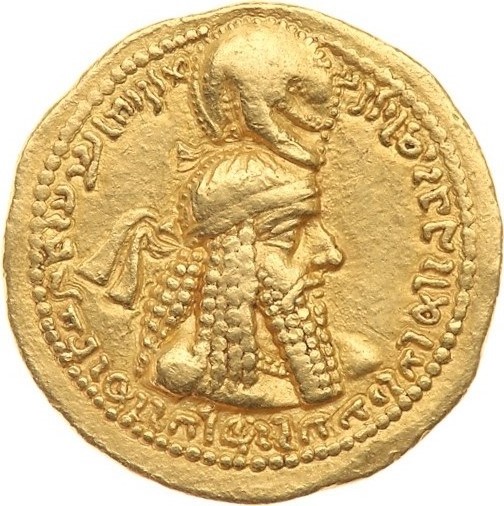
Dinar of Ardashir I (cropped)Unknown authorUnknown author · Public domain · Commons
The Sasanian Empire, officially Eranshahr (Middle Persian: 𐭠𐭩𐭥𐭠𐭭𐭱𐭲𐭥𐭩, romanized: Ērānšahr, lit. 'Empire of the Iranians'), was an Iranian empire that was founded and ruled by the House of Sasan from 224 to 651 AD (the era of late antiquity). Lasting for over four centuries, the length of the Sasanian dynasty's reign over ancient Iran was second only to that of the Arsacid dynasty of Parthia which immediately preceded it.
Conflicting accounts shroud the details of the fall of the Parthian Empire and subsequent rise of the Sasanian Empire in mystery. The Sasanian Empire was established in Estakhr by Ardashir I.
Read more
Ardashir's father, Papak, was originally the ruler of a region called Khir. However, by 200, Papak had managed to overthrow Gochihr and appoint himself the new ruler of the Bazrangids. Papak's mother, Rodhagh, was the daughter of the provincial governor of Pars. Papak and his eldest son Shapur managed to expand their power over all of Pars. Subsequent events are unclear due to the elusive nature of the sources. It is certain that following the death of Papak, Ardashir, the governor of Darabgerd, became involved in a power struggle with his elder brother Shapur. Sources reveal that Shapur was killed when the roof of a building collapsed on him.
The Sasanians established an empire roughly within the frontiers achieved by the Parthian Arsacids, with the capital at Ctesiphon in the Asoristan province. In administering this empire, Sassanid rulers took the title of shahanshah (King of Kings), becoming the central overlords and also assumed guardianship of the sacred fire, the symbol of the national religion. This symbol is explicit on Sasanian coins where the reigning monarch, with his crown and regalia of office, appears on the obverse, backed by the sacred fire, the symbol of the national religion, on the coin's reverse. Sassanid queens had the title of banbishnan banbishn (Queen of Queens).
Read more
On a smaller scale, the territory might also be ruled by a number of petty rulers from a noble family, known as shahrdar, overseen directly by the shahanshah.
Persian industry under the Sasanians developed from domestic to urban forms. Guilds were numerous. Good roads and bridges, well patrolled, enabled state post and merchant caravans to link Ctesiphon with all provinces; and harbors were built in the Persian Gulf to quicken trade with India. Sasanian merchants ranged far and wide and gradually ousted Romans from the lucrative Indian Ocean trade routes. Recent archeological discovery has shown the interesting fact that Sasanians used special labels (commercial labels) on goods as a way of promoting their brands and distinguish between different qualities.
Read more
Khosrow I further extended the already vast trade network.
The Sasanian kings were patrons of letters and philosophy. Khosrow I had the works of Plato and Aristotle, translated into Pahlavi, taught at Gundishapur, and read them himself. During his reign, many historical annals were compiled, of which the sole survivor is the Karnamak-i Artaxshir-i Papakan (Deeds of Ardashir), a mixture of history and romance that served as the basis of the Iranian national epic, the Shahnameh. When Justinian I closed the schools of Athens, seven of their professors went to Persia and found refuge at Khosrow's court. In his treaty of 533 with Justinian, the Sasanian king stipulated that the Greek sages should be allowed to return and be free from persecution.
While successful at its first stage (from 602 to 622), the campaign of Khosrow II had actually exhausted the Persian army and treasuries. In an effort to rebuild the national treasuries, Khosrow overtaxed the population. Thus, while his empire was on the verge of total defeat, Heraclius (610–641) drew on all his diminished and devastated empire's remaining resources, reorganised his armies, and mounted a remarkable, risky counter-offensive. Between 622 and 627, he campaigned against the Persians in Anatolia and the Caucasus, winning a string of victories against Persian forces under Shahrbaraz, Shahin, and Shahraplakan (whose competition to claim the glory of personally defeating the Byzantine emperor contributed to their failure), sacking the great Zoroastrian temple at Ganzak, and securing assistance from the Khazars and Western Turkic Khaganate.
The influence of the Sasanian Empire continued long after it fell. The empire had achieved a Persian renaissance that would become a driving force behind the civilization of the newly established religion of Islam. In modern Iran and the regions of the Iranosphere, the Sasanian period is regarded as one of the high points of Iranian civilization.
The foreign relations of the Byzantine Empire were conducted by the emperor. Preferring diplomacy over war, the emperor would use alliances, treaty's and diplomatic tactics to achieve goals. Military confrontations also occurred, with Dimitri Obolensky calling it as a form of "defensive imperialism". The conduct of its foreign relations is a large factor to the Empire's longevity of 1,123 years.
850 CE – 921 CE · Capital: Various, including Frankfurt and Ratisbon (Regensburg), Old High German, Old Low German, Old Frisian, Slavic languages · 1,246,963 km²
Historical city centre of Frankfurt (Germany) with Frankfurt Skyline behindThomas Wolf, www.foto-tw.de · CC BY-SA 3.0 de · Commons
East Francia (Latin: Francia orientalis) or the Kingdom of the East Franks (Regnum Francorum orientalium) was a successor state of the Carolingian Empire ruled by the Carolingian dynasty until 911. It was established through the 843 Treaty of Verdun which divided the former kingdom of Francia into three kingdoms: Francia Orientalis (the East Frankish kingdom); Francia Media (the Middle Frankish kingdom); and Francia Occidentalis (the West Frankish kingdom).
Denarius van Antoninus Pius in zilver, 140 tot 143 NC, vindplaats: Onbekend, collectie Gallo-Romeins Museum Tongeren, S-175http://exploratorium.galloromeinsmuseum.be/Default.aspx?query=search=deeplink%7C/record/uniqid=obj_46165&showtype=record · Public domain · Commons
Allegiance of Ziyadid dynasty to Abbasid Caliphate
866 CE – 946 CE · Capital: Zabid · 7,650,172 km²
The Ziyadid dynasty (Arabic: الزياديون) was a Muslim dynasty that ruled western Yemen from 819 until 1018 from the capital city of Zabid. It was the first dynastic regime to wield power over the Yemeni lowland after the introduction of Islam in about 630.
Muhammad ibn Ziyad was a descendant of Yazid, younger brother of the first Umayyad caliph Muawiyah I. In 814 he was arrested and brought to the Abbasid caliph al-Ma'mun on account of his ancestry, but his life was spared in the end. He was merely placed under surveillance and became the protégé of the caliph's minister al-Fadl ibn Sahl. Three years later a letter from the governor of Yemen arrived to Baghdad, complaining about attacks by the Ash'arite and Akkite tribes. Al-Fadl recommended that al-Ma'mun send the capable Muhammad ibn Ziyad to Tihamah in order to suppress the tribes. The situation was particularly critical since the Alids under a leader called Ibrahim al-Jazzar threatened to detach Yemen from Abbasid control at this time. Muhammad ibn Ziyad was a sworn enemy of the Alids, which made him a suitable choice for the task.
The Yufirids again attacked in 989 and burnt Zabid. However, the Mamluk al-Husayn bin Salamah managed to save the kingdom from complete collapse. He defeated the mountain tribes and restored the Ziyadid realm to its old limits. Al-Husayn was remembered as a just and high-spirited regent who dug wells and canals and constructed roads across the kingdom. He governed until his peaceful demise in 1012. The back side of the coin was that the Ziyadid monarchs lost effective power after 981 while a succession of Mamluks held real power, which at length made for political turmoil. After al-Husayn's death, his slave, the eunuch Marjan, held power as wazir. He in turn raised two Ethiopian slaves called Nafis and Najah who received high offices in the state. According to Kamal Suleiman Salibi, the last Ziyadi ruler was murdered in 1018 and replaced by Nafis.
The Samanid Empire (Persian: سامانیان, romanized: Sāmāniyān) was a Persianate Sunni Muslim empire, ruled by a dynasty of Iranian dehqan origin, from 819 to 999. The empire was centred in Khorasan and Transoxiana, and at its greatest extent included northeastern Iran and Central Asia.
The Samanid dynasty originated with four brothers: Nuh, Ahmad, Yahya, and Ilyas, who were made governors of territories under Abbasid suzerainty in 819. In 892, Ismail Samani, son of Ahmad, united the Samanids under his rule. It was also under him that the Samanids became effectively independent of the Abbasids.
The Samanid dynasty was descended from Saman Khuda, a dehqan of Iranian origin from the village of Saman in Balkh province, in present-day northern Afghanistan. The earliest appearance of the Samanid family appears to be in Khorasan rather than Transoxiana. In some sources, the Samanids claimed to be descended from the House of Mihran of Bahram Chobin. This claim is further supported by a geographical treatise from the second half of the 8th century, compiled by five Tuyuhun men and translated into the Tibetan language. In this chronicle, it is mentioned that the descendants of Bahram Chobin migrated to Balkh and settled there. According to Lev Gumilev, they were considered the ancestors of the Samanids.
Khazar coin, the so called 'Moses coin', from the Spillings Hoard at Gotland Museum, Visby, Gotland, Sweden, cropped photo.W.carter · CC BY-SA 4.0 · Commons
During the 9th and 10th centuries, there was a large amount of growth in literature, mostly in poetry. It was during the Samanid period that Persian literature appeared in Transoxiana and was formally recognized. The advancement of an Islamic New Persian literature thus started in Transoxiana and Khorasan instead of Fars, the homeland of the Persians. The best known poets of the Samanid period were Rudaki (d. 941), Daqiqi (d. 977) and Ferdowsi (d. 1020).
Read more
Although Persian was the most-favored language, Arabic continued to enjoy a high status and was still popular among the members of the Samanid family. For example, al-Tha'alibi wrote an Arabic anthology named Yatimat al-Dahr ("The Unique Pearl"). The fourth section of the anthology included a detailed account of the poets that lived under the Samanids. It also states that the poets of Khwarazm mostly wrote in Arabic.
The power of the Samanids began to crumble in the latter half of the 10th century. In 962, one of the ghulams, Alp Tigin, commander of the army in Khorasan, seized Ghazna and established himself there. His successors, however, including Sabuktigin, continued to rule as Samanid "governors". With the weakened Samanids facing rising challenges from the Karakhanids for control of Transoxiana, Sabuktigin later took control of all the provinces south of the Oxus and established the Ghaznavid Empire.
Read more
An Arab geographer remarked that, by 985, the Samanids possessed such large numbers of Turkic slaves that their dominance of the slave trade flooded the market and drove prices downward.
In 992, a Karakhanid, Harun Bughra Khan, grandson of the paramount tribal chief of the Karluk confederation Sultan Satuq Bughra Khan, captured Bukhara, the Samanid capital.
"Where have all the great Sasanians gone?From the Bahrāmids to the Samanids what has come upon?"
Read more
A Bukharan historian writing in 943 stated that Ismail Samani: was indeed worthy and right for padishahship. He was an intelligent, just, compassionate person, one possessing reason and prescience...he conducted affairs with justice and good ethics. Whoever tyrannized people he would punish...In affairs of state he was always impartial.
The celebrated scholar Nizam al-Mulk, in his famous work Siyasatnama, stated that Ismail Samani: was extremely just, and his good qualities were many. He had pure faith in God (to Him be power and glory) and he was generous to the poor – to name only one of his notable virtues.
Allegiance of Duchy of Aquitaine to Kingdom of France
990 CE – 1138 CE · Capital: Toulouse · 420,380 km²
Queen EleanorFrederick Sandys · Public domain · Commons
The Duchy of Aquitaine (Occitan: Ducat d'Aquitània, IPA: [dyˈkad dakiˈtanjɔ]; French: Duché d'Aquitaine, IPA: [dyʃe dakitɛn]) was a historical fiefdom located in the western, central, and southern areas of present-day France, south of the river Loire. The full extent of the duchy, as well as its name, fluctuated greatly over the centuries and at times comprised much of what is now southwestern (including Gascony) and central France.
Gallia Aquitania fell under Visigothic rule in the 5th century. It was conquered by the Franks under Clovis I in 507, as a result of the Battle of Vouillé. During the 6th and early 7th century, it was under direct rule of Frankish kings, divided between the realms of Childebert II and Guntram in the Treaty of Andelot of 587. Under Chlothar II, Aquitaine was again an integral part of Francia, but after Chlothar's death in 629, his heir Dagobert I granted a subkingdom in southern Aquitaine to his younger brother Charibert II. This subkingdom, consisting of Gascony and the southern fringe of Aquitaine proper, is conventionally known as "Aquitaine" and forms the historical basis for the later duchy.
Blason de l'Aquitaine et de la GuyenneYou may select the license of your choice. · CC BY 2.5 · Commons
Wars and Battles
In 1337, King Philip VI of France reclaimed the fief of Aquitaine (essentially corresponding to Gascony) from Eleanor's descendant, Edward III of England. Edward in turn claimed the entire Kingdom of France as the only grandson of King Philip IV of France. This triggered the Hundred Years' War, in which both the Plantagenets and the House of Valois claimed supremacy over Aquitaine. In 1360, both sides signed the Treaty of Brétigny, in which Edward renounced his claim to the French crown but remained sovereign lord of Aquitaine (rather than merely duke). However, when the treaty was broken in 1369, both these English claims and the war resumed. In 1362, Edward III, as Lord of Aquitaine, made his eldest son Edward the Black Prince, Prince of Aquitaine. In 1390, King Richard II, son of Edward the Black Prince, appointed his uncle John of Gaunt as Duke of Aquitaine.
1126 CE – 1235 CE · Capital: Main: Gaegyeong), Hwangdo, Junggyeong, Songak, Songdo, Songgyeong, Wanggyeong, Temporary: Cheorwon, (918–919), Ganghwa), (1232–1270), Hanyang), Yangju, (1382–1383, 1390–1391) · 2,261,028 km²
고려시대 귀족의 생활을 묘사한 고려시대 회화.작가 미상 · Public domain · Commons
Goryeo (Korean: 고려; Hanja: 高麗; Middle Korean: 고ᇢ롕〮, romanized: kwòwlyéy) was a Korean state founded in 918, during a time of national division called the Later Three Kingdoms period, that unified and ruled the Korean Peninsula until the establishment of Joseon in 1392. Goryeo achieved what has been called a "true national unification" by Korean historians, as it not only unified the Later Three Kingdoms but also incorporated much of the ruling class of the northern kingdom of Balhae, who had origins in Goguryeo of the earlier Three Kingdoms of Korea.
In the late 7th century, the kingdom of Silla unified the Three Kingdoms of Korea and entered a period known in historiography as "Unified Silla" or "Later Silla". Later Silla implemented a national policy of integrating Baekje and Goguryeo refugees called the "Unification of the Samhan", referring to the Three Kingdoms of Korea. Silla organized a new central army called the Ku-sŏdang (구서당; 九誓幢) that was divided into 3 units of Silla people, 3 units of Goguryeo people, 2 units of Baekje people, and 1 unit of Mohe people. However, the Baekje and Goguryeo refugees retained their respective collective consciousnesses and maintained a deep-seated resentment and hostility toward Silla.
ntil 1270, when Koryŏ capitulated to the Mongols after thirty years of resistance, early Koryŏ rulers and most of its officials had held a "pluralist" (tawŏnjŏk) outlook that recognized greater and equal empires in China and in Manchuria, while positing Koryŏ as the center of a separate and bounded world ruled by the Koryŏ emperor, who claimed a ritual status reserved for the Son of Heaven.
Read more
Goryeo positioned itself at the center of its own "world" (천하; 天下) called "Haedong". Haedong, meaning "East of the Sea", was a distinct and independent world that encompassed the historical domain of the "Samhan", another name for the Three Kingdoms of Korea. The rulers of Goryeo, or Haedong, used the titles of emperor and Son of Heaven. Imperial titles were used since the founding of Goryeo, and the last king of Silla addressed Wang Geon as the Son of Heaven when he capitulated.
A Sang P'yŏng T'ong Bo (常平通寶) coin of 5 mun issued by the Treasury Department Mint (戶).Donald Trung · CC BY-SA 4.0 · Commons
Currency
Korean mun
A copper-alloy coin issued by the Kingdom of Great(er) Joseon nominally worth 1/100th Yang.The government of the Kingdom of Great(er) Joseon. · Public domain · Commons
Royal flag of Goryeo (Bong-gi)Samhanin · Public domain · Commons
Wars and Battles
Following the "Manbu Bridge Incident" of 942, Goryeo prepared itself for a conflict with the Khitan Empire: Jeongjong established a military reserve force of 300,000 soldiers called the "Resplendent Army" in 947, and Gwangjong built fortresses north of the Chongchon River, expanding toward the Yalu River. However an attempt to control the Yalu River basin in 984 failed due to conflict with the Jurchens. The Khitans considered Goryeo a potential threat and, with tensions rising, invaded in 993. The Jurchens warned Goryeo of the invasion twice. At first Goryeo did not believe the information but came around upon the second warning and took up a defensive strategy. The Koreans were defeated in their first encounter with the Khitans, but successfully halted their advance at Anyung-jin (in modern Anju, South Pyongan Province) at the Chongchon River.
The official histories of early Korea such as the Samguk sagi and Samguk yusa, written in Classical Chinese, remain some of the most important historical works in Korean historiography.
Read more
Various writing systems that utilized the phonetic value of Hanja characters were used to transcribe Old Korean, Idu being the most notable of them as it was used for administrative purposes and recordkeeping. This script originates in Goguryeo and was designed for a very specific sort of syntax that made use of postpositional particles, such as the Old Korean accusative marker *-ul/*-ur ending represented by 尸 'corpse' and 乙 '2nd Heavenly stem'. It was eventually phased out once it became too impractical upon the invention of Hangeul.
Gugyeol was used to gloss Middle Chinese poems so Koreans could read them, with two versions having been used limited by their timeframes.
In 1388, King U (son of King Gongmin and a concubine) and general Ch'oe Yŏng planned a campaign to invade now Liaoning of China. King U put the general Yi Sŏnggye (later Taejo) in charge, but he stopped at the border and rebelled.
Read more
Goryeo fell to Yi Sŏnggye, who put to death the last three Goryeo kings, usurped the throne, and established in 1392 the Joseon dynasty.
The Western Xia or the Xi Xia (Chinese: 西夏; pinyin: Xī Xià; Wade–Giles: Hsi1 Hsia4), officially the Kingdom of the Great Xia of the White and Lofty (Tangut: 𗴂𗹭𘜶𗴲𗂧) or Great Xia (大夏; Dà Xià; Ta4 Hsia4), also known as the Tangut Empire, was a Tangut-led imperial dynasty of China that existed from 1038 to 1227 AD. At its peak, the dynasty ruled over 1,000,000 square kilometres (390,000 square miles) of modern-day north-central China.
The capital of the Western Xia was Xingqing, now Yinchuan; another major Xia city and archaeological site is Khara-Khoto.
The Tanguts originally came from the Qinghai-Sichuan-Tibet region, whose home originally was in the highlands of western Sichuan. According to Chinese records, which called them the Dangxiang, the Tanguts were descended from the Western Qiang people, and occupied the steppes around Qinghai Lake and the mountains to its south.
Read more
In 608, the Tanguts helped the Sui dynasty defeat the Tuyuhun, however they were betrayed by the Sui forces, who took the chance to loot the Tanguts. In 635, they were requested to serve as guides for Emperor Taizong's campaign against Tuyuhun, but the Tang forces double crossed them in a surprise attack and seized thousands of livestock. In retaliation, the Tanguts attacked the Tang and killed thousands of their soldiers.
In recent years, corrupt frontier generals have repeatedly harassed and mistreated [the Tanguts].
Buddhism, Taoism, Confucianism, Chinese folk religion
Coins, Currency and Symbols
Currency
Barter, copper coins, See Western Xia coinage
Wars and Battles
Since ancient times we have fought using both infantry and cavalry. Although we have the Iron Hawks that can charge on the plains and the Trekker infantry that can fight in the hills, if we happen to encounter some new tactic our cavalry will have difficulty deploying. If we encounter [Mighty- Arm bows], then our infantry will be scattered. The problem is our troops can only fight according to convention and are unable to adapt to changes during battle.
Read more
In 1980, the Wuwei Bronze Cannon was discovered in a cellar dating to the Western Xia period. Dating to the early 13th century, it is one of the earliest cannons ever discovered. It weighs 108 kg and was discovered with an iron ball about 9cm in diameter inside its barrel.
Tangut society was patriarchal and a woman was considered the property of her parents, husband, and in-laws. A Tangut proverb describes the role of men and women: "A woman is governed by purity within the tent, and a man by purity in the state". Tangut men could have one wife but multiple concubines. If the man committed a crime requiring collective punishment, the children of concubines were exempt while the children of the wife were exiled to become shepherds and peasants. The age of marriage for a woman was 13 under the Tangut Code. A man who touched an under-age girl against her will was punished but if it was with her consent, she was punished. Only her father or maternal uncle were allowed to report assaults.
Read more
Marriage was arranged by the parents of the groom and bride. The groom's parents paid a fee for the girl while the bride's parents provided a dowry.
Seated Portrait of Song TaizuAnonymousUnknown author · Public domain · Commons
The Song dynasty (SUUNG) was an imperial dynasty of China that ruled from 960 to 1279. The dynasty was founded by Emperor Taizu of Song, who usurped the throne of the Later Zhou dynasty and went on to conquer the rest of the Ten Kingdoms, ending the Five Dynasties and Ten Kingdoms period. The Song often came into conflict with the contemporaneous Liao, Western Xia, and Jin dynasties in northern China. After retreating to southern China following attacks by the Jin dynasty, the Song was eventually conquered by the Mongol-led Yuan dynasty.
Chinese Buddhism, Taoism, Confucianism, Chinese folk religion, Islam, Nestorian Christianity
Economy and Trade
The Song dynasty had one of the most prosperous and advanced economies in the medieval world. Song Chinese invested their funds in joint stock companies and in multiple sailing vessels at a time when monetary gain was assured from the vigorous overseas trade and domestic trade along the Grand Canal and Yangtze River. Both private and government-controlled industries met the needs of a growing Chinese population in the Song; prominent merchant families and private businesses were allowed to occupy industries that were not already government-operated monopolies. Artisans and merchants formed guilds that the state had to deal with when assessing taxes, requisitioning goods, and setting standard workers' wages and prices on goods.
Read more
The iron industry was pursued by both private entrepreneurs who owned their own smelters as well as government-supervised smelting facilities.
The Song dynasty was an era of administrative sophistication and complex social organization. Some of the largest cities in the world were found in China during this period (Kaifeng and Hangzhou had populations of over a million). People enjoyed various social clubs and entertainment in the cities, and there were many schools and temples to provide the people with education and religious services. The Song government supported social welfare programs including the establishment of retirement homes, public clinics, and paupers' graveyards. The Song dynasty supported a widespread postal service that was modeled on the earlier Han dynasty (202 BCE – CE 220) postal system to provide swift communication throughout the empire. The central government employed thousands of postal workers of various ranks to provide service for post offices and larger postal stations.
Allegiance of Ayyubid Sultanate to Abbasid Caliphate
1202 CE – 1249 CE · Capital: Cairo · 1,986,781 km²
Skyline of the city of Cairo (2020)Faris El-Gwely · CC BY 4.0 · Commons
The Ayyubid dynasty (Arabic: الأيوبيون, romanized: al-Ayyūbīyūn), also known as the Ayyubid Sultanate, was a Sunni Muslim dynasty of Kurdish origin that founded the medieval Sultanate of Egypt, which was established by Saladin in 1171, following his abolition of the Fatimid Caliphate. Saladin had originally served the Zengid ruler Nur al-Din, leading the latter's army against the Crusaders in Fatimid Egypt, where he was made vizier.
The progenitor of the Ayyubid dynasty, Najm ad-Din Ayyub ibn Shadhi, belonged to the Kurdish Rawadiya, a branch of the Hadhbani tribe. Ibn Khallikan reported that historians agreed on the family's Kurdish origin, and wrote that he found no source naming anyone earlier than Shadhi, though a member of the Ayyubid family told him Shadhi was the son of Marwan. The Rawadiya were of Arab origin but became Kurdicized over time. In later periods, members of the Ayyubid dynasty sponsored genealogies showing that they were not Kurds, but rather descended from noble Arab lineages, including the Banu Umayya. While these genealogies are generally regarded as politically motivated constructions, the historian Vladimir Minorsky argued that they reflect an underlying historical reality.
Saladin structured the Ayyubid empire around the concept of collective sovereignty i.e. a confederation of principalities held together by the idea of family rule. Under this arrangement there existed numerous "petty sultans" while one family member, as-Sultan al-Mu'azzam, reigned supreme. After the death of Saladin, this coveted position became open to whoever was strong enough to seize it. Subsequent rivalry between the Ayyubids of Syria and Egypt reached a point where the rulers of each territory would at times collude with Crusaders against the other. Ayyubid rule differed in these two regions. In Syria, each major city was ruled as a relatively independent principality under an Ayyubid family member, while in Egypt the long tradition of centralized rule enabled the Ayyubids to maintain direct control over the province from Cairo.
Arabicb (majority, administration, science, poetry, numismatics), Kurdish (native language of the ruling family), Persian (spoken by some sultans), Turkic
Religion
Sunni Islam
Economy and Trade
Having pushed the Crusaders out of most of Syria, the Ayyubids generally adopted a policy of peace with them. The war with the Crusaders did not prevent Muslims under Ayyubid governance from developing good commercial relations with European states. This led to fruitful interaction between both sides in different fields of economic activity, particularly in agriculture and trade.
Read more
Numerous measures were undertaken by the Ayyubids to increase agricultural production. Canals were dug to facilitate the irrigation of agricultural lands throughout the empire. Cultivation of sugarcane was officially encouraged to meet the great demand of it by both the local inhabitants and the Europeans. Meanwhile, as a result of the Crusades, several new plants were introduced to Europe, including sesame, carob, millet, rice, lemons, melons, apricots, and shallots.
Although still nominally a vassal of Nur al-Din, Saladin adopted an increasingly independent foreign policy. This independence became more publicly pronounced after Nur al-Din's death in 1174. Thereafter, Saladin set out to conquer Syria from the Zengids; and on November 23 he was welcomed in Damascus by the governor of the city. By 1175, he had taken control of Hama and Homs but failed to take Aleppo after besieging it. Control of Homs was handed to the descendants of Shirkuh in 1179 and Hama was given to Saladin's nephew, al-Muzaffar Umar. Saladin's successes alarmed Emir Saif al-Din of Mosul, the head of the Zengids at the time, who regarded Syria as his family's estate and was angered that it was being usurped by a former servant of Nur al-Din. He mustered an army to confront Saladin near Hama.
Military architecture was the supreme expression of the Ayyubid period, as well as an eagerness to fortify the restoration of Sunni Islam, especially in a previously Shia-dominated Egypt by constructing Sunni madrasas. The most radical change Saladin implemented in Egypt was the enclosure of Cairo and al-Fustat within one city wall. Some of the techniques of fortification were learned from the Crusaders, such as curtain walls following the natural topography. Many were also inherited from the Fatimids like machicolations and round towers, while other techniques were developed simultaneously by the Ayyubids, particularly concentric planning.
Read more
Muslim women, particularly those from the Ayyubid family, the families of local governors, and the families of the ulema ("religious scholars") took an active role in Ayyubid architecture.
The Ayyubids had been under the nominal sovereignty of the Mongol Empire after a Mongol force targeted Ayyubid territories in Anatolia in 1244. An-Nasir Yusuf sent an embassy to the Mongol capital Karakorum in 1250, shortly after assuming power. These understandings did not last, however, and the Mongol Great Khan, Möngke, issued a directive to his brother Hulagu to extend the realms of the empire to the Nile River. The latter raised an army of 120,000 and in 1258, sacked Baghdad and slaughtered its inhabitants, including Caliph al-Musta'sim and most of his family after the Ayyubids failed to assemble an army to protect the city. That same year the Ayyubids lost Diyar Bakr to the Mongols.
Read more
An-Nasir Yusuf sent a delegation to Hulagu afterward, repeating his protestations to submission. Hulagu refused to accept the terms and so an-Nasir Yusuf called on Cairo for aid.
Allegiance of Sultanate of Rum to Abbasid Caliphate
1202 CE – 1249 CE · Capital: Nicaea (İznik), (1077–1097), Iconium (Konya), (1097–1308), Sebastia (Sivas), (1211–1220) · 515,669 km²
The Sultanate of Rum, or Seljuk Sultanate of Rum, was a culturally Turco-Persian, Sunni Muslim state established over conquered Byzantine territories and peoples (Rum) of Anatolia by the Seljuk Turks following their entry into Anatolia after the Battle of Manzikert in 1071. The name Rum was a synonym for the medieval Roman Empire and its peoples, as it remains in modern Turkish. The name is derived from the Aramaic (romī) and Parthian (frwm) names for ancient Rome, which had reached these languages via the Greek Ῥωμαῖοι (Romaioi). The Seljuk Turks used the name to refer to Anatolia.
Since the 1030s, migratory Turkish groups in search of pastureland had penetrated Byzantine borders into Anatolia. In the 1070s, after the Battle of Manzikert, the Seljuk commander Suleiman ibn Qutulmish, a distant cousin of Alp Arslan and a former contender for the throne of the Seljuk Empire, came to power in western Anatolia. Between 1075 and 1081, he gained control of the Byzantine cities of Nicaea and briefly also Nicomedia. Around two years later, he established a Sultanate that, while nominally still a Byzantine vassal state, became increasingly independent after six to ten years. The Sultanate was officially recognized as a vassal state by the Seljuk ruler Malikshah in 1084, but as late as 1085, Suleiman was tasked by Byzantine emperor Alexios I Komnenos to reconquer Antioch and the former travelled there on a secret route, presumably guided by the Byzantines.
The Rum Seljuks sought to establish themselves as orthodox sovereigns dedicated to preserving and defending the structures of Sunni Islam. They sponsored the construction of many madrasas, mosques, and mausolea, expressing their religious devotion through sustained patronage of the ʿulamāʾ and affording them institutional platforms from which to preach to—and potentially convert—the Greek and Armenian Christian communities within their domains.
Read more
In 1084, Suleiman ibn Qutalmish transformed the church of Cassianus in Antioch into a mosque. The construction of the Alâeddin Mosque in Konya, began during sultan Mesud I's reign c. 1116-1156. In 1196, the Friday Mosque of Sivas was constructed during the reigns of Kaykhusraw I and Rukn al-Din Suleiman II. With the capture of Antalya in 1207, Kaykhusraw I established a mosque, while in c.1211 Kaykaus I constructed a madrasa at Ankara.
Sunni Islam (official), Greek Orthodox (majority of population)
Wars and Battles
Kaykhusraw II (1237–1246) began his reign by capturing the region around Diyarbakır, but in 1239 he had to face an uprising led by a popular preacher named Baba Ishak. After three years, when he had finally quelled the revolt, the Crimean foothold was lost and the state and the sultanate's army had weakened. It is in these conditions that he had to face a far more dangerous threat, that of the expanding Mongols. The forces of the Mongol Empire took Erzurum in 1242 and in 1243, the sultan was crushed by Baiju in the Battle of Köse Dağ (a mountain between the cities of Sivas and Erzincan), resulting in the Seljuk Turks being forced to swear allegiance to the Mongols and became their vassals. The sultan himself had fled to Antalya after the battle, where he died in 1246; his death started a period of tripartite, and then dual, rule that lasted until 1260.
The Sultanate was founded by militaristic bands of Oghuz warriors who Turkified the Anatolian peninsula, and had little in common with the primarily Persian character, language, and culture of the Seljuk rulers. Still, a Turco-Persian cultural synthesis gradually emerged which, by the 13th century, came to define the intellectual and aesthetic life, to the point of Sultanate of Rum elites naming their sons with New Persian names. The phenomenon was reinforced by the massive influx of Persian refugees fleeing the Mongol invasions of the 13th century. The Seljuks of Rum made Turco-Persian tradition the culture of their court, and inherited the tımar and tahrir methods of Persian statecraft from the Seljuk Empire, which they later passed on to the Ottomans. Despites such influences, Seljuk art remained essentially Central Asian in character.
The Kingdom of Bohemia (Czech: České království), sometimes referenced in English literature as the Czech Kingdom, was a medieval and early modern monarchy in Central Europe. It was the predecessor state of the modern Czech Republic.
The Kingdom of Bohemia was an Imperial State in the Holy Roman Empire. The Bohemian king was a prince-elector of the empire. The kings of Bohemia, besides the region of Bohemia itself, also ruled other lands belonging to the Bohemian Crown, which at various times included Moravia, Silesia, Lusatia, and parts of Saxony, Brandenburg, and Bavaria.
Bohemia was among the first countries in Europe to become industrialized. Mining of tin and silver began in Ore mountains in early 12th century. The German hospes had a major role in the industrial development of the Czech Kingdom. In the late 12th and in the 13th century the Přemyslid rulers promoted the colonisation of certain areas of their lands by German settlers from the adjacent lands of Bavaria, Franconia, Upper Saxony and Austria during the Ostsiedlung migration. The new settlers not only brought their customs and language with them, but also new technical skills and equipment that were adapted within a few decades, especially in agriculture and crafts.
Fernando de Austria, emperador del Sacro Imperio Romano-Germánico.Hans Bocksberger the Elder · Public domain · Commons
In 1740 the Prussian Army conquered Bohemian Silesia in the Silesian Wars and forced Maria Theresa in 1742 to cede the majority of Silesia, except the southernmost area with the duchies of Cieszyn, Krnov and Opava, to Prussia. In 1756 Prussian King Frederick II faced an enemy coalition led by Austria, when Maria Theresa was preparing for war with Prussia to reclaim Silesia. The Prussian army conquered Saxony and in 1757 invaded Bohemia. In the Battle of Prague (1757) they defeated the Habsburgs and subsequently occupied Prague. More than one quarter of Prague was destroyed and the St. Vitus Cathedral suffered heavy damage. In the Battle of Kolín, however, Frederick lost and had to vacate Prague and retreat from Bohemia.
Allegiance of Delhi Sultanate to Abbasid Caliphate
1210 CE – 1259 CE · Capital: Delhi · 1,505,957 km²
Tomb of Sultan Qutb al-Din Aibak, LahoreMuhammad Umair Mirza · CC BY-SA 4.0 · Commons
The Delhi Sultanate or the Sultanate of Delhi was a late medieval empire primarily based in Delhi that stretched over large parts of the Indian subcontinent for more than three centuries. The sultanate was established in 1206 in the former Ghurid territories in India. Its history is generally divided into five periods: Mamluk (1206–1290), Khalji (1290–1320), Tughlaq (1320–1414), Sayyid (1414–1451), and Lodi (1451–1526). It covered large swaths of territory in modern-day India, Pakistan, Bangladesh, as well as some parts of southern Nepal.
Like other agrarian societies in history, those in the Indian subcontinent have been attacked by nomadic tribes throughout its long history. The northwestern subcontinent was a frequent target of tribes raiding from Central Asia in the pre-Islamic era, and the Muslim intrusions and later Muslim invasions were not dissimilar to those of the earlier invasions during the 1st millennium.
Read more
The rise of the Delhi Sultanate in India was part of a wider trend affecting much of the Asian continent, including the whole of southern and western Asia: the influx of nomadic Turkic peoples from the Central Asian steppes that traces back to the 9th century when the Islamic caliphate began fragmenting in the Middle East. Muslim rulers in rival states began enslaving non-Muslim nomadic Turks from the Central Asian steppes and raising many of them to become loyal army slaves called Mamluks.
Medieval scholars such as Abdul Malik Isami and Ziauddin Barani suggested that the prehistory of the Delhi Sultanate lay in the Ghaznavid state and that its ruler, Mahmud Ghaznavi, provided the foundation and inspiration integral to the making of the Delhi regime. The Mongol and Hindu monarchies were the great "Others" in these narratives and the Persianate and class-conscious, aristocratic virtues of the ideal state were creatively memorialised in the Ghaznavid state, now the templates for the Delhi Sultanate. Cast within a historical narrative, it allowed for a more self-reflective, linear rooting of the sultanate in the great traditions of Muslim statecraft. Over time, successive Muslim dynasties created a "centralized structure in the Persian tradition whose task was to mobilize human and material resources for the ongoing armed struggle against both Mongol and Hindu monarchies".
Some historians argue that the Delhi Sultanate was responsible for making India more multicultural and cosmopolitan. The establishment of the Delhi Sultanate in India has been compared to the expansion of the Mongol Empire and called "part of a larger trend occurring throughout much of Eurasia, in which nomadic people migrated from the steppes of Inner Asia and became politically dominant".
Read more
According to Angus Maddison, between the years 1000 and 1500, India's GDP, of which the sultanates represented a significant part, grew nearly 8% to $60.5 billion in 1500. Though the overall the percentage of the GDP share reduced from 33% to 22% According to Maddison's estimates, India's population grew from 85 million in 1200 to 101 million in 1500.
The Delhi Sultanate period coincided with more use of mechanical technology in the Indian subcontinent.
The establishment of the Delhi Sultanate in 1206 under Qutb ud-Din Aibak introduced a large Islamic state to India, using Central Asian styles. The types and forms of large buildings required by Muslim elites, with mosques and tombs much the most common, were very different from those previously built in India. The exteriors of both were very often topped by large domes and made extensive use of arches. Both of these features were hardly used in Hindu temple architecture and other indigenous Indian styles. Both types of building essentially consist of a single large space under a high dome, and completely avoid the figurative sculpture so important to Hindu temple architecture.
Read more
The important Qutb Minar complex in Delhi was begun under Muhammad of Ghor, by 1199, and continued under Qutb ud-Din Aibak and later sultans. The Quwwat-ul-Islam Mosque, now a ruin, was the first structure.
Historian Richard Eaton has tabulated a campaign of destruction of idols and temples by the Delhi Sultans, intermixed with certain years where the temples were protected from desecration. In his paper, he has listed 37 instances of Hindu temples being desecrated or destroyed in India during the Delhi Sultanate, from 1234 to 1518, for which reasonable evidences are available. He notes that this was not unusual in medieval India, as there were numerous recorded instances of temple desecration by Hindu and Buddhist kings against rival Indian kingdoms between 642 and 1520, involving conflict between devotees of different Hindu deities, as well as between Hindus, Buddhists and Jains at small scales.
1294 CE – 1374 CE · Capital: Almaliq, Qarshi · 16,710,781 km²
Ancient bridge (1583) in Qarshi (Uzbekistan).Akhemen · CC BY-SA 4.0 · Commons
The Chagatai Khanate, also known as the Chagatai Ulus, was a Mongol khanate that comprised the lands ruled by Chagatai Khan, second son of Genghis Khan, and his descendants and successors. Over time, its Mongol ruling groups underwent a gradual and uneven process of linguistic and cultural Turkification and Islamization, though Mongolian political and administrative traditions remained important.
The Chagatai Mongols remained mostly nomadic in their mode of government and did not settle down in urban centers until the late 15th century. The Mongols of the Chagatai Khanate treated the urban dwellers of Transoxiana and the Tarim Basin as dependencies.
After Kaidu's death in 1301, both Duwa and Kaidu's son Chapar recognized Yuan authority in 1303. However, Duwa threw off his allegiance to Chapar. Both the Yuan dynasty and Duwa attacked Chapar, forcing him to surrender his territory to Duwa in 1306. Meanwhile, Prince Turghai invaded the Delhi Sultanate in 1303 and looted the Delhi region. In 1304 they invaded again but suffered a crushing defeat. Duwa died soon after and was succeeded by his son Könchek, who ruled only for a year and a half before he died. One of Buqa Temür's brothers, Taliqu, seized power, but Duwa's family rebelled and killed him at a banquet. Duwa's younger son Kebek became khan. Kebek invaded the Delhi Sutunate again in 1305, looting the Multan region, but suffered a defeat on the way back. Chapar took advantage of the political turmoil to attack Kebek but was defeated and fled to the Yuan dynasty.
1294 CE – 1362 CE · Capital: Sarai (Western wing, later overall), Sighnaq (Eastern wing) · 19,183,978 km²
Golden Horde in the Catalan Atlas (1375)Cresques Abraham · Public domain · Commons
The Golden Horde, or Ulus of Jochi, self-designated as Ulug Ulus (lit. 'Great State' in Turkic), was originally a Mongol and later Turkicized khanate established in the 13th century, originating from the northwestern part of the Mongol Empire. After the division of the empire in 1259, it became a functionally independent khanate. It is also known as the Kipchak Khanate, and replaced the earlier, less organized Cuman–Kipchak confederation.
It originally consisted of the lands bequeathed to Jochi (d. 1225). It grew greatly in size under Batu Khan, the founder of the Blue Horde.
Genghis Khan divided the Mongol Empire amongst his four sons as appanages. Jochi (d. 1225) was given the lands (an ulus) around the Irtysh River. As the eldest son, he was given the lands that were farthest away from his father's native land, according to the Mongol custom. However, the territory was not fixed and Jochi died before he could significantly expand it. Batu Khan was designated as his primary heir. Jochi's eldest son Orda founded a separate power in the east (the eastern wing). Both agreed they could not claim each other's territories and that Batu's descendants had precedence over Orda's descendants.
Read more
In 1229, at Ögödei's enthronement, the kurultai decided to subdue the Kipchaks and Batu was tasked with military operations in the west, having won Ögödei's favor.
The historian Charles Halperin cautioned: "To analyze the Mongols' administration of Russia requires meticulous examination both of the extant sources individually and of the larger picture they present. Many of the references to Mongol officials occur in unreliable texts from later periods, showing obvious signs of interpolation." Although it is evident that the Mongols started collecting taxes in the principalities as early as 1245 (shortly after they subdued them during or after the invasion of 1237), this appears to have been a localised affair with baskaki (singular baskak or basqaq, a Turkic word used in early sources meaning a local Mongol official who was primarily responsible for collecting tribute and conscripting troops), appointed per village, town or city, rather than a simultaneous imposition of a uniform taxation system.
According to Baumer the natural trade route was down the Volga to Serai where it intersected the east–west route north of the Caspian, and then down the west side of the Caspian to Tabriz in Persian Azerbaijan where it met the larger east–west route south of the Caspian. In 1262, Berke began a war with the Il-Khan Hulagu Khan. This led to several battles on the west side of the Caspian which the Horde usually lost. The interruption of trade and conflict with Persia led the Horde to build trading towns along the northern route. They also allied with the Mamluks of Egypt who were the Il-Khan's enemies. Trade between the Horde and Egypt was carried by the Genoese based in Crimea. An important part of this trade was slaves for the Mamluk army. Trade was weakened by a quarrel with the Genoese in 1307 and a Mamluk-Persian peace in 1323.
Some of the Mongols' subjects adopted Mongol military accoutrements. In 1245, Daniel of Galicia's army was dressed in the Mongol fashion after a visit to Batu Khan's camp. Austrian visitors to Daniel's camp remarked that with the exception of Daniel himself, all the horsemen dressed like Mongols. Muscovite cavalrymen were equipped in a similar fashion to the Mongols as late as the 16th century, when they were depicted using a Mongol-style saddle with Mongol stirrups, wearing a Mongol helmet, and armed with a Mongol bow and quiver. European observers mistook them for Ottoman dress. Muscovite armies also deployed in a similar fashion to the Mongols with the right guard ranked above the left (due to a shamanist belief). The emphasis on cavalry declined in the 16th century as warfare increasingly involved sieges in Eastern Europe than on the steppes with nomadic horsemen.
Berdi Beg was killed in a coup by his brother Qulpa in 1359. Qulpa's two sons were Christians and bore the Slavic names Michael and Ivan, which outraged the Muslim populace of the Golden Horde. In 1360, Qulpa's brother Nawruz Beg revolted against the khan and killed him and his sons. In 1361, a descendant of Shiban (5th son of Jochi) was invited by some grandees to seize the throne. Khidr rebelled against Nawruz, whose own lieutenant betrayed him and handed him over to be executed. Khidr was slain by his own son, Timur Khwaja, in the same year. Timur Khwaja reigned for only five weeks before descendants of Öz Beg Khan seized power.
Read more
In 1362, the Golden Horde was divided between Keldi Beg in Sarai, Bulat Temir in Volga Bulgaria, and Abdullah in Crimea.
Aristocratic Russians responded more uniformly to Mongol rule but the same cannot be said with certainty for the peasantry. There is not much evidence for Mongol influence on the Russian peasantry, whose direct contact with the Mongols was mainly through slavery or forced labor. Russian sources generally tend to focus on military encounters with the Mongols but the literary prose betrays a greater Mongol impact on Russian society than accepted at face value. There was a great deal of familiarity with the Mongols among writers, who recorded the name of virtually every Mongol prince, grandee, and official they came into contact with. The Galician–Volhynian Chronicle recounts the words of Tovrul, a captured informant at the Siege of Kiev (1240), who identifies the Mongol captains by name.
The Ilkhanate or Il-khanate was a Mongol khanate founded in the southwestern territories of the Mongol Empire. It was ruled by the Il-Khans or Ilkhanids (Persian: ایلخانان, romanized: Īlkhānān), and was known to the Mongols as Hülegü Ulus (lit. 'people / state of Hülegü'). The Ilkhanid realm was officially known as the Land of Iran (Irānzamin) or simply Iran. It was established after Hülegü, the son of Tolui and grandson of Genghis Khan, inherited the West Asian and Central Asian part of the Mongol Empire after his brother Möngke Khan died in 1259.
When Muhammad II of Khwarazm ordered a contingent of merchants, dispatched by the Mongols, to be killed, Genghis Khan declared war on the Anushtegin dynasty in 1219. The Mongols overran the empire, occupying the major cities and population centers between 1219 and 1221. Iran was ravaged by the Mongol detachment under Jebe and Subutai, who left the area in ruin. Transoxiana also came under Mongol control after the invasion.
Read more
Muhammad II's son Jalal al-Din Mangburni returned to Iran in c. 1224 after fleeing to India. The rival Turkic states, which were all that remained of his father's empire, quickly declared their allegiance to Jalal. He repulsed the first Mongol attempt to take Central Persia. However, Jalal al-Din was overwhelmed and crushed by Chormaqan's army sent by the Great Khan Ögedei in 1231.
In contrast to the China-based Yuan dynasty, who excluded the native population from gaining control of high offices, the Ilkhanids ruled their realm through a Central Asian–Persian ("Tajik") administration in partnership with Turco-Mongol military officers. Not all of the Persian administrators were Muslims or members of the traditional families that had served the Seljuqs and Khwarazmians (e.g., the Juvayni family). For example, the Ilkhanate vizier from 1288 to 1291 was Sa'ad al-Dawla, a Jew, while the prominent vizier and historian Rashid-al-Din Hamadani was a Jewish convert to Islam.
Read more
The Ilkhanid rulers, who were keen to increase their autonomy, supported their Persian bureaucrats' promotion of the traditional Iranian idea of kingship.
Mongolian Buddhism (Until 1295), Islam (From 1295), Christianity (widely practiced)
Coins, Currency and Symbols
Khazar coin, the so called 'Moses coin', from the Spillings Hoard at Gotland Museum, Visby, Gotland, Sweden, cropped photo.W.carter · CC BY-SA 4.0 · Commons
Currency
dinar, Dirham
Anillos iberorromanos, lingote, estátera escita (siglo I a. C.), dinar indio (325-345) e histamenon bizantino (1059-1067). Exposición permante de la Historia del dinero. Museo de Prehistoria de ValenciaDorieo · CC BY-SA 4.0 · Commons
Among the arts patronized by the Ilkhans, the most important were the arts of the book. The major centers of manuscript production and illumination were Mosul and Baghdad in Iraq. They matched the quality of contemporary production in the Mamluk Sultanate and may have influenced the latter, as there are artistic similarities between Mamluk and Ilkhanid manuscripts. One notable development in this period is the production of manuscripts with very large pages, up to 70 by 50 centimetres (28 in × 20 in) in size, with accordingly large scripts, particularly in muhaqqaq style. Illustrations were common and are found in works on a variety of topics such as history, nature, religion, and astronomy. Among these was also an increased production of copies of the Shahnameh.
Öljaitü's son, the last ilkhan, Abu Sa'id Bahadur Khan, was enthroned in 1316. He was faced with rebellion in 1318 by the Chagatayids and Qara'unas in Khorasan, and an invasion by the Golden Horde at the same time. An Anatolian emir, Irenchin, also rebelled. Irenchin was crushed by Chupan of the Taichiud in the Battle of Zanjan-Rud on 13 July 1319. Under the influence of Chupan, the Ilkhanate made peace with the Chagatais, who helped them crush the Chagatayid revolt, and the Mamluks. In 1327, Abu-Sai'd replaced Chupan with "Big" Hasan. Hasan was accused of attempting to assassinate the khan and exiled to Anatolia in 1332. The non-Mongol emirs Sharaf-ud-Din Mahmud-Shah and Ghiyas-ud-Din Muhammad were given unprecedented military authority, which irked the Mongol emirs.
The emergence of the Ilkhanate had an important historical impact in West Asia. The establishment of the unified Mongol Empire had significantly eased trade and commerce across Asia. The communications between the Ilkhanate and the Yuan dynasty headquartered in China encouraged this development. The dragon clothing of Imperial China was used by the Ilkhanids, the Chinese Huangdi (Emperor) title was used by the Ilkhanids due to heavy influence upon the Mongols of the Chinese system of politics. Seals with Chinese characters were created by the Ilkhanids themselves besides the seals they received from the Yuan dynasty which contain references to a Chinese government organization.
Read more
The Ilkhanate also helped to pave the way for the later Safavid dynastic state, and ultimately the modern country of Iran. Hulegu's conquests had also opened Iran to Chinese influence from the east.
Modern statue in en:Bassenheim, Germany of en:Henry Walpot, the first Grand Master of the en:Teutonic OrderGFreihalter · CC BY-SA 3.0 · Commons
The Teutonic Order is a Catholic religious institution founded as a military society c. 1190 in Acre, Kingdom of Jerusalem. The Order of Brothers of the German House of Saint Mary in Jerusalem was formed to aid Christians on their pilgrimages to the Holy Land and to establish hospitals. Its members have commonly been known as the Teutonic Knights, having historically served as a crusading military order for supporting Catholic rule in the Holy Land and the Northern Crusades during the Middle Ages, as well as supplying military protection for Catholics in Eastern Europe.
In 1143, Pope Celestine II ordered the Knights Hospitaller to take over management of a German hospital in Jerusalem, which, according to the chronicler Jean d'Ypres, accommodated the countless German pilgrims and crusaders who could neither speak the local language nor Latin (patriæ linguam ignorantibus atque Latinam). Although formally an institution of the Hospitallers, the pope commanded that the prior and the brothers of the domus Theutonicorum (house of the Germans) should always be Germans themselves, so a tradition of a German-led religious institution could develop during the 12th century in the Kingdom of Jerusalem.
The Catholic order continued to exist in the various territories ruled by the Austrian Empire, out of Napoleon's reach. From 1804 the Order was headed by members of the Habsburg dynasty.
Read more
The collapse of the Habsburg monarchy and the Empire it governed in Austria, the Italian Tyrol, Bohemia and the Balkans brought a shattering crisis to the Order. While in the new Austrian Republic, the Order seemed to have some hope of survival, in the other former parts of the Habsburg territories, the tendency was to regard the Order as an honorary chivalric Order of the House of Habsburg. The consequence of this risked being the confiscation of the Order's property as belongings of the House of Habsburg.
In 1236, the Knights of Saint Thomas, an English order, adopted the rules of the Teutonic Order. A contingent of Teutonic Knights of indeterminate number is traditionally believed to have participated at the Battle of Legnica in 1241 during the first Mongol invasion of Poland. The combined Polish-German army was crushed by the Mongol army and their superior tactics, with few survivors.
In 1410, at the Battle of Grunwald a combined Polish–Lithuanian army, led by Władysław II Jagiełło and Vytautas, decisively defeated the Order in the Polish–Lithuanian–Teutonic War. Grand Master Ulrich von Jungingen and most (50 out of 60) of the Order's higher dignitaries fell on the battlefield. The Polish–Lithuanian army then began the Siege of Marienburg (Malbork), the capital of the Order, but was unable to take Marienburg owing to the resistance of Heinrich von Plauen. When the First Peace of Thorn was signed in 1411, the Order managed to retain essentially all of its territories, although the Knights' reputation as invincible warriors was irreparably damaged.
Read more
While Poland and Lithuania were growing in power, that of the Teutonic Knights dwindled through infighting.
The German historian Heinrich von Treitschke used imagery of the Teutonic Knights, a Germanic myth, to promote pro-German and anti-Polish rhetoric. Many middle-class German nationalists adopted this imagery and its symbols. During the Weimar Republic, associations and organisations of this nature contributed to laying the groundwork for the formation of Nazi Germany.
Read more
An organization predating the Nazi Party itself,α as well as Nazi-supported preceding and Nazi propaganda preceding and during[β] World War II made use of the Teutonic Knights' imagery, with the common goal of instilling the importance of Lebensraum for the future of Germany and the German people. According to medieval historian Eric Christiansen, "Himmler's plan to mould the SS as a reincarnation of [The Teutonic Order] proved [...] the irresistible strength of bad history."
Switzerland, officially the Swiss Confederation, is a landlocked country located at the intersection of Central, Western, and Southern Europe. It is bordered by Germany to the north, France to the west, Austria and Liechtenstein to the east, and Italy to the south.
The oldest traces of hominid existence in Switzerland date to about 150,000 years ago. The oldest known farming settlements in Switzerland, which were found at Gächlingen, date to around 5300 BC.
Read more
The earliest known tribes formed the Hallstatt and La Tène cultures, named after the archaeological site of La Tène on the north side of Lake Neuchâtel. La Tène culture developed and flourished during the late Iron Age from around 450 BC, possibly influenced by Greek and Etruscan civilisations. One of the most prominent La Tène tribes were the Helvetii, who primarily occupied the Swiss Plateau, alongside the Rhaetians in the eastern regions. Facing pressures from Germanic tribes, in 58 BC, the Helvetii, influenced by Orgetorix, a wealthy aristocrat, decided to abandon the Swiss Plateau for better opportunities in western Gallia.
Traditionally, Switzerland avoids alliances that might entail military, political, or direct economic action and has been neutral since the end of its expansion in 1515. Its policy of neutrality was internationally recognised at the Congress of Vienna in 1815. Swiss neutrality has been questioned at times. In 2002 Switzerland became a full member of the United Nations. It was the first state to join it by referendum. Switzerland maintains diplomatic relations with almost all countries and historically has served as an intermediary between other states. Switzerland is not a member of the European Union; the Swiss people have consistently rejected membership since the early 1990s. However, Switzerland does participate in the Schengen Area.
Read more
Many international institutions have headquarters in Switzerland, in part because of its policy of neutrality.
German (62%), French (23%), Italian (8%), Romansh (0.5%)
Religion
54.7% Christianity, 30% Catholicism, 18.7% Protestantism, 6% other Christian, 36.8% no religion, 6% Islam, 1.5% other religions, 0.9% unanswered
Economy and Trade
Switzerland has a stable, prosperous and high-tech economy. It is frequently ranked among the world's wealthiest country per capita; for example in 2024 the CIA world factbook ranked Switzerland as having the 10th highest GDP per capita (at purchasing power parity) in the world. The country ranks as one of the least corrupt countries in the world, while its banking sector was rated in 2018 as "one of the most corrupt in the world". It has the world's twentieth largest economy by nominal GDP and the thirty-eighth largest by purchasing power parity. As of 2021, it is the thirteenth largest exporter, and the fifth largest per capita. Zurich and Geneva are regarded as global cities, ranked as Alpha and Beta respectively. Basel is the capital of Switzerland's pharmaceutical industry, hosting Novartis, Roche, and many other players.
Skiing, snowboarding and mountaineering are among the most popular sports, reflecting the nature of the country. Winter sports are practised by natives and visitors. The bobsleigh was invented in St. Moritz. The first world ski championships were held in Mürren (1931) and St. Moritz (1934). The latter town hosted the second Winter Olympic Games in 1928 and the fifth edition in 1948. Among its most successful skiers and world champions are Pirmin Zurbriggen and Didier Cuche.
Read more
The most prominently watched sports in Switzerland are football and ice hockey.
The headquarters of the international football's and ice hockey's governing bodies, the International Federation of Association Football (FIFA) and International Ice Hockey Federation (IIHF) are located in Zurich. Many other headquarters of international sports federations are located in Switzerland.
Allegiance of Jalayirid Sultanate to Timurid Empire
1375 CE – 1394 CE · Capital: Baghdad · 3,025,193 km²
Gold dinar of Hasan Buzurg [1]Unknown authorUnknown author · Public domain · Commons
The Jalayirid Sultanate (Persian: جلایریان, romanized: Jalāyiriyān), also Ilka dynasty or Ilkanids, was a Mongol dynasty which ruled over modern-day Iraq and western Iran after the breakup of the Ilkhanate in the 1330s. It expanded for about fifty years, until disrupted by Timur's conquests and the revolts of the Qara Qoyunlu Turkoman. After Timur's death in 1405, there was a brief attempt to re-establish the sultanate in southern Iraq and Khuzistan. The Jalayirids were finally eliminated by the Qara Qoyunlu in 1432.
During the disintegration years of the Ilkhanate after the death of Abu Sa'id Bahadur Khan in 1335, the family of emir Ilge (Īlgā) Noyan, known as Köke (Kukā, 'Blue') Ilge, descendants of the Jalayirid tribe, first emerged as the inheritors of the traditional governors of the southwestern lands of the Ilkhanate. The Jalairs hailed from pasturelands along the River Onon in Mongolia and produced several military commanders during the Mongol era. According to the Jami' al-tawarikh written by Rashid-al-Din Hamadani, Ilge, who accompanied Hulegu on his great expedition to West Asia in the 1250s, was among the generals who besieged the Assassins' strongholds in Qohestan in 1256. Besides, Ilge joined the expedition to Baghdad and was tasked with overseeing the rebuilding of the city after its siege in 1258. Ilge Noyan served Hülegü until the khan's death in 1265.
The Jalayirid administration was modeled after Ilkhanate protocols, with documents in Persian and Mongolian. Its diplomatic correspondence also resembled the Ilkhanate's, using a red ink square seal with Islamic phrases in Arabic.
Albums of the period, such as Saray Album H.2153 or Saray Album H.2160 often contain foreign work or works "in the manner of", complete with labelled inscriptions of as “Cathayan work” (kāri khaṭāy/khiṭāy) or “Frankish work” (kāri farang/firang). One such example is the a Europeanizing ink and wash drawing, named Eight Figures in European Attire, a work "in the Frankish manner" in the European "grisaille" style, located next to works attributed to Ahmad Musa (H. 2153, fols. 55r, 54v). Another Jalayirid work, named Celestial Vision, combines elements from the arts of Europe (a Christian scene of enlightenment, in the style of Taddeo Gaddi’s Annunciation to the Shepherds (1327–30) of Pietro Lorenzetti’s Stigmata of St. Francis (c. 1320), and China (a bent tree, a five-clawed two-horned imperial dragon, Chinese cloud bands).
As soon as Shaikh Hussain Jalayir (ruled 1374-1382) started his reign, Tabriz was raided by the Muzaffarids, hailing from Isfahan. In 1376, Shaikh Hussain Jalayir finally took up residence in Tabriz. In the following spring, he undertook a successful campaign against the Qara Qoyunlu under Bayram Khwaja, who had been raiding from the west.
Read more
Shaikh Hussain Jalayir lost his supporters because of the external enemies and conflicts within the amirs. His brother Sultan Ahmad Jalayir came to power as a result of a plot against him. Sultan Ahmad advanced with an armed force from Ardabil, captured Tabriz, and executed his brother. Ahmad's other brothers, Shaikh 'Ali and Bayazid opposed him. To secure his position, Ahmad requested the assistance of the Kara Koyunlu ruler Qara Mahammad. Shaikh 'Ali fell in battle against the Kara Koyunlu.
1385 CE – 1401 CE · Capital: Sarai (Western wing, later overall), Sighnaq (Eastern wing) · 8,257,512 km²
Golden Horde in the Catalan Atlas (1375)Cresques Abraham · Public domain · Commons
The Golden Horde, or Ulus of Jochi, self-designated as Ulug Ulus (lit. 'Great State' in Turkic), was originally a Mongol and later Turkicized khanate established in the 13th century, originating from the northwestern part of the Mongol Empire. After the division of the empire in 1259, it became a functionally independent khanate. It is also known as the Kipchak Khanate, and replaced the earlier, less organized Cuman–Kipchak confederation.
It originally consisted of the lands bequeathed to Jochi (d. 1225). It grew greatly in size under Batu Khan, the founder of the Blue Horde.
Genghis Khan divided the Mongol Empire amongst his four sons as appanages. Jochi (d. 1225) was given the lands (an ulus) around the Irtysh River. As the eldest son, he was given the lands that were farthest away from his father's native land, according to the Mongol custom. However, the territory was not fixed and Jochi died before he could significantly expand it. Batu Khan was designated as his primary heir. Jochi's eldest son Orda founded a separate power in the east (the eastern wing). Both agreed they could not claim each other's territories and that Batu's descendants had precedence over Orda's descendants.
Read more
In 1229, at Ögödei's enthronement, the kurultai decided to subdue the Kipchaks and Batu was tasked with military operations in the west, having won Ögödei's favor.
The historian Charles Halperin cautioned: "To analyze the Mongols' administration of Russia requires meticulous examination both of the extant sources individually and of the larger picture they present. Many of the references to Mongol officials occur in unreliable texts from later periods, showing obvious signs of interpolation." Although it is evident that the Mongols started collecting taxes in the principalities as early as 1245 (shortly after they subdued them during or after the invasion of 1237), this appears to have been a localised affair with baskaki (singular baskak or basqaq, a Turkic word used in early sources meaning a local Mongol official who was primarily responsible for collecting tribute and conscripting troops), appointed per village, town or city, rather than a simultaneous imposition of a uniform taxation system.
According to Baumer the natural trade route was down the Volga to Serai where it intersected the east–west route north of the Caspian, and then down the west side of the Caspian to Tabriz in Persian Azerbaijan where it met the larger east–west route south of the Caspian. In 1262, Berke began a war with the Il-Khan Hulagu Khan. This led to several battles on the west side of the Caspian which the Horde usually lost. The interruption of trade and conflict with Persia led the Horde to build trading towns along the northern route. They also allied with the Mamluks of Egypt who were the Il-Khan's enemies. Trade between the Horde and Egypt was carried by the Genoese based in Crimea. An important part of this trade was slaves for the Mamluk army. Trade was weakened by a quarrel with the Genoese in 1307 and a Mamluk-Persian peace in 1323.
Some of the Mongols' subjects adopted Mongol military accoutrements. In 1245, Daniel of Galicia's army was dressed in the Mongol fashion after a visit to Batu Khan's camp. Austrian visitors to Daniel's camp remarked that with the exception of Daniel himself, all the horsemen dressed like Mongols. Muscovite cavalrymen were equipped in a similar fashion to the Mongols as late as the 16th century, when they were depicted using a Mongol-style saddle with Mongol stirrups, wearing a Mongol helmet, and armed with a Mongol bow and quiver. European observers mistook them for Ottoman dress. Muscovite armies also deployed in a similar fashion to the Mongols with the right guard ranked above the left (due to a shamanist belief). The emphasis on cavalry declined in the 16th century as warfare increasingly involved sieges in Eastern Europe than on the steppes with nomadic horsemen.
Berdi Beg was killed in a coup by his brother Qulpa in 1359. Qulpa's two sons were Christians and bore the Slavic names Michael and Ivan, which outraged the Muslim populace of the Golden Horde. In 1360, Qulpa's brother Nawruz Beg revolted against the khan and killed him and his sons. In 1361, a descendant of Shiban (5th son of Jochi) was invited by some grandees to seize the throne. Khidr rebelled against Nawruz, whose own lieutenant betrayed him and handed him over to be executed. Khidr was slain by his own son, Timur Khwaja, in the same year. Timur Khwaja reigned for only five weeks before descendants of Öz Beg Khan seized power.
Read more
In 1362, the Golden Horde was divided between Keldi Beg in Sarai, Bulat Temir in Volga Bulgaria, and Abdullah in Crimea.
Aristocratic Russians responded more uniformly to Mongol rule but the same cannot be said with certainty for the peasantry. There is not much evidence for Mongol influence on the Russian peasantry, whose direct contact with the Mongols was mainly through slavery or forced labor. Russian sources generally tend to focus on military encounters with the Mongols but the literary prose betrays a greater Mongol impact on Russian society than accepted at face value. There was a great deal of familiarity with the Mongols among writers, who recorded the name of virtually every Mongol prince, grandee, and official they came into contact with. The Galician–Volhynian Chronicle recounts the words of Tovrul, a captured informant at the Siege of Kiev (1240), who identifies the Mongol captains by name.
Vassalage of Jaffna kingdom to Vijayanagara Empire
1385 CE – 1501 CE · Capital: Nallur · 579,358 km²
One of the most significant Hindu temples in Jaffna, Sri Lanka. It stands in the town of Nallur. The presiding Deity is Lord Muruga in the form of the holy Vel.Gane Kumaraswamy · CC BY-SA 2.0 · Commons
The Jaffna kingdom (Tamil: யாழ்ப்பாண அரசு, Sinhala: යාපනය රාජධානිය; 1215–1619 CE), also known as Kingdom of Aryachakravarti, was a historical kingdom of what today is northern Sri Lanka. It came into existence around the town of Jaffna on the Jaffna Peninsula and was traditionally thought to have been established after the invasion of Kalinga Magha from Kalinga in India.
The origin of the Jaffna kingdom is obscure and still the subject of controversy among historians. Among mainstream historians, such as K. M. de Silva, S. Pathmanathan and Karthigesu Indrapala, the widely accepted view is that the kingdom of the Aryacakravarti dynasty in Jaffna began in 1215 with the invasion of a previously unknown chieftain called Magha, who claimed to be from Kalinga in modern India. He deposed the ruling Parakrama Pandyan II, a foreigner from the Pandyan dynasty who was ruling the Kingdom of Polonnaruwa at the time with the help of his soldiers and mercenaries from the Kalinga, modern Kerala and Damila (Tamil Nadu) regions in India.
Read more
After the conquest of Rajarata, he moved the capital to the Jaffna Peninsula which was more secured by heavy Vanni forest and ruled as a tribute-paying subordinate of the Chola Empire of Tanjavur, in modern Tamil Nadu, India.
According to Ibn Batuta, a traveling Moroccan historian of note, by 1344, the kingdom had two capitals: one in Nallur in the north and the other in Puttalam in the west during the pearling season. The kingdom proper, that is the Jaffna peninsula, was divided into various provinces with subdivisions of parrus meaning property or larger territorial units and ur or villages, the smallest unit, was administered on a hierarchical and regional basis. At the summit was the king whose kingship was hereditary; he was usually succeeded by his eldest son. Next in the hierarchy stood the adikaris who were the provincial administrators. Then came the mudaliyars who functioned as judges and interpreters of the laws and customs of the land. It was also their duty to gather information of whatever was happening in the provinces and report to higher authorities.
The economy of the kingdom was almost exclusively based on subsistence agriculture until the 15th century. After the 15th century, however, the economy became diversified and commercialized as it became incorporated into the expanding Indian Ocean.
Read more
Ibn Batuta, during his visit in 1344, observed that the kingdom of Jaffna was a major trading kingdom with extensive overseas contacts, who described that the kingdom had a "considerable forces by the sea", testifying to their strong reputed navy. He witnessed a hundred ships of varying sizes belonging to the Jaffna kingdom on the Malabar Coast. The kingdom's trades were oriented towards maritime South India, with which it developed a commercial interdependence. The non-agriculture tradition of the kingdom became strong as a result of large coastal fishing and boating population and growing opportunities for seaborne commerce.
The Kotte conquest of the Jaffna kingdom was led by king Parakramabahu VI's adopted son, Prince Sapumal. This battle took place in many stages. Firstly, the tributaries to the Jaffna kingdom in the Vanni area, namely the Vanniar chieftains of the Vannimai were neutralised. This was followed by two successive invasions. The first invasion did not succeed in capturing the kingdom and failed. It was the second invasion dated to 1450 that eventually was successful.
Read more
Apparently connected with this event was an expedition to Adriampet in modern South India, occasioned according to Valentyn by the seizure of a Sri Lankan ship laden with cinnamon. The Tenkasi inscription of Arikesari Parakrama Pandya of Tinnevelly who saw the backs of kings at Singai, Anurai, and elsewhere, may refer to these wars; it is dated between 1449–50 and 1453–54 and it's pointing to Pandyan Victory over Kotte.
The social organization of the people of the Jaffna kingdom was based on a caste system and a matrilineal kudi (clan) system similar to the caste structure of South India. The Aryacakravarti kings and their immediate family claimed Brahma-Kshatriya status, meaning Brahmins who took to martial life. The Madapalli were the aristocrats and cooks, the Akampadayar's formed the palace servants, the Paraiyar were the royal heralds and the Siviyar were the royal palanquin bearers. The army and navy generals were from the Karaiyar caste, who also controlled the pearl trade and whose chiefs were known as Mudaliyar, Paddankatti and Adapannar. The Mukkuvar and Thimilar were also engaged in the pearl fishery. The Udayars or village headmen and landlords of agriculture societies were mostly drawn from the Vellalar caste.
Portuguese traders reached Sri Lanka by 1505 where their initial forays were against the south-western coastal Kotte kingdom due to the lucrative monopoly on trade in spices that the Kotte kingdom enjoyed that was also of interest to the Portuguese. The Jaffna kingdom came to the attention of Portuguese officials in Colombo for multiple reasons which included their interference in Roman Catholic missionary activities, (which was assumed to be patronizing Portuguese interests) and their support to anti-Portuguese factions of the Kotte kingdom, such as the chieftains from Sitawaka. The Jaffna kingdom also functioned as a logistical base for the Kandyan kingdom, located in the central highlands without access to any seaports, as an entryport for military aid arriving from South India.
1395 CE – 1571 CE · Capital: Main: Hanseong, (now Seoul) (1394–1399/1405–1897), Temporary: Kaegyŏng, (1392–1394/1399–1405) · 6,479,749 km²
A view of Seoul in 1894.Frank G. Carpenter · Public domain · Commons
Joseon (English: CHOH-sun; Korean: 조선; Hanja: 朝鮮; also romanized as Chosun), officially Great Joseon State (대조선국; 大朝鮮國), was a dynastic kingdom of Korea that existed for 505 years. It was founded by Taejo of Joseon in 1392 and replaced by the Korean Empire in 1897. The kingdom was founded after the overthrow of Goryeo in what is today the city of Kaesong. In 1393, Korea was retitled and the capital was moved to modern-day Seoul. The kingdom's northernmost borders were expanded to the natural boundaries at the rivers of Amnok and Tuman through the subjugation of the Jurchens.
By the late 14th century, the nearly 500-year-old Goryeo established in 918 was tottering; its foundations were collapsing from years of war spilled over from the disintegrating Yuan dynasty. Following the emergence of the Ming dynasty, the royal court in Goryeo split into two conflicting factions, one favoring neutrality and the other wanting to retake the Liaodong peninsula, which many in Goryeo believed was theirs. Goryeo remained a neutral third-party observer in the conflict between the Yuan and the Ming and had friendly diplomatic relations with both. In 1388, a Ming messenger came to Goryeo to demand that territories of the former Ssangseong Prefecture be handed over to Ming China. The tract of land was taken by Mongol forces during the invasion of Korea, but had been reclaimed by Goryeo in 1356 as the Yuan dynasty weakened.
Three Offices, or Samsa, is a collective name for three offices that functioned as a major organ of the press and provided checks and balances on the king and the officials. While modeled after the Chinese system, they played much more prominent roles in the Joseon government than their Chinese counterparts. In their role as organ of press, they did not have actual authority to decide or implement policies, but had influential voice in the ensuing debate.
Read more
The officials who served in these offices tended to be younger and of lower rank compared to other offices but had a strong academic reputation and enjoyed special privileges and great prestige (for instance, censors were permitted to drink during working hours because of their function of criticizing the king). To be appointed, they went through more thorough review of character and family background.
Middle Korean, Early Modern Korean, Classical Chinese (literary Chinese or Hanmun in Korean)
Religion
Confucianism, (state religion), Buddhism, Musok, Taoism, Christianity, (recognized in 1886)
Coins, Currency and Symbols
An unissued specimen banknote of the Kingdom of Joseon denominated in "Yang" (兩).The Government of the Kingdom of Joseon · Public domain · Commons
Currency
Korean yang, Korean mun
A Sang P'yŏng T'ong Bo (常平通寶) coin of 5 mun issued by the Treasury Department Mint (戶).Donald Trung · CC BY-SA 4.0 · Commons
A copper-alloy coin issued by the Kingdom of Great(er) Joseon nominally worth 1/100th Yang.The government of the Kingdom of Great(er) Joseon. · Public domain · Commons
A copper-alloy coin issued by the Kingdom of Great(er) Joseon nominally worth 1/100th Yang.The government of the Kingdom of Great(er) Joseon. · Public domain · Commons
Flag of the king of JoseonUnknown author · Public domain · Commons
Coat of Arms of Joseon KoreaDarkstyx, Vinhtantran, Oppashi, Sshu94 · Public domain · Commons
The Mid-Joseon period painting styles moved toward increased realism. A national painting style of landscapes called "true view" began – moving from the traditional Chinese style of idealized general landscapes to particular locations exactly rendered. While not photographic, the style was academic enough to become established and supported as a standardized style in Korean painting. At this time China ceased to have pre-eminent influence, Korean art took its own course, and became increasingly distinctive to the traditional Chinese painting.
Read more
Ceramics are a form of popular art during the Joseon period. Examples of ceramics include white porcelain or white porcelain decorated with cobalt, copper red underglaze, blue underglaze and iron underglaze.
In 1863, King Gojong took the throne. His father, Heungseon Daewongun, ruled for him until Gojong reached adulthood. During the mid-1860s the regent was the main proponent of isolationism and the instrument of the persecution of native and foreign Catholics, a policy that led directly to the unsuccessful French Campaign against Korea in 1866. The early years of Gojong's rule also witnessed a large effort to restore the dilapidated Gyeongbokgung, the seat of royal authority. From 1862 to 1864, an insurgency movement driven by Donghak followers and religious leader Cho'e Cheu gathered a peasant army to take over southern parts of Korea until Cheu was executed in 1864.
Read more
During Gojong's reign, the power and authority of the in-law families such as the Andong Kims sharply declined.
The Kingdom of Georgia, also known as the Georgian Empire, was a medieval Eurasian monarchy that was founded in c. 1008 AD. It reached its Golden Age of political and economic strength during the reign of King David IV and Queen Tamar the Great from the 11th to 13th centuries. Georgia became one of the pre-eminent nations of the Christian East, and its pan-Caucasian empire and network of tributaries stretched from Eastern Europe to Anatolia and northern frontiers of Iran.
Over the course of the Roman–Persian wars, early Georgian kingdoms were weakened and reduced to feudal regions. As a result of this decline, some parts of the region subsequently fell prey to the early Muslim conquests of the 7th century.
Read more
Iberian princes from the Bagrationi dynasty fought against the Arab occupation and came to rule the Tao-Klarjeti region. They established the Kouropalatate of Iberia as a nominal vassal of the Byzantine Empire. By 888, they had gained control of the central Georgian land, Kartli, and restored the Iberian kingship. The Bagrationi dynasty was unable to maintain their kingdom, and it was divided between the three branches of the family. The main branch controlled Tao, while another controlled Klarjeti.
Bagrat IV of Georgialived 1018–1072 CEPublic domainPublic domainfalsefalse This work is in the public domain in its country of origin and other countries and areas where the copyright term is the… · Public domain · Commons
Bagrat IV's (r.1027 – 1072) coins featured Greek inscriptions alongside Georgian. By the reigns of Demetrius I (r.1125-1154), Giorgi III (r.1156–1184), David IV (r.1089–1125), and Tamar (r.1184 – 1213), coins were minted bearing the titles "malik al-mulūk" and "malikat al-malikāt", respectively. According to Brosset, Georgia used Arabic as a lingua franca because of the importance of trade relations with the Islamic world. Karst supports this stating that the bilingual coins served as an official and visible symbol of the cordial relationship between Georgia and the Caliphate.
Read more
Demetrius I's (r.1125-1154) reign exclusively struck copper coins. There are several recognized patterns in his coinage, which eschewed Byzantine conventions in favor of a hybrid Georgian-Muslim style.
George I's reign was known primarily for its war against the Byzantines. This war had its roots in the 990s, when David III, after losing a rebellion against the Byzantine Emperor Basil II, agreed to cede his lands in Tao to the emperor upon his death. George I, in an attempt to take back the Kuropalates' land, occupied Tao starting from 1015 or 1016, during a Byzantine war with the Bulgarian Empire. When Bulgaria was dealt with in 1021, Basil II turned his attention to Georgia, leading to a two-year-long war and an eventual Byzantine victory. George, as a result, had to abandon his claims in Tao and surrender some of his southwestern lands, which were eventually made into the theme of Iberia. George's son, who would eventually become Bagrat IV, was also given to Basil as a hostage.
1407 CE – 1467 CE · Capital: Tabriz · 4,732,201 km²
Мавзолей шейха Джунейда в селе Хазра, Гусарского района Азербайджана.Gulustan · CC BY-SA 3.0 · Commons
The Qara Qoyunlu or Kara Koyunlu (Azerbaijani: Qaraqoyunlular, قاراقویونلولار; Persian: قره قویونلو), also known as the Black Sheep Turkomans, were a Turkoman, culturally Persianate, Muslim dynasty that ruled over the territory comprising present-day Azerbaijan, Armenia, northwestern Iran, eastern Turkey, and northeastern Iraq from about 1374 to 1468.
During the 14th century, the Qara Qoyunlu had several encounters with the powerful Jalayirid Sultanate, which was based in Baghdad and Tabriz. In 1366, Shaykh Uways Jalayir marched against the Qara Qoyunlu, defeating their leader Birdi Khwaja in Mosul and his brother Bayram Khwaja, at the battle of Mush. The Qara Qoyunlu Turkomans then became vassals of the Jalayirid Sultanate from about 1375, and the leader of their leading tribe ruled from Mosul. The Qara Qoyunlu ruler Qara Mahammad invaded Mardin in 1384 and received the submission of its Artuqid ruler Majd al-Din Isa Al-Zahir (1376-1407), who became a vassal.
Read more
In 1400, the Timurid Empire under Timur defeated the Qara Qoyunlu, and Qara Yusuf fled to Egypt, seeking refuge with the Mamluk Sultanate. Qara Yusuf was welcomed by Sheikh Mahmud, the nāʾib of Damascus. Not long after, the Jalayirid sultan Ahmad Jalayir also came to Damascus.
The Qara Qoyunlu state organization was based mainly on of its predecessors, Jalayirids, and the Ilkhanids. Qara Qoyunlu rulers used the title sultan since the enthronement of Pirbudag by Qara Yusuf. Sometimes the title bahadur appeared on the coinage. They also used the titles khan, khagan and padishah.
Read more
Keeping with a Persianate culture, the Qara Qoyunlu used the Persian language for diplomacy, poetry, and as a court language. Diplomatic letters to the Timurids and Ottomans were written in Persian, while the correspondence with the Mamluk sultans were in Arabic. Official internal documents (farmān, suyūrghāl) were also written in Persian. Jahan Shah was titled Padishah-i Iran and King of Kings of Iran during his reign.
As for the provincial organization, the provinces were governed by şehzade and beys, who had smaller divans in each of the provinces.
Jahan Shah is known for several architectural contributions through western Iran. The Northern Iwan of Darb-e Imam in Isfahan is attributed to him. He commissioned and dedicated the monument in 1453, two years after conquering the city. The gate is considered as "a masterpiece of tile decoration", and "among the finest specimens of such work in Persia". It has a monumental inscription in Persian recording the rule of Jahanshah and the local governorship of his son Moḥammad: "When the ruler of the greatest domain, lord of the mightiest realm, and sovereign protector of the world Abu’l-Moẓaffar Mīrzāda Jahānšāh, may God perpetuate his stewardship, entrusted the government of this province to the care and direction of the prince, the support of the pillars of the religion of Moḥammad Abu’l-Fatḥ Moḥammadī...".
Though much territory was gained during his rule, Jahān Shāh's reign was troubled by his rebellious sons and the almost autonomous rulers of Baghdad, whom he expelled in 1464. In 1466, Jahan Shah attempt to take Diyarbakır from the Aq Qoyunlu ("White Sheep Turkomans") ended in a catastrophic failure, which resulted in Jahān Shāh's death in the Battle of Chapakchur in 1467 and the collapse of the Qara Qoyunlu control in the Middle East. This time Hasanali Mirza came to power, but was killed by Uzun Hasan. By 1468, at their height under Uzun Hasan (1452–1478), the Aq Qoyunlu defeated the Qara Qoyunlu and conquered Iraq, Azerbaijan, and western Iran.
Vassalage of Electorate of Brandenburg to Holy Roman Empire
1422 CE – 1458 CE · Capital: Brandenburg an der Havel (1157–1417), Berlin (1417–1806) · 1,213,036 km²
Berlin Cityscape seen from Victory ColumnThomas Wolf, www.foto-tw.de · CC BY-SA 3.0 · Commons
The Margraviate of Brandenburg (German: Markgrafschaft Brandenburg) was a major principality of the Holy Roman Empire from 1157 to 1806. Though initially an underdeveloped and economically modest territory, Brandenburg held electoral status within the Empire. Facing land division with Küstrin as recent as middle in the 16th century, it then quickly reunited and grew rapidly in importance after inheriting the Duchy of Prussia in 1618. Brandenburg came to play a pivotal role in both German and European history as the core of the Prussian kingdom.
Because of the sandy soil prevalent in Brandenburg, the agriculturally meager principality was denigrated as "the sandbox of the Holy Roman Empire". Albert invited colonists to settle the new territory, many of whom came from the Altmark ("Old March", a later name for the original Northern March), the Harz, Flanders (hence the Fläming region), and the Rhineland. After the capture of territory along the Elbe and Havel Rivers in the 1160s, Flemish and Dutch settlers from flooded regions in Holland used their expertise to build dikes in Brandenburg. Initially, the Ascanians protected the country by settling knights in villages; castles fortified with knights were mostly located in the border region of the Neumark. After a 14th century decline in imperial power, however, knights began constructing castles throughout the principality, granting them more independence.
Dominant confession among the population was Roman Catholic until the 1530s, then Lutheran., Elector was Roman Catholic until 1539, then Lutheran until 1613, and then Reformed.
Coins, Currency and Symbols
Flag of Brandenburg (1657-1701)Armoiries_électeur_Brandebourg.svg: Odejea derivative work: Amber and Black (talk) · CC BY-SA 3.0 · Commons
After Albert's death in 1170, his son succeeded him as Otto I, Margrave of Brandenburg. The Ascanians pursued a policy of expanding to the east and the northeast with the goal of connecting their territories through Pomerania to the Baltic Sea. This policy brought them into conflict with the Kingdom of Denmark. After the Battle of Bornhöved (1227), Margrave John I staked his claim to Pomerania, receiving it as a fief from Emperor Frederick II in 1231. The middle of the 13th century was a time of important developments for the Ascanian House, as it won Stettin (Szczecin) and the Uckermark (1250), although the former was later lost to the Duchy of Pomerania. Also around 1250 it took over Lubusz Land from then-fragmented Poland and subsequently conquered northwestern parts of the Duchy of Greater Poland in the late 13th century, moving the border east of the Oder river.
Pope Aeneas Piccolomini Canonizes Catherine of Siena // Fresco Piccolomini Library, Duomo, SienaPinturicchio · Public domain · Commons
The Papal States (PAY-pəl), officially the State of the Church, were a conglomeration of territories on the Italian Peninsula under the direct sovereign rule of the pope from 756 to 1870. They were among the major Italian states from the 8th century until the unification of Italy, which took place between 1859 and 1870, culminating in their incorporation into the Kingdom of Italy.
For its first 300 years, within the Roman Empire, the Church was persecuted and unable to hold or transfer property. Early congregations met in rooms set aside for the purpose in the homes of wealthy adherents, and a number of titular churches located on the outskirts of Rome were held as property by individuals, rather than by any corporate body. Nonetheless, the property held nominally or actually by individual members of the Roman churches would usually be treated as a common patrimony handed over successively to the legitimate "heir" of that property, often its senior deacons, who were, in turn, assistants to the local bishop. This common patrimony became quite considerable, including as it did not only include houses etc. in Rome or nearby but also landed estates, such as latifundia, whole or in part, across Italy and beyond.
The Papal States were ruled under the Pope's temporal power, comprising thirteen provinces in central and northern Italy. These provinces were administered through a hierarchical system of papal officials.
Read more
By the mid-18th century, major provinces were governed chiefly by cardinal legates (legati a latere), while provincial and principal city governments were entrusted to prelates of the Roman Curia. Lesser jurisdictions were administered by legally trained governors, who could be removed or transferred according to administrative need. Certain territories outside Italy, such as Benevento and Avignon, were likewise governed by papal prelates holding gubernatorial or vice-legatine authority.
The Papal States were governed through a centralized curial system of cardinal-led congregations.
In the 17th century the Papal States faced chronic financial crisis. Revenues of just over 2 million scudi were largely consumed by debt interest, and public debt rose sharply from about 15 million scudi in the 1620s to around 50 million by the 1670s. Extraordinary levies were also imposed during times of crisis, including a subsidy of about 700,000 scudi during the famine of 1647 to 1648. By 1676 the state carried a public debt that imposed an annual interest burden of about 2.4 million scudi. Heavy fiscal pressures and war expenses contributed to widespread poverty and economic stagnation.
Read more
In the 18th century the finances of the Papal States were marked by structural imbalance between ordinary revenue and growing expenditure.
Buono (bono) da 100 Scudi pontifici della serie G stampato in 9000 esemplari, suddivisi in 1000 esemplari per ciascuna delle nove serie individuate con le lettere dell'alfabeto dalla A alla I.Bjørn Christian Tørrissen · CC BY-SA 3.0 · Commons
Flag of the Papal States (1803-1825)Tibetan Pop Rocks · CC BY-SA 3.0 · Commons
In 1792 the Papal army had a mere 5,000 regular soldiers for a state that controlled most of Central Italy. In theory this could be augmented by 80,000 reserves and citizen-militia, though nowhere near as many were actually called up at any point. Control over the military was divided among the Commissioner of Arms (most troops), the Treasurer General (the customs guards and garrisons beyond Lazio), the Secretary of the Consulta (a handful of personnel), and the Master of the Apostolic Palace (the palace guard). Each commander jealously guarded his powers, and the army was restricted to performing the duties of ceremonial honor guard, fortress garrison, border patrol, customs police, coastal surveillance, and law enforcement.
Education in the Papal States was fragmented and unevenly distributed until the early 19th century. Before the 1825 Regulation published by the Congregation of Studies there was no common curriculum, and teaching ranged from basic religious instruction to grammar and history according to local initiative. Many schools were run by religious orders or supported by municipalities, while others functioned clandestinely without license.
Read more
From the late 16th century onward, a relatively articulated educational system developed, aimed at different social strata. Primary education was provided by a wide range of institutions, including schools run by regular and secular clergy and, to a lesser extent, by private individuals. Religious orders played a central role, viewing education both as a means of religious instruction and as a tool for the social advancement of the lower classes.
Allegiance of Kingdom of Hawaï'i to British Empire
1811 CE – 1819 CE · Capital: Waikīkī / Honolulu / Kailua-Kona (following the movements of Kamehameha I (1795–1820), Lāhainā (1820–1845), Honolulu (1845–1893) · 3,600,147 km²
Views from Diamond Head in Honolulu, HawaiiFarragutful · CC BY-SA 4.0 · Commons
The Hawaiian Kingdom, also known as the Kingdom of Hawaiʻi (Hawaiian: Ke Aupuni Hawaiʻi [kɛ ɐwˈpuni həˈvɐjʔi]), was an archipelagic country from 1795 to 1893, which eventually encompassed all of the inhabited Hawaiian Islands. It was established in 1795 when Kamehameha I, then Aliʻi nui of Hawaii, conquered the islands of Oʻahu, Maui, Molokaʻi, and Lānaʻi, and unified them under one government. In 1810, the Hawaiian Islands were fully unified when the islands of Kauaʻi and Niʻihau voluntarily joined the Hawaiian Kingdom.
Hawaii was originally settled by Polynesian voyagers from the Marquesas Islands or Tahiti. The date of their first arrival is uncertain. Early archaeological studies suggested they may have arrived as early as the 3rd century CE, while more recent analyses suggest that they did not arrive until around 900–1200 CE. The islands were governed as independent chiefdoms.
Read more
In ancient Hawaiʻi, society was divided into multiple classes. Rulers came from the aliʻi class with each island ruled by a separate aliʻi nui. These rulers were believed to come from a hereditary line descended from the first Polynesian, Papa, who became the earth mother goddess of the Hawaiian religion. Captain James Cook was the first European to encounter the Hawaiian Islands, on his Pacific third voyage (1776–1780). He was killed at Kealakekua Bay on Hawaiʻi Island in 1779 in a dispute over the taking of a longboat.
Kalākaualived 1836–1891 CEBain News Service; photographer unknown. This version edited by User:Greg L and User:Jbarta. · Public domain · Commons
Liliʻuokalanilived 1838–1917 CEJames J. Williams / Adam Cuerden · Public domain · Commons
Government, Society and Religion
When Hawaii operated under an absolute monarchy, federalism was utilised in regional governance. Foreigners within the lands of Hawaii were thought to themselves as unprosecutable, so a unitary state along with a constitutional monarchy replaced the previous system in 1827 to have uniformity across the entire country.
Economic and demographic factors in the 19th century reshaped the islands. Their consolidation opened international trade. Under Kamehameha (1795–1819), sandalwood was exported to China. That led to the introduction of money and trade throughout the islands.
Read more
Following Kamehameha's death, succession was overseen by his principal wife, Kaʻahumanu, who was designated as regent over the new king, Liholiho, who was a minor.
Queen Kaʻahumanu eliminated various prohibitions (kapu) governing women's behavior. She allowed men and women to eat together and women to eat bananas. She also overturned the old religion in favor of Christianity. The missionaries developed a written Hawaiian language. That led to high levels of literacy in Hawaiʻi, above 90 percent in the latter half of the 19th century. Writing aided in the consolidation of government. Written constitutions were developed.
The Hawaiian army and navy developed from the warriors of Kona under Kamehameha I. The army and navy used both traditional canoes and uniforms including helmets made of natural materials and loincloths (called the malo) as well as Western technology such as artillery cannons, muskets and ships and Western-style organization such as military uniforms and a military rank system. European advisors were treated well and became Hawaiian citizens. When Kamehameha died in 1819 he left his son Liholiho a large arsenal with tens of thousands of soldiers and many warships. This helped put down the revolt at Kuamoʻo later in 1819 and Humehume's rebellion on Kauaʻi in 1824.
Read more
The military shrank with the population under the onslaught of disease, so by the end of the Kamehameha dynasty the Hawaiian navy was severely reduced, having a few outdated ships and the army consisted of a few hundred troops.
Vassal States and Allegiances: Frequently Asked Questions
What were the Vassal States and Allegiances?
A vassal state is any state that has varying degrees of influence, but is obligated to a superior state or empire.
How many states were there among the Vassal States and Allegiances?
The atlas maps 37 of them: Alliance between Elam and Babylonia, Allegiance of Seleucid Empire to Roman Republic, Alliance between Han Dynasty and Xiongnu, Alliance between Gupta Empire and Vakataka Kingdom, Allegiance of Kidarites to Sasanian Empire, Alliance between Northern Wei and Rouran Khaganate, Alliance between White Huns and Sasanian Empire, Alliance between Western Roman Empire and Visigothic Kingdom, Allegiance of Ostrogothic Kingdom to Eastern Roman Empire, Alliance between Ostrogothic Kingdom and Visigothic Kingdom, Alliance between Sasanian Empire and Byzantine Empire, Allegiance of Papal States to Byzantine Empire and 25 more.
Which was the largest of the Vassal States and Allegiances?
Allegiance of Golden Horde to Yuan Dynasty had the largest mapped extent, about 19,183,978 km².
Which of the Vassal States and Allegiances lasted longest?
Vassalage of Kingdom of Bohemia to Holy Roman Empire lasted longest, 1202 CE – 1452 CE.
↑↓ to navigate↵ to open
12,754 Planetary Entities Indexed
We use Google Analytics cookies to understand which pages are useful. Necessary storage only keeps your theme and this choice on your device. Privacy policy