Medieval States of the Indian Subcontinent, 476 CE – 1072 CE: Map & History
22 states of the Indian Subcontinent on one map, from 476 CE to 1351 CE.The largest, Pala Empire, covered about 1,362,437 km²; the longest-lived, Kashmir, lasted 626 CE – 1343 CE. Each has its own section below with its rulers, capitals, wars and pictures where the records hold them.
Each state in its own colour. Move the timeline to see which existed in any year from 476 AD to 1351 AD; select a territory to read about it. Borders: Cliopatria / Seshat (CC BY 4.0).
The Medieval States of the Indian Subcontinent, 476 CE – 1072 CE Compared
The Maitraka dynasty ruled the Kingdom of Valabhi in western India from approximately 475 to 776 from their capital at Vallabhi. With the sole exception of Dharapaṭṭa (the fifth king in the dynasty), who is associated with sun-worship, they were followers of Shaivism.
Following the decline of the Gupta Empire, Maitraka dynasty was founded by Senapati (general) Bhaṭārka, who was a military governor of Saurashtra under Gupta Empire, who had established himself as the independent around 475 CE. The first two Maitraka rulers Bhaṭārka and Dharasena I used only the title of Senapati (general).
Early scholars like Fleet had misread copperplate grant and considered Maitrakas as some foreign tribe defeated by Bhaṭārka. Bhagwanlal Indraji believed that Maitrakas were foreign tribe while Bhaṭārka, who defeated them, belonged to the indigenous dynasty. Later readings corrected that Bhaṭārka was himself Maitraka who had succeeded in many battles. The earlier scholars had suggested the name Maitraka is derived from Mithra, the Sun or solar deity, and their supposed connection to Mihira and their sun-worshiping inclination.
Read more
Though Mitra and Mihira are synonyms for the sun, the Sanskrit literature does not use it in sense of sun-worshipers. Dharapaṭṭa is the fifth and the only king of all Maitraka kings connected with sun-worship. All other kings were followers of Shaivism.
The Maitrakas were follower of the Shiva except Dhruvasena I who was Vaiṣnava and Dharapaṭṭa who was sun-worshiper. They all used title of parama-maheshwara before the names of king except those two. It is evident from the use of symbols like Nandi, the Bull and Trishula, the trident in their coins and inscriptions. There were presence of Vaishnavism and Goddess worship under their rule. There were large number of Buddhist Viharas in the Maitraka kingdom. Jains held their important Valabhi council here. The Maitrakas were tolerant to all religions and made donations and grants to all of them without partiality.
The Chalukya dynasty (Kannada: [tʃaːlukjɐ]) was a Classical Indian dynasty that ruled large parts of southern and central India between the 6th and the 12th centuries. During this period, they ruled as three related yet individual dynasties. The earliest dynasty, known as the "Badami Chalukyas", ruled from Vatapi (modern Badami) from the middle of the 6th century. The Badami Chalukyas began to assert their independence at the decline of the Kadamba kingdom of Banavasi and rapidly rose to prominence during the reign of Pulakeshin II.
Pulikesin II, the Chalukhaya, receives envoys from Persia (1)Ambrose Dudley · Public domain · Commons
While opinions vary regarding the early origins of the Chalukyas, the consensus among noted historians such as John Keay, D.C. Sircar, Hans Raj, S. Sen, Kamath, K. V. Ramesh and Karmarkar is that the founders of the empire at Badami were native to the modern Karnataka region.
Read more
A theory that they were descendants of a 2nd-century chieftain called Kandachaliki Remmanaka, a feudatory of the Andhra Ikshvaku (from an Ikshvaku inscription of the 2nd century) was put forward. This according to Kamath has failed to explain the difference in lineage. The Kandachaliki feudatory call themselves Vashisthiputras of the Hiranyakagotra. The Chalukyas, however, address themselves as Harithiputras of Manavyasagotra in their inscriptions, which is the same lineage as their early overlords, the Kadambas of Banavasi. This makes them descendants of the Kadambas.
The government, at higher levels, was closely modelled after the Magadhan and Satavahana administrative machinery. The empire was divided into Maharashtrakas (provinces), then into smaller Rashtrakas (Mandala), Vishaya (district), Bhoga (group of 10 villages) which is similar to the Dasagrama unit used by the Kadambas. At the lower levels of administration, the Kadamba style prevailed fully. The Sanjan plates of Vikramaditya I even mentions a land unit called Dasagrama. In addition to imperial provinces, there were autonomous regions ruled by feudatories such as the Alupas, the Gangas, the Banas and the Sendrakas. Local assemblies and guilds looked after local issues. Groups of mahajanas (learned brahmins) looked after agraharas (called ghatika or "place of higher learning") such as at Badami which was served by 2000 mahajans and Aihole which was served by 500 mahajanas.
The Badami Chalukyas minted coins that were of a different standard compared to the coins of the northern kingdoms. The coins had Nagari and Kannada legends. The coins of Mangalesha had the symbol of a temple on the obverse and a 'sceptre between lamps' or a temple on the reverse. Pulakeshin II's coins had a caparisoned lion facing right on the obverse and a temple on the reverse. The coins weighed 4 grams and were called, in old-Kannada, hun (or honnu) and had fractions such as fana (or fanam) and the quarter fana (the modern day Kannada equivalent being hana – which literally means "money"). A gold coin called gadyana is mentioned in a record at the Vijayeshwara Temple at Pattadakal, which later came to be known as varaha (their royal emblem).
The army was well organised and this was the reason for Pulakeshin II's success beyond the Vindyas. It consisted of an infantry, a cavalry, an elephant corps and a powerful navy. The Chinese traveller Hiuen-Tsiang wrote that the Chalukyan army had hundreds of elephants which were intoxicated with liquor prior to battle. It was with their navy that they conquered Revatidvipa (Goa), and Puri on east coast of India. Rashtrakuta inscriptions use the term Karnatakabala when referring to the powerful Chalukya armies.
The Badami Chalukya era was an important period in the development of South Indian architecture. The kings of this dynasty were called Umapati Varlabdh and built many temples for the Hindu god Shiva. Their style of architecture is called "Chalukyan architecture" or "Karnata Dravida architecture". Nearly a hundred monuments built by them, rock cut (cave) and structural, are found in the Malaprabha river basin in modern Bagalkot district of northern Karnataka. The building material they used was a reddish-golden Sandstone found locally. These cave temples are basically excavations, cut out of the living rock sites they occupy. They were not built as their structural counterparts were, rather created by a special technique known as "subtraction" and are basically sculptural.
The Maukhari dynasty (Gupta script:, Mau-kha-ri) was a post-Gupta dynasty who controlled the vast plains of Ganga-Yamuna for almost a century from Kannauj. They earlier served as vassals of the Guptas and later of Harsha's Vardhana dynasty. The Maukharis established their independence during the mid-6th century. The dynasty ruled over much of Uttar Pradesh and Magadha. Around 606 CE, a large area of their empire was reconquered by the Later Guptas. According to Xuanzang, the territory may have been lost to King Shashanka of the Gauda Kingdom, who declared independence circa 600CE.
Several Maukhari branches were found to be distributed across multiple regions of the subcontinent. The dynastic name is believed to derive from Mukhara, an eponymous progenitor. According to the Harshacharita by Bāṇabhaṭṭa, the marriage between princess Rājyaśrī and Grahavarman united the Pushyabhuti and Mukhara lineages. The dynasty claimed descent from Ashvapati, who is described in the Mahabharata as the ruler of Madra in the Punjab, thereby associating themselves with the Solar dynasty.
Read more
Epigraphic evidence indicates that the Maukhari presence extended beyond northern India. The Chandravalli inscription records that a branch of the family resided in the Karnataka region, in the vicinity of Punnata. Based on references in the Sanskrit play Kaumudi Mahotsava, historian E. A. Pires hypothesized that the Maukharis ruled Magadha prior to the emergence of the Gupta Empire.
Kanyakubja, the Maukhari capital, grew in prosperity and importance as a great cosmopolitan city. After the demise of the Maukharis, it even became the capital of Emperor Harsha. Hence, Kanyakubja was largely contested by imperial powers.
Read more
The first three Maukhari kings are mentioned in the inscriptions as Maharaja, but their successors assumed grander titles showing an increase in power and prestige. Ishanavarman was the first Maukhari ruler to adopt the title Maharajadhiraja (lit., King of Great Kings).
"The son of that king (Kumaragupta) was the illustrious Dâmôdaragupta, by whom (his) enemies were slain, just like the demons by (the god) Dâmôdara. Breaking up the proudly stepping array of mighty elephants, belonging to the Maukhari, which had thrown aloft in battle the troops of the Hûnas (in order to trample them to death), he became unconscious (and expired in the fight)."
Read more
The Maukharis, rather than the Guptas, were therefore the key actors in repelling the Hunas.
With the end of Hunnic power, new contacts were established between India and the Sasanian Persia. Intellectual games such as chess and backgammon demonstrated and celebrated the diplomatic relationship between Khosrow I and a "great king of India." The vizier of the Indian king invented chess as a cheerful, playful challenge to Emperor Khosrow. It seems that the Indian ruler who sent the game of chess to Khosrow was the Maukhari monarch Śarvavarman of Kannauj, between the beginning of Śarvavarman's reign in 560/565 and the end of Khosrow's reign in 579. When the game was sent to Iran it came with a letter which read: "As your name is the King of Kings, all your emperorship over us connotes that your wise men should be wiser than ours. Either you send us an explanation of this game of chess or send revenue and tribute us."
592 CE – 921 CE · Capital: Korkai (port, early historic), Madurai (till 1335 CE), Tenkasi (1422–1618 CE) · 77,513 km²
Madurai and view of the gopurams of Meenakshi temple, State of Tamil Nadu, IndiaBernard Gagnon · CC BY-SA 3.0 · Commons
The Pandya dynasty (Tamil: [paːɳɖijɐr]), also referred to as the Pandyas of Madurai, was an ancient Tamil dynasty of South India, and among the four great kingdoms of Tamilakam, the other three being the Pallavas, the Cholas and the Cheras. Existing since at least the 4th to 3rd centuries BCE, the dynasty passed through two periods of imperial dominance, the 6th to 10th centuries CE, and under the 'Later Pandyas' (13th to 14th centuries CE).
The etymology of Pandya is still a matter of considerable speculation among scholars. One theory is that the word pandya is derived from the ancient Tamil word "pandu" meaning "old". The theory suggests that in early historic Tamil lexicon the word pandya means old country in contrast with Chola meaning new country, Chera meaning hill country and Pallava meaning branch. Another theory is that the word Pandya is derived from the Sanskrit word Pandu to mean white or pale, in reference to king Pandu and the Pandavas. Apart from these derivations mentioned, several other theories do appear in historical studies.
Read more
Tamil legends narrate an origin myth for the three crowned kings, described by K. A. Nilakanta Sastri as a legend similar to that of Romulus and Remus. According to the myth, the three brothers Cheran, Cholan and Pandyan ruled in common at the southern city of Korkai.
Early Pandya rulers are traditionally associated with patronage of Jainism and Shaivism. In literary and inscriptional records, several Pandya kings are described as having supported Jain monks and institutions. According to tradition, a Pandya ruler known as Koon Pandya was later converted to Shaivism. Based on such accounts, historians believe that the early Pandyas were originally adherents of Jainism and only later converted to Shaivism and lending royal support to the Bhakti movement.
Read more
The Pandya period (c. 13th century CE) was characterised by several elite forms of Hinduism, a popular bhakti religion and an even more widespread local form of Hinduism. The distinctions between the three were not differentiated. The worship of the gods Vishnu and Shiva was generally supported by the elite and Shiva was generally later supported by the elite.
The Pandya country, located at the extreme southwestern tip of South Asia, served as an important meeting point throughout the history of India. The location was economically and geopolitically significant as a key point connecting the shipping between Southeast Asia and the Middle East. Graeco-Roman merchants frequented the ancient Tamil country, present day south India and Sri Lanka, securing contacts with the Tamil chiefdoms of the Pandya, Chola and Chera families. The western sailors also established several trading settlements on the harbours of the ancient Tamil region. The trade with South Asia by the Greco-Roman world flourished since the time of the Ptolemaic dynasty a few decades before the start of the Common Era and remained long after the fall of the Western Roman Empire.
After the death of Maravarman Kulasekhara I (1310), his sons Vira Pandya IV and Sundara Pandya IV fought a war of succession for control of the empire. It seems that Maravarman Kulasekhara wanted Vira Pandya to succeed him (who in turn was defeated by Sundara Pandya after a short period). Unfortunately, the Pandya civil war coincided with the Khalji raids in south India. Taking advantage of the political situation, the neighbouring Hoysala king Ballala III invaded the Pandya territory. However, Ballala had to retreat to his capital, when Alauddin Khalji's general Malik Kafur invaded his kingdom at the same time. After subjugating Ballala III, the Khalji forces marched to the Pandya territory in March 1311. The Pandya brothers fled their headquarters, and the Khaljis pursued them unsuccessfully.
While the Pandyas and the Rashtrakutas were busy engaging the Pallavas, with the Gangas and the Simhalas (Sri Lanka) also in the mix, the Cholas emerged from the Kaveri delta and took on the chieftains of Thanjavur (the Mutharaiyar chieftain had transferred their loyalty from the Pallava to the Pandya). The Chola king Vijayalaya conquered Thanjavur by defeating the Mutharaiyar chieftain around c. 850 CE. The Pandya control north of the Kaveri river was severely weakened by this move (and straightened the position of the Pallava ruler Nripatunga). Pandya ruler Varaguna-varman II (r. c. 862–880 CE) responded by marching into the Chola country and facing a formidable alliance of Pallava prince Aparajita, the Chola king Aditya I and the Ganga king Prithvipati I. The Pandya king suffered a crushing defeat (c. 880 CE) in a battle fought near Kumbakonam.
602 CE – 611 CE · Capital: Karnasuvarna · 90,554 km²
This is a photo of ASI monument numberAmitabha Gupta · CC BY-SA 4.0 · Commons
The Gauḍa kingdom was a kingdom during the Classical era in the Indian subcontinent, which originated in the Gauda region of Bengal (modern-day West Bengal and Bangladesh) in 4th century CE or possibly earlier.
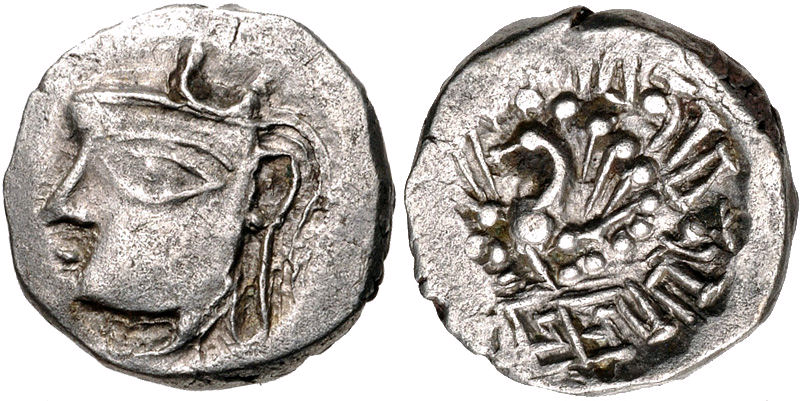
Harshavardhana Circa AD 606-647. AR Drachm (13mm, 2.28 g, 1h). Head left; crescent above / Fan-tailed Garuda standing facing.CNG Coins · CC BY-SA 3.0 · Commons
Harshavardhana (Sanskrit: हर्षवर्धन; 4 June 590 – 647) was the emperor of Kannauj from April 606 until his death in 647. He was the king of Thanesar who had defeated the Alchon Huns, and the younger brother of Rajyavardhana, son of Prabhakaravardhana and last king of Thanesar. He is regarded as one of the greatest kings of the Kingdom of Kannauj, which under him expanded into a vast realm in northern India.
At the height of Harsha's power, his realm covered much of northern and northwestern India, with the Narmada River as its southern boundary.
Much of the information about Harsha's youth comes from the account of Bāṇabhaṭṭa. Harsha was the second son of Prabhakarvardhana, king of Thanesar. After the downfall of the Gupta Empire in the middle of the 6th century, Northern India was split into several independent kingdoms. The northern and western regions of the Indian subcontinent passed into the hands of a dozen or more feudatory states. Prabhakaravardhana, the monarch of Sthanvesvara, who belonged to the Vardhana family, extended his control over neighbouring states. Prabhakaravardhana was the first monarch of the Vardhana dynasty with his capital at Sthanvesvara. After Prabhakaravardhana's died in 605, his eldest son, Rajyavardhana, ascended the throne. Harshavardhana was Rajyavardhana's younger brother. This period of kings from the same line has been referred to as the Vardhana dynasty in many publications.
Like many other ancient Indian rulers, Harsha was eclectic in his religious views and practices. His seals describe his ancestors as worshippers of the sun god, Surya, his elder brother as a Buddhist, and himself as a Shaivite. His land grant inscriptions describe him as Parama-maheshvara (supreme devotee of Shiva). His court poet Bana also describes him as a Shaivite.
Read more
Harsha's play Nāgānanda tells the story of the Bodhisattva Jīmūtavāhavana, and the invocatory verse at the beginning is dedicated to the Buddha, described in the act of vanquishing Māra (so much so that the two verses, together with a third, are also preserved separately in Tibetan translation as the *Mārajit-stotra). Shiva's consort Gauri plays an important role in the play, and raises the hero to life using her divine power.
According to the Chinese Buddhist traveler Xuanzang, Harsha was a devout Buddhist.
Kashmir (KASH-meer or kash-MEER) is the northernmost geographical region of the Indian subcontinent. Until the mid-19th century, the term Kashmir denoted only the Kashmir Valley between the Great Himalayas and the Pir Panjal Range. The term has since also come to encompass a larger area that formerly comprised the princely state of Jammu and Kashmir, and includes the Indian-administered territories of Jammu and Kashmir and Ladakh, the Pakistani-administered territories of Azad Kashmir and Gilgit-Baltistan, and the Chinese-administered territories of Aksai Chin and the Trans-Karakoram Tract.
India has control of about half the area of the former princely state of Jammu and Kashmir, which comprises Jammu and Kashmir and Ladakh, while Pakistan controls a third of the region, divided into two provinces, Azad Kashmir and Gilgit-Baltistan. Jammu and Kashmir and Ladakh are administered by India as union territories. They formed a single state until 5 August 2019, when the state was bifurcated, and its limited autonomy was revoked.
Read more
Although there was a clear Muslim majority in Kashmir before the 1947 partition, and its economic, cultural, and geographic contiguity with the Muslim-majority area of the Punjab (in Pakistan) could be convincingly demonstrated, the political developments during and after the partition resulted in a division of the region.
Kashmir's economy is centred around agriculture. Traditionally the staple crop of the valley was rice, which formed the chief food of the people. In addition, Indian corn, wheat, barley and oats were also grown. Given its temperate climate, it is suited for crops like asparagus, artichoke, seakale, broad beans, scarletrunners, beetroot, cauliflower and cabbage. Fruit trees are common in the valley, and the cultivated orchards yield pears, apples, peaches, and cherries. The chief trees are deodar, firs and pines, chinar or plane, maple, birch and walnut, apple, cherry.
Read more
Historically, Kashmir became known worldwide when Cashmere wool was exported to other regions and nations (exports have ceased due to decreased abundance of the cashmere goat and increased competition from China). Kashmiris are well adept at knitting and making Pashmina shawls, silk carpets, rugs, kurtas, and pottery.
656 CE – 704 CE · Capital: Karmanta Vasaka, (present-day Barakamata, Comilla district) · 90,427 km²
Khadga dynasty (Bengali: [kʰɔɽɡo rad͡ʒbɔŋʃo]), was a Buddhist dynasty which ruled the areas of Vanga and Samatata in ancient Bengal from 625 CE to 716 CE. Chronologically, the dynasty emerged as a powerful kingdom of Bengal between the fall of Gauda Kingdom and the rise of the Pala Empire. Their ascendancy may have been immediately preceded by the overthrow of a previously ruling Bhadra dynasty. While they did not assume imperial titles, the Khadgas retained sovereignty over the ancient kingdom of Vanga and later conquered Samatata.
The Pratihara dynasty, also called the Gurjara-Pratiharas, the Pratiharas of Kannauj or the Imperial Pratiharas, was a prominent medieval Indian dynasty which initially ruled the Gurjaradesa until its victory in the Tripartite Struggle in 816 in which Pratiharas secured the throne of Kannauj. Cadet branches of the dynasty ruled other minor states in the subcontinent. Pratihara are known for their sculptures, carved panels and open pavilion style temples.
The Pratiharas were instrumental in containing Arab armies to the west of Indus River.
The origin of the dynasty and the meaning of the term 'Gurjara' in its name is disputed among historians. The rulers of this dynasty used the self-designation 'Pratihara' for their clan, and never referred to themselves as Gurjaras. They claimed descent from the legendary hero Lakshmana, who is said to have acted as a pratihara ("door-keeper") for his brother Rama.
Read more
Multiple inscriptions of their neighbouring dynasties describe the Pratiharas as Gurjara. The term Gurjara-Pratihara occurs only in the Rajor inscription of a feudatory ruler named Mathanadeva, who describes himself as a Gurjara-Pratihara. According to one school of thought, Gurjara was the name of the territory, Gurjaradesa, originally ruled by the Pratiharas; gradually, the term came to denote the people of this territory.
After bringing much of Rajasthan under his control, Vatsaraja embarked to become "master of all the land lying between the two seas." Contemporary Jijasena's Harivamsha Purana describes him as "master of western quarter".
Read more
According to the Radhanpur Plate and Prithviraja Vijaya, Vatsaraja led an expedition against the Palas under Dharmapala of Bengal As such, the Palas came into conflict from time to time with the Imperial Pratiharas. According to the above inscription Dharmapala, was deprived of his two white Royal Umbrellas, and fled, followed by the Pratihara forces under general Durlabharaja I of Shakambhari. The Prithviraja Vijaya claimed that, Durlabharaja I "washed his sword at the confluence of the river Ganga and the ocean, and savouring the land of the Gaudas". The Baroda Inscription (AD 812) states Nagabhata defeated the Dharmapala.
Bhoja II (910–912) was overthrown by Mahipala I (912–944). Several feudatories of the empire took advantage of the temporary weakness of the Pratiharas to declare their independence, notably the Paramaras of Malwa, the Chandela Empire, the Kalachuris, the Tomaras, and the Chahamanas of Shakambhari. The south Indian Emperor Indra III (c. 914–928) of the Rashtrakuta Empire captured the Kannauj in 916, and although the Pratiharas regained the city, their position continued to weaken in the tenth century, partly as a result of the drain of simultaneously fighting off Turkic attacks from the west, the attacks from the Rashtrakuta dynasty from the south and the Pala advances in the east. The Pratiharas lost control of Rajasthan to their feudatories, and the Chandelas captured the strategic fortress of Gwalior in central India around 950.
Historians of India, since the days of Elphinstone, have wondered at the slow progress of Muslim invaders in India, as compared with their rapid advance in other parts of the world. The Arabs possibly only stationed small invasions independent of the Caliph. Arguments of doubtful validity have often been put forward to explain this unique phenomenon. Currently it is believed that it was the power of the Pratihara army that effectively barred the progress of the Muslims beyond the confines of Sindh, their first conquest for nearly three hundred years. In the light of later events this might be regarded as the "Chief contribution of the Pratiharas to the history of India".
Kannauj (Hindustani pronunciation: [kənːɔːd͡ʒ]) is an ancient city in the Indian state of Uttar Pradesh and a municipal board (nagar palika) home to the administrative headquarters of the eponymous district. Known as Kanyakubja during the ancient Vedic period, it was successively the capital city of the Mahajanapada Panchala Kingdom and then of the Ayudha dynasty.
Archaeological discoveries show that Kannauj was inhabited by the Painted Grey Ware and Northern Black Polished Ware cultures, c. 1200–600 BCE and c. 700–200 BCE, respectively. During the Vedic period, it was the capital city of the Panchala Kingdom during the reign of king Vajrayudha.
Read more
The epic also accounts for the origin of the name Kanyakubja (the ancient root of "Kannauj"): according to the legend in Sarga 33, Kushanabha's one hundred daughters refused the advances of the wind god Vayu, who in retaliation made them hunchbacks (kubja), leading the city to be called Kanyakubja ("the city of hunchbacked maidens"). Despite this, the original name Mahodaya remained in formal and epigraphic use for centuries, appearing in royal grants and inscriptions well into the reign of the Gurjara-Pratihara dynasty.
As of 2011 India census, Kannauj had a population of 84,862. Males constitute 53% of the population and females 47%. Kannauj has an average literacy rate of 72.70%: male literacy is 80.90%, and female literacy is 63.33%. In Kannauj, 14% of the population is under 6 years of age.
750 CE – 1168 CE · Capital: Mahipal, MurshidabadVarious, (9th century – 1161) · 1,362,437 km²
Ideal plan of Pataliputra after Megasthenes and Mahabhasya (above), archaeological sites in Patna (below).Pyule · CC BY-SA 3.0 · Commons
The Pāla Empire was an early medieval Indian empire ruled by the Pāla (Prakrit and Sanskrit: पाल, romanized: Pāla, lit. 'protector') dynasty. The empire was founded with the election of Gopāla by the chiefs of Gauda in the late 8th century CE. The Pala stronghold was located in Bengal and Bihar, which included the major cities of Gauḍa, Vikramapura, Pāṭaliputra, Monghyr, Somapura, Ramavati (Varendra), Tāmralipta and Jagaddala.
The Pālas were astute diplomats and military conquerors. Their army was noted for its vast war elephant corps.
The origin and early history of the Palas is uncertain, with historians relying on indirect evidence regarding their ancestry.
Read more
The 11th-century Sanskrit epic Ramacharitam, written by a Pala court poet, states that Varendra (North Bengal) was the fatherland (Janakabhu) of the Palas. In Ramacharitam Dharmapala is hailed as the glory of the 'Samudra' (oceanic) dynasty; it also attests the fifteenth Pala emperor, Ramapala, as a Kshatriya. The 16th-century Tibetan Lama Taranatha in his History of Buddhism in India described that Gopala was born of the seed of a certain tree-god from the womb of a Kshatriya woman. Historian Niharranjan Ray mentions that this story is connected with totemic lore, and it is a reflection of the society outside of Puranic Brahmanism.
The Pala rule was monarchial. The king was the centre of all power. Pala kings would adopt imperial titles like Parameshwara, Paramvattaraka, Maharajadhiraja. Pala kings appointed Prime Ministers known as Mahamantri. The Line of Garga served as the Prime Ministers of the Palas for 100 years.
Read more
Pala Empire was divided into separate Bhuktis (Provinces). Bhuktis were divided into Vishayas (Divisions) and Mandalas (Districts). Smaller units were Khandala, Bhaga, Avritti, Chaturaka, and Pattaka. Administration covered widespread area from the grass root level to the imperial court.
The highest military officer in the Pala empire was the Mahasenapati (commander-in-chief). The Palas recruited mercenary soldiers from a number of kingdoms, including Malava, Khasa, Huna, Kulika, Mithila, Karnata, Lata, Odra and Manahali. According to the contemporary accounts, the Rashtrakutas had the best infantry, the Gurjara-Pratiharas had the finest cavalry and the Palas had the largest elephant force. The Arab merchant Sulaiman states that the Palas had an army bigger than those of the Balhara (possibly the Rashtrakutas) and the king of Jurz (possibly the Gurjara-Pratiharas). He also states that the Pala army employed 10,000–15,000 men for fuelling and washing clothes. He further claims that during the battles, the Pala king would lead 50,000 war elephants. Sulaiman's accounts seem to be based on exaggerated reports; Ibn Khaldun mentions the number of elephants as 5,000.
The Pala school of sculptural art is recognised as a distinct phase of the Indian art, and is noted for the artistic genius of the Bengal sculptors. It is influenced by the Gupta art.
Read more
The Pala style was inherited and continued to develop under the Sena Empire. During this time, the style of sculpture changed from "Post-Gupta" to a distinctive style that was widely influential in other areas and later centuries. Deity figures became more rigid in posture, very often standing with straight legs close together, and figures were often heavily loaded with jewellery; they very often have multiple arms, a convention allowing them to hold many attributes and display mudras. The typical form for temple images is a slab with a main figure, rather over half life-size, in very high relief, surrounded by smaller attendant figures, who might have freer tribhanga poses.
Nayapala, the son of Mahipala I, defeated the Kalachuri king Karna (son of Ganggeyadeva) after a long struggle. The two later signed a peace treaty at the mediation of the Buddhist scholar Atiśa. During the reign of Nayapala's son Vigrahapala III, Karna once again invaded Bengal but was defeated. The conflict ended with a peace treaty, and Vigrahapala III married Karna's daughter Yauvanasri. Vigrahapala III was later defeated by the invading Chalukya king Vikramaditya VI. Vigrahapala III also faced another invasion led by the Somavamsi king Mahasivagupta Yayati of Orissa. Subsequently, a series of invasions considerably reduced the power of the Palas. The Varmans occupied eastern Bengal during his reign.
Read more
The successor and older son of Vighrahapala III by his wife Yauvanashri, Mahipala II's reign is well-documented by Sandhyakar Nandi in Ramacharitam.
The Rashtrakuta Empire (Kannada: [raːʂʈrɐkuːʈɐ]) was an early medieval Indian empire ruling large parts of the Indian subcontinent between the 6th and 10th centuries. At their peak the Rashtrakutas of Manyakheta ruled a vast empire stretching from the Ganges River and Yamuna River doab in the north to Kanyakumari in the south, a fruitful time of political expansion, architectural achievements and famous literary contributions.
The earliest known Rashtrakuta inscription is a 7th-century copper plate grant detailing their rule from Manapur, a city in Central or West India.
The heart of the Rashtrakuta Empire included nearly all of Karnataka, Maharashtra and parts of Andhra Pradesh, an area which the Rashtrakutas ruled for over two centuries. The Samangadh copper plate grant (753) confirms that the feudatory King Dantidurga, who probably ruled from Achalapura in Berar (modern Elichpur in Maharashtra), defeated the great Karnatic army (referring to the army of the Badami Chalukyas) of Kirtivarman II of Badami in 753 and took control of the northern regions of the Chalukya empire. He then helped his son-in-law, Pallava King Nandivarman II regain Kanchi from the Chalukyas and defeated the Gurjaras, and the rulers of Kalinga, Kosala and Srisailam.
Read more
Dantidurga's successor Krishna I brought major portions of present-day Karnataka and Konkan under his control.
Inscriptions and other literary records indicate the Rashtrakutas selected the crown prince based on heredity. The crown did not always pass on to the eldest son. Abilities were considered more important than age and chronology of birth, as exemplified by the crowning of Govinda III who was the third son of king Dhruva Dharavarsha. The most important position under the king was the Chief Minister (Mahasandhivigrahi) whose position came with five insignia commensurate with his position namely, a flag, a conch, a fan, a white umbrella, a large drum and five musical instruments called Panchamahashabdas. Under him was the commander (Dandanayaka), the foreign minister (Mahakshapataladhikrita) and a prime minister (Mahamatya or Purnamathya), all of whom were usually associated with one of the feudatory kings and must have held a position in government equivalent to a premier.
The Rashtrakuta economy was sustained by its natural and agricultural produce, its manufacturing revenues and moneys gained from its conquests. Cotton was the chief crop of the regions of southern Gujarat, Khandesh and Berar. Minnagar, Gujarat, Ujjain, Paithan and Tagara were important centres of textile industry. Muslin cloth were manufactured in Paithan and Warangal. The cotton yarn and cloth was exported from Bharoch. White calicos were manufactured in Burhanpur and Berar and exported to Persia, Byzantines, Khazaria, Arabia and Egypt. The Konkan region, ruled by the feudatory Silharas, produced large quantities of betel leaves, coconut and rice while the lush forests of Mysore, ruled by the feudatory Gangas, produced such woods as sandal, timber, teak and ebony. Incense and perfumes were exported from the ports of Thana and Saimur.
The Rashtrakuta kings supported the popular religions of the day in the traditional spirit of religious tolerance. Scholars have offered various arguments regarding which specific religion the Rashtrakutas favoured, basing their evidence on inscriptions, coins and contemporary literature. Some claim the Rashtrakutas were inclined towards Jainism since many of the scholars who flourished in their courts and wrote in Sanskrit, Kannada, and a few in Apabhramsha and Prakrit were Jains. The Rashtrakutas built well-known Jain temples at locations such as Lokapura in Bagalkot district and their loyal feudatory, the Western Ganga Dynasty, built Jain monuments at Shravanabelagola and Kambadahalli.
In 972, during the rule of Khottiga Amoghavarsha, the Malwa King Siyaka Harsha attacked the empire and plundered Manyakheta, the capital of the Rashtrakutas. This seriously undermined the reputation of the Rastrakuta Empire and consequently led to its downfall. The final decline was sudden as Tailapa II, a feudatory of the Rashtrakuta ruling from Tardavadi province in modern Bijapur district, declared himself independent by taking advantage of this defeat. Indra IV, the last emperor, committed Sallekhana (fasting unto death practised by Jain monks) at Shravanabelagola. With the fall of the Rashtrakutas, their feudatories and related clans in the Deccan and northern India declared independence. The Western Chalukyas annexed Manyakheta and made it their capital until 1015 and built an impressive empire in the Rashtrakuta heartland during the 11th century.
The Habbari Dynasty (Arabic: اﻹﻣﺎرة اﻟﻬﺒﺎرﻳﺔ, Sindhi: ھباري گھراڻو) were an Arab dynasty that ruled much of Sindh, as a semi-independent emirate from 854 to 1024. Beginning with the rule of 'Umar bin Abdul Aziz al-Habbari in 854 CE, the region became semi-independent from the Abbasid Caliphate in 861, while continuing to nominally pledge allegiance to the Abbasid Caliph in Baghdad. The Habbari ascension marked the end of a period of direct rule of Sindh by the Umayyad and Abbasid Caliphates, which had begun in 711 CE.
The region of Greater Sindh was first brought under Arab Islamic rule after the conquest of the Umayyad general Muhammad ibn Qasim in 711 CE, and formed the easternmost province of the Muslim Empire. The region corresponded to an area greater in area than the modern Pakistani province of Sindh, and included the Makran coast, central Balochistan, and southern Punjab, which in sum correspond to much of the territory of modern Pakistan. The province's internal administration was largely delegated to the natives, rather than the Arab conquerors.
Read more
According to Arab accounts of the initial conquest, central and southern Sindh was largely Buddhist—corresponding to the regions south of the old capital of Aror, although these regions had a large Hindu population as well. Upper Sindh, however, had few Buddhists, and was overwhelmingly Hindu.
The first Habbaris were followers of the Sunni school of thought, and pledged allegiance to the Sunni caliphs in Baghdad, although the last Habbari ruler, Khafif, may have converted to Isma'ili Islam. Under Habbari rule, Ismaili missionaries, who pledged allegiance to the Fatimid Caliphate in Cairo, became active in Sindh, which became one of 12 jaza'ir, or "islands" in the Islamic world in which Ismaili missionary activity was successful. In 957, al-Qadi al-Nu'man recorded that an Ismaili da'i travelled throughout Sindh in the mid-10th century, and successfully converted large numbers of non-Muslims to Ismaili Islam. By 985, Al-Maqdisi noted that the population of Multan (in northern Greater Sindh, ruled by the Banu Munnabih) was largely Shia, although the population of Mansura pledged allegiance to the Sunni Imam Daud Zahiri ibn Athir.
947 CE – 1249 CE · Capital: Anahilavada (modern Patan) · 234,889 km²
The Chaulukya dynasty (IAST: Caulukya), also Solanki dynasty, was a dynasty that ruled parts of what are now Gujarat and Rajasthan in north-western India, between c. 940 CE and c. 1244 CE. Their capital was located at Anahilavada (modern Patan). At times, their rule extended to the Malwa region in present-day Madhya Pradesh. The family is also known as the "Solanki dynasty" in the vernacular literature. They belonged to the Solanki clan of Rajputs.
Mularaja, the founder of the dynasty, supplanted the last ruler of the Chavda dynasty around 940 CE.
The word "Chaulukya" is thought to be a variant of the word "Chalukya". Several other dynasties were known by the name "Chalukya", including the Chalukyas of Vatapi, Navasarika, Vemulavada, Kalyani, Vengi and Lata. These dynasties are sometimes thought to be branches of the same family, but the relationship between all of them is not certain. Unlike the Chalukyas of Kalyani and Vengi, the Chaulukyas of Gujarat never claimed a shared descent or any other association with the earliest Chalukya dynasty—the Chalukyas of Vatapi. Moreover, they never used the term "Chalukya" to describe themselves.
Read more
However, the Chaulukyas of Gujarat shared a myth of origin with the Chalukyas of Kalyani and Vengi. According to this legend, the progenitor of the dynasty was created by Brahma.
The dynasty's founder Mularaja is said to have built Mulavasatika temple for Digambara Jains and the Mulanatha-Jinadeva temple for the Svetambara Jains. The earliest of the Dilwara Temples and the Modhera Sun Temple were constructed during the reign of Bhima I. According to popular tradition, his queen Udayamati also commissioned the Queen's step-well. Kumarapala started patronizing Jainism at some point in his life, and the subsequent Jain accounts portray him as the last great royal patron of Jainism. The Chaulukya rulers also endowed mosques to maintain good relationship with the Muslim traders.
Taking advantage of the young age of Bhima II, some provincial governors rebelled against him in order to establish independent states. His loyal Vaghela feudatory Arnoraja came to his rescue, and died fighting the rebels. Arnoraja’s descendants Lavanaprasada and Viradhavala became powerful during Bhima’s reign.
Read more
During Bhima’s reign, the Hoysala ruler Veera Ballala II seems to have raided the Lata region. The Yadava ruler Bhillama V also invaded Gujarat, but was forced to retreat by Bhima’s feudatory Kelhanadeva. The Shakambhari Chahamana king Prithviraja III also fought with the Chaulukyas, but Bhima’s general Jagaddeva managed to conclude a peace treaty with Prithviraja sometime before 1187 CE.
By the mid-1190s CE, the Ghurids defeated the Prithviraja and the other major Hindu kings of northern India.
The Chandela Empire was an Indian dynasty in Central India. The Chandelas ruled much of the Bundelkhand region (then called Jejakabhukti) between the 9th and the 13th centuries. They belonged to the Chandel clan of the Rajputs.
The Chandelas initially ruled as feudatories of the Gurjara-Pratiharas of Kanyakubja (Kannauj). The 10th century Chandela ruler Yashovarman became practically independent, although he continued to acknowledge the Pratihara suzerainty. By the time of his successor Dhanga, the Chandelas had become a sovereign power.
The origin of the Chandelas is obscured by mythical legends. The epigraphic records of the dynasty, as well as contemporary texts such as Balabhadra-vilasa and Prabodha-chandrodaya, suggest that the Chandelas belonged to the legendary Lunar dynasty (Chandravansha). A 954 CE Khajuraho inscription states that the dynasty's first king Nannuka was a descendant of sage Chandratreya, who was a son of Atri. A 1002 CE Khajuraho inscription gives a slightly different account, in which Chandratreya is mentioned as a son of Indu (the Moon) and a grandson of Atri. The 1195 CE Baghari inscription and the 1260 CE Ajaygadh inscription contain similar accounts. The Balabhadra-vilasa also names Atri among the ancestors of the Chandelas. Another Khajuraho inscription describes the Chandela king Dhanga as a member of the Vrishni clan of the Yadavas (who also claimed to be part of the Lunar dynasty).
The Chandelas are well known for their art and architecture. They commissioned a number of temples, water bodies, palaces and forts at various places. The most famous example of their cultural achievements are the Hindu and Jain temples at Khajuraho. Three other important Chandela strongholds were Jayapura-Durga (modern Ajaigarh), Kalanjara (modern Kalinjar) and Mahotsava-Nagara (modern Mahoba).
Read more
Other smaller Chandela sites include Chandpur, Deogarh, Dudahi, Kakadeo, Madanpur and Aharji.
Paramardi (reigned c. 1165-1203 CE) ascended the Chandela throne at a young age. While the early years of his reign were peaceful, around 1182–1183 CE, the Chahamana ruler Prithviraj Chauhan invaded the Chandela kingdom. According to the medieval legendary ballads, Prithviraj's army lost its way after a surprise attack by (Ghurid) Turkic forces, and unknowingly camped at the Chandela capital Mahoba. This led to a brief conflict between the Chandelas and the Chauhans, before Prithviraj left for Delhi. Sometime later, Prithviraj invaded the Chandela kingdom and sacked Mahoba. Paramardi cowardly took shelter in the Kalanjara fort. The Chandela force, led by Alha, Udal banaphar, rajputs, of Udal and other generals, was defeated in this battle.
The Utpala Dynasty was a medieval Kashmiri Hindu dynasty that ruled over Kashmir from the 9th to 10th centuries. Founded by Avantivarman in 855, it replaced the Karkota dynasty. It came into existence in the northern region of the Indian subcontinent. The cities of Avantipur (Awantipora) and Suyapur (Sopore) were founded during the reign, and many Hindu temples dedicated to both Vishnu and Shiva, and Buddhist monasteries were built, notable of which is the Avantiswara and Avantiswami temples.
Following the death of Cippatajayapida, the last significant king of the Karkota dynasty, around 840, a bitter power struggle erupted between his maternal uncles. The war between Padma, Utpala, Kalyana, Mamma, and Dharma to seize control of the empire grew increasingly bloody and the line of succession unclear. In the meantime, puppet kings were propped up and discarded, hailing from the Karkota lineage but failing to exert sufficient authority or establish stability.
Read more
Tribhuvanapida's son, Ajitapida was nominated by Utpala immediately after Cippatajayapida's death. A few years afterwards, Mamma waged a successful battle against Utpala, and installed Anangipida. Three years later, Utpala's son Sukhavarman rebelled successfully and installed Utpalapida, a son of Ajitapida.
Avantivarman along with his chief-minister Sura commissioned numerous temples and towns—Avantipura, Surapura and the Avantiswami Temple. Suyya established the town of Suyyapura. Samkaravarman established Samkarapura (modern-day Pattan) and, in conjunction with Sugandha, the Shiva-temples of Samkaragaurisa and Sugandhesa. Another Shiva-temple in Fattegarh has been dated to his times. Sugandha, during her rule, got constructed the towns of Sugandhapura and Gopalapura, the Vishnu temple Gopalakesava, and the monastery Gopalamatha. Nanda consecrated the shrines of Nandakesava and Nandamatha. Meruvardhana built the Vishnu shrine of Meruvardhanasvamin at Puranadhisthana (modern-day Pandrethan). Sambavati was responsible for founding the Shiva-shrine of Sambveswara.
Suravarman II reigned for hardly a few days, before being ousted by his commander-in-chief Kamalvardhana, who had declared rebellion from his base in Madavarajya against the Damras (and by extension, the Utpalas). He fled the kingdom with his mother, bringing the Utpala Dynasty to an end. Kamalvardhana convened an assembly of Brahmins to appoint the next ruler, who rejected his self-nomination as well as a request from Suravarman II's mother.
Read more
Yasaskara, the son of Prabhakaradeva was instead chosen. This brought an end to the Utpala dynasty and would set the stage for Didda's autocracy.
The Chauhan dynasty are a dynasty associated with various ruling Rajput families in the present-day Indian state of Rajasthan from seventh century onwards.
Origins and Founding
The word Chauhan is the vernacular form of the Sanskrit term Chahamana (IAST: Cāhamāna). Several Chauhan inscriptions name a legendary hero called Chahamana as their ancestor, but none of them state the period in which he lived.
Read more
The earliest known ruler of the dynasty was Vasudeva. According to the Prabandha-Kosha of the 14th century Jain scholar Rajashekhara Suri, Vasudeva ascended the throne in 551 CE (608 Vikram Samvat). The historical accuracy of this statement is not certain.
The earliest extant inscription that describes the origin of the Chauhans is the 1119 CE Sevadi inscription of Ratnapala, a ruler of the Naddula Chahamana dynasty. According to this inscription, the ancestor of the Chahamanas was born from the eye of Indra.
The Paramara dynasty (IAST: Paramāra) was an Indian dynasty that ruled Malwa and surrounding areas in west-central India between 948 and 1305. They belonged to the Paramara clan of the Rajputs.
The dynasty was established in either the 9th or 10th century, and its early rulers most probably ruled as vassals of the Rashtrakutas of Manyakheta. The earliest extant Paramara inscriptions, issued by the 10th-century ruler Siyaka, have been found in Gujarat. Around 972, Siyaka sacked the Rashtrakuta capital Manyakheta, and established the Paramaras as a sovereign power.
The Harsola copper plates issued by the Paramara king Siyaka II in 949 mentions a king called Akalavarsha, followed by the expression tasmin kule ("in that family"), and then followed by the name "Vappairaja" (identified with the Paramara king Vakpati I). Based on the identification of "Akalavarsha" (which was a Rashtrakuta title) with the Rashtrakuta king Krishna III, historian as D.C. Ganguly theorized that the Paramaras were descended from the Rashtrakutas. Ganguly tried to find support for his theory in Ain-i-Akbari, whose variation of the Agnikula myth (see below) states that a predecessor of the Paramaras came to Malwa from Deccan. According to Ain-i-Akbari, Dhanji - a man born from a fire sacrifice - came from Deccan to establish a kingdom in Malwa; when his descendant Putraj died heirless, the nobles established Aditya Ponwar - the ancestor of the Paramaras - as the new king.
Bhoja's successor Jayasimha I, who was probably his son, faced the joint Kalachuri-Chaulukya invasion immediately after Bhoja's death. Bilhana's writings suggest that he sought help from the Chalukyas of Kalyani. Jayasimha's successor and Bhoja's brother Udayaditya was defeated by Chamundaraja, his vassal at Vagada. He repulsed an invasion by the Chaulukya ruler Karna, with help from his allies. Udayaditya's eldest son Lakshmadeva has been credited with extensive military conquests in the Nagpur Prashasti inscription of 1104-05 CE. However, these appear to be poetic exaggerations. At best, he might have defeated the Kalachuris of Tripuri. Udayaditya's younger son Naravarman faced several defeats, losing to the Chandelas of Jejakabhukti and the Chaulukya king Jayasimha Siddharaja. By the end of his reign, one Vijayapala had carved out an independent kingdom to the north-east of Ujjain.
The Western Chalukya Empire (chə-LOO-kyə) ruled most of the western Deccan, South India, between the 10th and 12th centuries. This Kannada dynasty is sometimes called the Kalyani Chalukya after its regal capital at Kalyani, today's Basavakalyan in the modern Bidar district of Karnataka state, and alternatively the Later Chalukya from its theoretical relationship to the 6th-century Chalukya dynasty of Badami. The dynasty is called Western Chalukyas to differentiate from the contemporaneous Eastern Chalukyas of Vengi, a separate dynasty.
The Western Chalukya kingship was hereditary, passing to the king's brother if the king did not have a male heir. The administration was highly decentralised and feudatory clans such as the Alupas, the Hoysalas, the Kakatiya, the Seuna, the southern Kalachuri and others were allowed to rule their autonomous provinces, paying an annual tribute to the Chalukya emperor. Excavated inscriptions record titles such as Mahapradhana (Chief minister), Sandhivigrahika, and Dharmadhikari (chief justice). Some positions such as Tadeyadandanayaka (commander of reserve army) were specialised in function while all ministerial positions included the role of Dandanayaka (commander), showing that cabinet members were trained as army commanders as well as in general administrative skills.
Agriculture was the empire's main source of income through taxes on land and produce. The majority of the people lived in villages and worked farming the staple crops of rice, pulses, and cotton in the dry areas and sugarcane in areas having sufficient rainfall, with areca and betel being the chief cash crops. The living conditions of the labourers who farmed the land must have been bearable as there are no records of revolts by the landless against wealthy landlords. If peasants were disgruntled the common practice was to migrate in large numbers out of the jurisdiction of the ruler who was mistreating them, thereby depriving him of revenue from their labor.
Read more
Taxes were levied on mining and forest products, and additional income was raised through tolls for the use of transportation facilities. The state also collected fees from customs, professional licenses, and judicial fines.
The Western Chalukya era was one of substantial literary activity in the native Kannada, and Sanskrit. In a golden age of Kannada literature, Jain scholars wrote about the life of Tirthankaras and Virashaiva poets expressed their closeness to God through pithy poems called Vachanas. Nearly three hundred contemporary Vachanakaras (Vachana poets) including thirty women poets have been recorded. Early works by Brahmin writers were on the epics, Ramayana, Mahabharata, Bhagavata, Puranas and Vedas. In the field of secular literature, subjects such as romance, erotics, medicine, lexicon, mathematics, astrology, encyclopedia etc. were written for the first time.
Read more
Most notable among Kannada scholars were Ranna, grammarian Nagavarma II, minister Durgasimha and the Virashaiva saint and social reformer Basavanna.
The continual warring with the Cholas exhausted both empires, giving their subordinates the opportunity to rebel. In the decades after Vikramaditya VI's death in 1126, the empire steadily decreased in size as their powerful feudatories expanded in autonomy and territorial command. The time period between 1150 and 1200 saw many hard fought battles between the Chalukyas and their feudatories who were also at war with each other. By the time of Jagadhekamalla II, the Chalukyas had lost control of Vengi and his successor, Tailapa III, was defeated by the Kakatiya king Prola in 1149. Tailapa III was taken captive and later released bringing down the prestige of the Western Chalukyas. Seeing decadence and uncertainty seeping into Chalukya rule, the Hoysalas and Seunas also encroached upon the empire.
1003 CE – 1259 CE · Capital: Srinagar · 226,659 km²
The Lohara dynasty was a dynasty that ruled over Kashmir and surrounding regions in the northwestern part of the Indian subcontinent between 1003 and approximately 1175. The early history of the dynasty was described in the Rajatarangini (Chronicle of Kings), a work written by Kalhana in the mid-12th century, upon which many studies of the first 150 years of the dynasty depend. Subsequent accounts which provide information up to and beyond the end of the dynasty come from Jonarāja and Śrīvara. The later rulers of the dynasty were perceived as weak.
According to the 12th-century text Rajatarangini translated by Sir Marc Aurel Stein, the family of the chiefs of Lohara were from the Khaśa tribe. The original seat of the Lohara dynasty was a hill fortress called Loharkot. Stein identified its location in the Pir Panjal mountain range, situated on a trade route between western Punjab and Kashmir in the present-day Poonch district of Jammu. The kingdom of Lohara was centered on a valley that contained a group of large villages, collectively known as Lohrin, and likely extended into neighboring valleys.
Read more
Didda, a daughter of King Simharja of Lohara, married King Kshemgupta of Kashmir, thereby uniting the two regions. In comparison to other societies of the period, women in Kashmir were highly esteemed. When Kshemgupta died in 958, Didda took on the role of regent for her young son, Abhimanyu II.
Describing the collapse of order, Hasan states: "the Dãmaras or feudal chiefs grew powerful, defied royal authority, and by their constant revolts plunged the country into confusion. Life and property were not safe, agriculture declined, and there were periods when trade came to a standstill. Socially and morally too the court and the country had sunk to the depths of degradations."
1056 CE – 1351 CE · Capital: Kalinganagara, Dantapura, Kataka, Paralakhemundi · 205,867 km²
The Eastern Ganga dynasty (also known as Purba Gangas, Rudhi Gangas or Prachya Gangas) were a large medieval era dynasty that reigned from Kalinga from as early as the 5th century to the mid 20th century. They are known as "Eastern Gangas" to distinguish them from the Western Gangas who ruled over Karnataka. The territory ruled by the dynasty consisted of the whole of the modern-day Indian state of Odisha, as well as major parts of north Andhra Pradesh, parts of Chhattisgarh and some southern districts of West Bengal.
As per B. Masthanaiah, the origin of the Eastern Gangas is not clearly established. However, renowned British scholar, artist, art critic, historian, archaeologist, and an authority on Indian art and architecture, Percy Brown, suggested that the temples of Mukhalingam predated the temples of Bhubaneswar and had been built as per the Badami Chalukya Temple Architecture originating from Karnataka since the 4th century CE. A certain temple tower in Odisha shows a combination of both Rekha and Pidha Deul decoration types which was taken from the Kadamba temples of Karnataka where it first appeared. The Mukhalingam (Kalinganagara) Madhukeswara (Mukhalingeswara) temple too resembles the Kadamba temples of Karnataka.
The Eastern Ganga coinage consisted of gold fanams. The obverse typically depicts a couchant bull along with other symbols. The reverse features a symbol which represents the letter sa (for samvat, which means year) flanked by elephant goads or an elephant goad with a battle axe, along with a number below, which depicts the regnal year(anka year) of the reigning monarch. Some coins also carry the legend śrī rāma on the reverse above the letter sa.
Read more
An interesting aspect of the Eastern Ganga coin dates is that these coins may be the earliest Hindu coins using decimal numbers for dating.
The Government of the Ganga empire was monarchial. The empire was divided into several provinces known as Maha mandalas each being governed by a governor called a Mahamandalika. Each Mahamandala is divided into several mandalas. Again these mandalas were subdivided into units called Visayas which were like modern day districts and were ruled by a Visayapati. At local government level, every village or grama was a self governing unit. The Gramas were led by a Gramika. There were different village officials such as Karanika (accountant), Dandapani (police officer), Gramavatta (village watchman).
Read more
The Ganga military system also had a royal navy at the time of Chodaganga. The Ganga empire had large number of fortified cities and flourishing ports.
The Gangas were Shaivites and had constructed many temples dedicated to lord Shiva, the group of Shiva temples in Mukhalingam built by Kamarnaba deva, Chateswar Temple, Meghesvara Templke, Nagnath Temple built by Anangabhima Deva III.
By successfully defeating the invasion attempts of Muslim invaders, the Eastern Ganga Empire is attributed to have served as the conservatory of the Hindu religion, art and culture at a time when India's indigenous civilization was endangered through the large scale massacre of Hindus, plundering of cities, desecration and destruction of temples and forcible conversions of the Hindu populace. The Ganga Empire also harbored the fleeing culture and art from other parts of India.
Read more
The Eastern Gangas were great patrons of religion and the arts, and the temples of the Ganga period rank among the masterpieces of Kalinga and Hindu architecture.
1072 CE – 1235 CE · Capital: Gauda, Bikrampur, Nabadwip, Lakhnauti · 257,822 km²
The wooden idol of Chaitanya Mahaprabhu, worshiped by Bishnupriya Debi, now placed in Nabadwip Dhameswar Mahaprabhu Temple.বাক্যবাগীশ · CC BY-SA 4.0 · Commons
The Sena dynasty, or the Senas, were a Hindu dynasty that succeeded the Pala Empire and ruled much of the eastern region of the Indian subcontinent from Bengal, during the early medieval period, through the 11th and 13th centuries.
The dynasty's founder was Samanta Sena. After him came Hemanta Sena, who usurped power and styled himself king in 1095 AD. His successor Vijaya Sena (r. 1096–1159) helped lay the foundations of the dynasty and had an unusually long reign of over 60 years.
The rulers of the Sena Dynasty traced their origin to the south of India. Deopara Prashasti described the founder of Sena dynasty Samanta Sena, as a migrant Brahmaksatriya from Karnataka. The epithet 'Brahma-Kshatriya' suggests that Senas were Brahmins by caste who took the profession of arms and became Kshatriyas. The Sena kings were also probably Baidyas, according to historian P.N. Chopra.
Read more
A copper plate suggests that the Senas settled in western Bengal before the birth of Samantasena. The Senas entered into the service of Palas as sāmantas in Rāḍha, probably under Samantasena. With the decline of the Pālas, their territory had expanded to include Vaṅga and a part of Varendra by the end of Vijayasena's reign. The Palas were ousted in totality, and their entire territory annexed sometime after 1165.
In the political history of Bengal, Sena dynasty was a mighty ruling dynasty in power. Various currency names have been regularly mentioned in the Sena writings, such as Purana, Chalana, Dharan, Dramma. These terms were used to mean a silver coin weighing 32 ratis (56.6 grains) or a karshapan weighing scale. The term Kapardaka Purana is seen as a medium of exchange in the writings of the Sena kings and other contemporary kings. Kapardak means Cowrie in Sanskrit and 'Chalana' means a coin. The conjunction ‘kapardaka-purana’ refers to a medium of exchange whose quality is equal to that of a purana or silver coin (56.6 grains), but which is actually calculated by the proportional denominator. The table found in the traditional arithmetic of Bengal contained 1260 cowries instead of one silver coin (Purana or Dramma). That is, the ratio of Purana and Kapardaka is 1: 1280.
The Sena dynasty is notable for building Hindu temples and monasteries. King Ballāla Sena built the Dhakeshwari Temple in 12-century CE in what is now Dhaka, Bangladesh.
Read more
In Kashmir, the dynasty also likely built a temple knows as Sankara Gaureshwara.
Downfall of Sena dynasty was destined under the rule of weak rulers of this dynasty. This dynasty started declining during the rule of Lakshmana Sena who was the last significant Sena king. He was succeeded by his two sons Vishvarupa Sena and Keshava Sena. Probably they ruled till at least 1230 AD. However it was learnt from Tabaqat-i-Nasiri that the descendants of Lakshmana Sena ruled in Bengal (Bang) till at least 1245 AD or 1260 AD.
The Senas and their descendants merged into the Kayastha caste-group, heralding them as the neo-Kshatriyas of Bengal — hence, Abul Fazl would write that Bengal had always been ruled by Kayasthas. The actual caste-status of Senas — notwithstanding the anachronism — remain contested in popular memory: premodern Baidya genealogies claim the Senas as their own which are agreed upon by some Brahmin genealogies but rejected by Kayastha ones.
Medieval States of the Indian Subcontinent, 476 CE – 1072 CE: Frequently Asked Questions
Which states existed in the Indian Subcontinent in this period?
This page maps 22 states of the Indian Subcontinent founded between 476 CE and 1072 CE: Maitraka Dynasty, Chalukya Dynasty, Maukhari Dynasty, Pandya Dynasty, Gauda Kingdom, Harsha's Empire, Kashmir, Khadga Dynasty, Gurjara-Pratihara Dynasty, Kannauj-Varman Dynasty, Pala Empire, Rashtrakuta Dynasty and 10 more.
Which was the largest of the Medieval States of the Indian Subcontinent, 476 CE – 1072 CE?
Pala Empire had the largest mapped extent, about 1,362,437 km².
Which of the Medieval States of the Indian Subcontinent, 476 CE – 1072 CE lasted longest?
Kashmir lasted longest, 626 CE – 1343 CE.
↑↓ to navigate↵ to open
12,754 Planetary Entities Indexed
We use Google Analytics cookies to understand which pages are useful. Necessary storage only keeps your theme and this choice on your device. Privacy policy