20 states of Italy on one map, from 500 CE to 1946 CE.The largest, Ostrogothic Kingdom, covered about 576,943 km²; the longest-lived, Kingdom of Italy, lasted 587 CE – 1946 CE. Each has its own section below with its rulers, capitals, wars and pictures where the records hold them.
Each state in its own colour. Move the timeline to see which existed in any year from 500 AD to 1946; select a territory to read about it. Borders: Cliopatria / Seshat (CC BY 4.0).
The Ostrogothic Kingdom, officially the Kingdom of Italy (Latin: Regnum Italiae), was a barbarian kingdom established by the Germanic Ostrogoths that controlled Italy and neighbouring areas between 493 and 553. Led by Theodoric the Great, the Ostrogoths killed Odoacer, a Germanic soldier and erstwhile leader of the foederati. Odoacer had previously become the de facto ruler of Italy following Odoacer's deposition of Romulus Augustulus, the final emperor of the Western Roman Empire, in 476.
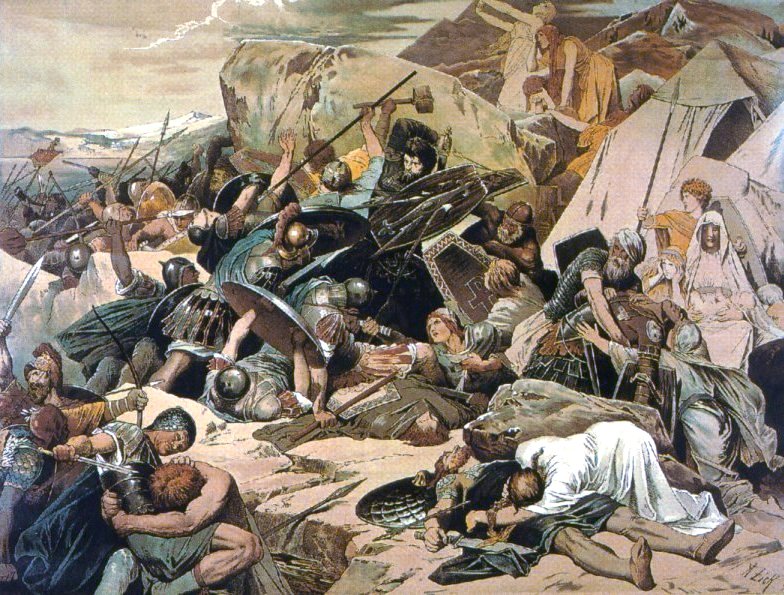
Teia551–552 CEThe original uploader was Captain Blood at German Wikipedia. · Public domain · Commons
Government, Society and Religion
Historians have proposed widely varying estimates for the population that accompanied Theodoric into Italy in 489 CE, ranging from approximately 100,000 to 250,000 individuals. The incoming Goths constituted a minority relative to the established Italo-Roman population, while maintaining a distinct political and social identity during the early Ostrogothic kingdom. Following the defeat of Odoacer, many of his former soldiers, drawn from groups such as the Sciri, Rugii, Heruli, Turcilingi, Alans, and other contingents, were integrated into the new political and military order. The Goths were particularly prominent in the western Po Valley, the Alpine region, and areas corresponding to modern Veneto, Trentino, Friuli and Marche.
An agreement was reached between Zeno and Theodoric, stipulating that Theodoric, if victorious, was to rule in Italy as the emperor's representative. Theodoric with his people set out from Moesia in the autumn of 488, passed through Dalmatia and crossed the Julian Alps into Italy in late August 489. The first confrontation with the army of Odoacer was at the river Isonzo (the battle of Isonzo) on August 28. Odoacer was defeated and withdrew towards Verona, where a month later another battle was fought, resulting in a bloody, but crushing, Gothic victory.
Read more
Odoacer fled to his capital at Ravenna, while the larger part of his army under Tufa surrendered to the Goths. Theodoric then sent Tufa and his men against Odoacer, but he changed his allegiance again and returned to Odoacer.
Because of the kingdom's short history, no fusion of the two peoples and their art was achieved. However, under the patronage of Theodoric and Amalasuntha, large-scale restoration of ancient Roman buildings was undertaken, and the tradition of Roman civic architecture continued. In Ravenna, new churches and monumental buildings were erected, several of which survive.
Read more
The Basilica of Sant'Apollinare Nuovo, its baptistry, and the Archiepiscopal Chapel follow the typical late Roman architectural and decorative motifs, but the Mausoleum of Theodoric displays purely Gothic elements, such as its construction not from the usual brick, but of massive slabs of Istrian limestone, or the 300-ton single-piece roof stone.
Maintenance, restoration, and in some cases new construction of functioning water systems in many cities outside of Ravenna also occurred in the Ostrogothic Kingdom.
The Gothic War between the Eastern Roman Empire and the Ostrogothic Kingdom was fought from 535 until 554 in Italy, Dalmatia, Sardinia, Sicily and Corsica. It is commonly divided into two phases. The first phase lasted from 535 to 540 and ended with the fall of Ravenna and the apparent reconquest of Italy by the Byzantines. With the fall of Ravenna, the capital of the kingdom was brought to Pavia, which it became the last centres of Ostrogothic resistance that continued the war and opposed Eastern Roman rule.
Read more
During the second phase (540/541–553), Gothic resistance was reinvigorated under Totila and put down only after a long struggle by Narses in the Battle of Taginae and later in the Battle of Mons Lactarius. In 554, at the Battle of the Volturno, Narses also repelled a joint contingent of Franks and Alemanni, who had been invited by the Goths.
577 CE – 1084 CE · Capital: Benevento · 46,656 km²
Panoramic view of Benevento from the mount Pentime (1,168 amsl), part of the Taburnus mountain range.Dэя-Бøяg · CC BY-SA 3.0 · Commons
The Duchy of Benevento was the southernmost Lombard duchy in the Italian Peninsula that was centered in Benevento, a city in Southern Italy. Lombard dukes ruled Benevento from 571 to 774, when the Kingdom of the Lombards was conquered by the Kingdom of the Franks. Being cut off from the rest of the Lombard possessions by the papal Duchy of Rome, Benevento always had held some degree of independence. Only during the reigns of Grimoald (r. 662–671) and the kings from Liutprand (r. 712–744) on was the duchy closely tied to the Kingdom of the Lombards.
The circumstances surrounding the creation of the duchy are disputed. According to some scholars, Lombards were present in southern Italy well before the complete conquest of the Po Valley: the duchy by these accounts would have been founded in 571. The Lombards may have entered later, around 590. Whatever the case, the first duke was Zotto, a leader of a band of soldiers who descended the coast of Campania. Though at first independent, Zotto was eventually made to submit to the royal authority of the north. His successor was Arechis, his nephew, and the principle of hereditary succession guided the Beneventan duchy to the end.
the piazza an facade of the cathedral of Spoleto, UmbriaWittylama · CC BY-SA 4.0 · Commons
The Duchy of Spoleto (Latin: Ducatus Spolitanorum) was a duchy in central Italy that existed from the late 6th century until the early 13th century. Centered on the city of Spoleto, it controlled much of the mountainous interior of central Italy, including parts of modern Umbria, Abruzzo, Marche, and Lazio.
The duchy emerged during the Lombard conquest of Italy in the 570s, under Duke Faroald I. Owing to its position astride the Via Flaminia, Spoleto became strategically important in the struggle between the Lombards and the Byzantine Empire.
Within the Lombard kingdom, the Duchy of Spoleto formed part of the southern grouping of territories commonly referred to as Tuscia, which included Tuscany, Spoleto, and Benevento.
Read more
The duchy was ruled by a duke, described with the title Summus et Gloriosus Dux Langobardorum. In large duchies such as Spoleto, the duke exercised substantial authority, while acknowledging the higher sovereignty of the Lombard king.
Subordinate officials operated within the duchy. Among them were gastalds, who governed territorial districts and administered revenues connected with ducal authority. These officials exercised both civil and military functions.
At the local level, settlements were supervised by officials called sculdasci or centenarii. Each oversaw a district known as a sculdascia, and beneath them were decani, who were responsible for smaller ecclesiastical or local units.
The Duchy of Spoleto emerged during the Lombard expansion into central Italy in the late 6th century. Its origins are traditionally placed during the reign of Alboin, around 571. An alternative chronology places the foundation of the duchy after the failed Byzantine offensive of 575–576 led by Baduarius. Following this defeat Faroald I and associated Lombard groups established control, placing the foundation of the duchy a few years later.
Read more
From Spoleto, Lombard expansion advanced toward the central Apennines. The valleys of the Vigi, Nera, and Corno were progressively occupied.
The conquest divided central Italy into two main spheres: the Tuscia Romanorum, corresponding to the Byzantine-held Duchy of Perugia, and the Tuscia Longobardorum, or Duchy of Spoleto.
Lucca, Tuscany, Italy, seen from the Torre Guinigi. On this view, one can see in particular the church of San San Giusto, the campanile of San Michele in Foro and the Torre delle Ore.Myrabella · CC BY-SA 3.0 · Commons
The Duchy of Tuscia (TUSS-ee-ə, TUSH-(ee-)ə; Modern Italian: Ducato di Tuscia [duˈkaːto di ˈtuʃʃa]; Latin: Ducatus Tusciae), initially known as the Duchy of Lucca (Modern Italian: Ducato di Lucca; Latin: Ducatus Lucaniae), was a Lombard duchy in Central Italy, which included much of today's Tuscany. After the occupation of the territories belonging to the Byzantines, the Lombards founded this flourishing duchy which, among other centres, also included Florence. The capital of the duchy was Lucca, which was located along the Via Francigena, being also the city where the dukes resided.
In 774, following the conquest of the Lombard kingdom, Charlemagne assumed the title of "Gratia Dei rex Francorum et Langobardorum atque patricius Romanorum" ("By the grace of God, king of the Franks and of the Lombards and Roman patrician"), realizing a personal union of the two kingdoms. Charlemagne chose to maintain the "Leges Langobardorum" even if following the revolt of 776, led by the duke of Friuli Hrodgaud, he replaced the Lombard dukes with counts, public officials, and redistributed the latter's assets among the Frankish aristocrats.
Read more
Therefore, also the Duchy of Tuscia was reorganized on a comital basis and in 781 it was placed together with the other ex-Lombard territories in the Regnum Italicorum, entrusted to Pepin under the tutelage of his father, Charlemagne. Later the governors of the region received the title of margraves.
Victor Emmanuel II, first King of United Italy.Eugène Disdéri · Public domain · Commons
The Kingdom of Italy was a unitary state that existed from 17 March 1861, when Victor Emmanuel II, King of Sardinia, was proclaimed King of Italy, until 18 June 1946, when the monarchy was abolished, following civil discontent that led to an institutional referendum on 2 June, resulting in the establishment of the modern Italian Republic. The kingdom was established through the unification of several states over a decades-long process, called the Risorgimento. That process was influenced by House of Savoy-ruled Sardinia, which was one of Italy's legal predecessor states.
Montage of Turin, Italy. Clockwise from top: Panorama of Turin, Borgo Medioevale, Palazzo Madama, Piazza San Carlo, Gran Madre and Monte dei Cappuccini on the river Po, Mole Antonelliana, Royal Palace.Eccekevin · CC BY-SA 4.0 · Commons
Lee identifies three major themes in Mussolini's foreign policy. The first was a continuation of the foreign-policy objectives of the preceding Liberal regime. Liberal Italy had allied itself with Germany and Austria, and had great ambitions in the Balkans and North Africa. Ever since it had been badly defeated in Ethiopia in 1896, there was a strong demand for seizing that country. Second was a profound disillusionment after the heavy losses of the First World War; the small territorial gains from Austria were not enough to compensate. Third was Mussolini's promise to restore the pride and glory of the Roman Empire.
Read more
Italian Fascism is based upon Italian nationalism and in particular seeks to complete what it considers as the incomplete project of Risorgimento by incorporating Italia Irredenta (unredeemed Italy) into the state of Italy.
Unitary parliamentary constitutional monarchy, under a fascist dictatorship (1925–1943)
Languages
Italian
Religion
96% Catholicism (state religion from 1929)
Economy and Trade
Italy has a long history of different coinage types. Italian unification highlighted the confusion of the pre-unification Italian monetary system which was mostly based on silver monometallism and therefore in contrast with the gold monometallism in force in the Kingdom of Sardinia and in the major European nations. To reconcile the various monetary systems it was decided to opt for bimetallism, taking inspiration from the French franc model, from which the dimensions of the coins and the exchange rate of 1 to 15.50 between gold and silver were taken.
1000 italienische Lire-Banknote mit dem Bild Maria MontessorisBanca d'Italia · Public domain · Commons
Currency
Italian lira
Flag of Italy (1861–1946)F l a n k e r · Public domain · Commons
Coat of arms of the Kingdom of Italy (1890)Sodacan, Katepanomegas, ZuppaDiCarlo This file was derived from: Great coat of arms of the king of italy (1890-1946).svg · CC BY-SA 3.0 · Commons
Wars and Battles
Italy entered into the First World War in 1915 with the aim of completing national unity: for this reason, the Italian intervention in the First World War is also considered the Fourth Italian War of Independence, in a historiographical perspective that identifies in the latter the conclusion of the unification of Italy.
Read more
The war forced the decision whether to honor the alliance with Germany and Austria. For six months Italy remained neutral, as the Triple Alliance was only for defensive purposes. Italy took the initiative in entering the war in spring 1915, despite strong popular and elite sentiment in favor of neutrality. Italy was a large, poor country whose political system was chaotic, its finances were heavily strained, and its army was very poorly prepared. The Triple Alliance meant little either to Italians or Austrians – Vienna had declared war on Serbia without consulting Rome.
In Italy a state school system or education system has existed since 1859, when the Legge Casati (Casati Act) mandated educational responsibilities for the forthcoming Italian state (Italian unification took place in 1861).
Read more
The Casati Act made primary education (scuola elementare) compulsory, and had the goal of increasing literacy. This law gave control of primary education to the single towns, of secondary education to the provinces, and the universities were managed by the State. Even with the Casati Act and compulsory education, in rural (and southern) areas children often were not sent to school (the rate of children enrolled in primary education would reach 90% only after 70 years) and the illiteracy rate (which was nearly 80% in 1861) took more than 50 years to halve.
The next important law concerning the Italian education system was the Legge Gentile.
When Germany invaded Poland on 1 September 1939 beginning World War II, Mussolini chose to stay non-belligerent, although he declared his support for Hitler. In drawing out war plans, Mussolini and the Fascist regime decided that Italy would aim to annex large portions of Africa and the Middle East. Hesitance remained from the king and military commander Pietro Badoglio, who warned Mussolini that Italy had too few tanks, armoured vehicles, and aircraft available to be able to carry out a long-term war; Badoglio told Mussolini "It is suicide" for Italy to get involved in the European conflict. Mussolini and the Fascist regime thus waited as France was invaded by Germany in June 1940 (Battle of France) before deciding to get involved.
Read more
Italy entered the war on 10 June 1940, fulfilling its obligations towards the Pact of Steel.
Pope Aeneas Piccolomini Canonizes Catherine of Siena // Fresco Piccolomini Library, Duomo, SienaPinturicchio · Public domain · Commons
The Papal States (PAY-pəl), officially the State of the Church, were a conglomeration of territories on the Italian Peninsula under the direct sovereign rule of the pope from 756 to 1870. They were among the major Italian states from the 8th century until the unification of Italy, which took place between 1859 and 1870, culminating in their incorporation into the Kingdom of Italy.
For its first 300 years, within the Roman Empire, the Church was persecuted and unable to hold or transfer property. Early congregations met in rooms set aside for the purpose in the homes of wealthy adherents, and a number of titular churches located on the outskirts of Rome were held as property by individuals, rather than by any corporate body. Nonetheless, the property held nominally or actually by individual members of the Roman churches would usually be treated as a common patrimony handed over successively to the legitimate "heir" of that property, often its senior deacons, who were, in turn, assistants to the local bishop. This common patrimony became quite considerable, including as it did not only include houses etc. in Rome or nearby but also landed estates, such as latifundia, whole or in part, across Italy and beyond.
The Papal States were ruled under the Pope's temporal power, comprising thirteen provinces in central and northern Italy. These provinces were administered through a hierarchical system of papal officials.
Read more
By the mid-18th century, major provinces were governed chiefly by cardinal legates (legati a latere), while provincial and principal city governments were entrusted to prelates of the Roman Curia. Lesser jurisdictions were administered by legally trained governors, who could be removed or transferred according to administrative need. Certain territories outside Italy, such as Benevento and Avignon, were likewise governed by papal prelates holding gubernatorial or vice-legatine authority.
The Papal States were governed through a centralized curial system of cardinal-led congregations.
In the 17th century the Papal States faced chronic financial crisis. Revenues of just over 2 million scudi were largely consumed by debt interest, and public debt rose sharply from about 15 million scudi in the 1620s to around 50 million by the 1670s. Extraordinary levies were also imposed during times of crisis, including a subsidy of about 700,000 scudi during the famine of 1647 to 1648. By 1676 the state carried a public debt that imposed an annual interest burden of about 2.4 million scudi. Heavy fiscal pressures and war expenses contributed to widespread poverty and economic stagnation.
Read more
In the 18th century the finances of the Papal States were marked by structural imbalance between ordinary revenue and growing expenditure.
Buono (bono) da 100 Scudi pontifici della serie G stampato in 9000 esemplari, suddivisi in 1000 esemplari per ciascuna delle nove serie individuate con le lettere dell'alfabeto dalla A alla I.Bjørn Christian Tørrissen · CC BY-SA 3.0 · Commons
Flag of the Papal States (1803-1825)Tibetan Pop Rocks · CC BY-SA 3.0 · Commons
In 1792 the Papal army had a mere 5,000 regular soldiers for a state that controlled most of Central Italy. In theory this could be augmented by 80,000 reserves and citizen-militia, though nowhere near as many were actually called up at any point. Control over the military was divided among the Commissioner of Arms (most troops), the Treasurer General (the customs guards and garrisons beyond Lazio), the Secretary of the Consulta (a handful of personnel), and the Master of the Apostolic Palace (the palace guard). Each commander jealously guarded his powers, and the army was restricted to performing the duties of ceremonial honor guard, fortress garrison, border patrol, customs police, coastal surveillance, and law enforcement.
Education in the Papal States was fragmented and unevenly distributed until the early 19th century. Before the 1825 Regulation published by the Congregation of Studies there was no common curriculum, and teaching ranged from basic religious instruction to grammar and history according to local initiative. Many schools were run by religious orders or supported by municipalities, while others functioned clandestinely without license.
Read more
From the late 16th century onward, a relatively articulated educational system developed, aimed at different social strata. Primary education was provided by a wide range of institutions, including schools run by regular and secular clergy and, to a lesser extent, by private individuals. Religious orders played a central role, viewing education both as a means of religious instruction and as a tool for the social advancement of the lower classes.
View of the gulf of Naples from the Castel Sant'Elmo with the Certosa di San Martino.This Photo was taken by Wolfgang Moroder. Feel free to use my photos, but please mention me as the author and send me a message. · CC BY-SA 3.0 · Commons
The Duchy of Naples (Latin: Ducatus Neapolitanus, Neapolitan: Ducato di Napule) began as a Byzantine province in Southern Europe that was constituted in the seventh century, in the lands roughly corresponding to the current province of Naples that the Lombards had not conquered during their invasion of Italy in the sixth century. It was one of the tyrrhenian duchies along with the duchy of Gaeta, Amalfi and Sorrento which took their independence from Naples in the early 9th century.
The Principality of Capua (Latin: Principatus Capuae or Capue, Modern Italian: Principato di Capua) was a state centred on Capua in Southern Italy which lasted for about three centuries. Towards the end of the 10th century the Principality reached its apogee, occupying most of the Terra di Lavoro area. It was originally a gastaldate, then a county, within the principality of Salerno.
Old Capua was an ancient Italian city, the greatest Roman city of the south. It was the centre of Lombard gastaldate in the duchy of Benevento, although little is known of this part of its history. It first enters history as a Lombard state under Landulf the Old with the assassination of the Beneventan duke Sicard in 839. Landulf and his sons were partisans of Siconulf of Salerno. In 841, Capua was sacked and completely destroyed by Saracens in the pay of Radelchis I of Benevento. Landulf and his eldest son, Lando I, took the initiative in fortifying the nearby hill of Triflisco on which was built "New Capua": the Capua of today.
Read more
A civil war between Benevento and Salerno ensues. In 849, Emperor Louis II ends the civil war by decreeing that Benevento be split into two distinct principates - Benevento and Salerno.
The Principality of Salerno (Latin: Principatus Salerni) was a medieval Southern European state, formed in 851 out of the Principality of Benevento after a decade-long civil war. It was centred on the port city of Salerno. Although it owed allegiance at its foundation to the Carolingian emperor, it was de facto independent throughout its history and alternated its allegiance between the Carolingians and their successors in the West and the Byzantine emperors in the east.
In 839, the prince of Benevento, Sicard, died. Immediately, his chief army officer, Radelchis, seized power in Benevento and imprisoned Sicard's heir and brother, Siconulf, in Taranto. Amalfitan merchants rescued Siconulf from prison, and he was proclaimed prince in Salerno. A civil war erupted in the Italian Mezzogiorno. In 847, Emperor Lothair I had Guy I of Spoleto and Sergius I of Naples mediate a division of the great Lombard principality. In 851, Louis, King of Italy, divided the principality into two sections: one with its capital at Salerno and another with the original Benevento.
Read more
Salerno consisted of Taranto, Cassano, Cosenza, Paestum, Conza, Potenza, Sarno, Cimitile (Nola), Capua, Teano, and Sora. It was a maritime power with numerous seaports, including Salerno itself, and controlled mostly the western half of the old duchy.
John established his own dynasty, which was to usher in Salerno's final period of greatness as an independent Lombard entity. He tried to increase control of the church in his region, but failed. He followed the principle of co-regency of sons, to stabilise the succession. His son, Guaimar III, had to deal with Saracen attacks, but was aided by the Norman mercenaries he had helped to recruit to the south. He moved away from Byzantium throughout his reign and supported the Lombard rebels of Melus of Bari. He also supported his neighbour, Pandulf IV of Capua, despite the latter's unpopularity. Under Guaimar III, the Schola Medica Salernitana first began to flourish, and he was capable of striking Opulenta Salernitanum on his coins as a sign of the trading wealth of his city.
Read more
Guaimar IV brought Salerno to its greatest heights, but it did not survive him.
The island of Sicily (Arabic: صِقِلِّيَة, romanized: Ṣiqilliya) was under Islamic rule from the late ninth to the late eleventh centuries. It became a prosperous and influential commercial power in the Mediterranean, with its capital of Palermo (بَلَرْم, Balarm) serving as a major cultural and political center of the Muslim world.
Sicily was a peripheral part of the Byzantine Empire when Muslim forces from Ifriqiya (roughly present-day Tunisia) began launching raids in 652.
Seated in what is now the Royal Palace in Palermo, the emir held authority over most affairs of state, including the army, administration, justice, and the treasury. He appointed the governors of major cities, high ranking judges (qāḍī), and arbitrators for minor disputes between individuals (hakam). An assembly of notables called giamà'a played a consultative role, albeit sometimes making important decisions in lieu of the emir. It is also very likely that the authorities operated a tiraz, an official workshop that produced valuable fabrics such as silk, which were granted as a sign of appreciation to their subject or as a gift to foreign dignitaries.
Read more
Muslim sovereignty was never absolute across the island, and the creation of three subdivisions served to distinguish different approaches to government.
Islam (official), Sunni Islam, Shia Islam (Kalbids), Chalcedonian Christianity, Judaism
Coins, Currency and Symbols
Currency
Tarì, dirham
Wars and Battles
In 826, Euphemius, the commander of the Byzantine fleet of Sicily, forced a nun to marry him. Emperor Michael II caught wind of the matter and ordered that General Constantine end the marriage and cut off Euphemius' nose. Euphemius rose up, killed Constantine and then occupied Syracuse; he in turn was defeated and driven out to North Africa. He offered rule of Sicily over to Ziyadat Allah, the Aghlabid emir of Ifriqiya (around present-day Tunisia), in return for a place as a general and safety; the Emir agreed, offering to give Euphemius the island in exchange for a yearly tribute. The conquest was entrusted to the 70-year-old qadi Asad ibn al-Furat, who led a force 10,000 infantry, 700 cavalry and 100 ships.
By the 11th century, mainland southern Italian powers were hiring Norman mercenaries, who were Christian descendants of the Vikings; it was the Normans under Roger de Hauteville, who became Roger I of Sicily, that captured Sicily from the Muslims. In 1038, a Byzantine army under George Maniaces crossed the strait of Messina, and included a corps of Normans. After another decisive victory in the summer of 1040, Maniaces halted his march to lay siege to Syracuse. Despite his conquest of the latter, Maniaces was removed from his position, and the subsequent Muslim counter-offensive reconquered all the cities captured by the Byzantines. The Norman Robert Guiscard, son of Tancred, then conquered Sicily in 1060 after taking Apulia and Calabria, while his brother Roger de Hauteville occupied Messina with an army of 700 knights.
Lower Burgundy (Latin: Burgundia inferior; French: Bourgogne inférieure) was a historical region in the early medieval Burgundy, and a distinctive realm known as the Kingdom of Lower Burgundy, that existed from 879 to 933, when it was incorporated into the reunited Kingdom of Burgundy. During that period, Lower Burgundy was encompassing the entire Cisjuran Burgundy (fr. Bourgogne cisjurane), centered on the region of Vienne (fr. Bourgogne viennoise), and also the entire southern region around Arles (fr. Bourgogne arlésienne), centered on Provence.
Amalfi, sea view, Italy, June 2006.No machine-readable author provided. Sudodana2048 assumed (based on copyright claims). · CC BY-SA 3.0 · Commons
The Duchy of Amalfi (Latin: Ducatus Amalphitanus) or the Republic of Amalfi was a de facto independent state centered on the Southern European city of Amalfi during the 10th and 11th centuries. The city and its territory were originally part of the larger Duchy of Naples, governed by a patrician, but it extracted itself from Byzantine vassalage and first elected a duke (or doge) in 958.
During the 10th and 11th centuries Amalfi was estimated to have a population of 50,000–70,000 people.
While the Duchy of Amalfi never regained its independence after 1137, the city of Amalfi was still important to maritime trade for the next 200 years, until 1343, when an earthquake and a storm destroyed most of its harbor. The most important contribution Amalfi made during those 200 years was probably the perfection of the modern-day box compass. Between 1295 and 1302, Flavio Gioia converted the compass from a needle floating in water to what we use today, a round box with a compass card that rotates 360 degrees attached to a magnetic element.
Read more
The Knights Hospitaller, a Catholic military order that was active during and after the Crusades, was founded by Benedictine monks from Amalfi and used the duchy's eight-pointed cross as one of its symbols. It is believed that the symbol originated in the Byzantine Empire in the 6th century before being used in Amalfi.
The Republic of Pisa (Italian: Repubblica di Pisa) was an independent state existing from the 11th to the 15th century, centered on the Tuscan city of Pisa. It rose to become an economic powerhouse, a commercial center whose merchants dominated Mediterranean and Italian trade for a century, before being surpassed and superseded by the Republic of Genoa.
The republic's participation in the Crusades secured valuable commercial positions for Pisan traders, leading to increased wealth and power. Pisa was a historical rival to Genoa at sea and to Florence and Lucca on land.
During the High Middle Ages the city grew into a very important commercial and naval center and controlled a significant Mediterranean merchant fleet and navy. It expanded its influence through the sack of Reggio di Calabria in the south of Italy in 1005. Pisa was in continuous conflict with the Saracens for control of the Mediterranean. In alliance with Genoa, Sardinia was captured in 1016 with the defeat of the Saracen leader Mujāhid al-‘Āmirī (Latin: Mogehidus). This victory gave Pisa supremacy in the Tyrrhenian Sea. When the Pisans subsequently ousted the Genoese from Sardinia, a new conflict and rivalry was born between the two maritime republics. Between 1030 and 1035 Pisa went on to successfully defeat several rival towns in the Emirate of Sicily and conquer Carthage in North Africa.
The territory subjected to the Republic of Pisa has had important variations over the centuries. During the period of great political and economic expansion, the republic had its own consoles with commercial farms and warehouses in many seaside cities: Gaeta, Naples, Salerno, Messina, Palermo, Trapani, Mazara del Vallo and in Tunis.
Read more
Pisan troops were among the first to conquer Jerusalem in 1099, and were led by their archbishop, Dagobert, the future Latin Patriarch of Jerusalem. With significant presences in the Levant, in the Byzantine Empire and in the Crusader states of Palestine, particularly in Constantinople (where the Byzantine Emperor Alexius I Comnenus granted them special mooring and trading rights), Antioch, Latakia, Tyre, Acre, Jaffa, Tripoli, Alexandria and Cairo.
Denarius van Antoninus Pius in zilver, 140 tot 143 NC, vindplaats: Onbekend, collectie Gallo-Romeins Museum Tongeren, S-175http://exploratorium.galloromeinsmuseum.be/Default.aspx?query=search=deeplink%7C/record/uniqid=obj_46165&showtype=record · Public domain · Commons
Currency
denarius
Flag of the Republic of PisaSee File history below for details. · Public domain · Commons
The rivalry between Pisa and Republic of Genoa intensified in the 13th century and resulted in the naval Battle of Meloria (1284), with the casus belli of the rally of Giudice di Cinarca in Pisa, fought right in front of the Pisan port. It which marked the beginning of the decline of the power of the city, with the renunciation of any claim on Corsica and with the sale of part of Sardinia to Genoa in 1299.
Read more
Furthermore, from 1323, the Aragonese conquest of Sardinia began, which deprived the city of the dominion over the giudicati of Cagliari and Gallura.
1015 CE – 1168 CE · Capital: Zaragoza · 100,638 km²
Panoramic view of Jaca (Aragon, Spain), taken from the Rapitan fortress hill.Elemaki · CC BY 3.0 · Commons
The Kingdom of Aragon (Aragonese: Reino d'Aragón; Catalan: Regne d'Aragó; Latin: Regnum Aragoniae; Spanish: Reino de Aragón) was a medieval and early modern kingdom on the Iberian Peninsula, corresponding to the modern-day autonomous community of Aragon, in Spain.
The Norman conquest of southern Italy lasted from 999 to 1194, involving many battles and independent conquerors. In 1130, the territories in southern Italy united as the Kingdom of Sicily, which included the island of Sicily, the southern third of the Italian Peninsula (including Benevento, which was briefly held twice), the archipelago of Malta, and parts of North Africa.
Itinerant Norman forces arrived in southern Italy as mercenaries in the service of Lombard and Byzantine factions, communicating swiftly back home news about opportunities in the Mediterranean.
After roughly a century of Arab control (following the Saracen defeat of Byzantine forces in 965), Sicily was inhabited by a mix of Christians, Arab Muslims, and Muslim converts at the time of its conquest by the Normans. It had originally been under the rule of the Aghlabids and then the Fatimids, but in 948 the Kalbids wrested control of the island and held it until 1053. During the 1010s and 1020s, a series of succession crises paved the way for interference by the Zirids of Ifriqiya. Sicily was wracked by turmoil as petty fiefdoms battled each other for supremacy. Into this, the Normans under Robert Guiscard and his younger brother Roger Bosso came intending to conquer; the pope had conferred on Robert the title of "Duke of Sicily".
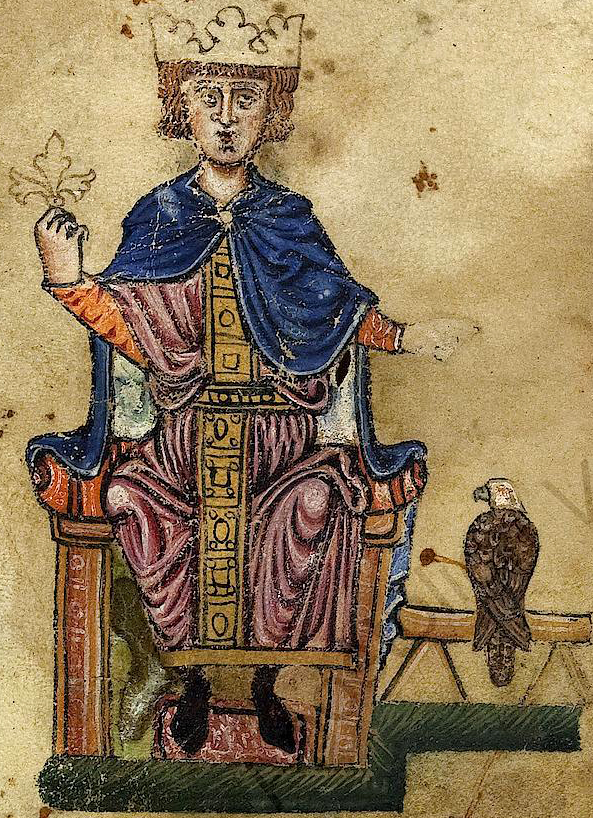
Frederick II and his falcon. From his book De arte venandi cum avibus (The art of hunting with birds). From a manuscript in Biblioteca Vaticana, Pal. lat 1071, fol. 1), late 13th centuryUnknown authorUnknown author · Public domain · Commons
The Kingdom of Sicily (Latin: Regnum Siciliae; Sicilian: Regnu di Sicilia; Italian: Regno di Sicilia) was a state that existed in Sicily and the southern Italian Peninsula as well as, for a time, in North Africa, from its founding by Roger II of Sicily in 1130 until 1816. It was a successor state of the County of Sicily, which had been founded in 1071 during the Norman conquest of the southern peninsula. The island was divided into three regions: Val di Mazara, Val Demone and Val di Noto.
During the Norman reign, several different religious communities coexisted in the Kingdom of Sicily. These included Latin Catholics, Greek Catholics, Muslims and Jews. Although local religious practices were not interrupted, the fact that Latin Catholics were in power tended to favor Latin Catholicism (Roman Catholicism). Bishops of the Greek rite were obliged to recognize the claims of the Latin Church in Sicily, while Muslim communities were no longer ruled by local emirs. Greek-speaking Christians, Latin Christians, and Muslims interacted on a regular basis, and were involved in each other's lives, economically, linguistically, and culturally. Some intermarried. Catholics living in an Arabic-speaking area might adopt Arabic or even Muslim names. In many cities, each religious community had its own administrative and judicial order.
The high fertility of the land led the Norman kings to bring settlers from neighbouring regions or to resettle farmers to areas where cultivation of land was needed. This led to an increase in agricultural production. The main sources of wealth for the Kingdom of Sicily in that time were its maritime cities, most important of which were the ancient port cities of Naples and its nearby counterpart Amalfi, from which local products were exported. The main export was durum wheat, with other exports including nuts, timber, oil, bacon, cheese, furs, hides, hemp and cloth. Grain and other dry products were measured in salme, which was equivalent to 275.08 litres in the western part of the Kingdom, and 300.3 litres in the eastern part. The salma was divided in 16 tumoli. One tumolo was equivalent to 17,193 litres. Weight was measured in cantari.
Bandiera del Regno di Sicilia 4Bandiera_del_Regno_di_Sicilia.svg: Oren neu dag Arms_of_the_Aragonese_Kings_of_Sicily.svg: Heralder derivative work: Luigi Chiesa (talk) · Public domain · Commons
Arms of the Aragonese Kings of Sicily(Crowned)Heralder · Public domain · Commons
Wars and Battles
By the 11th century, mainland southern Lombard and Byzantine powers were hiring Norman mercenaries, who were descendants of Vikings in northern France. It was the Normans under Roger I who conquered Sicily, taking it away from the Sicilian Muslims. After taking Apulia and Calabria, Roger occupied Messina with an army of 700 knights. In 1068, Roger I of Sicily and his men defeated the Muslims at Misilmeri but the most crucial battle was the Siege of Palermo, which led to Sicily being completely under Norman control by 1091.
The Crown of Aragon (US:) was a composite monarchy ruled by one king, originated by the dynastic union of the Kingdom of Aragon and the County of Barcelona (later Principality of Catalonia) and ended as a consequence of the War of the Spanish Succession.
Edicola con la quattrocentesca fontana di Mezzocannone e la statua di Alfonso II ('o rre 'e miezocannone)Unknown authorUnknown author · Public domain · Commons
The Crown of Aragon originated in 1137, when the Kingdom of Aragon and the County of Barcelona (along with the County of Provence, Girona, Cerdanya, Osona, and other territories) merged by dynastic union upon the marriage of Petronilla of Aragon and Raymond Berenguer IV of Barcelona; their individual titles combined in the person of their son Alfonso II of Aragon, who ascended to the throne in 1162. This union respected the existing institutions and parliaments of both territories. The combined state was initially known as Regno, Dominio et Corona Aragonum et Catalonie (only between 1286 and 1291), and later as Corona Regum Aragoniae, Corona Aragonum or simply Aragon.
Read more
Petronilla's father King Ramiro, "The Monk" (reigned 1134–1137) who was raised in the Monastery of Saint Pons de Thomières, Viscounty of Béziers as a Benedictine monk was the youngest of three brothers.
Alfonso III of Aragon1285–1291 CEJaume Mateu (Before 1402 - After 1452) Born in Documented in Valencia. Details on Google Art Project · Public domain · Commons
During the Crown of Aragon, the Catalan culture and language underwent a vigorous expansion. During the period of trade, Occitan-Catalan contributions to Maltese occurred.
Read more
King Fernando II and Queen Isabella, as the Catholic Monarchs who began the Inquisition, were contrary to the more plural development that preceded in the Crown of Aragon. The previous religious background was described as "longstanding tradition of Mudejarism, the royal sanctioning and protection of subject Muslim populations within Christian realms." Aesthetic Mudéjar architecture of Aragon has been observed as demonstrating the influence of Andalusian and Arab culture in Aragon proper. Gothic architecture was also developed.
The literary evocation of past splendour recalls correctly the great age of the 13th and 14th centuries, when Majorca, Valencia and Sicily were conquered, the population growth could be handled without social conflict, and the urban prosperity, which peaked in 1345, created the institutional and cultural achievements of the Crown.
Read more
The Aragonese crown's wealth and power stagnated and its authority was steadily transferred to the new Spanish crown settled in Castile after that date—the demographic growth was partially offset by the expulsion of the Jews from Spain (1492), Muslims (1502) and the expulsion of the Moriscos (1609).
The Republic of Florence (Old Italian: Republica di Fiorenza; contemporary Italian: Repubblica di Firenze), also known as the Florentine Republic (Latin: Res publica Florentina; Old Italian: Republica Fiorentina; contemporary Italian: Repubblica Fiorentina [reˈpubblika fjorenˈtiːna]), was a medieval and early modern state that was centered on the Italian city of Florence in Tuscany. The republic originated in 1115, when the Florentine people rebelled against the Margraviate of Tuscany upon the death of Matilda of Tuscany, who controlled vast territories that included Florence.
The city of Florence was established in 59 BC by Julius Caesar. Since 846 AD, the city had been part of the Marquisate of Tuscany. After Margravine Matilda of Tuscany died in 1115, the city did not submit readily to her successor, Rabodo (r. 1116–1119), who was killed in a dispute with the city.
Read more
It is not known precisely when Florence formed its own republican/oligarchical government independent of the marquisate, although the death of Rabodo in 1119 should be a turning point. The first official mention of the Florentine republic was in 1138, when several cities around Tuscany formed a league against the then-margrave of Tuscany, Duke Henry X of Bavaria. The country was nominally part of the Holy Roman Empire.
Rape of GanymedeBattista Franco Veneziano · Public domain · Commons
In 1569, Cosimo was elevated to the rank of the Grand Duke of Tuscany by Pope Pius V. This marks the end of the Florence Republic, and the beginning of the Grand Duchy of Tuscany.
Read more
Medici rule continued into the Grand Duchy of Tuscany until the family became extinct in 1737.
View of the gulf of Naples from the Castel Sant'Elmo with the Certosa di San Martino.This Photo was taken by Wolfgang Moroder. Feel free to use my photos, but please mention me as the author and send me a message. · CC BY-SA 3.0 · Commons
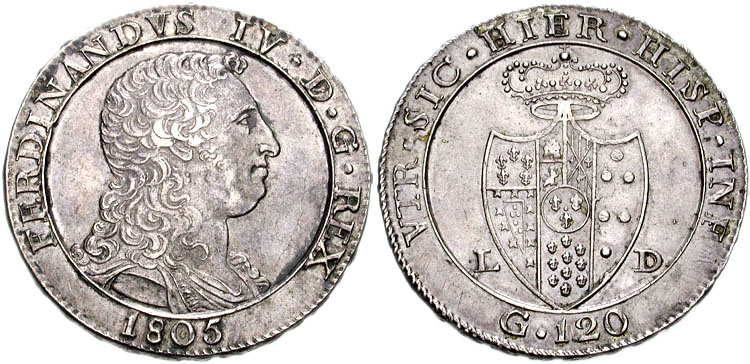
The Kingdom of Naples, officially the Kingdom of Sicily citra Pharum or "on this side of the lighthouse", was a state that ruled the part of the Italian Peninsula south of the Papal States between 1282 and 1816. It was established by the War of the Sicilian Vespers (1282–1302). Until then, the island of Sicily and southern Italy had constituted the "Kingdom of Sicily". When the island of Sicily revolted and was conquered by the Crown of Aragon, it became a separate kingdom also called the Kingdom of Sicily.
Naples, which was the capital of the Duchy of Naples since the 7th century, surrendered to Roger II of Sicily in 1137, and was annexed to the Kingdom of Sicily. The Normans were the first to bring political unity to southern Italy in the centuries after the failure of the Byzantine effort to reconquer Italy. The Normans established a kingdom that included southern mainland Italy and the island of Sicily, which was primarily ruled from Palermo. The title of King of Sicily was established by the Antipope Anacletus II as early as 1130 and subsequently legitimized, in 1139, by Pope Innocent II. Since the royal titles over the State had been assigned to the Normans by Innocent II, the popes, in particular Pope Innocent III and Pope Innocent IV, claimed the feudal rights of the Church State over the Kingdom.
The Neapolitan Republic of 1647 greatly influenced subsequent historical development of revolutions in Europe over the 17th century and 18th century, and it even inspired the French Revolution of 1789. It is noteworthy what was then reported by travellers (British for the most part) in the 18th century and 19th century inside Naples; they reported, in the daguerreotypes and in the pictorial representations of their travels, that spaghetti were eaten using bare hands in the streets of Naples. This tradition soon became a proper tourist attraction, so that tourists gave small change to the lazzaroni who then rushed to buy spaghetti and then eat them with their own hands.
Milan (Lombardy, Italy) – Milan Cathedral – view from the southwest over the Piazza del Duomo (Cathedral Square) with the triumphal arch of the historic shopping mall Galleria Vittorio Emanuele IISteffen Schmitz · CC BY-SA 4.0 · Commons
The Duchy of Milan (Italian: Ducato di Milano; Lombard: Ducaa de Milan) was a state in Northern Italy, created in 1395 by Gian Galeazzo Visconti, then the lord of Milan, and a member of the important Visconti family, which had ruled the city since 1277. At that time, it included twenty-six towns and the wide rural area of the middle Padan Plain east of the hills of Montferrat. During much of its existence, it was wedged between Savoy to the west, Republic of Venice to the east, the Swiss Confederacy to the north, and separated from the Mediterranean by the Republic of Genoa to the south.
Gian Galeazzo Visconti, duca di MilanoAliprando Caprioli · CC0 · Commons
The fate of the city of Milan was intertwined since the 13th century with that of the Visconti family, who resumed the policy of territorial expansionism inherited from the city's municipality. One of the first Visconti exponents to lead the Lombard city was Ottone Visconti, elected archbishop in 1262 and who defeated the Della Torre family in the Battle of Desio in 1277.
Read more
In the first half of the following century, his nephews and great-grandsons who came to govern Milan: Matteo I, Galeazzo I, Azzone and the Archbishop Giovanni, expanding the area of Visconti influence over the surrounding regions. An equal policy of enlargement and consolidation was pursued in the second half of the century by their successors: Matteo II, Bernabò and Gian Galeazzo.
ITALY, Milan. First Republic. 1250-1310. AR Soldo–Ambrosino Piccolo (20mm, 2.10 g, 9h). Cross with trefoils in angles St. Ambrose enthroned facing, wearing mitre and holding crozier. CNI V pg. 59, 25; Biaggi 1427.[User:Carlomorino]] · CC BY-SA 3.0 · Commons
Currency
soldo, Milanese scudo
Flag of the Duchy of Milan (1450)F l a n k e r · Public domain · Commons
Coat of arms of the Duchy of Milan (Sforza period)MostEpic · CC BY-SA 4.0 · Commons
Following Napoleon Bonaparte's victorious campaign in northern Italy in 1796, the duchy, entrusted to an interim government junta, was ceded to the French Republic by the Habsburgs with the Treaty of Campo Formio in 1797. Already in 1796, the French had established the vassal state of the Transpadane Republic on the territories of the Duchy of Milan, which merged with the Cispadane Republic in 1797 to form the Cisalpine Republic, of which Milan became the capital. After the defeat of Napoleon, on the basis of the decisions taken by the Congress of Vienna on 9 June 1815, the Duchy of Milan was not restored but became part of the Kingdom of Lombardy–Venetia, a constituent land of the Austrian Empire. The kingdom ceased to exist when the remaining portion of it was annexed to the Kingdom of Italy in 1866.
Medieval States of Italy: Frequently Asked Questions
Which states existed in Italy in this period?
This page maps 20 states of Italy founded between 500 CE and 1402 CE: Ostrogothic Kingdom, Duchy of Benevento, Duchy of Spoleto, Duchy of Tuscia, Kingdom of Italy, Papal States, Duchy of Naples, Principality of Capua, Principality of Salerno, Emirate of Sicily, Kingdom of Lower Burgundy, Republic of Amalfi and 8 more.
Which was the largest of the Medieval States of Italy?
Ostrogothic Kingdom had the largest mapped extent, about 576,943 km².
Which of the Medieval States of Italy lasted longest?
Kingdom of Italy lasted longest, 587 CE – 1946 CE.
↑↓ to navigate↵ to open
12,754 Planetary Entities Indexed
We use Google Analytics cookies to understand which pages are useful. Necessary storage only keeps your theme and this choice on your device. Privacy policy