Skip to content
YearMaps
8 states1450 CE – 1861 CE

Early Modern States of Italy: Map & History

8 states of Italy on one map, from 1450 CE to 1861 CE.The largest, Kingdom of Sardinia, covered about 235,522 km²; the longest-lived, House of Savoy, lasted 1564 CE – 1720 CE. Each has its own section below with its rulers, capitals, wars and pictures where the records hold them.

Milan (Lombardy, Italy) – Milan Cathedral – view from the southwest over the Piazza del Duomo (Cathedral Square) with the triumphal arch of the historic shopping mall Galleria Vittorio Emanuele II
Steffen Schmitz · CC BY-SA 4.0 · Commons
Humbert I "Biancamano" of Savoy
Abate Ferrero di Lavriano · Public domain · Commons
Italian: Vittorio Amedeo II in Maestà Victor Amadeus II in Majestytitle QS:P1476,it:"Vittorio Amedeo II in Maestà "label QS:Lit,"Vittorio Amedeo II in Maestà "label QS:Len,"Victor Amadeus II in Majesty"
Martin van Meytens · Public domain · Commons
Portrait of Joseph Bonaparte (1768-1844), King of Neapellabel QS:Len,"Portrait of Joseph Bonaparte (1768-1844), King of Neapel"label QS:Lfr,"Portrait de Joseph Bonaparte, roi de Naples"
Jean-Baptiste Wicar · Public domain · Commons
Base map
1450 AD
1798 AD
1861 AD
1450 AD
1550 AD
1650 AD
1750 AD
1861 AD
Epochs:
↗
↗
↗
↗
↗
↗
↗
↗

Each state in its own colour. Move the timeline to see which existed in any year from 1450 AD to 1861; select a territory to read about it. Borders: Cliopatria / Seshat (CC BY 4.0).

The Early Modern States of Italy Compared

StateYearsCapitalLargest extentRulers
Ambrosian Republic1450 CE – 1452 CEMilan29,911 km²2
House of Savoy1564 CE – 1720 CE–67,280 km²–
Kingdom of Sardinia1721 CE – 1861 CETurin, Cagliari (1798–1814)235,522 km²8
Kingdom of Naples (Napoleonic1762 CE – 1814 CENaples92,354 km²2
Cisalpine Republic1797 CE – 1799 CEMilan42,059 km²–
Grand Duchy of Tuscany1797 CE – 1848 CEFlorence24,632 km²2
Republic of San Marino1797 CE – 1799 CECity of San Marino47 km²40
Revolutionary Roman Republic1799 CE – 1799 CERome30,084 km²1

Timeline of the Early Modern States of Italy

When each state existed, 1450 CE to 1861 CE. Select a year to see the map then.

  1. Ambrosian Republic
    1450 CE – 1452 CE
  2. House of Savoy
    1564 CE – 1720 CE
  3. Kingdom of Sardinia
    1721 CE – 1861 CE
  4. Kingdom of Naples (Napoleonic
    1762 CE – 1814 CE
  5. Cisalpine Republic
    1797 CE – 1799 CE
  6. Grand Duchy of Tuscany
    1797 CE – 1848 CE
  7. Republic of San Marino
    1797 CE – 1799 CE
  8. Revolutionary Roman Republic
    1799 CE – 1799 CE

The 8 States

Ambrosian Republic

1450 CE – 1452 CE · Capital: Milan · 29,911 km²

Milan (Lombardy, Italy) – Milan Cathedral – view from the southwest over the Piazza del Duomo (Cathedral Square) with the triumphal arch of the historic shopping mall Galleria Vittorio Emanuele II
Milan (Lombardy, Italy) – Milan Cathedral – view from the southwest over the Piazza del Duomo (Cathedral Square) with the triumphal arch of the historic shopping mall Galleria Vittorio Emanuele II Steffen Schmitz · CC BY-SA 4.0 · Commons

The Golden Ambrosian Republic (Lombard: Aurea Republega Ambrosiana; Italian: Aurea Repubblica Ambrosiana; 1447–1450) was a short-lived republic founded in Milan by members of the University of Pavia with popular support, during the first phase of the Milanese War of Succession. They held out against France (battle of Bosco Marengo), the Republic of Venice (battle of Caravaggio), and the Swiss (battle of Castione); the Republic was abolished by the condottiero Francesco Sforza, who made himself Duke of Milan.

From Wikipedia: Golden Ambrosian Republic (CC BY-SA 4.0)

Origins and Founding

When Filippo Maria Visconti, Duke of Milan, died on 13 August 1447, the city was thrown into confusion by his unexpected demise and the speed with which claimants to his title acted. Filippo Maria had no heir through male bloodlines and therefore a succession crisis occurred.

Read more

Francesco Sforza, a famous condottiero and Filippo Maria's son-in-law through his illegitimate daughter Bianca Maria Visconti.

The two most prominent candidates supported by the Milanese population were however Alfonso of Aragon and Francesco Sforza.

The Bracceschi family, supporters of the King of Aragon, seized the city on the 13th, the night of Duke Filippo Maria's death, forcing the captains to swear allegiance to Alfonso. However, other influential citizens believed that a republic could be proclaimed.

From Wikipedia: Golden Ambrosian Republic · History: Foundation (CC BY-SA 4.0)

Founded
1450 CE
Preceded by
Duchy of Milan

Rulers

  • Mains of the 12 members: Carlo Gonzaga of Milan
  • Vitaliano I Borromeo

Government, Society and Religion

Government
Directorial republic
Languages
Lombard
Religion
Roman Catholicism

Coins, Currency and Symbols

Currency
Soldo
  • Vessillo della Repubblica Ambrosiana (1447-1450)
    Vessillo della Repubblica Ambrosiana (1447-1450) Unknown author · Public domain · Commons

Decline and Fall

Sforza was coming close to Milan itself in his conquests, and decided that since it was too powerful to be taken by force, he would surround it and starve the populace into surrender. With the loss of the outer cities by conquest or defection, Milan experienced famine. Gonzaga offered Crema to Sforza, hoping he would be tempted to take it himself and betray the Venetians. But Sforza remained staunch, and instead offered Gonzaga the city of Tortona if he would abandon Crema. This was accepted, and Crema, without support, quickly capitulated.

Read more

To the Milanese, Sforza's victory now seemed certain, but he found his Venetian allies beginning to have doubts about their Captain-General. They decided that Milan run by Sforza would be far more dangerous and detrimental to their interests than if it were run by a weak Republic.

From Wikipedia: Golden Ambrosian Republic · History: End of the Republic (CC BY-SA 4.0)

Ended
1452 CE
Succeeded by
Duchy of Milan

House of Savoy

1564 CE – 1720 CE · 67,280 km²

Humbert I "Biancamano" of Savoy
Humbert I "Biancamano" of Savoy Abate Ferrero di Lavriano · Public domain · Commons

The House of Savoy (Italian: Casa Savoia, French: Maison de Savoie, Arpitan: Mêson de Savouè) is a royal house (formally a dynasty) that was established in 1003 in the historical region of Savoy, which was originally part of the Kingdom of Burgundy and now lies mostly within southeastern France. Through gradual expansions, the family grew in power, first ruling the County of Savoy, a small Alpine county northwest of Italy, and later gaining absolute rule of the Kingdom of Sicily.

From Wikipedia: House of Savoy (CC BY-SA 4.0)

Origins and Founding

The name derives from the historical region of Savoy in the Alps between what is now France and Italy. Over time, the House of Savoy expanded its territory and influence through judicious marriages and international diplomacy. The house descended from Humbert I, Count of Sabaudia, also known as Umberto I "Biancamano" (1003–1047 or 1048). The ancestry of Humbert is uncertain, as contemporary documents make no mention of his father. His family was traditionally believed to have come from Saxony; more recent investigations into the 21st century pointed to the County of Vienne, where both Humbert and his relatives held extensive possessions, as a more plausible origin.

Read more

Although Sabaudia was originally a poor county, later counts were diplomatically skilled, and gained control over strategic mountain passes in the Alps.

From Wikipedia: House of Savoy · History: Early history (CC BY-SA 4.0)

Founder
Humbert I of Savoy
Founded
1564 CE

Coins, Currency and Symbols

Kingdom of Sardinia

1721 CE – 1861 CE · Capital: Turin, Cagliari (1798–1814) · 235,522 km²

Italian: Vittorio Amedeo II in Maestà Victor Amadeus II in Majestytitle QS:P1476,it:"Vittorio Amedeo II in Maestà "label QS:Lit,"Vittorio Amedeo II in Maestà "label QS:Len,"Victor Amadeus II in Majesty"
Italian: Vittorio Amedeo II in Maestà Victor Amadeus II in Majestytitle QS:P1476,it:"Vittorio Amedeo II in Maestà "label QS:Lit,"Vittorio Amedeo II in Maestà "label QS:Len,"Victor Amadeus II in Majesty" Martin van Meytens · Public domain · Commons

The term Kingdom of Sardinia denotes the Savoyard state from 1720 to 1861. From 1720 to 1847, only the island of Sardinia proper was part of the Kingdom of Sardinia, while the other mainland possessions (principally the Duchy of Savoy, Principality of Piedmont, County of Nice, Duchy of Genoa, and others) were held by the House of Savoy in their own right, hence forming a composite monarchy and a personal union, which was formally referred to as the "States of His Majesty the King of Sardinia". This situation was changed by the Perfect Fusion act of 1847, which created a unitary kingdom.

From Wikipedia: Kingdom of Sardinia (1720–1861) (CC BY-SA 4.0)

Origins and Founding

During the 3rd century BC, the Allobroges settled down in the region between the Rhône and the Alps. This region, named Allobrigia and later "Sapaudia" in Latin, was integrated to the Roman Empire. In the 5th century, the region of Savoy was ceded by the Western Roman Empire to the Burgundians and became part of the Kingdom of Burgundy.

Read more

Piedmont was inhabited in early historic times by Celto-Ligurian tribes such as the Taurini and the Salassi. They later submitted to the Romans (c. 220 BC), who founded several colonies there including Augusta Taurinorum (Turin) and Eporedia (Ivrea). After the fall of the Western Roman Empire, the region was repeatedly invaded by the Burgundians, the Goths (5th century), Byzantines, Lombards (6th century), and the Franks (773).

From Wikipedia: Kingdom of Sardinia (1720–1861) · History: Early history of Savoy (CC BY-SA 4.0)

Founded
1721 CE
Preceded by
Duchy of Savoy

Rulers

Government, Society and Religion

Before 1847, only the island of Sardinia proper was part of the Kingdom of Sardinia. The other mainland possessions, which primarily included the Duchy of Savoy, Principality of Piedmont, County of Nice, and Duchy of Genoa, among others, were held by the Savoys in their own right. This resulted in the formation a composite monarchy and a personal union. This personal union was formally referred to as the "States of His Majesty the King of Sardinia", such as in the documents of the Congress of Vienna.

From Wikipedia: Kingdom of Sardinia (1720–1861) · Government (CC BY-SA 4.0)

Government
Absolute monarchy, (1720–1848), Parliamentary constitutional monarchy, (1848–1861)
Languages
Italian (official), French (co-official in Savoy), Piedmontese, Ligurian, Occitan, Arpitan, Sardinian, Corsican, Catalan, and Spanish
Religion
Roman Catholicism, (official, 1848)

Economy and Trade

Major progress in the economy was achieved during the government of Camillo Benso, Count of Cavour. Cavour believed that economic progress had to precede political change, and stressed the advantages of railroad construction in the peninsula. He was a strong supporter of transportation by steam engine, sponsoring the building of many railroads and canals. Between 1838 and 1842 Cavour began several initiatives in attempts to solve economic problems in his area. He experimented with different agricultural techniques on his estate, such as growing sugar beets, and was one of the first Italian landowners to use chemical fertilizers. He also founded the Piedmontese Agricultural Society.

From Wikipedia: Kingdom of Sardinia (1720–1861) · Economy (CC BY-SA 4.0)

Coins, Currency and Symbols

Currency
Cagliarese, (1720–1813), Sardinian scudo, (1755–1816), Piedmontese scudo, (1713–1800), French franc, (1800–1816), Sardinian lira, (1816–1861)

Wars and Battles

In 1792, the Kingdom of Sardinia and the other states of the Savoy crown joined the War of the First Coalition against the French First Republic, but was beaten in 1796 by Napoleon and forced to conclude the disadvantageous Treaty of Paris (1796), giving the French army free passage through Piedmont. On 6 December 1798 General Joubert occupied Turin and forced Charles Emmanuel IV to abdicate and leave for the island of Sardinia. The provisionary government voted to unite Piedmont with France. In 1799, the Austro-Russians briefly occupied the city, but with the Battle of Marengo (1800), the French regained control. The island of Sardinia, having defeated the armies of the French expedition to Sardinia without the royal army's help, stayed out of the reach of the French for the rest of the war.

From Wikipedia: Kingdom of Sardinia (1720–1861) · History: Napoleonic Wars and the Congress of Vienna (CC BY-SA 4.0)

Decline and Fall

Ended
1861 CE
Last recorded ruler
Victor Emmanuel II of Italy
Succeeded by
Kingdom of Italy

Kingdom of Naples (Napoleonic

1762 CE – 1814 CE · Capital: Naples · 92,354 km²

Portrait of Joseph Bonaparte (1768-1844), King of Neapellabel QS:Len,"Portrait of Joseph Bonaparte (1768-1844), King of Neapel"label QS:Lfr,"Portrait de Joseph Bonaparte, roi de Naples"
Portrait of Joseph Bonaparte (1768-1844), King of Neapellabel QS:Len,"Portrait of Joseph Bonaparte (1768-1844), King of Neapel"label QS:Lfr,"Portrait de Joseph Bonaparte, roi de Naples" Jean-Baptiste Wicar · Public domain · Commons

The Kingdom of Naples (Italian: Regno di Napoli; Neapolitan: Regno 'e Napule) was a French client state in southern Italy that existed from 1806 to 1815. It was founded after the Bourbon Ferdinand IV and III of Naples and Sicily sided with the Third Coalition against Napoleon, and was in return ousted from his kingdom by a French invasion. Joseph Bonaparte, elder brother of Napoleon, was installed in his stead: Joseph conferred the title "Prince of Naples" to be hereditary on his children and grandchildren.

From Wikipedia: Kingdom of Naples (Napoleonic) (CC BY-SA 4.0)

Origins and Founding

King Ferdinand IV of Naples and his wife, Queen Maria Carolina of Austria, were fervent opponents of Revolutionary France and Napoleon Bonaparte, whom the queen called a "Corsican bastard, full of wickedness" in her correspondence with Marzio Mastrilli, the Neapolitan ambassador to France. In the lead up to the War of the Third Coalition in 1805, Maria Carolina assured the French ambassador to Naples, Charles-Jean-Marie Alquier, that her country would remain neutral during the conflict. In Paris, a treaty providing for Neapolitan neutrality in exchange for the evacuation of ports occupied by the French Army was even signed on 21 September by Mastrilli and French Foreign Minister Talleyrand. However, the Neapolitan sovereigns were playing a double game: a secret treaty had been signed on 10 September in Naples with Russian emissary Aleksandr Tatischev.

From Wikipedia: Kingdom of Naples (Napoleonic) · Background (CC BY-SA 4.0)

Founded
1762 CE

Rulers

Government, Society and Religion

Government
Unitary absolute monarchy
Languages
Italian, Neapolitan

Coins, Currency and Symbols

Murat mezza lira 1813 768769
Murat mezza lira 1813 768769 CNG · CC BY-SA 3.0 · Commons
Currency
Neapolitan lira
  • 3 Stuber, 1806, Düsseldorf, Joachim Murat, Berg. 1806 barcode 800000092030 (2)
    3 Stuber, 1806, Düsseldorf, Joachim Murat, Berg. 1806 barcode 800000092030 (2) Stockmar, Theodor, 1750-1820 · CC0 · Commons
  • Flag of the Kingdom of Naples (1811)
    Flag of the Kingdom of Naples (1811) Orange Tuesday; improved by Angelus (talk) · Public domain · Commons
  • Coat of Arms of Joachim Murat (King of Naples)
    Coat of Arms of Joachim Murat (King of Naples) Amrtin2671 · CC BY-SA 4.0 · Commons

Wars and Battles

On 27 December, the day after the signing of the Treaty of Pressburg between France and Austria, Napoleon declared at the Schönbrunn Palace: "The dynasty of Naples has ceased to reign. Its existence is incompatible with the peace of Europe and the honour of my crown." At the same time, General Gouvion Saint-Cyr marched on Naples at the head of an army of 40,000 men, formed on 9 December. He was first replaced by General André Masséna and then, by an imperial decree of 6 January 1806, by Joseph Bonaparte, Napoleon's older brother, who was promoted to general of division with the title of Lieutenant of the Emperor on this occasion. Napoleon intended to prolong the effect of the Battle of Austerlitz to drive the Austrian and Russian troops out of Italy while seizing the Kingdom of Naples, the last possession of the House of Bourbon in the peninsula.

From Wikipedia: Kingdom of Naples (Napoleonic) · Background: French conquest of Naples (CC BY-SA 4.0)

Decline and Fall

Ended
1814 CE
Last recorded ruler
Joseph Bonaparte

Cisalpine Republic

1797 CE – 1799 CE · Capital: Milan · 42,059 km²

Milan (Lombardy, Italy) – Milan Cathedral – view from the southwest over the Piazza del Duomo (Cathedral Square) with the triumphal arch of the historic shopping mall Galleria Vittorio Emanuele II
Milan (Lombardy, Italy) – Milan Cathedral – view from the southwest over the Piazza del Duomo (Cathedral Square) with the triumphal arch of the historic shopping mall Galleria Vittorio Emanuele II Steffen Schmitz · CC BY-SA 4.0 · Commons

The Cisalpine Republic (Italian: Repubblica Cisalpina; Lombard: Republica Cisalpina) was a sister republic (or a client state) of France in Northern Italy that existed from 1797 to 1799, with a second version until 1802.

From Wikipedia: Cisalpine Republic (CC BY-SA 4.0)

Origins and Founding

Founded
1797 CE
Preceded by
Valtellina

Government, Society and Religion

The Cisalpine Republic was for many years under the dominion of the House of Austria.

Read more

The French Republic succeeded it by right of conquest. It now renounces this right, and the Cisalpine Republic is free and independent. Recognized by France and by the Emperor, it will soon be equally acknowledged by the rest of Europe.

The Executive Directory of the French Republic, not content with employing its influence, and the victories of the Republican armies, to secure the political existence of the Cisalpine Republic, extends its care still further; and convinced that, if liberty be the first of blessings, the revolution which attends it is the greatest of evils, it has given to the Cisalpine people their peculiar Constitution, resulting from the wisdom of the most enlightened nation.

From a military regime, the Cisalpine people pass to a constitutional one.

From Wikipedia: Cisalpine Republic · Government: First constitution (CC BY-SA 4.0)

Government
Directorial republic
Languages
Emilian, Lombard, Romagnol, Veneto

Coins, Currency and Symbols

Currency
Milanese scudo

Wars and Battles

Decline and Fall

Ended
1799 CE
Succeeded by
Italian Republic
Succeeded by
Duchy of Milan

Grand Duchy of Tuscany

1797 CE – 1848 CE · Capital: Florence · 24,632 km²

La versione più celebre è quella oggi nella Galleria degli Uffizi di Firenze.
La versione più celebre è quella oggi nella Galleria degli Uffizi di Firenze. Bronzino · Public domain · Commons

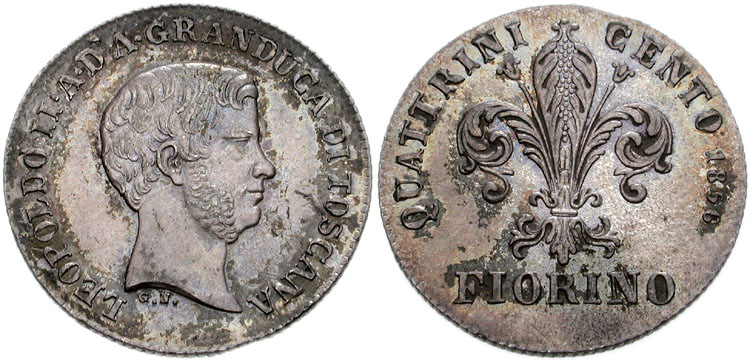
The Grand Duchy of Tuscany (Italian: Granducato di Toscana; Latin: Magnus Ducatus Etruriae) was an Italian monarchy located in Central Italy that existed, with interruptions, from 1569 to 1860, replacing the Republic of Florence. The grand duchy's capital was Florence. In the 19th century the population of the Grand Duchy was about 1,815,000 inhabitants. Having brought nearly all Tuscany under his control after conquering the Republic of Siena, Cosimo I de' Medici, was elevated by a papal bull of Pope Pius V to Grand Duke of Tuscany on 27 August 1569.

From Wikipedia: Grand Duchy of Tuscany (CC BY-SA 4.0)

Origins and Founding

Portrait of Cosimo I de Medici
Portrait of Cosimo I de Medici Creator:Lucas Vorsterman I · CC0 · Commons

In 1569, Cosimo de' Medici had ruled the Duchy of Florence for 32 years. During his reign, Florence purchased the island of Elba from the Republic of Genoa (in 1548), conquered Siena (in 1555) and developed a well-equipped and powerful naval base on Elba. Cosimo also banned the clergy from holding administrative positions and promulgated laws of freedom of religion, which were unknown during his time. Cosimo also was a long-term supporter of Pope Pius V, who in the light of Florence's expansion in August 1569, declared Cosimo Grand Duke of Tuscany, a title unprecedented in Italy.

Read more

The international reaction to Cosimo's elevation was bleak. Queen Catherine of France, though herself a Medici, viewed Cosimo with the utmost disdain. Rumours circulated at the Viennese court that had Cosimo as a candidate for King of England.

From Wikipedia: Grand Duchy of Tuscany · Medici period: Foundation (CC BY-SA 4.0)

Founder
Cosimo I de' Medici, Grand Duke of Tuscany
Founded
1797 CE

Rulers

Government, Society and Religion

Tuscany was divided into two main administrative districts: the stato nuovo (the new state) consisting of the former Republic of Siena, and the stato vecchio (the old state), the old Republic of Florence and her dependencies. The two areas were governed by separate laws. They were divided because the stato nuovo was a Spanish fief and the stato vecchio an Imperial one. Siena was ruled by a governor appointed by the grand duke. Charles V, Holy Roman Emperor proclaimed Alessandro de' Medici, Duke of Florence "for his lifetime, and after his death to be succeeded by his sons, male heirs and successors, of his body, by order of primogeniture, and failing them by the closest male of the Medici family, and likewise in succession forever, by order of primogeniture."

From Wikipedia: Grand Duchy of Tuscany · Government (CC BY-SA 4.0)

Government
(1569–1801), Absolute monarchy (1814–1848, 1852–1860), Semi-constitutional monarchy (1848–1852)
Languages
Italian
Religion
Roman Catholicism (official)

Coins, Currency and Symbols

Dena
Dena Unknown author · CC BY-SA 3.0 · Commons
Currency
Tuscan pound, Tuscan florin

Wars and Battles

In addition to its regular army, the duchy maintained a citizen-militia. This was used both for the protection of towns and fortresses that the army was not able to garrison, and as a reserve from which semi-trained men would be drawn into the army. The militia had its origins in 1498, in the predecessor state of the Florentine Republic. By 1506, it numbered 20,000 men, of whom 70% carried pikes, 20% halberds/bills and hog-spears, and 10% either arquebuses or crossbows. However, the size and quality of the duchy's militia varied throughout its existence, as did its army.

Read more

From 1553 to 1559, Tuscany raised 30,000 troops for their participation in the Last Italian War, which saw the Republic of Siena being added to the duchy.

From Wikipedia: Grand Duchy of Tuscany · Military: Army (CC BY-SA 4.0)

Decline and Fall

As Grand Prince Ferdinando, Gian Gastone's elder brother, predeceased Cosimo III, Gian Gastone succeeded his father in 1723. Gian Gastone for most of his life, kept to his bed and acted in an unregal manner, rarely appearing to his subjects, to the extent that, at times, he had been thought dead. Gian Gastone would repeal his father's puritan laws. In 1731, the Powers gathered at Vienna to decide who would succeed Gian Gastone. They drew up the Treaty of Vienna, which gave the grand ducal throne to Don Carlos, Duke of Parma. Gian Gastone was not as steadfast in negotiating Tuscany's future as his father was. He capitulated to foreign demands, and instead of endorsing the claim to the throne of his closest agnatic relative, the Prince of Ottajano, he allowed Tuscany to be bestowed upon Don Carlos.

From Wikipedia: Grand Duchy of Tuscany · Medici period: The last years of the Medicis (CC BY-SA 4.0)

Ended
1848 CE

Republic of San Marino

1797 CE – 1799 CE · Capital: City of San Marino · 47 km²

View of Mount Titano - San Marino.
View of Mount Titano - San Marino. Commonists · CC BY-SA 4.0 · Commons

San Marino, officially the Republic of San Marino, is a landlocked country in Southern Europe, completely surrounded by Italy. Located on the northeastern slopes of the Apennine Mountains, it is the larger of two microstates within the Italian Peninsula, the other being Vatican City. San Marino is the fifth-smallest country in the world, with a land area of just over 61 square kilometres (24 sq mi) and a population of 34,042 as of 2025 which in 2026 dropped to 33,559.

From Wikipedia: San Marino (CC BY-SA 4.0)

Rulers

Government, Society and Religion

San Marino has the political framework of a parliamentary representative democratic republic: the captains regent are heads of state, and there is a pluriform multi-party system. Executive power is exercised by the government. Although there is no formal head of government, the secretary for foreign and political affairs is in many ways equal to the prime minister in other countries. Legislative power is vested in both the government and the Grand and General Council. The judiciary is independent of the executive and the legislature. San Marino is considered to have the earliest written governing documents still in effect, as the Statutes of 1600 are still at the core of its constitutional framework.

Read more

San Marino was originally led by the Arengo, initially formed from the heads of each family. In the 13th century, power was given to the Grand and General Council.

From Wikipedia: San Marino · Government and politics (CC BY-SA 4.0)

Government
Parliamentary diarchic directorial republic
Languages
Italian

Economy and Trade

San Marino is a developed country, and although it is not a European Union member it is allowed to use the euro as its currency by arrangement with the Council of the European Union; it is also granted the right to use its own designs on the national side of the euro coins. It is one of six sovereign nations that use the Euro but are not part of the EU. The other nations are Kosovo, Monaco, Andorra, Vatican City, and Montenegro. Before the euro, the Sammarinese lira was pegged to, and exchangeable with, the Italian lira. The small number of Sammarinese euro coins, as was the case with the lira before it, are of interest to coin collectors. San Marino's GDP per capita and standard of living are comparable to that of Italy. Key industries include banking, electronics, and ceramics. The main agricultural products are wine and cheese. San Marino imports staple goods, mainly from Italy.

From Wikipedia: San Marino · Economy (CC BY-SA 4.0)

Coins, Currency and Symbols

200 lire san marino
200 lire san marino Nicolò Ardenghi · Public domain · Commons
Currency
euro, Sammarinese lira
  • 50 Euro Banknote
    50 Euro Banknote StefanosAndreadis · CC BY-SA 4.0 · Commons
  • Flag of San Marino
    Flag of San Marino Zscout370 · Public domain · Commons
  • Coat of arms of San Marino
    Coat of arms of San Marino Unknown author · Public domain · Commons

Achievements and Monuments

In San Marino, football is the most popular sport. Basketball and volleyball are also popular. The three sports have their own federations, the San Marino Football Federation, the San Marino Basketball Federation and the San Marino Volleyball Federation. San Marino has a club in the Italian football league system called A.S.D.V. San Marino and a domestic amateur league, the Campionato Sammarinese, whose teams also participate in European club competitions. Together with Italy, San Marino held the 2019 UEFA European Under-21 Championship, with teams playing at the Stadio Olimpico in Serravalle. With Italy being the sole automatic qualifiers, the Sammarinese team did not participate in the final tournament. The San Marino national football team has had little success, being made up of part-timers.

From Wikipedia: San Marino · Culture: Sport (CC BY-SA 4.0)

Decline and Fall

Ended
1799 CE
Last recorded ruler
Italo Righi

Revolutionary Roman Republic

1799 CE – 1799 CE · Capital: Rome · 30,084 km²

Roma / Rome - Lazio - Italia / Italy
Roma / Rome - Lazio - Italia / Italy Bert Kaufmann from Roermond, Netherlands · CC BY-SA 2.0 · Commons

The Roman Republic (Italian: Repubblica Romana) was a sister republic of the First French Republic that existed from 1798 to 1799. It was proclaimed on 15 February 1798 after Louis-Alexandre Berthier, a general of the French Revolutionary Army, had occupied the city of Rome on 11 February. It was led by a Directory of five men and comprised territory conquered from the Papal States. The Roman Republic immediately incorporated two other former-papal revolutionary administrations, the Tiberina Republic and the Anconine Republic.

From Wikipedia: Roman Republic (1798–1799) (CC BY-SA 4.0)

Origins and Founding

During the French Revolutionary Wars, the Papal States, under the temporal authority of the pope in Rome, was part of the First Coalition. After defeating the Kingdom of Sardinia early in the Italian campaign of 1796–1797, General Napoleon Bonaparte turned his attention south of Piedmont to deal with the Papal States. Bonaparte, skeptical over divided command for the invasion, sent two letters to the French Directory. The letters convinced the Directory to delay the invasion of the Papal States for a while. On 3 February 1797, the French defeated the pope's army at the Battle of Faenza. Under the Treaty of Tolentino, signed on 19 February, Pope Pius VI was forced to accept an ambassador of the French First Republic.

Read more

On 27 December 1797, General Léonard Duphot, a military attaché at the French embassy in Rome, was killed while trying to defuse a riot in front of the embassy.

From Wikipedia: Roman Republic (1798–1799) · Background (CC BY-SA 4.0)

Founded
1799 CE

Rulers

  • Consulate

Government, Society and Religion

The Roman Republic's constitutional organization was heavily influenced by that of the French Constitution of 1795, which itself was inspired by and loosely based on that of the ancient Roman Republic. Executive authority was vested in five consuls. The legislative branch was composed of two chambers, a 60-member Tribunate and a 30-member Senate, which elected the consuls.

From Wikipedia: Roman Republic (1798–1799) · Government (CC BY-SA 4.0)

Government
Unitary directorial republic
Languages
Italian
Religion
Catholicism

Coins, Currency and Symbols

3 baiocchi
3 baiocchi Niccolò Cerbara (engraver of the dies) Carlomorino, for the pic · CC BY-SA 2.5 · Commons
Currency
Roman scudo, baiocco
  • Buono (bono) da 100 Scudi pontifici della serie G stampato in 9000 esemplari, suddivisi in 1000 esemplari per ciascuna delle nove serie individuate con le lettere dell'alfabeto dalla A alla I.
    Buono (bono) da 100 Scudi pontifici della serie G stampato in 9000 esemplari, suddivisi in 1000 esemplari per ciascuna delle nove serie individuate con le lettere dell'alfabeto dalla A alla I. Bjørn Christian Tørrissen · CC BY-SA 3.0 · Commons
  • Papal States coins 1/2, 1, 2, 5 and 20 baiocchi.
    Papal States coins 1/2, 1, 2, 5 and 20 baiocchi. Enlil Ninlil2 · CC BY 3.0 · Commons
  • Flag of the Repubblica Romana (1798)
    Flag of the Repubblica Romana (1798) Unknown author · Public domain · Commons
  • Emblem of the Revolutionary Roman Republic
    Emblem of the Revolutionary Roman Republic Samhanin · CC BY-SA 3.0 · Commons

Early Modern States of Italy: Frequently Asked Questions

Which states existed in Italy in this period?

This page maps 8 states of Italy founded between 1450 CE and 1799 CE: Ambrosian Republic, House of Savoy, Kingdom of Sardinia, Kingdom of Naples (Napoleonic, Cisalpine Republic, Grand Duchy of Tuscany, Republic of San Marino, Revolutionary Roman Republic.

Which was the largest of the Early Modern States of Italy?

Kingdom of Sardinia had the largest mapped extent, about 235,522 km².

Which of the Early Modern States of Italy lasted longest?

House of Savoy lasted longest, 1564 CE – 1720 CE.

Sources

  • Reading text: Wikipedia articles on the group and each state, condensed (CC BY-SA 4.0).
  • Facts, rulers and wars: Wikidata (CC0).
  • Borders: Cliopatria, Seshat Global History Databank (CC BY 4.0).
  • Pictures: Wikimedia Commons; the author and licence are under each picture.

Largest state by mapped extent: Kingdom of Sardinia.