Skip to content
YearMaps
11 states197 BCE – 1278 CE

Ancient States of Korea and Japan: Map & History

11 states of Korea and Japan on one map, from 197 BCE to 1278 CE.The largest, Goguryeo, covered about 408,926 km²; the longest-lived, Tamna, lasted 263 CE – 1278 CE. Each has its own section below with its rulers, capitals, wars and pictures where the records hold them.

Korean-type bronze dagger and mirror with coarse design. Bronze ritual tools. 5th-4th century BCE. National Museum of Korea. Diameter of the mirror : about 8 cm.
Ismoon (talk) 11:10, 3 December 2017 (UTC) · CC BY-SA 4.0 · Commons
고구려의 복식이 담긴 벽화
donga.com · Public domain · Commons
siehe [1]
J. Patrick Fischer · CC BY-SA 3.0 · Commons
양직공도에 나타난 백제의 사신 (<양직공도>는 양나라의 원제(元帝)인 소역(蕭繹, 505∼554)이 제위(帝位)에 오르기 전인 형주자사(荊州刺史) 재임시(526∼539)에 편찬한 도서(圖書) 이다)
양직공 · Public domain · Commons
Base map
197 BC
36 BC
1278 AD
197 BC
100 AD
400 AD
700 AD
1000 AD
1278 AD
Epochs:
↗
↗
↗
↗
↗
↗
↗
↗

Each state in its own colour. Move the timeline to see which existed in any year from 197 BC to 1278 AD; select a territory to read about it. Borders: Cliopatria / Seshat (CC BY 4.0).

The Ancient States of Korea and Japan Compared

StateYearsCapitalLargest extentRulers
Gojoseon197 BCE – 92 BCEWanggeom City81,320 km²4
Korean Jin197 BCE – 92 BCEUnknown112,814 km²–
Byeonhan91 BCE – 566 CE–13,603 km²–
Dongye91 BCE – 391 CE–29,068 km²–
Jinhan91 BCE – 377 CE–23,506 km²–
Mahan91 BCE – 346 CE–49,731 km²–
Dong-okjeo36 BCE – 153 CE–32,149 km²–
Goguryeo36 BCE – 681 CEubl408,926 km²17
Tamna263 CE – 1278 CE(early), (later)1,959 km²1
Baekje347 CE – 660 CEWirye, (18 BCE – 475 CE), Gomnaru/Ungjin, (476–538), Sabi/Soburi, (538–660)49,731 km²5
Silla378 CE – 681 CESeorabeol), Saro, Sara, Seonabeol, Seoyabeol, Seobeol, Wanggyeong86,616 km²20

Timeline of the Ancient States of Korea and Japan

When each state existed, 197 BCE to 1278 CE. Select a year to see the map then.

  1. Gojoseon
    197 BCE – 92 BCE
  2. Korean Jin
    197 BCE – 92 BCE
  3. Byeonhan
    91 BCE – 566 CE
  4. Dongye
    91 BCE – 391 CE
  5. Jinhan
    91 BCE – 377 CE
  6. Mahan
    91 BCE – 346 CE
  7. Dong-okjeo
    36 BCE – 153 CE
  8. Goguryeo
    36 BCE – 681 CE
  9. Tamna
    263 CE – 1278 CE
  10. Baekje
    347 CE – 660 CE
  11. Silla
    378 CE – 681 CE

The 11 States

Gojoseon

197 BCE – 92 BCE · Capital: Wanggeom City · 81,320 km²

Korean-type bronze dagger and mirror with coarse design. Bronze ritual tools. 5th-4th century BCE. National Museum of Korea. Diameter of the mirror : about 8 cm.
Korean-type bronze dagger and mirror with coarse design. Bronze ritual tools. 5th-4th century BCE. National Museum of Korea. Diameter of the mirror : about 8 cm. Ismoon (talk) 11:10, 3 December 2017 (UTC) · CC BY-SA 4.0 · Commons

Old Chosŏn, also known as Gojoseon (Korean: 고조선; Hanja: 古朝鮮) and its contemporary name Joseon (Korean: 조선; Hanja: 朝鮮), was the first kingdom on the Korean Peninsula. According to Korean mythology, the kingdom was established by the legendary king Tan'gun. Old Chosŏn possessed the most advanced culture in the Korean Peninsula at the time and was an important marker in the progression towards the more centralized states of later periods. The addition of Go (고; 古), meaning "old" or "ancient", is used in historiography to distinguish the kingdom from the Joseon, which was founded in 1392.

From Wikipedia: Old Chosŏn (CC BY-SA 4.0)

Origins and Founding

The first extant Korean text to mention Kija (the Korean pronunciation of Jizi) was Kim Pusik's Samguk sagi (completed in 1145), which claimed that Kija had been enfeoffed in Haedong (海東: Korea) by the Zhou court, but commented that this account was uncertain because of the brevity of the sources. Only in the thirteenth century did Korean texts start to integrate Kija more fully into Korean history. The Samguk yusa (1281) explained that after being enfeoffed by King Wu of Zhou, Kija replaced Dangun's descendants as the ruler of Old Chosŏn, whereas Jewang Ungi (1287) identified Tan'gun and Kija as the first rulers of former and latter Joseon respectively. Most premodern Korean historians after that accepted that Kija had replaced another indigenous power (represented by Tan'gun) in Old Joseon.

From Wikipedia: Old Chosŏn · Founding myths: Controversies (CC BY-SA 4.0)

Founded
197 BCE

Rulers

Government, Society and Religion

Government
Monarchy
Languages
Ye-Maek (Koreanic), Classical Chinese (literary)
Religion
Shamanism

Achievements and Monuments

The beginning of the Bronze Age on the peninsula is usually said to be 1000 BCE, but estimates range from the 13th to 8th centuries BCE. Although the Korean Bronze Age culture derives from the Liaoning and Manchuria, it exhibits unique typology and styles, especially in ritual objects.

Read more

By the 7th century BCE, a Bronze Age material culture with influences from Manchuria, eastern Mongolia, as well as Siberia and Scythian bronze styles, flourished on the peninsula. Korean bronzes contain a higher percentage of zinc than those of the neighboring bronze cultures. Bronze artifacts, found most frequently in burial sites, consist mainly of swords, spears, daggers, small bells, and mirrors decorated with geometric patterns.

Gojoseon's development seems linked to the adoption of bronze technology.

From Wikipedia: Old Chosŏn · Culture: Bronze tools (CC BY-SA 4.0)

Korean Jin

197 BCE – 92 BCE · Capital: Unknown · 112,814 km²

The state of Jin (Korean: 진; Hanja: 辰) was a confederacy of statelets which occupied some portion of the southern Korean peninsula from the 4th to 2nd centuries BCE, bordering the Korean Kingdom of Old Chosŏn (Gojoseon) to the north. Its capital was somewhere south of the Han River. It preceded the Samhan confederacies, each of which claimed to be the successor of the Jin state.

From Wikipedia: Jin (Korean state) (CC BY-SA 4.0)

Government, Society and Religion

Alexander Vovin, among others, suggests that Japonic languages, which he classifies as Peninsular Japonic, were spoken in large parts of southern Korea and Jeju before they were replaced by proto-Koreanic languages. While it is believed that Koreanic/proto-Koreanic and Japonic/proto-Japonic (i.e. Peninsular Japonic) co-existed in the southern Korean Peninsula for an extended period of time, the establishment of Koreanic speakers and their assimilation of Japonic speakers may have played a role in a Yayoi migration to the Japanese archipelago, believed to have occurred between 1,000 BCE–300 CE, which overlaps with the period in which Jin is attested.

From Wikipedia: Jin (Korean state) · Language (CC BY-SA 4.0)

Government
Confederation
Languages
Samhan or Peninsular Japonic
Religion
Musok, possibly Koshinto

Decline and Fall

Ended
92 BCE
Succeeded by
Jinhan confederacy
Succeeded by
Mahan confederacy

Legacy in the Modern World

Jin was succeeded by the Samhan: Mahan, Jinhan and Byeonhan. Chinese historical text, Records of the Three Kingdoms says that Jinhan is the successor of the Jin state, while the Book of the Later Han writes that Mahan, Jinhan and Byeonhan were all part of the former Jin state as well as 78 other tribes.

Read more

The name of Jin continued to be used in the name of the Jinhan confederacy and in the name "Byeonjin," an alternate term for Byeonhan. In addition, for some time the leader of Mahan continued to call himself the "Jin king," asserting nominal overlordship over all of the Samhan tribes.

From Wikipedia: Jin (Korean state) · Legacy (CC BY-SA 4.0)

Byeonhan

91 BCE – 566 CE · 13,603 km²

Byeonhan (Korean: 변한; Hanja: 弁韓), also known as Byeonjin (변진; 弁辰), was a loose confederacy of chiefdoms that existed from around the beginning of the Common Era to the 4th century in the southern Korean Peninsula. Byeonhan was one of the Samhan (or "Three Hans"), along with Mahan and Jinhan.

From Wikipedia: Byeonhan confederacy (CC BY-SA 4.0)

Origins and Founding

Founded
91 BCE
Preceded by
Jin

Government, Society and Religion

Government
Confederacy
Languages
Han, possibly Peninsular Japonic
Religion
Musok, possibly Koshinto

Economy and Trade

Byeonhan may have simply been a political description for decentralized polities south and west of the Nakdong river valley that were not formal members of the Jinhan confederacy.

Read more

Byeonhan was internationally known for its production of iron, which was also its main export good to the Lelang commandery to the northwest, the Japanese archipelago, and the rest of the Korean Peninsula. It was also a center of stoneware manufacture.

From Wikipedia: Byeonhan confederacy · Politics and trade (CC BY-SA 4.0)

Achievements and Monuments

The Dongyi ("Eastern Barbarian") in the Book of Wei section of the Chinese book, Records of the Three Kingdoms states that the culture of Byeonhan was similar to that of Jinhan (言語法俗相似) and that their populations lived "intermingled together" (弁辰與辰韓雑居), while having similar language and customs.

Read more

The fifth century Book of the Later Han, however, notes on differences in their language and customs as "languages and customs have differences" (言語風俗有異), after stating that their enclosed settlements and clothing are the same.

Furthermore, the Wei shu states that "Jinhan men and women are close to Wa (男女近倭)", the ethnonym for the contemporary inhabitants of the Japanese archipelago, and like the Wa tattoo their bodies. The Book of the Later Han however identifies this with Byeonhan, stating that "their country is close to Wa, therefore they frequently have tattoos."

From Wikipedia: Byeonhan confederacy · Culture and language (CC BY-SA 4.0)

Decline and Fall

Ended
566 CE
Succeeded by
Silla

Dongye

91 BCE – 391 CE · 29,068 km²

Ye (Korean: 예; Hanja: 濊) or Dongye (동예; 東濊), which means the Eastern Ye, was a Korean chiefdom which occupied portions of the northeastern Korean peninsula from roughly the 3rd-century BC to around early 5th-century AD. It bordered Goguryeo and Okjeo to the north, Jinhan to the south, and China's Lelang Commandery to the west. Today, this territory consists of the provinces of South Hamgyŏng and Kangwon in North Korea, and Gangwon in South Korea.

From Wikipedia: Eastern Ye (CC BY-SA 4.0)

Achievements and Monuments

The Ye people considered themselves to be the same people as the people of Goguryeo, and shared their language and ethnic origins with the people of Okjeo and Goguryeo. This may indicate that Dongye also shared a common origin with Buyeo and Gojoseon. The population was recorded to be 20,000 households.

Read more

Very little information about Ye has survived; most of the extant information comes from the discussion of the Eastern barbarians in the Chinese Records of Three Kingdoms. The custom of "Mucheon" (무천, 舞天), a festival of worshipping heaven through song and dance in the 10th month, is mentioned in some records. This appears to have been closely related to the Goguryeo festival of Dongmaeng, held at the same time of year, which also incorporated martial displays. The people worshipped the tiger as a deity.

From Wikipedia: Eastern Ye · People and culture (CC BY-SA 4.0)

Jinhan

91 BCE – 377 CE · 23,506 km²

Jinhan (Korean: 진한; Hanja: 辰韓) was a loose confederacy of chiefdoms that existed from around the 1st century BCE to the 4th century CE in the southern Korean peninsula, to the east of the Nakdong River valley, Gyeongsang Province. Jinhan was one of the Samhan (or "Three Hans"), along with Byeonhan and Mahan. Apparently descending from the Jin state of southern Korea, Jinhan was absorbed by the later Silla, one of the Three Kingdoms of Korea.

From Wikipedia: Jinhan confederacy (CC BY-SA 4.0)

Origins and Founding

Founded
91 BCE
Preceded by
Jin

Government, Society and Religion

The language of Jinhan is thought to be the predecessor of the language of Silla, which in turn was the supposed ancestor of the modern Korean language.

Read more

Due to multiple evidence stating that Silla, Baekje and Goguryeo spoke similar languages without a need of a translator, it can be deduced that the languages spoken in Jinhan bore close resemblance to languages spoken in countries such as Byeonhan and Mahan at the time.

However, the ancient Book of Wei and Book of the Later Han provide conflicting testimonies that may contradict the previous claims.

From Wikipedia: Jinhan confederacy · Language (CC BY-SA 4.0)

Government
Confederacy
Languages
Han, possibly minority Peninsular Japonic
Religion
Musok, possibly minority Koshinto

Achievements and Monuments

Its relation to the earlier state of Jin is not clear, although the contemporary Chinese chronicle Records of the Three Kingdoms alleges that Jinhan was identical with Jin (while another record describes Jin as the predecessor of the Samhan as a whole). Jinhan and Byeonhan shared essentially the same culture, with varying religious customs, and apparently were not separated by a clear boundary.

Read more

Many of the archeological evidence found in the area lack distinguishable differences with the evidence found in the neighboring kingdoms, suggesting that the cultures were mostly similar across the southern part of the peninsula.

Little is known about the daily lives of the Jinhan people. The religion appears to have been shamanistic which played an important role in politics as well.

From Wikipedia: Jinhan confederacy · Culture (CC BY-SA 4.0)

Decline and Fall

Ended
377 CE
Succeeded by
Silla

Mahan

91 BCE – 346 CE · 49,731 km²

Mahan (Korean: 마한; Hanja: 馬韓) was a tribal grouping in southwestern Korea described in Chinese sources from the 3rd century. It was the largest of the 'three Hans' (the Samhan), along with Byeonhan and Jinhan. During the 4th century, the kingdom of Paekche rose in the territory of Mahan and became one of the Three Kingdoms of Korea.

From Wikipedia: Mahan confederacy (CC BY-SA 4.0)

Government, Society and Religion

Kings of Mahan occasionally called themselves "King of Jin," referring to the earlier Jin state and asserting nominal sovereignty over all of Samhan. A wealth of bronze artifacts and production facilities indicate that Mahan was probably the earliest developed of the three Hans. At its height, Mahan covered much of the Han River Basin and the modern-day provinces of Gyeonggi, Chungcheong, and Jeolla, although political unity was strongest led by Mokji state (목지국, 目支國) in Cheonan, Chungcheong.

From Wikipedia: Mahan confederacy · Politics (CC BY-SA 4.0)

Achievements and Monuments

"There are three stocks: the first is called Mahan, the second Jinhan, and the third Byeonhan, which is the ancient state of Jin. Mahan is to the west of it. Its people are settled on the land and both sow and plant... Scattered between the mountains and the sea, their settlements have no inner or outer walls... By custom they have few rules and regulations. Their national town has a dominant leader, but the people's settlements are scattered, and they are not readily subject to regulation and control. They do not have the ceremony of kneeling to make obeisance. For their dwellings they make grass-roofed earth-chambers shaped like tumuli; the door is on the top, and a whole family lives together inside, with no distinction as to old or young, male or female... They do not know about riding oxen and horses, their oxen and horses being used exclusively for accompanying the dead...

From Wikipedia: Mahan confederacy · Culture (CC BY-SA 4.0)

Legacy in the Modern World

Goryeo historians identified Mahan with Goguryeo, which was supported by their works like Samguk sagi, Samguk yusa and Chewang un'gi. That historical view was previously given by Ch'oe Ch'iwŏn, a noted Confucian scholar and historian in the late Silla period. Apart from the geographical location of Mahan, the Chinese historical record History of Song defines the ethnical origin of the Chŏngan kingdom, a successor state of Parhae, as Mahan.

Read more

In the late Joseon period, that historical notion came under criticism by early Silhak scholar Han Baek-gyeom, who emphasized the linkage between Mahan and Paekche in terms of the geographical location.

From Wikipedia: Mahan confederacy · Legacy (CC BY-SA 4.0)

Dong-okjeo

36 BCE – 153 CE · 32,149 km²

Okjeo (Korean: 옥저; Hanja: 沃沮) was an ancient Korean tribal state which arose in the northern Korean peninsula from perhaps the 2nd century BCE to the 5th century CE. Dong-okjeo (Eastern Okjeo) occupied roughly the area of the Hamgyŏng provinces of North Korea, and Buk-okjeo (Northern Okjeo) occupied the Duman River region. Dong-okjeo was often simply called Okjeo, while Buk-okjeo was also sometimes referred to as Chiguru (置溝婁, 치구루) or Guru (구루), the latter name being also applied to Goguryeo. Okjeo bordered the other minor state of Dongye on the south, and shared a similar fate.

From Wikipedia: Okjeo (CC BY-SA 4.0)

Government, Society and Religion

Okjeo was a presumed ancient language that was a part of the Puyŏ languages and existed from the 2nd century BC to the 5th century AD. In Peter H. Lee's book, he stated that although there are some small differences between Okjeo and Goguryeo, the two languages have many similarities that Okjeo did not have with the other Puyŏ languages. However, Christopher I. Beckwith considers Okjeo to have been a dialect of Goguryeo.

From Wikipedia: Okjeo · Language (CC BY-SA 4.0)

Achievements and Monuments

Eastern Okjeo is located to the east of the great mountains of Gaema in Goguryeo; its people make their settlements on the shore of the great sea. In shape their land is narrow in the northeast and long in the southwest, where it is perhaps a thousand li. It is contiguous on the north with Yilou and Buyeo, and on the south with Yemaek. Its households number five thousand. They have no supreme Ruler, each village having its own hereditary chief. Their language has broad similarity with that of Goguryeo, though at times there are small differences... Their land is fair and fertile, facing the sea with its back to the mountains. It is well suited to the cultivation of the five grains, and they are good at tilling and planting. The people are simple and direct, strong and brave. Having few oxen and horses, they are adept at fighting on foot, wielding spears.

From Wikipedia: Okjeo · Culture (CC BY-SA 4.0)

Goguryeo

36 BCE – 681 CE · Capital: ubl · 408,926 km²

고구려의 복식이 담긴 벽화
고구려의 복식이 담긴 벽화 donga.com · Public domain · Commons

Goguryeo (37 BC – 668 AD) (Korean: 고구려; Hanja: 高句麗; RR: Goguryeo; lit. 'high castle'; Korean pronunciation: [ko̞.ɡu.ɾjʌ̹]; Old Korean: Guryeo) also later known as Goryeo (Korean: 고려; Hanja: 高麗; RR: Goryeo; lit. 'high and beautiful'; Korean pronunciation: [ko.ɾjʌ]; Middle Korean: 고ᇢ롕〮, kwòwlyéy), was a Korean kingdom which was located on the northern and central parts of the Korean Peninsula and the southern and central parts of modern-day Northeast China (Manchuria).

From Wikipedia: Goguryeo (CC BY-SA 4.0)

Origins and Founding

The earliest record of the name of Goguryeo can be traced to geographic monographs in the Book of Han and is first attested as the name of one of the subdivisions of the Xuantu Commandery, established along the trade routes within the Amnok river basin following the destruction of Gojoseon in 113 BC. The American historian Christopher Beckwith offers the alternative proposal that the Guguryeo people were first located in or around Liaoxi (western Liaoning and parts of Inner Mongolia) and later migrated eastward, pointing to another account in the Book of Han. The early Goguryeo tribes from whom the administrative name is derived were located close to or within the area of control of the Xuantu Commandery. Its tribal leaders also appeared to have held the ruler title of "marquis" over said nominal Gaogouli/Goguryeo county.

From Wikipedia: Goguryeo · History: Origins (CC BY-SA 4.0)

Founded
36 BCE
Preceded by
Buyeo

Capitals

Panoramic view from Juche Tower in Pyongyang.
Panoramic view from Juche Tower in Pyongyang. Christophe95 · CC BY-SA 4.0 · Commons
Pyongyang
427–668 CE
Gungnae
3–427 CE

Rulers

Government, Society and Religion

Early Goguryeo was a federation of five tribes(called Obu in korean). The names of the five tribes were Yeonno, Jeolno, Soonno, Gwanno, and Gyeroo. The tribe that held kingship,which had the honorable title of Gochooka, was the Yeonno tribe, but the Gyeroo tribe later held the title. The five tribes later turned into five districts. As the autonomy of these five tribal collectives waned, regional officers were appointed with valley as a unit.As Goguryeo progressed into the 4th century, a regional administration unit arose that centred around fortresses that were built in the newly enlarged areas.

From Wikipedia: Goguryeo · Government (CC BY-SA 4.0)

Government
Monarchy
Languages
Goguryeo
Religion
Korean Buddhism (official), Confucianism, Taoism, Shamanism

Coins, Currency and Symbols

  • Military Flag of Goguryeo
    Military Flag of Goguryeo Samhanin · Public domain · Commons

Wars and Battles

In the winter of 642, King Yeongnyu was apprehensive about Yŏn Kaesomun, one of the great nobles of Goguryeo, and plotted with other officials to kill him. However, Yŏn Kaesomun caught news of the plot and killed Yeongnyu and 100 officials, initiating a coup d'état. He proceeded to enthrone Yeongnyu's nephew, Go Jang, as King Bojang while wielding de facto control of Goguryeo himself as the Dae Magniji (대막리지; 大莫離支; a position equivalent to a modern era dual office of prime minister and generalissimo). At the outset of his rule, Yŏn Kaesomun took a brief conciliatory stance toward Tang China. For instance, he supported Taoism at the expense of Buddhism, and to this effect in 643, sent emissaries to the Tang court requesting Taoist sages, eight of whom were brought to Goguryeo.

From Wikipedia: Goguryeo · History: Goguryeo–Silla War, Goguryeo-Tang War and the Silla–Tang alliance (CC BY-SA 4.0)

Achievements and Monuments

The culture of Goguryeo was shaped by its climate, religion, and the tense society that people dealt with due to the numerous wars Goguryeo waged.

Read more

The Book of Sui (Volume 81) recorded: "The customs, laws and clothes of Goguryeo, Paekche and Silla are generally identical."

Attributed with the earliest kimchi, the Goguryeo people were skilled at fermenting and widely consumed fermented food.

Singing and dancing played an important part in Goguryeo society, a legacy that, according to Kim Hunggyu, continues to this day in modern Korean society.

The practice of matrilocality in Korea started in the Goguryeo period, continued through the Goryeo period and ended in the early Joseon period. The Korean saying that when a man gets married, he is "entering jangga" (the house of his father-in-law), stems from the Goguryeo period.

From Wikipedia: Goguryeo · Culture (CC BY-SA 4.0)

Decline and Fall

In the summer of 666, Yŏn Kaesomun died of a natural cause and Goguryeo was thrown into chaos and weakened by a succession struggle among his sons and younger brother. He was initially succeeded as Dae Mangniji, the highest position newly made under the ruling period of Yŏn Kaesomun, by his oldest son Yŏn Namsaeng. As Yŏn Namsaeng subsequently carried out a tour of Goguryeo territory, however, rumors began to spread both that Yŏn Namsaeng was going to kill his younger brothers Yŏn Namgŏn and Yŏn Namsan, whom he had left in charge at Pyongyang, and that Yŏn Namgŏn and Yŏn Namsan were planning to rebel against Yŏn Namsaeng. When Yŏn Namsaeng subsequently sent officials close to him back to Pyongyang to try to spy on the situation, Yŏn Namgŏn arrested them and declared himself Dae Mangniji, attacking his brother.

From Wikipedia: Goguryeo · History: Fall (CC BY-SA 4.0)

Ended
681 CE
Succeeded by
Later Silla
Succeeded by
Tang dynasty

Legacy in the Modern World

Remains of walled towns, fortresses, palaces, tombs, and artifacts have been found in North Korea and Manchuria, including ancient paintings in a Goguryeo tomb complex in Pyongyang. Some ruins are also still visible in present-day China, for example at Wunü Mountain, suspected to be the site of Jolbon fortress, near Huanren in Liaoning province on the present border with North Korea. Ji'an is also home to a large collection of Goguryeo era tombs, including what Chinese scholars consider to be the tombs of Gwanggaeto and his son Jangsu, as well as perhaps the best-known Goguryeo artifact, the Gwanggaeto Stele, which is one of the primary sources for pre-5th-century Goguryeo history.

From Wikipedia: Goguryeo · Legacy (CC BY-SA 4.0)

Tamna

263 CE – 1278 CE · Capital: (early), (later) · 1,959 km²

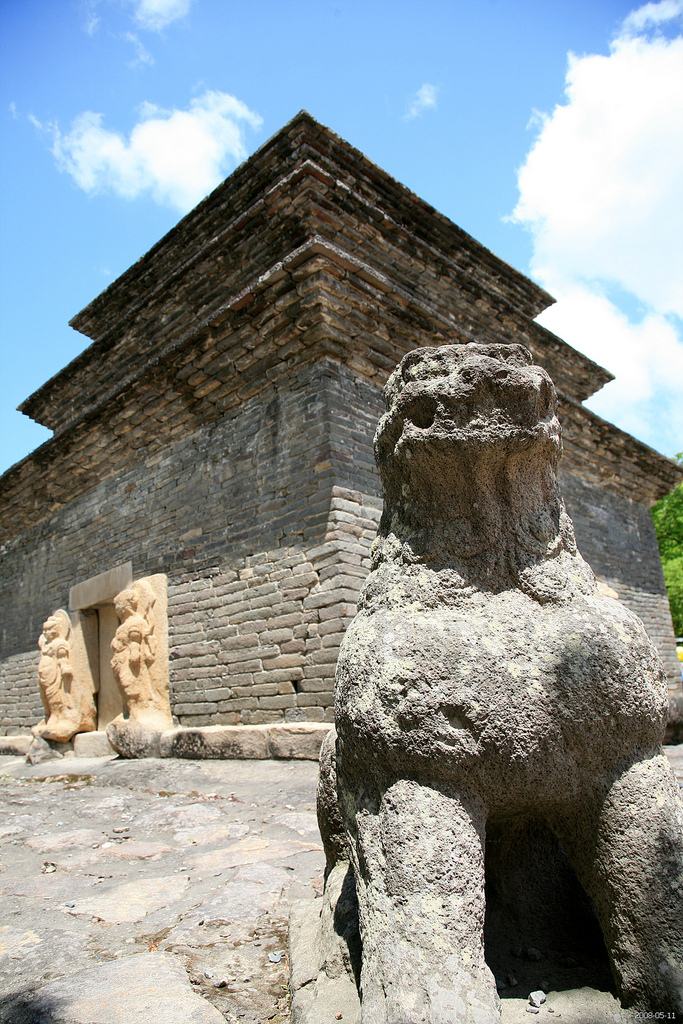
siehe [1]
siehe [1] J. Patrick Fischer · CC BY-SA 3.0 · Commons

Tamna (Korean: 탐라; Hanja: 耽羅) was a kingdom based on Jeju Island from ancient times until it was absorbed by the Korean Joseon dynasty in 1404, following a long period of being a tributary state or autonomous administrative region of various Korean kingdoms. The Go (Jeju) clan is the family name of the Lord (Korean: 성주; Hanja: 星主; RR: Seongju; lit. 'star-lord'), that ruled West Tamna over 400 years. The Moon (Nampyeong) clan is the family name of the Prince (왕자; 王子; Wangja; lit. 'prince'), that ruled East Tamna for 400 years.

From Wikipedia: Tamna (CC BY-SA 4.0)

Rulers

Government, Society and Religion

The Tamna language might have been Japonic in origin, later being replaced by a Koreanic language. Alexander Vovin compares certain glosses of Jeju Japonic to words of other Japonic languages.

Read more

Vovin (2013) notes that the old name for Jeju Island is tammura, which can be analyzed in Japanese as tani mura たにむら (谷村 'valley settlement') or tami mura たみむら (民村 'people's settlement'). Thus, Vovin concludes that Japonic speakers were present on Jeju Island before being replaced by Koreanic speakers sometime before the 15th century.

From Wikipedia: Tamna · Language (CC BY-SA 4.0)

Government
Monarchy (?–938), Autonomous region (938–1404)
Languages
Tamna, Old Korean, Middle Korean, Japonic?
Religion
Buddhism, Confucianism, Shamanism

Wars and Battles

Baekje

347 CE – 660 CE · Capital: Wirye, (18 BCE – 475 CE), Gomnaru/Ungjin, (476–538), Sabi/Soburi, (538–660) · 49,731 km²

양직공도에 나타난 백제의 사신 (<양직공도>는 양나라의 원제(元帝)인 소역(蕭繹, 505∼554)이 제위(帝位)에 오르기 전인 형주자사(荊州刺史) 재임시(526∼539)에 편찬한 도서(圖書) 이다)
양직공도에 나타난 백제의 사신 (<양직공도>는 양나라의 원제(元帝)인 소역(蕭繹, 505∼554)이 제위(帝位)에 오르기 전인 형주자사(荊州刺史) 재임시(526∼539)에 편찬한 도서(圖書) 이다) 양직공 · Public domain · Commons

Paekche or Baekje (Korean: 백제; Hanja: 百濟) was a Korean kingdom located in southwestern Korea from 18 BCE to 660 CE. It was one of the Three Kingdoms of Korea, together with Goguryeo and Silla. While the three kingdoms existed separately, Paekche had the largest population, at approximately 3,800,000 (760,000 households), which was much larger than that of Silla (850,000 people) and comparable to that of Goguryeo (3,500,000 people). Paekche was founded by Onjo, the third son of Goguryeo's founder, Donmeyong and Soseono, at Wiryeseong (now southern Seoul).

From Wikipedia: Paekche (CC BY-SA 4.0)

Origins and Founding

Paekche was mainly composed of the indigenous populations of the previous Mahan confederacy and the Koreanic Yemaek people from Goguryeo and Buyeo. In addition, smaller migrations happened via the inhabitants of the Jin state and the Lelang Commandery through trade and conquest, who were also admitted into the polities of Paekche.

Read more

According to the Samguk sagi, Paekche was founded in 18 BCE by King Onjo, who led a group of people from Goguryeo south to the Han basin. Jumong had left his son Yuri in Buyeo when he left that kingdom to establish the new kingdom of Goguryeo. Jumong became King Dongmyeong, and had two more sons with Soseono, Onjo and Biryu. Upon Yuri's later arrival in Goguryeo, Jumong promptly appointed him crown prince.

From Wikipedia: Paekche · History: Founding (CC BY-SA 4.0)

Founded
347 CE

Rulers

Government, Society and Religion

The establishment of a centralized state in Paekche is usually traced to the reign of King Goi, who may have first established patrilineal succession. Like most monarchies, a great deal of power was held by the aristocracy. King Seong, for example, strengthened royal power, but after he was slain in a disastrous campaign against Silla, the nobles took much of that power away from his son.

Read more

The ruler titles of Paekche were *eraγa (於羅瑕), mostly used by the nobility, and *k(j)ə-n kici (鞬吉支), as he would be called by the commoners. The queen consort was called *oluk (於陸) and pasɨkasɨ (벗〯갓) meaning "woman companion".

The Hae clan and the Jin clan were the representative royal houses who had considerable power from the early period of Paekche, and they produced many queens over several generations.

From Wikipedia: Paekche · Social and political structure (CC BY-SA 4.0)

Government
Monarchy
Languages
Baekje (Koreanic), Classical Chinese (literary)
Religion
Official Religion: Buddhism, Other religions: Confucianism, Taoism, Shamanism

Wars and Battles

The town leaders and its subjects participated in the military of Paekche on a local level, and loot and captives were distributed among them. The subjects usually worked in the supply division. The position of Jwajang led the military. Geunchogo established the division of central military and local militaries. The people of Paekche usually served in the military for three years. As Paekche entered the Sabi period, the military was divided into the royal private guard, the capital central military and the local military. The royal private guard handled matters such as protecting the palace. The weapons available to the soldiers were diverse.

From Wikipedia: Paekche · Military (CC BY-SA 4.0)

Achievements and Monuments

Paekche was established by immigrants from Goguryeo who spoke what could be a Buyeo language, a hypothetical group linking the languages of Old Chosŏn, Buyeo, Goguryeo, and Paekche. In a case of diglossia, the indigenous Samhan people, having migrated in an earlier wave from the same region, probably spoke a variety of the same language. Kōno Rokurō has argued that the kingdom of Paekche was bilingual, with the gentry speaking a Buyeo language and the common people a Han language. A view was proposed by Alexander Vovin, who noted that Japonic languages were spoken in the Tamna Kingdom on modern-day Jeju before the arrival of Koreanic, noting the presence of a Japonic substratum in the Jeju language.

Read more

Wooden tablets dated to the late Paekche era have been discovered by archaeologists, and some of them involve the rearrangement of Classical Chinese words according to native syntax.

From Wikipedia: Paekche · Language and culture (CC BY-SA 4.0)

Decline and Fall

In 660, the coalition troops of Silla and Tang China attacked Paekche, which was then allied with Goguryeo. A heavily outmanned army led by General Gyebaek was defeated in the Battle of Hwangsanbeol near Nonsan. The capital Sabi fell almost immediately thereafter, resulting in the annexation of Paekche by Tang China. Tang government set up Ungjin Commandery for the purpose of governing the Paekche area. King Uija and his son Buyeo Yung were sent into exile in China while at least some of the ruling class fled to Japan. The fall of Sabi resulted in one of the infamous episodes in Korean history, as countless Paekche court ladies, concubines and women of the nobility committed suicide by jumping off a cliff near Sabi rather than be captured by the Silla-Tang Alliance.

From Wikipedia: Paekche · History: Fall and restoration movement (CC BY-SA 4.0)

Ended
660 CE
Succeeded by
Later Silla

Legacy in the Modern World

To confront the military pressure of Goguryeo to its north and Silla to its east, Paekche (Kudara in Japanese) established close relations with Japan. According to the Korean chronicle Samguk sagi, Paekche and Silla sent some princes to the Japanese court as hostages. Whether the princes sent to Japan should be interpreted as diplomats as part of an embassy or literal hostages is debated. Due to the confusion on the exact nature of this relationship (the question of whether the Paekche Koreans were family or at least close to the Japanese Imperial line or whether they were hostages) and the fact that the Nihon Shoki, a primary source of material for this relationship, is a compilation of myth, makes it difficult to evaluate.

From Wikipedia: Paekche · Foreign relations: Cultural impact and military assistance (CC BY-SA 4.0)

Silla

378 CE – 681 CE · Capital: Seorabeol), Saro, Sara, Seonabeol, Seoyabeol, Seobeol, Wanggyeong · 86,616 km²

A view of Bunhwangsa, Gyeongju, North Gyeongsang province, South Korea
A view of Bunhwangsa, Gyeongju, North Gyeongsang province, South Korea by Junho Jung at Flickr from South Korea · CC BY-SA 3.0 · Commons

Silla (Korean: 신라; Hanja: 新羅; Old Korean: 徐羅伐, Yale: Syerapel) was a Korean kingdom that existed between 57 BCE and 935 CE and was located on the southern and central parts of the Korean Peninsula. Silla, along with Paekche and Goguryeo, formed the Three Kingdoms of Korea. Silla had the lowest population of the three, approximately 850,000 people (170,000 households), significantly smaller than those of Paekche (3,800,000 people) and Goguryeo (3,500,000 people) and was considered less developed and weaker compared to both Goguryeo and Paekche.

From Wikipedia: Silla (CC BY-SA 4.0)

Origins and Founding

In its early days, Silla started off as a city-state by the name of Saro (사로국; 斯盧國), initially founded by Yemaek refugees from Gojoseon. It also accepted dispersed people fleeing from the Lelang Commandery after Goguryeo's invasion, while later on incorporating native Jin people in the vicinity and Ye people to the North.

Read more

Talhae of Silla (57 CE–80 CE) was the son-in-law of Namhae of Silla (4 CE–24 CE). According to the Samguk sagi, Seoktalhae was the prince of Yongseongguk (龍成國) or Dapana (多婆那國), located 1,000-ri (里), northeast of Japan (?). Following the will of Namhae of Silla, he became the fourth king of Silla.

From Wikipedia: Silla · History: Early period (CC BY-SA 4.0)

Founded
378 CE
Preceded by
Later Silla

Rulers

Government, Society and Religion

From at least the 6th century, when Silla acquired a detailed system of law and governance, social status and official advancement were dictated by the bone rank system. This rigid lineage-based system also dictated clothing, house size, and the permitted range of marriage.

Read more

Since its emergence as a centralized polity Silla society had been characterized by its strict aristocratic makeup. Silla had two royal classes: "sacred bone" (seonggol, 성골, 聖骨) and "true bone" (jingol, 진골, 眞骨). Up until the reign of King Muyeol this aristocracy had been divided into "sacred bone" and "true bone" aristocrats, with the former differentiated by their eligibility to attain the kingship. This duality had ended when Queen Jindeok, the last ruler from the "sacred bone" class, died in 654.

From Wikipedia: Silla · Society and politics (CC BY-SA 4.0)

Government
Monarchy
Languages
Old Korean?, Classical Chinese, (literary)
Religion
Korean ethnic folk religion/Shamanism (Earlier state Religion: 57 BCE – 527 CE), Buddhism (State and official religion 527 CE – 935 CE), Other religions: Confucianism, Taoism, Islam

Wars and Battles

The early Silla military was built around a small number of Silla royal guards designed to protect royalty and nobility and in times of war served as the primary military force if needed. Due to the frequency of conflicts between Paekche and Goguryeo as well as Yamato Japan, Silla created six local garrisons one for each district. The royal guards eventually morphed into "sworn banner" or Sodang units. In 625 another group of Sodang was created. Garrison soldiers were responsible for local defense and also served as a police force.

Read more

A number of Silla's greatest generals and military leaders were Hwarang (equivalent to the Western knights or chevaliers). Originally a social group, due to the continuous military rivalry between the Three Kingdoms of Korea, they eventually transformed from a group of elite male aristocratic youth into soldiers and military leaders.

From Wikipedia: Silla · Military (CC BY-SA 4.0)

Achievements and Monuments

Centuries after Buddhism emerged in India, the strand called Mahayana Buddhism spread out of Central Asia, modern-day Afghanistan, and arrived in Silla the very last out of Goguryeo and Paekche due to its geographic isolation. In Korea, it was adopted as the state religion of 3 constituent polities of the Three Kingdoms Period, first by Goguryeo in 372 CE, by Silla in 528 CE, and by Paekche in 552 CE. Buddhism was introduced much more reluctantly compared to the two others to Silla in 528. Silla had been exposed to the religion for over a century during which the faith had certainly made inroads into the native populace and mixed with the native Shamanist and Animist folk religion to form the Korean specific form of Buddhism. The Buddhist monk Ado introduced Silla to Buddhism when he arrived to proselytize in the mid 5th century.

From Wikipedia: Silla · Culture: Buddhism (CC BY-SA 4.0)

Decline and Fall

The final century and a half of the Silla state was one of nearly constant upheaval and civil war as the king was reduced to little more than a figurehead and powerful aristocratic families rose to actual dominance outside the capital and royal court.

Read more

The tail end of this period, called the Later Three Kingdoms period, briefly saw the emergence of the kingdoms of Later Paekche and Taebong, which were composed of rebels originating from their respective regions' historical backgrounds. Silla was defeated first by Later Paekche and the era ended with Silla's submission to Goryeo.

From Wikipedia: Silla · History: Decline and fall (CC BY-SA 4.0)

Ended
681 CE
Succeeded by
Later Silla

Ancient States of Korea and Japan: Frequently Asked Questions

Which states existed in Korea and Japan in this period?

This page maps 11 states of Korea and Japan founded between 197 BCE and 378 CE: Gojoseon, Korean Jin, Byeonhan, Dongye, Jinhan, Mahan, Dong-okjeo, Goguryeo, Tamna, Baekje, Silla.

Which was the largest of the Ancient States of Korea and Japan?

Goguryeo had the largest mapped extent, about 408,926 km².

Which of the Ancient States of Korea and Japan lasted longest?

Tamna lasted longest, 263 CE – 1278 CE.

Sources

  • Reading text: Wikipedia articles on the group and each state, condensed (CC BY-SA 4.0).
  • Facts, rulers and wars: Wikidata (CC0).
  • Borders: Cliopatria, Seshat Global History Databank (CC BY 4.0).
  • Pictures: Wikimedia Commons; the author and licence are under each picture.

Largest state by mapped extent: Goguryeo.