Early Modern States of Mainland Southeast Asia: Map & History
17 states of Mainland Southeast Asia on one map, from 1482 CE to 1931 CE.The largest, First Toungoo Empire, covered about 1,477,943 km²; the longest-lived, Đại Việt, lasted 1529 CE – 1833 CE. Each has its own section below with its rulers, capitals, wars and pictures where the records hold them.
Each state in its own colour. Move the timeline to see which existed in any year from 1482 AD to 1931; select a territory to read about it. Borders: Cliopatria / Seshat (CC BY 4.0).
The Early Modern States of Mainland Southeast Asia Compared
1482 CE – 1546 CE · Capital: Prome (Pyay) · 19,580 km²
The Prome kingdom (Burmese: ဒုတိယ သရေခေတ္တရာ နေပြည်တော်, lit. "Second Sri Ksetra kingdom") also known as Pyay kingdom was a kingdom that existed for six decades between 1482 and 1542 in present-day central Burma (Myanmar). Based out of the city of Prome (Pyay), the minor kingdom was one of the several statelets that broke away from the dominant Ava kingdom in the late 15th century. Throughout the 1520s, Prome was an ally of the Confederation of Shan States, and together they raided Avan territory.
For much of the first half of the second millennium, Prome was a vassal state of Upper Burma-based kingdoms–Pagan, Pinya and Ava. During the Ava period (14th–15th centuries), Prome was the southernmost region abutting the rival Hanthawaddy kingdom. The region was a frequent battlefield during the Forty Years' War (1385–1424) between Ava and Hanthawaddy. Avan kings considered the region the most strategic, and appointed only the most senior princes as viceroys of Prome (Pyay). For example, Crown Prince Minye Kyawswa, King Thihathu of Ava and King Narapati of Ava were once governor of Prome.
Read more
The Forty Years' War, which ended in a stalemate, left Ava exhausted, and its vassals restless. From the 1420s to the 1480s, each new king of Ava had to put down rebellions.
Manipur to the Cambodian marches and from the borders of Arakan to Yunnan" and was "the largest empire in the history of Southeast Asia." The "most adventurous and militarily successful" dynasty in Burmese history was also the "shortest-lived."
The empire grew out of the principality of Toungoo, a minor vassal state of Ava until 1510. The landlocked petty state began its rise in the 1530s under Tabinshwehti who went on to found the largest polity in Myanmar since the Pagan kingdom by 1550.
The period between 1526 and 1533 saw power change hands in all of the major states of Burma. Three of the states were succeeded by weak rulers: Taka Yut Pi (r. 1526–39) at Hanthawaddy; Bayin Htwe (r. 1527–32) and Narapati (r. 1532–39) at Prome; and Thohanbwa (r. 1533–42) at Ava (Confederation). Two of the states were succeeded by ambitious and able rulers: Tabinshwehti (r. 1530–50) at Toungoo, and Min Bin (r. 1531–54) at Mrauk-U (Arakan). Though Arakan would become a power in its own right, its geographic isolation meant it would remain a marginal player in mainland affairs. This left the tiny Toungoo, which would bring war to much of mainland Southeast Asia till the end of the century.
Read more
The initial impetus for Toungoo's military campaigns was defensive. The landlocked state was being encircled by the powerful Confederation, which by 1533 had defeated its erstwhile ally Prome.
carte postale ancienne. Collection Ahuja. 1900No machine-readable author provided. Victorcouto assumed (based on copyright claims). · Public domain · Commons
The Toungoo military organisation drew on its Upper Burma precedent. The military was organised into a small standing army of a few thousand, which defended the capital and the palace, and a much larger conscript-based wartime army. The wartime army consisted of infantry, cavalry, elephantry, artillery and naval units. The navy was mainly river-borne, and used mostly for transportation of troops and cargo. Conscription was based on the ahmudan (အမှုထမ်း, "crown service") system, which required local chiefs to supply their predetermined quota of men from their jurisdiction on the basis of population in times of war. The ahmudan were a class of people, who were exempt from most personal taxes in exchange for regular or military service of the crown.
The coastal region instead relied heavily on trade. The main ports were Pegu, Martaban, Tavoy, and Mergui. Products and goods from the interior—rice, and other food stuffs, as well as a variety of luxury goods (rubies, sapphires, musk, lac, benzoin, gold)—were exported to Malacca, Sumatra, the Coromandel Coast (Portuguese Pulicat, Masulipatam), Bengal and Gujarat. In return, Pegu imported Chinese manufactures and spices from Malacca and Sumatra, and Indian textiles from the Indian states; and indeed highly sought after state-of-the-art firearms from the Portuguese. Pegu established maritime links with the Ottoman Empire by 1545.
Read more
The crown closely supervised trade, and collected duties on any trade that touched the coasts of Lower Burma and Siam. At Pegu, overseas trade was in the hands of eight brokers appointed by the king. Their fee was two percent.
Literacy throughout the empire remained essentially the preserve of the aristocrats and the monks. In the Irrawaddy valley, the system of near-universal village monasteries and male education characteristic of later centuries was not fully yet developed. Unlike in later periods, monks continued to staff the modest royal secretariats of the regional courts, and most of the Burmese (and certainly Pali) literature of the era were produced by the aristocrats and the clergy. Because scribal talent remained rare, the cost of Tipitika transcriptions as late as 1509 may not have been much lower than in the 13th century.
Read more
Burmese orthography continued to follow the antique square format developed for aristocratic stone inscriptions, rather than the cursive format that took hold from the 17th century, when popular writings led to wider use of palm leaves and folded papers known as parabaiks.
In the tradition of the prevailing Southeast Asian administrative model, every new high king had to establish his authority with the vassals all over again. This was already a difficult task when vassals were situated in the same geographic region but nearly impossible with faraway lands, given inherent difficulties in bringing serious warfare to those lands.
Read more
King Nanda (r. 1581–99) never gained the full support of his father's chosen vassal rulers. Within the first three years of his reign, both Ava and Ayutthaya revolted. Though he managed to defeat the Ava rebellion in 1584, the king never did establish firm control over Upper Burma and the surrounding Shan states. He could not get the most populous region in Burma to contribute much to his war effort in Siam. (His best troop levels were never more than a third of his father's.)
The First Toungoo Empire left no monumental architecture as the Pagan Empire did. The grandeur of Pegu was forever lost, and is known only from contemporary European accounts. Unlike the Ava period, few literary innovations came out. Its main legacies were political and cultural consolidations in both western and central mainland Southeast Asia.
Read more
The empire marked the end of the period of petty kingdoms in mainland Southeast Asia. Not only did the dynasty successfully reunify the Irrawaddy valley for the first time since the late 13th century but it also absorbed the surrounding highlands into the lowland orbit for good. Toungoo came of age in a period when the arrival of European firearms and an increase in Indian Ocean commerce enabled lowland polities to project power into interior states. The advantages of the lowland states persisted even after the monumental collapse of the empire.
1529 CE – 1833 CE · Capital: Đông Kinh (1527–1592), Cao Bằng (1592–1677) · 190,572 km²
Doctor’s Steles of Le, Temple of Literature in HanoiStefan Fussan · CC BY-SA 3.0 · Commons
The Mạc dynasty (Vietnamese: Nhà Mạc/triều Mạc; Hán-Nôm: 茹莫/朝莫) (1527–1677), officially Đại Việt (Chữ Hán: 大越), was a Vietnamese dynasty which ruled over a unified Vietnam between 1527 and 1540, and northern Vietnam from 1540 until 1593. The Mạc dynasty lost control over the capital Đông Kinh (modern Hanoi) for the last time in its wars against the Later Lê dynasty and the Trịnh Lords in 1592.
Neo-Confucianism, Buddhism, Taoism, Vietnamese folk religion, Roman Catholicism
Coins, Currency and Symbols
Currency
Copper-alloy and iron cash coins
Wars and Battles
Mạc Phúc Hải ruled only for six years before he died due to illness. During his rule, he was defeated by the Trịnh army and lost more territories. He was succeeded by Mạc Phúc Nguyên (ruled from 1546 to 1561) who had to fight against his uncle Mạc Chính Trung to enthrone. In 1561, he died because of smallpox.
Read more
Mạc Mậu Hợp succeeded the throne, and ruled from 1562 to 1592. He was the last significant Mạc ruler. In 1572 the capital was captured by the Trịnh army but then he recaptured it a year later. Then, in 1592, Trịnh Tùng unleashed a massive invasion of the north and conquered Hanoi along with the rest of the northern provinces. Mạc Mậu Hợp was captured during the retreat and was cut to pieces over three days. The Mạc had lost control over most of Northern Vietnam, only retaining areas in and around Cao Bằng Province under the formal protection of the Ming army.
In 1592, the new Mạc leader was Mạc Kính Chỉ. He managed to assemble a large army which defeated the army of Trịnh Tùng but a year later, he and his army were wiped out by a new Trịnh army under Trịnh Tùng. Later, his brother Mạc Kính Cung withdrawn to Cao Bằng province and ruled for more than thirty years (1593–1625). Based out of Van Ninh (Quảng Ninh Province) the Mạc army staged many attacks against the Trịnh. The Trịnh requested and received aid from the Nguyễn and the joint army (with Nguyễn Hoàng) defeated the Mạc.
Read more
In 1598, yet another official Ming commission declared the Mạc to be rulers over Cao Bằng province and so the Mạc rulers stayed in this protected area, occasionally launching raids into Trịnh controlled Vietnam.
The Nguyễn lords (Vietnamese: Chúa Nguyễn, chữ Hán: 主阮; 1558–1777, 1780–1802), also known as the Nguyễn clan (Vietnamese: Nguyễn thị; chữ Hán: 阮氏), were Nguyễn dynasty's forerunner and a feudal noble clan ruling southern Đại Việt in the Revival Lê dynasty. The Nguyễn lords were members of the House of Nguyễn Phúc.
The Nguyễn lords traced their descent from a powerful clan originally based in Thanh Hóa Province. The clan supported Lê Lợi in his successful war of independence against the Ming dynasty. From that point on, the Nguyễn were one of the major noble families in Vietnam. Perhaps the most famous Nguyễn of this time was Nguyễn Thị Anh, the queen-consort for nearly 20 years (1442–1459).
Feudal dynastic hereditary military dictatorship (1558–1775)Absolute monarchy (1789–1802)
Languages
Vietnamese
Religion
Neo-Confucianism, Buddhism, Taoism, Vietnamese folk religion, Catholicism
Coins, Currency and Symbols
Currency
Copper-alloy and zinc cash coins
Wars and Battles
The Nguyễn lords waged multiple wars against Champa in 1611, 1629, 1653, 1692, and by 1693 the Cham leadership had succumbed to the Nguyen domination. The Nguyễn lords established the protectorate of Principality of Thuận Thành to wield power over the Cham court until Minh Mạng Emperor abolished it in 1832. The Nguyễn also invaded Cambodia in 1658, 1690, 1691, 1697 and 1713. Inscription on a Nguyễn cannon manufactured by Portuguese engineer and military advisor Juan de Cruz dating from 1670 reads "for the King and grand Lord of Cochinchina, Champa and of Cambodia."
Read more
In 1714, the Nguyễn sent an army into Cambodia to support Ang Em's claim to the throne against Prea Srey Thomea. Siam sided with Prea Srey Thomea against the Vietnamese claimant. At Bantea Meas, the Vietnamese routed the Siamese armies, but by 1717 the Siamese had gained the upper hand.
In 1771, as a result of heavy taxes and defeats in the war with Cambodia, three brothers from Tây Sơn began a peasant uprising that quickly engulfed much of southern Vietnam. Within two years, the Tây Sơn brothers captured the provincial capital of Qui Nhơn. In 1774, the Trịnh in Hà Nội, seeing their rival gravely weakened, ended the hundred-year truce and launched an attack against the Nguyễn from the north. The Trịnh forces quickly overran the Nguyễn capital in 1774, while the Nguyễn lords fled south to Saigon. The Nguyễn fought against both the Trịnh army and the Tây Sơn, but their effort was in vain. By 1777, Gia Định was captured and nearly the entire Nguyễn family was killed except one nephew, Nguyễn Ánh, who managed to flee to Siam.
Patani, or the Sultanate of Patani (Jawi: كسلطانن ڤطاني) was a Malay sultanate in the historical Patani Region. It covered approximately the area of the modern Thai provinces of Patani, Yala, Narathiwat and part of the Malaysian state of Kelantan. The 2nd–15th century state of Langkasuka and the 6th–7th century state of Pan Pan may have been related.
Patani has been suggested to be founded some time between 1350 and 1450, although its history before 1500 is unclear. According to the Malay Annals, a prince named Sri Wangsa, founded Patani by conquering Kota Mahligai. He converted to Islam and took on the title of Sri Sultan Ahmad Shah in the late 14th to early 15th century. Patani may have become Islamised some time in the middle of 15th century, one source gives a date of 1470, but earlier dates have been proposed.
Read more
A story tells of a sheikh named Sa'id or Shafi'uddin from Kampong Pasai (presumably a small community of traders from Pasai who lived on the outskirts of Patani) reportedly healed the king of a rare skin disease. After much negotiation (and recurrence of the disease), the king agreed to convert to Islam, adopting the name Sultan Ismail Shah. All of the Sultan's officials also agreed to convert.
Raja Ungu died in 1634, and was succeeded by the last of four successive female rulers of Patani, Raja Kuning (or Ratu Kuning, the Yellow Queen). The war with Siam had caused considerable suffering to Patani as well as a significant decline in trade, and Raja Kuning adopted a more conciliatory stance towards the Siamese. The Siamese had intended to attack Patani again in 1635, but the Raja of Kedah intervened to help with the negotiation. In 1641, Raja Kuning visited the Ayutthayan court to resume good relation. The power of the queen had declined by this period, and she did not appear to wield any significant political power. In 1646, Patani joined other tributary states to rebel against Ayutthaya, but was later subdued by Ayutthaya.
1572 CE – 1787 CE · Capital: Đông Kinh · 158,296 km²
The Trịnh lords (Vietnamese: Chúa Trịnh; Chữ Hán: 主鄭; 1545–1787), formally titled as Viceroy of Trịnh (Vietnamese: Trịnh Vương; chữ Hán: 鄭王), also known as the House of Trịnh or the Trịnh clan (Trịnh thị; 鄭氏), were a feudal noble clan that ruled Đàng Ngoài (known by the exonym Tonkin) during the Revival Lê dynasty. The Trịnh lords were de jure subordinates of the Lê dynasty emperors but were in actuality the de facto rulers of northern Vietnam.
The founder of the clan was Trịnh Kiểm, who was born in what is now Vĩnh Lộc commune, Thanh Hóa province. Trịnh Kiểm came from a poor background and often stole chickens from his neighbors because chicken was his mother's favorite food. When his neighbors found out, they became angry. One day, when Trịnh Kiểm left home, his neighbors abducted his mother and threw her down an abyss. Trịnh Kiểm returned home and panicked due to her disappearance. When he found his mother's body, it was infested with maggots. After her death, he joined the Lê loyalist army led by Nguyễn Kim. Because of Trịnh Kiểm's talent, he was married to Nguyễn Kim's daughter Ngọc Bảo. In 1539, Trịnh Kiểm was promoted to general and received the title of Duke of Dực (Dực quận công).
After the death of emperor Lê Hiến Tông in 1504, Lê dynasty began to decline followed by some peasant rebellions due to adversities and corruption in central and regional government that led to rising social unrest and grievances of civilians. In 1527, Mạc Đăng Dung, a courtier of government began to seize control of imperial court and emperor gradually and overthrew emperor Lê Cung Hoàng, and established the Mạc dynasty. In 1533, the general and Lê royalist Nguyễn Kim revolted against the Mạc dynasty in Thanh Hóa and restored the Lê dynasty back after searching the Lê dynasty's surviving descendant called prince '"Lê Ninh"', who was a son of emperor Lê Chiêu Tông and enthroned him as emperor Lê Trang Tông during exile at Xam Neua, a territory of Kingdom of Lan Xang.
Neo-Confucianism, Buddhism, Taoism, Vietnamese folk religion
Coins, Currency and Symbols
Currency
Copper-alloy and zinc cash coins
Wars and Battles
In 1620, after the enthronement of another figurehead Lê emperor (Lê Thần Tông), the new Nguyễn leader, Nguyễn Phúc Nguyên, refused to send tax money to the court in Đông Đô to protest the tyranny of the Trịnh lords. In 1623, Trịnh Tung died and was succeeded by oldest son Trịnh Tráng. After five years of increasingly hostile talks, fighting broke out between the Trịnh and the Nguyễn in 1627. While the Trịnh ruled over much more populous territory, the Nguyễn had several advantages.
Read more
First, they initially were on the defensive and rarely launched operations into the north. Second, the Nguyễn were able to take advantage of their contacts with Europeans, specifically the Portuguese, to produce advanced cannons with the help of European engineers.
Trịnh Tông, the eldest son of Trịnh Sâm, feared that power would fall to his younger brother Trịnh Cán, who was favored by his father. In 1780, Trịnh Sâm became seriously ill, and Trịnh Tông used this to stage a coup d'état. The plan was discovered, many high-ranking mandarins on Trịnh Tông's side were purged, Tông himself was imprisoned.
Read more
In 1782, Trịnh Sâm died and passed power to Trịnh Cán. However, Cán was five years old at the time; the real ruler was Hoàng Ngũ Phúc's adopted son Hoàng Đình Bảo, who was appointed by Sâm as Cán's assistant. A few weeks after Cán was crowned, Trịnh Tông conspired with the Three Prefectures Army (Vietnamese: Tam phủ quân, chữ Hán: 三府軍) to kill Hoàng Đình Bảo and overthrow Trịnh Cán. However, because Tông was indebted to the army, he could not control it.
1600 CE – 1761 CE · Capital: Chiang Mai (1296-1775) · 52,798 km²
Wat Pa Sak, Chiang Saen, northern ThailandKesaputta at English Wikipedia · CC BY-SA 3.0 · Commons
The Lanna Kingdom, also spelled Lan Na, was a kingdom centered in present-day Northern Thailand which existed from the 13th to 18th centuries.
The cultural development of the Northern Thai people began earlier, in the kingdoms that preceded it. Lanna grew out of Ngoenyang and by the 15th century was strong enough to fight the Ayutthaya Kingdom on equal terms. It weakened thereafter and became a vassal state of the Toungoo dynasty in 1558. A succession of vassal kings followed, some of them with considerable autonomy.
Mangrai, the 25th king of Ngoenyang (modern Chiang Saen) of the Lavachangkaraj dynasty, whose mother was a princess of a kingdom in Sipsongpanna ("the twelve nations"), centralized the mueangs of Ngoenyang into a unified kingdom or mandala and allied with the neighboring Phayao Kingdom. In 1262, Mangrai moved the capital from Ngoenyang to the newly founded Chiang Rai, naming the city after himself. Mangrai then expanded to the south and subjugated the Mon kingdom of Hariphunchai (centered on modern Lamphun) in 1281. Mangrai moved his capital several times. Flooding drove him from Lamphun, and he built Wiang Kum Kam in 1286 or 1287 and stayed there until 1292. He founded Chiang Mai in 1296 and made it the capital.
Kham Mueang or Phasa Mueang (Thai: ภาษาเมือง) is the modern spoken form of the old Lanna language. Kham Mueang means "language of the principalities" (Kham, language or word; mueang, town, principality, kingdom) as opposed to the languages of many hill tribe peoples in the surrounding mountainous areas. The language may be written in the old Lanna script, which somewhat resembles that of the Thai, but differs significantly in spelling rules. Due to the influence of the latter, it also differs significantly from the modern pronunciation of Kham Mueang.
Lanna, Tai Lue, Tai Khuen, Shan, Siamese Thai, Burmese, Mon
Religion
Theravada Buddhism
Economy and Trade
Lanna law required the Lua to render forest produce to the crown, and the royal government held a monopoly on it, which allowed prices to be kept high. In exchange the Lua were exempted from labour service and from military service. The goods named in early Rattanakosin-period accounts are deer skin, rhinoceros horn, ivory, teak, frankincense, honey, beeswax, lac and lacquer.
Read more
Chiang Mai served as the collecting point, trading north to the Shan States and Yunnan and south to Sukhothai and Ayutthaya and to the Burmese ports of Moulmein and Martaban, so that the kingdom worked as an overland corridor between the sea ports and the inland towns. The earliest outside account of that trade is by the London merchant Ralph Fitch, who reached Chiang Mai in 1586, when Lanna was under Burmese rule, and met Yunnanese merchants bringing gold, silver and civet.
Temple Architecture: To reach Lanna forms as they stood before Bangkok influence, scholars looked to temples such as Wat Xieng Thong in Luang Prabang, which share the architecture of the upper Mekong region.
Read more
Textiles and Royalty: In his textile work Phanichphant holds that the gold-threaded tinsin borders and the ways of draping the sabai seen at modern Lanna festivals are imports from the Lao aristocratic tradition, and that the reintroduction of Luang Prabang silk helped people see their culture as courtly rather than rustic.
After Tilokaraj the kingdom fell into princely struggles that left it unable to defend itself against its growing neighbours, and the Shan states broke free of the control he had established. The last strong ruler was King Kaew who was the great-grandson of Tilokaraj. In 1507, Kaew invaded Ayutthaya but was repelled, and was invaded in turn in 1513 by Ramathibodi II and Lampang was sacked. In 1523, a dynastic struggle occurred in Kengtung State. One faction sought Lanna support while another faction went for Hsipaw. Kaew then sent Lanna armies to re-exert control there but was readily defeated by Hsipaw armies. The defeat was heavy enough that Lanna never recovered that dominance.
Read more
In 1538, King Ket, son of Kaew, was overthrown by his own son Thao Saikham.
1700 CE – 1802 CE · Capital: Phnom Penh · 85,545 km²
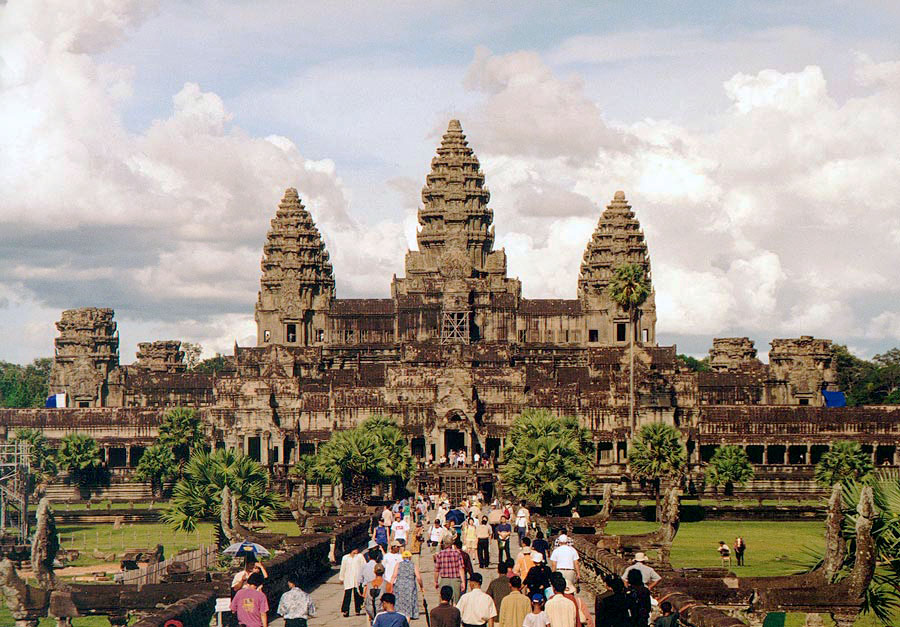
Angkor Wat, Cambodia, as seen from the west entranceManfred Werner (talk · contribs) · CC BY-SA 3.0 · Commons
Cambodia, officially the Kingdom of Cambodia, is a country in Mainland Southeast Asia. It is bordered by Thailand to the northwest, Laos to the north, and Vietnam to the east, and has a coastline along the Gulf of Thailand in the southwest. It spans an area of about 181,035 km2 (69,898 sq mi), dominated by a low-lying plain and the confluence of the Mekong river and Tonlé Sap, Southeast Asia's largest lake. It is dominated by a tropical climate. Cambodia has a population of about 17 million people, the majority of whom are ethnically Khmer.
There exists evidence for a Pleistocene human occupation of what later is Cambodia, which includes quartz and quartzite pebble tools found in terraces along the Mekong River, in Stung Treng and Kratié provinces, and in Kampot province. Some archaeological evidence shows communities of hunter-gatherers inhabited the region during the Holocene: the most ancient archaeological discovery site in Cambodia is considered to be the cave of Laang Spean, which belongs to the Hoabinhian period. Excavations in its lower layers produced a series of radiocarbon dates around 6000 BC. Upper layers in the same site gave evidence of transition to Neolithic, containing the earliest dated earthenware ceramics in Cambodia.
Read more
Archaeological records for the period between the Holocene and Iron Age remain equally limited.
Cambodia is a constitutional monarchy with a unitary structure and a parliamentary form of government. The king is officially the head of state and is the symbol of unity and "perpetuity" of the nation, as defined by Cambodia's constitution. Legislative powers are shared by the executive and the bicameral Parliament of Cambodia (សភាតំណាងរាស្ត្រ, sâphéa tâmnang réastrâ), which consists of a lower house, the National Assembly (រដ្ឋសភា, rôdthâsâphéa) and an upper house, the Senate (ព្រឹទ្ធសភា, prœ̆tthôsâphéa). Members of the 125-seat National Assembly are elected through a system of proportional representation and serve for a maximum term of five years. The Senate has 62 seats, two of which are appointed by the king and two others by the National Assembly, and the rest are elected by the commune councillors from the 24 provinces of Cambodia. Senators serve six-year terms.
Cambodia has two rail lines, totalling about 612 km (380 mi) of single, 1 m (3 ft 3 in) gauge track. The lines run from the capital to Sihanoukville on the southern coast. Trains are again running to and from the Cambodian capital and destinations in the south. After 14 years, regular rail services between the two cities restarted – offering a safer option than road for travellers. Trains run from Phnom Penh to Sisophon (trains often run only as far as Battambang). As of 1987, only one passenger train per week operated between Phnom Penh and Battambang and a US$141 million project, funded mostly by the Asian Development Bank, has been started to revitalise the languishing rail system that will "(interlink) Cambodia with major industrial and logistics centres in Bangkok and Ho Chi Minh City".
Scanned photograph of Cambodian currency (riel) circa 2000. Some notes now superseded but all still legal tender. Includes 100, 200, 500, 2000 and 5000 riel denominations.Paxse (Paxse) · CC BY-SA 3.0 · Commons
Currency
riel
Flag of CambodiaUnknown authorUnknown author · Public domain · Commons
Royal arms of CambodiaSodacan · Public domain · Commons
Rice is the staple grain, as in other Southeast Asian countries. Fish from the Mekong and Tonlé Sap rivers is a part of the diet. The supply of fish and fish products for food and trade as of 2000 was 20 kg (44 lb) per person or 2 ounces per day per person.
Read more
French influence on Cambodian cuisine includes the Cambodian red curry with toasted baguette bread. The toasted baguette pieces are dipped in the curry and eaten. Cambodian red curry is eaten with rice and rice vermicelli noodles. A dine out dish, kuyteav, is a pork broth rice noodle soup with fried garlic, scallions, green onions that may contain toppings such as beef balls, shrimp, pork liver or lettuce. Kampot pepper accompanies crab at the Kep crab shacks and squid in the restaurants on the Ou Trojak Jet river.
Tea is grown in Mondulkiri Province and around Kirirom.
Unfinished Royal Palace, Champasak, Laos.Mattun0211 · CC0 · Commons
The Kingdom of Champasak (Lao: ຈຳປາສັກ [tɕàmpàːsák]) or Bassac, (1713–1904) was a Lao kingdom that emerged under King Nokasad, a grandson of King Sourigna Vongsa, the last king of Lan Xang. Bassac and the neighboring principalities of Attapeu and Stung Treng emerged as power centers as a mandala.
The kingdom was sited on the eastern or Left Bank of the Mekong, south of the Right Bank principality of Khong Chiam where the Mun River joins; and east of where the Mekong makes a sharp bend to the west to return abruptly and flow southeasterly down to what is now Cambodia.
Luang Prabang (Lao: ຫລວງພະບາງ), historically known as Xieng Thong, and alternatively spelled Luang Phabang or Louangphabang, is the capital of Luang Prabang Province in north-central Laos. Its name, meaning “Royal Buddha Image,” derives from the Phra Bang, a statue symbolizing Lao sovereignty. Designated a UNESCO World Heritage Site in 1995, the city is recognized for blending Lao architecture, European colonial buildings, and over 30 Buddhist temples. The protected area encompasses 33 of its 58 villages, where daily rituals like the morning alms-giving ceremony persist.
The town was the scene of events during and in the aftermath of World War II and it was occupied by foreign countries during the war (Vichy France, Thailand, Imperial Japan, Free France, and Nationalist China). Initially, the Vichy French controlled the city and lost it to Thai forces following the Franco-Thai War of 1940–1941. On 9 March 1945, a nationalist group declared Laos once more independent, with Luang Prabang as its capital and on 7 April 1945 2 battalions of Japanese troops occupied the city. The Japanese attempted to force Sisavang Vong (the King of Luang Prabang) to declare Laotian independence and on 8 April he instead simply declared an end to Laos' status as a French protectorate. The King then secretly sent Prince Kindavong to represent Laos to the Allied forces and Sisavang Vatthana as representative to the Japanese.
Vientiane is the capital and largest city of Laos. Comprising the 5 urban districts of Vientiane Prefecture, the city is located on the banks of the Mekong, close to the border with Thailand. Vientiane was the administrative capital during French rule. The city had a population of 840,000 as of the 2023 census. Pha That Luang, an icon of Buddhism, is located in Vientiane. Other Buddhist temples can be found there, such as Haw Phra Kaew, which formerly housed the Emerald Buddha.
Vientiane has experienced economic growth from foreign investment. In 2011, the stock exchange opened with two listed company stocks, with the cooperation of South Korea. At the end of 2025, the Laos government announced that the economy of the city had grown by an average of 5.34% per year over the last five years, and that industrial and agricultural shares of the economy declined while the service economy gained in its share of the market. As of 2026, the economy continues to grow from aforementioned foreign investment, including the private health sector and the electric vehicle sector. At the beginning of 2026, the Lao government announced an initiative to accrue roughly US$30,000,000 in sought investments to drive the city's economic growth.
Vientiane EmblemUnknown authorUnknown author · Public domain · Commons
Achievements and Monuments
Vientiane is the centre of Laos' national media. It hosts the headquarters of Lao National Television and Lao National Radio. The city is also served by the municipal broadcaster VTE9, as well as CRI Vientiane, a station affiliated with China Radio International.
1741 CE – 1819 CE · Capital: Shwebo (1752–1760), Sagaing (1760–1765), Ava (1765–1783, 1821–1842), Amarapura (1783–1821, 1842–1857), Mandalay (1857–1885) · 675,755 km²
Statue of King Alaungpaya in front of the Defence Services AcademyHybernator · CC BY-SA 3.0 · Commons
The Konbaung dynasty (Burmese: ကုန်းဘောင်မင်းဆက်), also known as the Third Burmese Empire (တတိယမြန်မာနိုင်ငံတော်), was the last dynasty that ruled Burma from 1752 to 1885. It created the second-largest empire in Burmese history and continued the administrative reforms begun by the Toungoo dynasty, laying the foundations of the modern state of Burma. The reforms, however, proved insufficient to stem the advance of the British Empire, which defeated the Burmese in all three Anglo-Burmese Wars over a six-decade span (1824–1885) and ended the millennium-old Burmese monarchy in 1885.
The dynasty was founded by a village chief, who later became known as Alaungpaya, in 1752 to challenge the Restored Hanthawaddy Kingdom which had just toppled the Taungoo dynasty. By 1759, Alaungpaya's forces had reunited all of Burma (and Manipur) and driven out the French and the British who had provided arms to Hanthawaddy.
Read more
Alaungpaya's second son, Hsinbyushin, came to the throne after a short reign by his elder brother, Naungdawgyi (1760–1763). He continued his father's expansionist policy and finally took Ayutthaya in 1767, after seven years of fighting.
Uthumphonlived 1722–1796 CEUnknown authorUnknown author · Public domain · Commons
Government, Society and Religion
Konbaung society was centred on the king, who took many wives and fathered numerous children, creating a huge extended royal family which formed the power base of the dynasty and competed for influence at the royal court. It also posed problems of succession at the same time, often resulting in royal massacres.
Read more
The Lawka Byuha Kyan (လောကဗျူဟာကျမ်း), also known as the Inyon Sadan (အင်းယုံစာတန်း), is the earliest extant work on Burmese court protocols and customs. The work was written by Inyon Wungyi Thiri Uzana, also known as the Inyon Ywaza, during the reign of Alaungpaya, the founder of the Konbaung dynasty.
Royal court life in the Konbaung dynasty consisted of both codified rituals and ceremonies and those that were innovated with the progression of the dynasty.
Faced with a powerful China and a resurgent Siam in the east, the Konbaung dynasty had ambitions to expand the Konbaung Empire westwards.
Read more
Bodawpaya acquired the western kingdoms of Arakan (1784), Manipur (1814), and Assam (1817), leading to a long, ill-defined border with British India. The Konbaung court had set its sights on potentially conquering British Bengal by the outbreak of the First Anglo-Burmese War.
Europeans began to set up trading posts in the Irrawaddy delta region during this period. Konbaung tried to maintain its independence by balancing between the French and the British. In the end, it failed, the British severed diplomatic relations in 1811, and the dynasty fought and lost three wars against the British Empire, culminating in the total annexation of Burma by the British.
1769 CE – 1782 CE · Capital: Thonburi · 360,015 km²
The Thonburi Kingdom was a major Siamese kingdom which existed in Southeast Asia from 1767 to 1782, centred on the city of Thonburi, in Siam or present-day Thailand. The kingdom was founded by Taksin, who reunited Siam following the collapse of the Ayutthaya Kingdom, which saw the country separate into five warring regional states.
Thonburi government organization was centred on a loose-knit organization of city-states, whose provincial lords were appointed through 'personal ties' to the king, similar to Ayutthaya and, later, Rattanakosin administrations. Thonburi inherited most of the government apparatus from the Late Ayutthaya. Two prime ministers; Samuha Nayok the prime minister and Samuha Kalahom the minister of military, led the central government. In the early years of Thonburi, Chaophraya Chakri Mud the Muslim of Persian descent hold the position of Samuha Nayok until his death in 1774. Chakri Mut was succeeded as prime minister by Chaophraya Chakri Thongduang who later became King Rama I. Below the prime minister were the four ministers of Chatusadom.
Read more
Like in Ayutthaya, the regional government was organized in the hierarchy of cities, in which smaller towns were under jurisdiction of larger cities.
Thai (official), Northern Thai, Southern Thai, Lao, Khmer, Shan, Malay, Various Chinese languages
Religion
Majority: Buddhism, Minority: Hinduism, Christianity, Islam
Economy and Trade
In the Late Ayutthaya Period, Siam was a prominent rice exporter to Qing China. After the Fall of Ayutthaya in 1767, the Siamese economy collapsed. Rice production and economic activities ceased. Thonburi period was the time of economic crisis as people died from warfare and starvation and inflation was prevalent. Siam became a rice importer. In 1767, after his reconquest of Ayutthaya, King Taksin donated to over 1,000 desolate people. He also ordered an Ayutthayan bronze cannon to be broken down into pieces to buy rice and distribute to the starving populace, earning him a great popularity. The rice commodity price in Thonburi period was high, reaching apex in 1770 at the price of three Chang per one Kwian of rice. Thonburi court purchased imported rice and distribute it to ease the famine crisis. The port city-state of Hà Tiên was the major rice exporter into Siam before 1771.
Flag of Thailand (Ayutthaya period)Xiengyod · Public domain · Commons
Wars and Battles
After the Burmese conquest of Lanna (modern Northern Thailand) in 1763, Lanna including Chiang Mai returned to the Burmese rule. Thado Mindin the Burmese governor of Chiang Mai oppressed the local Lanna nobles. King Taksin marched against the Burmese-held Chiang Mai in 1771 but failed to take the city. In Chiang Mai, Thado Mindin faced opposition from Phaya Chaban Boonma, the native Lanna noble who led the resistance against Burmese domination.
Read more
In 1772, King Hsinbyushin of the Burmese Konbaung dynasty realized that Siam had recovered and arose powerful under Thonburi regime. Hsinbyushin initiated a new campaign against Siam. He ordered troops to be gathered in Burmese Chiang Mai and the Mon town of Martaban in order to invade Siam from both the north and the west in two directions: a similar approach to the invasion of 1765-1767.
Taksin's ruling style differed from traditional Ayutthayan mystic kingship in the aspect that it was based on personal charisma and merits rather than exquisite grandeur. Initially, Taksin's energy in fighting the Burmese earned him loyalty but as situation progressed some began to notice noncomformity of his rule. He did not erect a great royal city with splendid palaces nor did he actively pursue the old Ayutthayan ways. High titles and commands belonged to Taksin's early followers who were not much of high aristocratic stratum. Taksin's defeat at the hands of the Burmese in 1776 affected him greatly. After 1776, Taksin ceased to personally lead armies in battlefields but instead relegated military commands to the brothers Chaophraya Chakri and Chaophraya Surasi so powers shifted away from him as he focused on religious pursuits.
Panoramic view of Chiang Mai CitySupanut Arunoprayote · CC BY 4.0 · Commons
Chiang Mai is the largest city in northern Thailand, the capital of Chiang Mai province and the second-largest city in Thailand by urban population. It is 700 km (435 mi) north of Bangkok in a mountainous region called the Thai highlands, and has a population of approximately 127,000 within the city municipality and an urban population of about 1.2 million as of 2023.
The heart of the city is commonly defined by a square area about 1 mile × 1 mile. It is bordered by ancient red brick walls (now only remnants) and has a moat surrounding it.
The Administration of Chiang Mai Municipality is responsible for an area that covers approximately 40.216 square kilometers and consists of 4 Municipal Districts, 14 sub-districts, 94 municipal communities, and 89,656 households.
Read more
According to Municipal Act B.E. 2496 (1953, reviewed in 2003), the duties of the Municipality cover a lot of areas which include clean water supply, waste and sewage disposal, communicable disease control, public training and education, public hospitals and electricity, etc.
The mayor, or the highest executive, is directly elected by the eligible voters in the municipal area. The mayor serves a four-year term and is assisted by no more than four deputy mayors appointed directly by the mayor. The mayor will thus be permitted to appoint deputies, secretaries and advisors including the mayor himself or herself totally no more than 10.
As part of the smart city project supported by IBM, Chiang Mai is also looking to use technology to boost its presence as a medical tourism hub. In 2011, IBM launched its Smarter Cities Challenge, a three-year, 100 city, 1.6 billion baht (US$50 million) program where teams of experts study and make detailed recommendations to address local important urban issues. Chiang Mai won a grant of about US$400,000 in 2011. The IBM team focused on smarter healthcare initiatives, aimed at making Chiang Mai and the University Medical Clinic a medical hub, as well as improving efficiency of hospitals for improved service delivery. For example, healthcare providers could use real-time location tracking of patients and hospital assets to increase efficiency and build an internationally recognised service identity.
Flag of Chiang Mai City MunicipalityHaeKN · Public domain · Commons
Logo of Chiang Mai City MunicipalityHaeKN · Public domain · Commons
Achievements and Monuments
Loi Krathong (along with Yi Peng), held on the full moon of the 12th month of the traditional Thai lunar calendar, being the full moon of the second month of the old Lanna calendar. In the Western calendar this usually falls in November. Every year thousands of people assemble floating banana-leaf containers (krathong) decorated with flowers and candles and deposit them on the waterways of the city in worship of the Goddess of Water. Lanna-style sky lanterns (khom fai or kom loi), which are hot-air balloons made of paper, are launched into the air. These sky lanterns are believed to help rid the locals of troubles and are also used to decorate houses and streets.
Read more
Songkran is held in mid-April to celebrate the traditional Thai New Year. Chiang Mai has become one of the most popular locations to visit during this festival.
The Tây Sơn dynasty (Vietnamese: [təj ʂəːn]; Vietnamese: Nhà Tây Sơn or Triều Tây Sơn; chữ Hán: 朝西山; Chữ Nôm: 茹西山), officially Đại Việt (大越), was an imperial dynasty of Vietnam. It originated in a revolt led by three peasant brothers with the surname Nguyễn, rebelling against the Lê dynasty, Trịnh lords and Nguyễn lords (no relation). The Tây Sơn would later be succeeded by the Nguyễn dynasty.
The Tây Sơn dynasty ended the century-long war between the Trịnh and Nguyễn families, overthrew the Lê dynasty, and united the country for the first time in 200 years.
In the 18th century, Vietnam was de jure ruled by the Lê dynasty, but real power lay in the hands of two warring families, the Trịnh lords of the north who ruled from the imperial court in Thăng Long and the Nguyễn lords in the south, who ruled from their capital Huế. Both sides warred extensively for control of the country. Life for the peasants during these times was difficult: ownership of land concentrated in the hands of a few powerful landlords as time passed on. The imperial bureaucracy grew corrupt and oppressive; at one point the imperial examination-degrees were sold to whoever was wealthy enough to purchase them. The lords continued to live lavish lifestyles in opulent palaces as the poor grew poorer.
Triều đường chi ấnNhà Tây Sơn · Public domain · Commons
Wars and Battles
The Tây Sơn spent the next decade consolidating their control over the former Nguyễn territory. Nguyễn Ánh proved to be a stubborn enemy. He convinced the King of Siam, P'ya Taksin, to invade Vietnam in support of him. The Siamese army attacked in 1780, but in several years of warfare, it was unable to defeat the Tây Sơn army, as gains were followed by losses. In 1782, the Siamese king was killed in a revolt, and less than a year later, Nguyễn Ánh's forces were driven out of Vietnam. In 1785, Siam launched an invasion again and occupied part of the Mekong Delta, but was defeated by Nguyen Hue in the Battle of Rạch Gầm-Xoài Mút.
Quang Trung was resentful. He trained his army, built large warships and waited for an opportunity to take revenge. He also provided refuge to organizations such as the Tiandihui and the White Lotus. Chinese pirates, such as Chen Tien-pao (陳添保), Mo Kuan-fu (莫觀扶), Liang Wen-keng (梁文庚), Fan Wen-tsai (樊文才), Cheng Chi (鄭七) and Cheng I (鄭一) were granted official positions and noble ranks under the Tây Sơn empire. All attack plans had to be given up due to Nguyễn Huệ's sudden death. The attack never materialized by the time that Quang Trung died in 1792.
Read more
After the Tây Sơn massacred ethnic Han Chinese settlers in 1782, the support of the Qing Chinese shifted towards to the Nguyễn lords.
After Quang Trung's death, his son Nguyễn Quang Toản was enthroned as Emperor Cảnh Thịnh at the age of ten.
1783 CE – 1931 CE · Capital: Bangkok · 672,470 km²
This is a photo of a monument in Thailand identified by the IDPreecha.MJ · CC BY-SA 4.0 · Commons
The Rattanakosin Kingdom, also known as the Kingdom of Siam after 1855, refers to the Siamese kingdom (in modern-day Thailand) between 1782 and 1932. It was founded in 1782 with the establishment of Rattanakosin (Bangkok), which replaced the city of Thonburi as the capital of Siam.
The kingdom governed based on the mandala system. This allows for high-autonomy locally with the kingdom influencing and effectively ruling its area of suzerainty. At its zenith in 1805 to 1812, the Kingdom was composed of 25 polities, ranging from duchies and principalities to federations and kingdoms.
Chakri ruled under the name Ramathibodi, but was generally known as King Rama I, he moved the royal seat from Thonburi on the west bank of Chao Phraya River to the east bank, to the village of Bang Makok, meaning "place of olive plums". This was done due to its better strategic position in defenses against Burmese invasions from the West, the area was protected from attack by the river to the west and by a series of canals to the north, east and south. The east bank was surrounded by low marshlands inhabited by the Chinese, whom King Rama I ordered to move to Sampheng. The official foundation date of Bangkok is 21 April 1782 when the city pillar was consecrated in a ceremony. King Rama I underwent an abbreviated form of coronation in 1782. He founded the Chakri dynasty and made his younger brother Chao Phraya Surasi the Wangna or Prince Sura Singhanat of the Front Palace.
Westerners who came to Siam during the early nineteenth century were horrified of traditional Indo–Siamese judiciary system that involved trial by ordeal and trial by supernatural forces, especially in criminal cases and they were unwilling to be under jurisdiction of Siamese authorities. In the Bowring Treaty of 1855, Siamese court agreed to grant extraterritorial rights to British subjects in Siam, meaning that any legal cases concerning any British subjects, in both civil and criminal cases, would be tried and under jurisdiction of the newly established British consular court at Bangkok under British law rather than indigenous Siamese judiciary system, with the British consul himself acting as the judge. The United States acquired similar agreement with Siam in the Harris Treaty of 1856, France also in 1856 and other Western nations followed.
Central Thai, Southern Thai, Northern Thai, Lao, Khmer, Malay, various Chinese languages
Religion
Majority: Theravada Buddhism (official), Minority: Hinduism, Christianity, Islam
Economy and Trade
Tariffs, Changkob (จังกอบ); The royal court collected tariffs from both internal and external checkpoints called Khanon (ขนอน), both land and riverine, where officials inspected the commodity goods. One out of ten goods was collected by the Khanon. The Khanon also measured the width of the incoming ships to determine the size of the ship. Tariff was collected in accordance with the size of the ship, known as Phasi Pak Reua (ภาษีปากเรือ), or the measurement duties. Large ships paid more tariff. Arriving foreign traders were charged with tariffs. Phra Khlang Sinkha or the Royal Warehouse was responsible for the levy of Phasi Pak Reua on foreign merchant ships, which had been the major revenue for the royal court.
Read more
Akon (อากร); taxes imposed on specific kinds of commodity such as rice, fruits and beverages.
Flag of ThailandZscout370 · Public domain · Commons
Wars and Battles
In his speech to the Wild Tiger Corps, King Vajiravudh instituted the sacred inseparable trinity of Chat (Nation), Satsana (Buddhist Religion), and Phra Maha Kasat (Monarchy), which were the essence of Siamese nation, from British God, King, and Country. King Vajiravudh invented Thai elite nationalism that emphasized Siamese unified national identity under traditional social hierarchy. Seow Hutseng (蕭佛成), head of Siamese branch of Kuomintang, edited Chinosayam Warasap ("Sino–Siamese magazine") publications to propagate republican revolutionary ideas among the Chinese in Siam, who had numbered to 8.3 million people. The king adopted anti-Chinese stance and referred to them as the 'Jews of the East'. Chinese immigrants became ready targets of Siamese economic nationalism.
Siamese royal court of Early Bangkok Period sought to restore royal epics and plays lost during the wars. Kings Rama I and Rama II themselves wrote and recomposed royal plays including Ramakien (adapted from Indian epic Ramayana) and Inao (Thai version of Javanese Panji tales). Kings' own works were called Phra Ratchaniphon (พระราชนิพนธ์ "Royal writing"). Refined royal theater plays, known as Lakhon Nai (ละครใน "Inner plays"), was reserved only for royal court and was performed by all-female actors that were part of royal regalia, in contrast to vernacular, boisterous Lakhon Nok (ละครนอก "Outer plays") that entertained commoner folk and performed by all-male troupes. Krom Alak or Department of Royal Scribes formed circles of illustrious court poets and scholars under royal supervision. Traditional Siamese non-fiction genre includes Buddhist and historical themes.
The Nguyễn dynasty (Vietnamese: Nhà Nguyễn, chữ Nôm: 茹阮) was the last Vietnamese dynasty, preceded by the Nguyễn lords and ruling unified Vietnam independently from 1802 until the start of the French protectorate in 1883. Its emperors were members of the House of Nguyễn Phúc. During its existence, the Nguyễn empire expanded into modern-day Southern Vietnam, Cambodia, and Laos through a continuation of the centuries-long Nam tiến and Siamese–Vietnamese wars.
The Nguyễn clan, which originated in the Thanh Hóa Province had long exerted substantial political influence and military power throughout early modern Vietnamese history through one form or another. The clan's affiliations with the ruling elites dated back to the tenth century when Nguyễn Bặc was appointed the first grand chancellor of the short-lived Đinh dynasty under emperor Đinh Bộ Lĩnh in 968. Another instance of their influences materializes through Nguyễn Thị Anh, the empress consort of emperor Lê Thái Tông; she served as the official regent of Đại Việt for her son, the child emperor Lê Nhân Tông between 1442 and 1453.
The Nguyễn dynasty retained the bureaucratic and hierarchic system of previous dynasties. The emperor was the head of state who wielded absolute authority. Under the emperor was the Ministry of Interior (which worked on papers, imperial messages and recording) and four Grand Secretariats (Vietnamese: Tứ trụ Đại thần 四柱大臣), later renamed the Ministry of Secret Council.
Read more
The Emperor of the Nguyễn dynasty was an absolutist ruler, which means he was both the head of state and the head of government. The Gia Long Code in 1812 declared the Vietnamese monarch as the universal ruler of all Vietnam; using the Confucian concept of the Mandate of Heaven to provide monarchs absolute power.
Heirloom seal of the Nguyễn DynastyOriginal: Unknown author Vector: 麗春 · Public domain · Commons
Wars and Battles
In September 1858, Napoleon III orchestrated a Franco-Spanish army bombardment and invaded Đà Nẵng to protest against the executions of two Spanish Dominican missionaries. Seven months later, they sailed to the south to attack Saigon and the rich Mekong Delta. The Alliance troops held Saigon for two years, while a rebellion of Lê loyalists led by Catholic bishop Pedro Tạ Văn Phụng, who proclaimed himself to be a Lê prince, broke out in the north and escalated. Alongside the pretext of avenging the death of the missionaries the French invasion was designed to prove to Europe that France wasn't a second-rate power, and 'civilize' the area. In February 1861, French reinforcement and 70 warships led by General Vassoigne arrived and overwhelmed the Vietnamese strongholds.
Over the next forty years, Vietnam was ruled by two further independent emperors Thiệu Trị (r. 1841–1847) and Tự Đức (r. 1848–1883). Thiệu Trị or Prince Miên Tông, was the eldest son of Emperor Minh Mạng. His six-year reign showed a significant decrease in Catholic persecution. With the population growing fast from 6 million in the 1820s to 10 million in 1850, the attempts at agricultural self sufficiency were proving unworkable. Between 1802 and 1862, the court had faced 405 minor and large revolts of peasants, political dissents, ethnic minorities, Lê loyalists (people that were loyal to the old Lê Duy dynasty) across the country, this made responding to the challenge of European colonisers significantly more challenging.
Early Modern States of Mainland Southeast Asia: Frequently Asked Questions
Which states existed in Mainland Southeast Asia in this period?
This page maps 17 states of Mainland Southeast Asia founded between 1482 CE and 1791 CE: Prome Kingdom, First Toungoo Empire, Đại Việt, Nguyễn lords, Patani Kingdom, Trịnh lords, Lan Na, Cambodia, Kingdom of Champasak, Kingdom of Luang Phrabang, Vientiane, Konbaung Dynasty and 5 more.
Which was the largest of the Early Modern States of Mainland Southeast Asia?
First Toungoo Empire had the largest mapped extent, about 1,477,943 km².
Which of the Early Modern States of Mainland Southeast Asia lasted longest?
Đại Việt lasted longest, 1529 CE – 1833 CE.
↑↓ to navigate↵ to open
12,754 Planetary Entities Indexed
We use Google Analytics cookies to understand which pages are useful. Necessary storage only keeps your theme and this choice on your device. Privacy policy