Medieval States of the Balkans and Greece, 510 CE – 1210 CE: Map & History
21 states of the Balkans and Greece on one map, from 510 CE to 1884 CE.The largest, Avar Khaganate, covered about 1,022,315 km²; the longest-lived, Republic of Genoa, lasted 1010 CE – 1795 CE. Each has its own section below with its rulers, capitals, wars and pictures where the records hold them.
Each state in its own colour. Move the timeline to see which existed in any year from 510 AD to 1884; select a territory to read about it. Borders: Cliopatria / Seshat (CC BY 4.0).
The Medieval States of the Balkans and Greece, 510 CE – 1210 CE Compared
Kingdom of the Gepids in the 6th century (539-551)WikiEditor2004 · Public domain · Commons
The Gepids (Latin: Gepidae, Gipedae; Ancient Greek: Γήπαιδες, romanized: Gḗpaides) were an East Germanic tribe who lived in the area of modern Romania, Hungary, and Serbia, roughly between the Tisza, Sava, and Carpathian Mountains. They were said to share the religion and language of the Goths and Vandals.
They are first mentioned by Roman sources in the third century. In the fourth century, they were among the peoples incorporated into the Hunnic Empire, within which they formed an important part.
There is little direct evidence for the original language of the Gepids, but they were clearly Gothic in culture during the period when the Romans reported upon them. Most likely, the Gepids used the same language as the Goths, but in a different dialect. They had strained political relations with related peoples, the Goths and Vandals. The Byzantine chronicler of the 6th century, Procopius, in his Wars of Justinian, placed the Gepids among the "Gothic peoples" along with the Vandals, Visigoths and Goths proper, "having the same language, white bodies, blond hair and Arian form of Christianity". Their language was not mentioned after the 7th century and likely went extinct around this time period.
The Gepids were finally overrun by the Avars in the 567 Lombard-Gepid war. Many Gepids followed Alboin to Italy in 568 according to Paulus Diaconus, but many remained in the area of their old kingdom.
Read more
In 630, Theophylact Simocatta reported that the Byzantine Army entered the territory of the Avars and attacked a Gepid feast, capturing 30,000 Gepids (they met no Avars).
Recent excavation by the Tisza River at Szolnok brought up a Gepid nobleman from an Avar period grave who was also wearing Turkic-Avar pieces next to the traditional Germanic clothes in which he was buried.
In the eighth century, Paul the Deacon lists Gepid, Bulgarian, Sarmatian, Pannonian, Suabian and Norican villages in Italy but we do not know if Paul means in his own day or is simply lifting the phrase from an older source.
Abbildung aus dem Stuttgarter Psalter: Fränkische Panzerreiter im Kampf mit AwarenKarolingische Schreiber des 9. Jahrhunderts · Public domain · Commons
The Pannonian Avars or Carpathian Avars (AV-arz) were a confederation of Eurasian nomads. They were also known as the Obri (modern Russian: обры, Obry) in the chronicles of the Rus, as the Abaroi or Varchonitai (Greek: Βαρχονῖται, romanized: Varchonitai), or Pseudo-Avars in Byzantine sources, and as the Apar (Old Turkic: 𐰯𐰺) to the Göktürks. They established the Avar Khaganate, centred in the Carpathian Basin, which lasted from the late-6th to the early-9th centuries CE. They exerted influence and control over surrounding areas in Central, Eastern and Southeastern Europe.
The earliest clear reference to the Avar ethnonym comes from Priscus the Rhetor (420s–after 472), who recounts that in c. 463 the Šaragurs and Onogurs were attacked by the Sabirs, who had been attacked by the Avars. In turn, the Avars had been driven off by people fleeing "man-eating griffins" coming from "the ocean" (Priscus Fr 40). Whilst Priscus' accounts provide some information about the ethno-political situation in the Don-Kuban-Volga region after the demise of the Huns, no unequivocal conclusions can be reached. Denis Sinor has argued that whoever the "Avars" referred to by Priscus were, they differed from the Avars who appear a century later, during the time of Justinian (r. 527–565).
Read more
The next author to discuss the Avars, Menander Protector, appeared during the 6th century and wrote of Göktürk embassies to Constantinople in 565 and 568.
The Pannonian Basin was the centre of the Avar power base. The Avars resettled captives from the peripheries of their empire to more central regions. Avar material culture is found south to Macedonia. However, to the east of the Carpathians, there are next to no Avar archaeological finds, suggesting that they lived mainly in the western Balkans. Scholars propose that a highly structured and hierarchical Avar society existed, having complex interactions with other "barbarian" groups. The khagan was the paramount figure, surrounded by a minority of nomadic aristocracy.
Read more
A few exceptionally rich burials have been uncovered, confirming that power was limited to the khagan and a close-knit class of "elite warriors".
The Avars were skilled warriors and almost exclusively fought on horseback. They often used light horse archers armed with powerful composite bows, as many other steppe peoples. These archers wore little to no armour, besides occasional helmets or knee guards. The Avars also employed the use of heavy cavalry, fully armoured in chainmail or scale armour as well as helmets. These heavier troops were armed with long lances, swords, and daggers. Upon subjugating the Slavic tribes in Pannonia, they often allied with the Slavs and employed them as foot soldiers even together laying siege to Constantinople, along with large numbers of Persians. These Slav warriors were usually armed with bows, axes, various types of spears, and round shields.
The gradual decline of Avar power accelerated. A series of Frankish campaigns, from 788, ended with the conquest of the Avar realm within a decade.
Read more
Conflict between Avars and Franks began soon after the Frankish deposition of Bavarian duke Tassilo III and the establishment of direct Frankish rule over Bavaria in 788. At that time, the border between Bavarians and Avars was the river Enns. An initial Avarian incursion into Bavaria was repelled, and Franco-Bavarian forces responded by taking the war to neighbouring Avarian territories, situated along the Danube, east of the Enns. The two sides fought near the river Ybbs, on Ybbs Field (German: Ybbsfeld), where the Avars suffered defeat in 788. This heralded the rise of Frankish power and Avarian decline in the region.
In 790, the Avars tried to negotiate a peace settlement with the Franks, but no agreement was reached.
682 CE – 1017 CE · Capital: Pliska (681–893), Preslav (893–968/972), Skopje (972–992), Ohrid (992–1015), Bitola (1015–1018) · 428,320 km²
Macedonia Square seen from the Stone Bridge, Skopje.kallerna · CC BY-SA 4.0 · Commons
The First Bulgarian Empire was a medieval state that existed in Southeastern and southeastern Central Europe between the 7th and 11th centuries AD. It was founded in 680–681 after a group of Bulgars, led by Asparuh, moved south to the northeastern Balkans, and secured Byzantine recognition and their right to settle south of the Danube by defeating – possibly with the help of local South Slavic tribes – the Byzantine army led by Constantine IV.
... the Emperor [Constantine IV] signed peace with them [the Bulgars], and agreed to pay them tribute for shame of the Romans and for our many sins. For it was wondrous for faraway and close peoples to hear that he, who made everyone pay him tribute – to the east and to the west, to the north and to the south, had been defeated by these unclean and newly emerged people.
Read more
The relations between the Bulgars and the local Slavs is a matter of debate depending on the interpretation of the Byzantine sources. Vasil Zlatarski asserts that they concluded a treaty, but most historians agree that they were subjugated. The Bulgars were superior organisationally and militarily and came to politically dominate the new state, but there was cooperation between them and the Slavs for the protection of the country.
According to an inscription dated from the reign of Khan Malamir (r. 831–836) there were three classes in pagan Bulgaria – boilas, bagains and Bulgarians, i.e. the common people. The nobility were initially known as the boila but after the 10th century the word was transformed to bolyar, which was eventually adopted in many countries in Eastern Europe. Each boila clan had its own totem and was believed to have been divinely established, hence their staunch opposition to Christianity, which was seen as a threat to their privileges. Many of the clans had ancient origin that could be traced back to the time when the Bulgars inhabited the steppes to the north and east of the Black Sea. The Nominalia of the Bulgarian khans mentions monarchs of three clans that ruled Bulgaria until 766 – Dulo, Vokil and Ugain.
Danubian Bulgar, Common Slavic, Old Church Slavonic (official from 893), Medieval Greek, Common Romanian
Religion
Tengrism, Slavic paganism (681–864), Orthodox Christianity (state religion from 864)
Economy and Trade
Agriculture was the most important sector of the economy, the development of which was facilitated by the fertile soils of Moesia, Thrace, and partly, Macedonia. The land was divided into "lord's lands" and "village lands". The most widespread cereals were wheat, rye and millet, all of which were staple foods for the populace. Grapes were also significant, especially after the 9th century. Linen was used for fabrics and cloths that were exported to the Byzantine Empire. Harvests were prone to natural calamities, such as droughts or locusts, and there were occasional hunger years. In response to this problem the state maintained reserves of cereals. Animal husbandry was well developed, the main stocks being cattle, oxen, buffalos, sheep, pigs and horses. Animal stocks were vital for farming, transport, military, clothing and food.
Monogram on the silver eagle from the Voznesenka treasureVaskots7 · CC BY-SA 3.0 · Commons
Wars and Battles
After the formation of the Bulgarian state the ruling elite harboured deep distrust towards the Byzantines, against whose perfidy and sudden attacks they had to maintain constant vigilance in all directions. The Byzantine Empire never relinquished its claim over all lands to the south of the Danube and made several attempts to enforce that claim. Throughout the existence of the First Empire Bulgaria could expect Byzantine onslaughts aimed at its destruction. The steppes to the north-east were home to numerous peoples whose unpredictable pillaging raids were also of concern. Therefore, military preparedness was a top priority. Guards always stood on the alert and if anyone was to flee during a watch, the responsible guards were to be killed without hesitation.
The development of Old Church Slavonic literacy prevented the assimilation of the South Slavs into neighbouring cultures, while stimulating the formation of the distinct Bulgarian identity. Initially translation from Byzantine Greek of texts on theology, history and geography was a priority. Literary activities flourished during the reign of Simeon I, who had a personal interest in literature. He gathered many scholars in the court who translated an enormous number of books from Greek and wrote many new works. Among the most prominent figures were Constantine of Preslav, John the Exarch and Chernorizets Hrabar, who is believed by some historians to have been Simeon I himself. They wrote hagiographies, panegyrics, acolouthia, poetry, liturgical hymns, treatises on church music, etc.
John Harris Valda - Basil II at battle near Setania (Setina) in 1017 (illustration from Hutchinsons History of the Nations, 1915)John Harris Valda · Public domain · Commons
Despite the treaty and the largely peaceful era that followed, the strategic position of the Bulgarian Empire remained difficult. The country was surrounded by aggressive neighbours – the Magyars to the north-west, the Pechenegs and the growing power of Kievan Rus' to the north-east, and the Byzantine Empire to the south. Bulgaria suffered several devastating Magyar raids between 934 and 965. The growing insecurity, as well as expanding influence of the landed nobility and the higher clergy at the expense of the personal privileges of the peasantry, led to the emergence of Bogomilism, a dualistic heretic sect that in the subsequent centuries spread to the Byzantine Empire, northern Italy and southern France (cf. Cathars).
741 CE – 925 CE · Capital: No permanent seat, Nin, Biograd, Klis, Bijaći, Solin, Knin · 21,530 km²
The statue of Croatian King Thomas (Tomislav) in Zagreb near the Glavni kolodvorDoncsecz · CC BY-SA 3.0 · Commons
The Duchy of Croatia (Modern Croatian: Kneževina Hrvatska; also Duchy of the Croats, Modern Croatian: Kneževina Hrvata; Latin: Ducatus Chroatorum; Greek: Χρωβατία) was a medieval state that was established by White Croats who migrated into the area of the former Roman province of Dalmatia c. 7th century AD. Throughout its existence the Duchy had several seats – namely, Klis, Solin, Knin, Bijaći and Nin. It comprised the littoral – the coastal part of today's Croatia – except Istria, and included a large part of the mountainous hinterland as well.
The Principality of Serbia (Serbian: Књажество Србија, romanized: Knjažestvo Srbija) was an autonomous, later sovereign state in the Balkans that came into existence as a result of the Serbian Revolution. Its creation was negotiated first through an unwritten agreement between Miloš Obrenović, leader of the Second Serbian Uprising, and Ottoman official Marashli Pasha, followed by a series of decrees of the Sublime Porte in 1828–1833.
The Serbian revolutionary leaders, first Karađorđe and then Miloš Obrenović, succeeded in their goal of liberating Serbia from centuries-long Ottoman rule. Ottoman authorities acknowledged the state by the 1830 Hatt-i Sharif, and Miloš Obrenović became the hereditary prince (knjaz) of Serbia. Serbia was de jure an autonomous province of the Ottoman Empire, its autonomy was constrained by the presence of the Ottoman army on its soil and by being forced to pay to Istanbul a yearly tribute of 2.3 million groschen, which represented about 10% of the country's budget.
Read more
At first, the principality included only the territory of the former Pashaluk of Belgrade, but in 1831–1833 it expanded to the east, south, and west. In 1866 Serbia began the campaign of forging the First Balkan Alliance by signing a series of agreements with other Balkan entities in the period 1866–1868.
Akkerman Convention (October 7, 1826), treaty between the Russian Empire and Ottoman Empire, contained article 5 on Serbia: autonomy, and return of lands removed in 1813, Serbs were also granted freedom of movement through the Ottoman Empire. Rejected by Mahmud II in 1828.
1000 Serbian dinar banknote, 2006 issue, front.From the site of the National bank of Serbia[1]. · Public domain · Commons
Currency
Serbian dinar
1 динар 1876.Unknown authorUnknown author · Public domain · Commons
Flag of Serbia (1835–1882)This vector image includes elements that have been taken or adapted from this file: · Public domain · Commons
COA of Principality of SerbiaFenn-O-maniC · Public domain · Commons
Wars and Battles
The Armed Forces of the Principality of Serbia was the armed forces of the Principality of Serbia. Founded in 1830, it became a standing army to take part to the First and Second Serbo Turkish Wars of 1876–1878, the first conflict in the nation's modern history, after which the country gained its full independence. It was succeeded by the Royal Serbian Army.
Panoramic view of Heraklion from Kazantzakis Tomb, Crete, GreeceBernard Gagnon · CC BY-SA 3.0 · Commons
The Emirate of Crete (Arabic: إقريطش, romanized: Iqrīṭish or إقريطية, Iqrīṭiya; Greek: Κρήτη, romanized: Krētē) was an Arab Islamic state that existed on the Mediterranean island of Crete from the late 820s to the reconquest of the island by the Byzantine Empire in 961. Although the emirate recognized the suzerainty of the Abbasid Caliphate and maintained close ties with Tulunid Egypt, it was de facto independent.
A group of Arab Andalusian exiles led by Abu Hafs Umar al-Iqritishi conquered Crete in either 824 or 827/828, and established an independent Islamic state.
At some point in the second half of the reign of Byzantine Emperor Michael II (r. 820–829), a group of Andalusian exiles landed on Crete and began its conquest. These exiles had a long nomadic history. Traditionally they have been described as the survivors of a failed revolt against the emir al-Hakam I of Córdoba in 818. In the aftermath of the revolt's suppression, the citizens of the Córdoban suburb of al-Rabad were exiled en masse. Some settled in Fez in Morocco, but others, numbering over 10,000, took to piracy, probably joined by other Andalusians. They landed in Alexandria and took control of the city until 827, when they were besieged and expelled by the Abbasid general Abdullah ibn Tahir al-Khurasani.
This early Muslim period of Crete remains relatively obscure due to a paucity of surviving evidence regarding its internal history. Furthermore, other than a few place names recalling the presence of the Arabs, no major archaeological remains from the period survive, possibly due to deliberate Byzantine destruction after 961. This has influenced the way the emirate is generally regarded: scholars, forced to rely mostly on Byzantine accounts, have traditionally viewed the Emirate of Crete through a Byzantine lens as a quintessential "corsair's nest", surviving on piracy and the slave trade.
Read more
The picture painted by the few and scattered references to the Cretan emirate from the Muslim world, on the other hand, is of an ordered state with a regular monetary economy and extensive trade links, and there is evidence that Chandax was a cultural centre of some importance.
Hungarians, also known as Magyars, are an ethnic group native to present day Hungary (Magyarország), and the Carpathian Basin who share a common culture, language, history and ancestry. They have a notable presence in parts of the former Kingdom of Hungary. The Hungarian language belongs to the Ugric branch of the Uralic language family, alongside the Khanty and Mansi languages.
There are an estimated 14.5 million ethnic Hungarians and their descendants worldwide, of whom approximately 9.6 million live in today's Hungary.
The origin of Hungarians, the place and time of their ethnogenesis, has been a matter of debate. Due to the classification of the Hungarian language in the Ugric family, they are sometimes regarded as an Ugric people originating in Siberia. However, Fóthi et al. 2022 suggests that the conquering Hungarians have origins in three distinct regions on the Eurasian steppe: the Lake Baikal-Altai Mountains, spanning present-day northwestern Mongolia and southern Siberia, the Southern Urals-Western Siberia and the Black Sea-Northern Caucasus. Meanwhile, Neparáczki et al. 2018 proposes that over a third of the Hungarian conquerors' maternal lineages derive from Inner Asia, centred in present-day eastern Mongolia and southern Siberia, while the remainder is derived from the Pontic-Caspian Steppe. Maróti et al.
The culture of Hungary shows distinctive elements, incorporating local European and Ottoman influences, and minor Central Asian/Steppe derived traditions, such as Horse culture and Shamanistic remnants in Hungarian folklore.
926 CE – 1098 CE · Capital: Varied through time, Nin, Biograd, Solin, Knin · 92,789 km²
The statue of Croatian King Thomas (Tomislav) in Zagreb near the Glavni kolodvorDoncsecz · CC BY-SA 3.0 · Commons
The Kingdom of Croatia (Modern Croatian: Kraljevina Hrvatska, Hrvatsko Kraljevstvo; Latin: Regnum Croatiæ), and since 1060 known as Kingdom of Croatia and Dalmatia (Latin: Regnum Croatiae et Dalmatiae), was a medieval kingdom in Southern Europe comprising most of what is today Croatia (without western Istria, some Dalmatian coastal cities, and the part of Dalmatia south of the Neretva River), as well as most of the modern-day Bosnia and Herzegovina.
The Slavs arrived in southeastern Europe in the early 7th century and established several states, including the Duchy of Croatia. The Christianization of the Croats began soon after their arrival and was completed by the beginning of the 9th century. The rule over the duchy alternated between the rival Domagojević and Trpimirović dynasties. The duchy was rivaled by the neighbouring Republic of Venice, fought and allied with the First Bulgarian Empire, and went through periods of vassalage to the Carolingian Empire and the Byzantine Empire. In 879, Pope John VIII recognized Duke Branimir as an independent ruler.
Genova, panorama dalla villetta Di Negro sul centro storicopatano · CC BY-SA 3.0 · Commons
The Republic of Genoa was a medieval and early modern maritime republic from the years 1099 to 1797 in Liguria on the northwestern Italian coast. During the Late Middle Ages, it was a major commercial power in both the Mediterranean and Black Sea. Between the 16th and 17th centuries, it was one of the major financial centres of Europe.
Before 1100, Genoa emerged as an independent city-state, one of a number of Italian city-states during this period. Nominally, the Holy Roman Emperor was overlord and the Bishop of Genoa was president of the city; however, actual power was wielded by a number of "consuls" annually elected by popular assembly. At that time Muslim raiders were attacking coastal cities on the Tyrrhenian Sea. Muslims raided Pisa in 1000, and in 1015 they escalated their attacks, raiding Luni. Mujahid al-Siqlabi, Emir of the Taifa of Denia attacked Sardinia with a fleet of 125 ships. In 1016, the allied troops of Genoa and Pisa defended Sardinia. In 1066, war erupted between Genoa and Pisa – possibly over control of Sardinia.
Read more
The republic was one of the so-called "Maritime Republics" (Repubbliche Marinare), along with Venice, Pisa, Amalfi, Gaeta, Ancona, and Ragusa.
The history of Genoa, of the Genoese and of the republic that held its fate for a long time, but also of the governments that gradually took turns leading the city, to reach the time of the Doges, is traceable through the work of historians who have continued the storytelling work begun at the end of the 11th century by Caffaro Di Caschifellone (historian and himself municipal consul) with the "Annales ianuenses".
Read more
The republic was substantially democratic in shape, while those of the Podestàs and the Captains of the people strongly restored the often conflicting relationship between the authority and the freedom. The perpetual doges, on the other hand, proclaimed themselves popular, even though sometimes crossing the oligarchy; finally the fifth republic was institutionally aristocratic. By custom, prelates in Genoa were unable to take on public office.
Genoese traders bought salt – from Hyères near Toulon in French Provence, from Cagliari in Sardinia, Tortosa in Iberia, and from other areas in the Black Sea, North Africa, Cyprus, Crete, and Ibiza – and made salami. They then sold salami in southern Italy for raw silk, which was sold in Lucca for fabrics, which were then sold to Lyon. Mule caravans from Genoa carried salt directly to Piacenza, where it was transferred to river barges and transported down the Po to Parma, and other Po Valley cities such as Reggio and Bologna. Along these trade routes, Genoa competed with Venice for salt and for other cargoes, such as salami, prosciutto, cheese, textiles and spices.
In May 1625, a French-Savoian army briefly laid siege to Genoa. Though that siege was eventually lifted with the aid of the Spanish, the French would later bombard the city in May 1684 for its support of Spain during the War of the Reunions. In-between, a plague killed as many as half of the inhabitants of Genoa in 1656–57. Genoa continued its slow decline well into the 18th century, losing its last Mediterranean colony, the island fortress of Tabarka, to the Bey of Tunis in 1742.
Read more
As its economy and power both continued to decline, in 1729 the Republic had to face another revolt in Corsica. It is seen as the first real rupture between the island and the Genoese Republic: it may also be the most important, because the representatives of the Church and the Roman Curia both "justified" the war. This time the Genoese government requested the help of Charles VI.
1056 CE – 1071 CE · Capital: Bar, Shkodër · 28,346 km²
Duklja (Serbian Cyrillic: Дукља; Greek: Διόκλεια, romanized: Diókleia; Latin: Dioclea) was a medieval South Slavic state which roughly encompassed the territories of modern-day southeastern Montenegro, from the Bay of Kotor in the west to the Bojana river in the east, and to the sources of the Zeta and Morača rivers in the north.
With Bodin gone, his Norman wife, Jaquinta, feared that Bodin's nephew, Branislav, would try to seize power before her young children could take the throne. She ordered the arrest of Branislav and his family and Branislav died in captivity, while his other 6 brothers and sons found asylum in Ragusa. Thus in the haste to claim the throne, seeds of family hatred were planted among the extended family. After Bodin died, his half-brother Dobroslav II gained the throne of Duklja. Seeing a weak Duklja, the Byzantines started to meddle, sending Kočopar, one of Branislav's exiled brothers to capture the throne. He managed to get assistance from Vukan of Raška, and together they beat Dobroslav. However, there was a falling out between Kočopar and Vukan. Vukan drove out Kočopar, who then died in exile.
1056 CE – 1240 CE · Capital: Volodymyr, Halych, Chełm, (1241–1272), Lviv, (1272–1301) · 452,468 km²
Комплекс Успенського собору (12-17 ст.) - Успенський собор (ліворуч), будинок з дзвіницею (праворуч) - м.Володимир-Волинський (вул. Соборна) Волинська область УкраїнаViacheslav Galievskyi · CC BY-SA 4.0 · Commons
The Kingdom of Galicia–Volhynia, known as the Principality of Galicia–Volhynia before 1253, and also known as the Kingdom of Ruthenia or Kingdom of Rus', was a medieval state in Eastern Europe which existed from 1199 to 1349. Its territory was predominantly located in modern-day Ukraine, with parts in Belarus, Poland, Romania, Moldova, and Lithuania. Along with Novgorod and Vladimir-Suzdal, it was one of the three most important powers to emerge from the collapse of Kievan Rus'.
Roman the Great united the principalities of Galicia and Volhynia at the turn of the 13th century.
The Principality of Volhynia may have emerged as early as the late 10th century, with Vsevolod, a son of Vladimir I of Kiev, mentioned as a prince of the city of Volodymyr. Igor Yaroslavich reportedly briefly reigned as the prince of Volodymyr in the 1050s. Iaroslav Sviatopolkovich (r. 1100–1118) was the only prince in Kievan Rus' to oppose Vladimir II Monomakh's reign on the grounds of agnatic seniority, but after Vladimir ousted him in 1118, his Monomakhovichi descendants established a local dynastic branch. Roman Mstislavich, the great-great-grandson of Monomakh, inherited the throne of Volhynia in 1170.
Read more
The Principality of Galicia was formed in the years 1124–1144 by Vladimirko Volodarovich's unification of the principalities of Zvenyhorod, Peremyshl, and Terebovlia.
Both Volhynia and Galicia had experienced a remarkable economic development in the 12th century due to their commercial advantages. In part, this was because land trade routes in Asia Minor were severely disrupted due to the Byzantine–Seljuk wars (1046–1243), diverting numerous merchants coming from the east heading for Constantinople via Alexandria in Egypt, while others circumvented Anatolia via the port of Sudak (Sougdaia) in Crimea. The flourishing of the latter commercial hub soon attracted Kievan Rus' traders, who rerouted some of the would-be Byzantine goods (occasionally through itinerant Jewish merchants) to Poland, Hungary, Bohemia and Germany, via the towns of Volhynia and Galicia.
Yuri I of Galicia armsЛобачев Владимир · CC0 · Commons
Wars and Battles
In 1205, Roman's alliance with the Poles broke down, leading to a conflict with Leszek the White and Konrad of Masovia. Roman was subsequently killed by Polish forces in the Battle of Zawichost (1205), triggering a war of succession, while his dominion entered a period of rebellion and chaos that lasted almost 40 years. In this time, the Galician boyars made efforts to prevent the establishment of a hereditary princely dynasty, especially by Roman's son Daniel, and instead put all sorts of puppets on the throne which they could easily control. Thus weakened by war between Galician boyars and some appanage princes, Galicia–Volhynia also became an arena of rivalry between Poland and Hungary, which intervened in the region several times. Roman's successors would mostly use Halych (Galicia) as the designation of their combined kingdom.
By the 12th century, construction of new buildings was taking place at a faster rate in the emerging urban centres of Galicia–Volynia (as well as in Smolensk and Suzdalia) than in the older centres of princely power of Kiev, Chernigov, and Pereyaslavl. Galicia–Volynia and the Novgorod Republic were also prominent examples of regions that began to establish their own Rus' chronicle traditions, still starting with the Primary Chronicle (PVL), but increasingly focusing on their own lands rather than the wider Kievan Rus' realm. The Kievan Chronicle was supplemented by the Galician–Volhynian Chronicle (GVC), and as such copied, redistributed, and preserved in codices such as the Hypatian Codex and the Khlebnikov Codex.
In winter 1341 Tatars, Ruthenians led by Detko, and Lithuanians led by Liubartas were able to defeat the Poles, although they were not so successful in summer 1341. Finally, Detko was forced to accept Polish overlordship, as a starost of Galicia. After Detko's death, Casimir III mounted a successful invasion, capturing and annexing Galicia in 1349.The Romanovichi (branch of the Rurikid) dynasty of Daniel of Galicia attempted to gain support from Pope Benedict XII and broader European powers for an alliance against the Mongols, but ultimately proved unable to compete with the rising powers of the centralised Grand Duchy of Lithuania and the Kingdom of Poland. Only in 1349, after the occupation of Galicia–Volhynia by an allied Polish-Hungarian force, was Galicia–Volhynia finally conquered and incorporated into Poland.
1072 CE – 1138 CE · Capital: Bar, Shkodër · 49,994 km²
Duklja (Serbian Cyrillic: Дукља; Greek: Διόκλεια, romanized: Diókleia; Latin: Dioclea) was a medieval South Slavic state which roughly encompassed the territories of modern-day southeastern Montenegro, from the Bay of Kotor in the west to the Bojana river in the east, and to the sources of the Zeta and Morača rivers in the north.
With Bodin gone, his Norman wife, Jaquinta, feared that Bodin's nephew, Branislav, would try to seize power before her young children could take the throne. She ordered the arrest of Branislav and his family and Branislav died in captivity, while his other 6 brothers and sons found asylum in Ragusa. Thus in the haste to claim the throne, seeds of family hatred were planted among the extended family. After Bodin died, his half-brother Dobroslav II gained the throne of Duklja. Seeing a weak Duklja, the Byzantines started to meddle, sending Kočopar, one of Branislav's exiled brothers to capture the throne. He managed to get assistance from Vukan of Raška, and together they beat Dobroslav. However, there was a falling out between Kočopar and Vukan. Vukan drove out Kočopar, who then died in exile.
1094 CE – 1168 CE · Capital: Ras, Niš · 28,938 km²
Ras, one of the first capitals of the medieval Serbian state.Саша Стефановић!!! (talk) The original uploader was Kolossus at English Wikipedia. · Public domain · Commons
The Grand Principality of Serbia (Serbian: Великожупанска Србија / Velikožupanska Srbija), also known by the anachronistic exonym Rascia (Serbian: Рашка / Raška), was a medieval Serbian state that existed from the second half of the 11th century up until 1217, when it was transformed into the Kingdom of Serbia. After the Grand Principality of Serbia emerged, it gradually expanded during the 12th century, encompassing various neighbouring regions, including territories of Raška (Serbian Cyrillic: Рашка; Latin: Rascia), modern Montenegro, Herzegovina, and southern Dalmatia.
According to the De Administrando Imperio (DAI), the Serbs settled the Balkans under the protection of the Byzantine Emperor Heraclius (r. 610–641) and were ruled by a dynasty known in historiography as the Vlastimirović dynasty. Slavs had begun settling in the region in the early 6th century, after raiding deep into the Empire. They settled "baptized Serbia", which included Bosnia, and the maritime lands (Pomorje) of Travunija, Zahumlje and Paganija, while maritime Duklja was held by the Byzantines, it was presumably settled with Serbs as well. All of the maritime lands bordered "baptized Serbia" to the north. In the mid-9th century, the hitherto peaceful neighbour of Bulgaria invaded but was defeated in war. Serbia was Christianized in ca. 870, although missions had been made during Heraclius' reign.
The important Via de Zenta, a trade route connecting the Adriatic with Serbia started from the mouth of the Bojana, the Shkodër (Skadar) port, (alternatively Bar then Cetinje) along the Drin Valley to Prizren, then to Lipljan, then through Novo Brdo to Vranje and Niš. The Republic of Venice and Ragusa used the road for trade with Serbia and Bulgaria.
Read more
John Kinnamos, writing about the Byzantine conquest of Galič near Kosovska Mitrovica in 1149, said that many barbarians were imprisoned "who were partly warriors and partly cattle breeders".
William, the archbishop of Tyre, when crossing Serbia for the Holy Land in 1168, he described the Serbs: "They are rich in herds and flocks and unusually well supplied with milk, cheese, butter, meat, honey and wax".
1188 CE – 1384 CE · Capital: Visoko, Bobovac, Sutjeska · 48,973 km²
Bobovac Fortress, Bosnia and HerzegovinaMartin Brož · CC BY 3.0 · Commons
The Banate of Bosnia (Serbo-Croatian: Banovina Bosna / Бановина Босна), or Bosnian Banate (Bosanska banovina / Босанска бановина), was a medieval state located in what is today Bosnia and Herzegovina. Although Hungarian kings viewed Bosnia as part of Hungarian Crown Lands, the Banate of Bosnia was a de facto independent state for most of its existence. It was founded in the mid-12th century and existed until 1377 with interruptions under the Šubić family between 1299 and 1324. In 1377, it was elevated to a kingdom.
Ban Borić appears as the first known Bosnian ruler in 1154, as a Hungarian vassal, who participated in the Siege of Braničevo as part of the Hungarian King's forces. In 1167 he was involved in offensives against the Byzantines when he provided troops for Hungarian armies. War ended with the retreat of Hungarian army in Battle of Sirmium, near Belgrade in 1167. Borić's involvement in the war indicates that Bosnia was part of the Hungarian kingdom at that time, as war Byzantine–Hungarian treaty regards Bosnia "as part of Hungarian dominion taken by the Byzantines", and Byzantine emperor Manuel I Komnenos used in honorific title of the "dalmatikos, ougrikos, bosthnikos, krobatikos", and panegyric of Michael Anchialos mentioned to "let the Croat and the Bosnian be enrolled in the tables of the Romans".
Stephen II, Ban of BosniaDenkmäler der Kunst in Dalmatien, Herausgegeben von Georg Kowalczyk, mit einer Einleitung von Cornelius Gurlitt. Autor Georg Kowalczyk 1909 · Public domain · Commons
The key institution of state was the Stanak (or Sabor), the assembly of all Bosnian nobility (vlastela). The Stanak held significant power: it formally elected and confirmed the new ban, decided on foreign policy (war and peace), approved charters and land grants, and served as the highest court, especially in disputes between the ban and the nobility. The Ban could not make major state decisions without the consent of the Stanak. An assembly held by Jelena Šubić and the young Tvrtko I in Mile in 1354, for the purpose of confirming the privileges of the nobility, illustrates the Stanak's role. The power of the magnates was most evident in 1366, when they revolted at the Stanak, dethroned Tvrtko I, and replaced him with his brother, Vuk.
Feudal banate, (Decentralized monarchy governed by a noble assembly - Stanak)
Languages
Bosnian
Religion
Christianity
Economy and Trade
The second Bosnian ruler, Ban Kulin strengthened the country's economy through treaties with Dubrovnik in 1189 and Venice. Charter of Ban Kulin was a trade agreement between Bosnia and the Republic of Ragusa that effectively regulated Ragusan trade rights in Bosnia written on 29 August 1189. It is one of the oldest written state documents in the Balkans and is among the oldest historical documents written in Bosančica.
Read more
The export of metal ores and metalwork (mainly silver, copper and lead) formed the backbone of the Bosnian economy, as these goods along others like wax, silver, gold, honey and rawhide were transported over the Dinaric Alps to the seashore by Via Narenta, where they were bought chiefly by the Republics of Ragusa and Venice.
Anillos iberorromanos, lingote, estátera escita (siglo I a. C.), dinar indio (325-345) e histamenon bizantino (1059-1067). Exposición permante de la Historia del dinero. Museo de Prehistoria de ValenciaDorieo · CC BY-SA 4.0 · Commons
Currency
dinar
Banate of Bosnia flag of Stjepan II KotromanicSantasa99 · CC BY-SA 4.0 · Commons
1188 CE – 1884 CE · Capital: Belgrade · 102,416 km²
Александар I Карађорђевић, фотографија у бојиAuguste Léon · CC0 · Commons
The Kingdom of Serbia was a monarchy located in Southeastern Europe which was created when the ruler of the Principality of Serbia, Milan I, was proclaimed king in 1882.
Since 1817, the Principality was ruled by the Obrenović dynasty (replaced by the Karađorđević dynasty for a short time). The Principality of Serbia, under the suzerainty of the Ottoman Empire, de facto achieved full independence when the very last Ottoman troops left Belgrade in 1867.
The Bosnian Crisis of 1908–1909 (also referred to as the Annexation crisis) erupted into public view when on October 5, 1908, the Kingdom of Bulgaria declared its complete independence from Ottoman Empire and on October 6, 1908, when Austria-Hungary announced the annexation of Bosnia and Herzegovina, which was populated mainly by South Slavs.
Read more
Austria-Hungary had ambitions of imperialistic expansion and saw the Balkans in the same way that other colonial powers saw Africa or Asia. This idea was severely opposed by the Serbian public and intelligentsia, mainly gathered around Serbian Literary Herald (Srpski književni glasnik).
Russia, the Ottoman Empire, Britain, the Kingdom of Italy, Serbia, the Principality of Montenegro, German Empire and France took an interest in these events.
Serbia was geographically located in the path of several trade routes linking Western and Central Europe with Middle East. The Morava Valley was part of the strategically important terrestrial route that linked Central Europe with Greece and Constantinople. During the 19th century major efforts were made to improve the transport in this connections. At the Congress of Berlin in 1878, Austria-Hungary helped Serbia to gain new territories, conditioning Serbia, however, to sign a new convention. The convention obliged Serbia to construct the railway line from Belgrade to Vranje and Turkish and Bulgarian borders in three years. In addition, the obligation to sign commercial contracts was imposed on Serbia, as well as a claim to carry out regulation works in Đerdap. Serbian Government approved this treaty by adopting the Law on Proclamation of the convention.
Royal Coat of arms of Serbia (1882–1918)TRAJAN 117 · Public domain · Commons
Wars and Battles
Negotiations between Russia, Serbia and Bulgaria led to the Serbian-Bulgarian Treaty of Alliance of March 1912, which aimed to conquer and to divide the Ottoman held Macedonia. In May, a Serbian-Greek alliance was reached and in October 1912, a Serbia-Montenegro alliance was signed.
Read more
After the war started, Serbia, together with Montenegro, conquered Pristina and Novi Pazar. At the Battle of Kumanovo Serbs defeated the Ottoman army and proceeded to conquer Skopje and the whole of Kosovo vilayet. The region of Metohija was taken by Montenegro. At Bitola and Ohrid Serbian army units established contact with the Greek army.
Populations of ethnic Serbs and Albanians tended to shift following territorial conquests. As a result of the multi-ethnic composition of Kosovo, the new administrations provoked a mixed response from the local population. Serbs considered this a liberation.
The Kingdom of Serbia participated in the International Exhibition of Art of 1911, with a number of artists showing their work as a part of the Serbian pavilion, including Marko Murat, Ivan Meštrović, Đorđe Jovanović and other artists.
1188 CE – 1394 CE · Capital: Tarnovo, (1185–1393), Nikopol, (1393–1395), Vidin (1356/1396 as capital of the Tsardom of Vidin) · 312,296 km²
An anthropological reconstruction of the face of Tzar Kaloyan, made by Prof. Yordan Yordanov on the basis of the skull in the church "40 Martyrs" in Veliko Tarnovo. Exhibit of the National History Museum of BulgariaVassia Atanassova - Spiritia · CC BY-SA 3.0 · Commons
The Second Bulgarian Empire (Middle Bulgarian: Ц(а)рьство бл(ъ)гарское; Modern Bulgarian: Второ българско царство, romanized: Vtoro Balgarsko Tsarstvo) was a medieval Bulgarian state that existed between 1185 and 1396. A successor to the First Bulgarian Empire, it reached the peak of its power under Tsars Kaloyan and Ivan Asen II before gradually being conquered by the Ottomans in the late 14th century.
Until 1256, the Second Bulgarian Empire was the dominant power in the Balkans, defeating the Byzantine Empire in several major battles.
The throne was succeeded by Kaloyan, Asen's and Peter IV's youngest brother. An ambitious and ruthless ruler, he wanted to gain international recognition and to complete the liberation of Bulgaria. Kaloyan also wanted revenge against the Byzantines for blinding 14,000 of emperor Samuel's soldiers. Kaloyan called himself Romanoktonos (Roman-slayer) after Basil II, who was called Bulgaroktonos (Bulgar-slayer). He quickly allied himself with his brother's murderer, Ivanko. The Byzantines killed Ivanko, but the Bulgarians took the city of Constantia. In 1201, Kaloyan captured Varna, the last Byzantine stronghold in Moesia, which was defended by a large garrison. Despite capturing the city at Easter, Kaloyan ordered every Byzantine to be thrown in the moat. He then negotiated peace with Byzantines, securing Bulgarian gains in early 1202.
The Second Bulgarian Empire was a hereditary monarchy ruled by a Tsar—the Bulgarian word for Emperor that originated in the 10th century during the First Bulgarian Empire. The monarchs of Bulgaria styled themselves, "In Christ the Lord Faithful Emperor and Autocrat of all Bulgarians" or variations, sometimes including "...and Romans, Greeks, or Vlachs". The term all Bulgarians was added in the 14th century following the loss of many Bulgarian-populated territories and signified that the monarch in Tarnovo was the emperor of all Bulgarian people, even those who lived beyond the country's political borders.
Read more
The Emperor held supreme power over secular and religious affairs in an autocracy; his personal abilities played an important role in the country's well-being.
Middle Bulgarian, Common Romanian, Medieval Greek, Cuman, Albanian
Religion
Bulgarian Orthodoxy (official, 1204–1235 in the union with Rome), Bogomilism (banned)
Economy and Trade
The economy of the Second Bulgarian Empire was based on agriculture, mining, traditional crafts, and trade. Agriculture and livestock breeding remained the mainstays of the Bulgarian economy between the 12th and 14th centuries. Moesia, Zagore, and Dobrudzha were known for rich harvests of grain, including high quality wheat. Production of wheat, barley, and millet was also developed in most regions of Thrace. The main wine-producing areas were Thrace, the Black Sea coast, and the valleys of the Struma and Vardar rivers in Macedonia. Production of vegetables, orchards, and grapes became increasingly important since the beginning of the 13th century. The existence of large forests and pastures was favorable for livestock breeding, mainly in the mountainous and semi-mountainous regions of the country. Sericulture and especially apiculture were well developed.
The emperor of the Second Bulgarian Empire was commander-in-chief of its army; the second-in-command was the velik (great) voivoda. The detachments of the army were led by a voivoda. The protostrator was responsible for the defence of certain regions and the recruitment of soldiers. In the late 12th century, the army numbered 40,000 men-at-arms. The country could mobilize around 100,000 men in the first decade of the 13th century; Kaloyan reportedly offered Baldwin I, the leader of the Fourth Crusade, 100,000 soldiers to help him take Constantinople. By the end of the 13th century, the military declined and the army was reduced to fewer than 10,000 men—it was recorded that Ivaylo defeated two Byzantine armies of 5,000 and 10,000 men, and that his troops were outnumbered in both cases.
The main centres of literary activity were churches and monasteries, which provided primary education in basic literacy throughout the country. Some monasteries rose to prominence by providing a more advanced education, which included study of advanced grammar; biblical, theological, and ancient texts; and Greek language. Education was available to laymen; it was not restricted to the clergy. Those who completed the advanced studies were called gramatik (граматик). Books were initially written on parchment, but paper, imported via the port of Varna, was introduced at the beginning of the 14th century. At first, paper was more expensive than parchment, but by the end of the century its cost had fallen, resulting in the production of larger numbers of books.
Read more
Few texts from the 12th and 13th centuries have survived.
Ivan Asen II was succeeded by his seven-year-old son Kaliman I. Despite the initial success against the Mongols, the regency of the new emperor decided to avoid further raids and chose to pay them tribute instead. The lack of a strong monarch and increasing rivalries among the nobility caused Bulgaria to rapidly decline. Its main rival Nicaea avoided Mongol raids and gained power in the Balkans. After Kaliman I's death in 1246 at the age of twelve, the throne was succeeded by several short-reigned rulers. The weakness of the new government was exposed when the Nicaean army conquered large areas in southern Thrace, the Rhodopes, and Macedonia—including Adrianople, Tsepina, Stanimaka, Melnik, Serres, Skopje, and Ohrid—meeting little resistance. The Hungarians also exploited Bulgarian weakness, occupying Belgrade and Braničevo.
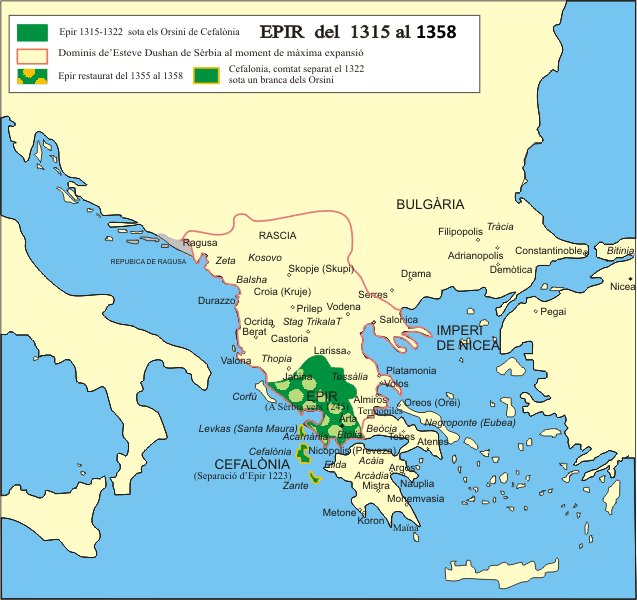
The Despotate of Epirus (Medieval Greek: Δεσποτᾶτον τῆς Ἠπείρου) was one of the Greek rump states of the Byzantine Empire established in the aftermath of the Fourth Crusade in 1204 by a branch of the Angelos dynasty, the Komnenodoukas dynasty. It claimed to be the legitimate successor of the Byzantine Empire during the subsequent struggle for Constantinople, along with the Empire of Nicaea and the Empire of Trebizond; its rulers briefly proclaiming themselves as Emperors in 1227–1242, during which it is most often called the Empire of Thessalonica.
The Epirote state was founded in 1205 by Michael Komnenos Doukas, a cousin of the Byzantine emperors Isaac II Angelos and Alexios III Angelos. At first, Michael allied with Boniface of Montferrat, but having lost the Morea (Peloponnese) to the Franks at the battle of the Olive Grove of Koundouros, he went to Epirus, where he considered himself the Byzantine governor of the old province of Nicopolis and revolted against Boniface. Epirus soon became the new home of many refugees from Constantinople, Thessaly, and the Peloponnese, and Michael was described as a second Noah, rescuing men from the Latin flood. John X Kamateros, the Patriarch of Constantinople, did not consider him a legitimate successor and instead joined Theodore I Laskaris in Nicaea; Michael instead recognized the authority of Pope Innocent III over Epirus, cutting ties to the Eastern Orthodox Church.
Medieval Greek, Old Albanian, Old Aromanian, Middle Bulgarian
Religion
Greek Orthodoxy
Coins, Currency and Symbols
Currency
Denier
Wars and Battles
Theodore Komnenos Doukas immediately set out to attack Thessalonica, and he fought with the Bulgarians along the way. Henry of Flanders died on the way to counterattack, and in 1217 Theodore captured his successor Peter of Courtenay, most likely executing him. The Latin Empire fell into disarray after losing the Battle of Poimanenon to the Nicaeans, and could not stop Theodore from capturing Thessalonica in 1224. Theodore now challenged Nicaea for the imperial title and crowned himself emperor, founding the short-lived Empire of Thessalonica. In 1225, after John III Doukas Vatatzes of Nicaea had taken Adrianople, Theodore arrived and took it back from him. Theodore also allied with the Bulgarians and drove the Latins out of Thrace. In 1227 Theodore crowned himself Byzantine emperor, although this was not recognized by most Greeks, especially not the Patriarch in Nicaea.
Anna succeeded in marrying off Thomas to a daughter of Michael IX, but Thomas was assassinated in 1318 by his cousin Nicholas Orsini, who married his widow and claimed to rule not only Epirus, but all of Greece; his rule was limited only to Akamania, or the southern part of Epirus. In 1323 he was overthrown by his brother John, who attempted to balance submission to Constantinople with cooperation with the Angevins of Naples, who also claimed Greece as part of their domains. John was poisoned around 1335 by his wife Anna, who became regent for their son Nikephoros II. In 1337 the new Emperor, Andronikos III Palaiologos, arrived in northern Epirus with an army partly composed of 2,000 Turks contributed by his ally Umur of Aydın. Andronikos first dealt with unrest due to attacks by Albanians and then turned his interest to the Despotate.
Blick vom höchsten Punkt auf dem Glockenturrm des "ROLOI" Uhrturm in der Altstadt von Rhodos.Böhringer Friedrich · CC BY-SA 2.5 · Commons
Rhodes (Greek: Ρόδος, romanized: Ródos [ˈroðos]) is the largest of Greece's Dodecanese islands and their historical capital, as well as the ninth largest island in the Mediterranean Sea. Administratively, Rhodes constitutes a municipality within the Rhodes regional unit, which is part of the South Aegean administrative region. The principal town of the island and seat of the municipality is the city of Rhodes, home to 50,636 inhabitants according to the 2011 census. By 2022, the island's population had grown to 125,113 people.
During the Late Pleistocene, the island was inhabited by an unnamed species of dwarf elephant. The island has been inhabited by humans since at least the late Neolithic, as evidenced by remains found at Kalythies cave on the northeast of the island.
The municipality has an area of 1400.681 km2. It covers the island of Rhodes and a few uninhabited offshore islets. Rhodes city was the capital of the former Dodecanese Prefecture. Rhodes is the most populated island of the South Aegean Region.
The economy is tourist-oriented, and the most developed sector is service. Tourism has elevated Rhodes economically, compared to the rest of Greece.
Read more
Small industries process imported raw materials for local retail, though other industry includes agricultural goods production, stockbreeding, fishery and winery.
Flag of Rhodes IslandTakisA1, Ancient Design found on coins [1] · Public domain · Commons
Wars and Battles
Following the Italian Armistice of 8 September 1943, the British attempted to get the Italian garrison on Rhodes to change sides. This was anticipated by the German Army, which succeeded in occupying the island with the Battle of Rhodes. In great measure, the German occupation caused the British failure in the subsequent Dodecanese Campaign.
Read more
After September 1943, the Jews were sent to concentration camps. However, the Turkish Consul Selahattin Ülkümen succeeded, at considerable risk to himself and his family, in saving 42 Jewish families, about 200 persons in total, who had Turkish citizenship or were members of Turkish citizens' families.
On 8 May 1945, the Germans under Otto Wagener surrendered Rhodes as well as the Dodecanese as a whole to the British, who soon after then occupied the islands as a military protectorate.
1206 CE – 1226 CE · Capital: Thessalonica · 33,116 km²
ThessalonicaSilentResident (compilation, sources to attribute see above; if any of the sources used in the Montage are removed from Wikimedia Commons, or better ones are… · CC BY-SA 3.0 · Commons
The Kingdom of Thessalonica (Greek: Βασίλειον τῆς Θεσσαλονίκης, romanized: Vasílion tis Thessaloníkis) was a short-lived Crusader State established as a vassal of the Latin Empire following the Fourth Crusade. It was formed from the partition of Byzantine lands in today's territory of Northern Greece with Thessalonica as its capital. The kingdom faced continual pressure from neighboring powers and collapsed after the Despotate of Epirus conquered it in 1224.
Boniface was assigned to a large fief in Anatolia, but he, wanting a fief in Europe, demanded Thessalonica, the second-largest Byzantine city after Constantinople. Late 13th and 14th century sources suggest that Boniface based his claim to Thessalonica on the statement that his younger brother Renier had been granted Thessalonica on his marriage to Maria Komnene in 1180. He set out to Thessalonica, however, Emperor Baldwin changed his mind and took control of the city before the arrival of Boniface. In response, Boniface moved against the Emperor's possessions by taking Didymoteicho and besieging Adrianople. The two men sought peace, with Boniface receiving Thessalonica and returning Didymoteicho to the emperor.
Read more
In 1204–05, Boniface extended his rule south into Greece, advancing through Thessaly, Boeotia, Euboea, and Attica.
Roman Catholic (official), Eastern Orthodox (popular)
Coins, Currency and Symbols
Coat of arms of the Kingdom of ThessalonicaPhilly boy92 (Trashpanda) · Public domain · Commons
Decline and Fall
Michael I of Epirus, a former ally of Boniface, attacked the kingdom in 1210, as did the Bulgarians. Henry of Flanders eventually defeated both, but after Michael's death in 1214, his brother and successor Theodore began the assault on the kingdom anew. Over the next nine years, Theodore gradually conquered all of Thessalonica except the city itself, as the Latin Empire could spare no army to defend it while it fought the Empire of Nicaea in Asia Minor. In 1224, just as Demetrius had become old enough to take power for himself, Theodore finally captured Thessalonica and the kingdom became part of the Despotate of Epirus.
The Triarchy of Negroponte was a crusader state established on the island of Euboea (Venetian: Negroponte) after the partition of the Byzantine Empire following the Fourth Crusade. Partitioned into three baronies (terzieri, "thirds") (Chalkis, Karystos and Oreos) run by a few interrelated Lombard families, the island soon fell under the influence of the Republic of Venice. From circa 1390, the island became a regular Venetian colony as the Realm of Negroponte (Venetian: Reame di Negroponte o Signoria di Negroponte).
According to the division of Byzantine territory (the Partitio terrarum imperii Romaniae), Euboea was awarded to Boniface of Montferrat, King of Thessalonica. Boniface in turn ceded the island as a fief to the Flemish noble Jacques II of Avesnes, who fortified the capital Chalkis.
Read more
After his death in mid-1205 however, the island was ceded to three Veronese barons: Ravano dalle Carceri, Giberto dalle Carceri and Pecoraro da Mercanuovo. They divided the island into three triarchies (terzieri, "thirds"): the northern, based at Oreos (Italian: terzero del Rio), the southern, ruled from Karystos (Italian: terzero di Caristo) and the central portion, ruled from Chalkis (Italian: terzero della Clissura).
Naxos (in Greek, Νάξος) is a Greek island, the largest island (429 km2 (166 sq mi)) in the Cyclades island group in the Aegean. It was the centre of archaic Cycladic culture. Taken from the Apollon's Gate.Sergio Alvarez · CC BY-SA 2.0 · Commons
The Duchy of the Archipelago (Greek: Δουκάτο του Αρχιπελάγους, romanized: Doukáto tou Archipelágous, Italian: Ducato dell'arcipelago, Venetian: Ducato de l'arcipelago), also known as Duchy of Naxos or Duchy of the Aegean, was a maritime state created by Venetian interests in the Cyclades archipelago in the Aegean Sea, in the aftermath of the Fourth Crusade, centered on the islands of Naxos and Paros. It included all the Cyclades (except Mykonos and Tinos).
The Italian city-states, especially the Republic of Genoa, Pisa, and Venice, had been interested in the islands of the Aegean long before the Fourth Crusade. There were Italian trading colonies in Constantinople and Italian pirates frequently attacked settlements in the Aegean in the 12th century. After the collapse and partitioning of the Byzantine Empire in 1204, in which the Venetians played a major role, Venetian interests in the Aegean could be more thoroughly realized.
Read more
The Duchy of the Archipelago was created in 1207 by the Venetian nobleman Marco Sanudo, a participant in the Fourth Crusade and nephew of the former Doge Enrico Dandolo, who had led the Venetian fleet to Constantinople. This was an independent venture, without the consent of the Latin emperor Henry of Flanders.
The institution of European feudalism caused little disruption to the local islanders, who were familiar with the rights of a landowner class under the Byzantine system of the pronoia. The significant legal distinctions between the Byzantine pronoia and feudalism were of little immediate consequence for those who farmed the land or fished the waters in question. In most cases, the local population submitted relatively peacefully to the authority of their new Venetian lords. Sanudo and his successors prudently followed a conciliatory course with their Byzantine subjects, granting even fiefs to certain among them, in an effort to bind them to the dynasty.
Read more
The Venetians brought the Catholic Church with them, but, as they were a minority of habitually absentee landowners, most of the population remained Greek Orthodox.
Before the last Latin Christian duke, Giacomo IV Crispo, was deposed in 1566 by Ottoman Sultan Selim II, he was already paying the Sultan tribute. The Sultan's appointed representative, the last Duke of Archipelago (1566–79) was a Portuguese Jew (Marrano), Joseph Nasi.
Read more
Latin Christian rule did not come to a complete end on that date: the Gozzadini family in Bologna survived as lords of Sifnos and other little islands in the Cyclades until 1617, and the island of Tinos remained Venetian until 1714. The last Venetian ports in Morea (the Peloponnese) were captured in 1718. Gaspar Graziani, a Dalmatian nobleman, was awarded the title of Duke of the Archipelago by the sultan in 1616, but the island was again under direct Ottoman rule at the end of 1617; he was the last to hold the title.
Today, Cyclades islands such as Syros and Tinos have some entirely Catholic villages and parishes, while many Greeks from the Cyclades have surnames with a distinctly Italo-Venetian origin e.g. Venieris, Ragousis, Dellaportas, Damigos etc.
Medieval States of the Balkans and Greece, 510 CE – 1210 CE: Frequently Asked Questions
Which states existed in the Balkans and Greece in this period?
This page maps 21 states of the Balkans and Greece founded between 510 CE and 1210 CE: Kingdom of the Gepids, Avar Khaganate, First Bulgarian Empire, Duchy of Croatia, Principality of Serbia, Emirate of Crete, Magyars, Kingdom of Croatia, Republic of Genoa, Great Principality of Duklja, Halych-Volhynia occupation, Kingdom of Duklja and 9 more.
Which was the largest of the Medieval States of the Balkans and Greece, 510 CE – 1210 CE?
Avar Khaganate had the largest mapped extent, about 1,022,315 km².
Which of the Medieval States of the Balkans and Greece, 510 CE – 1210 CE lasted longest?
Republic of Genoa lasted longest, 1010 CE – 1795 CE.
↑↓ to navigate↵ to open
12,754 Planetary Entities Indexed
We use Google Analytics cookies to understand which pages are useful. Necessary storage only keeps your theme and this choice on your device. Privacy policy