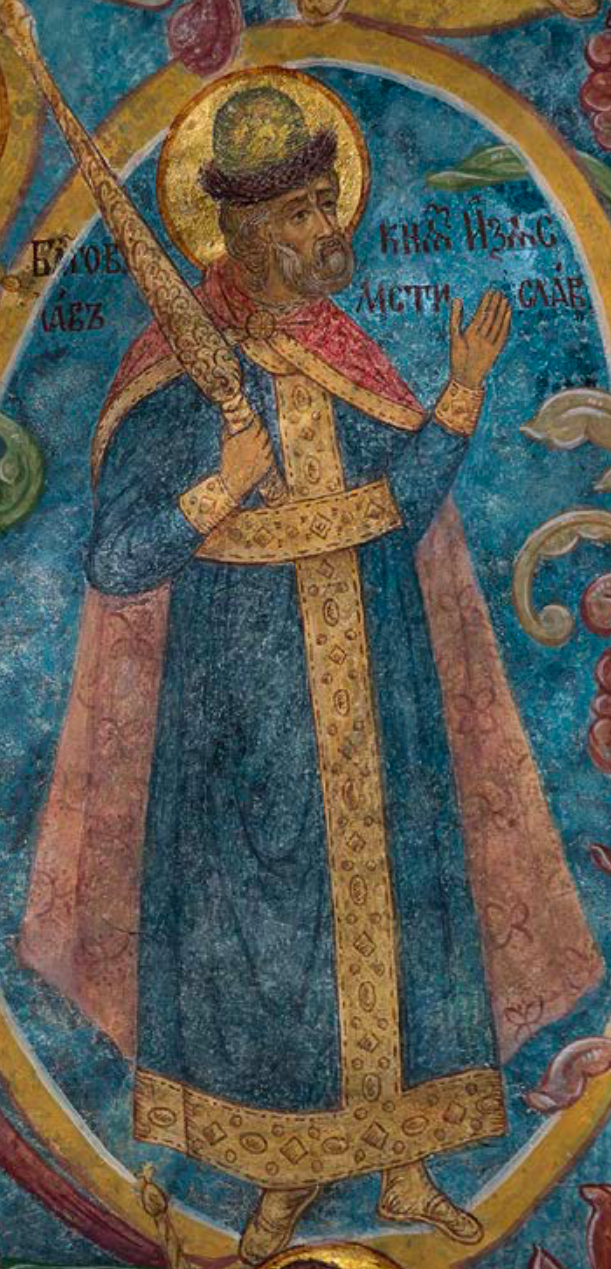
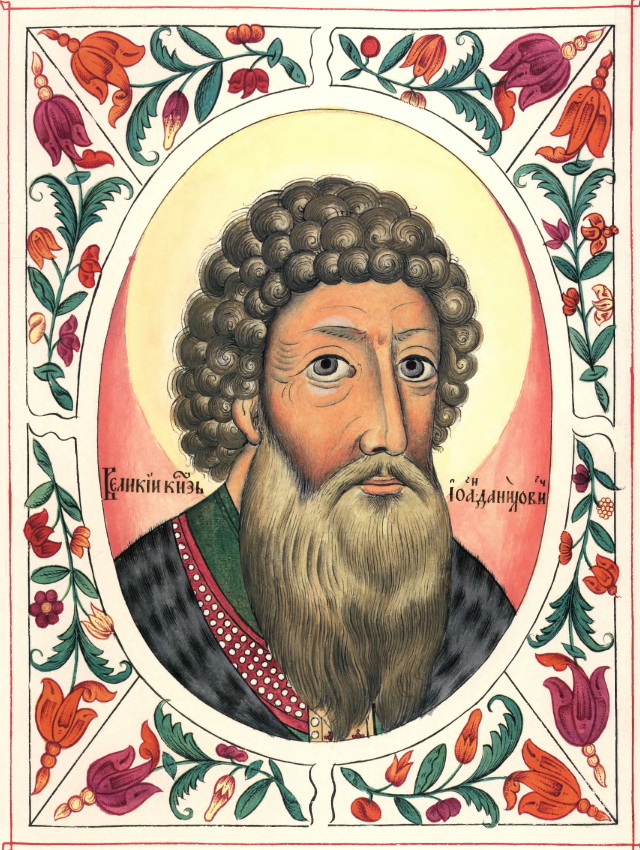
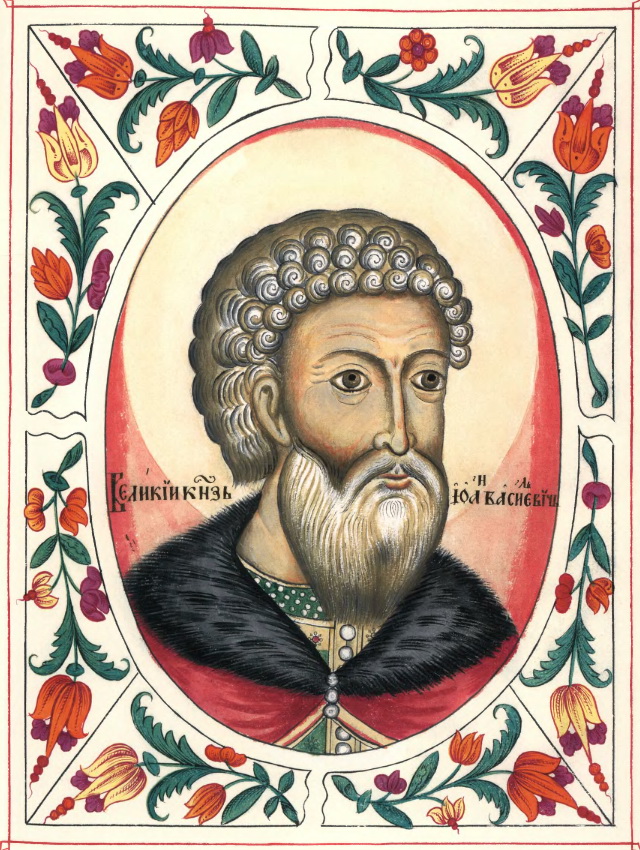
The disintegration of the Kievan Rus' was the process of political fragmentation of the Kievan Rus', which in the mid-12th century divided into independent principalities. Formally, the Kievan Rus' continued to exist up to the Mongol invasion (1237–1241), with Kiev considered to be its main city.
The period from the 12th to the 16th century is traditionally known as the appanage period, or as feudal fragmentation in Soviet Marxist historiography. The boundary of the disintegration is considered to be 1132 — the year of the death of the last powerful Kievan prince Mstislav the Great. The next stage of disintegration was the liquidation of the institution of "communion in the Russian land" as a result of the Mongol invasion: the cessation of the struggle for Kiev and the Kievan volosts, collective ownership and defense of the Kievan land by princes of various branches of the Rurikids. Its final completion falls on the second half of the 13th century, when the previous structure of almost all ancient Russian lands seriously changed, the power of Lithuania and Poland began to spread to their western part, and they thereby lost their dynastic unity.
The result of the disintegration was the emergence of new political entities on the site of Kievan Rus', and the remote consequence was the formation of modern peoples: Russians, Ukrainians, and Belarusians.
Each state in its own colour. Move the timeline to see which existed in any year from 1056 AD to 1546; select a territory to read about it. Borders: Cliopatria / Seshat (CC BY 4.0).
The Kievan land, which had turned from a metropole into a "simple" principality, was characterized by a steady decrease in its political role. The territory of the land itself, remaining under the control of the Kievan prince, also constantly decreased. One of the economic factors that undermined the power of the city was a change in international trade communications. The "Trade route from the Varangians to the Greeks", which was the core of Kievan Rus', lost its relevance after the Crusades. Europe and the East were now connected bypassing Kiev (via the Mediterranean Sea and via the Volga trade route). Constant struggle for the princely throne, political instability, and uprisings of citizens led to the fact that during the 12th century the Prince of Kiev changed 37 times; some of the princes occupied the throne for less than a year.
The Principality of Chernigov or Chernihiv was one of the largest and most powerful states within Kievan Rus'. For a time the principality was the second most powerful after the Principality of Kiev. The principality was formed in the 10th century and maintained some of its distinctiveness until the 16th century. The Principality of Chernigov consisted of regions of modern-day Ukraine, Belarus, and Russia.
Основание Киева тремя братьями Кием, Щеком и Хоривом и сестрой ЛыбедьюUnknown authorUnknown author · Public domain · Commons
The inner Principality of Kiev was a medieval principality centered on the city of Kiev.
The principality was formed during the process of political fragmentation of the Kievan Rus' in the early 12th century. As a result of that process, the effective rule of the grand princes of Kiev was gradually reduced to central regions of Kievan Rus' around its capital city Kiev, thus forming a reduced princely domain, known as the inner Principality of Kiev. It existed as a polity until the middle of the 14th century, when it was annexed by the Grand Duchy of Lithuania.
Златник X-XI века князя Владимира из коллекции Эрмитажа.Фотография из Эрмитажа · Public domain · Commons
Currency
zlatnik
Деньга 1613—1645 гг., без даты. Царь Михаил Федорович Романов. Новодел. Биткин II К49 (R2). Реверс. Надпись в шесть строк: ЦЬ I ВЕЛИКИ КНѦSЬ МИХАИЛ[О] ѲЕДОРОВЧЬ ВСЕ[Ѧ] РУСIИАНО «Международный нумизматический клуб» · CC BY-SA 4.0 · Commons
1056 CE – 1146 CE · Capital: Peremyshl · 62,424 km²
The Principality of Peremyshl was a medieval principality centered on Peremyshl (Old East Slavic: Перемышль; now Przemyśl, Poland), and encompassing the Przemyśl Land, in the historical region of Red Rus' (Cherven land, or Red Ruthenia). It was one of several minor principalities within Halychyna (medieval Galicia), situated in the most western part of the region, and thus bordering the medieval Polish state.
1056 CE – 1240 CE · Capital: Pereyaslavl · 95,082 km²
Вознесенський монастир (мур.), Переяслав-Хмельницький, вул. Г.Сковороди, 54Kiyanka · CC BY-SA 3.0 · Commons
The Principality of Pereyaslavl (Ukrainian: Переяславське князівство; Russian: Переяславское княжество) was a regional principality of Kievan Rus' from the end of 9th century until 1323, based in the city of Pereyaslavl (now Pereiaslav) on the river Trubizh.
Калаж для артыкулаў пра Полацк з фотаздымкаў:Belarus2578 · CC BY-SA 4.0 · Commons
Polotsk, or Polatsk, is a town in Vitebsk Region, Belarus. It is situated on the Dvina River and serves as the administrative center of Polotsk District. Polotsk is served by Polotsk Airport and Borovitsy air base. As of 2025, it has a population of 79,285.
Flag of the city of Polotsk BelarusAzgar · Public domain · Commons
Coat of Arms of Połack, BelarusAzgar · Public domain · Commons
Legacy in the Modern World
The city's Saint Sophia Cathedral (1044–1066) was a symbol of the independent-mindedness of Polotsk, rivaling churches of the same name in Novgorod and Kyiv. The name referred to the original Hagia Sophia in Constantinople, and thus claims imperial prestige, authority and sovereignty. The cathedral had been ruined by the troops of Peter I of Russia. Hence the present baroque building by Johann Christoph Glaubitz dates from the mid-18th century. Some genuine 12th-century architecture (notably Transfiguration Church) survives in the Convent of Saint Euphrosyne, which also features a neo-Byzantine cathedral, designed and built in 1893—1899 by Vladimir Korshikov.
1056 CE – 1240 CE · Capital: Suzdal (1125–1157), Vladimir (1157–1389) · 250,637 km²
Vsevolod III Big nest with sonsДмитровский Собор во Владимире · CC BY-SA 4.0 · Commons
The Grand Principality of Vladimir, before 1157 the Principality of Suzdal, commonly known as Vladimir-Suzdal, or simply Suzdalia, was a Russian principality. Its capital was the city of Vladimir. In Russian historiography, its original territory is commonly denoted as northeast Russia or northeast Rus'.
It was originally established during the disintegration of Kievan Rus'. Prince Yury Dolgoruky (r. 1125–1157) moved his capital from Rostov to Suzdal in 1125, following the death of his father, Vladimir Monomakh. He ruled a principality that had become virtually independent.
The first known prince of Rostov mentioned in the Primary Chronicle under the year 988 was Yaroslav Vladimirovich, appointed by his father Vladimir I of Kiev. In 1024, there was reportedly a famine in the area, and a revolt stoked up by pagan sorcerers was suppressed by Yaroslav personally. Upon his death in 1054, Vsevolod Yaroslavich received the lands of Rostov and Suzdal. Little is known about the region until the 1090s, except that the town of Yaroslavl had been founded upon the upper Volga by 1071, and that Vladimir Monomakh ordered a church to be built in Rostov. Bishops are recorded in the 1080s and 1090s, but the seat appears to have remained vacant for the next half-century. The 1097 Council of Liubech confirmed Vladimir Monomakh's possession of Rostov and Suzdal. By the early 12th century, the towns of Rostov, Suzdal and Murom remained junior postings.
Rus' was only able to recover from the consequences of the Mongol invasion by the late thirteenth century. The first areas to recover were Novgorod and Pskov, which had been spared the Tatar raids. These city-states, with parliamentarian rule, created an original kind of culture under some influence from their western Baltic neighbours. In the early fourteenth century, leadership in the northeastern lands was transferred from the Principality of Vladimir to Moscow, which, in turn, would fight for leadership against Tver for another century. Moscow was a part of the Vladimir lands and functioned as one of the border fortresses of north-eastern Rus'. In 1324, Metropolitan Peter left Vladimir and settled down in Moscow, thus, transferring the residence of the Russian Orthodox Church (Metropolitan Maximus had moved the residence from Kiev to Vladimir not long before, in 1299).
1056 CE – 1406 CE · Capital: Smolensk · 151,033 km²
The en:Assumption Cathedral in Smolensk, en:Russia. On the right, the Trinity (Troitsky) Cathedral of the Troitsky MonasteryFisss at English Wikipedia · Public domain · Commons
The Principality of Smolensk, also known as the Grand Principality of Smolensk, was a Russian principality with its capital in Smolensk.
It became an independent principality in 1125. Smolensk gradually came under Lithuanian influence and was incorporated into the Grand Duchy of Lithuania in 1404. The principality was later reorganized into the Smolensk Voivodeship in 1508.
In the last four decades of the 11th century, it was a dependency of Kiev (i.e. it was governed by an appointee of the prince of Kiev). The descendants of Yaroslav I of Kiev governed the principality until 1125, starting with Vyacheslav Yaroslavich from 1054. For most of the last quarter of the 11th century and the first quarter of the 12th century, it was a possession of Vladimir II Monomakh. Following his death, his son Mstislav I Vladimirovich became the prince of Kiev and Mstislav's son Rostislav Mstislavich became the prince of Smolensk in 1125, as well as the grand prince of Kiev.
Read more
At this point, Smolensk became an independent principality. Rostislav would be the progenitor of the Rostislavichi, one of the four major branches of the Rurikid dynasty. The family held Smolensk until the early 15th century.
The famous trade route from the Varangians to the Greeks passed through the principality and was an important source of income for its rulers. Trade with Riga and Visby developed during the second half of the 12th and 13th centuries. Wax was the main export followed by honey and furs; the main imports from Europe were textiles and later, salt, delicacies and wine.
1056 CE – 1201 CE · Capital: Volodymyr · 82,372 km²
Комплекс Успенського собору (12-17 ст.) - Успенський собор (ліворуч), будинок з дзвіницею (праворуч) - м.Володимир-Волинський (вул. Соборна) Волинська область УкраїнаViacheslav Galievskyi · CC BY-SA 4.0 · Commons
The Principality of Volhynia (Ukrainian: Волинське князівство) was a western Kievan Rus' principality founded by the Rurikid prince Vsevolod in 987 centered in the region of Volhynia, straddling the borders of modern-day Ukraine, Belarus, and Poland. From 1069 to 1118, it belonged to the Izyaslavichi who primarily ruled from Turov (see Principality of Turov). After losing Turov to the Monomakhovichi in 1105, the descendants of Iziaslav Yaroslavovich for a few years continued to rule in Volhynia.
1085 CE – 1146 CE · Capital: Terebovlia · 57,392 km²
The Principality of Terebovlia (Ukrainian: Теребовлянське князівство) was a principality of Kievan Rus' established as an appanage around the year 1084 and given to Vasylko Rostyslavych.
Andrei I Bogolyubsky, fresco of the Archangel CathedralUnknown authorUnknown author · CC BY-SA 4.0 · Commons
The Principality of Ryazan, later known as the Grand Principality of Ryazan, was a Russian principality from 1129 to 1521. Its capital was the city of Ryazan, now known as Old Ryazan, which was destroyed in 1237 during the Mongol invasions. The capital was moved to Pereyaslavl-Ryazansky, later renamed Ryazan.
Initially a part of the Principality of Murom, it fully split off from the Principality of Chernigov by 1129 as Murom-Ryazan.
Initially a part of the Principality of Chernigov, Murom-Ryazan became a separate principality under the reign of Yaroslav Sviatoslavich after he was ousted from Chernigov by Vsevolod Olgovich, which remained in possession of his descendants after he died in 1129.
Read more
The political centre of the principality was later moved to Ryazan. By the end of the 12th century, the principality waged wars with the neighbouring Grand Duchy of Vladimir. In the course of that stand-off, the city of Ryazan was burned twice in a span of twenty years from 1186 to 1208. In 1217, there was a culmination point in the history of Ryazan when during the civil war inside the Duchy six leaders of the state were killed by Gleb Vladimirovich who later defected to the Cumans.
Вид на Друцкое городище с левого берега р. ДрутиΔημήτριος · CC BY-SA 4.0 · Commons
The Principality of Drutsk (Belarusian: Княства Друцкае; obsolete spelling: Druck) was a small appanage of the Principality of Polotsk, centred in the city of Drutsk. It was located on a three way stick between Vitebsk, Minsk and Mogilev regions in modern Belarus.
The appanage principality of Drutsk was established after the death of Vseslav, the Prince of Polotsk, in 1101 and the division of the Polatsk territory between Vseslav's sons. Drutsk was given to Rogvolod-Boris.
Jersikas pareizticīgo baznīca, 2000-07-21J. Sedols · CC BY 3.0 · Commons
The Principality of Jersika (Latin: Gerzika, terra Lettia; German: Gerzika, Zargrad; Russian: Герсикское княжество, Ерсикское княжество) was a medieval Latgalian principality in the east of modern-day Latvia, and one of the largest medieval states in Latvia before the Northern Crusades. The capital of Jersika was located on a hill fort 165 kilometres (103 mi) southeast of Riga. In documents dating to the 13th century, the western part of the principality was called Lettia, and the eastern part by the Russian name Lotygola.
The Principality of Minsk was an appanage principality of the Principality of Polotsk and centered on the city of Minsk (today in Belarus). It existed from its founding in 1101 until it was nominally annexed by the Grand Duchy of Lithuania in 1242, and then fell under de facto annexation in 1326.
The Principality of Vitebsk (Belarusian: Віцебскае княства) was a Ruthenian principality centered on the city of Vitebsk in modern Belarus, that existed from its founding in 1101 until it was nominally inherited into the Grand Duchy of Lithuania in 1320. Vitebsk would later fall under the complete authority of Lithuania in 1508.
Houses in center of Halych, Ivano-Frankivsk Oblast, western Ukraine.Roman Zacharij · Public domain · Commons
The Principality of Galicia (Ukrainian: Галицьке князівство, romanized: Halytske kniazivstvo; Old East Slavic: Галицкоє кънѧжьство, romanized: Galickoje kǔnęžǐstvo), also known as the Principality of Halych or Principality of Halychian Rus', was a medieval East Slavic principality and one of the main regional states within the political framework of Kievan Rus'. It was established by members of the senior line of the descendants of Yaroslav the Wise.
The earliest recorded Slavic tribes inhabiting the territory of Red Rus' were the White Croats and the Dulebes.
Read more
In 907, the Croats and Dulebes took part in the military campaign against Constantinople led by Prince Oleg of Kiev. This was the first notable evidence of political alignment among the native tribes of Red Rus'.
According to Nestor the Chronicler, strongholds in the western part of Red Rus' were conquered by Vladimir the Great in 981. In 992 or 993, Vladimir conducted a campaign against the Croats. Around this time, the city of Volodymyr was founded in his honour and became the main political centre of the region.
During the 11th century, the western border cities, including Przemyśl, were annexed twice by the Kingdom of Poland (1018–1031 and 1069–1080). Meanwhile, Yaroslav the Wise consolidated Rus' authority in the area, establishing the city of Jarosław.
Unlike other principalities of Rus', by the mid-13th century Galicia developed a system of land tenure, where fiefs would be held by boyars for a limited amount of time in exchange for military service. Such landholdings existed along with the traditional otchina, and could be the result of specific relations between the local feudals and rulers, as well as influence from neighbouring Hungary and Poland.
Alex K HalychAlex Tora or Alex K in Ukranian and Japanese wiki · Public domain · Commons
Decline and Fall
During the later years of Daniel's rule, Galicia passed into the hands of his eldest son, Leo I of Galicia, who, after his father's death, gradually extended his authority over all of Volhynia. In the second half of the thirteenth century, he elevated the importance of Lviv, a new political and administrative center founded near Zvenyhorod on the border with Volhynia.
Read more
Around 1300, Leo briefly established control over Kiev, although he remained dependent on the Golden Horde. Following Leo's death, the center of the united Galician–Volhynian state shifted back to the city of Volodymyr. Under subsequent rulers, the local nobility gradually regained influence, and from 1341 to 1349 power was effectively exercised by the nobleman Dmytro Dedko, while the Lithuanian prince Liubartas held nominal authority.
1188 CE – 1240 CE · Capital: Turov, Pinsk · 69,423 km²
BLR Turau Castle Hill view to River Prypjats 1Pulkassa, Flickr · CC BY-SA 2.0 · Commons
The Principality of Turov, later called the Principality of Turov and Pinsk (Belarusian: Турава-Пінскае княства, romanized: Turava-Pinskaje kniastva; Russian: Турово-Пинское княжество, romanized: Turovo-Pinskoye knyazhestvo; Ukrainian: Турово-Пінське князівство, romanized: Turovo-Pins'ke knyazivstvo), also known as Turovian Rus', was a medieval principality of Kievan Rus' from the 10th century on the territory of modern-day Belarus and northern Ukraine. The princes of Turov often served as grand princes early in the 10th and 11th centuries.
In the early 13th century the Principality of Turov became dependent of the Kingdom of Galicia–Volhynia. To liberate itself from it, the dukes of Turov cooperated more and more with the Grand Duchy of Lithuania. In the early 14th century the Principality non-violently joined the Grand Duchy. By that time Hleb Narymunt, the son of Gediminas, was already ruler of Pinsk, while Turov and Haradok were still ruled by Rurikids. Later the territory of the Principality became part of the Brest Litovsk, Nowogródek, and Minsk Voivodeship.
1202 CE – 1240 CE · Capital: Volodymyr, Halych, Chełm, (1241–1272), Lviv, (1272–1301) · 188,420 km²
Комплекс Успенського собору (12-17 ст.) - Успенський собор (ліворуч), будинок з дзвіницею (праворуч) - м.Володимир-Волинський (вул. Соборна) Волинська область УкраїнаViacheslav Galievskyi · CC BY-SA 4.0 · Commons
The Kingdom of Galicia–Volhynia, known as the Principality of Galicia–Volhynia before 1253, and also known as the Kingdom of Ruthenia or Kingdom of Rus', was a medieval state in Eastern Europe which existed from 1199 to 1349. Its territory was predominantly located in modern-day Ukraine, with parts in Belarus, Poland, Romania, Moldova, and Lithuania. Along with Novgorod and Vladimir-Suzdal, it was one of the three most important powers to emerge from the collapse of Kievan Rus'.
Roman the Great united the principalities of Galicia and Volhynia at the turn of the 13th century.
The Principality of Volhynia may have emerged as early as the late 10th century, with Vsevolod, a son of Vladimir I of Kiev, mentioned as a prince of the city of Volodymyr. Igor Yaroslavich reportedly briefly reigned as the prince of Volodymyr in the 1050s. Iaroslav Sviatopolkovich (r. 1100–1118) was the only prince in Kievan Rus' to oppose Vladimir II Monomakh's reign on the grounds of agnatic seniority, but after Vladimir ousted him in 1118, his Monomakhovichi descendants established a local dynastic branch. Roman Mstislavich, the great-great-grandson of Monomakh, inherited the throne of Volhynia in 1170.
Read more
The Principality of Galicia was formed in the years 1124–1144 by Vladimirko Volodarovich's unification of the principalities of Zvenyhorod, Peremyshl, and Terebovlia.
Both Volhynia and Galicia had experienced a remarkable economic development in the 12th century due to their commercial advantages. In part, this was because land trade routes in Asia Minor were severely disrupted due to the Byzantine–Seljuk wars (1046–1243), diverting numerous merchants coming from the east heading for Constantinople via Alexandria in Egypt, while others circumvented Anatolia via the port of Sudak (Sougdaia) in Crimea. The flourishing of the latter commercial hub soon attracted Kievan Rus' traders, who rerouted some of the would-be Byzantine goods (occasionally through itinerant Jewish merchants) to Poland, Hungary, Bohemia and Germany, via the towns of Volhynia and Galicia.
Yuri I of Galicia armsЛобачев Владимир · CC0 · Commons
Wars and Battles
In 1205, Roman's alliance with the Poles broke down, leading to a conflict with Leszek the White and Konrad of Masovia. Roman was subsequently killed by Polish forces in the Battle of Zawichost (1205), triggering a war of succession, while his dominion entered a period of rebellion and chaos that lasted almost 40 years. In this time, the Galician boyars made efforts to prevent the establishment of a hereditary princely dynasty, especially by Roman's son Daniel, and instead put all sorts of puppets on the throne which they could easily control. Thus weakened by war between Galician boyars and some appanage princes, Galicia–Volhynia also became an arena of rivalry between Poland and Hungary, which intervened in the region several times. Roman's successors would mostly use Halych (Galicia) as the designation of their combined kingdom.
By the 12th century, construction of new buildings was taking place at a faster rate in the emerging urban centres of Galicia–Volynia (as well as in Smolensk and Suzdalia) than in the older centres of princely power of Kiev, Chernigov, and Pereyaslavl. Galicia–Volynia and the Novgorod Republic were also prominent examples of regions that began to establish their own Rus' chronicle traditions, still starting with the Primary Chronicle (PVL), but increasingly focusing on their own lands rather than the wider Kievan Rus' realm. The Kievan Chronicle was supplemented by the Galician–Volhynian Chronicle (GVC), and as such copied, redistributed, and preserved in codices such as the Hypatian Codex and the Khlebnikov Codex.
In winter 1341 Tatars, Ruthenians led by Detko, and Lithuanians led by Liubartas were able to defeat the Poles, although they were not so successful in summer 1341. Finally, Detko was forced to accept Polish overlordship, as a starost of Galicia. After Detko's death, Casimir III mounted a successful invasion, capturing and annexing Galicia in 1349.The Romanovichi (branch of the Rurikid) dynasty of Daniel of Galicia attempted to gain support from Pope Benedict XII and broader European powers for an alliance against the Mongols, but ultimately proved unable to compete with the rising powers of the centralised Grand Duchy of Lithuania and the Kingdom of Poland. Only in 1349, after the occupation of Galicia–Volhynia by an allied Polish-Hungarian force, was Galicia–Volhynia finally conquered and incorporated into Poland.
1294 CE – 1546 CE · Capital: Moscow · 2,433,401 km²
danila of Moscow.collective of Titularnik · Public domain · Commons
The Grand Principality of Moscow, before 1389 the Principality of Moscow, also known by the exonym Muscovy, was a late medieval Russian monarchy. Its capital was the city of Moscow. Originally established as an appanage principality in the 13th century, Moscow became the leading Russian principality and was transformed into a centralized Russian state in the late 15th century, laying the groundwork for Tsarist Russia.
Moscow became a separate principality when Daniel (r. 1263–1303), the youngest son of Alexander Nevsky, received the city and surrounding area as an appanage.
Moscow is first mentioned in chronicles under the year 1147, as part of the principality of Rostov-Suzdal. The importance of Moscow greatly increased during the second half of the 12th century, and it was converted into a fortified gorod (stronghold) in the 1150s. On the death of Vsevolod III in 1212, Moscow appears to have been passed to his son Yury, who succeeded his father as the grand prince of Vladimir. During the Mongol invasions of 1237–1238, Moscow was sacked following the destruction of Ryazan. The city is not mentioned again until the late 13th century.
Read more
The first prince of Moscow was Daniel (r. 1263–1303), the youngest son of Aleksandr Nevsky, and he was given Moscow as an otchina, where he established a local branch of Rurikid princes. Until 1271, the principality was ruled by the governors of Daniel's uncle Yaroslav.
Vasily Kosoy1434 CEМастера Оружейной Палаты: Г. Никитин, С. Савин, Симон Ушаков, С. Резанец, Ф. Зубов, Я. Казанец, И. Владимиров, Ф. Козлов. Artists of the Armoury: G. · Public domain · Commons
Ivan I (r. 1325–1340) stressed the unity of the ruling house of Moscow and its lands, and as a result, he ensured that the family's lands remained the collective property of all members while giving each one of his heirs a share of the inheritance. Simeon (r. 1340–1353) made a treaty with his brothers, in which the younger members of the house recognized Simeon as their leader and were obligated to follow him in his military campaigns in exchange for Simeon consulting his brothers on important state affairs. As a result, each brother had inviolable possession of his appanage, which he could administer autonomously and pass on to his direct heir.
In the 15th century, following the disintegration of the Golden Horde, Muscovite merchants began trading directly with Crimea, including with the Genoese in Caffa. A distinct merchant group known as the gosti-surozhane emerged, likely composed of native Russians, who specialized in trading with Crimea. Merchants from abroad, including Armenians and Genoese, came to Moscow via Crimea. Around the same time, the city of Kazan replaced Bolghar as the focal point of trade on the river. The annual fair in Kazan attracted many merchants from abroad, including Russians. The Nogai Horde also played an important role in the Muscovite economy by supplying the army with horses. By the 16th century, 20,000 horses were driven to markets in Moscow each year.
Read more
Since early times, the city of Novgorod served as the intermediary between other Russian cities and northwestern Europe.
A distinct school of icon painting was formed in Moscow in the second half of the 14th century, and would be led by Andrei Rublev, one of the most celebrated Russian icon painters. Among his most notable works is The Trinity, which dates to the early 15th century. The first original Russian school, the Suzdal school, was merged with the Moscow school in the early 15th century. Igor Grabar said it could be distinguished by "a general tone, which is always cool, silvery, in contrast to Novgorodian painting which inevitably tends towards the warm, the yellowish, the golden". Dionisius continued the traditions of Andrei Rublev and the Moscow school at the turn of the 16th century. The art of the miniature in illuminated manuscripts also continued to develop in Moscow, with manuscripts like the Khitrovo Gospels containing rich illustrations.
1294 CE – 1325 CE · Capital: Turov, Pinsk · 34,430 km²
BLR Turau Castle Hill view to River Prypjats 1Pulkassa, Flickr · CC BY-SA 2.0 · Commons
The Principality of Turov, later called the Principality of Turov and Pinsk (Belarusian: Турава-Пінскае княства, romanized: Turava-Pinskaje kniastva; Russian: Турово-Пинское княжество, romanized: Turovo-Pinskoye knyazhestvo; Ukrainian: Турово-Пінське князівство, romanized: Turovo-Pins'ke knyazivstvo), also known as Turovian Rus', was a medieval principality of Kievan Rus' from the 10th century on the territory of modern-day Belarus and northern Ukraine. The princes of Turov often served as grand princes early in the 10th and 11th centuries.
In the early 13th century the Principality of Turov became dependent of the Kingdom of Galicia–Volhynia. To liberate itself from it, the dukes of Turov cooperated more and more with the Grand Duchy of Lithuania. In the early 14th century the Principality non-violently joined the Grand Duchy. By that time Hleb Narymunt, the son of Gediminas, was already ruler of Pinsk, while Turov and Haradok were still ruled by Rurikids. Later the territory of the Principality became part of the Brest Litovsk, Nowogródek, and Minsk Voivodeship.
1294 CE – 1325 CE · Capital: Turov, Pinsk · 29,467 km²
BLR Turau Castle Hill view to River Prypjats 1Pulkassa, Flickr · CC BY-SA 2.0 · Commons
The Principality of Turov, later called the Principality of Turov and Pinsk (Belarusian: Турава-Пінскае княства, romanized: Turava-Pinskaje kniastva; Russian: Турово-Пинское княжество, romanized: Turovo-Pinskoye knyazhestvo; Ukrainian: Турово-Пінське князівство, romanized: Turovo-Pins'ke knyazivstvo), also known as Turovian Rus', was a medieval principality of Kievan Rus' from the 10th century on the territory of modern-day Belarus and northern Ukraine. The princes of Turov often served as grand princes early in the 10th and 11th centuries.
In the early 13th century the Principality of Turov became dependent of the Kingdom of Galicia–Volhynia. To liberate itself from it, the dukes of Turov cooperated more and more with the Grand Duchy of Lithuania. In the early 14th century the Principality non-violently joined the Grand Duchy. By that time Hleb Narymunt, the son of Gediminas, was already ruler of Pinsk, while Turov and Haradok were still ruled by Rurikids. Later the territory of the Principality became part of the Brest Litovsk, Nowogródek, and Minsk Voivodeship.
1294 CE – 1486 CE · Capital: Suzdal (1125–1157), Vladimir (1157–1389) · 215,209 km²
Vsevolod III Big nest with sonsДмитровский Собор во Владимире · CC BY-SA 4.0 · Commons
The Grand Principality of Vladimir, before 1157 the Principality of Suzdal, commonly known as Vladimir-Suzdal, or simply Suzdalia, was a Russian principality. Its capital was the city of Vladimir. In Russian historiography, its original territory is commonly denoted as northeast Russia or northeast Rus'.
It was originally established during the disintegration of Kievan Rus'. Prince Yury Dolgoruky (r. 1125–1157) moved his capital from Rostov to Suzdal in 1125, following the death of his father, Vladimir Monomakh. He ruled a principality that had become virtually independent.
The first known prince of Rostov mentioned in the Primary Chronicle under the year 988 was Yaroslav Vladimirovich, appointed by his father Vladimir I of Kiev. In 1024, there was reportedly a famine in the area, and a revolt stoked up by pagan sorcerers was suppressed by Yaroslav personally. Upon his death in 1054, Vsevolod Yaroslavich received the lands of Rostov and Suzdal. Little is known about the region until the 1090s, except that the town of Yaroslavl had been founded upon the upper Volga by 1071, and that Vladimir Monomakh ordered a church to be built in Rostov. Bishops are recorded in the 1080s and 1090s, but the seat appears to have remained vacant for the next half-century. The 1097 Council of Liubech confirmed Vladimir Monomakh's possession of Rostov and Suzdal. By the early 12th century, the towns of Rostov, Suzdal and Murom remained junior postings.
Rus' was only able to recover from the consequences of the Mongol invasion by the late thirteenth century. The first areas to recover were Novgorod and Pskov, which had been spared the Tatar raids. These city-states, with parliamentarian rule, created an original kind of culture under some influence from their western Baltic neighbours. In the early fourteenth century, leadership in the northeastern lands was transferred from the Principality of Vladimir to Moscow, which, in turn, would fight for leadership against Tver for another century. Moscow was a part of the Vladimir lands and functioned as one of the border fortresses of north-eastern Rus'. In 1324, Metropolitan Peter left Vladimir and settled down in Moscow, thus, transferring the residence of the Russian Orthodox Church (Metropolitan Maximus had moved the residence from Kiev to Vladimir not long before, in 1299).
The Principality of Theodoro (Greek: Αὐθεντία πόλεως Θεοδωροῦς καὶ παραθαλασσίας), also known as Gothia (Γοτθία) or the Principality of Theodoro-Mangup, was a former Roman principality in the southern part of Crimea, specifically on the foothills of the Crimean Mountains. It represented the final rump state of the Eastern Roman Empire and the last territorial vestige of the Crimean Goths until its conquest by the Ottoman Empire by the Ottoman Gedik Ahmed Pasha in 1475. Its capital was Doros, also sometimes called Theodoro and now known as Mangup.
In the late 12th century, the Crimean peninsula had seceded from the Byzantine Empire, but soon after the Sack of Constantinople in 1204, parts of it were included in the Trapezuntine Gazarian Perateia. This dependence was never very strong and was eventually replaced by the invading Mongols, who in 1238 poured into the peninsula, occupied its east and enforced a tribute on the western half, including Gothia. Their influence was limited, leaving administrative matters in native hands.
Read more
The Principality of Gothia is first mentioned in the early 14th century, with the earliest date offered by the post-Byzantine historian Theodore Spandounes, who records the existence of a "Prince of Gothia" in the reign of Andronikos III Palaiologos (1328–1341).
On 20 May 1475, an Ottoman fleet left Constantinople and headed off to Crimea. By 6 June, Gedik Ahmet Pasha, the fleet's Ottoman Albanian commander, had conquered Caffa after five days of siege. The prince sent a message on 20 June informing the Hungarian king that Theodoro had been captured by Alexander, brother-in-law of Stephen the Great; however, he also mentioned that Caffa had been captured by the Ottomans, while the khan of Crimea had allied with the sultan.
Read more
The siege of Theodoro castle began sometime in September. The prince had three hundred Wallachians fighting in the defense. According to Vasiliev, the city endured five major assaults during the siege; in the end, Theodoro's food supply was blockaded and the people began to succumb to famine.
Gothia's population was a mixture of Greeks, Crimean Goths, Alans, Circassians, Bulgars, Cumans, Kipchaks, and other ethnic groups, most of whom were adherents to Orthodox Christianity and Hellenized. The principality's official language was Greek.
Read more
The Crimean Goths had settled in Crimea since the 3rd century AD and became increasingly Hellenized, speaking both Greek and adhering to Orthodox Christianity. In the medieval period they mainly lived in rural areas and were still able to speak their language at least until the 16th and perhaps as late as the 18th century.
After the fall of Constantinople in 1453, many Qaraites, who were still Greek-speakers, decided to migrate to Crimea and in particular to the Principality of Theodoro and Chufut-Kale, as Crimea had a familiar Christian Greek culture.
Principalities of Rus': Frequently Asked Questions
What were the Principalities of Rus'?
The disintegration of the Kievan Rus' was the process of political fragmentation of the Kievan Rus', which in the mid-12th century divided into independent principalities.
How many states were there among the Principalities of Rus'?
The atlas maps 22 of them: Principality of Chernigov, Principality of Kiev, Principality of Peremyshl, Principality of Pereyaslavl, Principality of Polotsky, Principality of Rostov-Suzdal, Principality of Smolensk, Principality of Volhynia, Principality of Terebovlia, Principality of Ryazan, Principality of Drutsk, Principality of Jersika and 10 more.
Which was the largest of the Principalities of Rus'?
Grand Principality of Moscow had the largest mapped extent, about 2,433,401 km².
Which of the Principalities of Rus' lasted longest?
Principality of Smolensk lasted longest, 1056 CE – 1406 CE.
↑↓ to navigate↵ to open
12,754 Planetary Entities Indexed
We use Google Analytics cookies to understand which pages are useful. Necessary storage only keeps your theme and this choice on your device. Privacy policy