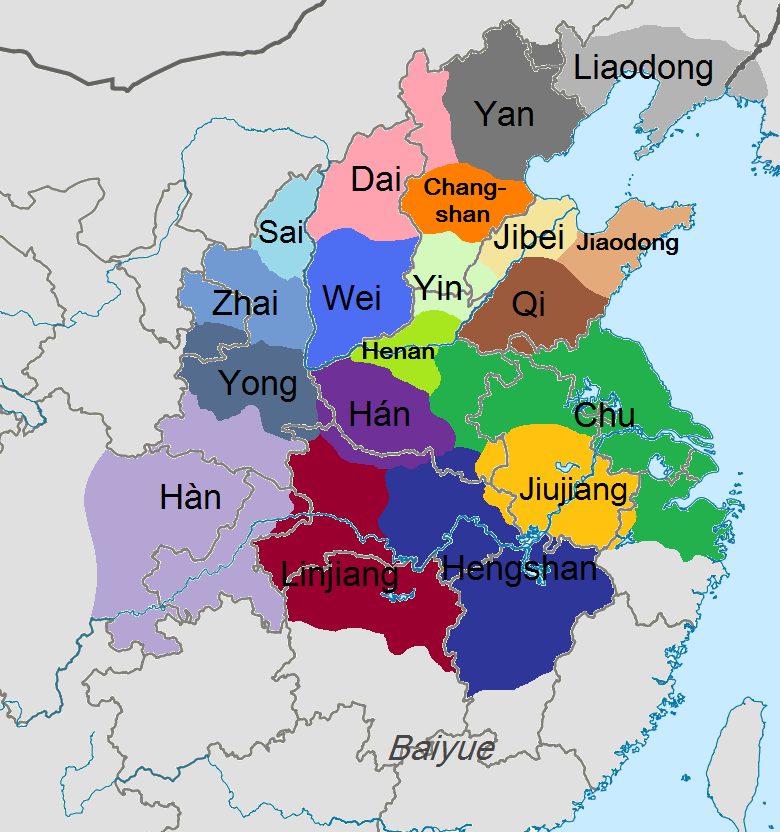
38 states of China on one map, from 1600 BCE to 665 CE.The largest, Xiongnu, covered about 5,619,496 km²; the longest-lived, Shang Dynasty, lasted 1600 BCE – 1001 BCE. Each has its own section below with its rulers, capitals, wars and pictures where the records hold them.
Each state in its own colour. Move the timeline to see which existed in any year from 1600 BC to 665 AD; select a territory to read about it. Borders: Cliopatria / Seshat (CC BY 4.0).
) (either modern Yanshi or Zhengzhou), Ao (near modern Zhengzhou), Yan (near modern Qufu), Xiang (near modern Anyang), Yin (near modern Anyang), Zhaoge (near modern Qi County, Hebi)
1600 BCE – 1001 BCE · Capital: ) (either modern Yanshi or Zhengzhou), Ao (near modern Zhengzhou), Yan (near modern Qufu), Xiang (near modern Anyang), Yin (near modern Anyang), Zhaoge (near modern Qi County, Hebi) · 154,175 km²
周文王像,明人绘Unknown authorUnknown author · Public domain · Commons
The Shang dynasty (Chinese: 商朝; pinyin: Shāngcháo), also known as the Yin dynasty (殷代; Yīn dài), was a Chinese royal dynasty that ruled in the Yellow River valley during the 2nd millennium BC, traditionally succeeding the Xia dynasty and followed by the Western Zhou dynasty. The classic account of the Shang comes from texts such as the Book of Documents, Bamboo Annals and Shiji. Modern scholarship dates the dynasty between the 16th and 11th centuries BC, with more agreement surrounding the end date than beginning date.
The founding myth of the Shang is described by Sima Qian in the Annals of the Yin. In the text, a woman named Jiandi, who was the second wife of Emperor Ku, swallowed an egg dropped by a black bird and subsequently gave birth miraculously to Xie. Xie is said to have helped Yu the Great to control the great flood and for his service to have been granted a place called Shang as a fief. The period before the Shang dynasty was established is known as the "Predynastic Shang" (or "Proto-Shang").
Shang religious rituals featured divination and sacrifice. The degree to which shamanism was a central aspect of Shang religion is a subject of debate.
Read more
The Shang believed that their ancestors held power over them and performed divination rituals to secure their approval for planned actions. Divination involved cracking a turtle carapace or ox scapula to answer a question, and to then record the response to that question on the bone itself. It is unknown what criteria the diviners used to determine the response, but it is believed to be the sound or pattern of the cracks on the bone.
The Shang also seem to have believed in an afterlife, as evidenced by the elaborate burial tombs built for deceased rulers. Often "carriages, utensils, sacrificial vessels, [and] weapons" would be included in the tomb.
The Shang dynasty entered into prolonged conflicts with northern frontier tribes called the Guifang.
Read more
Bronze weapons were an integral part of Shang society. Shang infantry were armed with a variety of stone and bronze weaponry, including spears, pole-axes, pole-based dagger-axes, composite bows, and bronze or leather helmets.
Although the Shang depended upon the military skills of their nobility, Shang rulers could mobilise the masses of town-dwelling and rural commoners as conscript labourers and soldiers for both campaigns of defence and conquest. Aristocrats and other state rulers were obligated to furnish their local garrisons with all necessary equipment, armour, and armaments. The Shang king maintained a force of about a thousand troops at his capital and would personally lead this force into battle.
Simplified Chinese: 《周武王立像》 Chinese: 《周武王立像》label QS:Lzh-hans,"周武王立像"label QS:Lzh,"周武王立像"Ma Lin · Public domain · Commons
The Zhou dynasty (JOH; Chinese: 周; pinyin: Zhōu, pronunciation: [ʈʂóʊ]) was a royal dynasty of China that existed for 790 years from c. 1046 BC until 256 BC, the longest span of any dynasty in Chinese history. During the Western Zhou period (c. 1046 – 771 BC), the royal house, surnamed Ji, had military control over territories centered on the Wei River valley and North China Plain.
Square Shoulder Spade coin from the State of Zhou. c. 650-400 BC. One character 貝 bei.Davidhartill · CC BY-SA 3.0 · Commons
Currency
spade money, knife money
Gary Lee Todd Collection, Ancient Chinese Coins. Complete indexed photo collection at www.WorldHistoryPics.com.Gary Lee Todd, Ph.D. · CC0 · Commons
Gary Lee Todd Collection, Ancient Chinese Coins. Complete indexed photo collection at www.WorldHistoryPics.com.Gary Lee Todd, Ph.D. · CC0 · Commons
Achievements and Monuments
Zhou rulers introduced the Mandate of Heaven, which would prove to be among East Asia's most enduring political doctrines. According to the theory, Heaven imposed a mandate to replace the Shang with the Zhou, whose moral superiority justified seizing Shang wealth and territory in order to return good governance to the people.
Read more
The Mandate of Heaven was presented as a religious compact between the Zhou people and their supreme god in heaven. The Zhou agreed that since worldly affairs were supposed to align with those of the heavens, the heavens conferred legitimate power on only one person, the Zhou ruler. In return, the ruler was duty-bound to uphold heaven's principles of harmony and honor. Any ruler who failed in this duty, who let instability creep into earthly affairs, or who let his people suffer, would lose the mandate.
Cai (Chinese: 蔡; pinyin: Cài; Wade–Giles: Ts'ai4; Old Chinese: *s.r̥ˤat-s) was an ancient Chinese state established at the beginning of the Zhou dynasty, rising to prominence during the Spring and Autumn period, and destroyed early in the Warring States period.
With the spread of surnames to all Chinese during the Qin dynasty, many people from the former state took the surname Cai in memory of their former home.
Read more
These former subjects have undertaken two major migrations. During the Huang Chao Rebellion against the Tang in AD 875, the Cai clan moved to Guangdong and Fujian. A later migration occurred when the Ming loyalist Koxinga relocated many Cai officers to Taiwan in the 17th century.
The State of Cao (simplified Chinese: 曹国; traditional Chinese: 曹國; pinyin: Cáoguó) was a vassal state in China during the Zhou dynasty (1046–221 BC). The state was founded sometime in the 11th century BC by Shu Zhenduo of Cao (d. 1053 BC), a son of King Wen of Zhou and younger brother of King Wu of Zhou. With its capital at Taoqiu (陶丘), the State of Cao covered roughly the area of modern-day Dingtao County, Shandong Province.
Bronze sword used by King Goujian of YueWindmemories · CC BY-SA 4.0 · Commons
The Spring and Autumn period (c. 770 – c. 481 BCE) was a period in Chinese history corresponding roughly to the first half of the Eastern Zhou (c. 771 – 256 BCE), characterized by the gradual erosion of royal power as local lords nominally subject to the Zhou exercised increasing political autonomy. The period's name derives from the Spring and Autumn Annals, a chronicle of the state of Lu between 722 and 481 BCE, which tradition associates with Confucius (551–479 BCE).
In 771 BCE, a Quanrong invasion in coalition with the states of Zeng and Shen—the latter polity being the fief of the grandfather of the disinherited crown prince Yijiu—destroyed the Western Zhou capital at Haojing, killing King You and establishing Yijiu as king at the eastern capital Luoyi. The event ushered in the Eastern Zhou dynasty, which is divided into the Spring and Autumn and the Warring States periods. During the Spring and Autumn period, China's fengjian system became largely irrelevant. The Zhou court, having lost its homeland in the Guanzhong region, held nominal power, but had real control over only a small royal demesne centered on Luoyi. During the early part of the Zhou dynasty period, royal relatives and generals had been given control over fiefdoms in an effort to maintain Zhou authority over vast territory.
Some version of the Five Classics existed in the Spring and Autumn period, as characters in the Zuozhuan and Analects frequently quote the Book of Poetry and Book of Documents. On the other hand, the Zuozhuan depicts some characters actually composing poems that would later be included in the received text of the Book of Poetry. In the Analects there are frequent references to "The Rites", but as Classical Chinese does not employ punctuation or any markup to distinguish book titles from regular nouns it is not possible to know if what is meant is the Etiquette and Ceremonial (known then as the Book of Rites) or just the concept of ritual in general. On the other hand, the existence of the Book of Changes is well-attested in the Zuozhuan, as multiple characters use it for divination and accurately quote the received text.
After the great age of Jin power, the Jin rulers began to lose authority over their ministerial lineages. A full-scale civil war between 497 and 453 ended with the elimination of most noble lines; the remaining aristocratic families divided Jin into three successor states: Han, Wei and Zhao. This is the last event recorded in the Zuozhuan.
Read more
With the absorption of most of the smaller states in the era, this partitioning left seven major states in the Zhou world: the three fragments of Jin, the three remaining great powers of Qin, Chu and Qi, and the weaker state of Yan (燕) near modern Beijing. The partition of Jin, along with the usurpation of Qi by Tian, marks the beginning of the Warring States period.
Teng (Chinese: 滕; pinyin: Téng; 1046–414 BC) was a minor Chinese vassal state that existed during the Spring and Autumn period and the Warring States period, located in the south of modern-day Shandong province. Its territory corresponds to the present-day county-level city of Tengzhou.
Teng's ruling family was the Ji family, with the founder, Shu Xiu of Cuo (錯叔繡), being the 14th brother of King Wu of Zhou. It was conquered and annexed by the Yue state during the reign of Goujian.
Wei (Chinese: 衞; pinyin: Wèi), commonly spelled Wey to distinguish from the contemporary larger Wei (魏) state, was an ancient Chinese state that was founded in the early Western Zhou dynasty and rose to prominence during the Spring and Autumn period. Its rulers were of the surname Ji (姬), the same as that of the rulers of Zhou. It was located in modern northeastern Henan Province, east of Jin (and later Wei 魏), and west of Cao.
The history of Wey dates back to the beginning of the Zhou dynasty and the Rebellion of the Three Guards. After the Duke of Zhou successfully defeated the rebellion, Kang Shu, a younger brother of King Wu of Zhou was given a fief centred on Zhaoge, the capital of the Shang dynasty, which had been the centre of the rebellion.
During the Warring States period, Wey steadily declined due to internal strife and pressure from neighbors, especially Wei.
Read more
In 346 BCE, the duke of Wey degraded his title to marquis (侯). By 320 BCE, the ruler further downgraded to jun (君, lord), and Wey controlled only the county of Puyang (濮陽).
In 254 BCE, King Anxi of Wei killed Lord Huai of Wey (衛懷君). Two years later (252 BCE), Wei installed its son-in-law (from the Wey house) as Lord Yuan of Wey (衛元君), making Wey a dependency of Wei.
In 241 BCE (year 6 of King Zheng of Qin's reign), Qin captured Puyang during its attack on Wei, incorporating it into the new Dong Commandery. Wey's ruler was relocated to Yewang (野王), and a Ji clan member was appointed as Lord Jiao of Wey (衛君角). Wey survived nominally as a Qin vassal with no real independence.
Xu (Chinese: 徐; pinyin: Xú), also called Xu Rong (徐戎) or Xu Yi (徐夷) by its enemies, was an independent Huaiyi state of the Chinese Bronze Age that was ruled by a branch of the Ying family (嬴) and controlled much of the Huai River valley for at least two centuries. It was centered in northern Jiangsu and Anhui.
An ancient but originally minor state that already existed during the late Shang dynasty, Xu was subjugated by the Western Zhou dynasty around 1039 BC, and was gradually sinified from then on.
At the time of its first recorded appearance, Xu was already a powerful Yi state that was probably located in southeastern Shandong or northwestern Jiangsu. Besides this state, a number of small Xu enclaves existed in western Shandong. Like the Dongyi states at Pugu and Yan, Xu participated in the Rebellion of the Three Guards against the Duke of Zhou, although it had no known direct relation to the three competing parties. Ralph D. Sawyer speculates that Xu joined the rebels because it did not wanted to alienate its neighboring states that had co-founded the rebel alliance. In contrast to other sources, the Records of the Grand Historian suggest that Xu and the Huaiyi were not involved in the initial rebellion at all, and only clashed with Zhou forces later.
Read more
Regardless of Xu's involvement, the rebels eventually lost the war.
Despite its confederation's end, the Xu kingdom still held considerable power, so that the dukes Yin and Huan of Lu tried to remain "on good terms with [the Xu peoples]". Their successor, Duke Zhuang of Lu, on the other side, considered the remaining Xu tribes of Shandong a threat and started a war to eliminate them. By that time, the only remaining northern Xu enclave of any significance was centered at Caozhou, holding the local marshes from where the Chi River originated. According to the Zuo Zhuan, the continued raiding activities of the Caozhou-Xu were responsible for the war. Duke Zhuang was able to gain the military assistance of Song, Zheng, and, most importantly, the powerful state of Qi. On the other side, the Xu of Shandong allied with the Xu kingdom. Qi first attacked the Xu of Shandong in 674 BC, but failed to subdue them.
While contemporary and later written records generally considered the people of Xu to be part of the "Huaiyi" or "barbarians of the Huai River", it remains unclear if the Huaiyi were defined on their political opposition to the Zhou dynasty or a shared culture and common ethnicity. Nevertheless, several sinologists, such as Donald B. Wagner, Constance A. Cook, and Barry B. Blakeley consider it likely that the Huaiyi were a specific people, distinct from other groups such as the Dongyi of Shandong and the Nanyi of the middle Yangtze. Archaeological excavations seem to corroborate this assumption, as they indicate that the Xu peoples had a distinct indigenous culture which had evolved from local Neolithic origins. As part of the Huaiyi, the Xu peoples were part of a highly developed bronze culture.
Beginning in 655 BC, the state of Chu began to expand into the Huai River valley, causing several local Huaiyi polities such as the Shu states to ally with it in order to profit from its military assistance. In response to this aggressive expansion into its heartland, the Xu kingdom began to cooperate with Chu's northern enemies, and occupied one of the now-hostile Shu states in 656 BC. Chu retaliated in 645 BC, and launched an invasion of Xu. Duke Huan of Qi, hegemon of China at that time, organised an alliance of Qi, Lu, Song, Chen, Wey, Zheng, Cao, and Xǔ to aid Xu. They sent an expedition to relieve the small kingdom, but the anti-Chu alliance was decisively defeated during the Battle of Loulin. While it was not destroyed and continued to fight for its independence, Xu was severely weakened, marking the beginning of its final decline.
750 BCE – 405 BCE · Capital: Zhu (now south of Qufu), Zou (now southeast of Zoucheng) · 6,650 km²
Zou (simplified Chinese: 邹; traditional Chinese: 鄒), originally Zhu (邾) or Zhulou (邾婁), was a minor state that existed during the Zhou dynasty of ancient China. It centered near today's Zoucheng, Shandong province.
King Wu of Zhou granted Cao Xia (曹挾) control of the small state of Zhu as a vassal ruler under the State of Lu with the feudal title Viscount (子), but later holding the title Duke of Zhu (邾公). The ancestral surname of the ruling family was Cao (曹).
Zhu (朱), without the radical, is one of the most common surnames of modern-day China. Another, albeit less common surname Zou (鄒/邹) is also derived from the former name of the state.
Read more
The noted Neo-Confucian Zhu Xi descends from the ruling house. The small state of Zou, however, is most famous as the birthplace of the Chinese philosopher Mencius. As the overlord State of Lu was the home state of Confucius and many of his disciples, this means that Confucianism's founder, and most of its minor sages and wise men hailed from or had ancestral roots in these two ancient states of China.
Roof tile-end with animal mask design from the Warring States Period, Yan State. Unearthed at Yanxiadu, Yixian, Hebei Province, 1958.BabelStone · CC BY-SA 3.0 · Commons
The Warring States period (c. 475 – 221 BC) in Chinese history comprises the final centuries of the Zhou dynasty (c. 1046 – 256 BC), which were characterized by warfare, bureaucratic and military reform, and political consolidation. It followed the Spring and Autumn period and concluded with the wars of conquest that saw the state of Qin annex each of the other contender states by 221 BC and found the Qin dynasty, the first imperial dynastic state in East Asian history. It saw developments in philosophy, commerce, agriculture, the arts, and society at large.
The Eastern Zhou dynasty began its fall around the 5th century BC. As their influence waned, they had to rely on armies in allied states rather than their own military force. Hundreds of smaller polities coalesced into seven major states which included Chu, Han, Qin, Wei, Yan, Qi and Zhao. However, there eventually was a shift in alliances because each state's ruler wanted independence. This caused hundreds of wars between 535 and 286 BC. The victorious state would have overall rule and control in China.
Read more
The system of feudal states created by the Western Zhou dynasty underwent enormous changes after 771 BC with the flight of the Zhou court to modern-day Luoyang and the diminution of its relevance and power. The Spring and Autumn period led to a few states gaining power at the expense of many others, the latter no longer able to depend on central authority for legitimacy or protection.
In 369 BC, Marquess Wen of Wei would ascend the throne of Wei and become the leader of the Wei family. With the help of the Three Qins, they besieged the Qi territory (located in modern-day Pingyuan County, Shandong.) Marquess Wen of Wei would also lead the Three Jins against the Chu state in response to their routine occupations. In 400 BC, Chu would be defeated. Marquess Wen would lead Wei to become the mightiest state in China, with even one of Confucius' old students, named Bu Shang, became Wei's court tutor and numerous strategists at their disposal.
Read more
King Hui of Wei ascended the throne of Wei one year later in 370 BC. Thanks to his predecessors and a great geographical position, King Hui of Wei was able to have several states enter an alliance under King Hui's supervision.
In 225 BC, Qin prepared to invade Chu. After receiving 400,000 soldiers, one-half led by Meng Wu towards modern-day Pingyu County and another half led by Li Xin, towards modern-day Shenqiu County. The Qin forces took both cities and met in Chengdu to begin another conquest. However, a revolution and hostage situation in modern-day Jiangling County forced Li Xin to quell the rebellion, leading to heavy casualties for Li Xin's army.
Read more
In 222 BC, Wang Jian was recalled to lead a second military invasion with 600,000 men against the rebels in Chu state. High in morale after their victory in the previous year, the Chu forces were content to sit back and defend against what they expected to be a siege of Chu. However, Wang Jian decided to weaken Chu's resolve and tricked the Chu army by appearing to be idle in his fortifications whilst secretly training his troops to fight in Chu territory.
The constant conflict and need for innovative social and political models led to the development of many philosophical doctrines, later known as the Hundred Schools of Thought. The most notable schools of thought include Mohism (expounded by Mozi), Confucianism (represented by Mencius and Xunzi), Legalism (represented by Shang Yang, Shen Buhai, Shen Dao and Han Fei) and Taoism (represented by Zhuangzi and Lao Tzu).
Read more
If it [war] is in winter it will be too cold, and if in summer it will be too hot. So it should be done neither in winter nor in summer. But if it is in spring it will take people away from sowing and planting, and if in fall it will take them away from reaping and harvesting. Should they be taken away in any of these seasons, innumerable people would die of hunger and cold.
By 453, Jin, one of the most powerful states of the Spring and Autumn period was undergoing a civil war between its four ruling families; the Han, Wei, Zhao and Zhi clans. The Zhi clan, led by Zhi Yao was the most powerful and influential of the four and demanded land from all three clans as a show of submission. Only the Zhao clan refused and was besieged by the other three at Jinyang (modern-day Taiyuan). Zhao, however, was aware that the other two clans were only coerced into joining and convinced them to betray Zhi by flooding his camp. Zhi Yao and his family were exterminated, and his skull was presented to Zhao Wuxu, who used it as a drinking cup. This is marked as the beginning of the Warring States period.
Zhongshan (Chinese: 中山 [ʈʂʊ́ŋ ʂán]), alternately romanized via Cantonese as Chungshan or Jungsaan, is a prefecture-level city in the south of the Pearl River Delta in Guangdong province, China. As of the 2020 census, the whole city with 4,418,060 inhabitants is now part of the Guangzhou–Shenzhen conurbation with 65,565,622 inhabitants. The city-core subdistricts used to be called Shiqi or Shekki (Chinese: 石岐).
Zhongshan is one of the few Chinese cities to be named after a person.
Although the main ethnic group in Zhongshan is Han Chinese, there is no one dominant language or dialect spoken making Zhongshan one of the most diverse cities in China. Dialects spoken in the city ranging from the more common Yue, Hakka, and Min dialects to the more local Shiqi, Shatian, Longdu, Nanlang, Sanxiang, Guzhen, Sanjiao, and Zhangjiabian dialects as well as Wuiguishan, the only Hakka dialect in the city. The most common language, however, is Cantonese.
Zhongshan, Dongguan, Nanhai, and Shunde are dubbed the 'Four Little Tigers' in Guangdong. The proximity of Zhongshan to Hong Kong and Macau is an advantage to its economic development, especially in manufacturing.
Read more
In the 1980s, Zhongshan had a relatively developed state-owned enterprise (SOE) sector that was used to stimulate Township and Village Enterprises (TVE) development in the countryside. Currently, the SOE sector is much weaker, and the economy is dominated by foreign investment and TVEs, and by specialized 'manufacturing towns'. Each of these towns specializes in making a particular product. Most of the towns have earned a reputation as leading manufacturers in their pillar industries.
The government of Zhongshan encourages "Research and Design" in the region by setting up national level research centres and specialized industrial regions.
Zhongshan Overseas Chinese Middle School (Chinese: 中山市华侨中学) opened in 1954 (Mr. Chen Maoyuan, a returned overseas Chinese, initiated the establishment of the school), is one of the first top-grade schools of Guangdong Province (省一级学校) and the first national demonstrative ordinary high schools (国家级示范性普通高中).
Read more
Sun Yat-sen Memorial Secondary School (中山纪念中学; Zhōngshān Jìniàn Zhōngxúe) was established in memory of Sun Yat-sen in 1934, and was built under the supervision of Soong Ching-ling, the widow of Sun Yat-sen.
Zhongshan No. 1 Middle School (中山市第一中学; Zhōngshānshì Dìyī Zhōngxúe) opened in 1908.
333 BCE – 111 BCE · Capital: Dongye (東冶, modern Fuzhou), Minwangcheng (闽王城, modern day Chengcun village, Wuyishan) · 468,197 km²
Minyue (Chinese: 閩越; Pinyin: Mǐnyuè, Mínyuè) was an ancient kingdom in what is now the Fujian province in southern China. It was a contemporary of the Han dynasty, and was later annexed by the Han empire as the dynasty expanded southward. The kingdom existed approximately from 306 BC to 110 BC.
Both Minyue and Dong'ou were founded by the royal family of Yue that fled after being defeated by Chu and Qi in 334 BC. When the Qin dynasty fell in 206 BC, the Hegemon-King Xiang Yu did not make Zou Wuzhu and Zou Yao kings. For that reason, they refused to support him and instead joined Liu Bang in attacking Xiang Yu. When Liu Bang won the war in 202 BC, he made Zou Wuzhu king of Minyue and in 192 BC, he made Zou Yao king of Dong'ou (Eastern Ou).
Read more
In 154 BC, Liu Pi King of Wu, revolted against the Han and tried to persuade Minyue and Dong'ou to join him. The king of Minyue refused but Dong'ou sided with the rebels. However, when Liu Pi was defeated and fled to Dong'ou, they killed him to appease the Han, and therefore escaped any retaliation. Liu Pi's son, Liu Ziju, fled to Minyue and worked to incite a war between the Minyue and Dong'ou.
The indigenous Minyue of Fujian province had customs similar to those of some of the Taiwanese indigenous people, such as snake totemism, short hair-style, tattooing, teeth pulling, pile-dwellings, cliff burials, and uxorilocal post-marital residences. Perhaps the Taiwan aborigines were also Minyue people, derived in ancient times from the southeast coast of mainland China, as suggested by linguists Li Jen-Kuei and Robert Blust. It is suggested that in the southeast coastal regions of China, there were many sea nomads during the Neolithic era and that many spoke ancestral Austronesian languages, and were skilled seafarers. In fact, there is evidence that an Austronesian language was still spoken in Fujian as late as 620 AD.
1962-05 1962年 陕西挖掘咸阳秦朝遗址《人民画报》 · Public domain · Commons
The Qin dynasty (CHIN) was the first imperial dynasty of China. It is named for its progenitor state of Qin, a fief of the confederal Zhou dynasty (c. 1046–256 BC). Beginning in 230 BC, the Qin under King Ying Zheng engaged in a series of wars conquering each of the rival states that had previously pledged fealty to the Zhou. This culminated in 221 BC with the successful unification of China. The Qin then assumed an imperial prerogative – with Ying Zheng declaring himself to be Qin Shi Huang, the first emperor of China, and bringing an end to the Warring States period (c. 475–221 BC).
According to the Shiji (c. 91 BC), during the 9th century BC, Feizi – said to be a descendant of the legendary political advisor Gao Yao – was granted rule over the settlement of Qin (秦邑; modern Qingshui County, Gansu). During the rule of King Xiao of Zhou, this area became known as the state of Qin. In 897 BC, during the Gonghe Regency, the area was allocated as a dependency dedicated to raising horses. In the late 8th century BC, one of Feizi's descendants, Duke Zhuang of Qin, was summoned by the Zhou to take part in a military campaign against the Western Rong; the effort was successful and Zhuang was rewarded with additional territory. In 770 BC, Zhuang's son Duke Xiang helped escort the Zhou court under King Ping in their emergency evacuation from Fenghao to Chengzhou under threat from the Western Rong – marking the divide between the Western and Eastern Zhou periodisations.
Zhao Tuolived 229–136 BCEDavid Chen (Iamdavidtheking 11:50, 10 September 2007 (UTC)) · CC BY 3.0 · Commons
Government, Society and Religion
The predominant form of religious belief in China during the early imperial period focused on shen (roughly meaning 'spirits'), yin (陰; 阴; 'shadows'), and the realm they were understood to inhabit. Spirits were classified as one of three types: 'human dead' (人鬼; rénguǐ), 'heavenly spirits' (天神; tiānshén) such as Shangdi, and 'earthly spirits' (地示; dìshì) corresponding to natural features like mountains and rivers. The spirit world was believed to be parallel to the earthly one: animal sacrifices were offered in order to make contact with it, and the spirits of people were thought to move there upon death. In general, ritual served two purposes: to receive blessings from the spirit realm, and to ensure the dead journeyed to and stayed there.
Qin law was articulated alongside ritual practice. Writing itself was seen as part of ritual in Ancient China, with Confucius and Laozi portrayed as sages, ritual masters and archivists. The Shiji presents writing and ritual as still being connected during the Qin dynasty. The First Emperor erected stone stele invoking divine protection, which proclaim the establishment of the government, referring to the First Emperor as a sage. Their inscription was supervised by the court, influencing the Han and later dynasties. The Tang dynasty established a requirement for court approval of stele as a safeguard.
Read more
Qin law was primarily administrative. Like most ancient societies, the early imperial Chinese state did not have separate structures of administration and jurisprudence.
The Qin ruled over territories roughly corresponding to the extent at the time of Chinese culture, as well as that of what would later be understood as the Han Chinese ethnic group. On the empire's frontiers were diverse groups with cultures foreign to the Qin; even areas under the control of the Qin military remained culturally distinct.
Read more
The Qin aristocracy were largely similar to the Zhou in culture and daily life, with regional variation generally considered a symbol of the lower classes – and ultimately as contrary to the unification that the government strove to achieve.
Commoners and rural villagers, who comprised more than 90% of the population, rarely left the villages or farmsteads where they were born.
In total, three assassination attempts were made on Qin Shi Huang – one in 227 BC by Jing Ke, and the other two around 218 BC. Owing in part to these incidents, the emperor became paranoid and obsessed with immortality. While on a trip to the eastern frontiers in 210 BC, Qin Shi Huang died in an attempt to procure an elixir of immortality from Taoist magicians, who claimed the elixir was stuck on an island guarded by a sea monster. The chief eunuch, Zhao Gao, and the prime minister, Li Si, hid the news of his death upon their return until they were able to alter his will. It is understood that his eldest son Fusu was intended to inherit the throne; however, Li and Zhao conspired to transmit a fabricated order for Fusu to commit suicide, and instead elevated the former emperor's son Huhai to the throne, taking the name of Qin Er Shi.
The Qin, despite existing for only 14 years, are credited with inaugurating the Chinese imperial system, which would persist in some form throughout Chinese history until it was ultimately overthrown by the Xinhai Revolution in 1911.
Read more
During the 2nd and 1st centuries BC, Han dynasty scholars began portraying the Qin as a monolithic, legalist tyranny, often invoked as an example of bad governance in contemporary debates about imperial policy. In particular, purges in 213 and 212 BC collectively known as the burning of books and burying of scholars are frequently cited to this end; however, the earliest account of these events is contained in the Shiji (c. 91 BC), and its veracity is disputed by some modern scholars. The Qin were deliberately contrasted with what was characterised as the virtuous rule of the Han.
Approximate location of the Eighteen Kingdoms after the fall of the Qin Dynasty (206-202 BCE). Superimposed on current borders.Nederlandse Leeuw · CC BY-SA 3.0 · Commons
The historiographical term "Eighteen Kingdoms" (Chinese: 十八國), also translated as "Eighteen States", refers to the eighteen fengjian states in China created by military leader Xiang Yu in 206 BCE, after the collapse of the Qin dynasty. The establishment and abolition of the Eighteen Kingdoms marked the beginning and end of a turbulent interregnum known as the Chu–Han Contention.
The Eighteen Kingdoms were short-lived.
Map of Chu-Han Contention between Qin and Han dynasties.SY · CC BY-SA 4.0 · Commons
The Chu–Han Contention (楚漢相爭), also known as the Chu–Han War (楚漢戰爭), was an interregnum of civil wars in Imperial China between the fall of the Qin dynasty in 206 BCE and the establishment of the Han dynasty in 202 BCE.
After the Qin dynasty was overthrown, the empire was divided into the Eighteen Kingdoms, ruled by enfeoffed rebel leaders and surrendered Qin generals according to the arrangement by Xiang Yu, the hegemon warlord.
Towards the end of the Warring States period, the western state of Qin conquered the other six states – Hán, Zhao, Yan, Wei, Chu and Qi – and unified China under the Qin dynasty in 221 BCE, and King Zheng of Qin declared himself the First Emperor of China. After his untimely death during the fifth imperial tour in 210 BCE, the chief eunuch Zhao Gao conspired with chancellor Li Si to install the incompetent Prince Huhai as the new emperor, forcing the suicide of the then-heir apparent Prince Fusu and purging anyone deemed disobedient in the Qin court. Due to Huhai's corrupt rule, a massive uprising led by Chen Sheng and Wu Guang broke out in Dazexiang (modern day Yongqiao District, Anhui) in 209 BC, and lasted five months until Qin forces finally managed to crush the rebellion with a hastily organized army of penal troopers led by General Zhang Han.
In 204 BCE, after the Kingdom of Yan had surrendered to him, Liu Bang made Zhang Er the new King of Zhao. Xiang Yu constantly sent his forces to attack the Kingdom of Zhao, but Han Xin and Zhang Er managed to hold their ground. Xiang Yu then turned his attention towards Xingyang, where Liu Bang was stationed. Liu Bang was forced to retreat to Chenggao, but he eventually abandoned Chenggao and headed north of the Yellow River to where Han Xin was. In a surprise move, Liu Bang seized control over the troops under Han Xin's command and ordered Han Xin to attack the Kingdom of Qi.
Read more
Just as Han Xin was preparing to attack Qi, Liu Bang sent Li Yiji to persuade Tian Guang, the King of Qi, to surrender. However, Liu Bang had not informed Han Xin about what he had sent Li Yiji to do.
The middle section of the board that separates the players' sides is called the "Chu river and Han border" (楚河漢界), and the red and black sides respectively represent Han and Chu.
Read more
At the Challenge at Guangwu Hill, Xiang Yu challenged Liu Bang to a duel to settle the war. Liu Bang refused but was subsequently shot and wounded in the chest by an arrow from Xiang Yu. This is also the anecdote for the "Flying General" rule in xiangqi. that prohibits the two Generals (called 帅; 帥; Shuài and 将; 將; Jiàng) from facing each other on the same file with no intervening pieces.
The Beijing opera The Hegemon-King Bids His Lady Farewell, also known as Farewell My Concubine, depicts the events of Xiang Yu's defeat at the Battle of Gaixia and his romance with Consort Yu.
While the bulk of the Qin forces were up north fighting Xiang Yu at Julu, Liu Bang led his forces west into the Guanzhong region via the Wu Pass, facing minimal resistance along the way due to his clever use of diplomacy, bribery and surprise attacks against the demoralized Qin defenders. By October 207 BCE, his army had overcome the last significant resistance in Lantian and arrived at the outskirts of the Qin capital Xianyang. Meanwhile, in the Qin royal court, Zhao Gao had committed treason by forcing King Huhai to commit suicide, and installed another prince Ziying as a puppet ruler. Ziying, however, hated Zhao Gao intensely and soon plotted with eunuchs to have him assassinated and his three clans exterminated. With Liu Bang's forces approaching unopposed, Ziying decided to surrender the capital, bringing an end to the Qin dynasty.
The Xiongnu (Chinese: 匈奴; [ɕjʊ́ŋ.nǔ]) were a tribal confederation of nomadic peoples who, according to ancient Chinese sources, inhabited the eastern Eurasian Steppe from the 3rd century BC to the late 1st century AD. Modu Chanyu, the supreme leader after 209 BC, founded the Xiongnu Empire.
After overthrowing their previous overlords, the Yuezhi, the Xiongnu became the dominant power on the steppes of East Asia, centred on the Mongolian Plateau. The Xiongnu were also active in areas now part of Siberia, Inner Mongolia, Gansu and Xinjiang.
The first known Xiongnu leader was Touman, who reigned between 220 and 209 BC. In 215 BC, Chinese Emperor Qin Shi Huang sent General Meng Tian on a military campaign against the Xiongnu. Meng Tian defeated the Xiongnu and expelled them from the Ordos Loop, forcing Touman and the Xiongnu to flee north into the Mongolian Plateau. In 210 BC, Meng Tian died, and in 209 BC, Touman's son Modu became the Xiongnu chanyu.
Read more
In order to protect the Xiongnu from the threat of the Qin dynasty, Modu Chanyu united the Xiongnu into a powerful confederation. This transformed the Xiongnu into a more formidable polity, able to form larger armies and exercise improved strategic coordination. The Qin dynasty fell in 207 BC, and was replaced by the Western Han dynasty in 202 BC after a period of internal conflict.
Although the Xiongnu were ethnically heterogeneous as a whole, it appears that variability was highly related to social status. Genetic heterogeneity was highest among retainers of low status, as identified by their smaller and peripheral tombs. These retainers mainly displayed ancestry related to the Chandman/Uyuk culture (characterized by a hybrid Eurasian gene pool combining the genetic profile of the Sintashta culture and Baikal hunter-gatherers, otherwise known as Baikal EBA), or various combinations of Chandman/Uyuk and Ancient Northeast Asian Ulaanzuukh/Slab Grave profiles.
Read more
On the contrary, high status Xiongnu individuals tended to have less genetic diversity, and their ancestry was essentially derived from East Eurasian-related Ulaanzuukh/Slab Grave culture groups, or alternatively from the Xianbei, suggesting multiple sources for their Eastern ancestry.
Flag of Xiongnu (16 Great Turkic Empires)Kirsehirlitv · CC0 · Commons
Wars and Battles
The Han dynasty made preparations for war when Emperor Wu dispatched Zhang Qian to explore the mysterious kingdoms to the west and to form an alliance with the Yuezhi people in order to combat the Xiongnu. During this time Zhang married a Xiongnu wife, who bore him a son, and gained the trust of the Xiongnu leader. While Zhang Qian did not succeed in this mission, his reports of the west provided even greater incentive to counter the Xiongnu hold on westward routes out of the Han Empire, and the Han prepared to mount a large scale attack using the Northern Silk Road to move men and material.
Read more
While the Han dynasty had been making preparations for a military confrontation since the reign of Emperor Wen, the break did not come until 133 BC, following an abortive trap to ambush the Chanyu at Mayi.
Within the Xiongnu culture more variety is visible from site to site than from "era" to "era," in terms of Chinese chronology, yet all form a whole that is distinct from that of the Han and other peoples of the non-Chinese north. In some instances, the iconography cannot be used as the main cultural identifier, because art depicting animal predation is common among the steppe peoples. An example of animal predation associated with Xiongnu culture is that of a tiger carrying dead prey. A similar motif appears in work from Maoqinggou, a site which is presumed to have been under Xiongnu political control but is still clearly non-Xiongnu. In the Maoqinggou example, the prey is replaced with an extension of the tiger's foot. The work also depicts a cruder level of execution; Maoqinggou work was executed in a rounder, less detailed style.
The Xiongnu confederation was unusually long-lived for a steppe empire. The purpose of raiding the Central Plain was not simply for goods, but to force the Central Plain polity to pay regular tribute. The power of the Xiongnu ruler was based on his control of Han tribute which he used to reward his supporters. The Han and Xiongnu empires rose at the same time because the Xiongnu state depended on Han tribute. A major Xiongnu weakness was the custom of lateral succession. If a dead ruler's son was not old enough to take command, power passed to the late ruler's brother. This worked in the first generation but could lead to civil war in the second generation. The first time this happened, in 60 BC, the weaker party adopted what Barfield calls the 'inner frontier strategy.'
1962-05 1962年 陕西挖掘咸阳秦朝遗址《人民画报》 · Public domain · Commons
The Qin dynasty (CHIN) was the first imperial dynasty of China. It is named for its progenitor state of Qin, a fief of the confederal Zhou dynasty (c. 1046–256 BC). Beginning in 230 BC, the Qin under King Ying Zheng engaged in a series of wars conquering each of the rival states that had previously pledged fealty to the Zhou. This culminated in 221 BC with the successful unification of China. The Qin then assumed an imperial prerogative – with Ying Zheng declaring himself to be Qin Shi Huang, the first emperor of China, and bringing an end to the Warring States period (c. 475–221 BC).
According to the Shiji (c. 91 BC), during the 9th century BC, Feizi – said to be a descendant of the legendary political advisor Gao Yao – was granted rule over the settlement of Qin (秦邑; modern Qingshui County, Gansu). During the rule of King Xiao of Zhou, this area became known as the state of Qin. In 897 BC, during the Gonghe Regency, the area was allocated as a dependency dedicated to raising horses. In the late 8th century BC, one of Feizi's descendants, Duke Zhuang of Qin, was summoned by the Zhou to take part in a military campaign against the Western Rong; the effort was successful and Zhuang was rewarded with additional territory. In 770 BC, Zhuang's son Duke Xiang helped escort the Zhou court under King Ping in their emergency evacuation from Fenghao to Chengzhou under threat from the Western Rong – marking the divide between the Western and Eastern Zhou periodisations.
Zhao Tuolived 229–136 BCEDavid Chen (Iamdavidtheking 11:50, 10 September 2007 (UTC)) · CC BY 3.0 · Commons
Government, Society and Religion
The predominant form of religious belief in China during the early imperial period focused on shen (roughly meaning 'spirits'), yin (陰; 阴; 'shadows'), and the realm they were understood to inhabit. Spirits were classified as one of three types: 'human dead' (人鬼; rénguǐ), 'heavenly spirits' (天神; tiānshén) such as Shangdi, and 'earthly spirits' (地示; dìshì) corresponding to natural features like mountains and rivers. The spirit world was believed to be parallel to the earthly one: animal sacrifices were offered in order to make contact with it, and the spirits of people were thought to move there upon death. In general, ritual served two purposes: to receive blessings from the spirit realm, and to ensure the dead journeyed to and stayed there.
Qin law was articulated alongside ritual practice. Writing itself was seen as part of ritual in Ancient China, with Confucius and Laozi portrayed as sages, ritual masters and archivists. The Shiji presents writing and ritual as still being connected during the Qin dynasty. The First Emperor erected stone stele invoking divine protection, which proclaim the establishment of the government, referring to the First Emperor as a sage. Their inscription was supervised by the court, influencing the Han and later dynasties. The Tang dynasty established a requirement for court approval of stele as a safeguard.
Read more
Qin law was primarily administrative. Like most ancient societies, the early imperial Chinese state did not have separate structures of administration and jurisprudence.
The Qin ruled over territories roughly corresponding to the extent at the time of Chinese culture, as well as that of what would later be understood as the Han Chinese ethnic group. On the empire's frontiers were diverse groups with cultures foreign to the Qin; even areas under the control of the Qin military remained culturally distinct.
Read more
The Qin aristocracy were largely similar to the Zhou in culture and daily life, with regional variation generally considered a symbol of the lower classes – and ultimately as contrary to the unification that the government strove to achieve.
Commoners and rural villagers, who comprised more than 90% of the population, rarely left the villages or farmsteads where they were born.
In total, three assassination attempts were made on Qin Shi Huang – one in 227 BC by Jing Ke, and the other two around 218 BC. Owing in part to these incidents, the emperor became paranoid and obsessed with immortality. While on a trip to the eastern frontiers in 210 BC, Qin Shi Huang died in an attempt to procure an elixir of immortality from Taoist magicians, who claimed the elixir was stuck on an island guarded by a sea monster. The chief eunuch, Zhao Gao, and the prime minister, Li Si, hid the news of his death upon their return until they were able to alter his will. It is understood that his eldest son Fusu was intended to inherit the throne; however, Li and Zhao conspired to transmit a fabricated order for Fusu to commit suicide, and instead elevated the former emperor's son Huhai to the throne, taking the name of Qin Er Shi.
The Qin, despite existing for only 14 years, are credited with inaugurating the Chinese imperial system, which would persist in some form throughout Chinese history until it was ultimately overthrown by the Xinhai Revolution in 1911.
Read more
During the 2nd and 1st centuries BC, Han dynasty scholars began portraying the Qin as a monolithic, legalist tyranny, often invoked as an example of bad governance in contemporary debates about imperial policy. In particular, purges in 213 and 212 BC collectively known as the burning of books and burying of scholars are frequently cited to this end; however, the earliest account of these events is contained in the Shiji (c. 91 BC), and its veracity is disputed by some modern scholars. The Qin were deliberately contrasted with what was characterised as the virtuous rule of the Han.
Approximate location of the Eighteen Kingdoms after the fall of the Qin Dynasty (206-202 BCE). Superimposed on current borders.Nederlandse Leeuw · CC BY-SA 3.0 · Commons
The historiographical term "Eighteen Kingdoms" (Chinese: 十八國), also translated as "Eighteen States", refers to the eighteen fengjian states in China created by military leader Xiang Yu in 206 BCE, after the collapse of the Qin dynasty. The establishment and abolition of the Eighteen Kingdoms marked the beginning and end of a turbulent interregnum known as the Chu–Han Contention.
The Eighteen Kingdoms were short-lived.
Approximate location of the Eighteen Kingdoms after the fall of the Qin Dynasty (206-202 BCE). Superimposed on current borders.Nederlandse Leeuw · CC BY-SA 3.0 · Commons
The historiographical term "Eighteen Kingdoms" (Chinese: 十八國), also translated as "Eighteen States", refers to the eighteen fengjian states in China created by military leader Xiang Yu in 206 BCE, after the collapse of the Qin dynasty. The establishment and abolition of the Eighteen Kingdoms marked the beginning and end of a turbulent interregnum known as the Chu–Han Contention.
The Eighteen Kingdoms were short-lived.
Approximate location of the Eighteen Kingdoms after the fall of the Qin Dynasty (206-202 BCE). Superimposed on current borders.Nederlandse Leeuw · CC BY-SA 3.0 · Commons
The historiographical term "Eighteen Kingdoms" (Chinese: 十八國), also translated as "Eighteen States", refers to the eighteen fengjian states in China created by military leader Xiang Yu in 206 BCE, after the collapse of the Qin dynasty. The establishment and abolition of the Eighteen Kingdoms marked the beginning and end of a turbulent interregnum known as the Chu–Han Contention.
The Eighteen Kingdoms were short-lived.
ChinaTrip2005-110The original uploader was Bobak at English Wikipedia. · CC BY 2.5 · Commons
The Xin dynasty (Chinese: 新朝; pinyin: Xīn Cháo), also known as Xin Mang (新莽) in Chinese historiography, was a short-lived Chinese imperial dynasty which lasted from 9 to 23 AD, established by the Han dynasty consort kin Wang Mang, who usurped the throne of the Emperor Ping of Han and the infant "crown prince" Liu Ying. The Xin dynasty ruled for over a decade before it was overthrown by rebels.
Wang Mang implemented several reforms, systematically transforming the government of the Han dynasty based on his understanding of the Confucian classics and what turned out to be his faulty beliefs about the ancient Western Zhou's government system. Sinologist Li Feng described these reforms as "socialist and imperialist combined".
Read more
In order to weaken the nobles, strengthen the central government, reform the economy, and improve the peasants' situation, Wang Mang redistributed land from the rich to those who owned nothing, introduced new taxes on slave owning, prohibited the sale of slaves, and implemented limits on how much farmland one family was allowed to own.
He established the world's first income tax through a 10% tax of net earnings from wild herb and fruit collection, fishing, shepherding, and various nonagricultural activities and forms of trading.
Gary Lee Todd Collection, Ancient Chinese Coins. Complete indexed photo collection at www.WorldHistoryPics.com.Gary Lee Todd, Ph.D. · CC0 · Commons
Currency
Xin Dynasty coinage
The 16 coins of the Xin Dynasty. The denominations of the 6 round coins are 1, 10, 20, 30, 40 and 50;The denominations of the 10 spade coins are 100, 200, 300, 400, 500, 600, 700, 800, 900 and 1000.Baomi · CC BY-SA 4.0 · Commons
Gary Lee Todd Collection, Ancient Chinese Coins. Complete indexed photo collection at www.WorldHistoryPics.com.Gary Lee Todd, Ph.D. · CC0 · Commons
The Xiongnu (Chinese: 匈奴; [ɕjʊ́ŋ.nǔ]) were a tribal confederation of nomadic peoples who, according to ancient Chinese sources, inhabited the eastern Eurasian Steppe from the 3rd century BC to the late 1st century AD. Modu Chanyu, the supreme leader after 209 BC, founded the Xiongnu Empire.
After overthrowing their previous overlords, the Yuezhi, the Xiongnu became the dominant power on the steppes of East Asia, centred on the Mongolian Plateau. The Xiongnu were also active in areas now part of Siberia, Inner Mongolia, Gansu and Xinjiang.
The first known Xiongnu leader was Touman, who reigned between 220 and 209 BC. In 215 BC, Chinese Emperor Qin Shi Huang sent General Meng Tian on a military campaign against the Xiongnu. Meng Tian defeated the Xiongnu and expelled them from the Ordos Loop, forcing Touman and the Xiongnu to flee north into the Mongolian Plateau. In 210 BC, Meng Tian died, and in 209 BC, Touman's son Modu became the Xiongnu chanyu.
Read more
In order to protect the Xiongnu from the threat of the Qin dynasty, Modu Chanyu united the Xiongnu into a powerful confederation. This transformed the Xiongnu into a more formidable polity, able to form larger armies and exercise improved strategic coordination. The Qin dynasty fell in 207 BC, and was replaced by the Western Han dynasty in 202 BC after a period of internal conflict.
Although the Xiongnu were ethnically heterogeneous as a whole, it appears that variability was highly related to social status. Genetic heterogeneity was highest among retainers of low status, as identified by their smaller and peripheral tombs. These retainers mainly displayed ancestry related to the Chandman/Uyuk culture (characterized by a hybrid Eurasian gene pool combining the genetic profile of the Sintashta culture and Baikal hunter-gatherers, otherwise known as Baikal EBA), or various combinations of Chandman/Uyuk and Ancient Northeast Asian Ulaanzuukh/Slab Grave profiles.
Read more
On the contrary, high status Xiongnu individuals tended to have less genetic diversity, and their ancestry was essentially derived from East Eurasian-related Ulaanzuukh/Slab Grave culture groups, or alternatively from the Xianbei, suggesting multiple sources for their Eastern ancestry.
Flag of Xiongnu (16 Great Turkic Empires)Kirsehirlitv · CC0 · Commons
Wars and Battles
The Han dynasty made preparations for war when Emperor Wu dispatched Zhang Qian to explore the mysterious kingdoms to the west and to form an alliance with the Yuezhi people in order to combat the Xiongnu. During this time Zhang married a Xiongnu wife, who bore him a son, and gained the trust of the Xiongnu leader. While Zhang Qian did not succeed in this mission, his reports of the west provided even greater incentive to counter the Xiongnu hold on westward routes out of the Han Empire, and the Han prepared to mount a large scale attack using the Northern Silk Road to move men and material.
Read more
While the Han dynasty had been making preparations for a military confrontation since the reign of Emperor Wen, the break did not come until 133 BC, following an abortive trap to ambush the Chanyu at Mayi.
Within the Xiongnu culture more variety is visible from site to site than from "era" to "era," in terms of Chinese chronology, yet all form a whole that is distinct from that of the Han and other peoples of the non-Chinese north. In some instances, the iconography cannot be used as the main cultural identifier, because art depicting animal predation is common among the steppe peoples. An example of animal predation associated with Xiongnu culture is that of a tiger carrying dead prey. A similar motif appears in work from Maoqinggou, a site which is presumed to have been under Xiongnu political control but is still clearly non-Xiongnu. In the Maoqinggou example, the prey is replaced with an extension of the tiger's foot. The work also depicts a cruder level of execution; Maoqinggou work was executed in a rounder, less detailed style.
The Xiongnu confederation was unusually long-lived for a steppe empire. The purpose of raiding the Central Plain was not simply for goods, but to force the Central Plain polity to pay regular tribute. The power of the Xiongnu ruler was based on his control of Han tribute which he used to reward his supporters. The Han and Xiongnu empires rose at the same time because the Xiongnu state depended on Han tribute. A major Xiongnu weakness was the custom of lateral succession. If a dead ruler's son was not old enough to take command, power passed to the late ruler's brother. This worked in the first generation but could lead to civil war in the second generation. The first time this happened, in 60 BC, the weaker party adopted what Barfield calls the 'inner frontier strategy.'
The Protectorate of the Western Regions (simplified Chinese: 西域都护府; traditional Chinese: 西域都護府; pinyin: Xīyù Dūhù Fǔ; Wade–Giles: Hsi1-yü4 Tu1-hu4 Fu3) was an imperial administration (a protectorate) situated in the Western Regions administered by Han dynasty China and its successors on and off from 59 or 60 BCE until the end of the Sixteen Kingdoms period in 439 AD. The "Western Regions" refers to areas west of Yumen Pass, especially the Tarim Basin in southern Xinjiang. These areas would later be termed Altishahr (southern Xinjiang, excluding Dzungaria) by Turkic-speaking peoples.
The position of protector-general was officially established in 59 or 60 BCE after the Southern Xiongnu ruler Bi, the Rizhu King of the Right, submitted to the Han dynasty. Rizhu was bestowed the title of Marquis of Allegiance to Imperial Authority while Zheng Ji, the envoy who received him, was commissioned to act as protector-general of both the Northern and Southern routes. Another account states that the post of protector-general had already been established by 64 BC and Zheng Ji was sent out to meet Rizhu, who led over 10,000 Xiongnu to submit to Han authority. Under the protector-general was a deputy colonel of the Western Regions.
Read more
The protector-general established a general headquarters at Wūlěi 烏壘 (Minimal Old Chinese *ʔâ-ruiʔ, Later Han *ʔɑ-luiᴮ): 吉於是中西域而立莫府,治烏壘城 "Zheng Ji then established his headquarters in the central western regions, governing the city of Wūlěi".
Cao Cao ([tsʰǎʊ tsʰáʊ]; Chinese: 曹操; c. 155 – 15 March 220), courtesy name Mengde, was a Chinese statesman, warlord, and poet who rose to power during the end of the Han dynasty (c. 184–220 AD), ultimately taking effective control of the Han central government. He laid the foundation for the state of Cao Wei (220–265 AD), established by his son and successor Cao Pi, who ended the Eastern Han dynasty and inaugurated the Three Kingdoms period (220–280 AD).
Cao Cao's ancestral home was in Qiao County (譙縣), Pei State, which is present-day Bozhou, Anhui. He was purportedly a descendant of Cao Shen, a statesman of the early Western Han dynasty. His father, Cao Song, served as the Grand Commandant during the reign of Emperor Ling (r. 168–189), buying his way into high government office for an exorbitant sum, and serving less than half a year. Cao Song was a foster son of Cao Teng, a eunuch who served as a Central Regular Attendant and the Empress's Chamberlain under Emperor Huan (r. 146–168), and held the peerage of Marquis of Fei Village (費亭侯).
Read more
In his youth, Cao Cao was known to be perceptive and manipulative. He liked to hunt, idle, roam about freely, and play vigilante so he was not as highly regarded as his more studious peers.
Emperor Xian had been held hostage in Chang'an by Li Jue, Guo Si and other former followers of Dong Zhuo. Around 195, when internal conflict broke out between Li Jue and Guo Si, Emperor Xian escaped from Chang'an and after a harrowing journey returned to the ruins of Luoyang, which Dong Zhuo had ordered to be destroyed by fire in 190 when moving the capital to Chang'an. In Luoyang, Emperor Xian came under the protection of Dong Cheng, former bandit Yang Feng, and other petty strongmen who have been characterised as "ragtag gangsters". The emperor sought refuge under Yuan Shao, but was rebuffed. In February or March 196, acting on the advice of Xun Yu and Cheng Yu, Cao Cao sent Cao Hong west to fetch Emperor Xian but was blocked by Dong Cheng and Yuan Shu's subordinate Chang Nu (萇奴).
207 CE – 282 CE · Capital: Wuchang, (222–229, 265–266), Jianye, (229–265, 266–280) · 1,399,751 km²
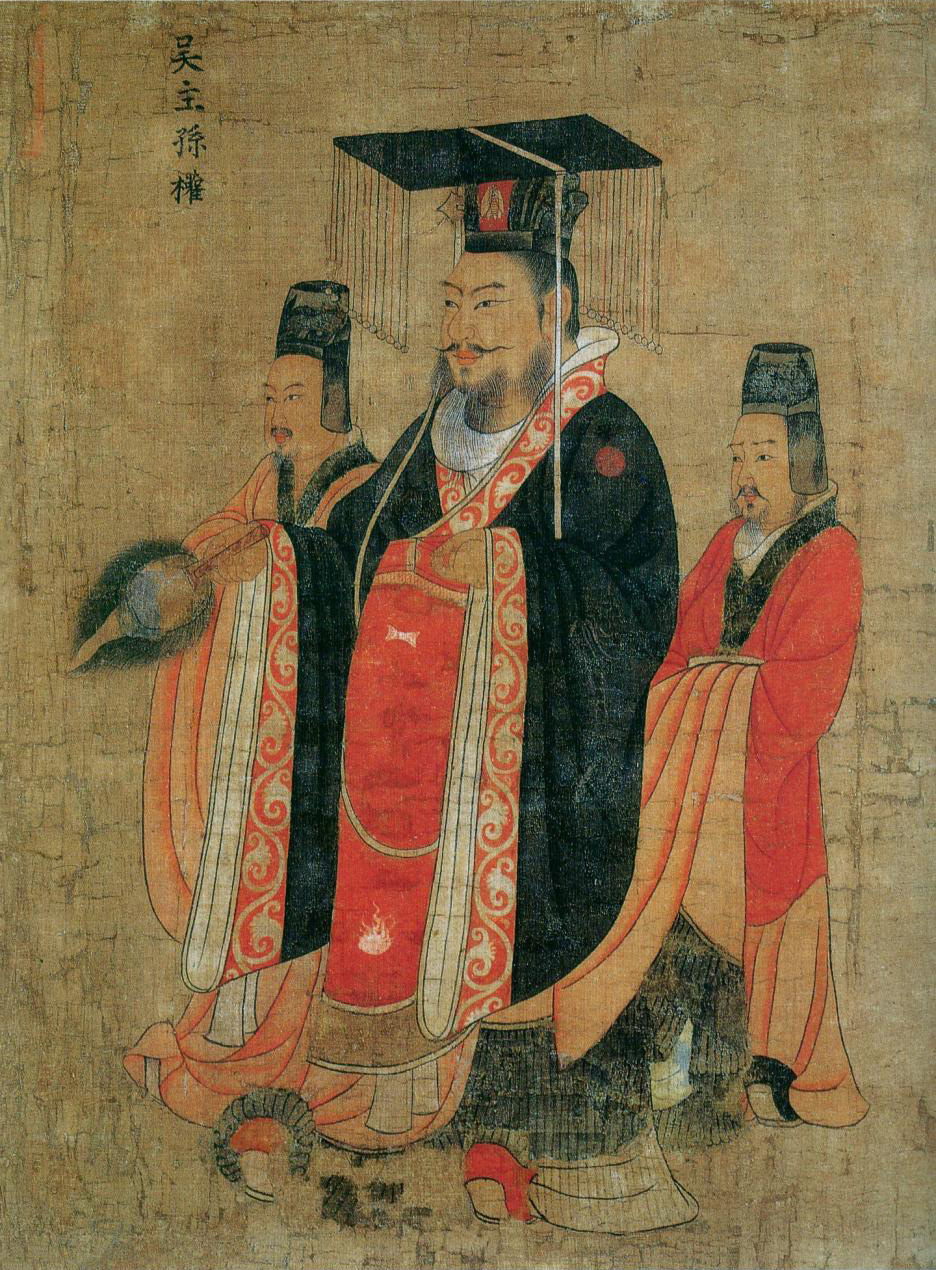
Thirteen Emperors Scroll (detail)Yan Liben · Public domain · Commons
Wu (Chinese: 吳; pinyin: Wú; Middle Chinese *ŋuo < Eastern Han Chinese: *ŋuɑ), known in historiography as Eastern Wu or Sun Wu, was a dynastic state of China and one of the three major states that competed for supremacy over China during the Three Kingdoms period. It previously existed from 220 to 222 AD as a vassal kingdom nominally under its rival state Cao Wei but declared complete independence in November 222 AD. It was elevated to an empire in May 229 AD after its founding ruler Sun Quan (Emperor Da) declared himself emperor.
Towards the end of the Han dynasty, Sun Ce, the eldest son of the warlord Sun Jian, and his followers borrowed troops from the warlord Yuan Shu and embarked on a series of military conquests in the Jiangdong and Wu regions between 194 and 199, seizing several territories previously occupied by warlords such as Liu Yao, Yan Baihu and Wang Lang. Sun Ce broke off relations with Yuan Shu around 196–197 after the latter declared himself emperor—an act deemed as treason against Emperor Xian, the figurehead ruler of the Han dynasty. The warlord Cao Cao, who was the de facto head of government in the Han imperial court, asked Emperor Xian to grant Sun Ce the title of "Marquis of Wu" (吳侯).
Read more
Sun Ce was assassinated in the summer of 200 and was succeeded by his younger brother, Sun Quan.
Eastern Han Chinese, Old Jiangdong Chinese, Proto-Wu Chinese
Religion
Taoism
Economy and Trade
The culture of Wu was most solidified under the reign of Sun Quan from 229 to 252. Migrations from the north and the needed settlement from the Shanyue barbarians made it possible for the increase in manpower, agriculture, and settling the lower most parts of Wu. Along with that, river transportation became a huge factor and flourished as the Jiangnan and Zhedong canals were finished with construction. After the Battle of Xiaoting and during the invasions of Wu by Wei in the 220s, Shu was able to reestablish their trade and relationships with Wu. Shu's cotton was a great influx for Wu, and the development of shipbuilding, salt, and metal industries was greatly increased.
Read more
The fact of inflation and economic problems still were in existence since the Han dynasty. Sun Quan tried to start a currency of large coins manufactured by copper. He also tried to prohibit private minting.
S-106 W Han banliang, Wudi, 140-87 BC, lead, prob private mint, 22-23mmProf. Gary Lee Todd · CC BY-SA 4.0 · Commons
Currency
ancient Chinese coinage
Wars and Battles
Despite Sun Quan proclaiming himself emperor in 229, its politics reflected its warlord origins. When Wu was initially founded its military was dominated by famed generals who had gained their positions through prowess and pluck. These generals were celebrated for their individualism.
Read more
Politics within the court were often influenced by conflicts between powerful families and individuals. Positions within the court were inherited from one generation to the next unlike the Han dynasty's bureaucracy. However, over time, the influence ultimately would move away from the central government. Outside of the court, families displayed their own independent authority. Wu, at times, was to a certain extent run for the protection of particular families.
The Eastern Wu era was a formative period in Vietnamese history.
Sun Xiu died of illness in 264, a year after Shu was conquered by Wei. At the time, Wu was experiencing internal turmoil because rebellions had broken out in Jiaozhi (交趾) in the south. The ministers Puyang Xing, Wan Yu and Zhang Bu decided to install Sun He's son, Sun Hao, on the throne.
Read more
In the beginning of Sun Hao's reign, the emperor reduced taxes, gave relief to the poor, and granted freedom to a large number of palace maids. However, Sun Hao gradually became more cruel and superstitious and started indulging in wine and women instead of finding ways to revive his declining state. Sun Hao's tyranny caused widespread anger and hatred towards him in Wu, but it was due to the efforts of officials such as Lu Kai and Lu Kang that Wu was able to remain relatively stable and peaceful.
Under the rule of Wu, the Yangtze River Delta region, regarded in early history as a barbaric "jungle", developed into one of the commercial, cultural, and political centres of China. The achievements of Wu in the south marked the coming of Chinese civilization to the farthest southern reaches of the empire.
Read more
In 230, the island of Yizhou (夷州) was reached by the Chinese during the Three Kingdoms period under the reign of Sun Quan, who dispatched officials to the island in an abortive atttempt to establish contact with the native population. The identification of Yizhou is open to dispute; some historians believe it was Taiwan, while others believe it was the Ryukyu Islands. Wu merchants also may have reached Southern Vietnam and Cambodia.
224 CE – 264 CE · Capital: Xuchang (220–226), Luoyang (226–266) · 2,972,911 km²
Thirteen Emperors Scroll (detail)Yan Li-pen · Public domain · Commons
Wei (Chinese: 魏), also known as Cao Wei (曹魏) or Former Wei, was one of the major dynastic states in China during the Three Kingdoms period. The state was established in 220 AD by Cao Pi based upon the foundations laid by his father Cao Cao during the end of the Han dynasty. Its capital was initially located at Xuchang, and was later moved to Luoyang.
The name Wei first became associated with Cao Cao when he was named the Duke of Wei by the Eastern Han government in 213 AD, and became the name of the state when Cao Pi proclaimed himself emperor in 220 AD.
Towards the end of the Eastern Han dynasty, northern China came under the control of Cao Cao, the chancellor to the last Han ruler, Emperor Xian. In 213, Emperor Xian granted Cao Cao the title of "Duke of Wei" (魏公) and gave him ten cities as his dukedom. The area was named "Wei". At that time, the southern part of China was divided into two areas controlled by two other warlords, Liu Bei and Sun Quan. In 216, Emperor Xian promoted Cao Cao to the status of a vassal king – "King of Wei (魏王)".
Read more
Cao Cao died on 15 March 220 and his vassal king title was inherited by his son Cao Pi. Later that year, on 11 December, Cao Pi forced Emperor Xian to abdicate in his favour and took over the throne, establishing the state of Wei. However, Liu Bei immediately contested Cao Pi's claim to the Han throne and declared himself "Emperor of Han" a year later.
The system of government in Wei inherited many aspects from that of the Eastern Han dynasty. During his reign, Cao Pi established two separate government bodies – the Central Inspectorate (中書監) and the Imperial Secretariat plenipotentiary (行尚書臺) – to reduce the authority of the Imperial Secretariat (尚書臺) and consolidate the power of the central government.
Read more
During this time, the minister Chen Qun developed the nine-rank system for civil service nomination, which was adopted by later dynasties until it was superseded by the imperial examination system in the Sui dynasty.
Cao Pi felt that the Han dynasty collapsed because the Governors (州牧) of the various provinces wielded too much power and fell outside the control of the central government.
S-106 W Han banliang, Wudi, 140-87 BC, lead, prob private mint, 22-23mmProf. Gary Lee Todd · CC BY-SA 4.0 · Commons
Currency
ancient Chinese coinage
Wars and Battles
Around that time, as the Korean kingdom Goguryeo consolidated its power, it proceeded to conquer the territories on the Korean peninsula which were under Chinese rule. Goguryeo initiated the Goguryeo–Wei Wars in 242, trying to cut off Chinese access to its territories in Korea by attempting to take a Chinese fort. However, Wei responded by invading and defeated Goguryeo. Hwando was destroyed in a reprisal raid by Wei forces in 244. The invasions sent its king fleeing, and broke the tributary relationships between Goguryeo and the other tribes of Korea that formed much of Goguryeo's economy. Although the king evaded capture and eventually settled in a new capital, Goguryeo was reduced to such insignificance that for half a century there was no mention of the state in Chinese historical texts.
The kaishu style of Chinese calligraphy was developed at some time between the late Eastern Han dynasty and the Cao Wei dynasty, as well as the Jian'an poetry style. The first known master of the former was Zhong Yao, an official of Wei, of the latter; Cao Cao's son, Cao Zhi.
Read more
Since the beginning of the Cao Wei dynasty, finding their roots in Cao Cao's administrative influences, intellectual constraints were relaxed, leading to the formation of new groups of intellectuals, such as the Seven Sages of the Bamboo Grove. These intellectual freedoms were overturned by the time of the Jin dynasty (it was Sima Yi himself who associated with the orthodox Confucianists, who despised these new intellectual groups, and therefore were more willing to offer their support to the Sima clan).
In 249, during the reign of Cao Rui's successor, Cao Fang, the regent Sima Yi seized state power from his co-regent, Cao Shuang, in a coup. This event marked the collapse of imperial authority in Wei, as Cao Fang's role had been reduced to that of a puppet ruler while Sima Yi wielded state power firmly in his hands. Wang Ling, a Wei general, tried to rebel against Sima Yi, but was swiftly dealt with, and took his own life. Sima Yi died on 7 September 251, passing on his authority to his eldest son, Sima Shi, who continued ruling as regent.
Read more
Sima Shi deposed Cao Fang in 254, on grounds of planning to stage a rebellion, and replaced him with Cao Mao.
Han (漢; 221–263 AD), known in historiography as Shu Han (蜀漢 [ʂù xân]) or Ji Han (季漢 "Junior Han"), or often shortened to Shu (Chinese: 蜀; pinyin: Shǔ; Sichuanese Pinyin: Su2 < Middle Chinese: *źjowk < Eastern Han Chinese: *dźok), was a dynastic state of China and one of the three major states that competed for supremacy over China in the Three Kingdoms period.
Towards the end of the Eastern Han dynasty, Liu Bei, a warlord and distant relative of the Han imperial clan, rallied the support of many capable followers. Following the counsel of his advisor, Zhuge Liang, and Zhuge's Longzhong Plan, Liu Bei conquered parts of Jing Province (covering present-day Hubei and Hunan) in 208 and 209, took over Yi Province (covering present-day Sichuan and Chongqing) from the warlord Liu Zhang between 212 and 214, and wrestled control of Hanzhong from his rival, Cao Cao, in 219. Afterwards, Liu Bei proclaimed himself King of Hanzhong.
Read more
From the territories he gained, Liu Bei established a position for himself in China during the final years of the Han dynasty. However, in 219, the alliance between Liu Bei and his ally, Sun Quan, was broken when Sun sent his general, Lü Meng, to invade Jing Province. Liu Bei lost his territories in Jing Province to Sun Quan.
Shu was not merely a nation at war. During peacetime, the Shu state began many irrigation and road-building projects designed to improve the economy. Many of these public works still exist and are widely used. For example, the Zipingpu Dam is still present near Chengdu, Sichuan. These works helped improve the economy of southwestern China, and can be seen as the beginning of economic activity in Sichuan. It also promoted trade with southern China, which was then ruled by Eastern Wu.
S-106 W Han banliang, Wudi, 140-87 BC, lead, prob private mint, 22-23mmProf. Gary Lee Todd · CC BY-SA 4.0 · Commons
Currency
ancient Chinese coinage
Decline and Fall
In 263, armies led by the Wei generals Deng Ai and Zhong Hui attacked Shu, and conquered its capital, Chengdu, without much struggle — the state having been exhausted by Jiang Wei's ill-fated campaigns. In the same year, Liu Shan surrendered to Deng Ai outside Chengdu, marking the end of Shu. In spite of this, Jiang Wei attempted to incite conflict between Deng Ai and Zhong Hui, in the hope of taking advantage of the situation to revive Shu. Zhong Hui captured Deng Ai, and openly rebelled against the Wei regent, Sima Zhao, but the revolt was suppressed by Wei forces. Jiang Wei, Zhong Hui, and Deng Ai were killed in the struggle.
Read more
Liu Shan was brought to Luoyang, where he met with Sima Zhao, and was awarded the title of "Duke of Anle." He lived a comfortable and peaceful life in Luoyang until the end of his days.
The Jin dynasty or the Jin Empire, officially Jin, sometimes distinguished as the Sima Jin or the Two Jins, was an imperial dynasty in China that existed from 266 to 420 CE. It was founded by Sima Yan, posthumously known as Emperor Wu of Jin, who previously served as the regent of the Cao Wei dynasty.
There are two main divisions in the history of the dynasty. The Western Jin (266–316 CE) was established as the successor to Cao Wei after Emperor Wu usurped the throne from Cao Huan. The capital of the Western Jin was initially in Luoyang, though it later moved to Chang'an (modern Xi'an).
During the Three Kingdoms period, the Sima clan—with its most accomplished individual being Sima Yi—rose to prominence within the kingdom of Cao Wei that dominated northern China. Sima Yi was the regent of Cao Wei, and in 249 he instigated a coup d'état known as the Incident at the Gaoping Tombs, after which the Sima clan began to surpass the imperial Cao clan's power in the kingdom. After Sima Yi's death in 251, Sima Yi's eldest son Sima Shi succeeded his father as regent of Cao Wei, maintaining the Sima clan's tight grip on the Cao Wei political scene. After Sima Shi's death in 255, Sima Shi's younger brother Sima Zhao became the regent of Cao Wei. Sima Zhao further assisted his clans' interests by suppressing rebellions and dissent.
The Eastern Jin court established three levels of administrative divisions which served as strongholds for the qiaoren: the qiaozhou (僑州, 'province'), qiaojun (僑郡, 'commandery'), and qiaoxian (僑縣, the lodged county), these lodged administrative divisions were merely nominal without possessing actual domain, or rather, they were local government in exile; what could scarcely be denied was their significance in Jin's legitimacy for the northern territory as somewhat an announcement. Furthermore, it was also an action done to appease the refugees' homesickness, which was evoking their desire to reacquire what had been lost.
Read more
During the rule of Emperor Yuan, Emperor Ming, and Emperor Cheng, the lodged administrative divisions were concentrated in the area south of the Huai River and the Lower Yangtze Plain.
S-106 W Han banliang, Wudi, 140-87 BC, lead, prob private mint, 22-23mmProf. Gary Lee Todd · CC BY-SA 4.0 · Commons
Currency
ancient Chinese coinage
Wars and Battles
In order to recover the lands lost during the fall of the Western Jin, the Eastern Jin dynasty launched several military campaigns against the northern states, such as the expeditions led by Huan Wen from 354 to 369. Most notably, in 383, a heavily outnumbered Eastern Jin force inflicted a devastating defeat on the state of Former Qin at the Battle of Fei River. After this battle, the Former Qin—which had recently unified northern China—began to collapse, and the Jin dynasty recovered the lands south of the Yellow River. Some of these lands were later lost, but the Jin regained them once more when Liu Yu defeated the northern states in his northern expeditions of 409–416.
Read more
Despite successes against the northern states like the Battle of Fei River, paranoia in the royal family and a constant disruptions to the throne often caused loss of support for northern campaigns.
The Jin dynasty is well known for the quality of its greenish celadon porcelain wares, which immediately followed the development of proto-celadon. Jar designs often incorporated animal, as well as Buddhist, figures. Examples of Yue ware are also known from the Jin dynasty.
In 403, Huan Xuan, the son of esteemed general Huan Wen, usurped the Jin throne and declared the dynasty of Huan Chu. Huan Xuan was soon toppled by Liu Yu, who reinstated Jin rule by installing Sima Dezong on the throne, posthumously known as Emperor An. Meanwhile, the civilian administration suffered, as there were further revolts led by Sun En and Lu Xun, and Western Shu became an independent kingdom under Qiao Zong. In 419, Liu Yu had Sima Dezong strangled and replaced by his brother Sima Dewen, posthumously known as Emperor Gong. Finally, in 420, Sima Dewen abdicated in favour of Liu Yu, who declared himself the ruler of the new Song dynasty (which is referred to as the Liu Song dynasty by historians in order to prevent confusion with the Song dynasty established in 960). Sima Dewen was then asphyxiated with a blanket in the following year.
287 CE – 665 CE · Capital: Fuqi (in modern Gonghe, Qinghai) · 555,182 km²
Tuyuhun (Chinese: 吐谷渾; LHC: *tʰɑʔ-jok-guən; Wade-Giles: T'u-yühun), also known as Henan (Chinese: 河南) and Azha (Tibetan: ཨ་ཞ་, Wylie: ‘A-zha; Chinese: 阿豺), was a dynastic monarchy established by the nomadic peoples related to the Xianbei in the Qilian Mountains and upper Yellow River valley. Its territory spanned what is now Qinghai and Gansu of China. The kingdom was defeated and absorbed by the Tibetan Empire in the mid-7th century.
Alexander Vovin (2015) identifies the extinct Tuyuhun language as a Para-Mongolic language, meaning that Tuyuhun is related to Mongolic as a sister clade but is not directly descended from the Proto-Mongolic language. The Khitan language is also a Para-Mongolic language.
During the beginning of the Tang dynasty, the Tuyuhun Empire came to a gradual decline and was increasingly caught in the conflict between the Tang and the Tibetan Empire. Because the Tuyuhun controlled the crucial trade routes between east and the west, the empire became the immediate target of invasion by the Tang.
Read more
The Tibetan Empire developed rapidly under the leadership of Songtsen Gampo, who united the Tibetans and expanded northward, directly threatening the Tuyuhun Empire. Soon after he took the throne of the Yarlung Kingdom in Central Tibet in 634, he defeated the Tuyuhun near Qinghai Lake and received an envoy from the Tang. The Tibetan emperor requested marriage to a Tang princess, but was refused. In 635–636 the Emperor Taizong of Tang defeated the Tibetan army; after this campaign, the Emperor Taizong agreed to provide a Tang princess to Songtsen Gampo.
When the Chinese pilgrim Songyun visited the region in 518, he noted that the people had a written language, which was more than a hundred years before Thonmi Sambhota is said to have returned from India after developing a script for writing the Tibetan language.
After the fall of the kingdom, the Tuyuhun people split. Led by Murong Nuohebo on the eastern side of the Qilian Mountains they migrated eastwards into central China. The rest remained and were under the rule of the Tibetan Empire.
Read more
Through this period, the Xianbei underwent massive diasporata over a vast territory that stretched from the northwest into central and eastern parts of China, with the greatest concentrations by Mount Yin near the Ordos Loop. In 946, a Shatuo, Liu Zhiyuan, conspired to murder the highest Xianbei leader, Bai Chengfu, who was reportedly so wealthy that "his horses had silver mangers". With the looted wealth that included an abundance of property and thousands of fine horses, Liu established the Later Han (947–950).
Ancient States of China: Frequently Asked Questions
Which states existed in China in this period?
This page maps 38 states of China founded between 1600 BCE and 287 CE: Shang Dynasty, Zhou Dynasty, Cai, Cao, Spring and Autumn States, Teng, Wey, Xu, Zhu, Warring States China, Zhongshan, Minyue and 26 more.
Which was the largest of the Ancient States of China?
Xiongnu had the largest mapped extent, about 5,619,496 km².
Which of the Ancient States of China lasted longest?
We use Google Analytics cookies to understand which pages are useful. Necessary storage only keeps your theme and this choice on your device. Privacy policy


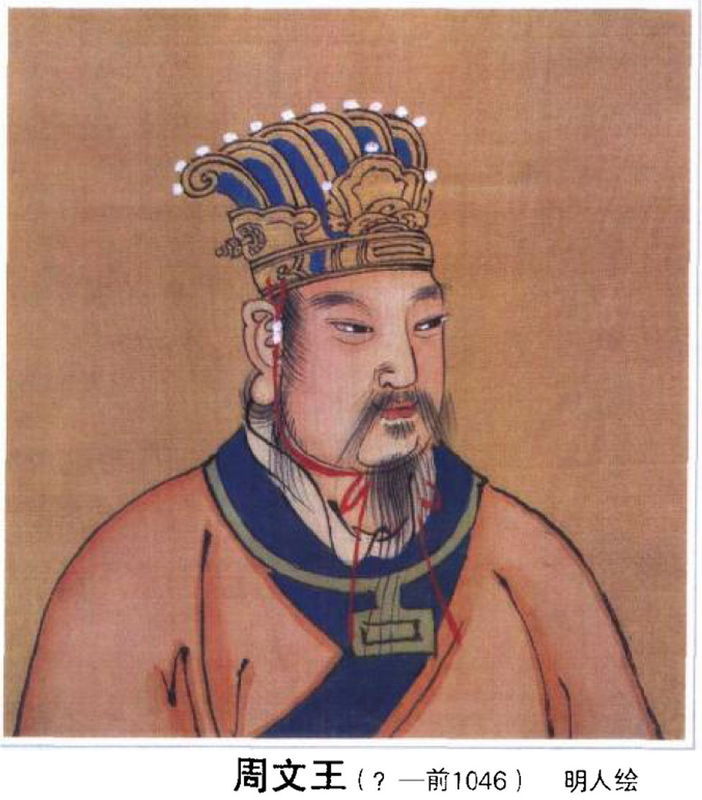
 seal in the SinosphereUnknown authorUnknown author · Public domain · Commons
 Houmuwu dingMlogic · CC BY-SA 3.0 · Commons
 Ritual vessel in the shape of a rhinocerosEd Bierman · CC BY 2.0 · Commons