19 states of China on one map, from 587 CE to 1952 CE.The largest, Yuan Dynasty, covered about 14,251,555 km²; the longest-lived, Tibet, lasted 1363 CE – 1952 CE. Each has its own section below with its rulers, capitals, wars and pictures where the records hold them.
Each state in its own colour. Move the timeline to see which existed in any year from 587 AD to 1952; select a territory to read about it. Borders: Cliopatria / Seshat (CC BY 4.0).
587 CE – 627 CE · Capital: Daxing (581–605), Luoyang (605–618) · 3,426,819 km²
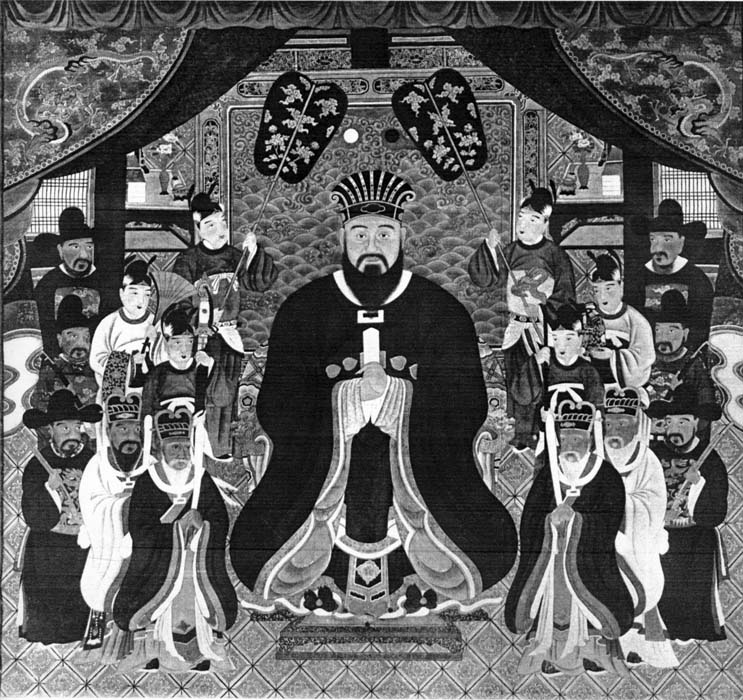
This depicts Emperor Taizong of Tang (唐太宗).Unknown artistUnknown artist · Public domain · Commons
The Sui dynasty (SWAY) was a Chinese imperial dynasty that ruled from 581 to 618 AD. The re-unification of China proper under the Sui brought the Northern and Southern dynasties era to a close, ending a prolonged period of political division since the War of the Eight Princes. The Sui endeavoured to rebuild the state, re-establishing and reforming many imperial institutions; in so doing, the Sui laid much of the foundation for the subsequent Tang dynasty, which after toppling the Sui would ultimately preside over a new golden age in Chinese history.
During the late Northern and Southern dynasties period, the Xianbei-led Northern Zhou conquered the Northern Qi in 577, reunifying northern China. By this time, Yang Jian, a Northern Zhou general who would later found the Sui dynasty, became the regent to the Northern Zhou court. Yang Jian's clan, the Yang clan of Hongnong, had Han origins and claimed descent from the Han dynasty general Yang Zhen, but had intermarried with the Xianbei for generations. Yang Jian's daughter was the Empress Dowager, and her stepson, Emperor Jing of Northern Zhou, was a child. After crushing an army in the eastern provinces, Yang Jian usurped the throne from the Northern Zhou rulers, and became Emperor Wen of Sui.
Buddhism, Taoism, Confucianism, Chinese folk religion, Zoroastrianism
Coins, Currency and Symbols
S-106 W Han banliang, Wudi, 140-87 BC, lead, prob private mint, 22-23mmProf. Gary Lee Todd · CC BY-SA 4.0 · Commons
Currency
ancient Chinese coinage
Wars and Battles
Emperor Yang of Sui (569–618) ascended the throne after his father's death, possibly by murder. He further extended the empire, but unlike his father, did not seek to gain support from the nomads. Instead, he restored Confucian education and the Confucian examination system for bureaucrats. By supporting educational reforms, he lost the support of the nomads. He also started many expensive construction projects such as the Grand Canal, and became embroiled in several costly wars. Between these policies, invasions into China from Turkic nomads, and his growing life of decadent luxury at the expense of the peasantry, he lost public support and was eventually assassinated by his own ministers.
Buddhism was popular during the Sixteen Kingdoms and Northern and Southern dynasties period that preceded the Sui dynasty, spreading from India through Kushan Afghanistan into China during the Late Han period. Buddhism gained prominence during the period when central political control was limited. Buddhism created a unifying cultural force that uplifted the people out of war and into the Sui dynasty. In many ways, Buddhism was responsible for the rebirth of culture in China under the Sui dynasty.
Read more
While early Buddhist teachings were acquired from Sanskrit sutras, it was during the late Six dynasties and Sui dynasty that local Chinese schools of Buddhist thoughts started to flourish.
One of the major work projects undertaken by the Sui was construction activities along the Great Wall of China; but this, along with other large projects, strained the economy and angered the resentful workforce employed. During the last few years of the Sui dynasty, the rebellion that rose against it took many of China's able-bodied men from rural farms and other occupations, which in turn damaged the agricultural base and the economy further. Men would deliberately break their limbs in order to avoid military conscription, calling the practice "propitious paws" and "fortunate feet." Later, after the fall of Sui, in the year 642, Emperor Taizong of Tang made an effort to eradicate this practice by issuing a decree of a stiffer punishment for those who were found to deliberately injure and heal themselves.
Gao Kaidao (Chinese: 高開道; died 624), at one point known as Li Kaidao (李開道), was an agrarian rebel leader who rose against the Sui dynasty at the end of Emperor Yang's reign. He occupied the region centering Huairong (懷戎, in modern Zhangjiakou, Hebei) and claimed the title of Prince of Yan, in alliance with the Eastern Turkic Khaganate (Dong Tujue). In 620, he briefly submitted to Emperor Gaozu of Tang and was bestowed the imperial surname of Li, but in 621 he rebelled against Tang and reasserted independence.
The Tibetan Empire (Tibetan: བོད་ཆེན་པོ, Wylie: bod chen po, lit. 'Great Tibet') was centered on the Tibetan Plateau and formed as a result of expansions under the Yarlung dynasty's 33rd king, Songtsen Gampo, in the 7th century. It expanded further under Trisong Detsen and reached its greatest extent under Tritsuk Detsen, stretching east to Chang'an, west beyond modern Afghanistan, south into modern India and the Bay of Bengal. It is referred to as Tufan or Tubo (吐蕃) in Chinese sources.
The Yarlung dynasty was founded in 127 BC in the Yarlung Valley along the Yarlung River, south of Lhasa.
The power that became the Tibetan state originated at the Taktsé Castle (Wylie: Stag-rtse) in the Chingba (Phying-ba) district of Chonggyä (Phyongs-rgyas). There, according to the Old Tibetan Chronicle, a group convinced Tagbu Nyazig (Stag-bu snya-gzigs) to rebel against Gudri Zingpoje (Dgu-gri Zing-po-rje), who was, in turn, a vassal of the Zhangzhung empire under the Lig myi dynasty. The group prevailed against Zingpoje. At this point Namri Songtsen (also known as Namri Löntsän) was the leader of a clan which one by one prevailed over all his neighbouring clans. He besieged the Kingdom of Sumpa in the early 7th century and eventually conquered it. He gained control of all the area around what is now Lhasa, before his assassination around 618. This new-born regional state would later become known as the "Tibetan Empire".
The early Tibetans worshipped a god of war known as "Yuandi" (Chinese transcription) according to a Chinese transliteration from the Old Book of Tang.
Read more
"They grow no rice but have black oats, red pulse, barley, and buckwheat. The principal domestic animals are the yak, pig, dog, sheep, and horse. There are flying squirrels, sembling in shape those of our own country, but as large as cats, the fur of which is used for clothes. They have abundance of gold, silver, copper, and tin. The natives generally follow their flocks to pasture and have no fixed dwelling-place. They have, however, some walled cities. The capital of the state is called the city of Lohsieh. The houses are all flat-roofed and often reach to the height of several tens of feet. The men of rank live in large felt tents, which are called fulu.
Tibetan snow leopardJkwchui · Public domain · Commons
Wars and Battles
The soldiers of the Tibetan Empire wore armour such as lamellar and chainmail, and were proficient in the use of swords and lances. According to the Tibetan author Tashi Namgyal, writing in 1524, the history of lamellar armour in Tibet was divided into three distinct periods. The oldest armour dated from the time of the "Righteous Kings, Uncle, and Nephew" which would place it sometime during the Yarlung dynasty, early seventh to mid ninth century.
Read more
"The men and horses all wear chain mail armor. Its workmanship is extremely fine. It envelops them completely, leaving openings only for the two eyes. Thus, strong bows and sharp swords cannot injure them. When they do battle, they must dismount and array themselves in ranks. When one dies, another takes his place. To the end, they are not willing to retreat. Their lances are longer and thinner than those in China.
The Battle of U-Yor that arose over Langdarma's successor led to the collapse of the Tibetan Empire. The period that followed, known traditionally as the Era of Fragmentation, was dominated by rebellions against the remnants of imperial Tibet and the rise of regional warlords.
Nanzhao (simplified Chinese: 南诏; traditional Chinese: 南詔; pinyin: Nánzhào), also spelled Nanchao (lit. 'Southern Zhao', Yi language: ꂷꏂꌅ, Mashynzy), was a dynastic kingdom that flourished in what is now southwestern China and northern Southeast Asia during the 8th and 9th centuries, during the mid/late Tang dynasty. It was centered on present-day Yunnan in China, with its capitals in modern-day Dali City. The kingdom was officially called Dameng (大蒙) from 738 to 859 AD, Dali (大禮) from 859 to 877 and Dafengmin (大封民) from 877 to 902.
In 649, the chieftain of the Mengshe tribe, Xinuluo (細奴邏, Senola), son of Jiadupang and grandson of Shelong, founded the Great Meng (大蒙) and took the title of Qijia Wang (奇嘉王; "Outstanding King"). He acknowledged Tang suzerainty. In 652, Xinuluo absorbed the White Mywa realm of Zhang Lejinqiu, who ruled Erhai Lake and Cang Mountain. This event occurred peacefully as Zhang made way for Xinuluo of his own accord. The agreement was consecrated under an iron pillar in Dali. Thereafter the Black and White Mywa acted as warriors and ministers respectively. In 655, Xinuluo sent his eldest son to Chang'an to ask for the Tang dynasty's protection. The Tang emperor appointed Xinuluo as prefect of Weizhou, sent him an embroidered official robe, and sent troops to defeat rebellious tribes in 672, thus enhancing Xinuluou's position.
Nanzhao society was separated into two distinct castes: the administrative White Mywa living in western Yunnan, and the militaristic Black Mywa in eastern Yunnan. The rulers of Nanzhao were from the Mengshe tribe of the Black Mywa. Nanzhao modelled its government on the Tang dynasty with ministries (nine instead of six) and imperial examinations. However the system of governance and rule in Nanzhao was essentially feudal. The King of Nanzhao relied on a council of chief ministers and generals called the Qingping guan (清平官). These councillors also served as regional administrative heads with a six-way division mirroring the Tang's Six Ministries system. Nanzhao's mode of governance has been described as combining Sinitic bureaucracy with Southeast Asian-style alliances of allegiance with local leaders.
Nuosu (elite spoken), Bai (majority spoken), Middle Chinese (literary)
Religion
Buddhism
Economy and Trade
The Lake Erhai region that formed the core of the Nanzhao territory strategically allowed Nanzaho to regulate and conduct overland trade between China, India and Southeast Asia. Historian Yumio Sakurai described Nanzhao as a "trade route controlling state". The fertile land near Lake Erhai and Lake Dian also created an agrarian base for the Nanzhao Kingdom. It established walled cities into Southeast Asia to expand its trade dominace, such as the walled city of Yongchang on the Upper Irrawaddy River. They controlled the Upper Irrawaddy and its various tribes by constructing walled cities organised into five circuits to exert control and keep trade routes open.
Nanzhao had an elite vanguard unit called the Luojuzi, which means tiger sons, that served as full-time soldiers. For every hundred soldiers, the strongest one was chosen for service in the Luojuzi. They were outfitted with red helmets, leather armour, and bronze shields, but went barefoot. Only wounds to the front were allowed and if they suffered any wounds to their back, they were executed. The commander of a hundred Luojuzi was called Luojuzuo. The king's personal guards, known as the Zhunu Quju, were recruited from the Luojuzi. "Quju" is a type of belt. Other types of Quju are known, such as Golden Quju. "Zhunu" in Chinese means "red crossbow".
Read more
Picked from troops raised from the countryside, the Luojuzi formed four armies. They wore vermilion helmets, bore rhinoceros hide bronze shields, and went barefoot. They ran into danger as though flying.
Shilong's successor, Longshun, entered negotiations with the Tang for a marriage alliance, which was agreed to in 880. The marriage alliance never came to fruition owing to the Huang Chao rebellion. By the end of 880 the rebels had taken Luoyang and seized the Tong Pass. Longshun did not give up on the marriage however. In 883 he sent a delegation to Chengdu to fetch the Princess of Anhua. They brought with them one hundred rugs and carpets as betrothal gifts. The Nanzhao delegation was detained for two years due to a dispute in ceremony and failed to bring back the princess. In 897 Longshun was murdered by one of his own ministers. His successor, Shunhua, sent envoys to the Tang requesting restoration of friendly relations, but by this time the Tang emperor was merely a puppet figurehead of more powerful military governors. No response returned.
Tibetans (Tibetan: བོད་པ་, Wylie: bod pa, THL: bö pa) are an East Asian ethnic group native to Tibet. Their current population is estimated to be around 7.7 million. In addition to the majority living in the Tibet Autonomous Region of China, significant numbers of Tibetans live in the Chinese provinces of Gansu, Qinghai, Sichuan, and Yunnan, as well as in India, Nepal, and Bhutan.
The Tibetic languages are a branch of the Tibeto-Burman language family.
The ethnic roots of Tibetans can be traced back to a deep Eastern Asian lineage representing the indigenous population of the Tibetan plateau since c. 40,000 to 30,000 years ago, and arriving Neolithic farmers from the Yellow River within the last 10,000 years, and which can be associated with having introduced the Sino-Tibetan languages.
Most Tibetans generally observe Tibetan Buddhism or a collection of native traditions known as Bön (also absorbed into mainstream Tibetan Buddhism). There is a minority Tibetan Muslim population. There is also a small Tibetan Christian population in the eastern Tibet and northwestern Yunnan of China.
Read more
According to legend, the 28th king of Tibet, Thothori Nyantsen, dreamed of a sacred treasure falling from heaven, which contained a Buddhist sutra, mantras, and religious objects. However, because the Tibetan script had not been invented, the text could not be translated in writing and no one initially knew what was written in it. Buddhism did not take root in Tibet until the reign of Songtsen Gampo, who married two Buddhist princesses, Bhrikuti of Nepal and Wencheng of China.
The most unusual feature of Tibetan architecture is that many of the houses and monasteries are built on elevated, sunny sites facing the south. They are commonly made of a mixture of rocks, wood, cement and earth. Little fuel is available for heating or lighting, so flat roofs are built to conserve heat, and multiple windows are constructed to let in sunlight. Walls are usually sloped inwards at 10 degrees as a precaution against frequent earthquakes in the mountainous area. Tibetan homes and buildings are white-washed on the outside, and beautifully decorated inside.
Read more
Standing at 117 metres (384 ft) in height and 360 metres (1,180 ft) in width, the Potala Palace is considered the most important example of Tibetan architecture.
860 CE – 1039 CE · Capital: Ganzhou (Zhangye) · 233,037 km²
A mural depicting division of Buddhist Relics among Eight Kings, from West Temple, Beiting in XinjiangZhentong Li · CC0 · Commons
The Ganzhou Uyghur Kingdom (traditional Chinese: 甘州回鶻; simplified Chinese: 甘州回鹘; pinyin: Gānzhōu Huíhú), also referred to as the Hexi Uyghurs (traditional Chinese: 河西回鶻; simplified Chinese: 河西回鹘; pinyin: Héxī Huíhú), was a Turkic dynastic state ruled by the Uyghur Yaglakar clan. It was established in 894 around Ganzhou in modern-day Zhangye, and lasted until 1036. During that time, many of Ganzhou's residents converted to Buddhism.
The Hexi Corridor, located within modern Gansu, was traditionally a Chinese inroad into Central Asia.
The Uighur believe mostly in Buddhism. They place the (Buddhist) sculptures in the hall. At each sacrifice, they must slaughter a lamb. Some drink alcohol merrily. Then they dip their finger into the blood of the lamb and dye the mouth of the Buddha with blood. Some hold the foot of the Buddha screaming, which was meant to show intimacy and respect for the Buddha. When chanting the Scripture, they wore Kasaya (the monk’s robe) and used the Indian language.
Qocho or Kara-Khoja (Chinese: 高昌回鶻; pinyin: Gāochāng Huíhú; lit. 'Gaochang Uyghurs'), also known as Idiqut ("holy wealth"; "glory"; "lord of fortune"), was a Uyghur kingdom created in 843, with strong Chinese Buddhist and Tocharian influences. It was founded by refugees fleeing the destruction of the Uyghur Khaganate after being driven out by the Yenisei Kirghiz. They made their winter capital in Qocho (also called Gaochang or Qara-Khoja, near modern Turpan) and summer capital in Beshbalik (modern Jimsar County, also known as Tingzhou).
Tang rule over Qocho and Turfan left a lasting Chinese Buddhist influence on the area. Tang names remained on more than 50 Buddhist temples with Emperor Taizong of Tang's edicts stored in the "Imperial Writings Tower" and Chinese dictionaries like Jingyun, Yupian, Tang yun, and da zang jing (Buddhist scriptures) stored inside the Buddhist temples. Uyghur Buddhists studied the Chinese language and used Chinese books like the Thousand Character Classic and the Qieyun. It was written that "In Qocho city were more than fifty monasteries, all titles of which are granted by the emperors of the Tang dynasty, which keep many Buddhist texts as the Tripiṭaka, Tangyun, Yupuan, Jingyin etc."
Read more
The Uyghurs of Qocho continued to produce the Chinese Qieyun rime dictionary and developed their own pronunciations of Chinese characters.
Old Uyghur, Middle Chinese; also Tocharian and Sogdian in early years
Religion
Manichaeism (official initially 843–965), Buddhism (Later declared as official), Church of the East
Wars and Battles
The Uyghurs of Qocho were Buddhists whose religious identity were intertwined with their religion. Qocho was a Buddhist state with both state-sponsored Mahayana Buddhism and Manichaeism. The Uyghurs sponsored the construction of many of the temple-caves in what is now called the Bezeklik Caves. Although they retained some of their culture, they were heavily influenced by the indigenous peoples of western China and abandoned the Old Turkic alphabet in favor of a modified Sogdian alphabet, which later came to be known as the Old Uyghur alphabet. The Idiquts (the title of the Qocho rulers) ruled independently until they become a vassal state of the Qara Khitai (Chinese: "Western Liao").
Read more
They do not cremate their dead, but bury the dead without coffins. They always bury the dead with the head facing west.
Hotan Tuanjie Square Day facing north, center is Statue of Mao Zedong and Kurban TulumVoidvector · CC BY-SA 4.0 · Commons
The Kingdom of Khotan, also called the Kingdom of Yutian (Chinese: 于闐), was an ancient Buddhist Saka kingdom located on the branch of the Silk Road that ran along the southern edge of the Taklamakan Desert in the Tarim Basin (modern-day Xinjiang, China). The ancient capital was originally sited to the west of modern-day Hotan at Yotkan. From the Han dynasty until at least the Tang dynasty it was known in Chinese as Yutian.
There are four versions of the legend of the founding of Khotan, the earliest of which date to the 7th century and thus can only be considered a reflection of the tradition present in Khotan at that time. These are found in the account given by the Chinese pilgrim Xuanzang and in Tibetan translations of Khotanese documents. According to the Chinese and Tibetan texts, which we cannot distrust, Khotan was founded by exiled Indian and Chinese groups. As per all four versions, the city was founded around the third century BC by a colonising party led by the son and ministers of Ashoka. According to one version, the nobles of a tribe in ancient Taxila, who traced their ancestry to the deity Vaiśravaṇa, were said to have blinded Kunala, a son of Ashoka.
Initially Gandhārī written in Kharosthi served as official language of Khotan, until 5th century AD, with Khotanese appearing in the written records from 6th century onwards. Surviving documents from Khotan of later centuries indicate that the people of Khotan spoke the Saka language, an Eastern Iranian language that was closely related to the Sogdian language (of Sogdiana); as an Indo-European language, Saka was more distantly related to the Tocharian languages (also known as Agnean-Kuchean) spoken in adjoining areas of the Tarim Basin. It also shared areal features with Tocharian.
Read more
The various Khotanese manuscripts found in the areas surrounding Khotan come from various time periods, ranging from the fifth to the tenth centuries. Khotanese was written using the Brahmi script.
Khotan was the first place outside of inland China to begin cultivating silk. The legend, repeated in many sources, and illustrated in murals discovered by archaeologists, is that a Chinese princess brought silkworm eggs hidden in her hair when she was sent to marry the Khotanese king. This probably took place in the first half of the 1st century AD but is disputed by a number of scholars.
Read more
One version of the story is told by the Chinese Buddhist monk Xuanzang who describes the covert transfer of silkworms to Khotan by a Chinese princess. Xuanzang, on his return from India between 640 and 645, crossed Central Asia passing through the kingdoms of Kashgar and Khotan (Yutian in Chinese).
Silk was a major currency for Khotan, and many purchased other items with bolts of silk.
In the 10th century, the Iranic Saka Buddhist Kingdom of Khotan was the only city-state in the Tarim Basin that was not yet conquered by either the Turkic Uyghur Qocho Kingdom (Buddhist) or by the Turkic Kara-Khanid Khanate (Muslim). During the latter part of the tenth century, Khotan became engaged in a struggle against the Kara-Khanid Khanate. The Islamic conquests of the Buddhist cities east of Kashgar began with the conversion of the Karakhanid Sultan Satuq Bughra Khan to Islam in 934. Satuq Bughra Khan and later his son Musa directed endeavors to proselytize Islam among the Turks and engage in military conquests, and a long war ensued between Islamic Kashgar and Buddhist Khotan. Satuq Bughra Khan's nephew or grandson Ali Arslan was said to have been killed during the war with the Buddhists.
911 CE – 1125 CE · Capital: Shangjing · 1,924,516 km²
Preparing for hunting, Mural from Tomb in Aohan, Liao DynastyUnknown authorUnknown author · Public domain · Commons
The Liao dynasty (traditional Chinese: 遼朝; simplified Chinese: 辽朝; pinyin: Liáo cháo), also known as the Khitan State (Mos diau-d kitai huldʒi gur), officially the Great Liao (Chinese: 大遼; pinyin: Dà Liáo), was a Khitan-led imperial dynasty of China and empire ruled by the Yelü clan that existed between 916 and 1125. Founded around the time of the collapse of the Tang dynasty, at its greatest extent it ruled over Manchuria, the Mongolian Plateau, the northern part of the Korean Peninsula, southern portions of Siberia, and the northern tip of the North China Plain.
The earliest reference to a Khitan state is found in the Book of Wei, a history of the Northern Wei dynasty (386–534) that was completed in 554. Several books written after 554 mention the Khitans being active during the late third and early fourth centuries. The Book of Jin (648) mentions the Khitans in the section covering the reign of Murong Sheng (398–401). The Samguk Sagi (1145) mentions a Khitan raid taking place in 378.
Read more
It is generally believed that the Khitans emerged from the Yuwen branch of the Xianbei people. Following a defeat at the hands of another branch of the Xianbei in 345, the Yuwen split into three tribes, one of which was called the Kumo Xi. In 388 the Kumo Xi itself split, with one group remaining under the name Kumo Xi and the other group becoming the Khitans.
The Khitans were originally divided into 8 tribes each led by a commander replaced once every three years. Abaoji then declared himself king to prevent the other clans from replacing him. The tribes convened for discussions for mobilization or warfare. From these military origins developed the Khitan custom of convening assemblies. After ascending the throne, Abaoji divided his own Yila tribe into two and entrusted them to members of his family, requiring him to establish a new guard by drawing recruits from each tribe.
Read more
The Liao army was originally 2,000 men picked from various tribes and cities as Abaoji's personal retinue. Another 2,000 men were added from captives taken from Balhae and Jingzhou. This retinue became an orda, the emperor's private army that contained 15,000 households, and could field up to 6,000 horsemen.
The influence of the Liao dynasty on subsequent culture includes a large legacy of statuary art works, with important surviving examples in painted wood, metal, and three-colour glazed sancai ceramics. The music and songs of the Liao dynasty are also known to have indirectly or directly influenced Mongol, Jurchen, and Chinese musical traditions.
Read more
The rhythmic and tonal pattern of the ci (詞) form of poetry, an important part of Song dynasty poetry, uses a set of poetic meters and is based upon certain definitive musical song tunes. The specific origin of these various original tunes and musical modes is not known, but the influence of Liao dynasty lyrics both directly and indirectly through the music and lyrics of the Jurchen Jin dynasty appears likely.
The Dali Kingdom, also known as the Dali State (traditional Chinese: 大理國; simplified Chinese: 大理国; pinyin: Dàlǐ Guó; Bai: Dablit Guaif), was a Bai dynastic state situated in modern Yunnan province, China, from 937 to 1253. In 1253, it was conquered by the Mongols. However, descendants of its ruling house continued to administer the area as tusi chiefs under Yuan dynasty rule until the Ming conquest of Yunnan in 1382. The former capital of the Dali Kingdom remains known as Dali in modern Yunnan Province today.
Yuan records claim that the Dali kingdom’s Duan rulers originally came from Wuwei Commandery in modern-day Gansu Province, but this is not confirmed by Song or Dali sources. A significant change from Nanzhao is apparent in Dali rulers’ naming practices, which generally do not follow the patronymic linkage system. This suggests that the Dali elites presented themselves as more “Chinese” than their Nanzhao counterparts.
Read more
Nanzhao's last ruler, Shunhuazhen (r. 897-902), was deposed by the chief minister (buxie), Zheng Maisi. Zheng Maisi was descended from a Tang official named Zheng Hui, who had been captured by Nanzhao in 756 and rose to become Nanzhao's imperial tutor and chief minister. Zheng Maisi changed his name to Zheng Chang and proclaimed a new reign era named Anguo for the Great Changhe Kingdom. Great Changhe portrayed itself as the successor to both the Tang dynasty and Nanzhao.
The administration of the Dali Kingdom has been characterized as a mandala state similar to Southeast Asian kingdoms with some Chinese influence. The Duan rulers bestowed Sinitic-style official appointments upon clans such as the Gao, Yang, and Dong to incorporate them into the mandala's center while subordinating peripheral ethnic groups by establishing alliances with their leaders. The Dali court granted hereditary fiefs to pre-existing clan chiefs, in particular the Duan, Gao, Yang, and Dong clans, to win over their support. Some administrative units were designated semi-autonomous military divisions. Similarly to the Nanzhao military, the Dali military consisted of a standing army, townsfolk peasant-soldiers and indigenous militia. Sometimes the clans and alliances fractured, resulting in rebellions.
Written Classic Chinese (court, dynastic, literary), Bai
Religion
Buddhism
Wars and Battles
In 1381, the Ming dynasty dispatched 300,000 troops to crush the Yuan remnants in Yunnan.
Read more
The Duan clan, who helped the Yuan dynasty against a Red Turban Rebellion attack from Sichuan, also fought against the Ming army. Duan Shi, the 13th and the last hereditary Governor-General of Dali, refused to surrender by writing to Fu Youde, making it clear that Dali could only be a tributary to the Ming. In 1382 Lan Yu and Mu Ying's forces attacked and crushed Duan's realm after a fierce battle. The Duan family were then taken captive and escorted to the Ming capital of Nanjing.
Möngke Khan sent envoys requesting the surrender of Dali. The king of Dali murdered the envoys and when Möngke received word of this, he placed his brother Kublai in charge of invading Dali.
Read more
Kublai split his army into three columns. The western column was led by Uriyangkhadai, who was the son of Subutai, and he was instructed to march from Lintao through Kham into Dali. Wang Dezhen led the eastern column through Sichuan. Wang's column rejoined Kublai's middle column at Jianchang in southern Sichuan. Kublai planned to engage Dali's main army at the Jinsha River, leaving Dali vulnerable to Uriyangkhadai's forces to the northwest. After several skirmishes where Dali forces turned back Mongol raids across the Jinsha River, Kublai's army crossed the river during the night and routed the Dali army. In late 1253, the three columns converged on the city of Dali.
The Western Xia or the Xi Xia (Chinese: 西夏; pinyin: Xī Xià; Wade–Giles: Hsi1 Hsia4), officially the Kingdom of the Great Xia of the White and Lofty (Tangut: 𗴂𗹭𘜶𗴲𗂧) or Great Xia (大夏; Dà Xià; Ta4 Hsia4), also known as the Tangut Empire, was a Tangut-led imperial dynasty of China that existed from 1038 to 1227 AD. At its peak, the dynasty ruled over 1,000,000 square kilometres (390,000 square miles) of modern-day north-central China.
The capital of the Western Xia was Xingqing, now Yinchuan; another major Xia city and archaeological site is Khara-Khoto.
The Tanguts originally came from the Qinghai-Sichuan-Tibet region, whose home originally was in the highlands of western Sichuan. According to Chinese records, which called them the Dangxiang, the Tanguts were descended from the Western Qiang people, and occupied the steppes around Qinghai Lake and the mountains to its south.
Read more
In 608, the Tanguts helped the Sui dynasty defeat the Tuyuhun, however they were betrayed by the Sui forces, who took the chance to loot the Tanguts. In 635, they were requested to serve as guides for Emperor Taizong's campaign against Tuyuhun, but the Tang forces double crossed them in a surprise attack and seized thousands of livestock. In retaliation, the Tanguts attacked the Tang and killed thousands of their soldiers.
In recent years, corrupt frontier generals have repeatedly harassed and mistreated [the Tanguts].
Buddhism, Taoism, Confucianism, Chinese folk religion
Coins, Currency and Symbols
Currency
Barter, copper coins, See Western Xia coinage
Wars and Battles
Since ancient times we have fought using both infantry and cavalry. Although we have the Iron Hawks that can charge on the plains and the Trekker infantry that can fight in the hills, if we happen to encounter some new tactic our cavalry will have difficulty deploying. If we encounter [Mighty- Arm bows], then our infantry will be scattered. The problem is our troops can only fight according to convention and are unable to adapt to changes during battle.
Read more
In 1980, the Wuwei Bronze Cannon was discovered in a cellar dating to the Western Xia period. Dating to the early 13th century, it is one of the earliest cannons ever discovered. It weighs 108 kg and was discovered with an iron ball about 9cm in diameter inside its barrel.
Tangut society was patriarchal and a woman was considered the property of her parents, husband, and in-laws. A Tangut proverb describes the role of men and women: "A woman is governed by purity within the tent, and a man by purity in the state". Tangut men could have one wife but multiple concubines. If the man committed a crime requiring collective punishment, the children of concubines were exempt while the children of the wife were exiled to become shepherds and peasants. The age of marriage for a woman was 13 under the Tangut Code. A man who touched an under-age girl against her will was punished but if it was with her consent, she was punished. Only her father or maternal uncle were allowed to report assaults.
Read more
Marriage was arranged by the parents of the groom and bride. The groom's parents paid a fee for the girl while the bride's parents provided a dowry.
1126 CE – 1235 CE · Capital: Zhongdu · 2,118,396 km²
Plan of Huiningfu historical city from the Museum of Huiningfu, Acheng, Harbin, China.Slb nsk · CC BY-SA 3.0 · Commons
The Jin dynasty (Chinese: 金朝; pinyin: Jīn cháo), officially the Great Jin (大金; Dà Jīn), was a Jurchen-led imperial dynasty of China and empire ruled by the Wanyan clan that existed between 1115 and 1234. It is also often called the Jurchen dynasty or the Jurchen Jin after the ruling Jurchen people. At its peak, the empire extended from Outer Manchuria in the north to the Qinling–Huaihe Line in the south.
In the early 12th century, the Jurchen leader Aguda sent ambassadors to the Liao dynasty to call on the Balhae people there to rebel against the Liao by appealing to a common origin between the Jurchens and Balhae. Aguda claimed that "the Jurchens and Bohai were originally of the same family" (女直渤海本同一家) and that they were "actually one family, because in origin they were consisted of seven Wuji tribes." The appeal states that both the Jurchens and Balhae people descended from the seven Wuji (Kr. Mulgil) tribes. However, according to Alexander Kim, this only applied to the Mohe portion of Balhae's population and not the Goguryeo people, who were not included in the seven Wuji tribes. The call for Balhae cooperation against the Liao Khitans was a success.
The government of the Jin dynasty merged Jurchen customs with institutions adopted from the Liao and Song dynasties. The pre-dynastic Jurchen government was based on the quasi-egalitarian tribal council. Jurchen society at the time did not have a strong political hierarchy. The Shuo Fu (說郛) records that the Jurchen tribes were not ruled by central authority and locally elected their chieftains. Tribal customs were retained after Aguda united the Jurchen tribes and formed the Jin dynasty, coexisting alongside more centralised institutions. The Jin dynasty had five capitals, a practice they adopted from the Balhae and the Liao. The Jin had to overcome the difficulties of controlling a multicultural empire composed of territories once ruled by the Liao and Northern Song. The solution of the early Jin government was to establish separate government structures for different ethnic groups.
A significant branch of Taoism called the Quanzhen School was founded under the Jin Dynasty by Han Chinese Wang Zhe (1113–1170), founder of formal congregations in 1167 and 1168. He took the nickname of Wang Chongyang (Wang "Double Yang"), and his disciples were retrospectively known as the "seven patriarchs of Quanzhen". The ci poetry that characterized Jin literature was tightly linked to Quanzhen: two-thirds of the ci poetry written in Jin times was composed by Quanzhen Taoists.
Read more
The Jin state sponsored an edition of the Taoist Canon that is known as the Precious Canon of the Mysterious Metropolis of the Great Jin (大金玄都寶藏; Dà Jīn Xuándū Bǎozàng). Based on a smaller version of the Canon printed by Emperor Huizong (r. 1100–1125) of the Song, it was completed in 1192 under the direction and support of Emperor Zhangzong (r. 1190–1208).
The Shunten dynasty (舜天王統) was the second dynasty in the traditional historiography of Okinawa Island. It was established by Shunten in 1187. According to Chūzan Seikan, Shunten's mother was a daughter of the aji, or local chieftain, of Ōzato; his father, Minamoto no Tametomo, was an adventurer from Japan. Prior to becoming king, Shunten was the lord of Urasoe. At that time, Okinawa Island was in great confusion; the last overlord of Tenson dynasty was assassinated by the powerful official named Riyū (利勇), whom promoted himself as paramount chief.
The Yuan dynasty, officially the Great Yuan, was a Mongol-led imperial dynasty of China and a successor state to the Mongol Empire after its division. It was established by Kublai (Emperor Shizu or Setsen Khan), the fifth khagan-emperor of the Mongol Empire from the Borjigin clan, and lasted from 1271 to 1368 CE. In Chinese history, the Yuan dynasty followed the Song dynasty and preceded the Ming dynasty.
Genghis Khan united the Mongol tribes of the steppes and became Great Khan in 1206. He and his successors expanded the Mongol empire across Asia. Under the reign of Genghis' third son, Ögedei Khan, the Mongols destroyed the weakened Jin dynasty in 1234, conquering most of northern China. Ögedei offered his nephew Kublai a position in Xingzhou, Hebei. Kublai was unable to read Chinese but had several Han teachers attached to him since his early years by his mother Sorghaghtani. He sought the counsel of Chinese Buddhist and Confucian advisers. Möngke Khan succeeded Ögedei's son, Güyük, as Great Khan in 1251. He granted his brother Kublai control over Mongol held territories in China. Kublai built schools for Confucian scholars, issued paper money, revived Chinese rituals, and endorsed policies that stimulated agricultural and commercial growth.
The Yuan government was centred on the emperor, huangdi in Chinese and khagan in Mongolian. Unlike ethnically Han dynasties, the Yuan court did not adhere to primogeniture and all of Kublai's descendants were eligible candidates for the throne. Election Kurultais (assemblies), during which genuine discussion on the succession would occur, were held until 1311. With the enthronement of Gegeen Khan in 1320, kurultais became a formality and real power over succession was held by empress-dowagers, guard units, or high officials.
Read more
The dynasty chose white as its imperial colour, which corresponds to the Metal element according to the theory of the Five Elements (wuxing). The Metal element does not directly follow the Song's dynastic element, Fire, in the creation sequence of the five elements. Instead, it follows the Jin dynasty's dynastic element, Earth.
Buddhism, Confucianism, Taoism, Shamanism, Tengrism, Chinese Hinduism, Nestorian Christianity, Chinese folk religion, Catholic Christianity, Judaism, Manichaeism, Islam
After strengthening his government in northern China, Kublai pursued an expansionist policy in line with the tradition of Mongol and Chinese imperialism. He renewed a massive drive against the Song dynasty to the south. Kublai besieged Xiangyang between 1268 and 1273, the last obstacle in his way to capture the rich Yangtze River basin. An unsuccessful naval expedition was undertaken against Japan in 1274. The Duan family ruling the Kingdom of Dali in Yunnan submitted to the Yuan dynasty as vassals and were allowed to keep their throne, militarily assisting the Yuan dynasty against the Song dynasty in southern China.
Read more
The Duan family still ruled Dali relatively independently during the Yuan dynasty. The Tusi chieftains and local tribe leaders and kingdoms in Yunnan, Guizhou and Sichuan submitted to Yuan rule and were allowed to keep their titles.
The Mongol rulers patronized the Yuan printing industry. Chinese printing technology was transferred to the Mongols through Kingdom of Qocho and Tibetan intermediaries. Some Yuan documents such as Wang Zhen's Nong Shu were printed with earthenware movable type, a technology invented in the 12th century. However, most published works were still produced through traditional block printing techniques. The publication of a Taoist text inscribed with the name of Töregene Khatun, Ögedei's wife, is one of the first printed works sponsored by the Mongols. In 1273, the Mongols created the Imperial Library Directorate, a government-sponsored printing office. The Yuan government established centres for printing throughout China. Local schools and government agencies were funded to support the publishing of books.
Read more
Private printing businesses also flourished under the Yuan.
The final years of the Yuan dynasty were marked by struggle, famine, and bitterness among the populace. In time, Kublai Khan's successors lost all influence on other Mongol lands across Asia, while the Mongols beyond the Middle Kingdom saw them as too Chinese. Gradually, they lost influence in China as well. The reigns of the later Yuan emperors were short and marked by intrigues and rivalries. Uninterested in administration, they were separated from both the army and the populace, and China was torn by dissension and unrest. Outlaws ravaged the country without interference from the weakening Yuan armies.
Read more
From the late 1340s onwards, people in the countryside suffered from frequent natural disasters such as droughts, floods and the resulting famines, and the government's lack of effective policy led to a loss of popular support.
A rich cultural diversity developed during the Yuan dynasty. The major cultural achievements were the development of drama and the novel and the increased use of the written vernacular. Arts and culture also greatly developed and flourished during the Yuan dynasty. There was a widespread introduction of blue and white painted porcelain, as well as a major change to Chinese painting. The political unity of China and much of central Asia promoted trade between East and West. The Mongols' extensive West Asian and European contacts produced a fair amount of cultural exchange. The other cultures and peoples in the Mongol Empire also very much influenced China. It had significantly eased trade and commerce across Asia until its decline; the communications between Yuan dynasty and its ally and subordinate in Persia, the Ilkhanate, encouraged this development.
Chūzan (中山, Okinawan: Chūzan) was one of three kingdoms which controlled Okinawa in the 14th century. Okinawa, previously controlled by a number of local chieftains or lords, loosely bound by a paramount chieftain or king of the entire island, split into these three more solidly defined kingdoms within a few years after 1314; the Sanzan period thus began, and would end roughly one hundred years later, when Chūzan's King Shō Hashi conquered Hokuzan in 1419 and Nanzan in 1429.
Nakijin Village Office in Okinawa, Japanja:user:Hykw-a4 · CC BY-SA 3.0 · Commons
Hokuzan (北山; Kunigami: Fukuuzan), also known as Sanhoku (山北, Okinawan: Sanfuku) before the 18th century, located in the north of Okinawa Island, was one of three independent political entities which controlled Okinawa in the 14th century during Sanzan period. The political entity was identified as a tiny country, a kingdom, or a principality by modern historians, however the rulers of Hokuzan were in fact not "kings" at all, but petty lords with their own retainers owing their direct service, and their own estates.
1314 CE – 1401 CE · Capital: Nanzan Castle · 321 km²
Nanzan (南山, Okinawan: Nanzan), also known as Sannan (山南, Okinawan: Sannan) before the 18th century, located in the south of Okinawa Island, was one of three independent political entities which controlled Okinawa in the 14th century. The political entity was identified as a tiny country, a kingdom, or a principality by modern historians; however, the rulers of Nanzan were not "kings", but petty lords with their own retainers owing their direct service, and their own estates.
While the Tibetan Plateau has been inhabited since pre-historic times, most of Tibet's history went unrecorded until the creation of Tibetan script in the 7th century. Tibetan texts refer to the kingdom of Zhangzhung (c. 500 BC– 625 AD) as the precursor of later Tibetan kingdoms and the originators of the Bon religion. While mythical accounts of early rulers of the Yarlung dynasty exist, historical accounts begin with the introduction of Tibetan script from the unified Tibetan Empire in the 7th century.
Some archaeological data suggest archaic humans passed through Tibet at the time India was first inhabited, half a million years ago. Impressions of hands and feet suggest hominins were present at the above 4,000 meters above sea level high Tibetan Plateau 169,000–226,000 years ago. Modern humans first inhabited the Tibetan Plateau at least twenty-one thousand years ago. This population was largely replaced around 3000 years ago by Neolithic immigrants from northern China. However, there is a "partial genetic continuity between the Paleolithic inhabitants and the contemporary Tibetan populations". The vast majority of Tibetan maternal mtDNA components can trace their ancestry to both paleolithic and Neolithic during the mid-Holocene.
Read more
Megalithic monuments dot the Tibetan Plateau and may have been used in ancestor worship.
The Ganden Phodrang was the Tibetan government established in 1642 by the 5th Dalai Lama with the military assistance of Güshi Khan of the Khoshut Khanate. Lhasa became the capital of Tibet in the beginning of this period, with all temporal power being conferred to the 5th Dalai Lama by Güshi Khan in Shigatse.
During this era, the region was dominated by the Sakya lama with the Mongols' support, so it is also called the Sakya dynasty. The first documented contact between the Tibetans and the Mongols occurred when the missionary Tsang-pa Dung-khur (gTsang-pa Dung-khur-ba) and six disciples met Genghis Khan, probably on the Tangut border where he may have been taken captive, around 1221–22. He left Mongolia as the Quanzhen sect of Daoism gained the upper hand, but remet Genghis Khan when Mongols conquered Tangut shortly before the Khan's death. Closer contacts ensued when the Mongols successively sought to move through the Sino-Tibetan borderlands to attack the Jin dynasty and then the Southern Song, with incursions on outlying areas.
The Era of Fragmentation was a period of Tibetan history in the 9th and 10th centuries. During this era, the political centralization of the earlier Tibetan Empire collapsed. The period was dominated by rebellions against the remnants of imperial Tibet and the rise of regional warlords. Upon the death of Langdarma, the last emperor of a unified Tibetan empire, there was a controversy over whether he would be succeeded by his alleged heir Yumtän (Yum brtan), or by another son (or nephew) Ösung ('Od-srung; either 843–905 or 847–885). A civil war ensued, which effectively ended centralized Tibetan administration until the Sa-skya period. Ösung's allies managed to keep control of Lhasa, and Yumtän was forced to go to Yalung, where he established a separate line of kings. In 910, the tombs of the emperors were defiled.
Read more
The son of Ösung was Pälkhortsän (Dpal 'khor brtsan; 865–895 or 893–923).
King Shō Shin, 1465-1526Shō Genko, 1748-1841 · Public domain · Commons
The Ryukyu Kingdom was a kingdom in the Ryukyu Islands from 1429 until 1872, when it was reorganized as the Ryukyu Domain, before being fully abolished in 1879. It was ruled as a tributary state of the Ming dynasty by the Ryukyuan monarchy, who unified Okinawa Island to end the Sanzan period, and subsequently extended the kingdom to the Amami Islands and Sakishima Islands. The Ryukyu Kingdom played a central role in the maritime trade networks of medieval East Asia and Southeast Asia despite its small size.
In the 14th century small domains scattered on Okinawa Island were unified into three principalities: Hokuzan (北山; Northern Mountain), Chūzan (中山; Central Mountain), and Nanzan (南山; Southern Mountain). This was known as the Sanzan (三山; Three Mountains) period. Hokuzan, which constituted much of the northern half of the island, was the largest in terms of land area and military strength but was economically the weakest of the three. Nanzan constituted the southern portion of the island. Chūzan lay in the center of the island and was economically the strongest. Its political capital at Shuri, Nanzan was adjacent to the major port of Naha, and Kume-mura, the center of traditional Chinese education. These sites and Chūzan as a whole would continue to form the center of the Ryukyu Kingdom until its abolition.
In 1493, Ryukyu and the “Japanese warships”(日本甲船) were involved in a conflict in Amami and Ryukyu was victorious in the incident. In 1500, the Oyake Akahachi Rebellion broke out in Ishigaki Island, one of Yaeyama Islands. King Shō Shin deployed approximately 3,000 troops and 46 warships to conquer the region. In 1507, he invaded Kume Island, and in 1522, he suppressed the rebellion of Onikō in Yonaguni (与那国・ 鬼 虎 の乱). In 1537 and 1571, he suppressed rebellions in the Amami region.
Read more
In 1509, as stated in stone tablet "Momourasoe-no-Kanmei" (百浦添之欄干之銘), the so-called “sword hunt”(刀狩り) was carried out, and all weapons possessed by the nobility called Samure (士族) and civilians were confiscated and stored in the royal armory under the strict control of the Shuri royal government.
For nearly two hundred years the Ryukyu Kingdom would thrive as a key player in maritime trade with Southeast and East Asia. Central to the kingdom's maritime activities was the continuation of the tributary relationship with Ming dynasty China, begun by Chūzan in 1372, and enjoyed by the three Okinawan kingdoms which followed it. China provided ships for Ryukyu's maritime trade activities, allowed a limited number of Ryukyuans to study at the Imperial Academy in Beijing, and formally recognized the authority of the King of Chūzan, allowing the kingdom to trade formally at Ming ports. Ryukyuan ships, often provided by China, traded at ports throughout the region, which included, among others, China, Đại Việt (Vietnam), Japan, Java, Korea, Luzon, Malacca, Pattani, Palembang, Siam, and Sumatra.
A Ryūkyūan cash coin issued during the reign of King Shō En.The government of the Kingdom of Ryūkyū. · Public domain · Commons
British Museum - Room 68Paul Hudson from United Kingdom · CC BY 2.0 · Commons
A collection of cash coins issued by the Ryūkyūans and the Satsuma Domain "for circulation in the Ryūkyū Islands".Dr. Luke Roberts & As6673. · CC BY-SA 3.0 · Commons
Merchant flag of the Ryukyu KingdomSamhanin · CC BY 3.0 · Commons
Medieval States of China: Frequently Asked Questions
Which states existed in China in this period?
This page maps 19 states of China founded between 587 CE and 1429 CE: Sui Dynasty, Gao Kaidao, Tibetan Empire, Nanzhao, Tibetans, Ganzhou Kingdom, Qocho Kingdom, Kingdom of Khotan, Liao Dynasty, Kingdom of Dali, Western Xia, Great Jin and 7 more.
Which was the largest of the Medieval States of China?
Yuan Dynasty had the largest mapped extent, about 14,251,555 km².
Which of the Medieval States of China lasted longest?
Tibet lasted longest, 1363 CE – 1952 CE.
↑↓ to navigate↵ to open
12,754 Planetary Entities Indexed
We use Google Analytics cookies to understand which pages are useful. Necessary storage only keeps your theme and this choice on your device. Privacy policy


 Taiji Palace呂大防 · Public domain · Commons