Skip to content
YearMaps
4 states1459 CE – 1863 CE

Early Modern States of Central Europe: Map & History

4 states of Central Europe on one map, from 1459 CE to 1863 CE.The largest, Habsburg Monarchy, covered about 752,168 km². Each has its own section below with its rulers, capitals, wars and pictures where the records hold them.

Portrait of Rudolf II.
Joseph Heintz the Elder · Public domain · Commons
Berlin Cityscape seen from Victory Column
Thomas Wolf, www.foto-tw.de · CC BY-SA 3.0 · Commons
This media shows the protected monument with the number 802-1117/1 CHMSK/802-1117/1,CHMSK/802-1117(other) in the Slovak Republic.
Ville Miettinen · CC BY 2.0 · Commons
Portrait of Frederick I of Prussia (1657-1713)
Friedrich Wilhelm Weidemann · Public domain · Commons
Base map
1459 AD
1683 AD
1863 AD
1459 AD
1550 AD
1650 AD
1750 AD
1863 AD
Epochs:
↗
↗
↗
↗
↗
↗
↗
↗

Each state in its own colour. Move the timeline to see which existed in any year from 1459 AD to 1863; select a territory to read about it. Borders: Cliopatria / Seshat (CC BY 4.0).

The Early Modern States of Central Europe Compared

StateYearsCapitalLargest extentRulers
Habsburg Monarchy1459 CE – 1805 CE–752,168 km²4
Brandenburg-Prussia1619 CE – 1720 CEBerlin and Königsberg124,820 km²2
Principality of Upper Hungary1683 CE – 1686 CEKassa (present-day Košice)65,916 km²1
Kingdom of Prussia1702 CE – 1863 CEBerlin345,646 km²7

Timeline of the Early Modern States of Central Europe

When each state existed, 1459 CE to 1863 CE. Select a year to see the map then.

  1. Habsburg Monarchy
    1459 CE – 1805 CE
  2. Brandenburg-Prussia
    1619 CE – 1720 CE
  3. Principality of Upper Hungary
    1683 CE – 1686 CE
  4. Kingdom of Prussia
    1702 CE – 1863 CE

The 4 States

Habsburg Monarchy

1459 CE – 1805 CE · 752,168 km²

Portrait of Rudolf II.
Portrait of Rudolf II. Joseph Heintz the Elder · Public domain · Commons

The Habsburg monarchy, also known as the Habsburg Empire, Habsburg Realm, or Danube Monarchy, was the collection of empires, kingdoms, duchies, counties and other polities (composite monarchy) that were ruled by the House of Habsburg. From 1804 onward it was referred to as the Austrian Empire, and from 1867 onward as Austria-Hungary. The history of the Habsburg monarchy can be traced back to the election of Rudolf I as King of Germany in 1273 and his acquisition of the Duchy of Austria for the Habsburgs in 1282. In 1482, Maximilian I acquired the Netherlands through marriage.

From Wikipedia: Habsburg monarchy (CC BY-SA 4.0)

Origins and Founding

The first Habsburg who can be reliably traced was Radbot of Klettgau, who was born in the late 10th century; the family name originated with Habsburg Castle, in present-day Switzerland, which was built by Radbot. After 1279, the Habsburgs came to rule in the Duchy of Austria, which was part of the elective Kingdom of Germany within the Holy Roman Empire. King Rudolf I of Germany of the Habsburg family assigned the Duchy of Austria to his sons at the Diet of Augsburg (1282), thus establishing the "Austrian hereditary lands". From that moment, the Habsburg dynasty was also known as the House of Austria. Between 1438 and 1806, with few exceptions, the Habsburg Archduke of Austria was elected as Holy Roman Emperor.

Read more

The Habsburgs grew to European prominence as a result of the dynastic policy pursued by Maximilian I, Holy Roman Emperor.

From Wikipedia: Habsburg monarchy · Origins and expansion (CC BY-SA 4.0)

Founded
1459 CE

Rulers

Coins, Currency and Symbols

  • Flag of the Habsburg Monarchy
    Flag of the Habsburg Monarchy ThrashedParanoid and Peregrine981. · Public domain · Commons
  • Lesser and Middle Arms of Francis II, Holy Roman Emperor (1804-1806)
    Lesser and Middle Arms of Francis II, Holy Roman Emperor (1804-1806) Adelbrecht (in collaboration with Heralder) · CC BY-SA 3.0 · Commons

Wars and Battles

Achievements and Monuments

Decline and Fall

Napoleon Bonaparte crossing the Alps at the Grand Saint Bernard title QS:P1476,en:"Napoleon Bonaparte crossing the Alps at the Grand Saint Bernard "label QS:Len,"Napoleon Bonaparte crossing the Alps at the Grand Saint…
Napoleon Bonaparte crossing the Alps at the Grand Saint Bernard title QS:P1476,en:"Napoleon Bonaparte crossing the Alps at the Grand Saint Bernard "label QS:Len,"Napoleon Bonaparte crossing the Alps at the Grand Saint… Jacques-Louis David · Public domain · Commons
Ended
1805 CE

Brandenburg-Prussia

1619 CE – 1720 CE · Capital: Berlin and Königsberg · 124,820 km²

Berlin Cityscape seen from Victory Column
Berlin Cityscape seen from Victory Column Thomas Wolf, www.foto-tw.de · CC BY-SA 3.0 · Commons

Brandenburg–Prussia (German: Brandenburg-Preußen; Low German: Brannenborg-Preußen) is the historiographic denomination for the early modern realm of the Brandenburgian House of Hohenzollern between 1618 and 1701. Based in the Electorate of Brandenburg, the main branch of the Hohenzollern intermarried with the branch ruling the Duchy of Prussia, and secured succession upon the latter's extinction in the male line in 1618. Another consequence of intermarriage was the incorporation of the lower Rhenish principalities of Cleves, Mark and Ravensberg after the Treaty of Xanten in 1614.

From Wikipedia: Brandenburg–Prussia (CC BY-SA 4.0)

Origins and Founding

The Margraviate of Brandenburg had been the seat of the main branch of the Hohenzollerns, who were prince-electors in the Holy Roman Empire, since 1415. In 1525, by the Treaty of Krakow, the Duchy of Prussia was created through partial secularization of the State of the Teutonic Order. It was a vassal of the Kingdom of Poland and was governed by Duke Albert of Prussia, a member of a cadet branch of the House of Hohenzollern. On behalf of her mother Elisabeth of the Brandenburgian Hohenzollern, Anna Marie of Brunswick-Lüneburg became Albert's second wife in 1550, and bore him his successor Albert Frederick. In 1563, the Brandenburgian branch of the Hohenzollern was granted the right of succession by the Polish crown. Albert Frederick became duke of Prussia after Albert's death in 1568. His mother died in the same year, and thereafter he showed signs of mental disorder.

From Wikipedia: Brandenburg–Prussia · Establishment under John Sigismund (1618) (CC BY-SA 4.0)

Founded
1619 CE

Capitals

Königsberg Castle and Monument for the german Emperor William I. in Königsberg (Preußen) (nowadays Kaliningrad, Russia)
Königsberg Castle and Monument for the german Emperor William I. in Königsberg (Preußen) (nowadays Kaliningrad, Russia) Unknown authorUnknown author · Public domain · Commons
Berlin
Capital
Königsberg
Capital

Rulers

  • John Sigismund
  • George William

Government, Society and Religion

In the mid-16th century, the margraves of Brandenburg had become highly dependent on the estates (counts, lords, knights and towns, no prelates due to the Protestant Reformation in 1538). The margraviate's liabilities and tax income, as well as the margrave's finances, were controlled by the Kreditwerk, an institution not controlled by the elector, and the Großer Ausschuß ("Great Committee") of the estates. This was due to concessions made by Joachim II in 1541 in turn for financial aid by the estates; however, the Kreditwerk went bankrupt between 1618 and 1625. The margraves further had to yield the veto of the estates in all issues concerning the "better or worse of the country", in all legal commitments, and in all issues concerning pawn or sale of the elector's real property.

From Wikipedia: Brandenburg–Prussia · Administration (CC BY-SA 4.0)

Government
Feudal monarchy
Languages
German
Religion
Population: Lutheran, Elector-Duke: Calvinist

Coins, Currency and Symbols

  • Flag of Brandenburg (1657-1701)
    Flag of Brandenburg (1657-1701) Armoiries_électeur_Brandebourg.svg: Odejea derivative work: Amber and Black (talk) · CC BY-SA 3.0 · Commons
  • Arms of Brandenburg
    Arms of Brandenburg Glasshouse · CC BY-SA 4.0 · Commons

Wars and Battles

In 1672, the Franco-Dutch War broke out, with Brandenburg–Prussia involved as an ally of the Dutch Republic. This alliance was based on a treaty of 1669, and resulted in French occupation of Brandenburg–Prussian Cleves. In June 1673, Frederick William abandoned the Dutch alliance and concluded a subsidy treaty with France, who in return withdrew from Cleves. When the Holy Roman Empire declared war on France, a so-called Reichskrieg, Brandenburg–Prussia again changed sides and joined the imperial forces. France pressured her ally Sweden to relieve her by attacking Brandenburg–Prussia from the north. Charles XI of Sweden, dependent on French subsidies, reluctantly occupied the Brandenburgian Uckermark in 1674, starting the German theater of the Scanian War (Brandenburg–Swedish War).

From Wikipedia: Brandenburg–Prussia · "The Great Elector", Frederick William, 1640–1688: Dutch and Scanian Wars (CC BY-SA 4.0)

Decline and Fall

Ended
1720 CE
Succeeded by
Kingdom of Prussia

Principality of Upper Hungary

1683 CE – 1686 CE · Capital: Kassa (present-day Košice) · 65,916 km²

This media shows the protected monument with the number 802-1117/1 CHMSK/802-1117/1,CHMSK/802-1117(other) in the Slovak Republic.
This media shows the protected monument with the number 802-1117/1 CHMSK/802-1117/1,CHMSK/802-1117(other) in the Slovak Republic. Ville Miettinen · CC BY 2.0 · Commons

The Principality of Upper Hungary (Hungarian: Felső-Magyarországi Fejedelemség; Slovak: Hornouhorské kniežatstvo; Turkish: Orta Macar) was a short-lived vassal state of the Ottoman Empire ruled by Emeric Thököly. It encompassed most of present-day Slovakia, part of present-day northeastern Hungary, and small parts of present-day western Ukraine and northern Romania.

From Wikipedia: Principality of Upper Hungary (CC BY-SA 4.0)

Origins and Founding

After the Treaty of Vasvár was signed in 1664, loyalty felt by Hungarians towards the Habsburg dynasty was in decline. The Hungarian nobility was dissatisfied by Emperor Leopold I's refusal to capitalize on the victory at the Battle of Saint Gotthard to liberate more of the Hungarian lands from the Ottomans, and the subsequent Imperial administration of Hungary was seen as acting against interests of the Hungarian estates. In 1671 a rebellion was successfully thwarted. However, a year later Mihály Teleki led a more successful rebellion. In 1673 the Emperor appointed Johann Caspar von Ampringen, the Teutonic Grandmaster as governor of Royal Hungary, precipitating a harsh crackdown on disloyal nobles and Protestants which further increased the resentment of the Hungarian nobility against the Habsburgs.

From Wikipedia: Principality of Upper Hungary · Background (CC BY-SA 4.0)

Founded
1683 CE

Rulers

  • Emeric Thököly

Government, Society and Religion

Government
Principality

Coins, Currency and Symbols

Wars and Battles

Kingdom of Prussia

1702 CE – 1863 CE · Capital: Berlin · 345,646 km²

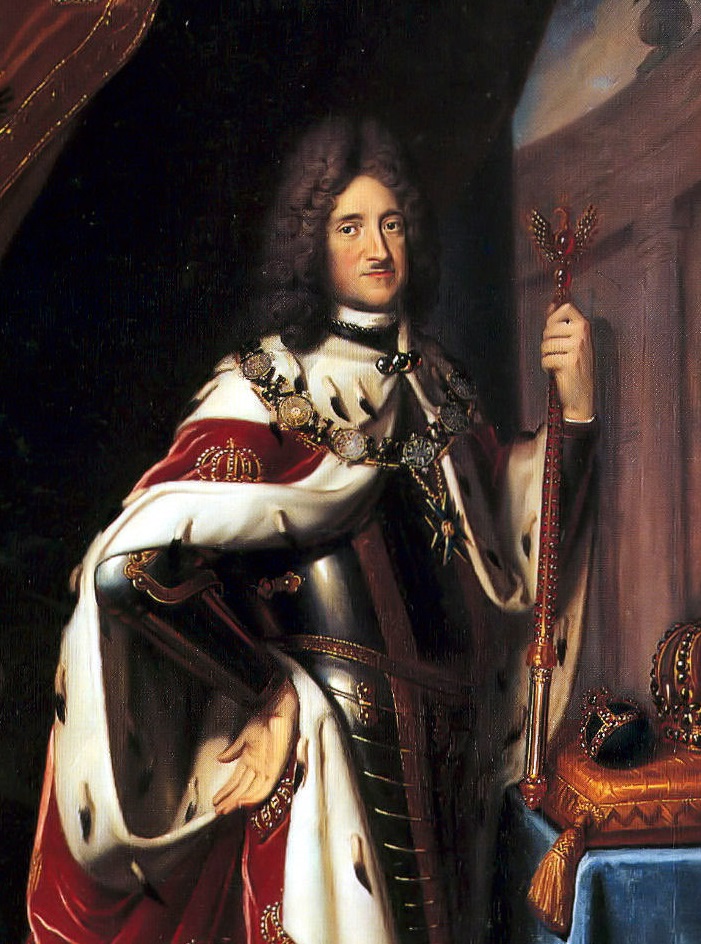
Portrait of Frederick I of Prussia (1657-1713)
Portrait of Frederick I of Prussia (1657-1713) Friedrich Wilhelm Weidemann · Public domain · Commons

The Kingdom of Prussia (German: Königreich Preußen, pronounced [ˈkøːnɪkʁaɪç ˈpʁɔʏsn̩]) was a German state that existed from 1701 to 1918. It played a significant role in the unification of Germany in 1871 and was a major constituent of the German Empire until its dissolution in 1918. The Kingdom of Prussia took its name from the historical region of Prussia, and controlled most of said region, although it was based in the Margraviate of Brandenburg, and its capital was Berlin. The kings of Prussia were from the House of Hohenzollern.

From Wikipedia: Kingdom of Prussia (CC BY-SA 4.0)

Origins and Founding

The Hohenzollerns were made rulers of the Margraviate of Brandenburg in 1518. In 1529, the Hohenzollerns secured the reversion of the Duchy of Pomerania after a series of conflicts, and acquired its eastern part following the Peace of Westphalia.

Read more

In 1618, the electors of Brandenburg also inherited the Duchy of Prussia, since 1511 ruled by a younger branch of the House of Hohenzollern. In 1525, Albrecht of Brandenburg, the last grand master of the Teutonic Order, secularised his territory and converted it into a duchy. It was ruled in a personal union with Brandenburg, known as "Brandenburg-Prussia". A full union was not possible, since Brandenburg was still legally part of the Holy Roman Empire and the Duchy of Prussia was a fief of Poland. The Teutonic Order had paid homage to Poland since 1466, and the Hohenzollerns continued to pay homage after secularizing Ducal Prussia.

From Wikipedia: Kingdom of Prussia · History: Background and establishment (CC BY-SA 4.0)

Founded
1702 CE
Preceded by
Duchy of Prussia

Rulers

Government, Society and Religion

The Kingdom of Prussia was an absolute monarchy until the Revolutions of 1848 in the German states, after which Prussia became a constitutional monarchy and Adolf Heinrich von Arnim-Boitzenburg was appointed as Prussia's first Minister President. Following Prussia's first constitution, a two-house parliament was formed, called the Landtag. The lower house, or Prussian House of Representatives, was elected by all males over the age of 25 using the Prussian three-class franchise introduced in the Constitution of 1850, which assured dominance by the more well-to-do elements of the population. The upper house, which was later renamed the Prussian House of Lords, was appointed by the king. He retained full executive authority and ministers were responsible only to him.

From Wikipedia: Kingdom of Prussia · State: Politics (CC BY-SA 4.0)

Government
constitutional monarchy
Languages
Official: German, Neo-Latin (until 1806), hidden
Religion
Statewide majority: Protestantism (Lutheran and Calvinist; Prussian United after 1817 (state religion)), Majority in some territories: Catholicism, Other minorities:

Coins, Currency and Symbols

Prussia, King Friedrich Wilhelm II., 1/3 Thaler 1788 E. Diameter is about 29 mm.
Prussia, King Friedrich Wilhelm II., 1/3 Thaler 1788 E. Diameter is about 29 mm. Johannes Robalotoff · CC BY-SA 3.0 de · Commons
Currency
Prussian thaler, Reichsthaler
  • Kurfürstentum Sachsen, August, Kurfürst von Sachsen, Reichstaler 1575
    Kurfürstentum Sachsen, August, Kurfürst von Sachsen, Reichstaler 1575 Weners · CC BY-SA 3.0 · Commons
  • Middle Arms of the Kingdom of Prussia 1873
    Middle Arms of the Kingdom of Prussia 1873 Glasshouse using elements from Sodacan · CC BY-SA 4.0 · Commons

Wars and Battles

During the half-century that followed the Congress of Vienna, a conflict of ideals took place within the German Confederation between the formation of a single German nation and the conservation of the current collection of smaller German states and kingdoms. The main debate centered around whether Prussia or the Austrian Empire should be the leading member of any unified Germany. Those advocating for Prussian leadership contended that Austria had far too many non-German interests to work for the greater good of Germany. They argued that Prussia, as by far the most powerful state with a majority of German speakers, was best suited to lead the new nation.

Read more

The establishment of the German Customs Union (Zollverein) in 1834, which excluded Austria, increased Prussian influence over the member states.

From Wikipedia: Kingdom of Prussia · History: 1848–1871: German wars of unification (CC BY-SA 4.0)

Achievements and Monuments

Decline and Fall

Bismarck's new empire was the most powerful state on the Continent. Prussia's dominance over the new empire was almost as absolute as it was with the North German Confederation. It included two-thirds of the empire's territory and three-fifths of its population. The imperial crown was a hereditary office of the House of Hohenzollern. Prussia also had a large plurality of seats in the Bundesrat, with 17 votes out of 58 (17 out of 61 after 1911); no other state had more than six votes. As before, it could effectively control the proceedings with the support of its allies in the secondary states. As mentioned above, Bismarck served as foreign minister of Prussia for almost his entire career, and in that role instructed the Prussian deputies to the Bundesrat.

From Wikipedia: Kingdom of Prussia · History: 1871–1918: Peak and fall (CC BY-SA 4.0)

Ended
1863 CE
Last recorded ruler
Wilhelm I

Early Modern States of Central Europe: Frequently Asked Questions

Which states existed in Central Europe in this period?

This page maps 4 states of Central Europe founded between 1459 CE and 1702 CE: Habsburg Monarchy, Brandenburg-Prussia, Principality of Upper Hungary, Kingdom of Prussia.

Which was the largest of the Early Modern States of Central Europe?

Habsburg Monarchy had the largest mapped extent, about 752,168 km².

Which of the Early Modern States of Central Europe lasted longest?

Habsburg Monarchy lasted longest, 1459 CE – 1805 CE.

Sources

  • Reading text: Wikipedia articles on the group and each state, condensed (CC BY-SA 4.0).
  • Facts, rulers and wars: Wikidata (CC0).
  • Borders: Cliopatria, Seshat Global History Databank (CC BY 4.0).
  • Pictures: Wikimedia Commons; the author and licence are under each picture.

Largest state by mapped extent: Habsburg Monarchy.