Every day from Japan’s surrender to the end of the USSR: who sided with whom, the Iron Curtain, colonies winning independence and every crisis as it happened.
Loading map…
NATOOther US alliesUSSR and Warsaw PactSoviet-alignedCommunist, not Soviet-ledNon-Aligned MovementNeutral or unalignedColony or occupiedContested
1945195019551960196519701975198019851990
Drag the slider or press ←→ to move a month (Shift for a year, PgUpPgDn for a decade) · Space to play
How to use the Cold War map
This interactive map follows the Cold War one day at a time, from Japan’s surrender on 2 September 1945 to the end of the Soviet Union on 26 December 1991. Drag the slider through all 16,917 days to see who sided with whom, which colonies won independence, where the dividing lines ran and where the rivalry turned into open war.
Colours show each state’s side on the selected day. Treaty membership decides first, so NATO and the Warsaw Pact change colour on the day a state signed or left. Hatching marks colonies and occupied land in the colour of the power that held it. Tap any country to see why it has its colour, with a link to the source.
16,917 days, 1945-09-02 to 1991-12-26
1,698 dated events
151 states and territories at war
342 changes of alignment
Turning points of the Cold War
Each turning point below opens the map on the day it happened.
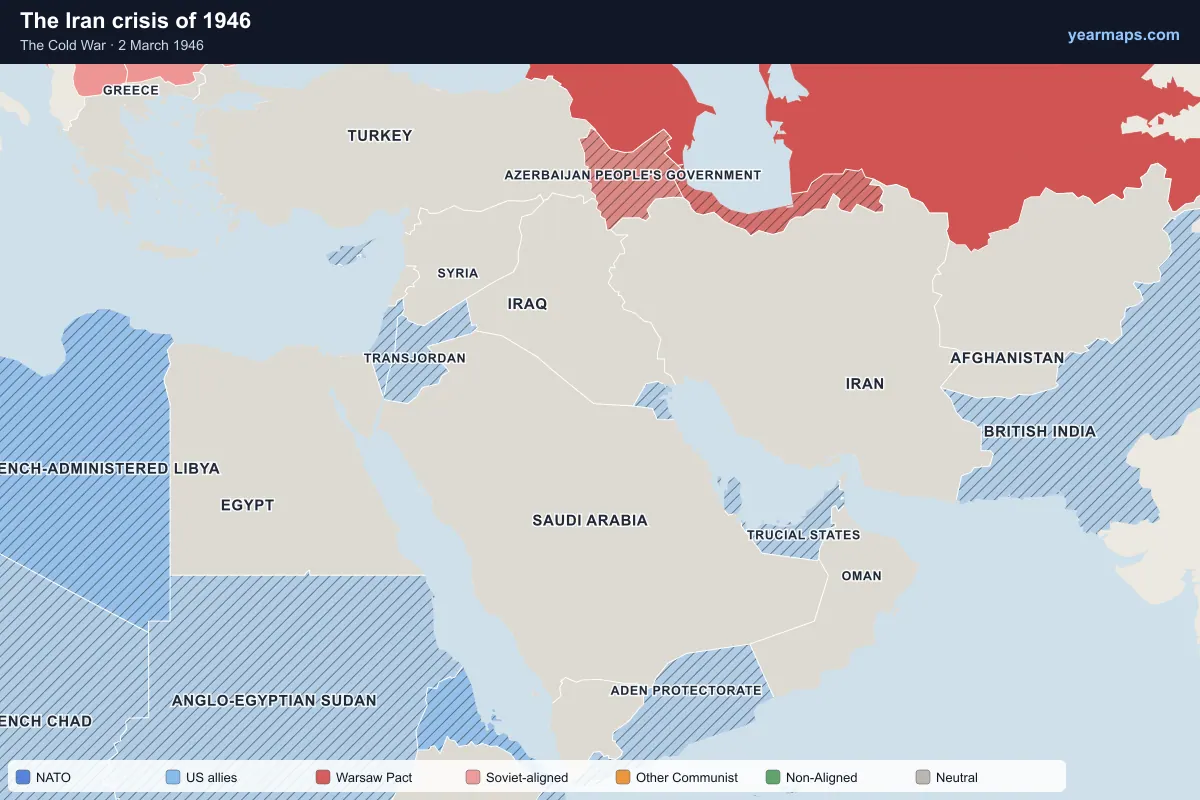
The Iran crisis of 1946
the Balkans and the Middle East, 2 March 1946: territory held by each side.
British, American and Soviet troops had occupied Iran during World War II and agreed to leave within six months of the war’s end. The deadline passed on 2 March with Soviet forces still in the north, where a Soviet-backed government held Tabriz. Under pressure at the new United Nations and in exchange for an oil promise that Iran’s parliament later rejected, Moscow withdrew by May. It was one of the first open tests of the wartime alliance.
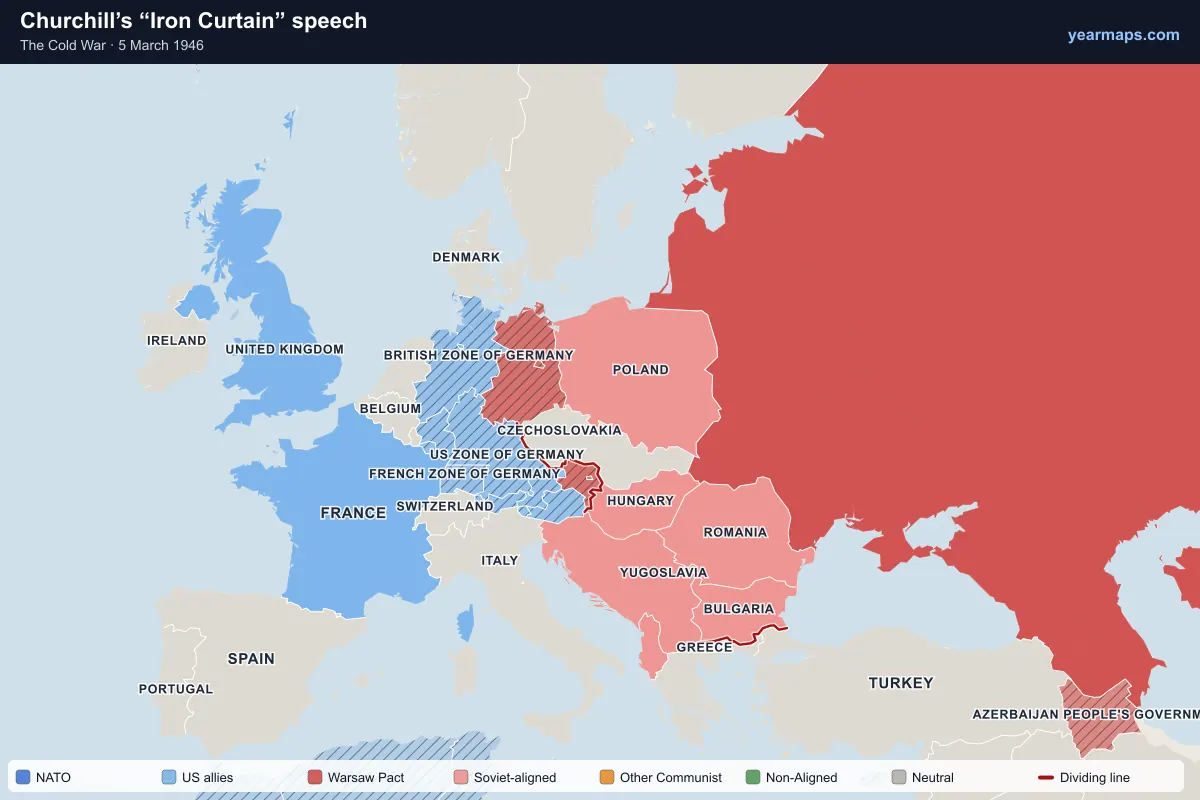
Europe, 5 March 1946: territory held by each side.
Speaking at Fulton, Missouri, with President Truman beside him, Winston Churchill described an iron curtain falling across Europe from Stettin on the Baltic to Trieste on the Adriatic. The map shows how much of it was already true: Soviet troops held eastern Germany, Poland, Hungary, Romania and Bulgaria. Germany and Austria were divided into occupation zones, drawn here in the colour of each occupier.
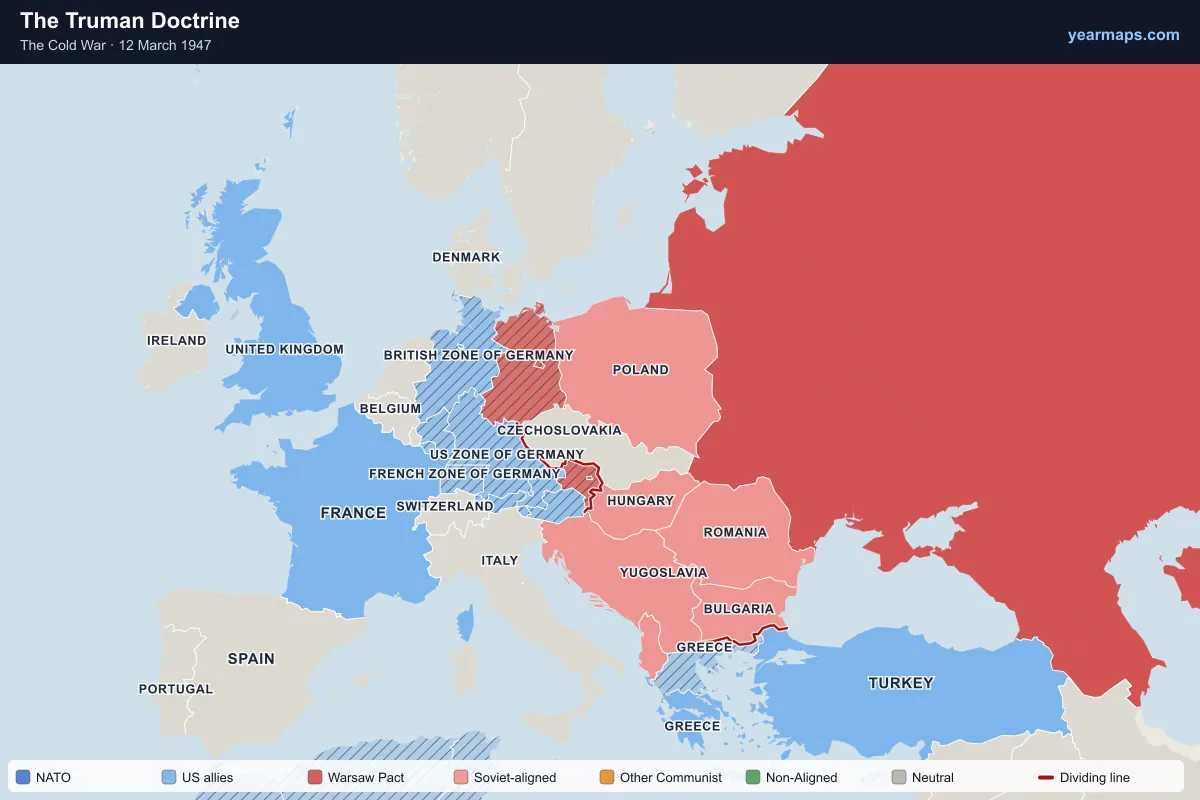
Europe, 12 March 1947: territory held by each side.
Britain could no longer afford to support Greece and Turkey, so President Truman asked Congress for 400 million dollars in aid and declared that the United States would help free peoples resist outside pressure. Many histories date the start of the Cold War from this speech. On the map, Greece’s northern provinces are hatched as contested: its civil war between the government and Communist-led forces ran until 1949.
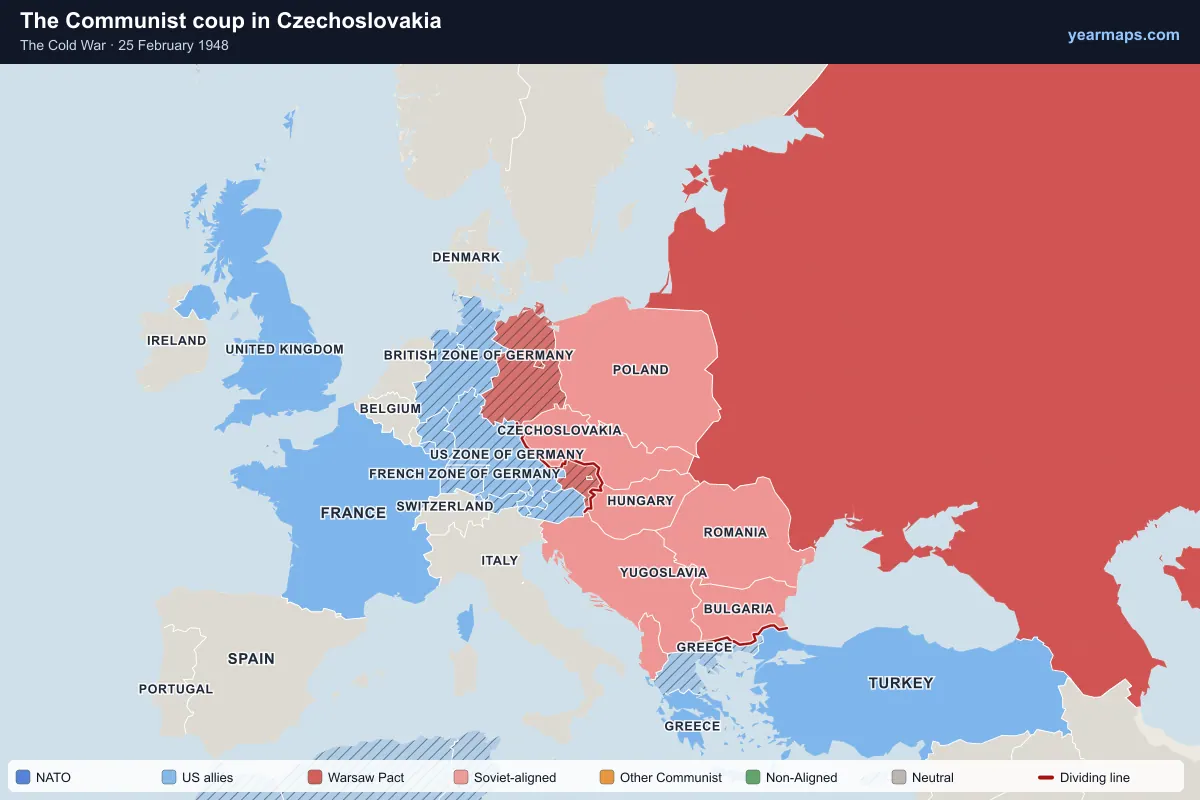
Europe, 25 February 1948: territory held by each side.
Czechoslovakia was the last state in Eastern Europe with a coalition government. When non-Communist ministers resigned in protest in February 1948, the Communist Party used the crisis, the police and worker militias to take full power. President Beneš accepted a new cabinet on 25 February. The shock in the West helped push the Marshall Plan through Congress and sped up talks on a defence pact.
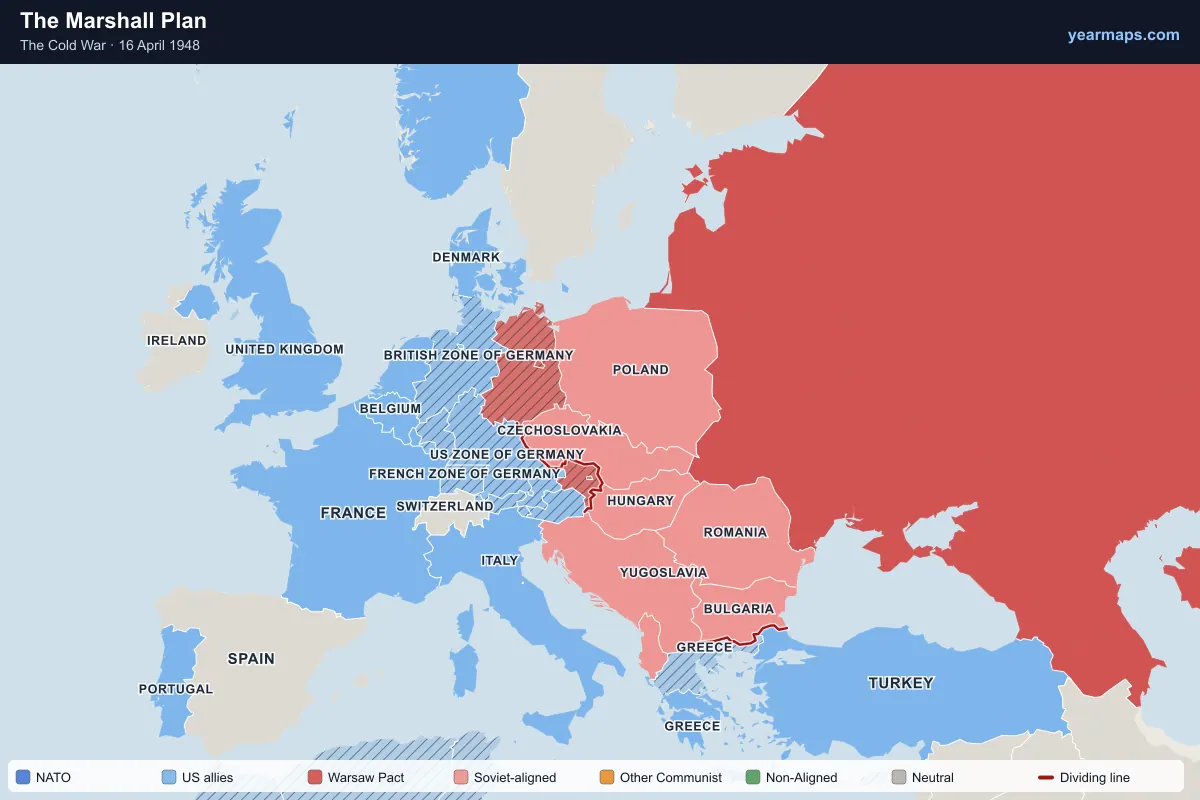
Europe, 16 April 1948: territory held by each side.
Sixteen European states formed the organisation that would share out American recovery aid, about 13 billion dollars over four years. Moscow refused the plan and made its neighbours refuse too, so aid itself became a line across the continent. Several recipients turn light blue on this date, showing Western alignment before NATO existed; Sweden, Switzerland and Ireland took the aid and stayed neutral.
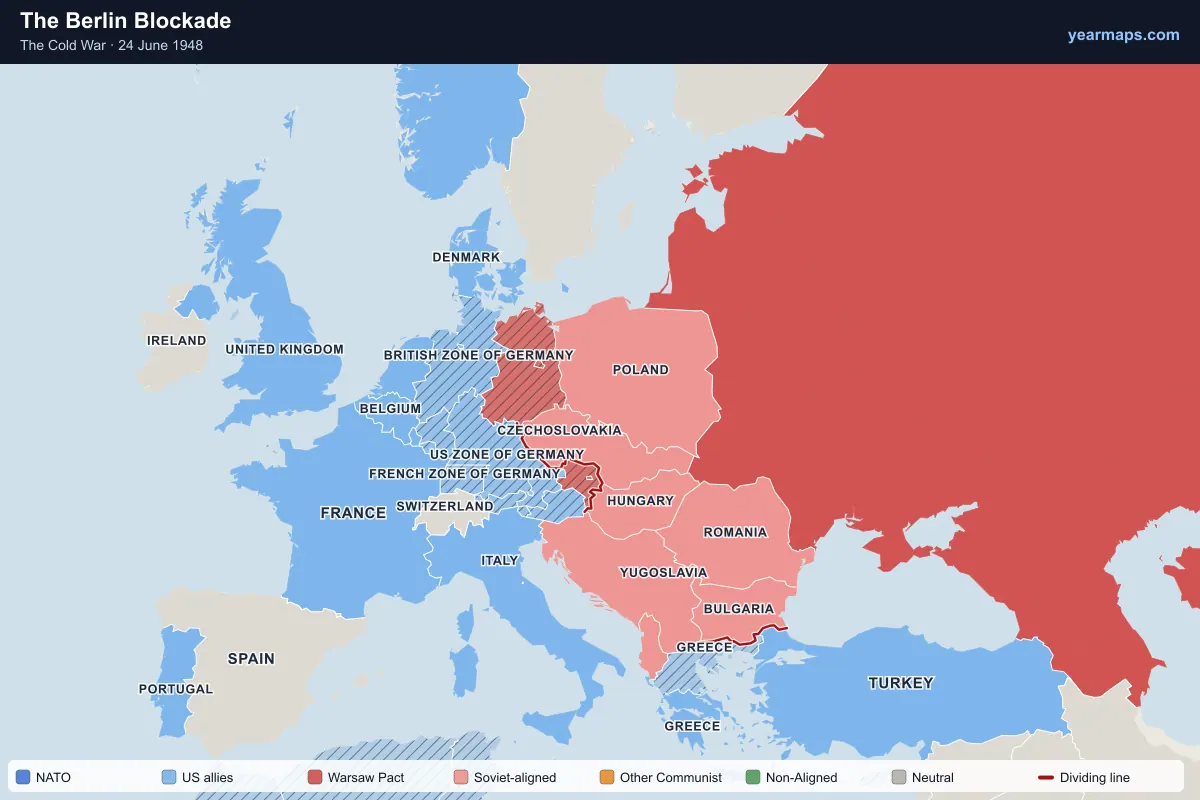
Europe, 24 June 1948: territory held by each side.
After the Western powers introduced a new currency in their zones, the Soviet Union cut road, rail and canal links to West Berlin, deep inside its own zone. The United States and Britain supplied the city by air for almost a year. The blockade was lifted on 12 May 1949 without a shot fired between the powers, and it made the division of Germany permanent.
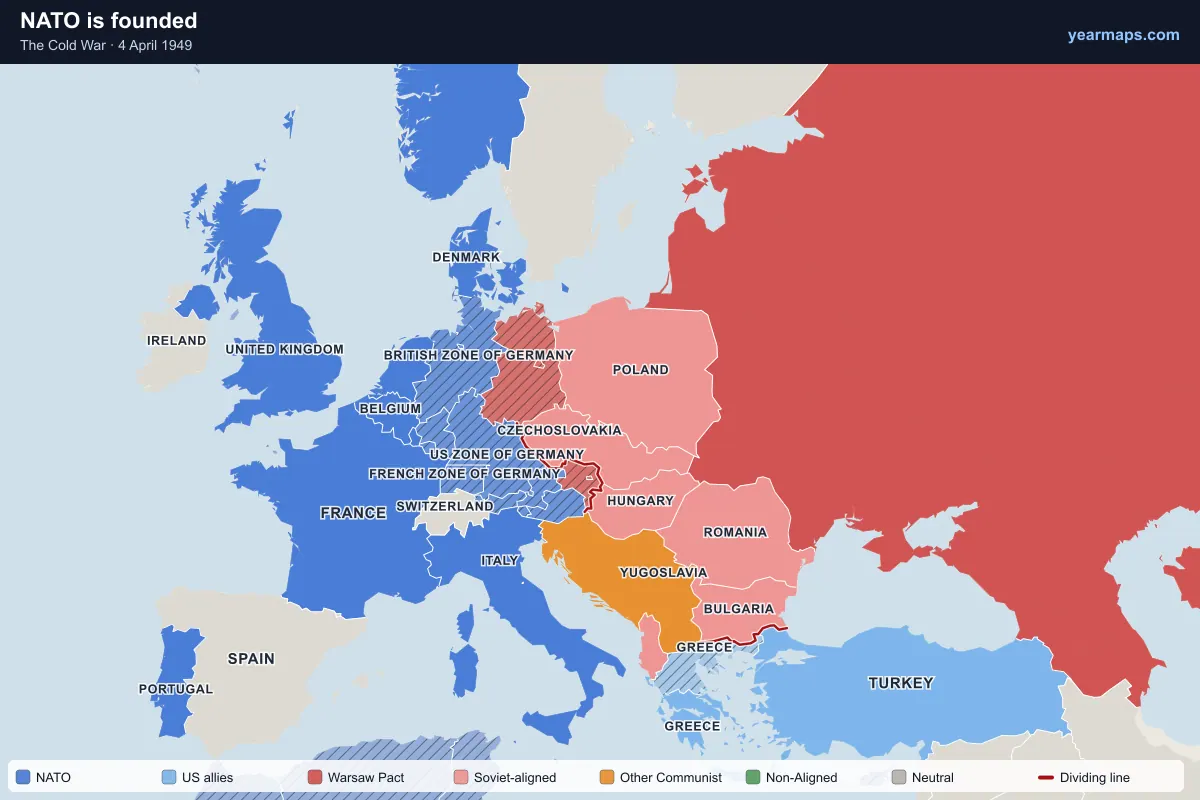
Europe, 4 April 1949: territory held by each side.
Twelve states signed the North Atlantic Treaty in Washington, promising that an armed attack on one would count as an attack on all. It was the first peacetime military alliance the United States had joined in the modern era. The founding members turn dark blue on this day. Greece and Turkey joined in 1952 and West Germany in 1955.
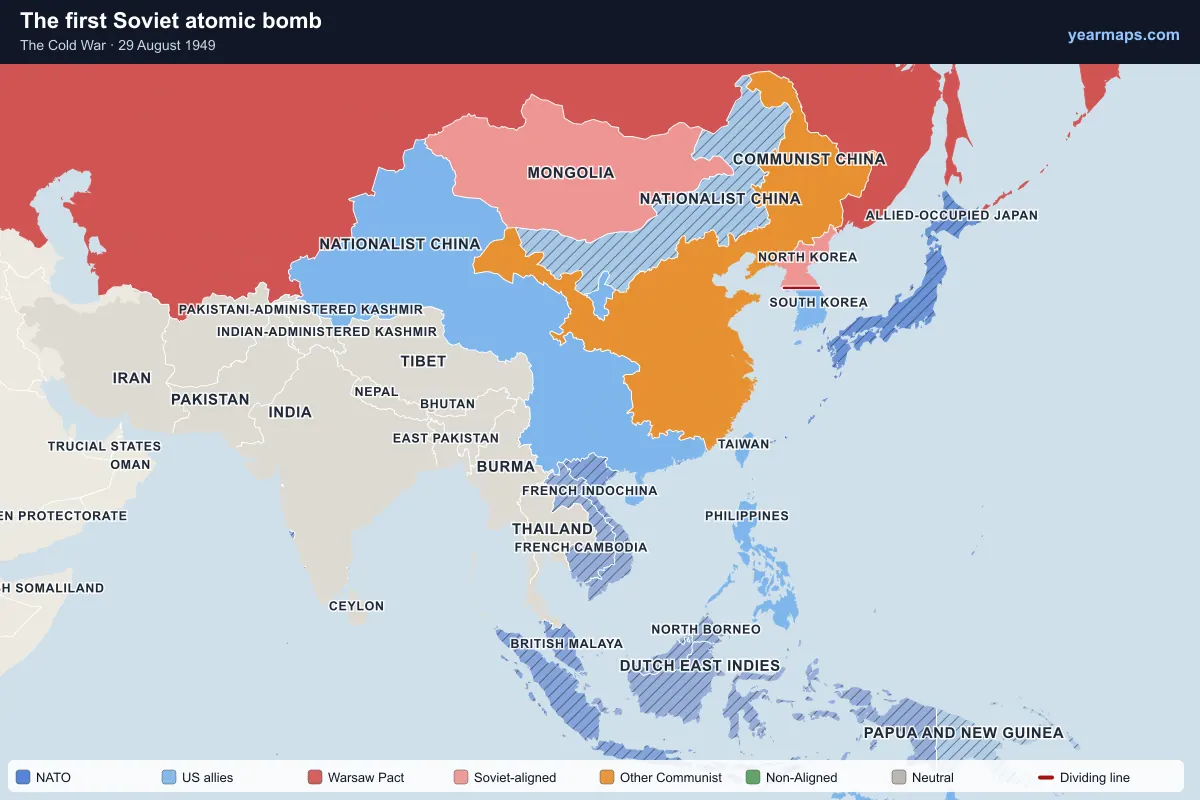
East and South-East Asia, 29 August 1949: territory held by each side.
The Soviet Union tested its first atomic bomb near Semipalatinsk in Kazakhstan, years before most American forecasts expected it. The US monopoly on the weapon had lasted four years. President Truman announced the test in September and in January 1950 ordered work on the hydrogen bomb. The arms race that followed shaped every crisis on this map.
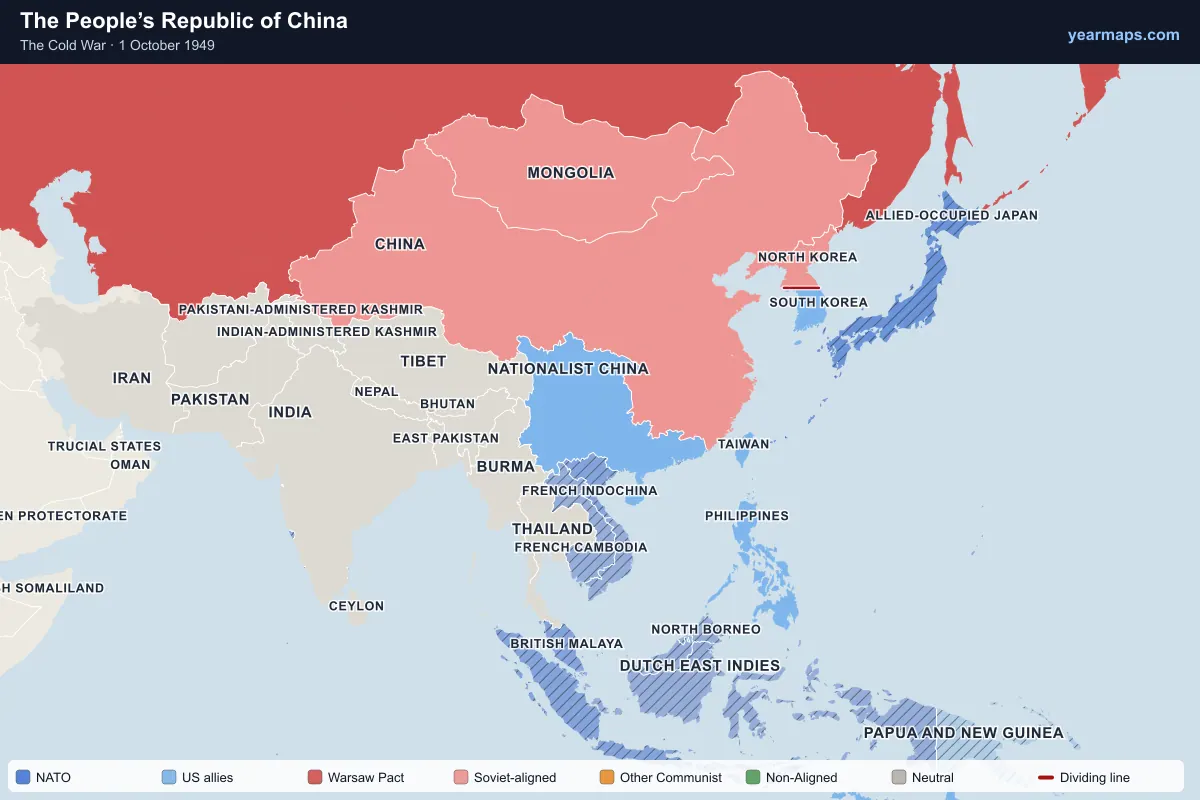
East and South-East Asia, 1 October 1949: territory held by each side.
Mao Zedong proclaimed the People’s Republic in Beijing after a civil war that had moved quickly once Manchuria fell in late 1948. Follow the slider from that autumn to see province after province change hands, one main city at a time. The Nationalist government withdrew to Taiwan in December. With China now allied to the USSR, the Cold War had become a contest in Asia as well.
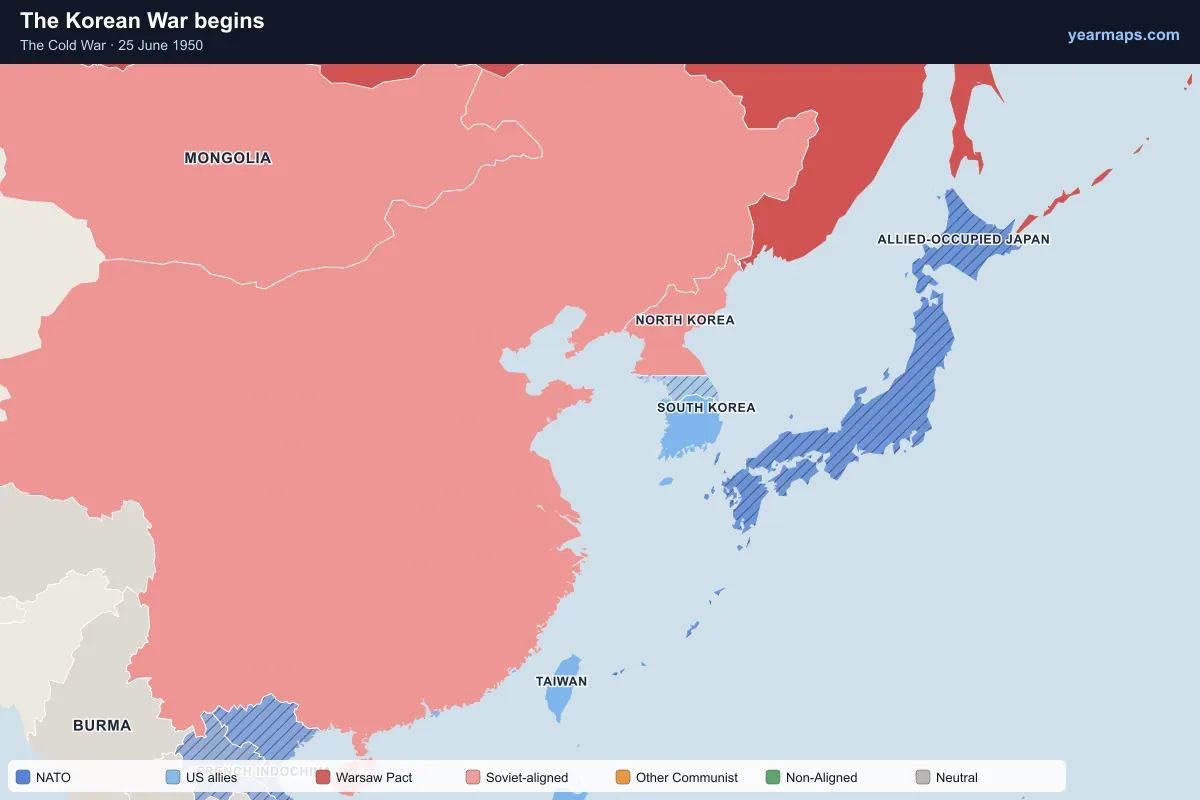
East Asia, 25 June 1950: territory held by each side.
North Korean forces crossed the 38th parallel, the line along which the US and USSR had divided Korea in 1945. Within six weeks they had pushed South Korean and American troops into a corner around Busan. The UN Security Council, which the Soviet delegate was boycotting at the time, backed a US-led force.
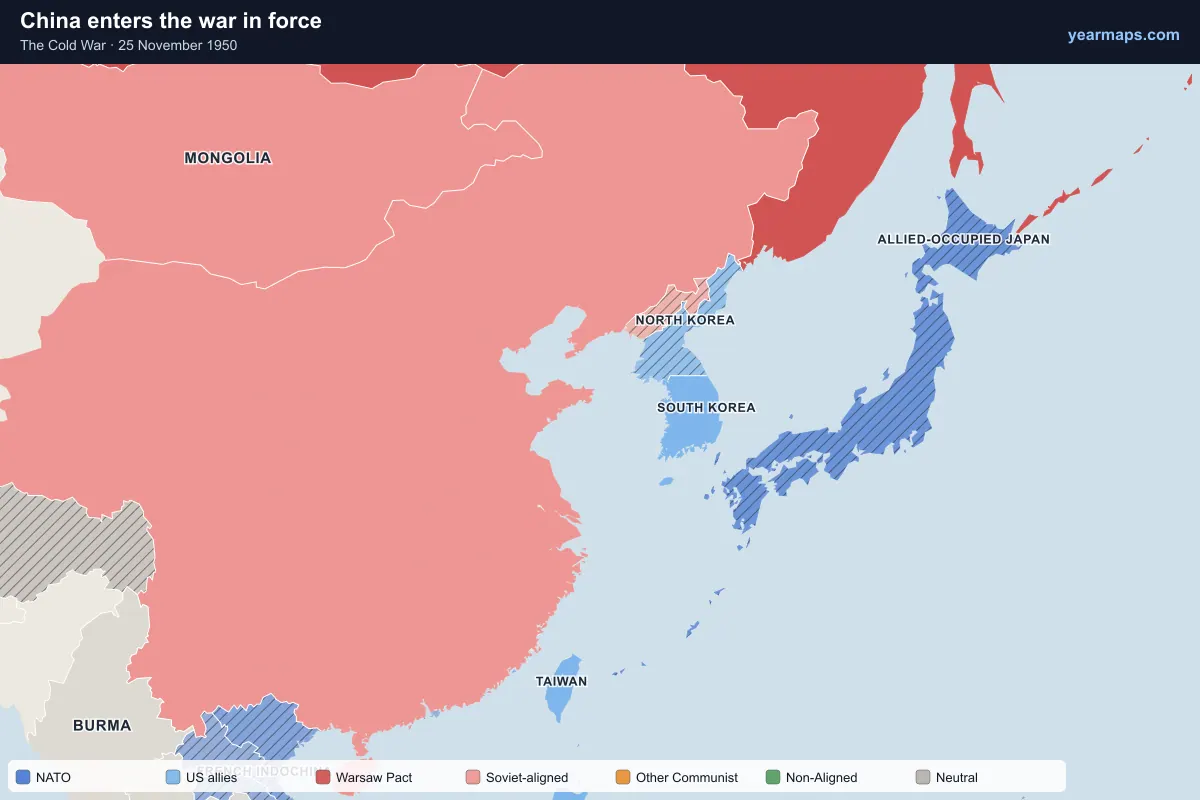
East Asia, 25 November 1950: territory held by each side.
After the Inchon landing in September, UN forces crossed the 38th parallel and drove toward the Chinese border. Chinese troops had already crossed the Yalu in secret, and in late November they launched a huge offensive that forced the longest retreat in US military history. Seoul changed hands twice more before the front settled near where the war had begun.
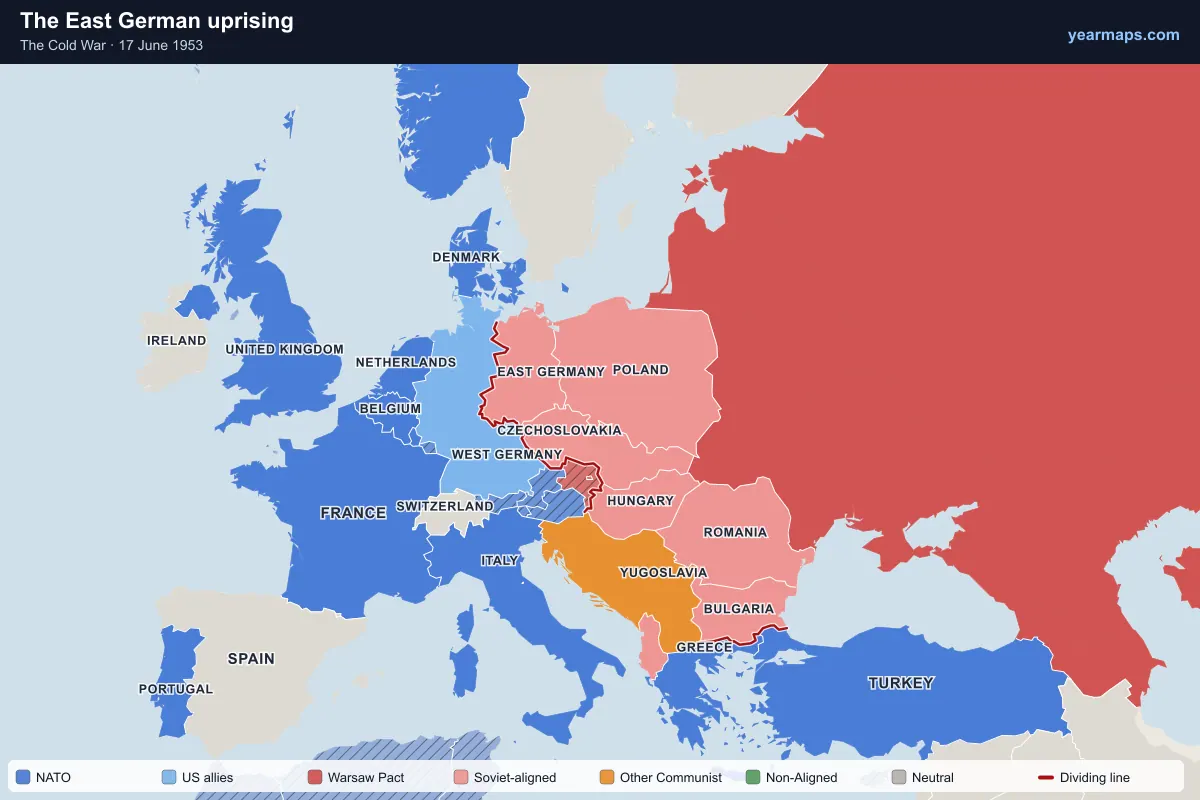
Europe, 17 June 1953: territory held by each side.
Three months after Stalin’s death, a strike by East Berlin construction workers over raised work quotas spread to hundreds of towns across East Germany. Soviet tanks put it down within days. It was the first mass revolt inside the Eastern Bloc, and the pattern would return in Hungary in 1956 and Czechoslovakia in 1968.
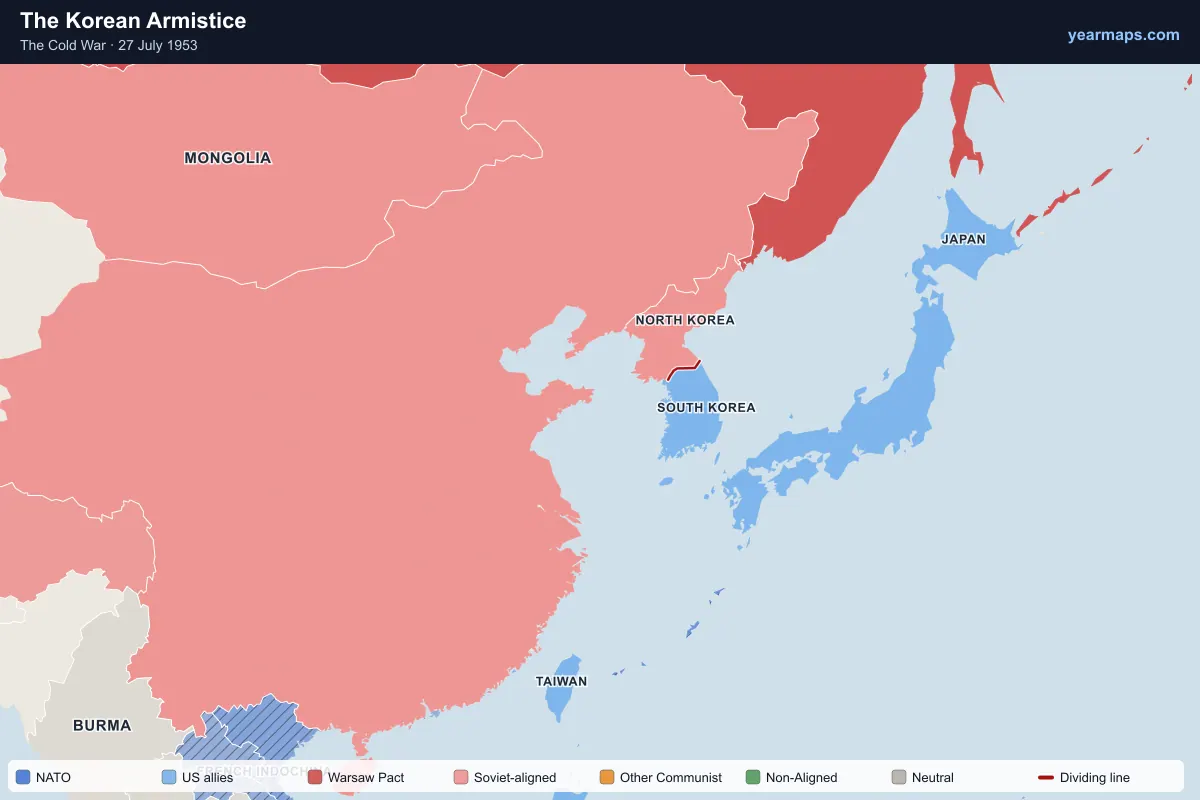
East Asia, 27 July 1953: territory held by each side.
After two years of talks and fighting along a nearly static line, an armistice was signed at Panmunjom. It created a demilitarized zone close to the 38th parallel and was never followed by a peace treaty. Estimates of the dead vary widely and run to several million, most of them Korean civilians.
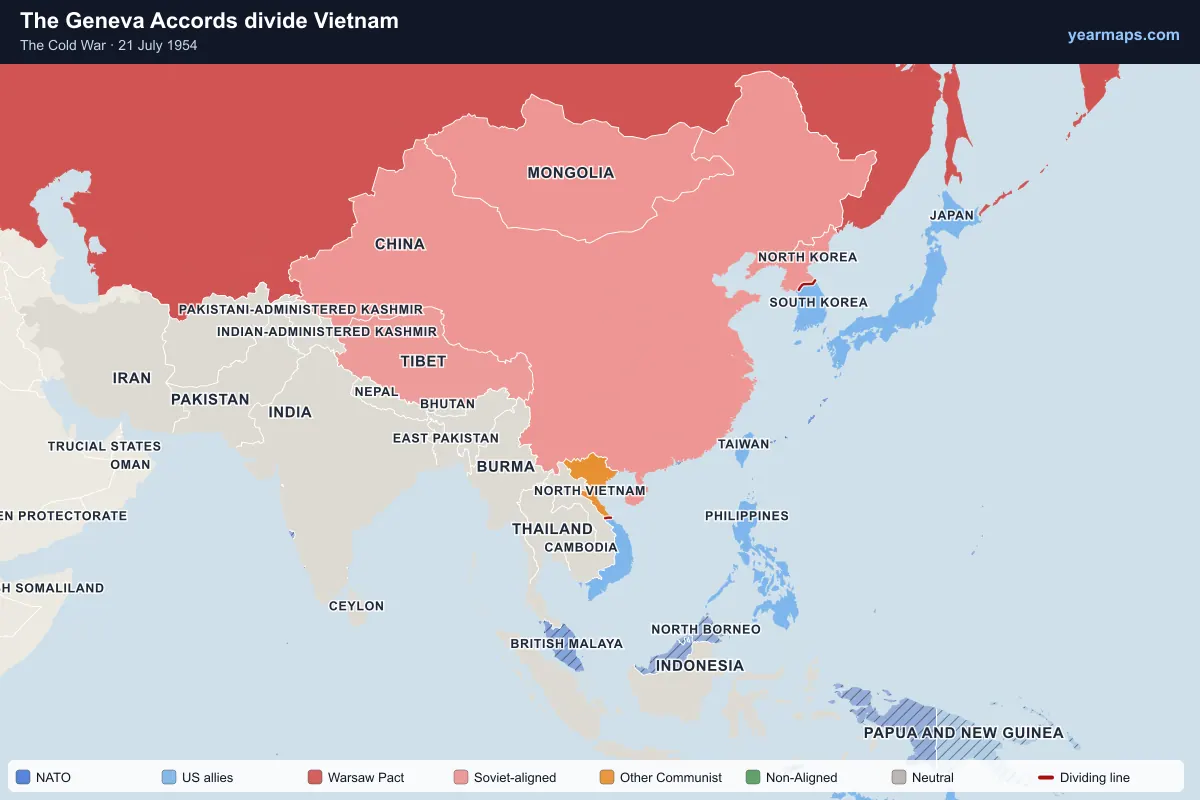
East and South-East Asia, 21 July 1954: territory held by each side.
Two months after the French defeat at Dien Bien Phu, the Geneva conference ended the First Indochina War. Vietnam was divided at the 17th parallel until elections due in 1956, which were never held. Laos and Cambodia were already independent. The United States stayed out of the agreement and began to back the state in the south.
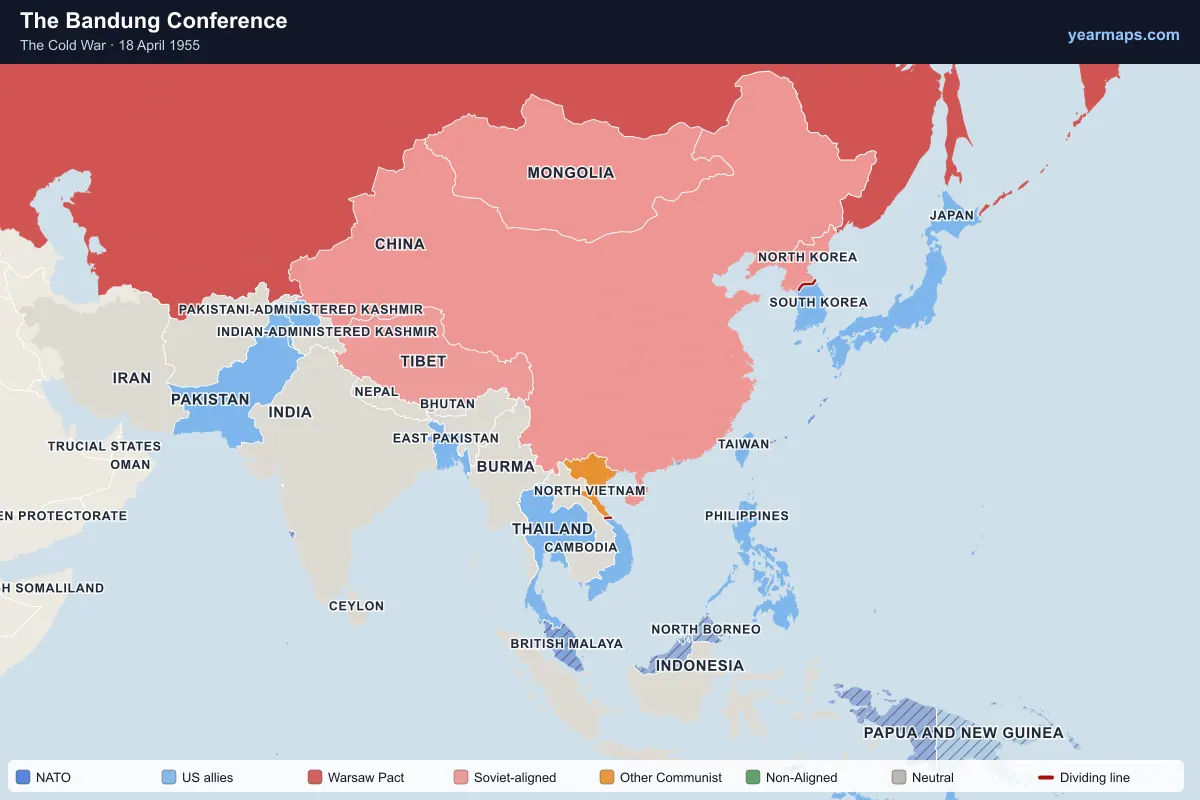
East and South-East Asia, 18 April 1955: territory held by each side.
Twenty-nine Asian and African states met in Indonesia, most of them recently independent. They represented more than half of humanity and wanted no part in choosing between the two blocs. The meeting was the forerunner of the Non-Aligned Movement, founded at Belgrade in 1961. On the map, watch the hatching of colonial rule start to clear across Asia.
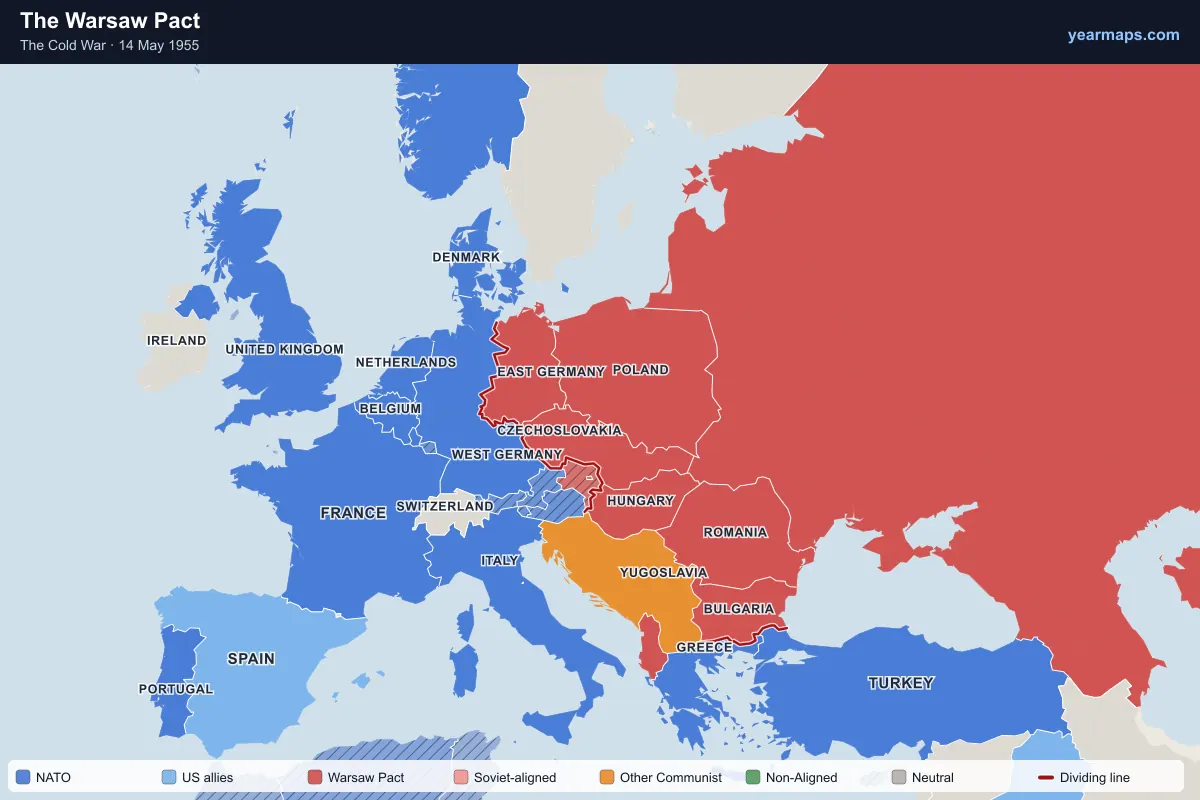
Nine days after West Germany gained sovereignty, and days after it joined NATO, the Soviet Union and seven Eastern European states signed a mutual defence treaty in Warsaw. Europe’s two blocs now had matching military alliances, and the map shows them facing each other from the Baltic to the Black Sea. The next day, the Austrian State Treaty offered a different path: a neutral Austria, with all occupation troops gone by October.
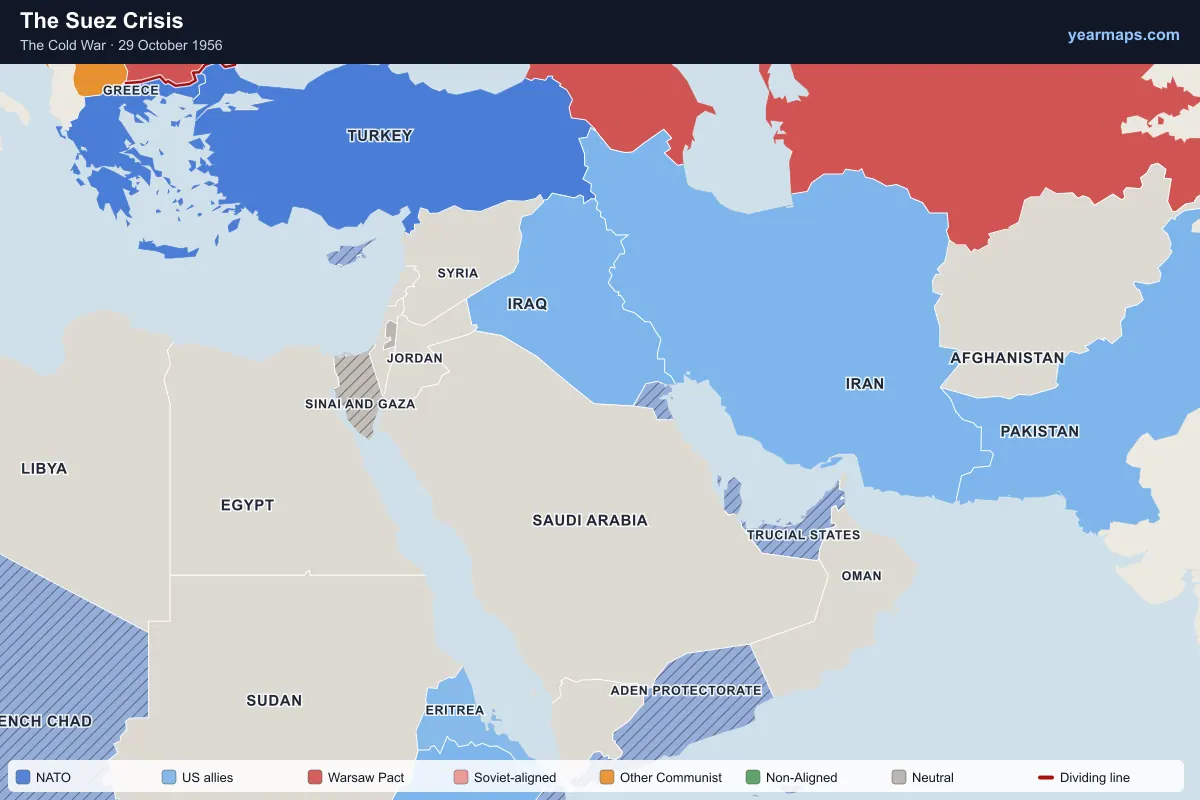
the Balkans and the Middle East, 29 October 1956: territory held by each side.
Israel invaded Sinai, and Britain and France followed with landings at Port Said after Egypt nationalised the Suez Canal. Washington and Moscow both demanded that they stop, and US financial pressure forced Britain out within weeks. The crisis marked the end of Britain and France as independent world powers in the Middle East, and it raised Nasser’s standing across the Arab world.
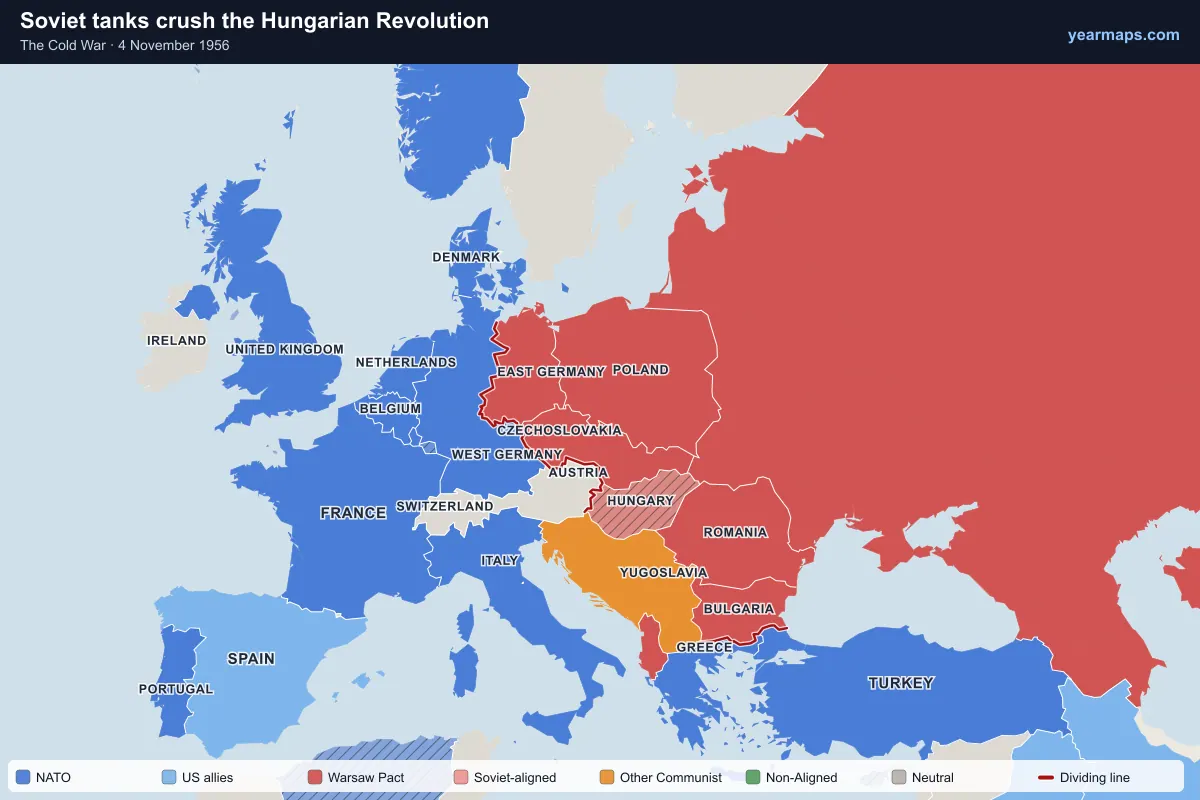
Europe, 4 November 1956: territory held by each side.
What began as a student protest in Budapest on 23 October became a national uprising, and Imre Nagy’s government announced that Hungary would leave the Warsaw Pact. On 4 November Soviet forces returned in strength. Thousands died, about 200,000 people fled the country, and Nagy was later executed. The West, distracted by Suez, did not intervene, which showed the limits of its talk of liberating Eastern Europe.
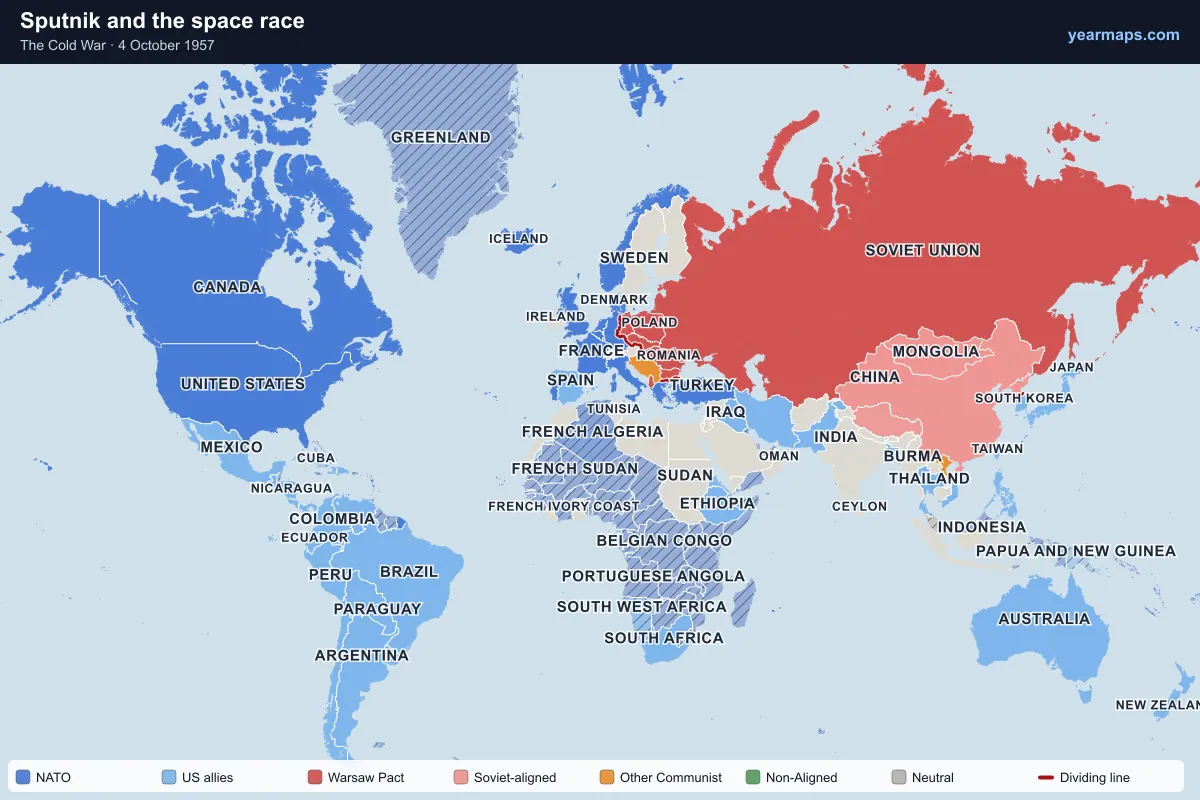
the world, 4 October 1957: territory held by each side.
The USSR launched the first artificial satellite from Baikonur in Kazakhstan. The same rocket could in principle carry a warhead to America, and the shock led directly to NASA and to a surge of US spending on science. Soviet firsts continued with Yuri Gagarin in 1961, until Apollo 11 put Americans on the Moon in 1969.
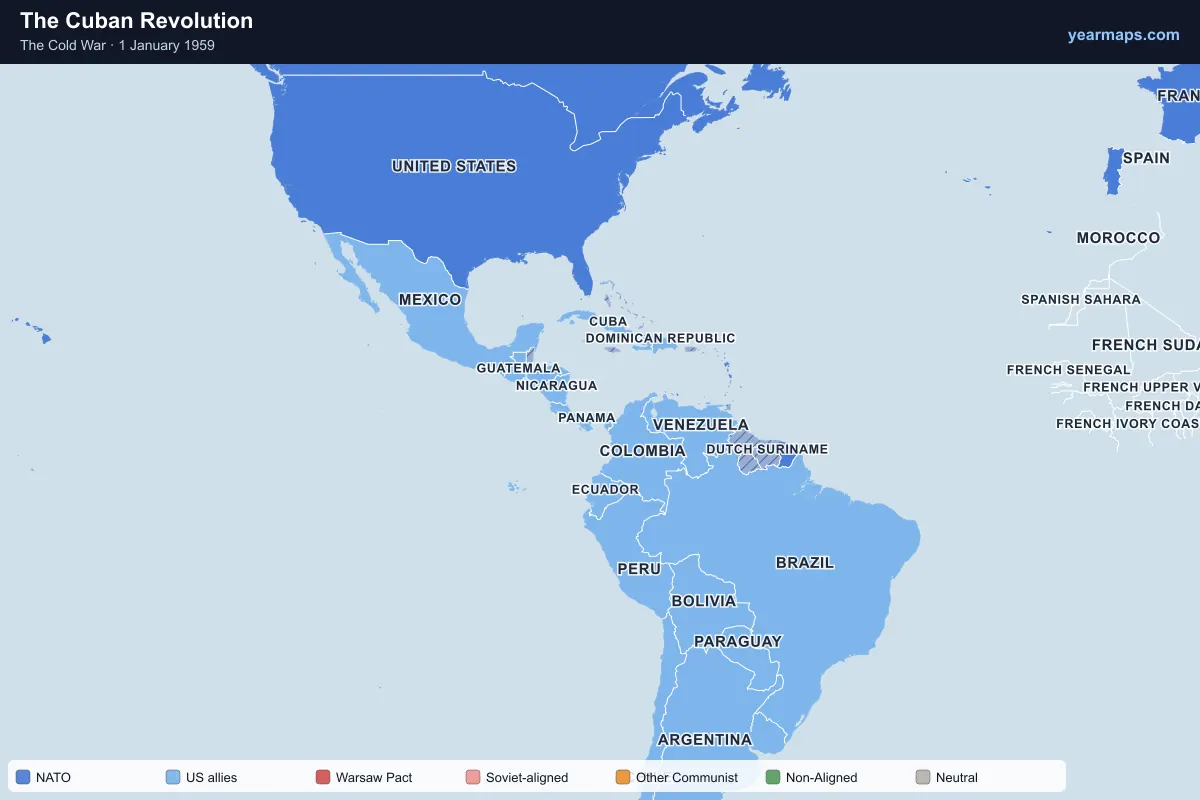
the Americas, 1 January 1959: territory held by each side.
Fulgencio Batista fled Havana on New Year’s Day after two years of guerrilla war led by Fidel Castro. The new government clashed with Washington over land reform and US-owned property, and turned to Moscow for oil and sugar sales. Cuba restored relations with the USSR in May 1960 and changes colour on the map that day: a Soviet ally 150 kilometres from Florida.
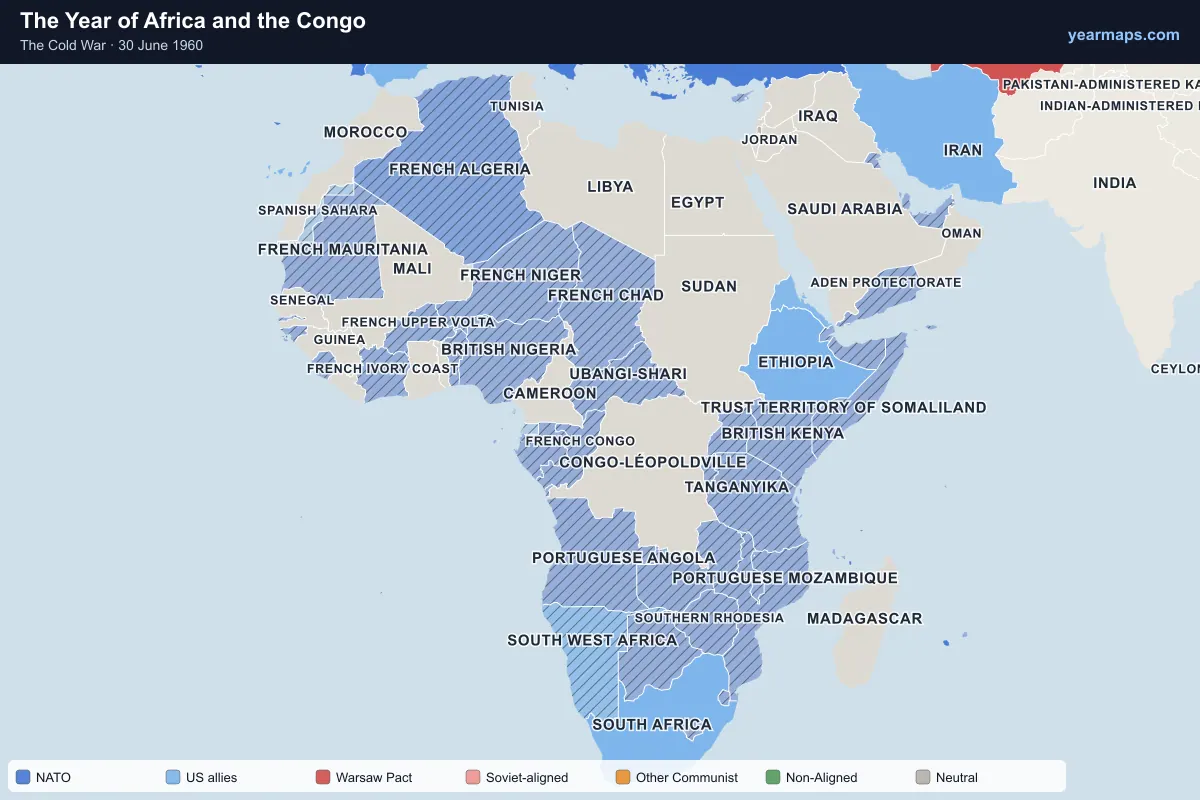
Africa, 30 June 1960: territory held by each side.
Seventeen African states became independent in 1960, and the hatching of colonial rule clears across the map month by month. Congo’s independence from Belgium on 30 June collapsed almost at once into mutiny and secession. Prime Minister Patrice Lumumba appealed to Moscow, alarming Washington, and was murdered in January 1961. The new states would be courted by both sides for the rest of the Cold War.
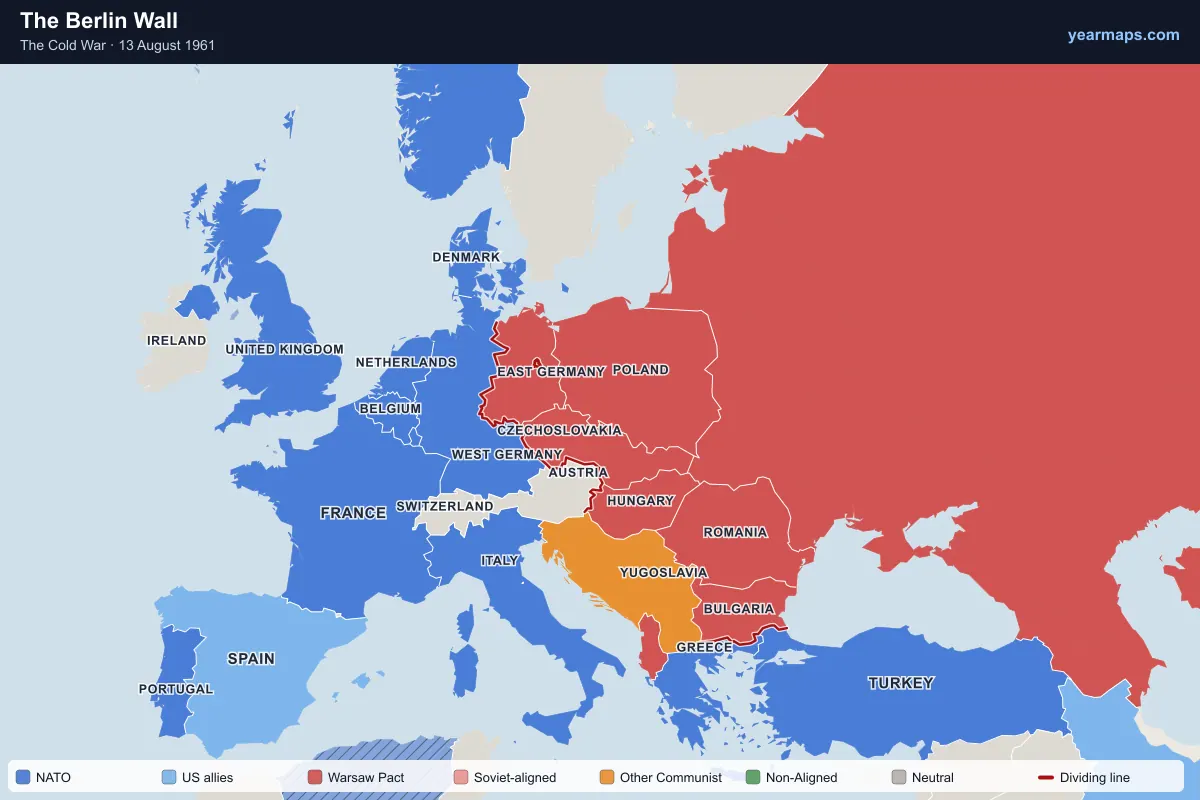
Europe, 13 August 1961: territory held by each side.
About 2.7 million people had fled East Germany since 1949, many of them through Berlin, where the border was still open. Overnight on 13 August East German troops closed it with barbed wire, and the concrete wall followed. It stood for 28 years. Turn on the dividing lines to see it, or read our page on the Berlin Wall.
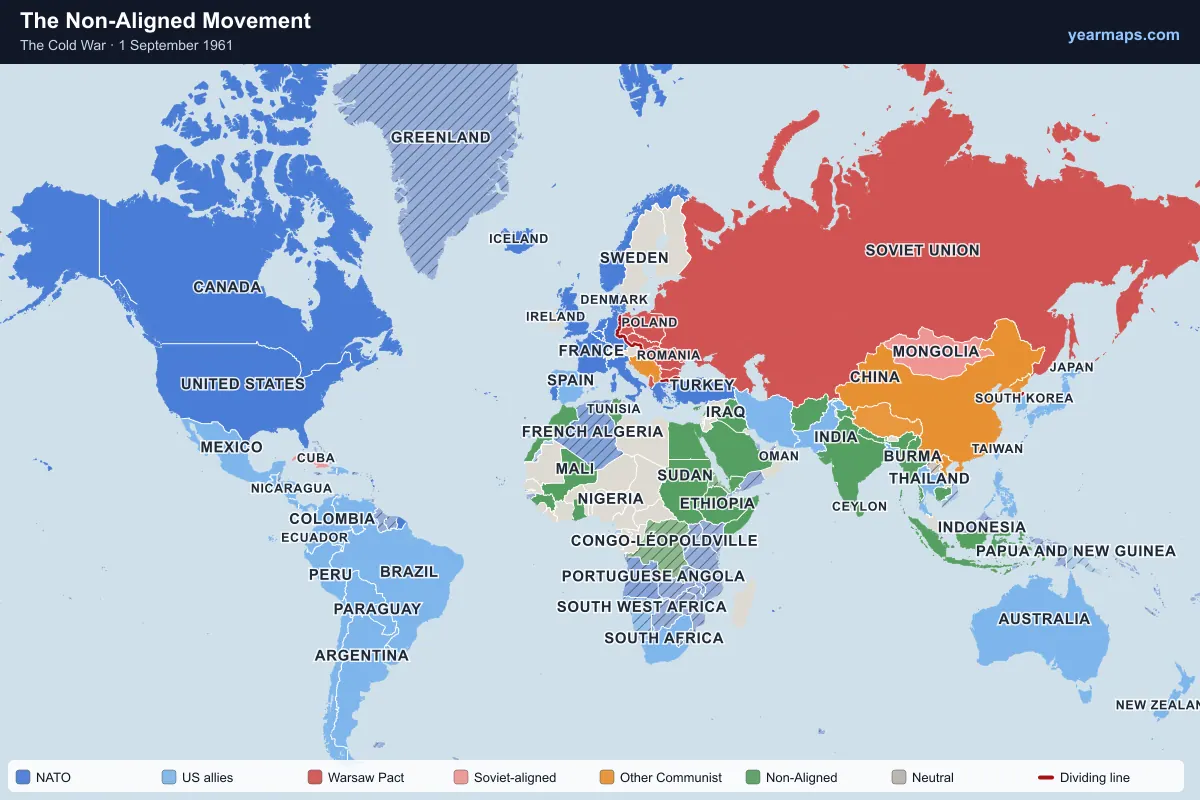
the world, 1 September 1961: territory held by each side.
Twenty-five states met in Belgrade at the invitation of Tito, Nehru and Nasser and refused to join either bloc. Their members turn green on this day. The group grew at each summit as colonies won independence, and by 1979 it included most of the world’s states, though some members leaned clearly to one side.
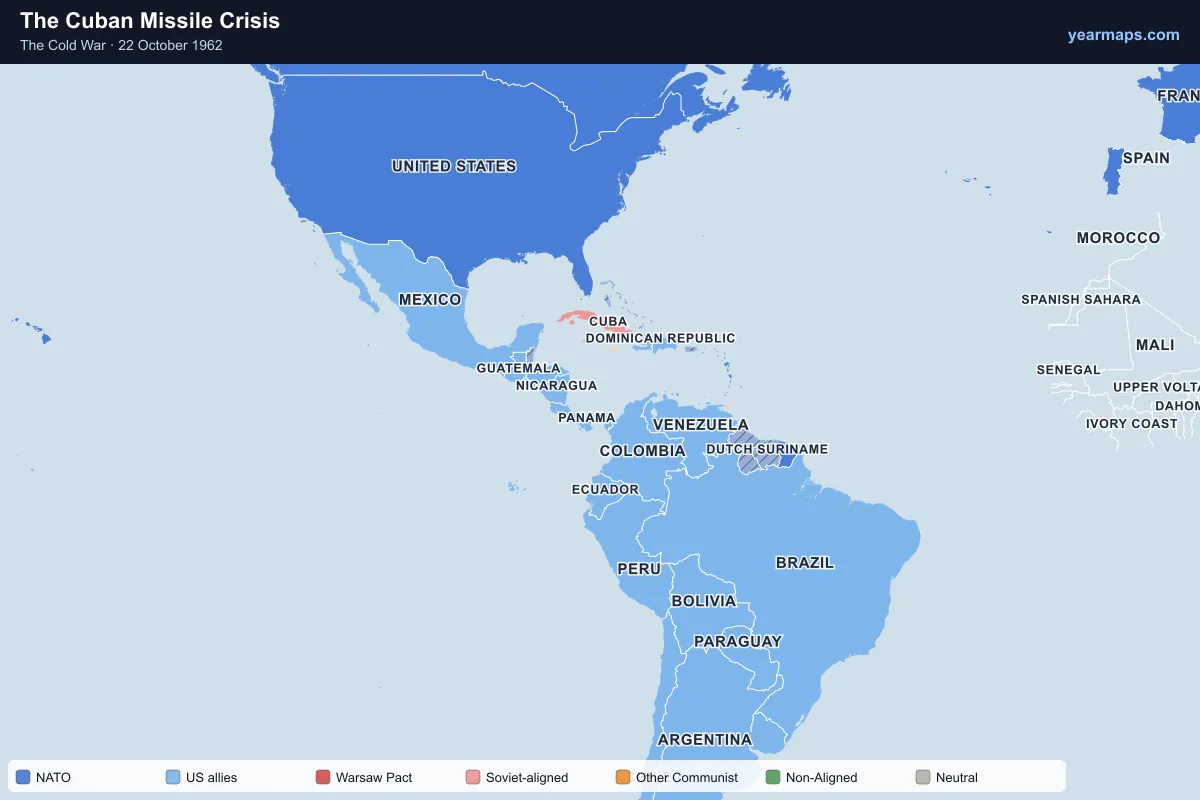
the Americas, 22 October 1962: territory held by each side.
US spy planes found Soviet nuclear missile sites being built in Cuba. On 22 October President Kennedy announced a naval quarantine of the island and demanded their removal. For six days the world came closer to nuclear war than at any other time. Khrushchev agreed to withdraw the missiles on 28 October, in return for a US pledge not to invade Cuba and a secret promise to remove American missiles from Turkey.
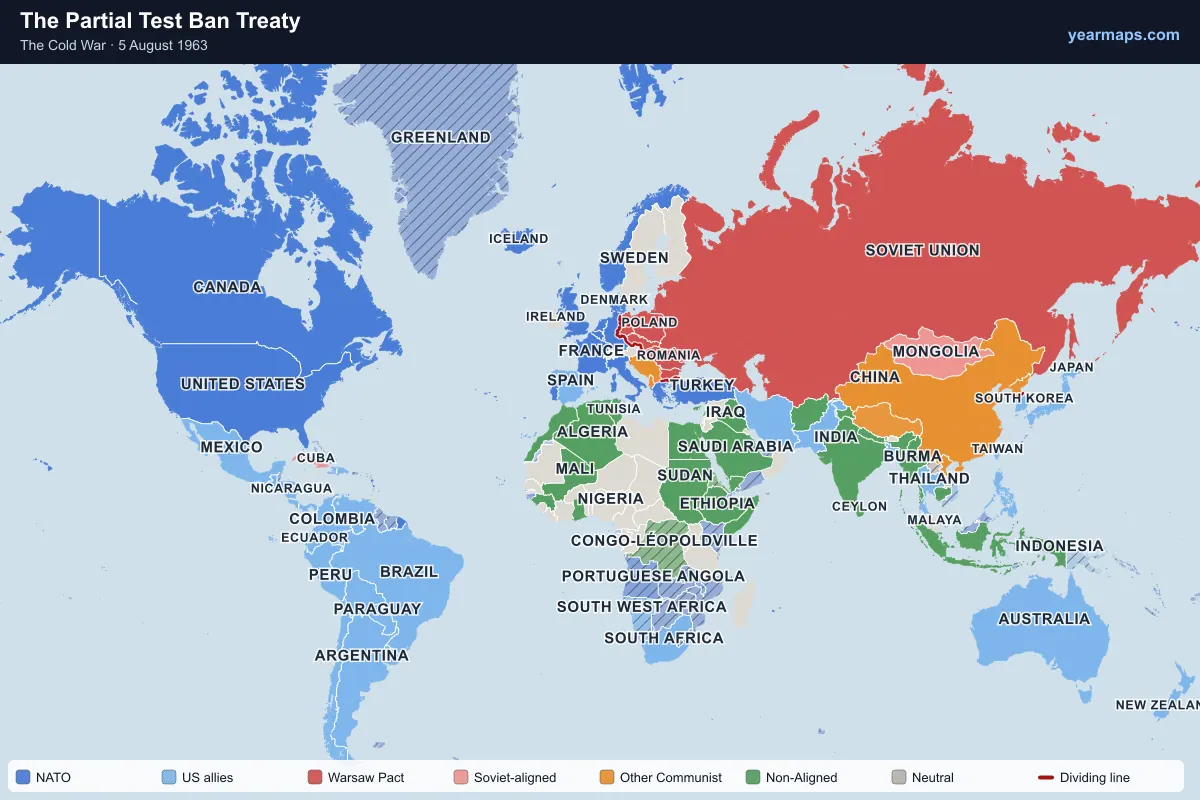
the world, 5 August 1963: territory held by each side.
Shaken by the Cuban crisis, the US, USSR and UK agreed to stop nuclear tests in the atmosphere, in space and under water. A hotline between Washington and Moscow was set up the same year. Testing moved underground and went on for decades: turn on the nuclear tests layer to watch the count rise. France and China did not sign.
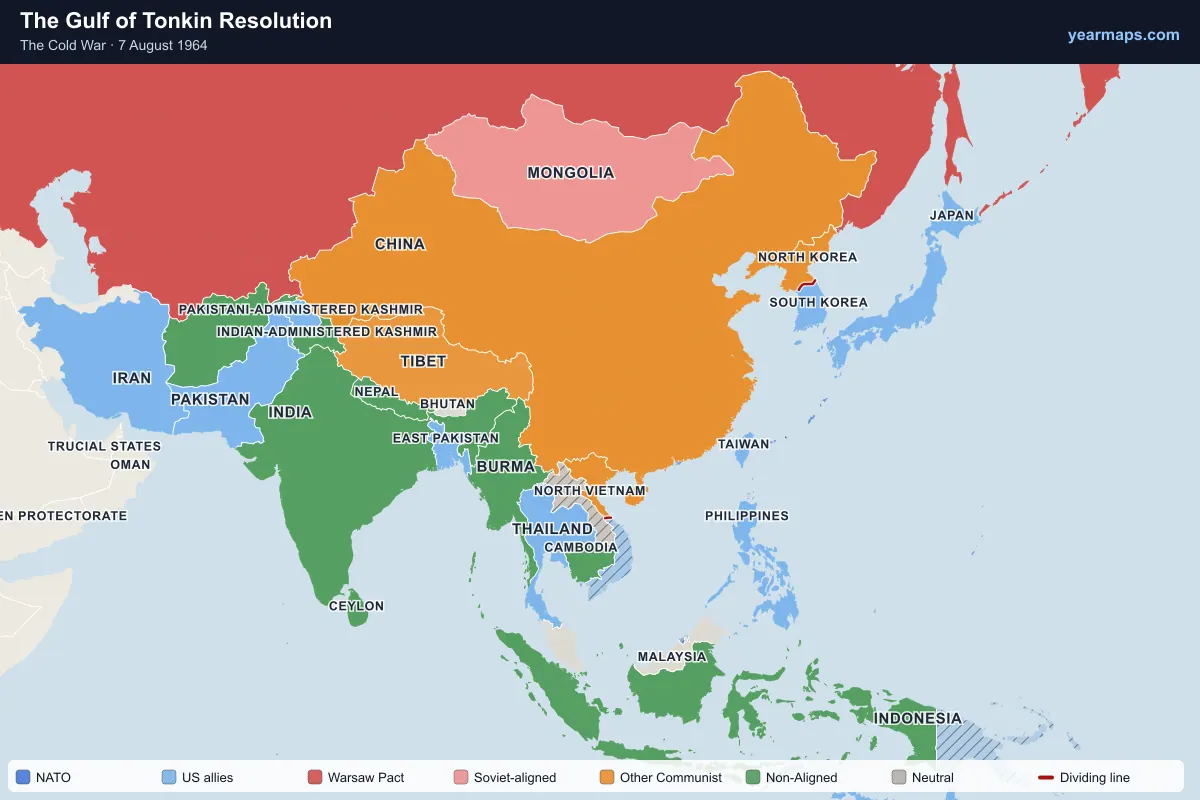
East and South-East Asia, 7 August 1964: territory held by each side.
After reports of attacks on US destroyers off North Vietnam, one of which is now known not to have happened, Congress gave President Johnson broad authority to use force. US combat troops landed at Da Nang in March 1965, and within three years more than 500,000 Americans were serving in Vietnam.
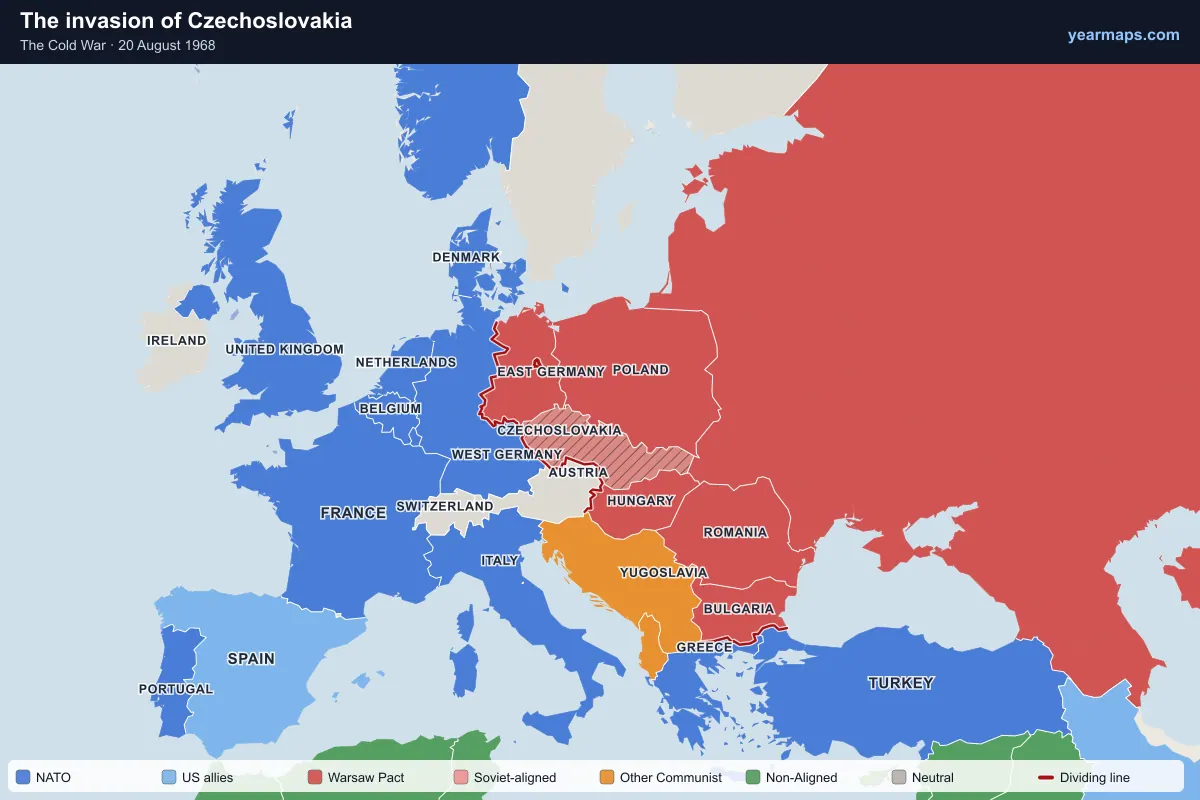
Europe, 20 August 1968: territory held by each side.
Alexander Dubček’s reforms of the Prague Spring promised “socialism with a human face”. On the night of 20 August, troops of the USSR, Poland, Hungary and Bulgaria invaded to end them. Moscow then declared the right to intervene wherever socialism was threatened, known as the Brezhnev Doctrine. Romania refused to take part, and Albania formally left the Warsaw Pact in protest.
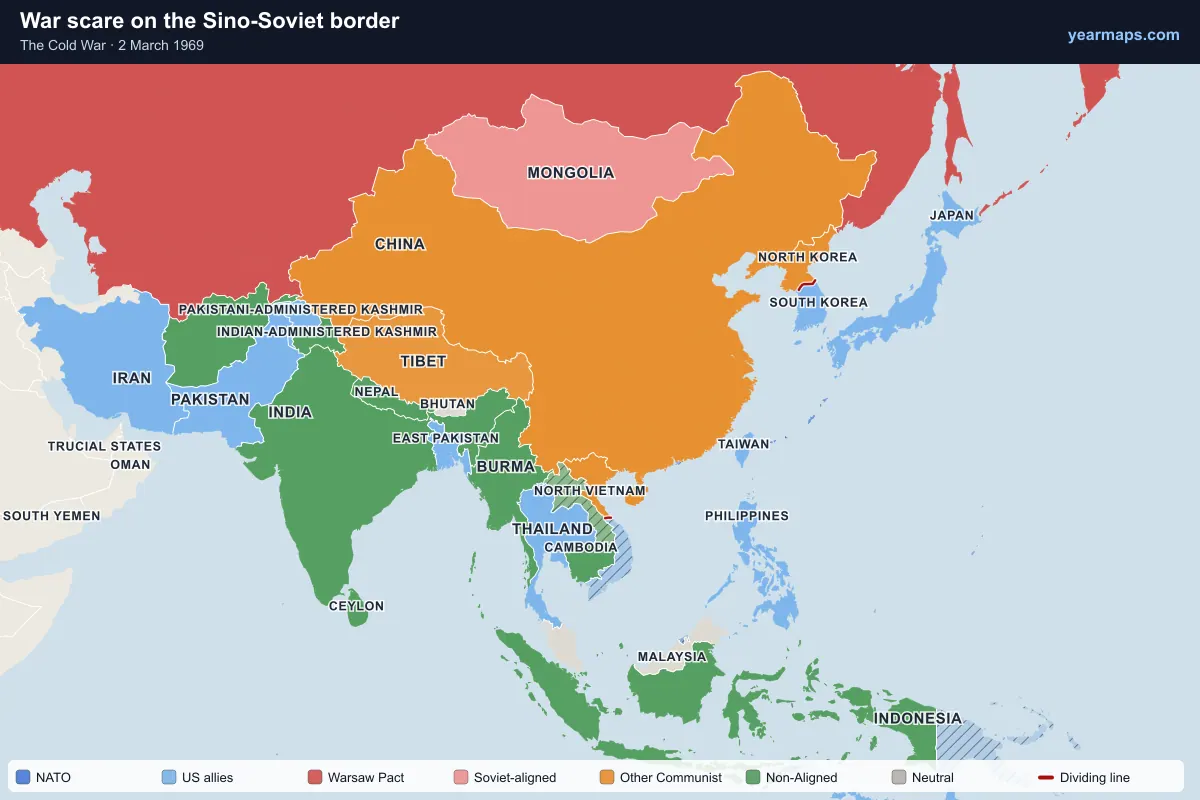
East and South-East Asia, 2 March 1969: territory held by each side.
Chinese and Soviet troops fought on Zhenbao Island in the Ussuri River, and the two Communist giants came to the edge of a wider war that year. China had been coloured separately since the split of 1960. The clashes convinced Beijing that the USSR was the greater threat, which opened the way for talks with Washington.
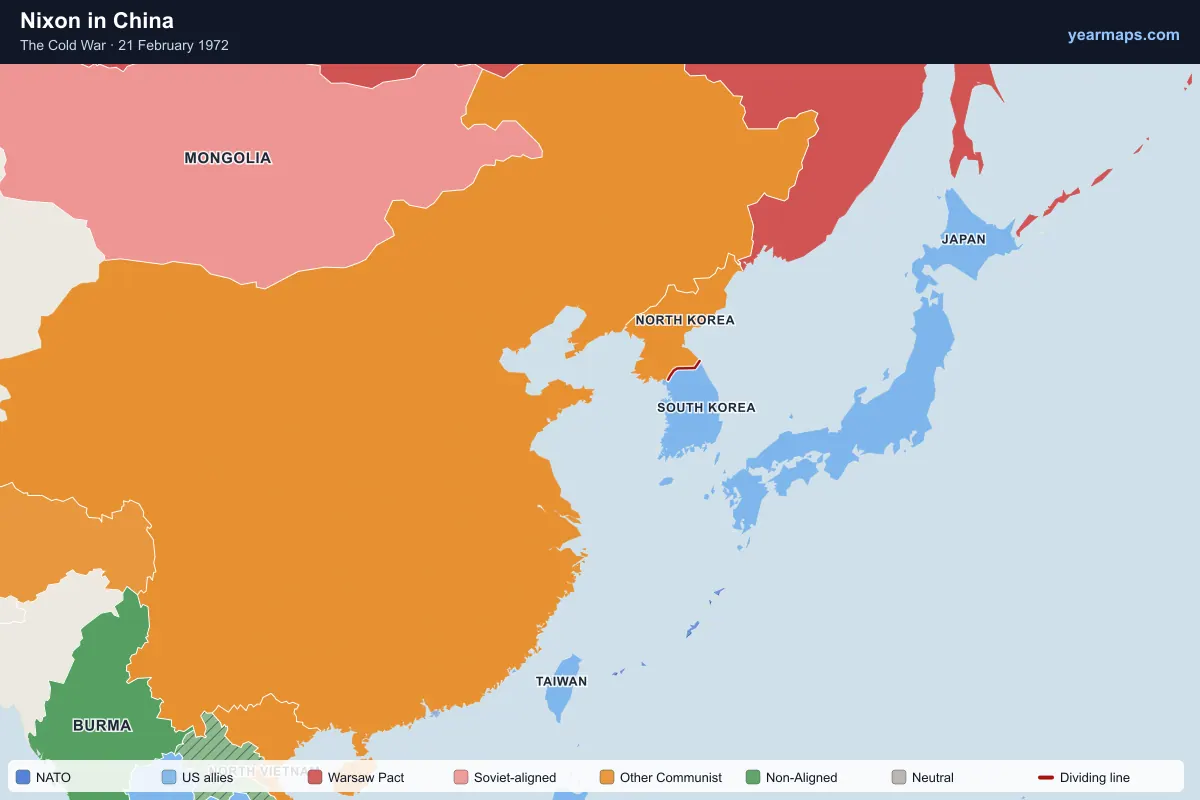
East Asia, 21 February 1972: territory held by each side.
President Nixon’s visit to Beijing ended more than 20 years of hostility and turned the Cold War into a three-way contest. Three months later he signed the first strategic arms limits with Brezhnev in Moscow. This was the height of détente, the easing of tension that lasted through most of the 1970s.
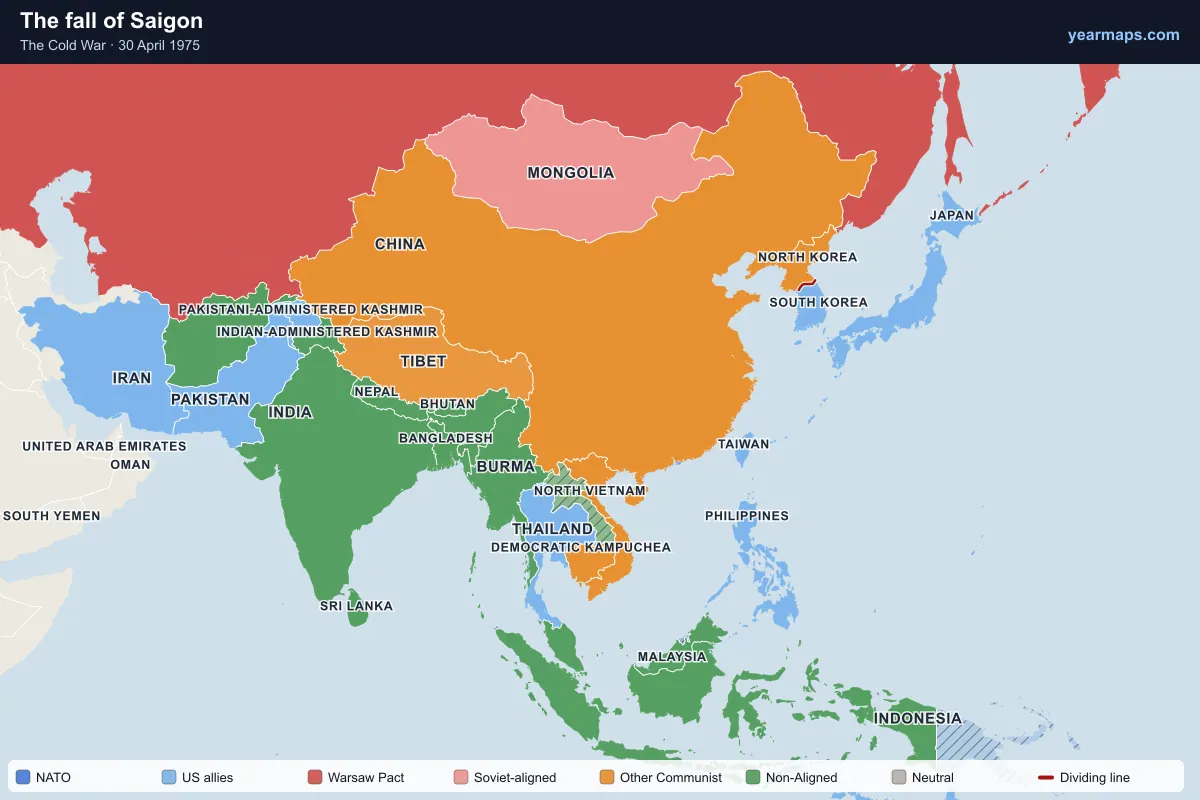
East and South-East Asia, 30 April 1975: territory held by each side.
Two years after the last US combat troops left, North Vietnam’s final offensive took just eight weeks, and you can watch it come down the map province by province from March. Cambodia had fallen to the Khmer Rouge two weeks earlier, and Laos followed in December. Vietnam was formally reunified in July 1976.
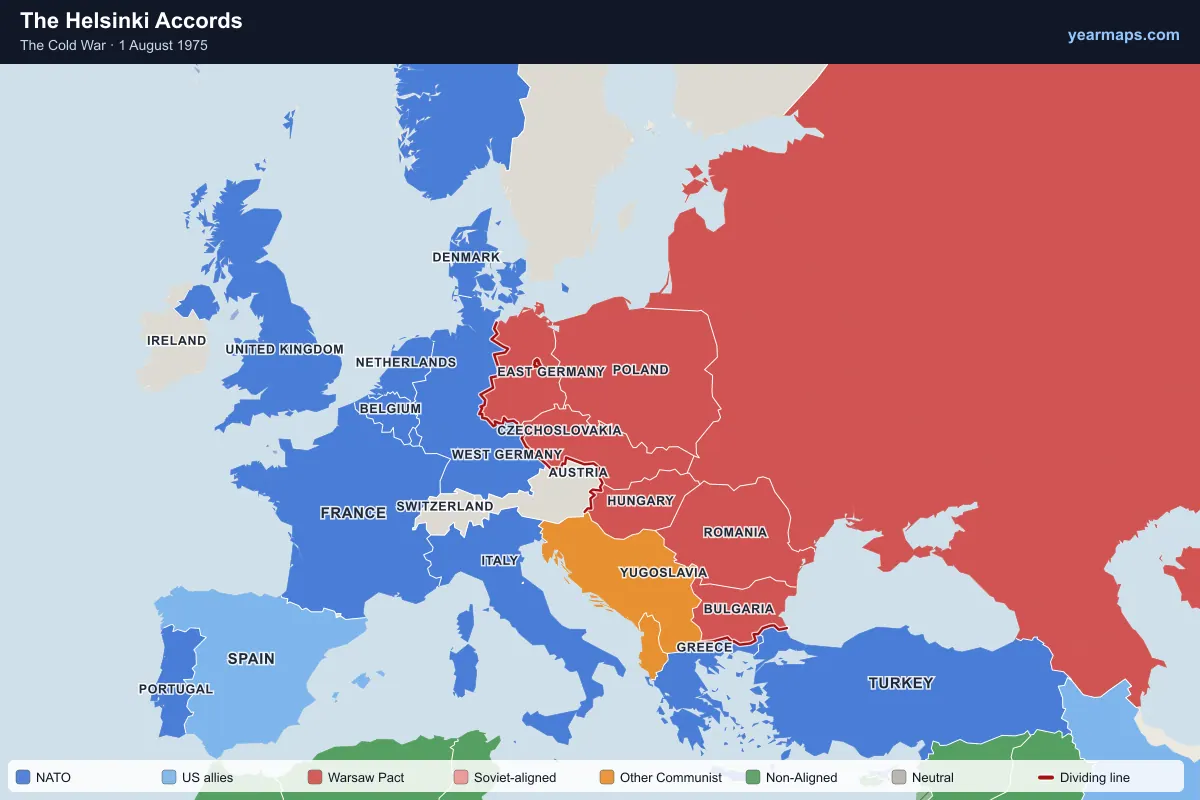
Europe, 1 August 1975: territory held by each side.
Thirty-five states, including the US, USSR and every European state but Albania, accepted Europe’s post-war borders. Moscow saw this as a victory. But the Accords also committed signatories to human rights, and dissident groups across the Eastern Bloc began to hold their governments to that promise.
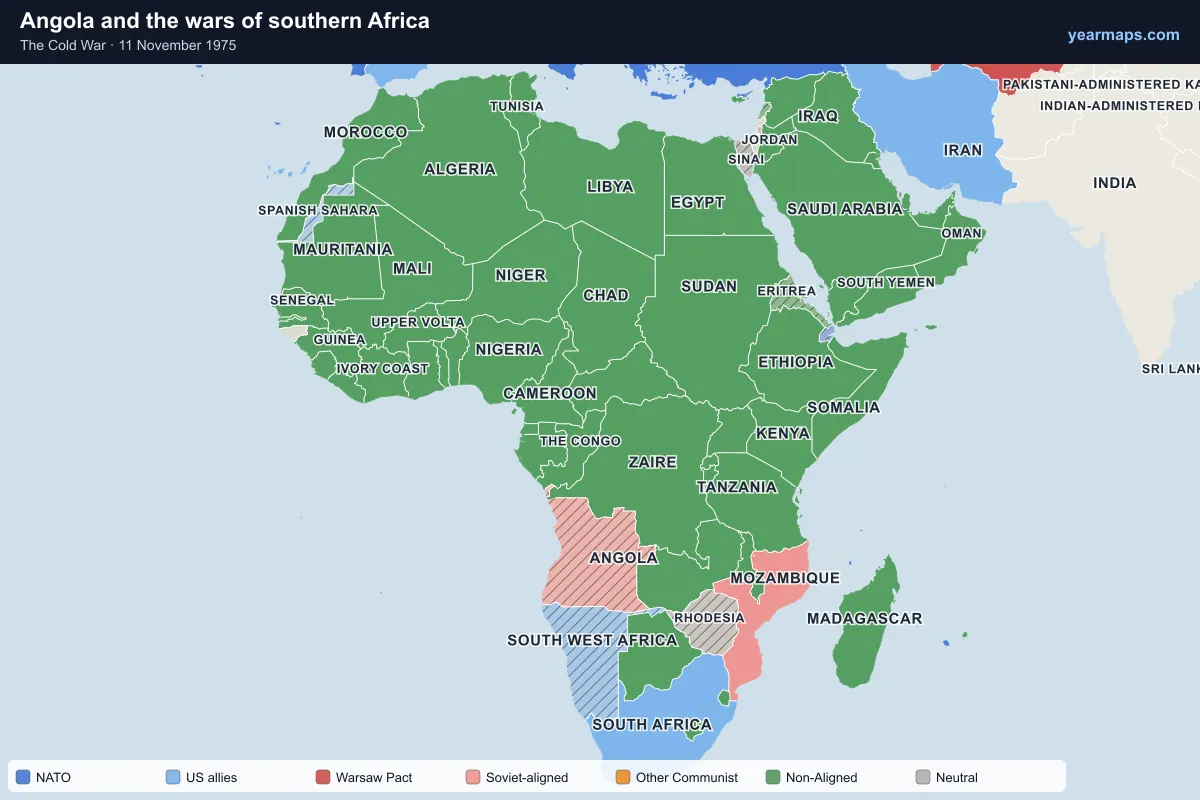
Africa, 11 November 1975: territory held by each side.
Portugal’s empire collapsed after its 1974 revolution. In Angola three movements fought for power, with the Soviet-backed MPLA holding Luanda with Cuban troops while South Africa and the US backed its rivals. The Cold War had reached southern Africa, and this war ran on long after it ended.
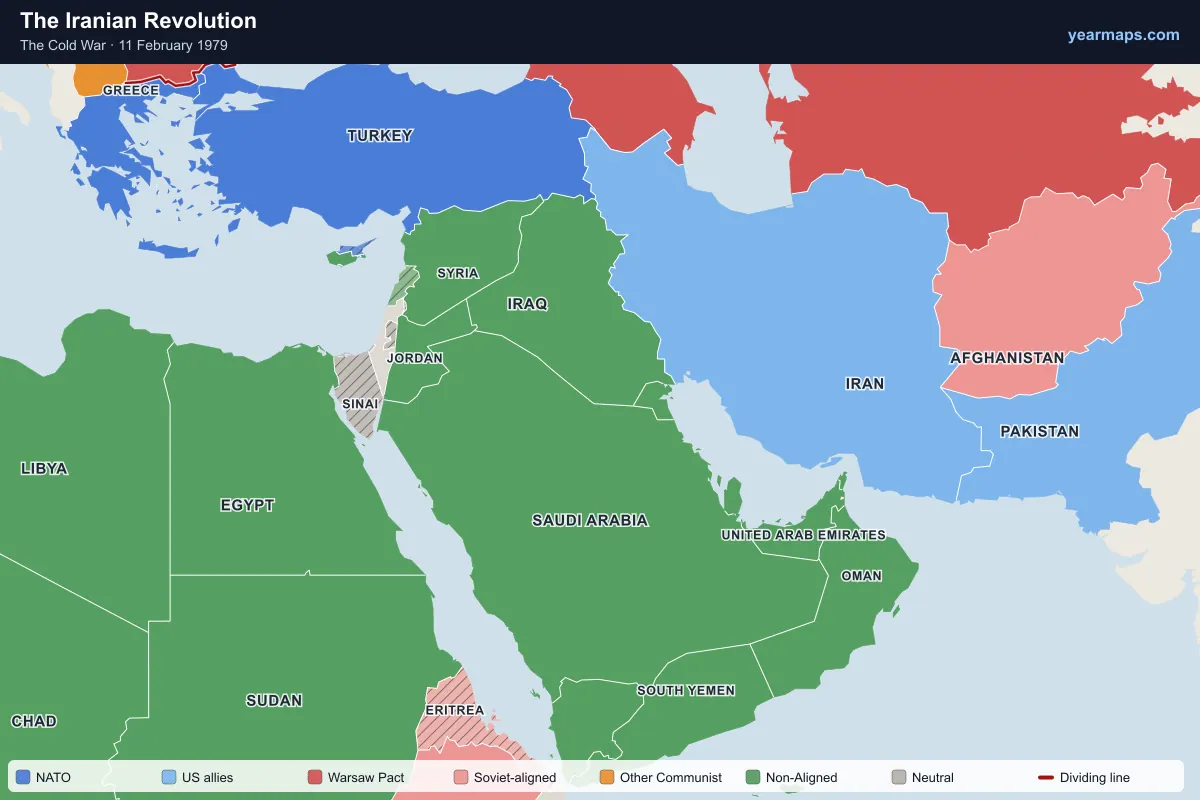
the Balkans and the Middle East, 11 February 1979: territory held by each side.
The Shah, the main US ally in the Gulf since the coup of 1953, fell to a revolution that was neither capitalist nor Communist. Iran left CENTO, which collapsed, and joined the Non-Aligned Movement that September. In November students seized the US embassy and held its staff for 444 days.
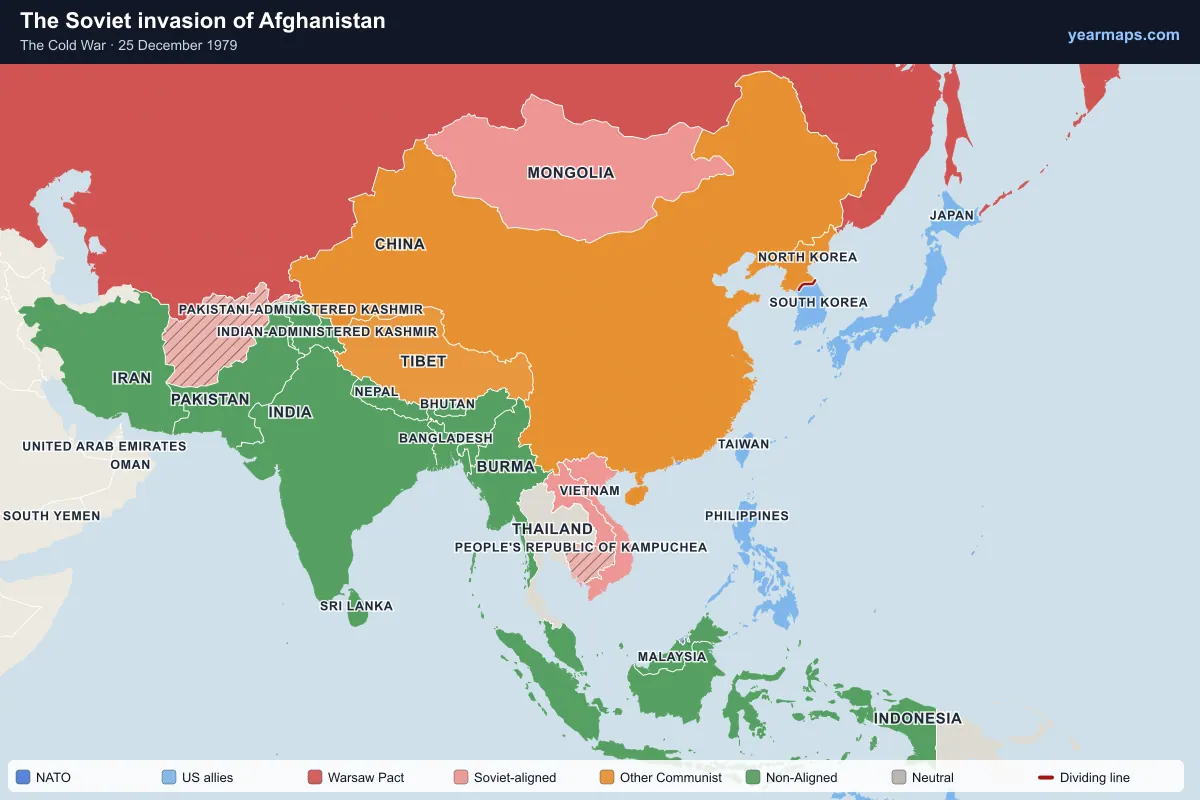
East and South-East Asia, 25 December 1979: territory held by each side.
Soviet troops entered Afghanistan to save a failing Communist government, killed its leader and installed another. Détente ended: the US Senate shelved SALT II, Washington boycotted the Moscow Olympics, and the CIA began arming the mujahideen through Pakistan. The last Soviet soldiers left in February 1989, after a war often called the USSR’s Vietnam.
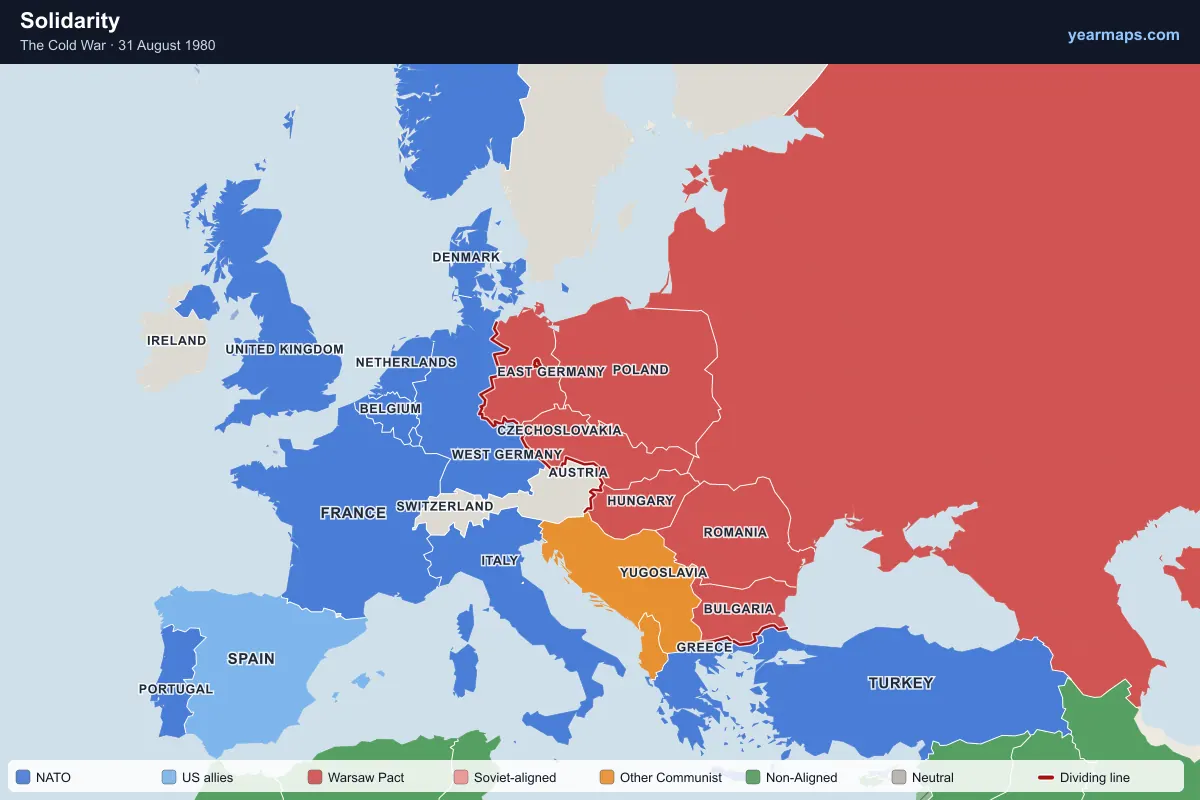
Europe, 31 August 1980: territory held by each side.
Strikes at the Gdańsk shipyard forced Poland’s government to accept the first independent trade union in the Eastern Bloc. Within a year Solidarity had about ten million members. General Jaruzelski imposed martial law in December 1981, but the movement survived underground and won Poland’s partly free election in June 1989.
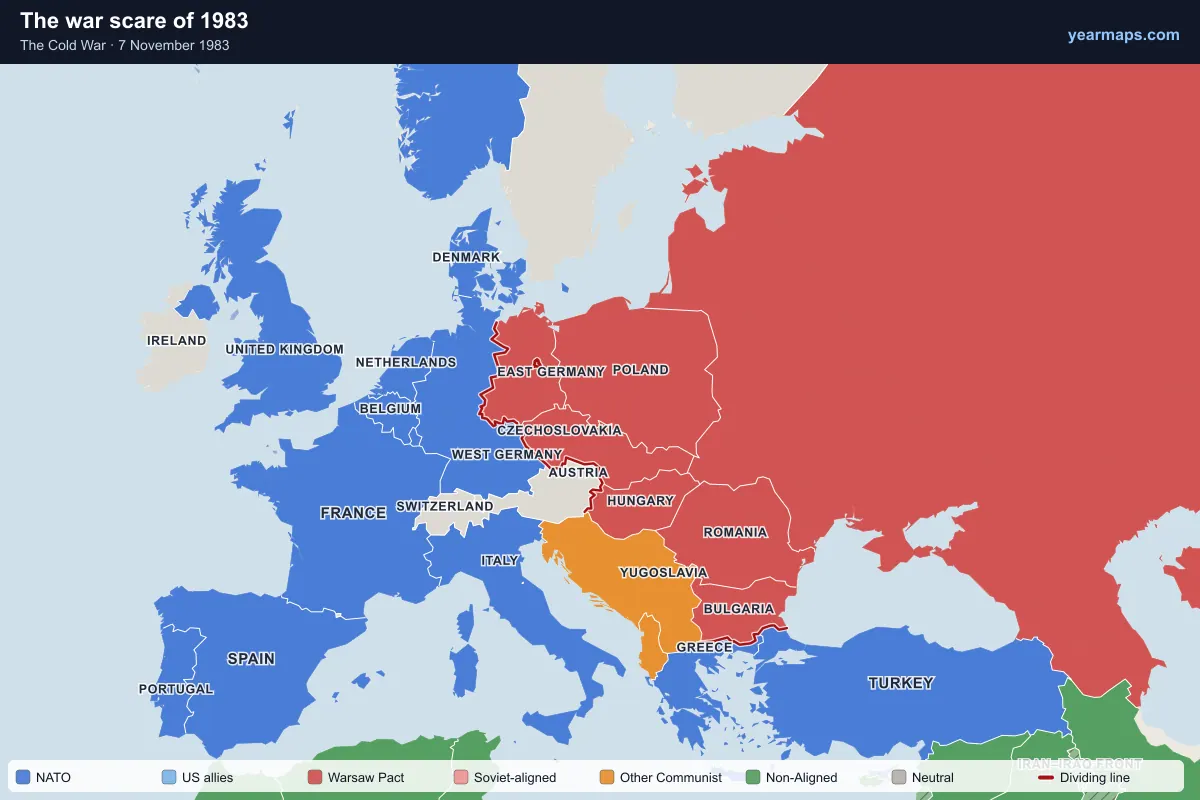
Europe, 7 November 1983: territory held by each side.
It was the most dangerous year since Cuba. Reagan announced his missile shield in March, a Soviet fighter shot down a Korean airliner in September, and later that month a Soviet officer, Stanislav Petrov, judged a satellite warning of US missiles to be false. In November the NATO exercise Able Archer alarmed Moscow, and US missiles began arriving in Europe.
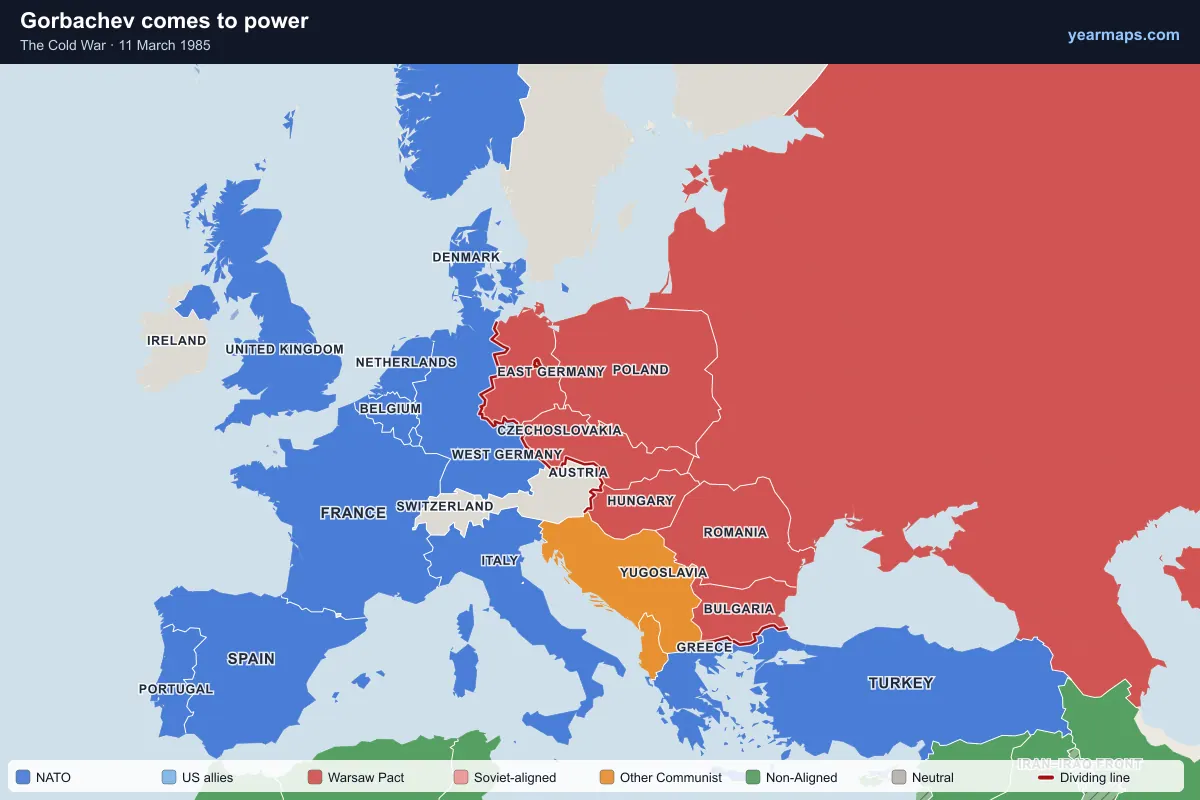
Europe, 11 March 1985: territory held by each side.
At 54, Mikhail Gorbachev was far younger than the leaders before him, and he inherited a stagnating economy and a costly war. His policies of glasnost (openness) and perestroika (restructuring) were meant to save the Soviet system. He met Reagan at Geneva that November, and in 1988 he told the UN that Eastern Europe could choose its own path.
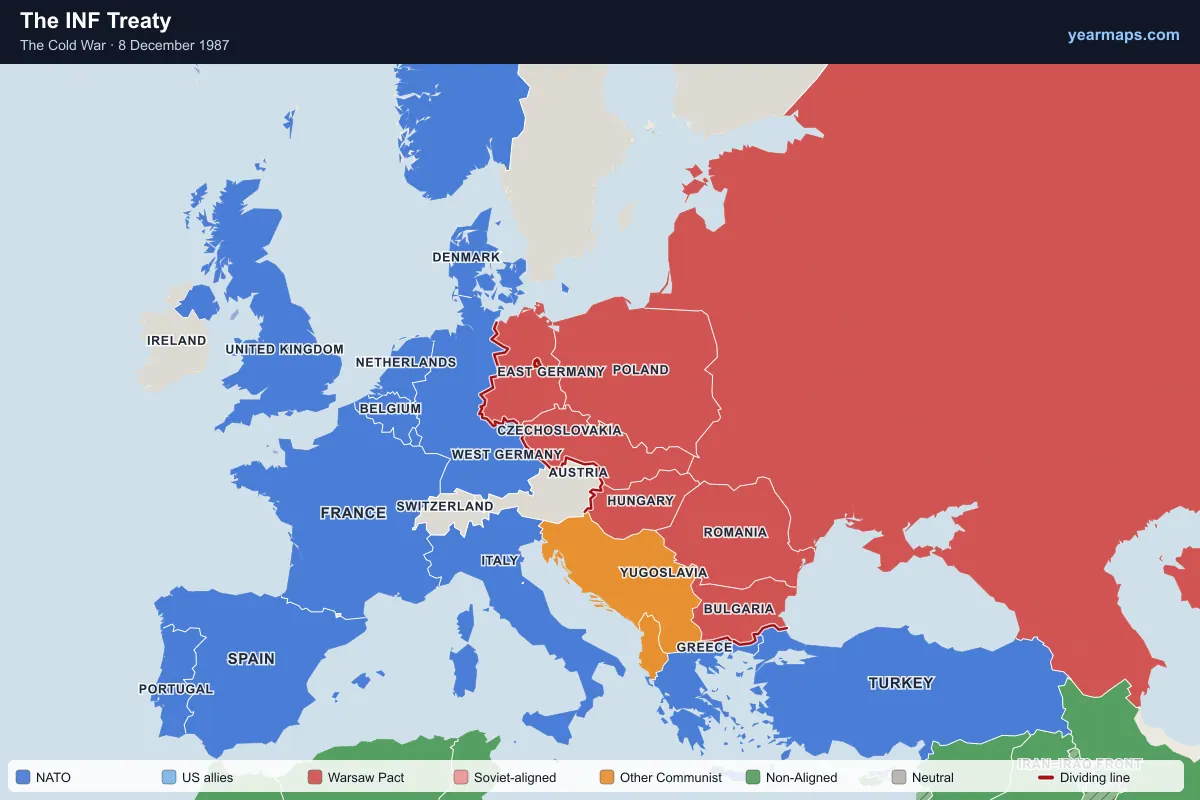
Europe, 8 December 1987: territory held by each side.
Reagan and Gorbachev signed a treaty eliminating all their ground-launched missiles with a range of 500 to 5,500 kilometres, the first agreement to scrap a whole class of nuclear weapons, with inspectors on each other’s soil. A year earlier at Reykjavík they had come close to agreeing to abolish nuclear weapons altogether.
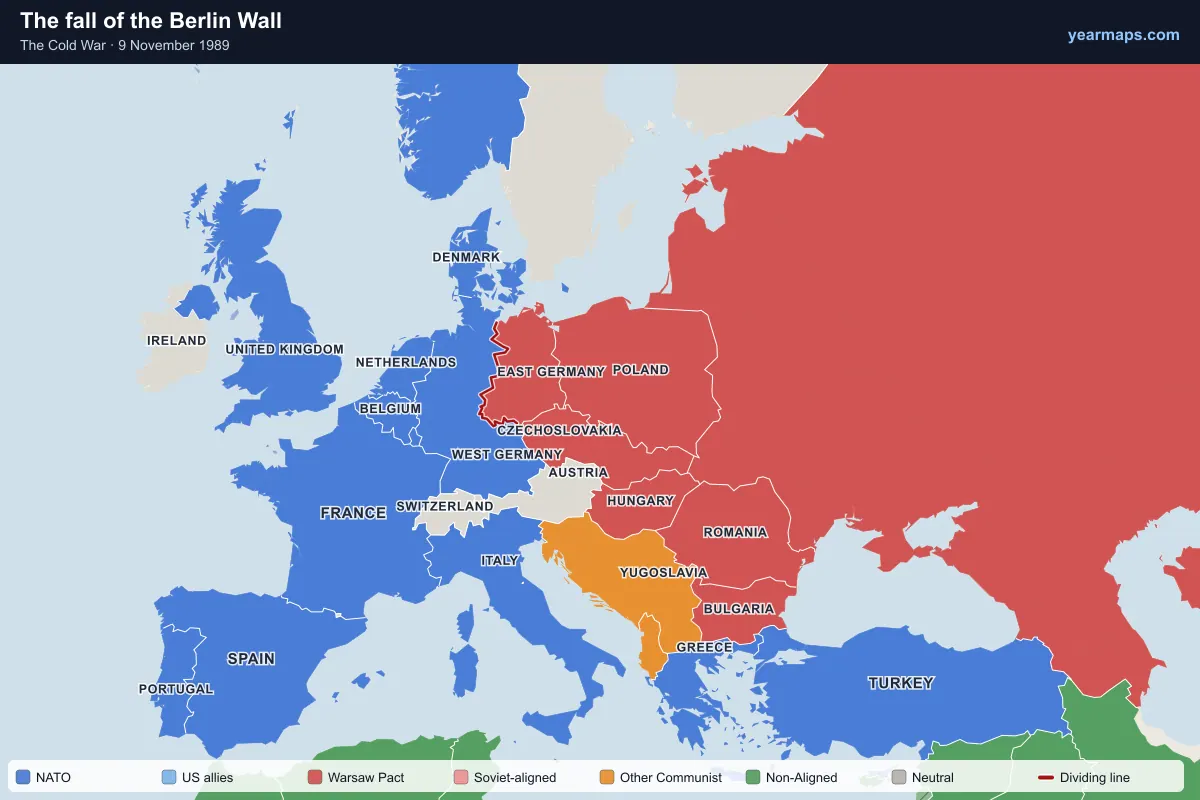
Europe, 9 November 1989: territory held by each side.
Poland had elected a non-Communist government in the summer, and Hungary had opened its border with Austria. When an East German official announced new travel rules on 9 November and said they applied immediately, crowds gathered at the Wall and the guards let them through. Czechoslovakia, Bulgaria and Romania all changed regime within weeks.
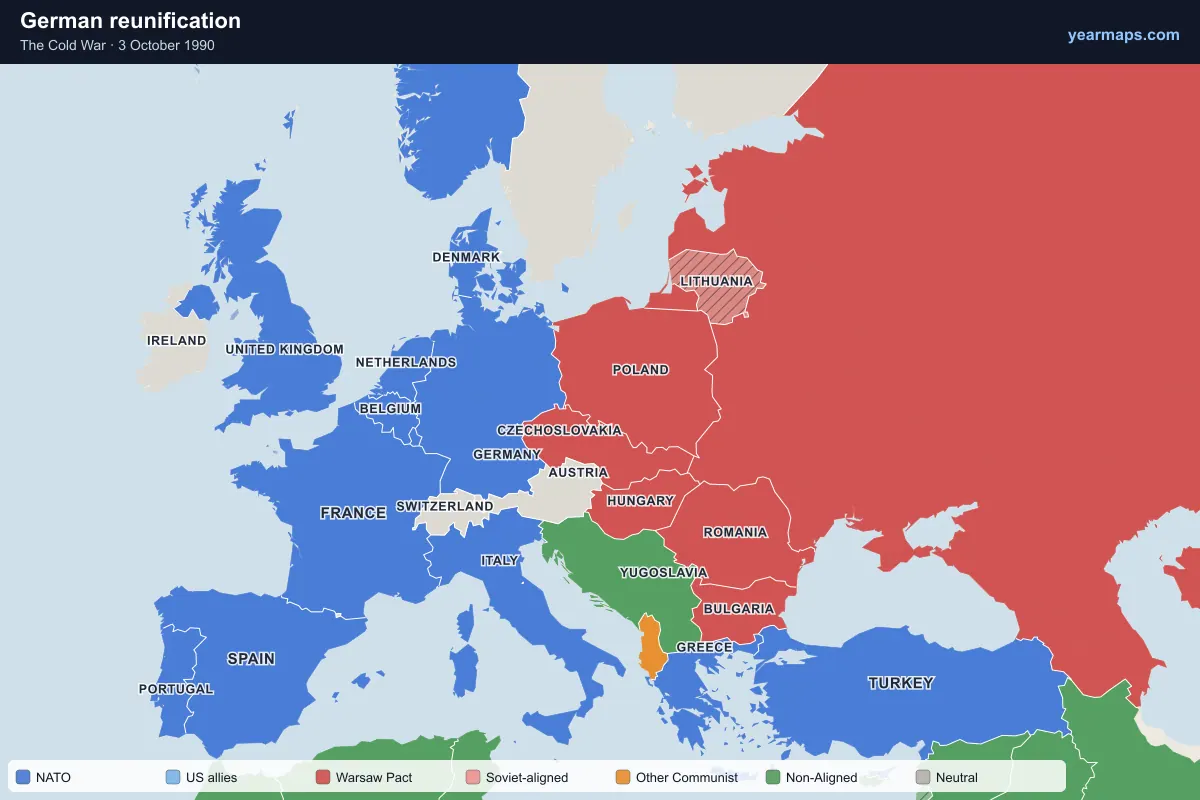
Europe, 3 October 1990: territory held by each side.
East Germany joined the Federal Republic less than a year after the Wall fell, and the united Germany stayed in NATO, with Soviet agreement. The inner German border disappears from the map on this day, and the eastern states turn NATO blue.
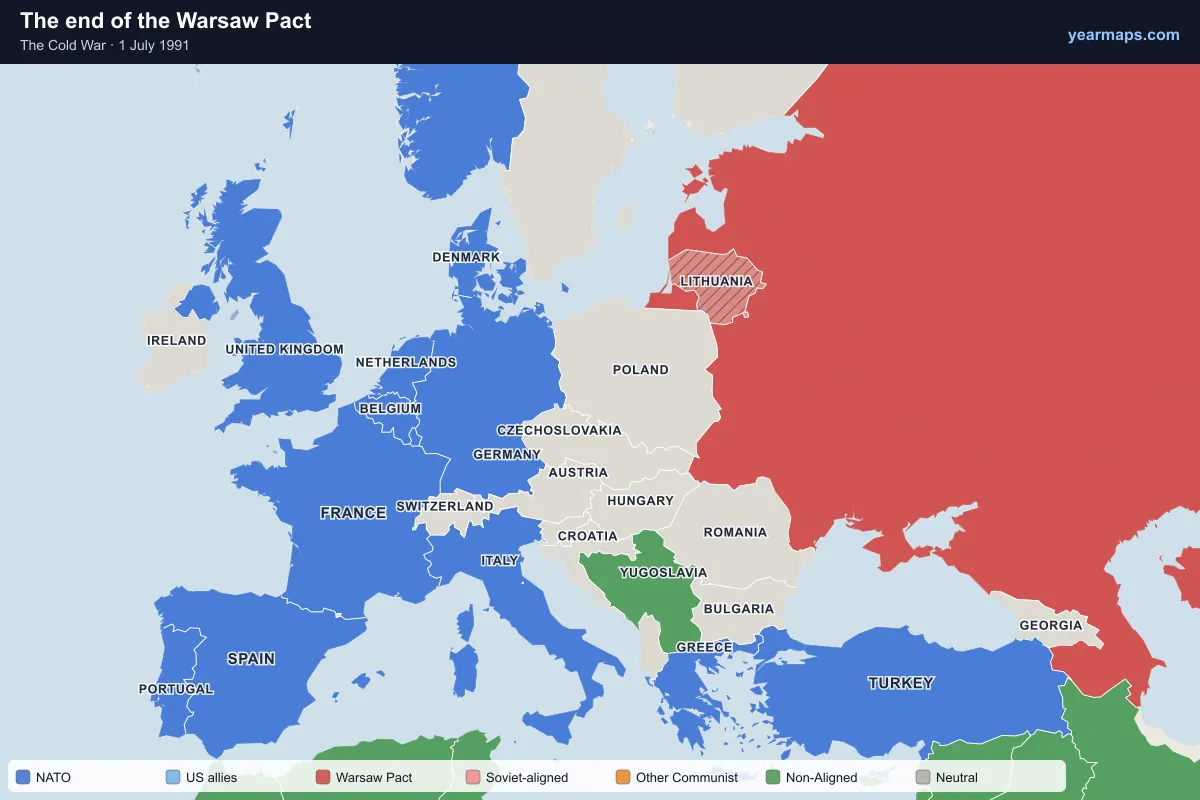
The alliance’s remaining members dissolved it in Prague. Six weeks later hardliners tried to overthrow Gorbachev in Moscow. The coup collapsed in three days, in the face of crowds led by Boris Yeltsin, but the republics began declaring independence at once, and they turn grey one by one on the map.
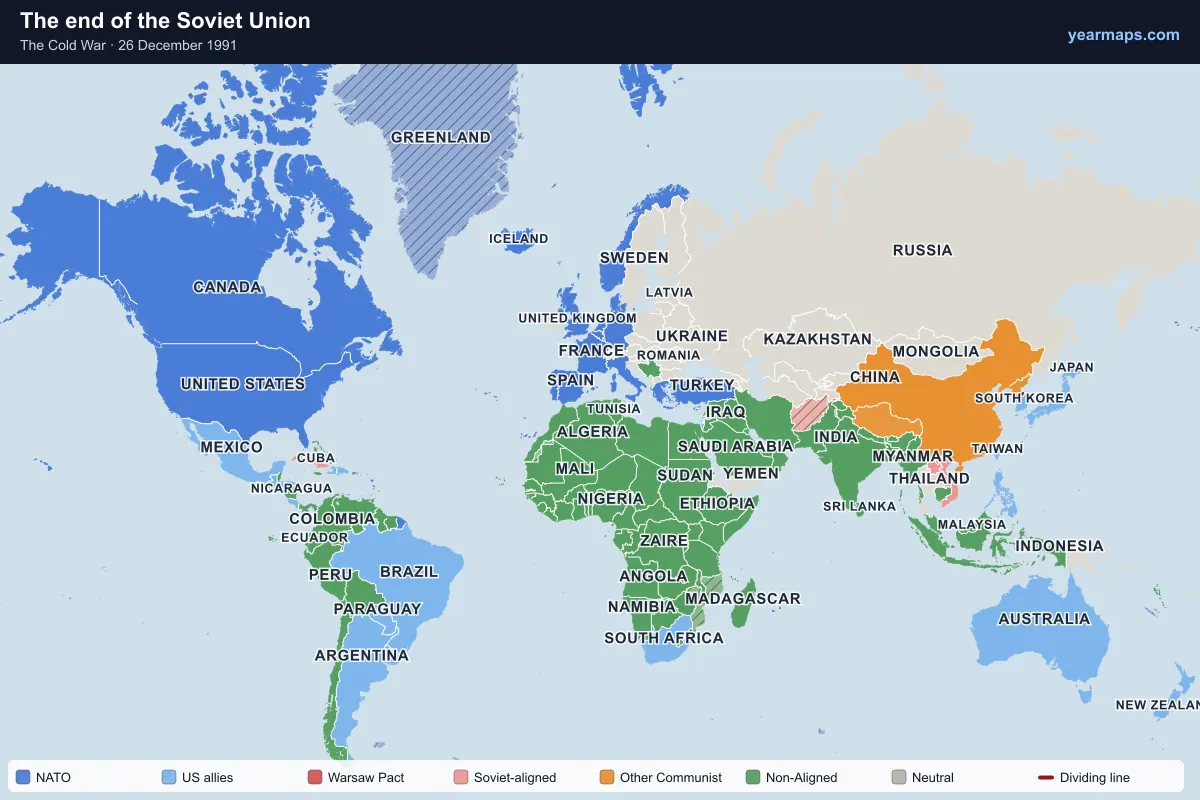
the world, 26 December 1991: territory held by each side.
Gorbachev resigned on 25 December and the Soviet flag came down from the Kremlin that evening. The next day the Supreme Soviet voted the USSR out of existence, and the map ends. Most of the alliances and dividing lines shown here were gone, though Korea’s armistice line, Vietnam’s Communist government and Cuba’s stand-off with Washington all outlived the Cold War.
The map starts on the day World War II ended, but the rivalry is older. The United States, Britain and France sent troops into Russia during its civil war after the 1917 revolution, and Washington did not recognise the Soviet government until 1933. They became allies only because of Hitler. As victory came closer, they argued over what would follow, above all over Poland and Germany, at the Yalta Conference in February 1945 and at Potsdam that July. Both links open our World War II map on that day.
NATO, the Warsaw Pact and other Cold War alliances
The treaties that decide the map’s colours, with the date each member signed or joined. Select a date to see that day on the map.
The conflicts where the rivalry turned violent, with the outside powers that backed each side. Select a war to open the map there, with the proxy wars layer on.
The CIA funded rebels against the Sandinistas, and the secret funding led to the Iran–Contra scandal.
1981–1990
United States
Soviet Union, Cuba
Sandinistas lost the 1990 election
The Non-Aligned Movement
Founded at Belgrade in 1961 by states that refused to join either bloc. Members are listed by the summit at which they joined, and the map colours them green from that date.
Joined
States
Algeria, DR Congo, Egypt, Ethiopia, Ghana, Guinea, Mali, Morocco, Somalia, Sudan, Tunisia, Afghanistan, Cambodia, India, Indonesia, Iraq, Lebanon, Burma, Nepal, Saudi Arabia, Sri Lanka, Cuba, North Yemen, Cyprus, Yugoslavia
Benin, Burundi, Cameroon, Central African Republic, Chad, Kenya, Liberia, Libya, Malawi, Mauritania, Nigeria, Republic of the Congo, Senegal, Sierra Leone, Tanzania, Togo, Uganda, Zambia, Jordan, Kuwait, Laos, Syria
Botswana, Equatorial Guinea, Eswatini, Gabon, Lesotho, Rwanda, Malaysia, Singapore, Guyana, Jamaica, Trinidad and Tobago, South Yemen
United Arab Emirates, Burkina Faso, Gambia, Ivory Coast, Madagascar, Mauritius, Niger, Bahrain, Bangladesh, Bhutan, Oman, Qatar, Peru, Malta, Argentina
Chile
North Korea
Angola, Cape Verde, Comoros, Guinea-Bissau, Mozambique, Sao Tome and Principe, Seychelles, Maldives, North Vietnam, Panama
Djibouti, The Bahamas, Barbados, Colombia, Ecuador, Saint Lucia, Suriname, Vanuatu
Venezuela
Namibia
Photographs of the Cold War
The era in pictures, from both sides of the Iron Curtain, drawn from public archives including the US National Archives, the German Federal Archives, RIA Novosti, the Dutch National Archives, Fortepan and NASA. Select a photograph to see it full size.
973 photographs in 31 collections. Each is public domain or openly licensed, and credited below.
Yalta, Potsdam and the division of Europe25
Stalin Roosevelt Churchill at Tehran12th Army Air Force Signal Corps · Public domainGeneral Marshall, Sir Archibald Clark Kerr, and Marshal Stalin at Tehran Conference, Iran, 1943National Museum of the U.S. Navy · Public domainFrom left to right: Joseph Stalin, Franklin D. Roosevelt, and Winston Churchill on the portico of the Soviet Embassy during the Tehran Conference.U.S. Signal Corps photo. · Public domainShah with FDRU.S. Government · Public domainAnthony Eden (foreground, right) arrives at Gatow Airport in Berlin for the Potsdam Conference. Others are unidentified. From Potsdam album, 1945.United States Army Signal Corps · Public domainPotsdamer Konferenz, Winston ChurchillAuthor unknown · CC BY-SA 3.0 de
The Marshall Plan and rebuilding Europe20
13 pointe du hoc 1944 debarquement normandieUnited States Army · Public domainU. S. members of the Joint Chiefs of Staff during the Potsdam Conference. L to R: Unidentified, Gen. Henry H. Arnold, Gen. George C. MarshallAuthor unknown · Public domainConferentie te Parijs. Count Sforza (Italie) wordt door journalisten bestormdHarry Sagers / Anefo · CC0Conferentie te Parijs. Aankomst Nederlandse delegatieHarry Sagers / Anefo · CC0Conferentie te Parijs. Aankomst Nederlandse delegatieHarry Sagers / Anefo · CC0Conferentie te Parijs. Aankomst SpaakNationaal Archief · CC0
The Berlin Blockade and Airlift25
Фото "Советские агитационные плакаты", июнь 1945, Германия, г. Берлин - История России в фотографияхYevgeny Khaldei · Public domainCaptain W. R. A. Bateman RASC instructs Aircraftsman Jenkins on the positioning of tanker aircraftRAF official photographer · Public domainThe first U.S. Air Force Fairchild C-82A Packet used during the Berlin Airlift is unloaded at Tempelhof Airport.USAF · Public domainHasting op vliegveld bij Kiel. LuchtbrugNationaal Archief · CC0An Avro York transport aircraft of the Royal Air Force on its approach to Berlin - TempelhofUnbekannter Fotograf · Public domainIn October 1948, OCAMA commander Maj. Gen. Fred S. “Fritz” Borum, along with key military and civilian managers, went to Burtonwood, England, to aid the Berlin Airlift. Tinker…USAF photo · Public domain
NATO25
Paris, NATO-Vertrag, Unterzeichnung AdenauerAuthor unknown · CC BY-SA 3.0 deParis, NATO-Konferenz, Walter HallsteinAuthor unknown · CC BY-SA 3.0 deParis, Verhandlungen über NATO-BeitrittAuthor unknown · CC BY-SA 3.0 deParis, NATO-Aufnahme der BundesrepublikAuthor unknown · CC BY-SA 3.0 deNATO Peace Conference in PortmeirionGeoff Charles · CC BY-SA 4.0NAVO eskader bezoekt Amsterdam, vlaggeschip HNS NorfolkHans Peters for Anefo · CC0
The Warsaw Pact and the Eastern Bloc9
Conference at the Council of Ministers Palace in Warsaw during which the Warsaw Pact was signednieznany/unknown · Public domainBerlin, 27. Jahrestag DDR-Gründung, ParadeZimmermann, Peter · CC BY-SA 3.0 deBerlin, 30. Jahrestag DDR-Gründung, ParadeMuszeljan · CC BY-SA 3.0 deBerlin, Jahrestag der DDR, Parade, EhrentribüneRainer Mittelstädt · CC BY-SA 3.0 deBerlin, Tagung Warschauer Pakt, GruppenfotoRainer Mittelstädt · CC BY-SA 3.0 deBerlin, Rotes Rathaus, Besuch Staatsführer Warschauer PaktHubert Link · CC BY-SA 3.0 de
The Chinese Civil War20
Mao Zedong and Chiang Kai-shek in Chongqing, China, in September 1945, toasting the victory over Japan.Author unknown · Public domainChiang Kai-shek and Mao Zedong (cropped)傑克 威克爾斯 · Public domainMao Zedong and Chiang Kai-shek in Chongqing, China, in September 1945, toasting the victory over Japan.Author unknown · Public domainMao Zedong before going to ChongqingAuthor unknown · Public domainDong bei gong jun未署名 · Public domainZhouenlai 1946Historical Record of Political Consultation Conference · Public domain
The Korean War70
The Landings at Inchon. 15 September 1950, Aerial Photographs Taken From Carrier Borne Aircraft of HMS Triumph Operating in Korean Waters in Support of the Landings. A31721Author unknown · Public domainUSS Helena (CA-75) firing at targets in Korea, in August 1950 (NH 96898)U.S. Navy photo NH 96898 · Public domainOriginal Caption: Marines with a bazooka and a protecting machine gun set up a security post against possible tank counter-attack. 1stMarDiv. Korea.Photog: Sgt. Frank Kerr, Unites States Marine Corps · Public domainCarrying scaling ladders, U.S. Marines in landing crafts head for the seawall at Inchon. September 15, 1950. S.Sgt. W. W. Frank. (Marine Corps) NARA FILE #: 127-N-A3189 WAR &…SSgt. W. W. Frank · Public domainFirst wave landing craft approach Inchon, Korea, on 15 September 1950 (NH 96877)U.S. Navy photo NH 96877 · Public domainLieutenant Colonel Chŏng Pong-uk, Commanding Officer of the Korean People's Army 13th Division's Artillery Regiment, and His Aide.Cpl. Walker · Public domain
The First Indochina War and Geneva30
General Leclerc reviews troops of the 20th Indian Division, Saigon, French Indochina, 22 December 1945.Sanders, P A · Public domainThe Allied Reoccupation of French Indo-china Lack of Allied troops led to some trusted Japanese prisoners of war being armed for guard duty. Here a Japanese sentry salutes the…Johnson W G (Sergeant), No 9 Army Film & Photographic Unit · Public domainC-46 of Civil Air Transport (CIA) in IndochinaUSAF · Public domainA-26Cs in the Philippines on the way to IndochinaUSAF · Public domainBattle in Laos. French General Salan and Prince Savang in Luang Prabang, Lao capital, 4 May 1953Author unknown · CC BY-SA 3.0Operation Camargue, French and Vietnamese advance inlandU.S. Information Agency 53-12197 · Public domain
East Germany and the uprising of 195320
Berlin, Großkundgebung zum 70. Geburtstag von J.W. StalinEva Kemlein · CC BY-SA 3.0 deBerlin, Großkundgebung zum 70. Geburtstag von J.W. Stalin.Walter Heilig · CC BY-SA 3.0 deBerlin, Bau Karl-Marx-Allee, Block E-SüdSchmidtke · CC BY-SA 3.0 deBerlin, Bau Karl-Marx-Allee, Block C-SüdPeter Heinz Junge · CC BY-SA 3.0 deBerlin, Ankunft von koreanischen GaststudentenLothar Gielow · CC BY-SA 3.0 deBerlin, Bau Karl-Marx-Allee, Strausberger StraßeMartin · CC BY-SA 3.0 de
The Hungarian Revolution of 195640
Hongaarse kinderen in VolendamDaan Noske / Anefo · CC0Ungarn AufstandJack Metzger · CC BY-SA 4.0Aankomst laatste transport Hongaarse vluchtelingenWim van Rossem for Anefo · CC0Tűzoltó utca a Ferenc körút felé nézve.FOTO:Fortepan — ID 24878: Adományozó/Donor: Nagy Gyula. archive copy at the Wayback Machine · CC BY-SA 3.0Szeles Erika - Hungarian Revolution of 1956 - Budapest (Vagn Hansen)Vagn Hansen · Public domainHerdenkingsavond op de Dam te Amsterdam, n.a.v. Hongaarse opstandDaan Noske / Anefo · CC0
The Suez Crisis20
Israel. Tseva haganah le-YiśraʼelSinai (Egypt) PhotographsBenno Rothenberg · CC BY 4.0Israel. Tseva haganah le-YiśraʼelIsmailia (Egypt : Province) PhotographsBenno Rothenberg · CC BY 4.0Three of the five British aircraft carriers involved in the Suez operation: HMS Eagle (R05) leads HMS Bulwark (R08) and HMS Albion (R07).Royal Navy official photographer · Public domainCollectie Fotocollectiie Afdrukken ANEFO Rousel, fotonummer 157-0124Afdruk zonder naam fotograaf / Anefo · CC0USS Severn (AO-61) refuels the USS Forrestal (CVA-59) and USS Des Moines (CA-134) in the Atlantic Ocean on 11 November 1956U.S. Navy · Public domainOperation Kadesh. XXIVIDF Spokesperson's Unit photographer · CC BY-SA 3.0
The space race48
“The USSR pilot-cosmonaut Valentina Tereshkova”. Valentina Tereshkova, the first female cosmonaut, Hero of the Soviet Union in ambassy of People's Republic of Bulgaria.Saikov / Сайков · CC BY-SA 3.0“Soviet pilot-cosmonaut Valentina Tereshkova”. Yaroslavl residents welcome the Soviet pilot-cosmonaut Valentina Tereshkova with bread and salt.Alexander Mokletsov / Александр Моклецов · CC BY-SA 3.0Gagarin, Tereshkova, Tikhonov and LyubeznovYakov Khalip · CC BY-SA 3.0GEMINI-TITAN (GT)-9 TEST - ASTRONAUT - EDWARD H WHITE II - TRAINING - CAPE (s65-27488)NASA Johnson Space Center · Public domainSoviet cosmonauts, Heroes of the Soviet Union Pavel Popovich, Yuri Gagarin, and Valentina TereshkovaYakov Khalip · CC BY-SA 3.0“The USSR pilot-cosmonauts”. Pavel Popovich, Yuri Gagarin, Valentina Tereshkova, Andrian Nikolayev, Valery Bykovsky and German Titov.Valeriy Shustov / Валерий Шустов · CC BY-SA 3.0
Cuba: revolution, Bay of Pigs and the Missile Crisis53
LtCol Samuel R. Shaw award ceremony with Gen ShepherdSgt. A. Potter · Public domainBullet holes in the Moncada Barracks after the 1953 attack.Author unknown · Public domainPresidential Palace Attack Redress Demonstration, Havana_April 8, 1957Cuban press · Public domainCuban army vehicle immediately after the attack at Presidential Palace, 13 March 1957.Author unknown · Public domainPresidential Palace Attack_Radio Reloj_Havana, Cuba, 1957Radio Reloj · Public domainSamuel Robert ShawTSgt. Kiser · Public domain
The Berlin Wall49
Berlin, Mauerbau, PanzersperrenSturm, Horst · CC BY-SA 3.0 deBerlin, Mauerbau, US-Soldaten, VolkspolizistenAuthor unknown · CC BY-SA 3.0 deBerlin-Prenzlauer Berg, Oderberger Straße, Sichtblende aus Holz und Tschechenigel, Blickrichtung Ost von der West-Berliner Aussichtsplattform Schwedter- Ecke Bernauer StraßeJim Hansen (1921–1999) · Public domainKelet-Berlin, Friedrich Ebert Platz (ekkor Clara Zetkin Strasse torkolata a Berlini Falnál), a túloldalon a Reichstag.FOTO:Fortepan — ID 58482: Adományozó/Donor: Nagy Gyula. · CC BY-SA 3.0Bundesarchiv B 145 Bild-F013004-0003, Berlin, Staatsbesuch Präsident von ZypernSteiner, Egon · CC BY-SA 3.0 deBundesarchiv B 145 Bild-F013004-0004, Berlin, Staatsbesuch Präsident von ZypernSteiner, Egon · CC BY-SA 3.0 de
Independence in Africa and the Congo Crisis37
Ralph Bunche photographed by Carl Van Vechten, 1951.Carl Van Vechten · Public domainKojo Botsio as a delegate of the Gold Coast in the Bandung Conference, 1955.Foreign Ministry of Indonesi · Public domainGala Dinner for the Asian-African Conference in Savoy Homann Hotel, Bandung, on April 19th 1955.Government of Indonesia · Public domainLa Presse TunisieLa presse Tunisie · Public domainU.N. SECY.-GEN. DAG HAMMARSKJOLD ARRIVES AT LYDDA AIRPORT, ON HIS WAY FROM BEIRUT TO CAIROFritz Cohen · Public domainIndependence in Africa and the Congo Crisis, 1958Author unknown · Public domain
The Algerian War19
Photo de classe d'une école à Khenchela, Algérie en 1952Author unknown · Public domainSix chefs FLN - 1954Author unknown · Public domainDemonstraties in Parijs tgv en voor De GaulleHerbert Behrens / Anefo · CC0Demonstraties in Parijs tgv en voor De GaulleHerbert Behrens / Anefo · CC0Demonstraties in Parijs tgv en voor De GaulleHerbert Behrens / Anefo · CC0Demonstraties in Parijs tegen en voor De GaulleHerbert Behrens / Anefo · CC0
Portugal's colonial wars and Angola24
Portuguese Paratrooper Combat Nurses, employed during the Portuguese Colonial War (1961-1975).Alfredo Serrano Rosa · Public domainPortuguese Paratrooper Combat Nurses, employed during the Portuguese Colonial War (1961-1975).Alfredo Serrano Rosa · Public domainPortuguese Paratrooper Combat Nurses, employed during the Portuguese Colonial War (1961-1975).Alfredo Serrano Rosa · Public domainPortuguese Paratrooper Combat Nurses, employed during the Portuguese Colonial War (1961-1975).Alfredo Serrano Rosa · Public domainPortuguese Paratrooper Combat Nurses, employed during the Portuguese Colonial War (1961-1975).Alfredo Serrano Rosa · Public domainPAIGC guerrillas in formation in front of commander Umaru Djalo, interior of Guinea-BissauAuthor unknown · Public domain
The Vietnam War75
Vietnamesische Christen in der DDRErich Zühlsdorf · CC BY-SA 3.0 deSP4 Bealock and scout dog "Chief" (German Shepherd) on patrol in Vietnam (Source: RG123S, Vietnam Photos Miscellaneous Collection).Author unknown · Public domainLCM Monitor, conversion of basic LCM hull, armed with .50 caliber machine gun, 20 and 40 mm cannons and an 81 mm mortar. This craft is used primarily for fire support missionsNational Archives USN 1104727 · Public domainArthur Z. Gardiner and unidentified dignitaries tour an earthworks construction site for a hamlet strong point in Gia Dinh Province at Vinh Loc, Vietnam. NAID: 348664005Arthur Z. Gardiner · Public domainRepublic of China vice-president Chen Cheng's entourages with local Republic of Vietnam officers in a strategic hamletAuthor unknown · Public domainDemonstrators against the war in Vietnam holding signs on the boardwalk during the 1964 Democratic National Convention, Atlantic City, New Jersey; one sign reads "End the war…Warren K. Leffler · Public domain
The Prague Spring and invasion of 196825
Gorbachev and classmates Moscow 1952Author unknown · CC BY 4.0Polští vojáci během okupace Československa 1968 21Zbyszko Siemaszko · Public domainRussische pantserwagens hebben posities ingenomen in de straten van PraagAnefo · CC0Polští vojáci během okupace Československa 1968 07Zbyszko Siemaszko · Public domainPolští vojáci během okupace Československa 1968 12Zbyszko Siemaszko · Public domainGewapende Russische soldaten en burgers zitten op een tank in Praag (cropped)Anefo · CC0
Nuclear weapons and testing44
In September 1945, many participants returned to the Trinity Test site for news crews. Here Oppenheimer and Groves examine the remains of one the bases of the steel test tower.U.S. Army Corps of Engineers · Public domainTrinity Test - Alamogordo, NM - July 16, 1945. Mushroom cloud after 10 seconds.Federal government of the United States · Public domainCloseup of the Gadget device at the Trinity test. The Y-shaped EBW detonators are highlighted in green (booster charge), light green (EBW arms), and yellow (EBW detonator wires).US Department of Energy · Public domainHerbert Lehr and Harry Daghlian loading the assembled tamper plug containing the plutonium pit and initiator into a sedan for transport from the McDonald ranch house to the…Author unknown · Public domainFamous color photograph of the "Trinity" shot, the first nuclear test explosion.Jack W. Aeby, July 16, 1945, Civilian worker at Los Alamos laboratory, working under the aegis of the Manhattan Project. · Public domainTrinity craterFederal government of the United States · Public domain
Leaders of the Soviet bloc34
Berlin-Weissensee, Edith Baumann, Erich HoneckerEva Kemlein · CC BY-SA 3.0 deWalter Ulbricht mit MitarbeiternWalter Heilig · CC BY-SA 3.0 deBerlin, Ausstellung, Pieck, Grotewohl, Ulbricht, NagelHorst Sturm · CC BY-SA 3.0 deBerlin; 3.Parteikonferenz der SED, Ulbricht sprichtAuthor unknown · CC BY-SA 3.0 deDessau, Jugendweihe, Walter UlbrichtOpitz; Wlocka · CC BY-SA 3.0 deLeipziger Messe, Ulbricht und ChruschtschowWalter Heilig · CC BY-SA 3.0 de
Summits and détente28
1955 Geneva 'Big 4' SummitPhoto (circa July 18-20, 1955; Geneva Switzerland) is the work of the United States Government. · CC BY-SA 4.0Scope and content: Photograph of President John F. Kennedy and Chairman Nikita Khrushchev during their meeting in Vienna, Austria.Stanley Tretick · Public domainScope and content: Photograph of President John F. Kennedy and Chairman Nikita Khrushchev during their meeting in Vienna, Austria.Stanley Tretick · Public domainJohn F. Kennedy meets with Nikita Khruchchev in Vienna, June, 1961.Stanley Tretick · Public domainJohn F. Kennedy meeting with Nikita Khrushchev in Vienna.Photograph from the U. S. Department of State in the John F. Kennedy Presidential Library and Museum, Boston. · Public domainErfurt, Treffen Willy Brandt mit Willi StophLudwig Wegmann · CC BY-SA 3.0 de
Iran: coup and revolution23
Tehran Mosavvar - Issue 1609 - Page 36 (cropped) 01Mohammad Sayyad / Kaveh Golestan · Public domainTehran Mosavvar - Issue 1609 - Page 41 (cropped) 02Mohammad Sayyad / Kaveh Golestan · Public domainThe anniversary of Islamic revolution is celebrated on 11 February 1979 and Iranian marches toward Azadi Tower. This political celebration held on the last day of Fajr decade.Mostafameraji · CC BY-SA 4.0Man holding sign during Iranian hostage crisis protest, 1979Marion S. Trikosko · Public domainTwee vrouwen met souvenirRob Croes / Anefo · CC0Tehran Mosavvar - Issue 1610 - Page 36 (cropped) 01Mohammad Sayyad / Kaveh Golestan · Public domain
The Soviet–Afghan War40
Sr. Lt. Leonid Khabarov standing atop the VDV Peak.“Soldiers of Russia” Cultural Center PO 620049, Yekaterinburg, 104 Pervomayskaya str., +7(343)383-45-47 PO 620057, PB 57 · CC BY-SA 3.0Дворец со стороны правого крыла после штурма 27 12 79Абрамов Андрей · CC BY-SA 4.0Delegatie PvdA bezoekt Russische Ambassade i.v.m. toestand in Afghanistan v.d.Koen Suyk / Anefo · CC0Delegatie PvdA bezoekt Russische Ambassade ivm toestan in Afghanistan een spKoen Suyk / Anefo · CC0Demonstratie in Amsterdam tegen Russische interventie in AfghanistanRob Bogaerts for Anefo · CC0Delegatie PvdA bezoekt Russische Ambassade ivm toestan in Afghanistan PvdA dKoen Suyk / Anefo · CC0
Latin America: Chile, Nicaragua and El Salvador29
left to right: Richard Nixon, Anastasio Somoza Debayle, Alexander M. Haig, Jr.Jack Kightlinger · Public domainPhotograph of President Gerald R. Ford Meeting with King Hussein of Jordan in the Oval Office prior to a State Dinner Held in His Majesty's HonorAuthor unknown · Public domainCombatientes alrededor de La CartoneraDora María Téllez · Public domainEntierro de "Abel" Guadalupe MorenoDora María Téllez · Public domainLatin America: Chile, Nicaragua and El Salvador, 1979Dora María Téllez · Public domainChepón RobeloDora María Téllez · Public domain
Poland and Solidarity20
Gen. Wojciech Jaruzelski, croppedAuthor unknown · Public domainSet of photographs mostly documenting street demonstrations and police actions in Poland during the martial law of 1981-1983.Author unknown · Public domainSet of photographs mostly documenting street demonstrations and police actions in Poland during the martial law of 1981-1983.Author unknown · Public domainSet of photographs mostly documenting street demonstrations and police actions in Poland during the martial law of 1981-1983.Author unknown · Public domainSet of photographs mostly documenting street demonstrations and police actions in Poland during the martial law of 1981-1983.Author unknown · Public domainSet of photographs mostly documenting street demonstrations and police actions in Poland during the martial law of 1981-1983.Author unknown · Public domain
The revolutions of 198940
Berlin, 11. VolkskammertagungRainer Mittelstädt · CC BY-SA 3.0 deBaltic Way, Lithuania.Rimantas Lazdynas · CC BY-SA 3.0Berlin, Demonstration von SED-MitgliedernRoeske, Robert · CC BY-SA 3.0 deBaltischer Weg - Fotos von der Demonstration in Riga 23.08.1989 (11)Author unknown · CC BY-SA 4.0Balti kett 31Jaan Künnap · CC BY-SA 4.0Berlin, 12. VolkskammertagungThomas Lehmann · CC BY-SA 3.0 de
German reunification15
Berlin, Staatsratsgebäude, NachtHans-Joachim Spremberg · CC BY-SA 3.0 deBerlin, Gendarmenmarkt, Schauspielhaus, Französischer DomPeter Heinz Junge · CC BY-SA 3.0 deBerlin, Ossietzkystraße, Wohnhäuser, GeschäfteHubert Link · CC BY-SA 3.0 deBerlin, Volkskammer, RegierungserklärungSchindler, Karl-Heinz · CC BY-SA 3.0 deBerlin, Volkskammerwahl, Druck SPD-WahlplakateHubert Link · CC BY-SA 3.0 deWismar, Volkskammerwahl, CDU-WahlkundgebungWolfried Paetzold · CC BY-SA 3.0 de
The end of the Soviet Union15
“Mikhail Gorbachev speaking in Reykjavik”. General Secretary of the Soviet Communist Party's Central Committee Mikhail Gorbachev, center, speaking at a press conference in…Yuryi Abramochkin / Юрий Абрамочкин · CC BY-SA 3.0“Mikhail Gorbachev”. General Secretary of the CPSU Central Committee Mikhail Gorbachev speaking at a news conference after a Soviet-American summit in Reykjavik, Iceland, in 1986.Yuriy Abramochkin · CC BY-SA 3.0“General Secretary of the CPSU CC M. Gorbachev”. General Secretary of the CPSU Central Committee Mikhail Gorbachev speaking at the 20th Congress of the VLKSM. Kremlin Palace of…RIAN_archive_850809_General_Secretary_of_the_CPSU_CC_M._Gorbachev.jpg: Vladimir Vyatkin / Владимир Вяткин derivative work: Jbarta · CC BY-SA 3.0Raisa Gorbachev and Mikhail Gorbachev during the official farewell to Maumo KoivistoLeonid Palladin / Леонид Палладин · CC BY-SA 3.0“Gorbachev with spouse in Poland”. General Secretary of the CPSU Central Committee Mikhail Gorbachev (right) and his spouse Raisa Gorbachev after a friendship meeting in the…Boris Babanov / Борис Бабанов · CC BY-SA 3.0Visit to Great Britain by General secretary of CPSU CC Mikhail GorbachevYuryi Abramochkin / Юрий Абрамочкин · CC BY-SA 3.0
Daily life in the East32
“Joining of Leningrad and Volkhov Fronts”. The Great Patriotic War. Troops of Leningrad and Volkhov Fronts united near workers settlement #5.Dmitriy Kozlov / Дмитрий Козлов · CC BY-SA 3.0“Workers of Moscow Likhachev Automotive Plant”. Moscow Likhachev Automotive Plant. Lathe assemblers brothers Anatoly and Valery Karavanov, center.Valeriy Shustov / Валерий Шустов · CC BY-SA 3.0Berlin, Stadtbahnhof AlexanderplatzPeter Heinz Junge · CC BY-SA 3.0 deMagyarország, Budapest VIII. A Magyar Rádió stúdiója, Hans Schmidt-Isserstedt német karmester.Szalay Zoltán · CC BY-SA 3.0Ferencváros - Újpest mérkőzés idején? Location: Hungary, Budapest XIV., Népstadion Tags: audience, shades, BudapestFOTO:Fortepan — ID 50841: Adományozó/Donor: Nagy Gyula. · CC BY-SA 3.0Szentháromság tér, háttérben a Mátyás-templom és a Halászbástya.FOTO:Fortepan — ID 18571: Adományozó/Donor: Pohl Pálma. archive copy at the Wayback Machine · CC BY-SA 3.0
Daily life and fear in the West19
Title: McCARRAN, PAT. SENATOR. PORTRAIT Abstract/medium: 1 negative : glass ; 5 x 7 in. or smallerHarris & Ewing, photographer · Public domainFoley trial attorneysACME Newspictures · Public domainWe Appeal to You for a Fair Trial Trim EditSelf Defense Committee of the 17 Smith Act Victims · Public domainJoseph McCarthy with Roy M. Cohn and G. David SchineLos Angeles Times · CC BY 4.0Senator Joseph McCarthy and Roy Cohn at the Army-McCarthy Hearings, March 12, 1954Associated Press wirephoto · Public domainPresident Dwight D. Eisenhower standing with Lyndon B. Johnson (center), Senator Walter F. George (right) and other guests, during a bipartisan luncheon at the White House,…Thomas J. O'Halloran · Public domain
The Cold War by the numbers
The eras of the Cold War
Historians divide the period in different ways. These are the common phases this page follows.
Era
Years
What defined it
Origins and containment
1945–1953
Division of Europe, the Berlin Blockade, NATO, China’s revolution, the Korean War
Arms race and the Third World
1953–1962
Warsaw Pact, Hungary and Suez, Sputnik, decolonisation, the Berlin Wall, the Cuban Missile Crisis
From confrontation to détente
1962–1979
Test Ban Treaty, Vietnam, Prague 1968, the Sino-Soviet split, Nixon in China, SALT, Helsinki
Renewed tension
1979–1985
Afghanistan, Solidarity, the Euromissiles, the Strategic Defense Initiative
The end
1985–1991
Gorbachev’s reforms, the INF Treaty, the revolutions of 1989, German reunification, the end of the USSR
Era boundaries follow common usage, and historians differ on the dates.
The nuclear arms race: warheads held
Estimated stockpiles, every five years. The exact figures were secret, especially on the Soviet side, so treat them as estimates.
Year
United States
Soviet Union
1945
2
0
1950
299
5
1955
2,422
200
1960
18,638
1,605
1965
31,149
6,129
1970
26,008
11,643
1975
27,519
19,055
1980
23,368
30,062
1985
21,392
39,197
1990
10,904
37,000
Source: Wikipedia, “Historical nuclear weapons stockpiles and nuclear tests by country” (CC BY-SA 4.0), which draws on estimates by Norris and Kristensen in the Bulletin of the Atomic Scientists. US government figures, which are public, put the American peak at 31,255 warheads in 1967 and the total at 22,217 in 1989.
Nuclear tests by country
Tests carried out in each five-year period. The drop after 1963 in some countries reflects the move underground, not an end to testing.
Years
United States
Soviet Union
United Kingdom
France
China
1945–49
8
1
0
0
0
1950–54
43
17
3
0
0
1955–59
145
65
18
0
0
1960–64
198
147
4
12
1
1965–69
230
85
1
19
9
1970–74
136
101
1
32
6
1975–79
96
126
4
37
10
1980–84
84
116
8
51
6
1985–89
71
56
4
41
2
Source: Wikipedia, “Historical nuclear weapons stockpiles and nuclear tests by country” (CC BY-SA 4.0). Counting rules vary between sources, so totals may differ slightly from the map’s nuclear tests layer, which uses Wikidata.
The Cold War: frequently asked questions
When did the Cold War start?
There is no single start date. Many histories use 12 March 1947, the day of the Truman Doctrine speech. Others begin with the arguments over Poland and Germany at Yalta and Potsdam in 1945, and some trace the rivalry back to the Russian Revolution of 1917. This map starts on 2 September 1945, the day World War II ended, so it continues directly from our World War II map.
When did the Cold War end?
Common end dates are the fall of the Berlin Wall on 9 November 1989, the Malta summit of December 1989, German reunification on 3 October 1990 and the end of the Soviet Union on 26 December 1991. The map runs to the last of these.
Why is it called the Cold War?
Because the United States and the Soviet Union never fought each other directly in a declared war. Their rivalry was carried on through alliances, arms races, propaganda, espionage and wars fought by or alongside other states. For the people living through those wars, in Korea, Vietnam, Angola or Afghanistan, it was far from cold.
Which countries were in NATO and the Warsaw Pact?
NATO’s twelve founders in 1949 were Belgium, Canada, Denmark, France, Iceland, Italy, Luxembourg, the Netherlands, Norway, Portugal, the United Kingdom and the United States. Greece and Turkey joined in 1952, West Germany in 1955 and Spain in 1982. The Warsaw Pact of 1955 joined the Soviet Union with Albania, Bulgaria, Czechoslovakia, East Germany, Hungary, Poland and Romania. The full tables are below.
What was the Iron Curtain?
The term for the line dividing Soviet-dominated Eastern Europe from the West, made famous by Winston Churchill in March 1946. In places it became a real barrier of fences, mines and watchtowers, above all the inner German border and the Berlin Wall. Turn on the dividing lines layer to see it on the map.
What was the Non-Aligned Movement?
A group of mostly newly independent states that refused to join either bloc, founded at Belgrade in September 1961 by 25 states and led by figures such as Tito, Nehru, Nasser, Sukarno and Nkrumah. The map colours its members green from the summit at which they joined. Some members were in practice close to one superpower, and those few are coloured by that alignment instead, with the reason given.
What was a proxy war?
A war in which a rival power backs one side with money, weapons, advisers or troops rather than fighting its main enemy directly. Korea, Vietnam, Angola, Nicaragua and Afghanistan are the best known of the Cold War. Most began as local conflicts, and the superpowers joined in because each feared the other would gain from them. Turn on the proxy wars layer to see them, with lines from their backers.
How many nuclear tests were there during the Cold War?
Over 2,000. The map shows the 2,145 tests between 1945 and 1991 that Wikidata records with a place, most of them by the United States and the Soviet Union. Turn on the nuclear tests layer and drag the slider to see them spread from New Mexico and the Pacific to Kazakhstan, Algeria, Australia, French Polynesia and western China. The numbers table on this page breaks them down by country.
How accurate are the colours on this map?
Membership of NATO, the Warsaw Pact and the other treaties is a matter of record, and those dates are the signature or accession dates. Softer alignment, such as Cuba’s with the Soviet Union, is a judgement that historians can argue over, so each such call names its reason and source when you tap the country.
Sources and method
The map is built from about 770 territorial units: each is a modern country (Natural Earth, public domain), split into provinces only where a war, a partition or a colony divided it, with cuts along the 38th and 17th parallels. Borders are close to today’s at this scale, so a unit stays fixed and only its holder changes. We tested the historical polity outlines used on our World War maps and did not use them here, because they cover land more than once (about 66 million km² in 1945, and still about 12 million in 1985) and leave gaps, such as Poland in 1946.
Every holder’s colour comes from a written order of priority. NATO and Warsaw Pact membership come first, then named judgement calls such as Cuba’s alignment with the Soviet Union, then Non-Aligned Movement membership, then other Western treaties such as the Rio Treaty. Treaty dates are signature or accession dates. Non-Aligned members are dated by the summit at which they joined. Tap a country to see the reason behind its colour on that day.
Fighting is drawn at the level of provinces: a region is shown as taken when its main city fell or most of it was held, and as contested while fighting lasted. These lines come from dated keyframes compiled for this page from standard chronologies. They show who held what in broad terms, not exact front lines.
Events combine four sources: the battles, operations and political events that Wikidata records as part of the Cold War with a known day or month; coups from Wikidata; conflict episodes from the UCDP/PRIO Armed Conflict Dataset; and treaties, summits and firsts in space and nuclear weapons that we added ourselves. Where a source gives no coordinates, the event is pinned at its named location or at the centre of its country, so a pin does not always mark the exact spot. Event summaries are the opening sentences of the matching English Wikipedia article (CC BY-SA 4.0), or our own wording.
Proxy wars and their backers are a selection we compiled and wrote for this page. The lines show which outside powers armed, funded or fought alongside each side, not the routes the support took. Nuclear tests come from Wikidata, and the stockpile figures are published estimates, because the true numbers were secret.
Natural Earth — territorial units, coastlines and lakes (Public domain)
We use Google Analytics cookies to understand which pages are useful. Necessary storage only keeps your theme and this choice on your device. Privacy policy